
MONEY Master the Game: Complete Chapter-by-Chapter Summary
Welcome to a transformative journey into mastering the game of money. Today, we're diving into Tony Robbins' powerful blueprint for achieving absolute financial freedom. Forget the idea that wealth is reserved for the lucky few; this is about taking control and building a secure, lifetime income stream that supports the life you truly want.
We're going to explore a clear, seven-step actionable plan designed to help you break free from financial anxiety and build lasting wealth. Whether you're just starting out or looking to optimize your current strategy, this guide offers the wisdom of the world's top investment masters, from John Bogle to Ray Dalio, all distilled into practical steps you can use today.
Let's begin by shifting your mindset: money isn't your master; it's your tool. When you master it, you gain the freedom to choose your path, support your loved ones, and live with purpose. This isn't just about accumulating numbers; it's about creating a foundation for a life of real freedom and security.
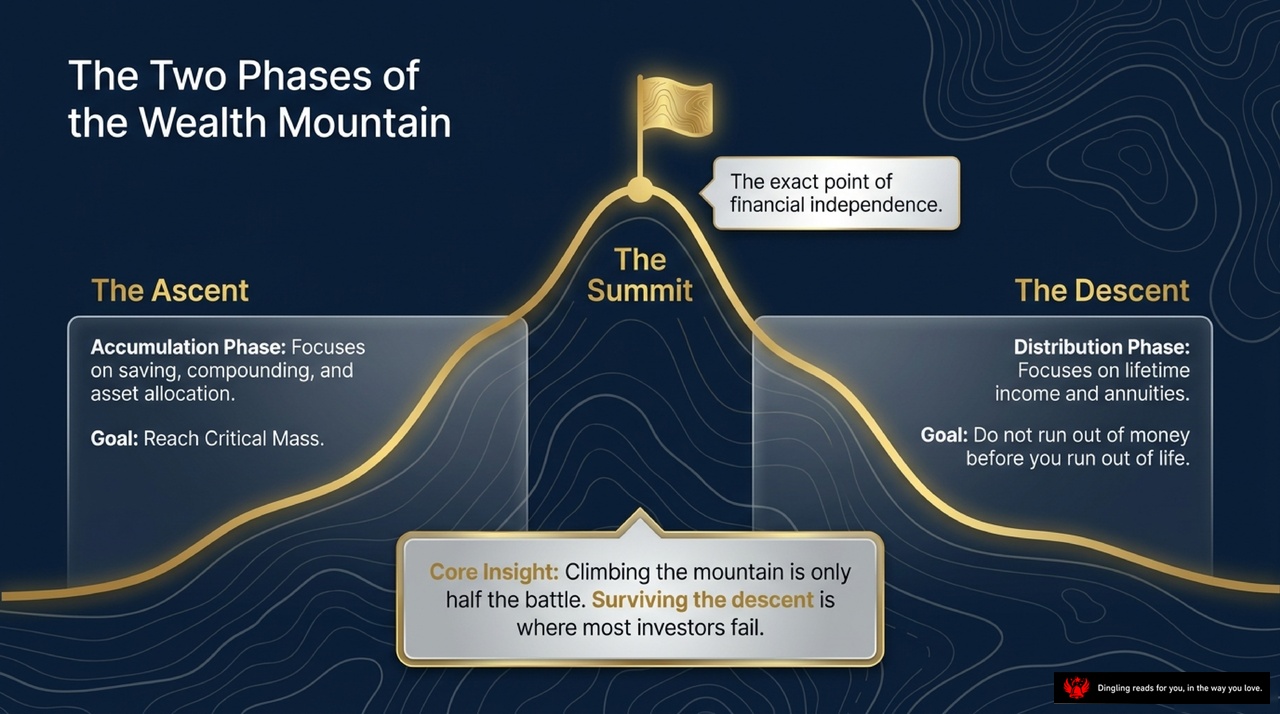
So, here's the hard truth that most investors ignore: climbing the mountain to financial independence is only half the battle. As this slide clearly shows, the real challenge lies in surviving the descent.
On the left, we have "The Ascent," or the Accumulation Phase. This is where you focus on saving, compounding, and smart asset allocation with one goal in mind: reaching critical mass. But on the right, we have "The Descent," the Distribution Phase. This is where the game truly changes. Here, the focus shifts from building wealth to managing lifetime income and annuities. Your goal isn't to grow the pile anymore; it's to ensure you never run out of money before you run out of life.
The core insight at the bottom of the slide hits home: most investors fail not because they couldn't climb, but because they couldn't survive the way down. It's easy to get rich, but it's incredibly difficult to stay rich and live comfortably for decades. That's why creating a sustainable, automated income stream is the ultimate key to true freedom.

Imagine your paycheck not as an expense to be managed, but as the fuel for a financial machine designed to work for you. The most critical decision you can make is to stop trading your time for money and instead, pay yourself first. Before you ever see a single dollar hit your bank account, automate a fixed percentage—aim for at least 10%—into a dedicated Freedom Fund. This isn't just about saving; it's about building an asset that generates its own income, shifting you from being a consumer to becoming an owner.
But knowledge alone doesn't build wealth; execution does. As Warren Buffett famously noted, his fortune came from living in America, some lucky genes, and most importantly, compound interest. The graph on your screen illustrates this powerful multiplier effect: a curve that starts slow but skyrockets over decades. This exponential growth is the engine of financial freedom, but it requires a commitment to automation to guarantee that you actually execute the plan.
The reality is that many high earners fail not because they lack income, but because they earn and spend without ever letting their money work for them. True wealth comes from creating a system where your savings and investments grow automatically, compounding over time. Whether you start with a small percentage of your paycheck or build a diversified portfolio, the principle remains the same: let time and complicity do the heavy lifting. By mastering this multiplier, you transform a simple paycheck into a legacy of freedom, proving that consistent, automated action is far more powerful than any amount of raw talent or market timing.
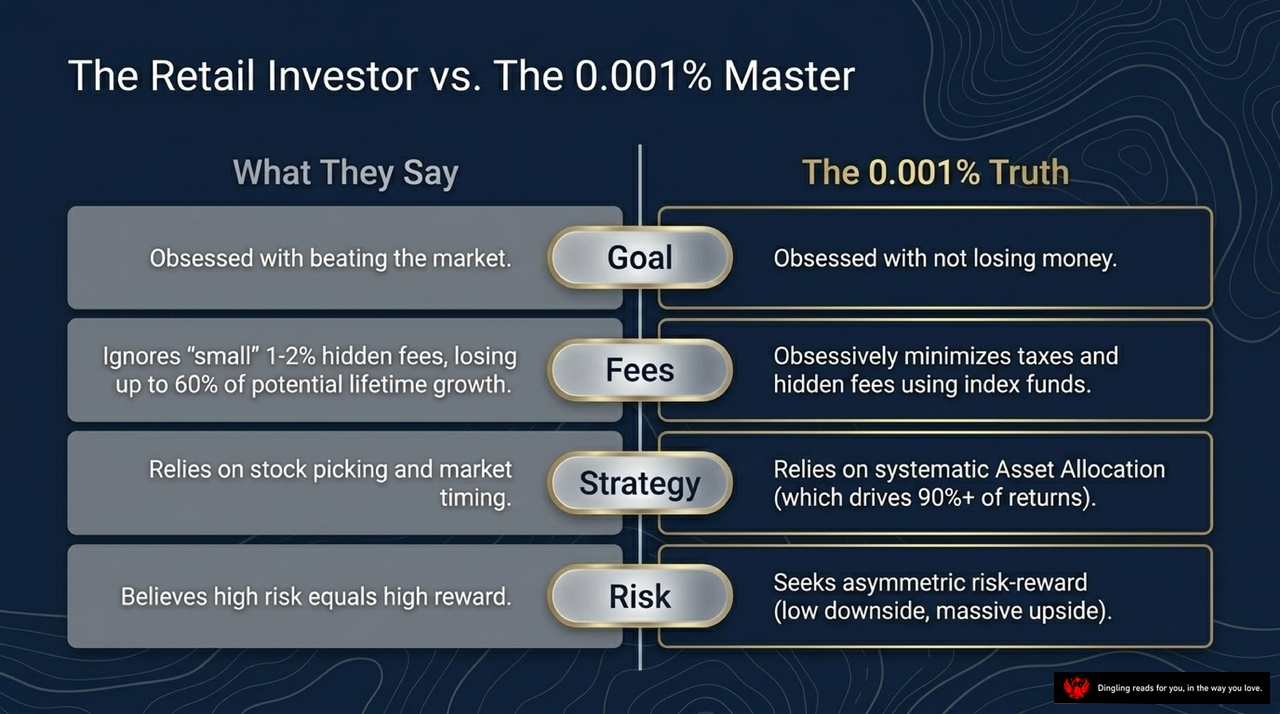
Imagine a world where you don't have to predict the market to win. Today's slide reveals the shocking truth behind the gap between the average retail investor and the elite "0.001% Master." While most of us are obsessed with beating the market, relying on risky stock-picking, and ignoring hidden fees, the true masters operate on a completely different set of principles.
Look at the "Goal." The average investor chases high returns, but the master is obsessed with one thing: not losing money. This shift in mindset is everything. Next, consider the "Strategy." Instead of trying to time the market or pick individual winners, the master relies on systematic Asset Allocation. This is the secret weapon that drives over 90% of long-term returns.
Don't let the "Risk" section fool you. While we believe high risk equals high reward, the master seeks asymmetric risk-reward—meaning they take on very little downside risk while positioning themselves for massive upside potential. Finally, look at the "Fees." The average investor ignores small 1-2% hidden costs that can eat up to 60% of their lifetime growth. In contrast, the master obsessively minimizes taxes and fees using low-cost index funds.
The lesson here is clear: Financial freedom isn't about working harder or taking bigger risks. It's about mastering the rules, protecting your capital, and letting a simple, systematic strategy work for you over time.
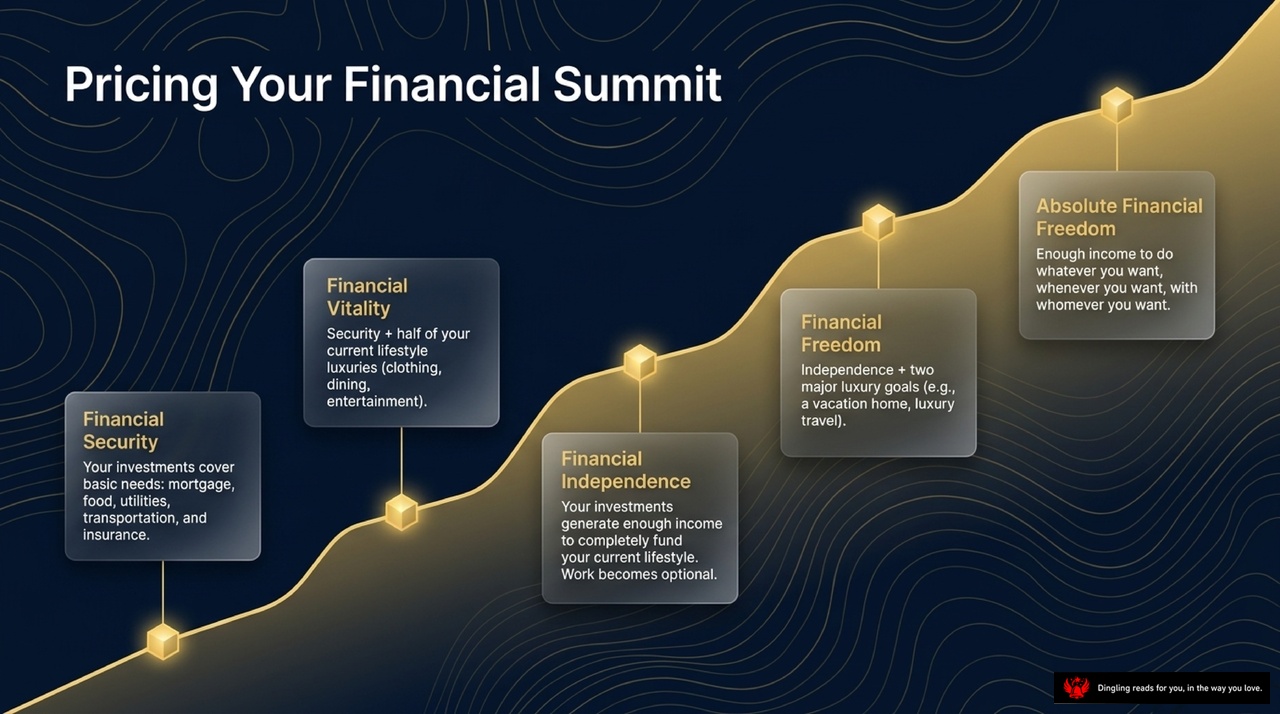
Today's slide maps out your financial summit, breaking the journey into five distinct levels. It starts at the bottom with Financial Security: the foundation where your investments cover your basic needs like mortgage, food, utilities, and insurance. Once that's secure, you climb to Financial Vitality, adding security plus half of your current lifestyle luxuries like dining and entertainment.
Next up is Financial Independence. This is the pivotal moment where your investments generate enough income to completely fund your current lifestyle, making work optional. Beyond that lies Financial Freedom, which combines that independence with the ability to achieve two major luxury goals, like a vacation home or a dream trip.
Finally, at the very peak, is Absolute Financial Freedom. This is the ultimate summit where you have enough income to do whatever you want, whenever you want, with whomever you want. The key takeaway here is that financial freedom isn't just about having a massive pile of cash; it's about the freedom of choice and the ability to design a life that aligns with your deepest values.
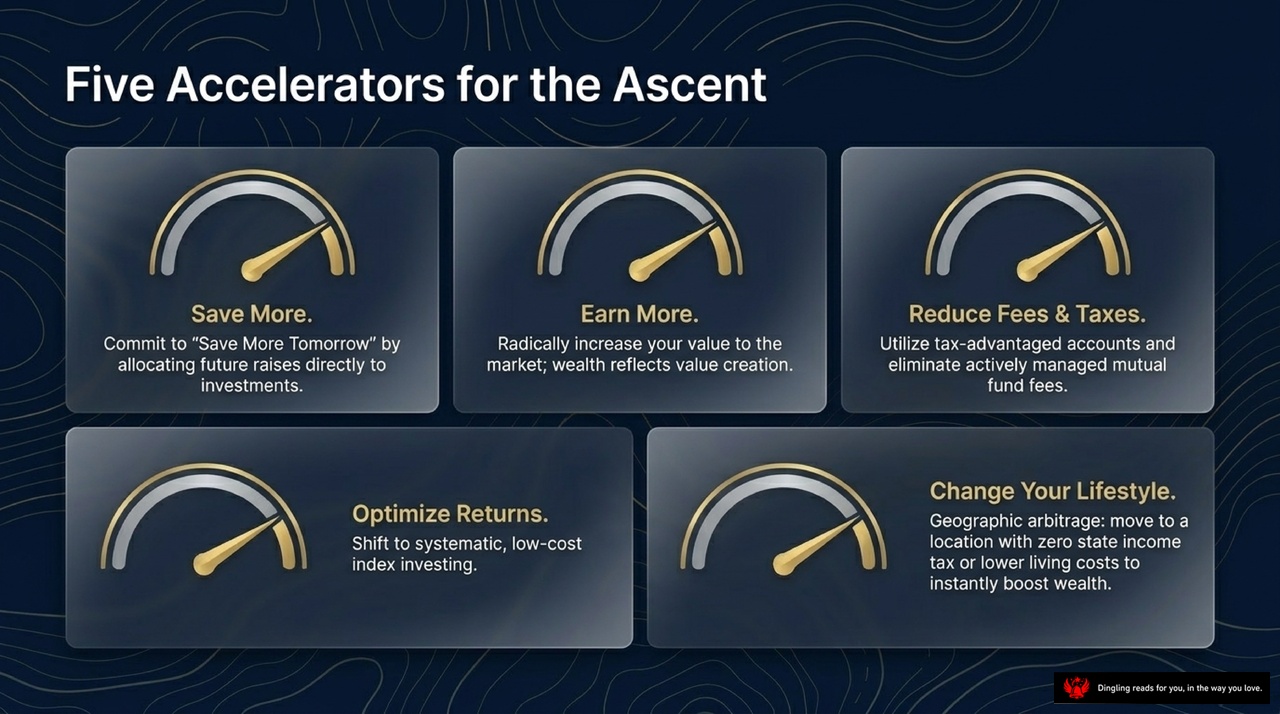
Imagine you have five powerful accelerators in your pocket, ready to turbocharge your journey to wealth. The first is simply saving more. It's not about being cheap; it's about committing to a "Save More Tomorrow" plan. By automatically allocating that next raise directly into investments, you build your financial freedom fund without even feeling the pinch.
The second accelerator is earning more. Your wealth is a direct reflection of the value you create for the market. You don't need to work harder for longer hours; you need to become more valuable. Whether that's mastering a new skill or taking on extra responsibilities, increasing your value is the fastest way to increase your income.
Third, reduce fees and taxes. This is where the real money hides. High fees and taxes are silent wealth killers that can eat up 50% to 70% of your returns over time. By utilizing tax-advantaged accounts and switching to low-cost index funds, you keep significantly more of what you earn working for you.
Fourth, optimize your returns by shifting to systematic, low-cost index investing. Stop trying to time the market or beat the pros. Instead, let time and compounding do the heavy lifting with a diversified, low-expense portfolio that consistently outperforms the majority of active funds.
Finally, change your lifestyle through geographic arbitrage. Why pay a premium for a high cost of living when you don't have to? Moving to a location with zero state income tax or simply lower living costs can instantly boost your net worth, giving you more freedom to invest and live the life you truly want.
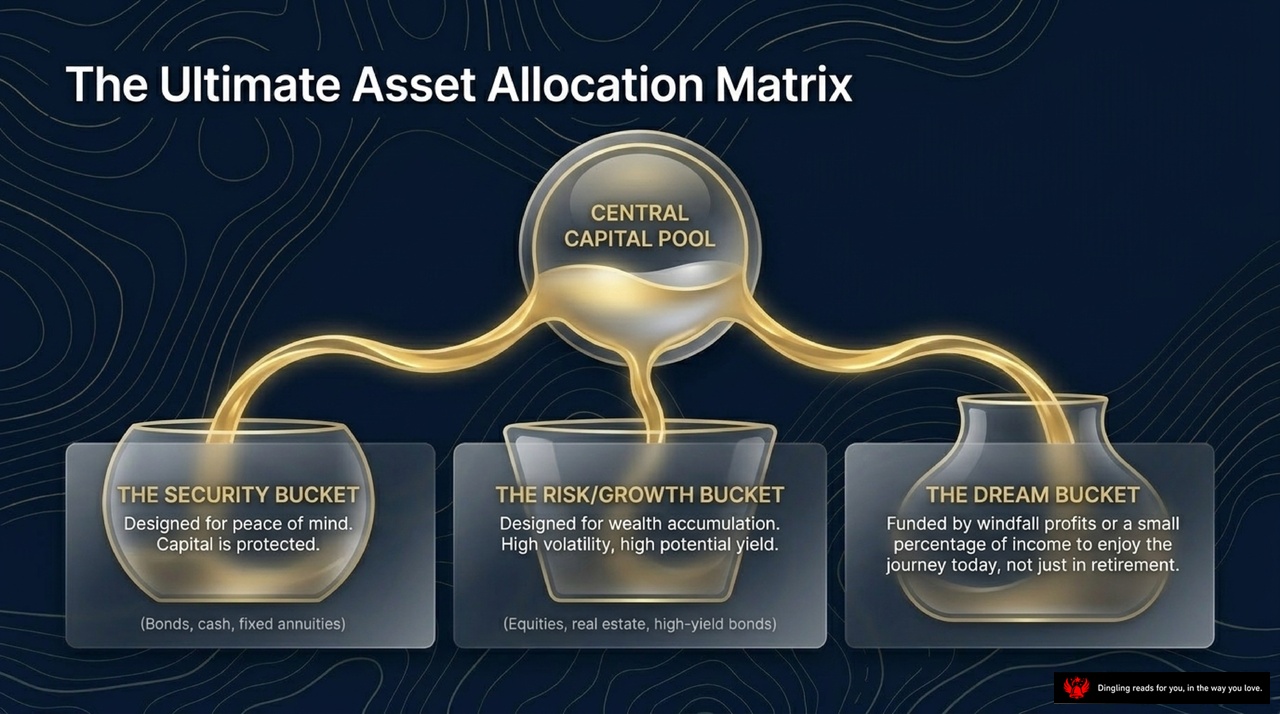
Imagine your wealth not as a single pile of gold, but as a sophisticated flow system, exactly like the one you see on this slide. At the very top sits your **Central Capital Pool**, the lifeblood of your entire financial strategy. From here, your resources don't just sit idle; they actively flow into three distinct vessels, each designed for a specific purpose.
First, on the left, we have **The Security Bucket**. This is your peace of mind. Think of this as your safety net—filled with bonds, cash, and fixed annuities. Its sole job is protection. It's designed to ensure that no matter what the market does, your capital remains safe and your life remains stable.
Next, pouring into the middle, is **The Risk/Growth Bucket**. This is where the magic happens. Here, you channel your funds into equities, real estate, and high-yield bonds. Yes, there is high volatility, but that's the price you pay for high potential yield. This bucket is the engine of your wealth accumulation, designed to grow your money significantly over the long term.
Finally, on the right, we have **The Dream Bucket**. This is the most exciting part. Funded by windfall profits or a small percentage of your income, this bucket isn't just for retirement; it's for enjoying your life *today*. Whether it's a dream vacation, a new hobby, or simply treating yourself, this bucket reminds you that financial freedom is about living well now, not just saving for the distant future.
The brilliance of this matrix is that it separates your needs. You don't have to choose between being safe and being rich. You can have both. By keeping your safety capital separate from your growth capital, you stop the panic when the market dips. You know your security bucket is untouched, so you can confidently let your risk bucket ride the waves. It's a simple, elegant way to take control of your money, stop the anxiety, and build a life where you truly have the freedom to choose.
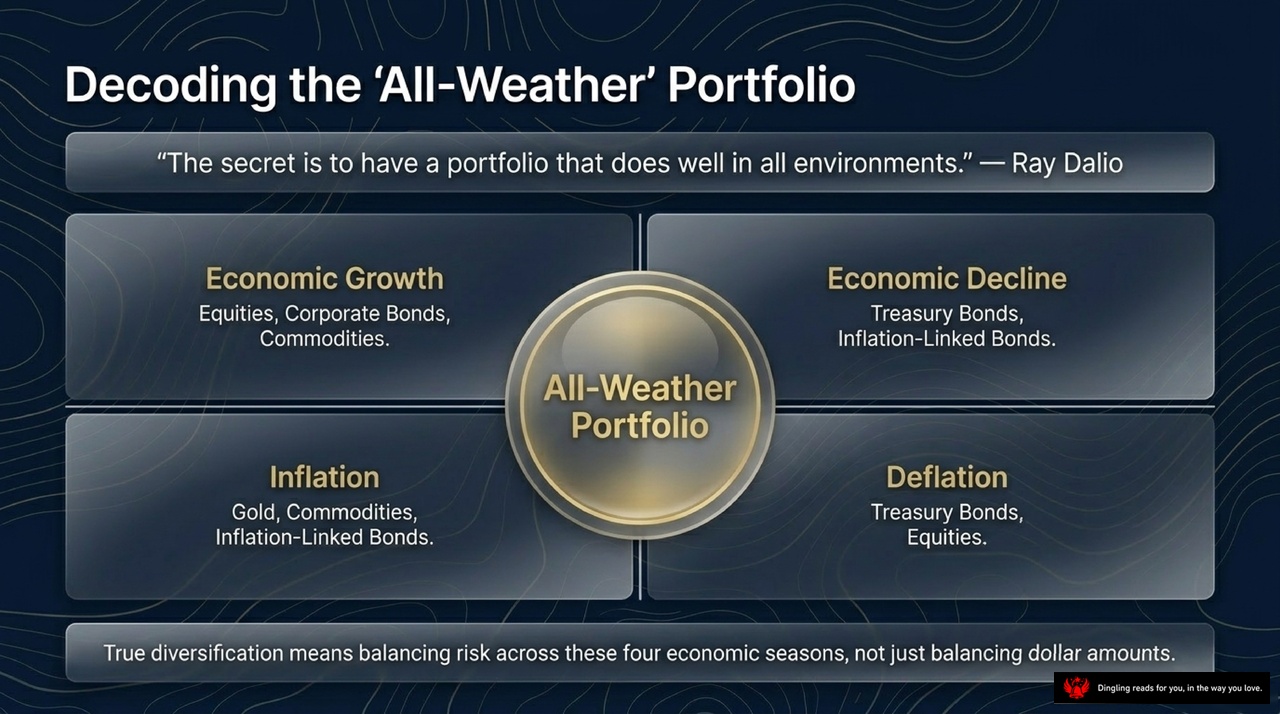
Imagine a world where your portfolio doesn't just survive the storm, but actually thrives in every single season of the economy. That is the core promise of Ray Dalio's "All-Weather" Portfolio. As the slide beautifully illustrates, the secret isn't trying to predict the future, but building a system that does well in all environments.
Dalio breaks down the economy into four distinct "seasons": Economic Growth, Economic Decline, Inflation, and Deflation. Each season demands a different asset class to succeed. When the economy is booming, equities and corporate bonds shine. When it's declining, Treasury bonds and inflation-linked bonds become your shield. During high inflation, gold and commodities protect your purchasing power. And in deflation, Treasury bonds and equities help you recover.
True diversification, as the slide reminds us, isn't just about balancing dollar amounts; it's about balancing risk across these four economic seasons. By holding a mix of equities, bonds, commodities, and gold, you ensure that no matter which economic "weather" comes your way, at least part of your portfolio will be generating returns while other parts protect your capital. This approach removes the need to guess when the market will crash or soar, allowing you to sleep soundly knowing your wealth is built to withstand any scenario.
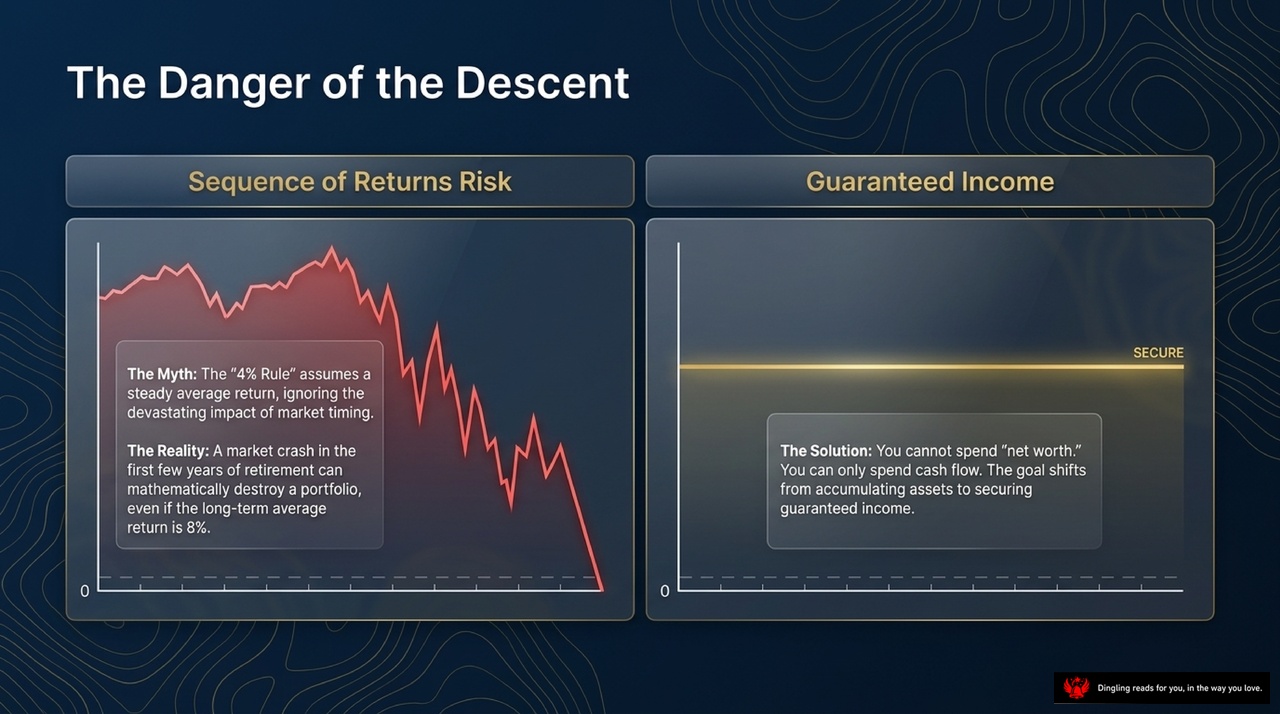
The danger of the descent isn't just about how high you climb, but how quickly you can fall when the market turns. Today, we're looking at a critical concept called "Sequence of Returns Risk."
Look at the graph on the left. It illustrates a dangerous myth: the "4% Rule." Many investors believe that if they have an average long-term return of 8%, they can safely withdraw 4% of their portfolio every year for the rest of their life. But this rule assumes a steady, smooth ride. It completely ignores the devastating impact of market timing.
The reality is far more brutal. A market crash in the first few years of retirement can mathematically destroy a portfolio, even if the long-term average return is a healthy 8%. If you need to withdraw money right when the market is crashing, you are forced to sell your assets at rock-bottom prices. This locks in your losses and leaves you with a shrunken nest egg that may never recover, leading to a permanent descent into financial insecurity.
So, what is the solution? The slide on the right offers a powerful shift in perspective: Guaranteed Income.
The core problem is that you cannot spend "net worth." You can only spend cash flow. Net worth is a snapshot of what you own at a specific moment; it doesn't pay the bills. To stay secure, your goal must shift from simply accumulating assets to securing a reliable stream of guaranteed income. Think of it as building a machine that pays you, rather than dipping into your savings account to pay yourself. By prioritizing guaranteed income streams, you protect your principal and ensure that no matter what the market does, your lifestyle remains intact.
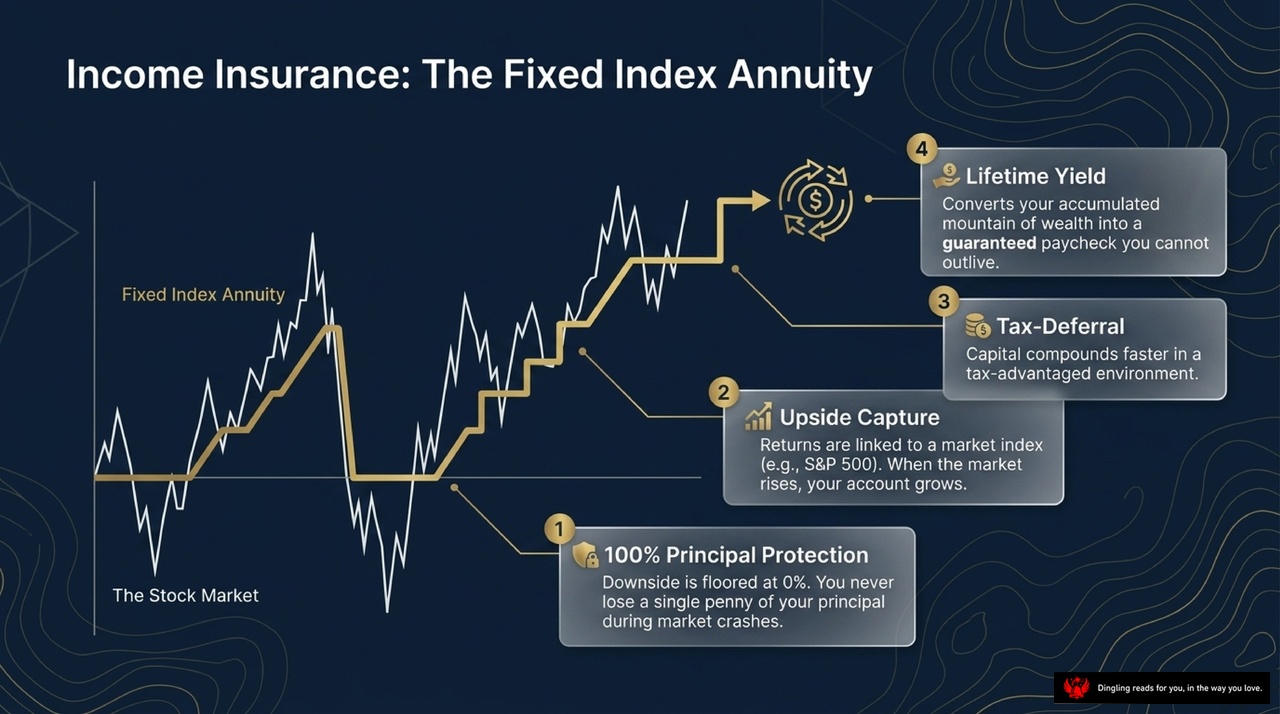
Have you ever wondered how to turn market volatility into your greatest ally? The slide you're looking at reveals the secret: the Fixed Index Annuity. Think of it as the ultimate "Income Insurance" that bridges the gap between the risky stock market and your need for guaranteed safety.
On the left, you see the wild swings of the stock market. But look at the golden line representing the Fixed Index Annuity. It offers you a powerful three-step advantage. First, it provides 100% Principal Protection. This means downside is floored at zero. Even if the market crashes, you never lose a single penny of your original investment. It's a complete safety net.
Second, it captures the upside. Your returns are linked to a market index, like the S&P 500. When the market rises, your account grows, letting you participate in the boom without the fear of the bust.
Third, it offers tax-deferral. Because your capital compounds in a tax-advantaged environment, your money grows faster than it would in a regular taxable account.
Finally, and most importantly, this structure converts your accumulated wealth into a Lifetime Yield. It turns your mountain of savings into a guaranteed paycheck that you literally cannot outlive. Unlike traditional retirement accounts where you might run out of money, an annuity ensures your income lasts for the rest of your life. This is the smartest way to secure your future while still allowing you to grow your wealth when the market performs well.
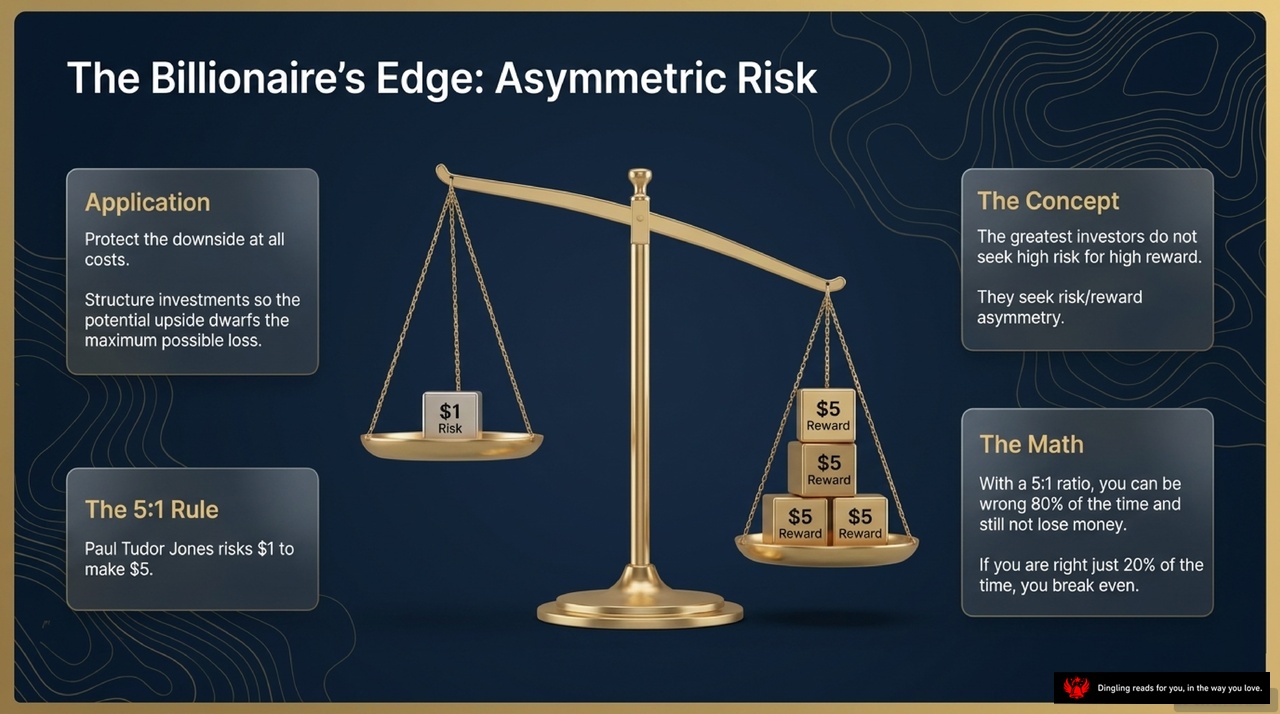
The greatest investors don't chase high risk for high reward; they hunt for something far more powerful: risk and reward asymmetry. Think of it like a golden scale. On one side, you only risk a single dollar. On the other, you stack five dollars of potential reward. This is the billionaire's edge.
The math is simple but life-changing. With a 5-to-1 ratio, you can actually be wrong 80% of the time and still not lose money. If you are right just 20% of the time, you break even. This is the core of the 5-to-1 Rule championed by legends like Paul Tudor Jones. He risks $1 to make $5. The application is clear: protect the downside at all costs and structure your investments so the potential upside dwarfs your maximum possible loss.
Most people fall into the trap of thinking they need to gamble big to win big. But true wealth isn't about how much you bet; it's about the ratio between what you stand to lose and what you stand to gain. By finding these asymmetric opportunities—where the loss is capped and the gain is unlimited—you stop fighting the market and start letting the market work for you. It's not about being right more often; it's about being right enough to win.
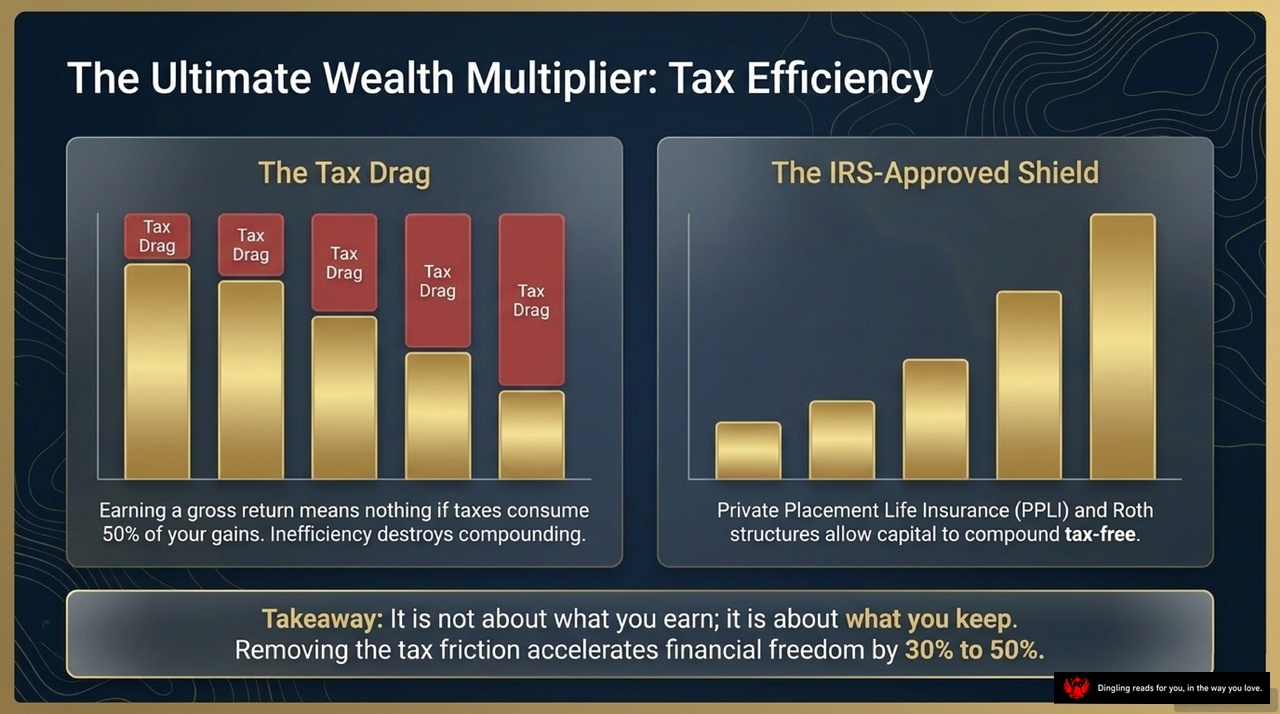
The slide highlights a powerful truth: it's not about how much you earn, but what you actually keep. On the left, we see "The Tax Drag." This graphic illustrates a harsh reality: if taxes consume 50% of your gains, earning a gross return is meaningless. Inefficiency destroys the very engine of wealth—compounding. Every dollar lost to friction is a dollar that never gets to work for you.
But the solution is right there on the right side: "The IRS-Approved Shield." This is where the game changes. Tools like Private Placement Life Insurance (PPLI) and Roth structures act as a financial shield, allowing your capital to compound tax-free. Think of it as removing the friction entirely. When you eliminate that 30% to 50% drag, you aren't just saving money; you are accelerating your path to financial freedom by the same percentage.
The takeaway is crystal clear. Stop obsessing over the paycheck and start mastering the retention rate. By strategically using these tax-efficient vehicles, you transform your investment strategy from a slow grind into a high-speed launch. It's the ultimate wealth multiplier, turning a good return into a life-changing one.
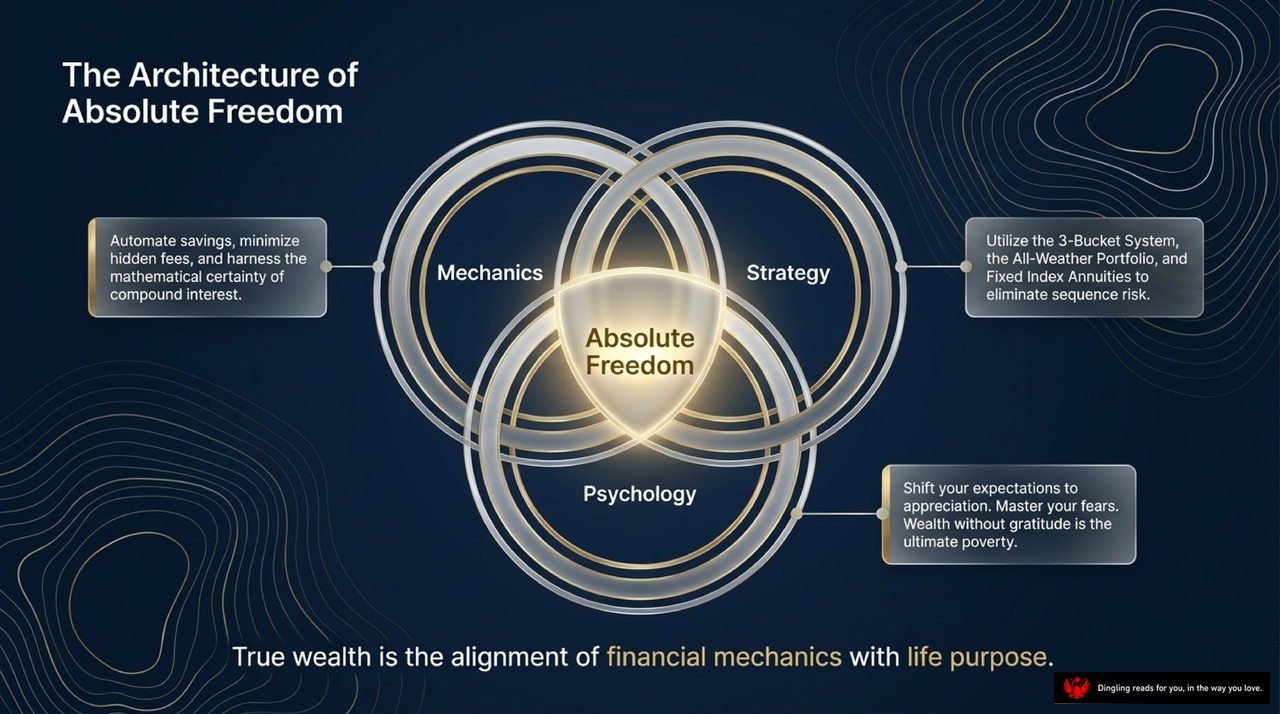
Today's slide reveals the complete blueprint for Absolute Freedom, where true wealth isn't just about numbers, but the perfect alignment of financial mechanics with your life's purpose. At the heart of this system are three interconnected pillars: Mechanics, Strategy, and Psychology.
On the Mechanics side, we automate savings to minimize hidden fees and harness the mathematical certainty of compound interest. This is the engine that gets the money working for you. On the Strategy side, we utilize the 3-Bucket System, the All-Weather Portfolio, and Fixed Index Annuities to eliminate sequence risk, ensuring your capital survives any market condition. Finally, the Psychology pillar is often the most overlooked; it requires shifting your expectations to appreciation, mastering your fears, and realizing that wealth without gratitude is the ultimate poverty.
When these three circles merge, they create a sustainable system where you stop chasing money and start controlling it. This is the architecture that turns financial freedom from a distant dream into a tangible reality.
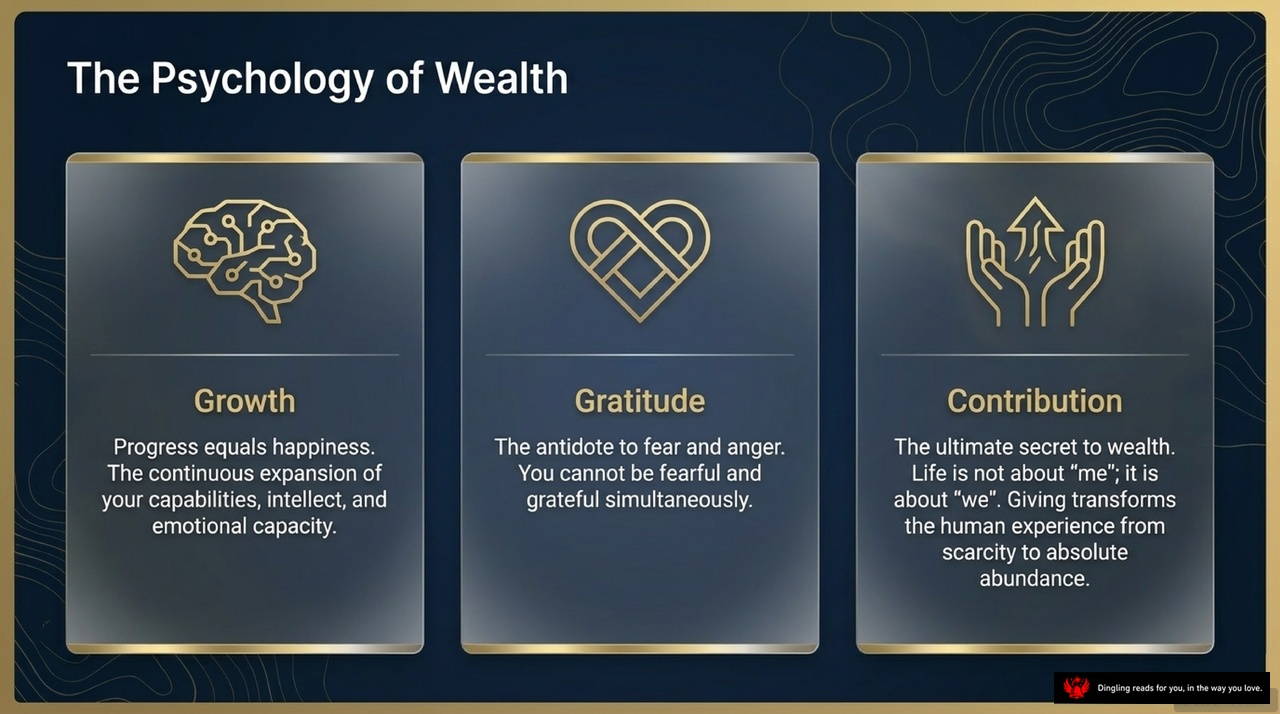
So, we've covered the heavy lifting on strategy—mastering asset allocation, understanding market cycles, and learning from giants like Dalio and Swensen. But today, I want to zoom out and look at the bigger picture. Because at the end of the day, wealth isn't just about the numbers on your screen; it's about the psychology behind them.
This slide breaks it down into three pillars: Growth, Gratitude, and Contribution.
First, look at **Growth**. The slide says, "Progress equals happiness." Think about this: true fulfillment comes from the continuous expansion of your capabilities, your intellect, and your emotional capacity. When you're constantly learning and improving, you aren't just building wealth; you're building a life you love.
Next is **Gratitude**. The text calls it "the antidote to fear and anger." Here's the hard truth: you cannot be fearful and grateful at the same time. If you're terrified of losing your money, you'll make bad decisions. But if you practice gratitude for what you have, you shift your mindset from scarcity to abundance, and suddenly, fear loses its grip on you.
Finally, there's **Contribution**, which the slide describes as "the ultimate secret to wealth." Life isn't about "me"; it's about "we." When you stop hoarding and start giving—whether it's mentoring someone, donating to a cause, or simply helping a neighbor—you transform your human experience from one of scarcity to absolute abundance.
So, remember this: real financial freedom isn't just about having money. It's about growing as a person, staying grateful despite the chaos, and using your resources to lift others up. That is how you truly master the psychology of wealth.
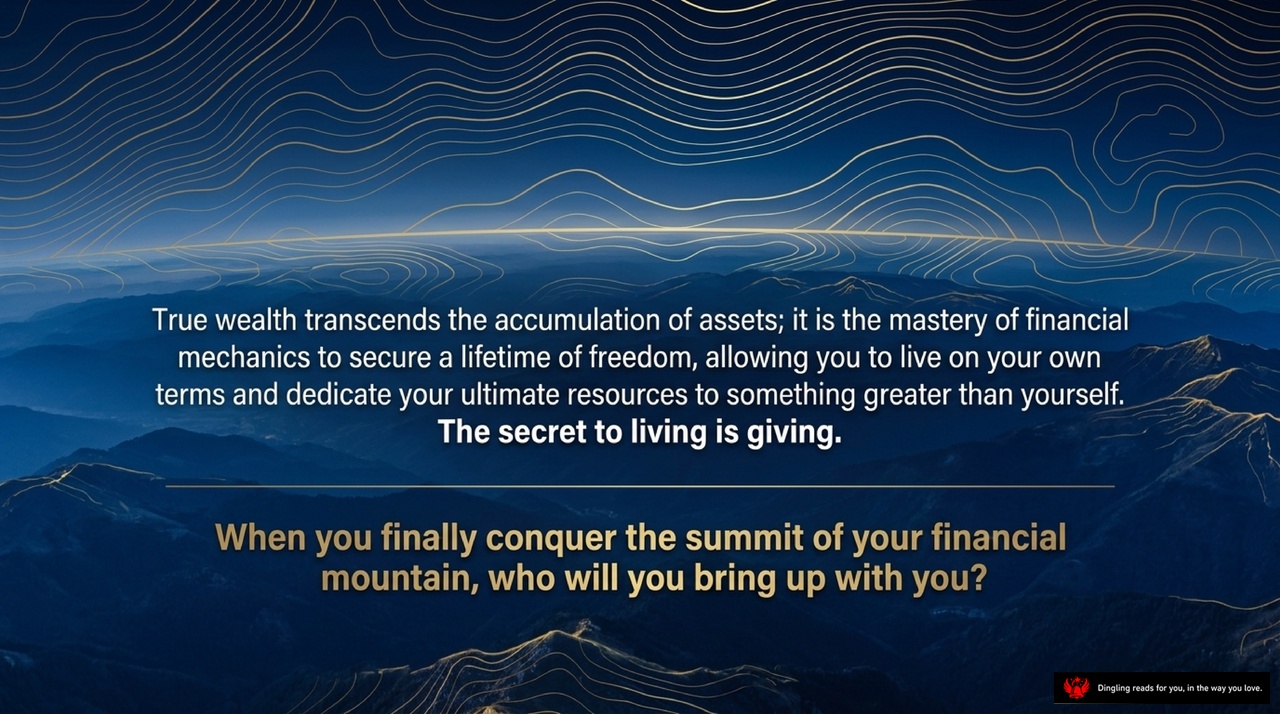
True wealth isn't about hoarding assets; it's about mastering the mechanics of money to buy your freedom. As the slide reminds us, the real secret to living is giving. When you finally conquer the summit of your financial mountain, the ultimate question isn't "How high did I climb?" but "Who will I bring up with me?"
This mindset shift is everything. Many people chase money for status or security, but they end up being controlled by it. True financial autonomy means using money as a tool to support what matters most—your family, your causes, and your passions—rather than letting it dictate your life.
Think about the difference between a hoarder and a giver. A hoarder might have billions but feels trapped by the fear of losing it. A giver, like the late Chuck Feeney, gave away his entire fortune anonymously to fight poverty and disease, living simply himself. He didn't lose his wealth; he transformed it into a legacy that outlived him.
The journey to this kind of freedom starts with changing your story. Instead of thinking, "I can't afford to give," you realize that giving is actually the highest form of investing in your own humanity. It breaks the cycle of anxiety and replaces it with purpose. When you stop viewing money as the goal and start seeing it as a vehicle for contribution, you unlock a level of satisfaction that no amount of accumulation ever could.
So, ask yourself today: What is the mountain you've climbed, and who are you bringing up with you? Because that's where true wealth lives.