
Muskets and Ledgers: Complete Chapter-by-Chapter Summary
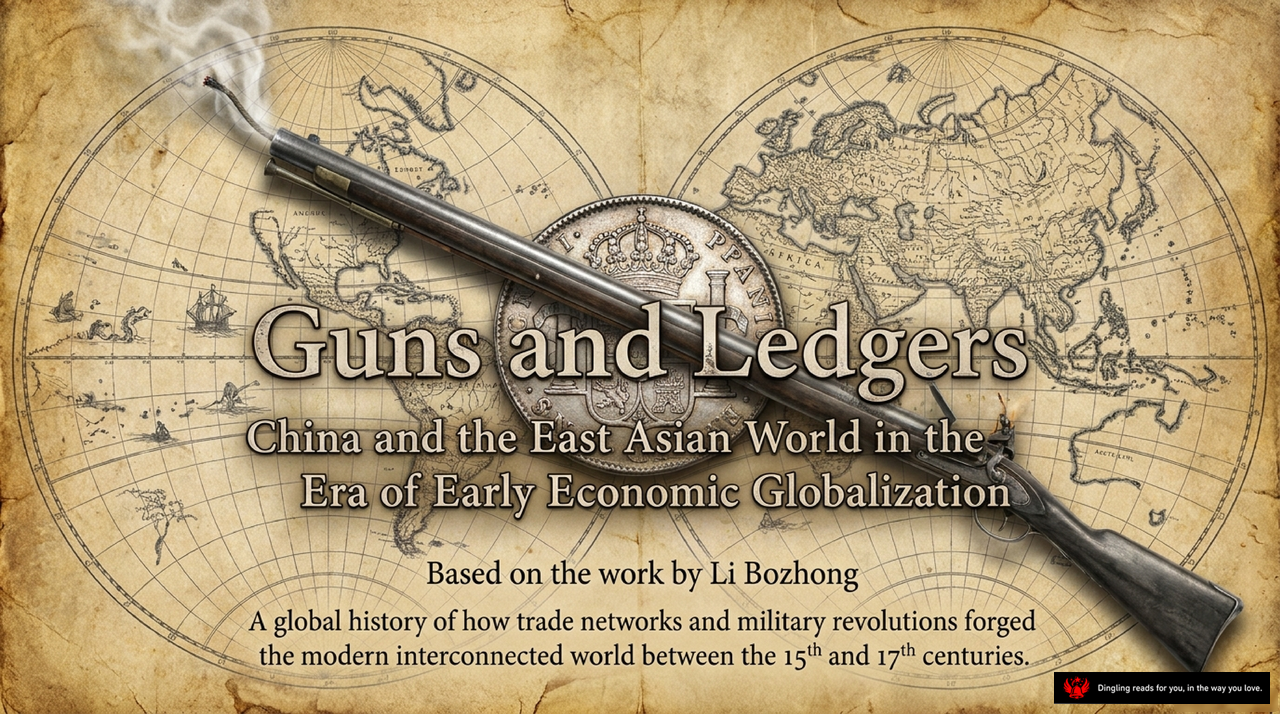
Welcome, everyone. Today we're exploring a pivotal moment in history through the lens of a powerful book, "Guns and Ledgers." Based on the work by Li Bozhong, this isn't just a story about the past; it's a global history of how trade networks and military revolutions forged the modern interconnected world between the 15th and 17th centuries.
Imagine the world before the internet or steam engines. Back then, the forces that connected us were far more violent and complex. The title itself tells the story: Guns represent the power of the sword, while Ledgers represent the power of the market. In this era, these two forces didn't just coexist; they drove each other. This book challenges the idea that early China was isolated. Instead, it reveals a dynamic East Asian world deeply entangled with global trade, silver, and military innovation.
We're going to uncover how a simple musket and a trade contract could reshape empires and define the modern world. So, let's step back in time and see how the world was built.
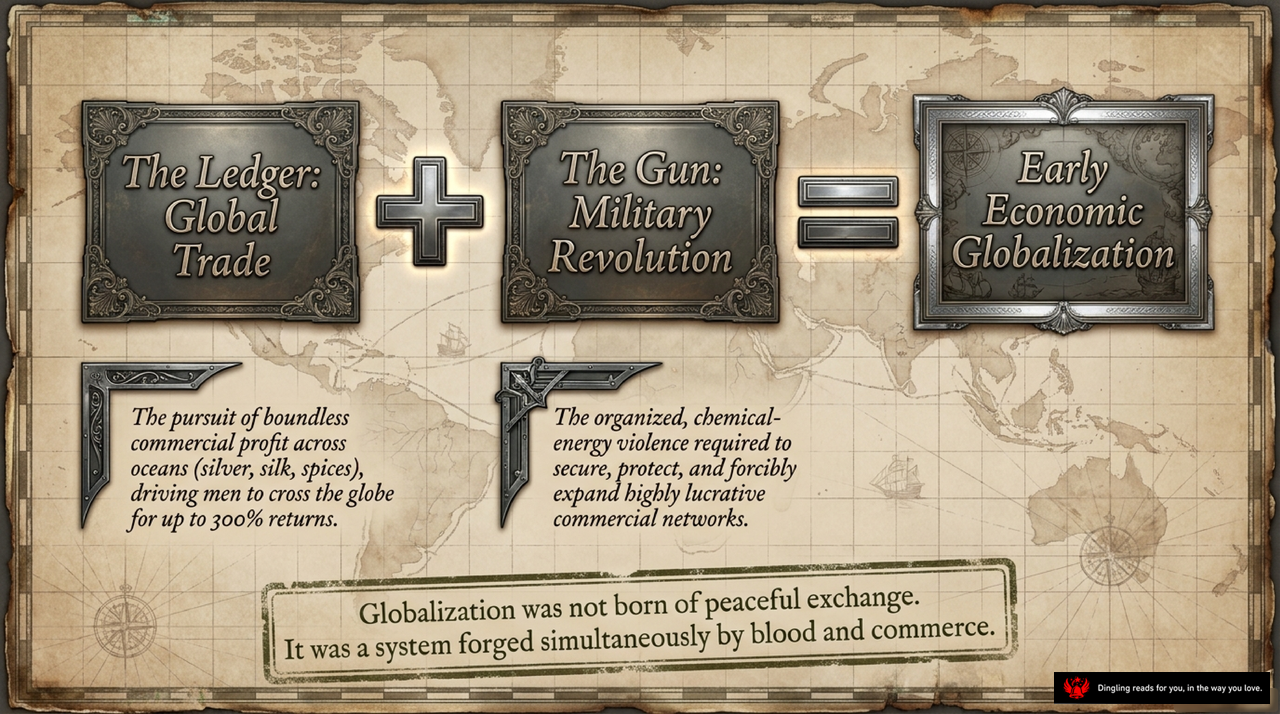
Look at this equation on the screen. It seems simple, but it actually defines the engine of our modern world: The Ledger plus The Gun equals Early Economic Globalization. Let's break down what this really means. The Ledger represents the drive for profit. It was the pursuit of boundless commercial profit across oceans. Think about silver, silk, and spices. The potential for returns was massive—up to 300%. That kind of money was enough to drive men to cross the globe. It was the ultimate incentive. But trade alone isn't enough. If you have a ship full of gold, you need protection. You can't just hope for the best. That's where The Gun comes in. This stands for the Military Revolution. It was about organized, chemical-energy violence. You needed this power to secure your trade routes, to protect your merchants, and to forcibly expand these lucrative commercial networks. Without the gun, the ledger is just a piece of paper. It's a recipe for disaster. So, put them together. Globalization was not born of peaceful exchange. It was a system forged simultaneously by blood and commerce. It wasn't just about goods moving from one place to another. It was about money and power moving together. This combination of trade and violence created the first truly global market. It explains why the early modern world looked the way it did. It was a mix of commerce and force that connected the world. This dynamic—profit seeking and military power—shaped the destiny of nations for centuries. It's a reminder that history isn't just about ideas; it's about the tools we use to enforce them.
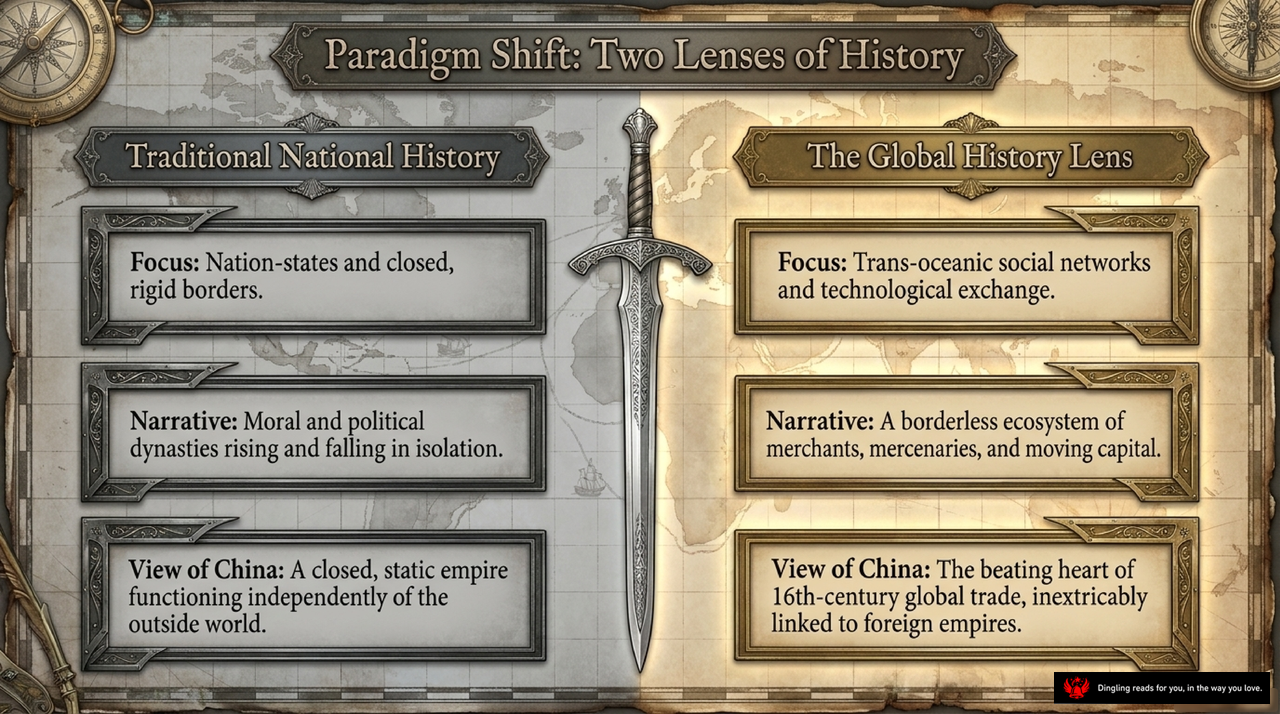
Welcome to the second slide, where we talk about a true paradigm shift. Think about how we used to teach history versus how we understand it today. On the left, you see the Traditional National History lens. For a long time, historians focused on nation-states with closed, rigid borders. The story was always about moral and political dynasties rising and falling in isolation. Under this view, China was seen as a closed, static empire functioning independently of the outside world. It was like an island, disconnected from the rest.
But on the right, we have The Global History Lens. This perspective completely changes the game. Instead of walls, it focuses on trans-oceanic social networks and technological exchange. The narrative isn't about isolated kingdoms anymore; it's about a borderless ecosystem of merchants, mercenaries, and moving capital. It breaks down the idea that nations operated in a vacuum.
This shift is crucial, especially when looking at China. The old view painted China as isolated and static. But the global lens reveals the truth: China was actually the beating heart of 16th-century global trade, inextricably linked to foreign empires. Think about the silver flowing in, the goods flowing out. It wasn't a closed door; it was a bustling hub.
So, why does this matter? Because this shift helps us understand the past without falling into old traps. It stops us from thinking China was always separate and starts us seeing how deeply connected the world really was. It moves us from a story of empires fighting alone to a story of networks interacting. This is the new way to see history, and it changes everything we thought we knew about the 16th century.
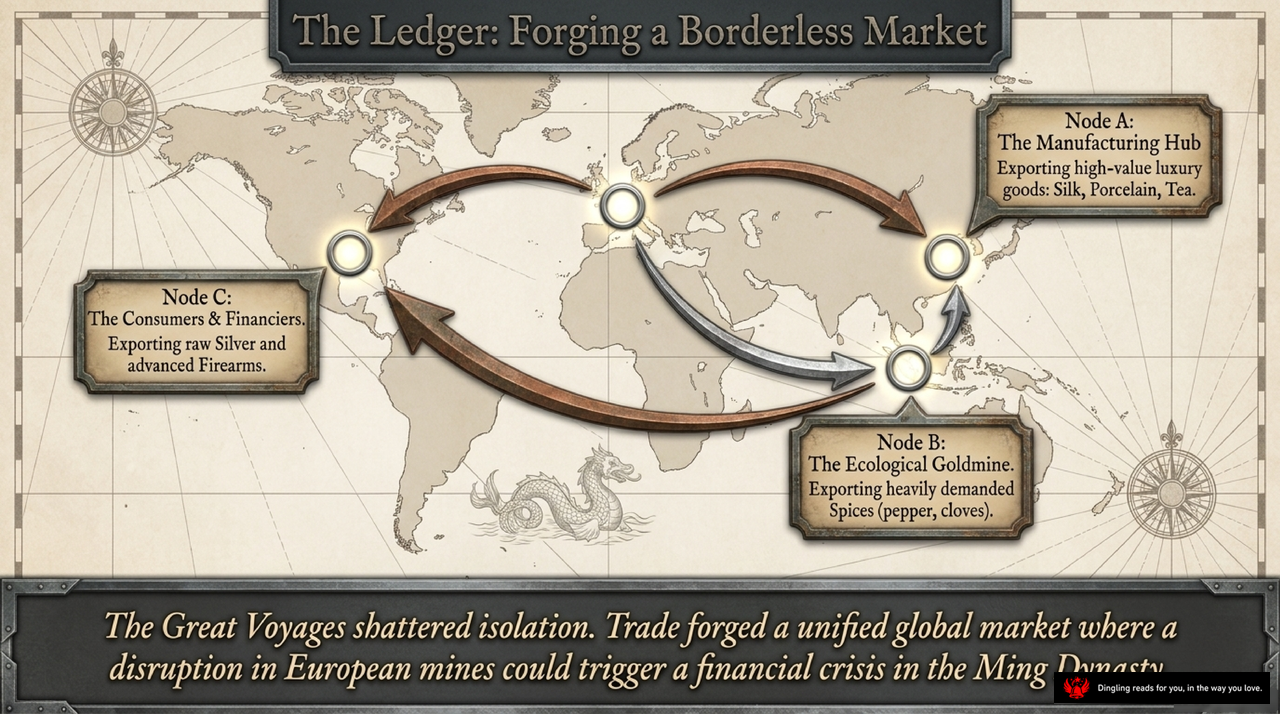
Welcome to the concept of "The Ledger: Forging a Borderless Market." What you're seeing on this map isn't just a trade route; it's the first true global financial system in human history. Before the 15th century, the world was fragmented into isolated regions. But the Great Voyages shattered that isolation, creating a unified global market where a disruption in one corner could trigger a crisis in another.
Let's break down the three nodes. On the right, Node A is the Manufacturing Hub—East Asia, specifically China. They were the world's factory, exporting high-value luxury goods like silk, porcelain, and tea. These weren't just commodities; they were status symbols that drove massive demand across the Atlantic.
Moving to Node B, the Ecological Goldmine. This covers the Indian Ocean and Southeast Asia. They exported heavily demanded spices like pepper and cloves. In Europe, these spices were worth their weight in gold, essential for trade, preservation, and flavor.
On the left, Node C represents the Consumers and Financiers. This includes Europe and the Americas. Here is the crucial part: they didn't have enough manufactured goods or spices to trade back. So, they exported raw silver and advanced firearms. Silver became the engine of this system. The Spanish mined silver in the Americas, shipped it to Manila, bought Chinese silk, and sent it to Europe. Meanwhile, silver flowed from Japan's mines to China. This massive flow of silver solved the trade imbalance. Interestingly, Node C wasn't just a passive buyer. They were also exporting advanced firearms. This flow of weapons changed the balance of power in Asia, forcing local powers to adapt or fall.
This is where the ledger concept becomes clear. Silver became the global currency. The bottom text captures the critical point: "The Great Voyages shattered isolation." This wasn't just about moving boxes; it was about linking economies. If a mine in Europe or America had a disruption, it could trigger a financial crisis in the Ming Dynasty. This is the power of a unified global market. It meant that for the first time, the economic fate of the East and West were inextricably linked. This system wasn't just about goods; it was about capital, finance, and power. It laid the foundation for the modern world we live in today.
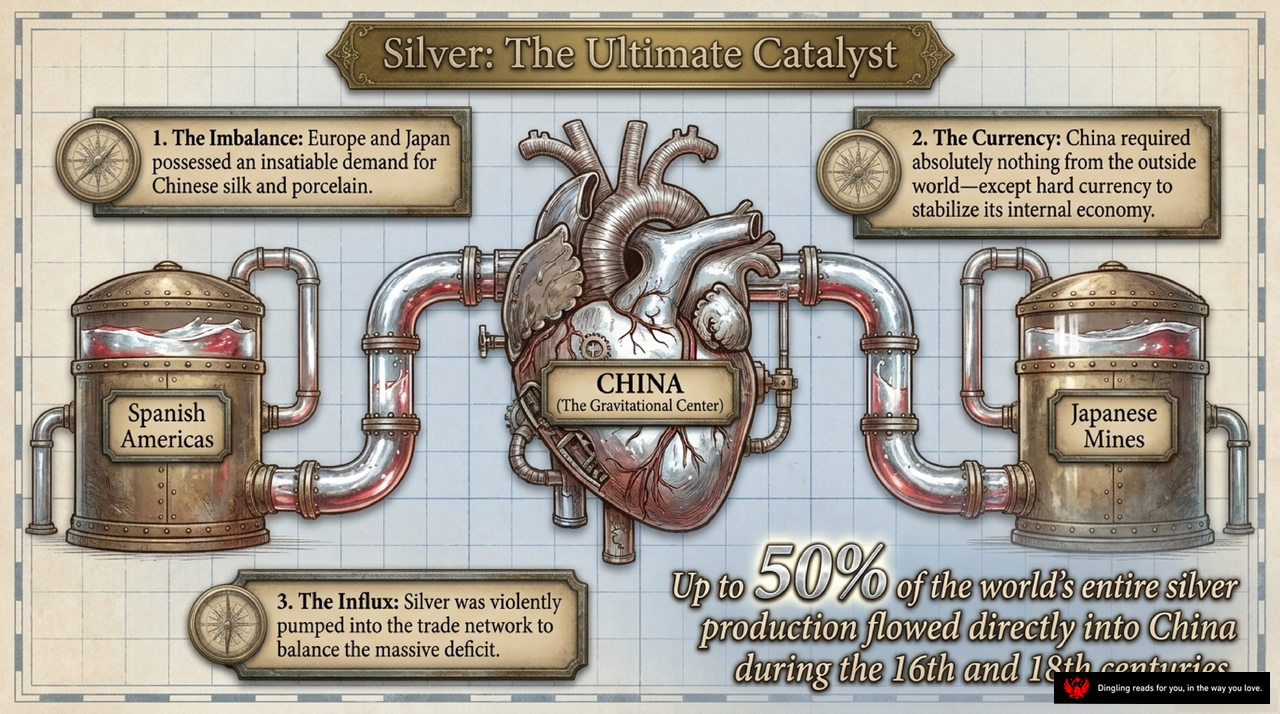
Look at this diagram. It visualizes a crucial moment in history where China became the gravitational center of the global economy. Why? Because of a massive trade imbalance that defined the era. Europe and Japan possessed an insatiable demand for Chinese silk and porcelain. They loved these goods, but they had almost nothing to offer in return. This created a huge trade deficit. On the other side, China required absolutely nothing from the outside world except hard currency to stabilize its internal economy. They didn't need European wool or Japanese swords in the same way they needed silver. So, how did the trade balance? Through silver. This was the ultimate catalyst. Silver was violently pumped into the trade network to balance the massive deficit. Where did it come from? Two main sources: the Spanish Americas and Japanese mines. The Spanish used their galleons to move silver from the Americas to Manila, then to China. Japan also had massive silver production, contributing significantly to the global supply. The result? Up to 50% of the world's entire silver production flowed directly into China during the 16th and 18th centuries. This wasn't just about money; it was about power and connectivity. This influx of silver connected the Americas, Asia, and Europe into a single economic system. It turned loose trade networks into a tight global web. Without this silver flow, the early economic globalization we talk about today simply wouldn't have happened. China became the hub, not just because of its culture, but because it was the only place where this global demand could be satisfied with the currency everyone else needed. This flow of silver effectively funded the rise of the modern world, linking the fate of a remote island in Japan to a silver mine in the Andes, all centered around the markets of China. It shows that before the industrial revolution, the global economy was driven by this single precious metal, making China the indispensable engine of the 16th and 18th-century world. This dynamic also highlights how the early modern world was interconnected long before we had modern shipping or internet, relying on the flow of metal to bind distant continents together. Ultimately, this slide reminds us that history isn't just about wars or kings, but about the invisible flow of resources that shaped the modern world. The pipes connecting the Americas and Japan to China in this image represent the arteries of the early global economy, proving that even centuries ago, our world was already a tightly integrated system.
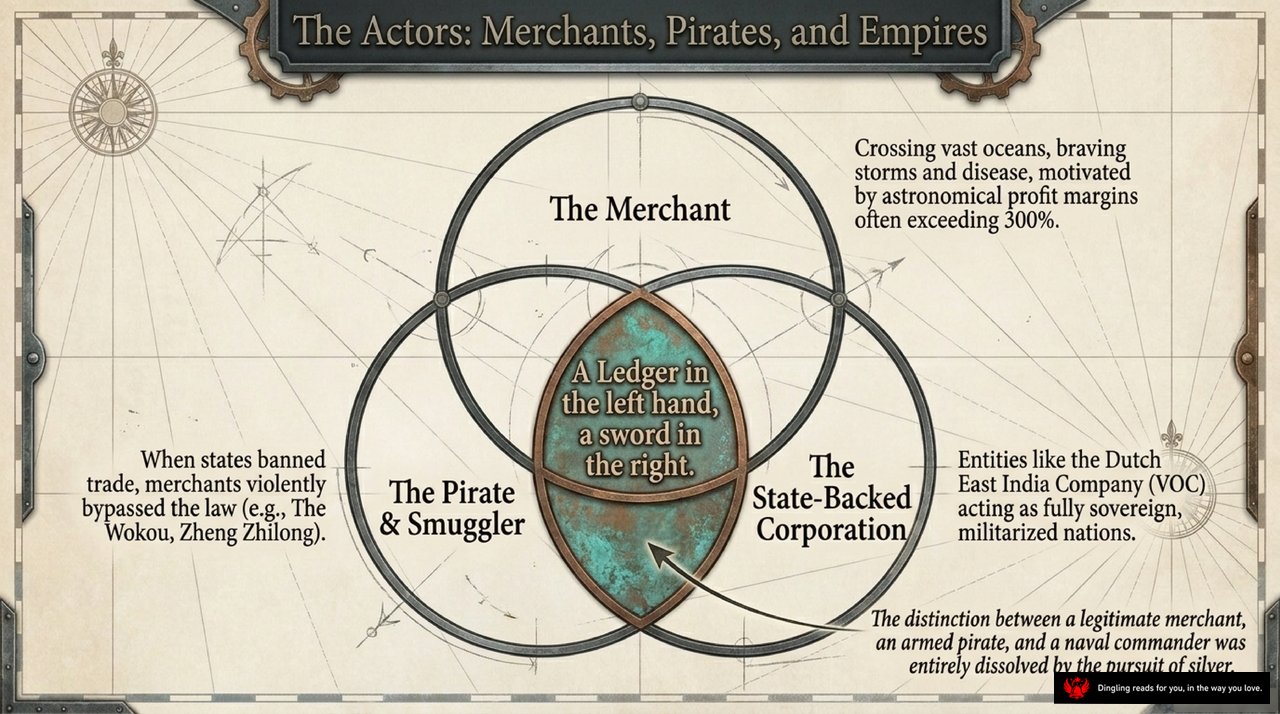
Welcome back. Today we're diving into the heart of early globalization: The Actors. Merchants, Pirates, and Empires. This isn't just a history lesson; it's about how the world actually functioned back then.
Let's start with the top circle: The Merchant. These were the ultimate risk-takers. They were crossing vast oceans, braving storms and disease. What drove them? Astronomical profit margins, often exceeding 300%. That kind of return motivated people to leave home and risk everything on the open water.
But trade wasn't always legal. Look at the left circle: The Pirate and Smuggler. When states banned trade, merchants didn't just stop. They violently bypassed the law. We see examples like the Wokou or Zheng Zhilong. As the text notes, sea merchants and pirates were often just one line apart. A Ming official famously said, "If trade opens, raiders turn to merchants; if trade is banned, merchants turn to raiders." It was a constant struggle for survival.
On the right, we have The State-Backed Corporation. Think of the Dutch East India Company, the VOC. They weren't just companies; they acted as fully sovereign, militarized nations. They held the power of a government but chased the profits of a business. They could wage war, sign treaties, and even mint their own coins.
Now, look at the center of this diagram. It says, "A Ledger in the left hand, a sword in the right." This is the defining characteristic of this era. You couldn't separate business from violence. The bottom text explains it clearly: "The distinction between a legitimate merchant, an armed pirate, and a naval commander was entirely dissolved by the pursuit of silver."
Silver was the ultimate fuel. It flowed from Japan and the Americas into China, connecting these disparate groups. Without silver, the trade circle would break. So, in this world, the line between a businessman, a pirate, and a naval commander was completely erased. It was all about the pursuit of silver.
This complex web of actors—merchants seeking profit, pirates seeking survival, and corporations seeking sovereignty—set the stage for the conflicts and connections we'll explore next.
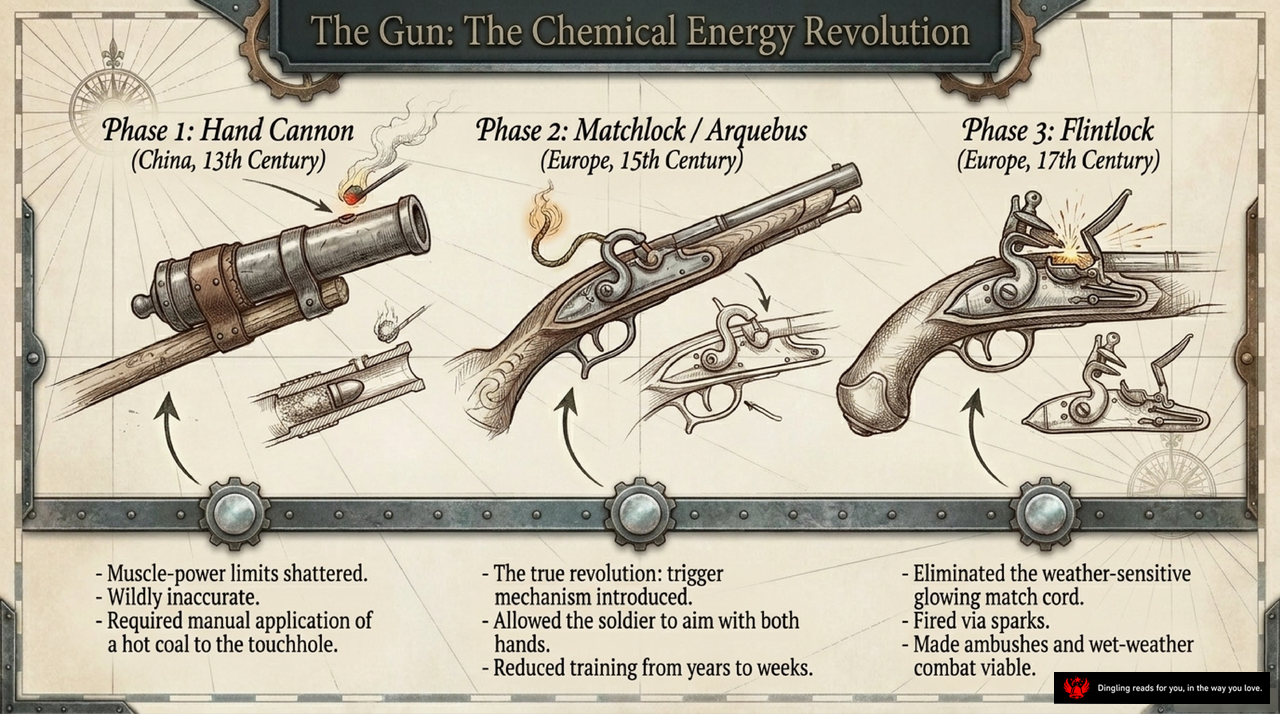
Welcome back. Today we're diving into the engine that powered the early modern world: The Gun. Specifically, we call it the Chemical Energy Revolution. It marks the shift from biological muscle power to stored chemical energy.
Take a look at the timeline on the screen. It breaks down into three distinct phases of technological evolution.
Phase 1 starts in China during the 13th century with the Hand Cannon. This was the first time we shattered muscle-power limits. Gunpowder meant you didn't need to throw a rock with all your strength anymore. But let's be honest, it was wildly inaccurate. You had to manually apply a hot coal to the touchhole every single time. It was dangerous, slow, and required a lot of skill.
Then, in the 15th century, Europe introduced the Matchlock, or Arquebus. This was the true revolution. The trigger mechanism was introduced, allowing a soldier to aim with both hands. This reduced training time from years down to just weeks. It made firearms accessible to more common soldiers, not just the elite.
However, there was a catch. The Matchlock relied on a glowing match cord. This made it highly weather-sensitive. If it rained, the cord would go out, and you couldn't fire. This was a massive tactical weakness.
Finally, Phase 3 arrives in the 17th century with the Flintlock. This eliminated the weather-sensitive glowing match cord entirely. Instead, they fired via sparks generated by the flint striking the pan. This made ambushes and wet-weather combat viable for the first time. Soldiers could fight in the rain without fear of misfires.
Why does this matter? Because this wasn't just about better tools. It was a Military Revolution. As the text notes, having advanced weapons isn't enough. You need changes in organization and tactics. This shift from cold weapons to gunpowder fundamentally changed who held the power. It allowed smaller forces to challenge larger ones, and it spread from East to West, connecting the military technologies of the globe.
So, the next time you think about the rise of modern empires, remember this: it started with a spark from a flintlock. This Chemical Energy Revolution laid the groundwork for the global conflicts we see today. It's a reminder that technology, when combined with the right organization, can reshape the world order in an instant. This is why understanding the history of the gun is crucial to understanding the history of the modern world. It transformed war from a contest of numbers into a contest of industrial capacity. And ultimately, it set the stage for the global power dynamics we are still dealing with today.
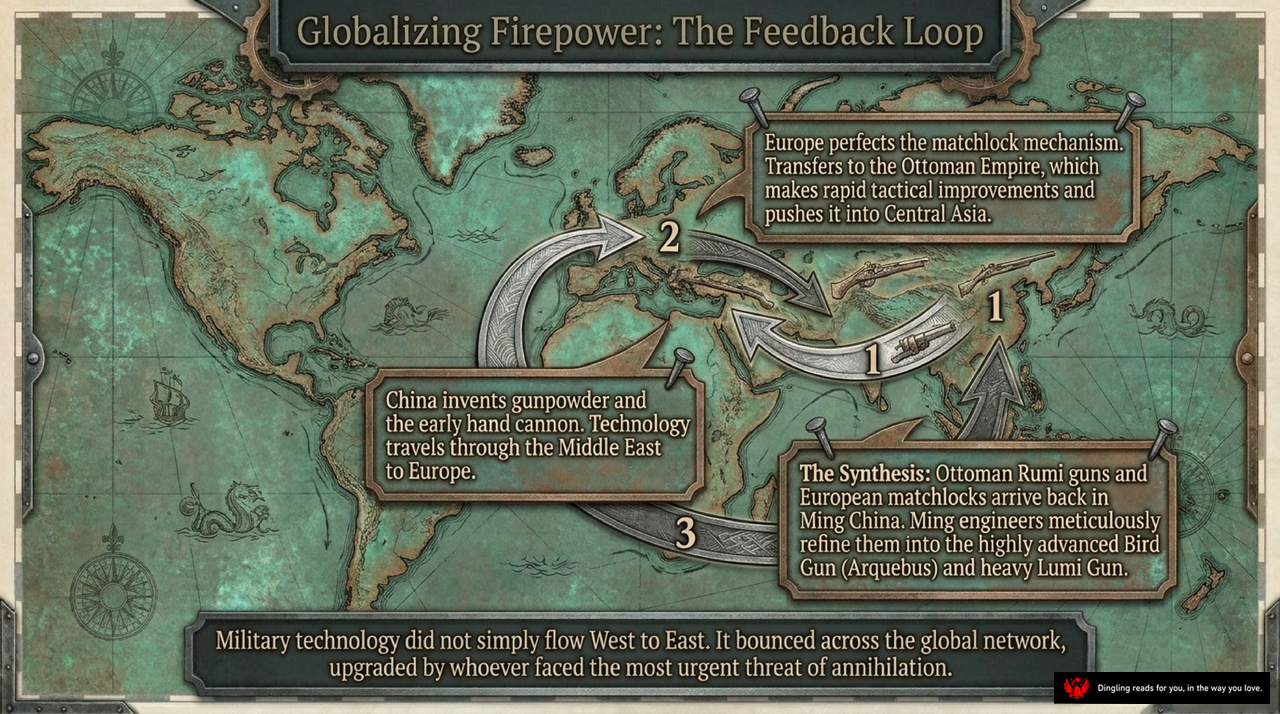
Let's take a closer look at this map. It illustrates the concept of Globalizing Firepower: The Feedback Loop. What's really striking here is that military technology didn't just flow from West to East in a straight line. Instead, it bounced across a global network, constantly upgrading.
Historically, this happened in two distinct phases. From the 12th to the 15th century, technology flowed from East to West. China invented gunpowder and the early hand cannon. This technology traveled through the Middle East to Europe. Once in Europe, they perfected the matchlock mechanism. This wasn't just about copying; it was about adapting.
From there, it transferred to the Ottoman Empire. The Ottomans made rapid tactical improvements and pushed it into Central Asia. They became a key bridge in this network.
But the loop didn't stop there. The synthesis happened when Ottoman Rumi guns and European matchlocks arrived back in Ming China. Ming engineers meticulously refined them into the highly advanced Bird Gun, also known as the Arquebus, and the heavy Lumi Gun. They didn't just take the tech; they improved it to fit their own needs.
This cycle highlights a vital truth. Military technology did not simply flow West to East. It bounced across the global network, upgraded by whoever faced the most urgent threat of annihilation.
Think about it. This feedback loop shows that innovation wasn't about one region dominating another. It was about survival. Whoever needed the firepower the most, adapted it the fastest. China, Europe, and the Ottomans all played roles in this global arms race, refining weapons to meet the urgent threats of their time.
In the 16th century, this military revolution changed everything. The Ottomans learned from Europe, and China learned from the Ottomans. This global interaction created a dynamic where technology spread faster than any single nation could invent it alone. It was a race driven by the fear of annihilation, not just by national pride. This is the essence of early global military history. It reminds us that in a connected world, survival depends on who can learn and adapt the fastest. The book text also mentions that this global network was built on trade and military power. Merchants and soldiers moved together, spreading these technologies. This is why the feedback loop was so effective. It wasn't just about armies fighting; it was about the whole system connecting. The 15th century was a turning point. Before that, both East and West were at the matchlock stage. But by the 16th century, Europe took the lead in the matchlock mechanism. Meanwhile, China was also innovating. The Ming engineers didn't just import weapons; they developed the self-igniting matchlock, or self-fire musket, almost simultaneously with Europe. This shows that the West to East narrative is incomplete. Also, the Ottomans used these guns to conquer Constantinople, which changed the Eurasian landscape. This global exchange was driven by the need to defeat enemies. The Ming Dynasty used these advanced guns to defend their borders against the Mongols and Japanese invaders. The Ottomans used them to expand their empire. Everyone was fighting for survival.
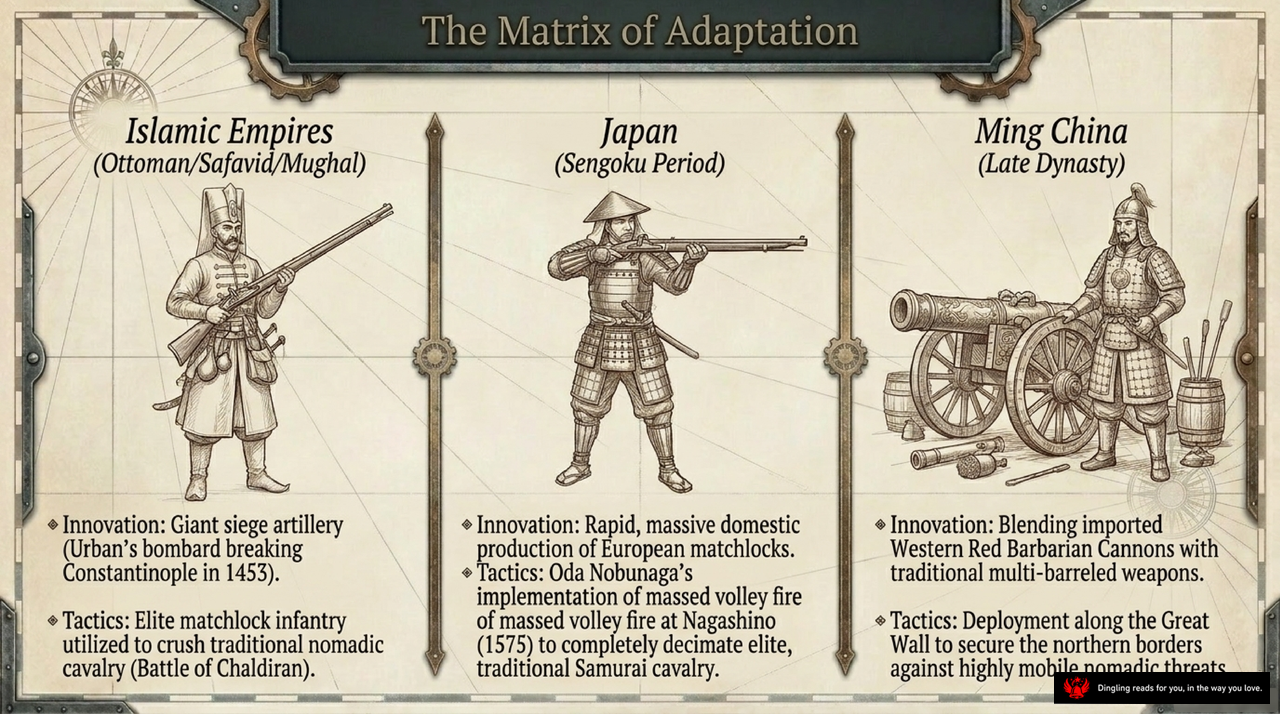
Welcome back to our book sharing session. Today, we're focusing on a pivotal concept from our text: "The Matrix of Adaptation." This slide illustrates how three distinct civilizations—the Islamic Empires, Japan, and Ming China—responded to the same global pressure: the rapid spread of gunpowder technology.
Let's start with the Islamic Empires, including the Ottomans, Safavids, and Mughals. You see the soldier with the matchlock. This wasn't just about importing tech; it was about mastering it. In 1453, the Ottomans used a giant siege bombard to break the walls of Constantinople, ending the Byzantine Empire. But the real tactical shift happened later. At the Battle of Chaldiran, they deployed elite matchlock infantry. This was revolutionary. They used these firearms to crush the traditional nomadic cavalry that had dominated the steppe for centuries. It proved that disciplined gunners could defeat mobile horsemen, fundamentally changing the balance of power in the Middle East.
Next, we have Japan during the Sengoku Period. Look at that samurai with the matchlock. The Japanese didn't just wait for weapons to arrive; they industrialized them. They rapidly produced European matchlocks domestically. The game-changer was Oda Nobunaga at Nagashino in 1575. He implemented a tactic called "massed volley fire." Imagine rows of guns firing in rotation. This completely decimated the elite samurai cavalry, forcing a total transformation of warfare in East Asia. It was a brutal but effective lesson in firepower and discipline.
Finally, Ming China. Often misunderstood as isolated, the Ming were actually very active in military innovation. They didn't just use the imported "Red Barbarian Cannons"; they blended them with their own traditional multi-barreled weapons. You see that cannon on the slide. This hybrid technology was essential for their defense. They deployed these heavy weapons along the Great Wall. This wasn't just a static wall; it was a mobile defense system designed to secure the northern borders against highly mobile nomadic threats.
So, what's the takeaway? The "Matrix of Adaptation" shows us that in a changing world, the best weapon isn't always the original one. It's the one you can modify and use best. Whether it was the Ottomans, the Japanese, or the Ming, they all took the same technology and made it their own. This global exchange of military tech was a key driver of early modernization. It reminds us that history isn't about static nations, but about dynamic responses to change. This slide serves as a perfect example of the "Global History" perspective we discussed earlier. Instead of looking at these nations in isolation, we see them all participating in the same global network of innovation and conflict.
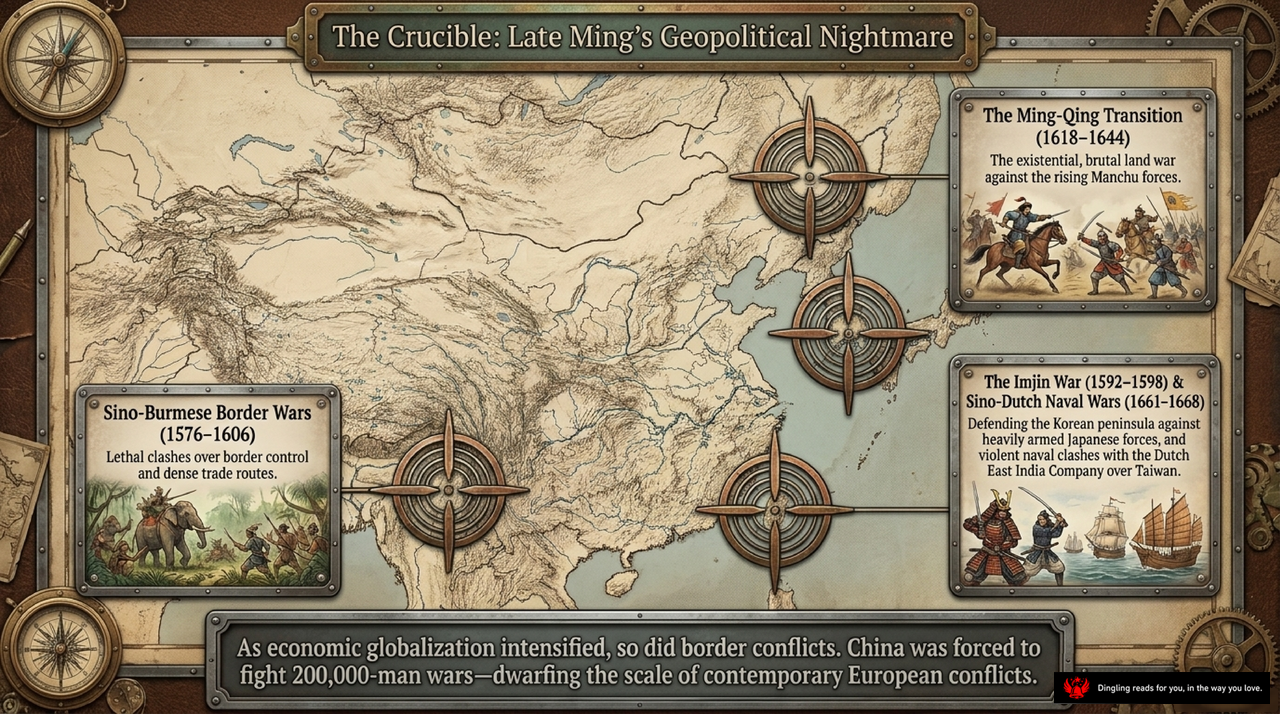
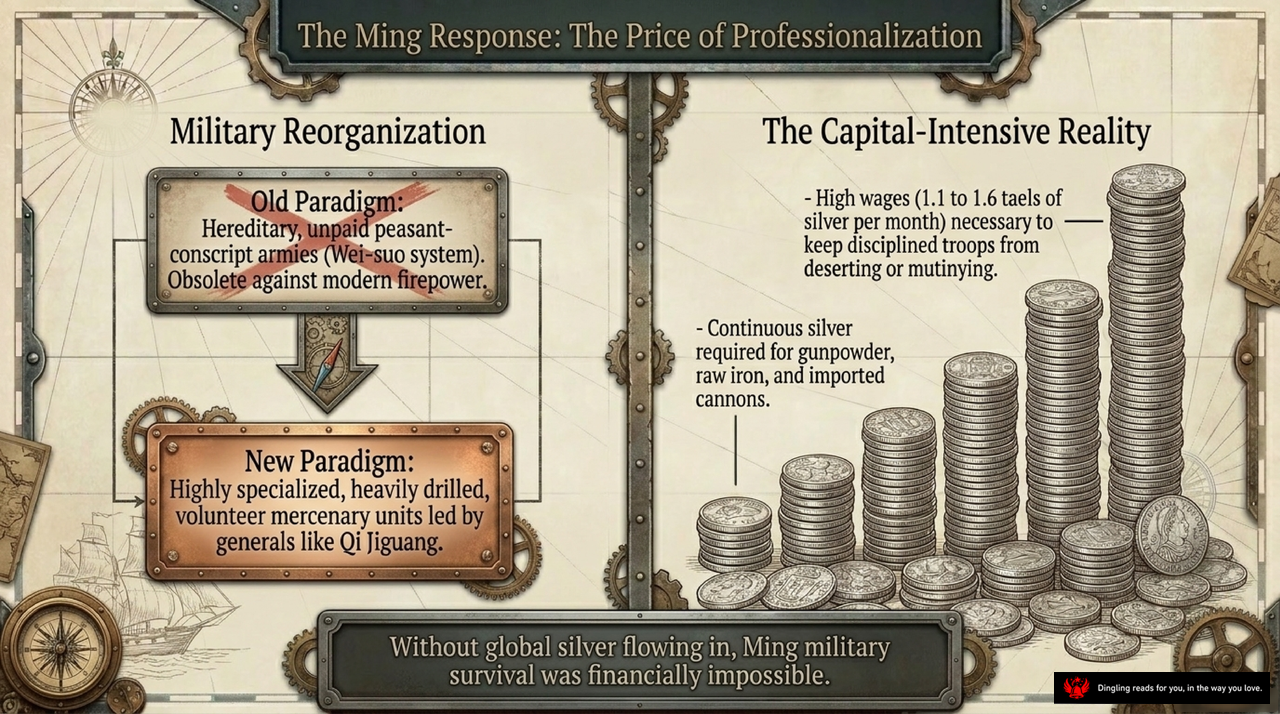
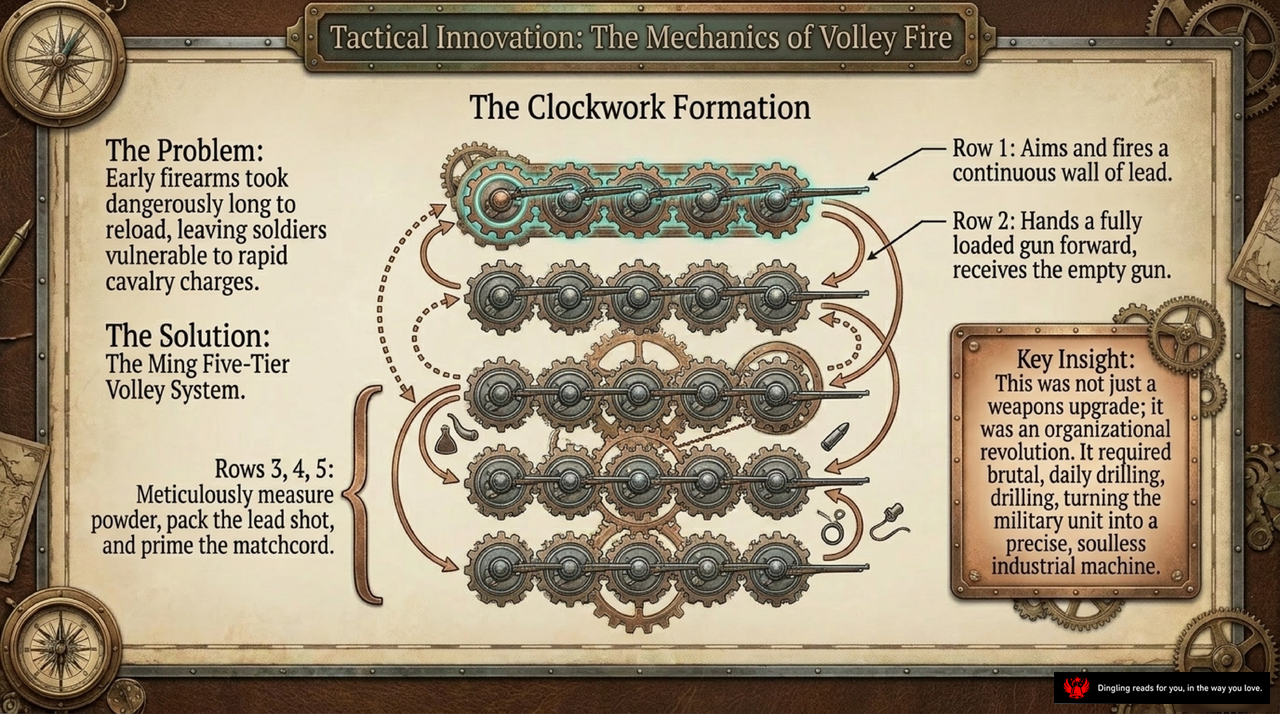
Let's dive into tactical innovation. Specifically, we're looking at the mechanics of volley fire. Picture the battlefield during the early days of gunpowder warfare. The problem was simple but deadly: early firearms took dangerously long to reload. A soldier would fire, then stand there for minutes waiting to load the next shot. That made them sitting ducks for a rapid cavalry charge. It was a tactical nightmare that could cost armies their lives.
But the Ming Dynasty in China had a brilliant solution. They developed something called the 'Ming Five-Tier Volley System,' often visualized as 'The Clockwork Formation.' Think of it as a human machine. Look at the diagram. The top row aims and fires a continuous wall of lead. While they do that, the second row steps forward, handing a fully loaded gun to the front, and grabbing the empty one. Meanwhile, rows three, four, and five are meticulously measuring powder, packing the lead shot, and priming the matchcord.
This system allowed for continuous fire, keeping the enemy suppressed. It was a response to the military revolution happening globally, where technology was spreading fast, but only the ones who could organize their troops efficiently would survive. The Ming realized that to beat the cavalry and the advancing European powers, they couldn't just rely on individual bravery. They needed discipline. They needed a system that worked like a factory.
The key insight here is profound: this was an organizational revolution, not just a weapons upgrade. It required brutal, daily drilling, drilling, turning the military unit into a precise, soulless industrial machine. Every soldier knew their role, like a cog in a clock. This level of coordination was rare for the time. It transformed the chaotic nature of early gunpowder warfare into something predictable and controlled.
It's a powerful reminder that in warfare, as in business, efficiency and organization often matter more than the raw power of the tools you hold. The Ming turned their army into a war machine long before the Industrial Revolution officially kicked off in Europe. It's a fascinating look at how early globalization and military tech shaped the world. This shift from individual heroics to systematic efficiency was a game-changer that echoed through history, proving that the best weapon isn't always the biggest gun, but the smartest army. This is why understanding the 'how' of war is just as important as the 'what'.
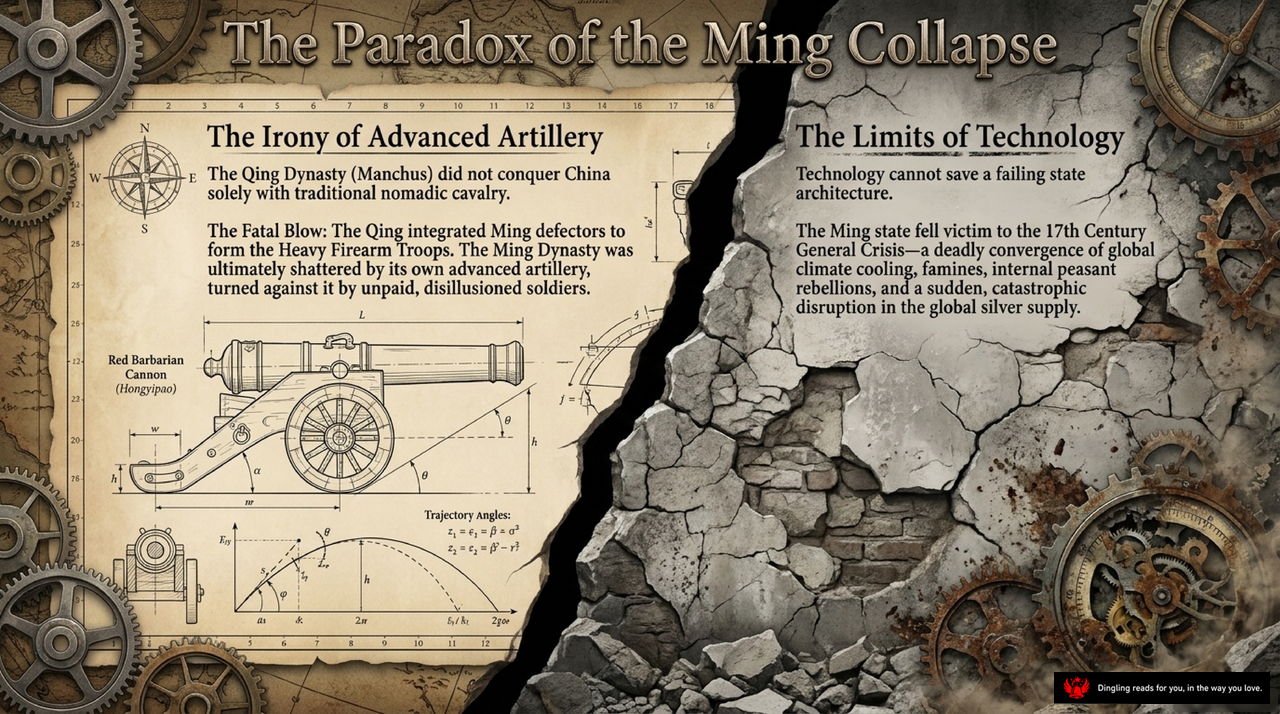
Welcome to the Paradox of the Ming Collapse. As you can see on this slide, we have two sides to this story that explain why a superpower fell. On the left, we have the Irony of Advanced Artillery. It’s a fascinating twist. The Qing Dynasty didn't conquer China just with traditional cavalry. In fact, the Ming Dynasty itself created the most advanced artillery of the time, like the Red Barbarian Cannon, or Hongyipao. They integrated these heavy firearms into their troops to form the Heavy Firearm Troops. But here’s the Fatal Blow: the Ming Dynasty was ultimately shattered by its own advanced artillery. Why? Because the soldiers were unpaid and disillusioned. They turned the weapons against their own government. The technology was there, but the loyalty wasn't. It’s a tragic irony that the very tools meant to protect the empire ended up destroying it.
Now, look at the right side. This is about the Limits of Technology. It’s a hard truth: technology cannot save a failing state architecture. Just having the best guns doesn't mean you win if the system is broken. The Ming state fell victim to what historians call the 17th Century General Crisis. This wasn't just a military failure. It was a deadly convergence of global climate cooling, famines, internal peasant rebellions, and a sudden, catastrophic disruption in the global silver supply. The economy collapsed, and the people revolted. The state simply couldn't hold together under that pressure.
So, what’s the takeaway? The Ming had the tech, but they lacked the stability. The global silver supply was drying up, the weather was changing, and the people were angry. Technology is a tool, but it’s not a cure-all for a broken society. Even during the Late Ming military reforms, figures like Xu Guangqi tried to modernize the army with western cannons. They built the Dengzhou Artillery Corps. But it wasn't enough. The reforms were limited in scale. The new armies were too small compared to the old, corrupt forces. The command structure was still broken.
This paradox teaches us that without a stable foundation, even the most advanced military technology can become the instrument of your own destruction. The Ming had the guns, but they lost the war because the state itself was crumbling. It’s a lesson for us today: technology amplifies power, but it doesn't create it. You need a solid system to wield the tools effectively. When the foundation cracks, the towers fall, no matter how high they are.
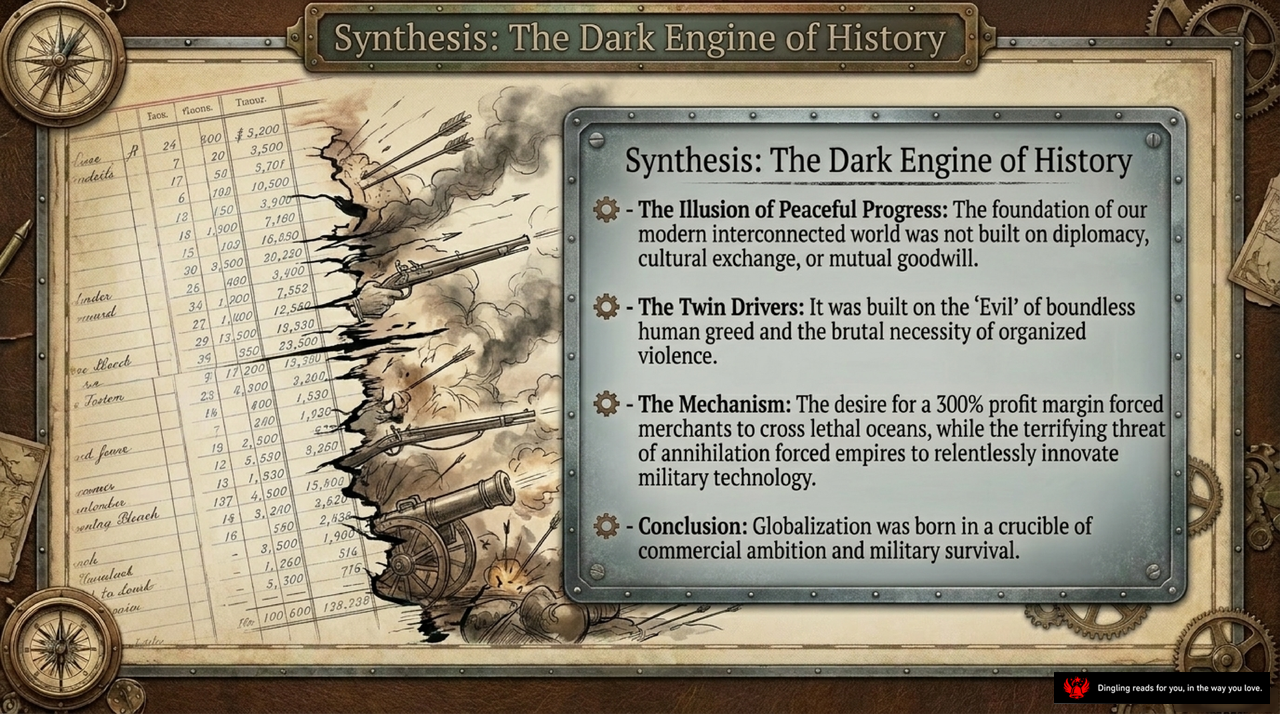
Welcome to our synthesis slide. Look closely at the title: The Dark Engine of History. This image with its old ledger and cannons represents the brutal reality behind the modern world we live in today.
We often grow up believing that globalization is a story of peaceful progress, built on diplomacy, cultural exchange, or mutual goodwill. But let's be honest with ourselves. The foundation of our modern interconnected world was not built on kindness. It was built on something much darker.
The slide points to two main drivers. First, the 'Evil' of boundless human greed. Second, the brutal necessity of organized violence. Think about the mechanism driving this. Why did merchants cross lethal oceans in the 15th and 16th centuries? Because the desire for a 300% profit margin forced them to take risks that would be unthinkable today. Capital would risk its head for such a return. But merchants weren't the only ones pushing the engine. Empires were relentlessly innovating military technology because the terrifying threat of annihilation forced their hand. You simply cannot have global trade without global security, and in that era, security meant raw firepower.
As the slide concludes, globalization was born in a crucible of commercial ambition and military survival. This is the dark engine. It wasn't a gentle evolution; it was a collision of commerce and the sword. The global market network was literally built on 'swords and fire.' Without the military power to protect the trade routes, the trade never happened. Without the trade, the military power had no economic fuel to sustain it.
In the early modern period, trade and violence were tightly bound. The rules were simple: new violence plus commercial interests. It acknowledges the system was forged in a chaotic, dangerous time.
When we look at history today, we need to stop romanticizing the past. The modern world we live in, with all its complexity, was forged in the fires of profit and survival. It was a chaotic time that created the system we rely on now. This synthesis reminds us that progress often comes with a heavy price, and understanding this 'dark engine' is crucial for understanding our current global challenges.
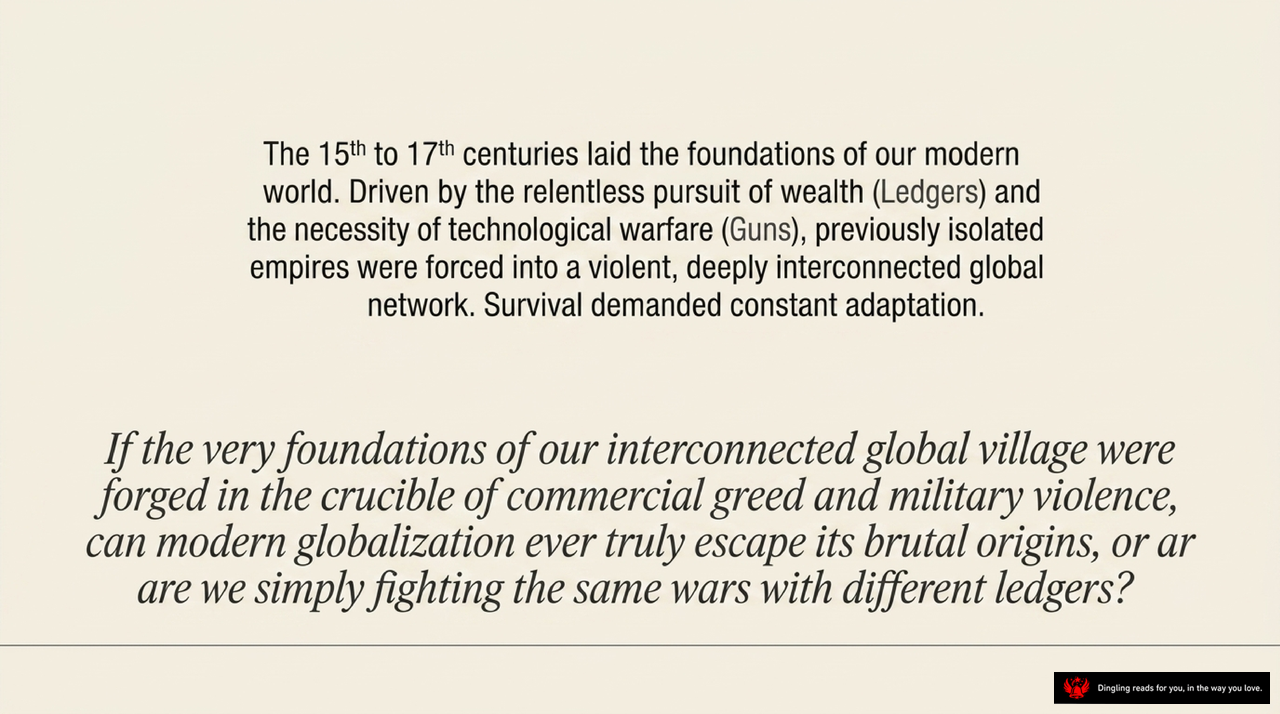
The 15th to 17th centuries didn't just change the calendar; they fundamentally built the stage for everything we know today. Before this, empires were mostly isolated, playing their own games in their own corners. But then, two powerful forces collided. First, the relentless pursuit of wealth—what the slide calls 'Ledgers.' And second, the necessity of technological warfare—'Guns.'
These weren't just tools; they were the architects of a new world order. Driven by the promise of gold and the need for firepower, previously isolated empires were forced into a violent, deeply interconnected global network. Survival demanded constant adaptation. You couldn't stay hidden anymore. If you didn't have the best guns or the best ledgers, you were left behind.
Think about it: This era, the Age of Discovery, was the birth of early economic globalization. But it wasn't a peaceful expansion. It was built on trade and 'sword and fire.' As we read in the book, the rules of this new game were simple but brutal: 'Guns plus Ledgers.' It was a combination of new violence and commercial interest.
Now, look at that question at the bottom. If our modern global village was forged in the crucible of commercial greed and military violence, can we ever truly escape those brutal origins? Or are we simply fighting the same wars with different ledgers?
The text suggests a dark truth. In this period, the global market was formed not just by merchants, but by empires competing for dominance. The 'Guns' part leveled the playing field in a way, allowing smaller powers to challenge the old giants, but it also meant that conflict became more destructive and frequent. The 'Ledgers' part meant that every interaction was measured in profit.
Consider the Ming Dynasty. The pressure from the 'Guns' and 'Ledgers' of Europe pushed them into a defensive posture. A small European fleet could challenge a massive empire, and trade routes became the primary battlefield. Silver flowed from the Americas to China, fueling the economy and the wars that defined the era.
So, when we look at today's globalization, we have to ask ourselves: Are we finally moving past the 15th century, or are we just repeating the cycle? The book argues that the foundations of our interconnected world were laid in blood and profit. Unless we fundamentally change how we balance wealth and power, we might just be fighting the same wars, just with more advanced technology. It's a challenge to us all.