
My Liangshan Brothers: Complete Chapter-by-Chapter Summary
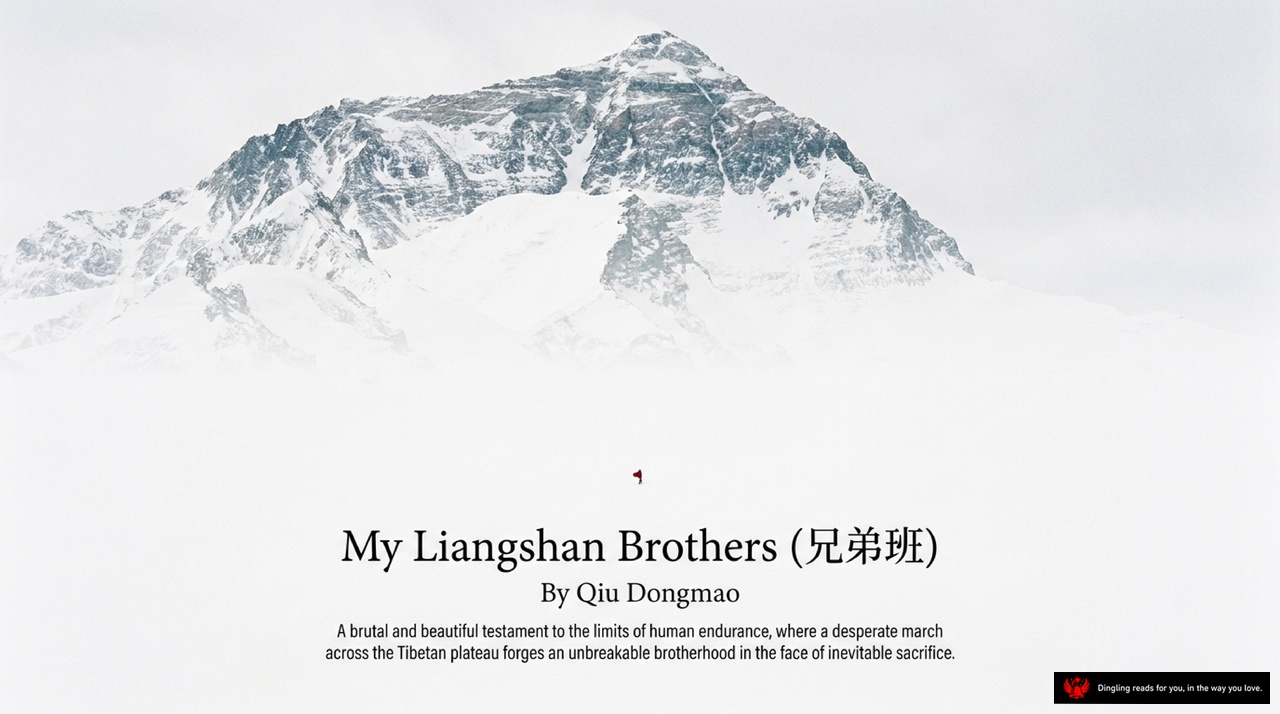
Welcome to our book club session on "My Liangshan Brothers" by Qiu Dongmao. Today, we're looking at the cover, which sets a powerful and haunting tone for the story ahead. The image features a majestic, snow-capped mountain piercing through a misty sky, with a tiny, solitary red flag planted in the vast white expanse below. This visual perfectly captures the book's core theme: a brutal yet beautiful testament to the limits of human endurance.
The book takes us to the Tibetan Plateau, where a desperate march forges an unbreakable brotherhood in the face of inevitable sacrifice. It's not just a story about geography; it's about the human spirit tested against overwhelming odds. As we dive into the pages, we'll explore how a group of brothers navigates the harsh realities of their environment, turning their shared struggle into a profound bond. The red flag in the snow symbolizes hope and resilience, a small but defiant statement of life in a world that often feels like it's closing in. Let's turn the page and see how these brothers find strength in each other.

Look at this topographic map of the "Death Zone." It outlines a terrifying ascent above 5,000 meters where nature reclaims absolute authority. As you climb, the environment dictates every parameter for survival: oxygen levels plummet, radio signals die, and every physical movement accelerates exhaustion.
The route highlights four critical checkpoints. At 5,037 meters, you hit "The Swamp," located in disputed borderlands. Just above that, at 5,300 meters, lies "The Black River," a zone of severe hypothermia risk. Pushing further up to 5,600 meters, you enter "The Avalanche Zone," where total communication blackout sets in. The final, most deadly barrier is at 5,800 meters: "The Daban Ice Cliff," marked by vertical impassability.
This map isn't just about geography; it's a tactical briefing on how modernity forces people into these lethal extremes. It illustrates the brutal reality where the environment itself becomes the ultimate adversary, leaving no room for error in a landscape defined by vertical death.

Imagine the plateau not just as a landscape, but as a battlefield where two powerful forces collide: the rigid demands of military duty and the raw, personal drive for survival. This slide maps out the four distinct archetypes of soldiers and civilians navigating this crisis, each representing a different way of facing the impossible.
In the top right, we see the idealistic sacrifice. Here is Xiao Mutian, the Commander. He is a stoic leader, but his strength is built on a heavy burden—the loss of his squadmates and his fiancée. He demands absolute survival and unyielding discipline, believing that only through total sacrifice can they endure. Moving to the top left, we find the pragmatic survivalist: Hao Dadi, the Veteran. He is a cynical, seasoned survivor who openly defies the very rules meant to protect him. His motivation isn't ideology, but a fierce, practical desire to save the individuals around him, like the military dog, even if it means breaking the law.
Now, shift your gaze to the civilian side. In the bottom right, we have Lang Cuo, the Innocent. He is a young Tibetan soldier who believes he is a child of the snow. He relies on faith, reincarnation, and song to endure the trauma that surrounds him. Finally, in the bottom left, we see Gu Meng'er, the Intruder. He is a civilian who initially sought death in the wilderness, only to be forced to confront the raw value of life through the squad's struggle. Together, these four figures show us that there is no single way to survive on the plateau; there is only the collision of their ideologies.
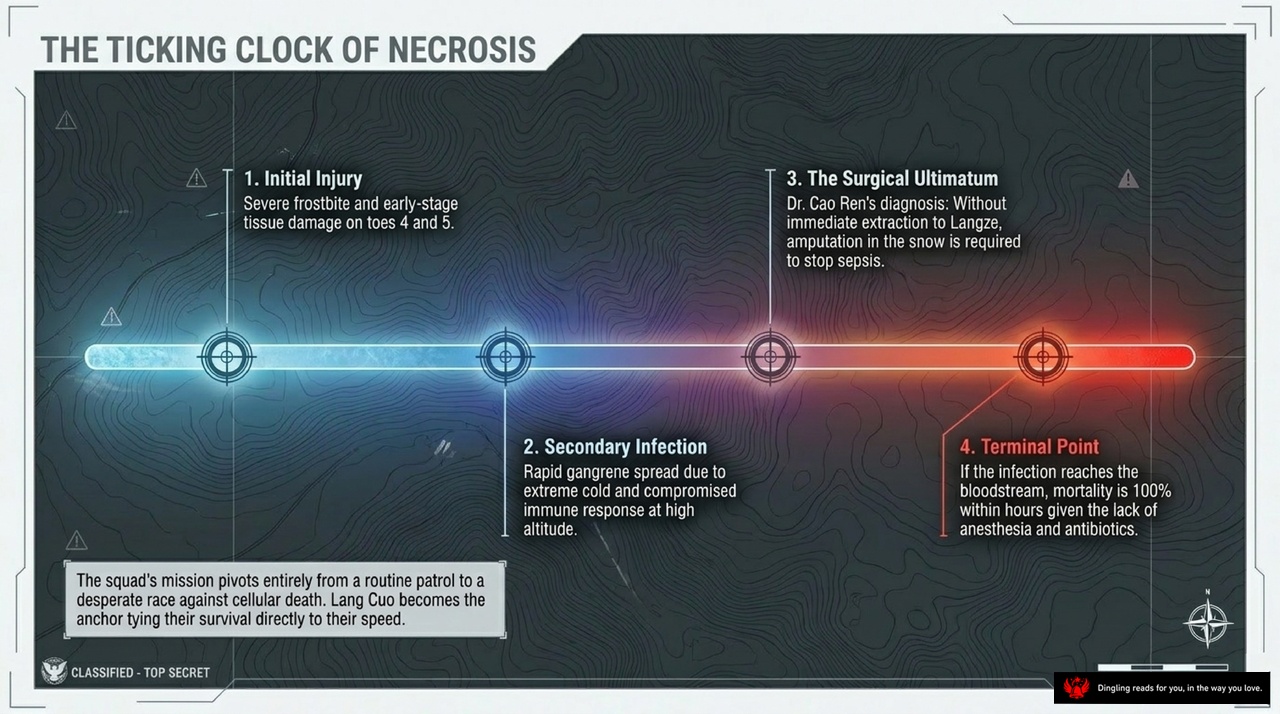
Imagine the squad's mission pivoting from a routine patrol into a desperate race against cellular death. This is the ticking clock of necrosis, a timeline where survival hangs on speed. It begins with the initial injury: severe frostbite causing early-stage tissue damage on toes 4 and 5. But the cold is just the trigger. As the temperature drops, a secondary infection takes hold. Rapid gangrene spreads due to extreme cold and a compromised immune response at high altitude. The situation escalates quickly to the surgical ultimatum. Dr. Cao Ren delivers a grim diagnosis: without immediate extraction to Langze, amputation in the snow is required to stop sepsis. The clock is running out. If the infection reaches the bloodstream, the terminal point is reached. Without anesthesia or antibiotics, mortality hits 100% within hours. This graphic illustrates the brutal reality of their struggle, where every minute counts against the relentless march of death.
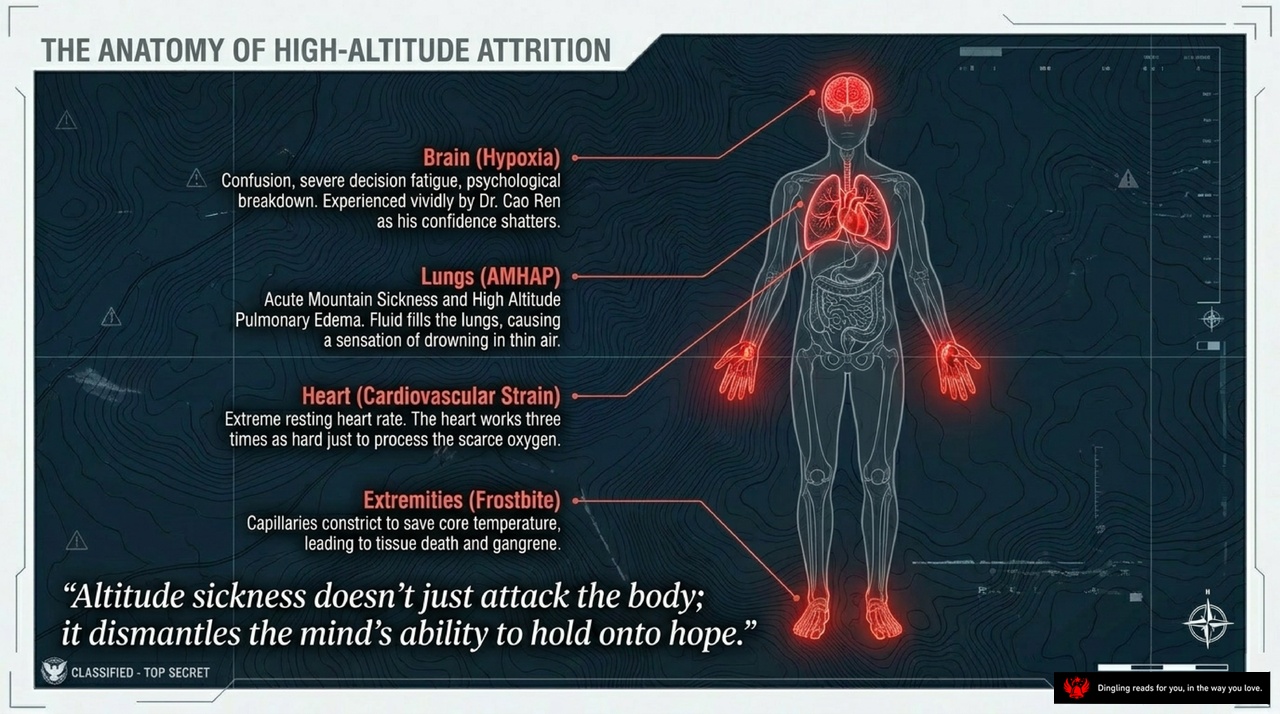
Look at this diagram. It shows the anatomy of high-altitude attrition, breaking down how altitude sickness dismantles the body and the mind. The image highlights four critical systems under extreme stress. First, the brain suffers from hypoxia, leading to confusion, severe decision fatigue, and even psychological breakdown as confidence shatters. Next, the lungs face Acute Mountain Sickness and High Altitude Pulmonary Edema; fluid fills the lungs, creating a terrifying sensation of drowning in thin air. The heart endures massive cardiovascular strain, pumping three times harder just to process scarce oxygen. Finally, the extremities freeze, with capillaries constricting to save core temperature, which leads to tissue death and gangrene. As the slide powerfully states, altitude sickness doesn't just attack the body; it dismantles the mind's ability to hold onto hope. This graphic vividly captures the physical toll described in our research, illustrating how environmental extremes can push human limits to their absolute breaking point.
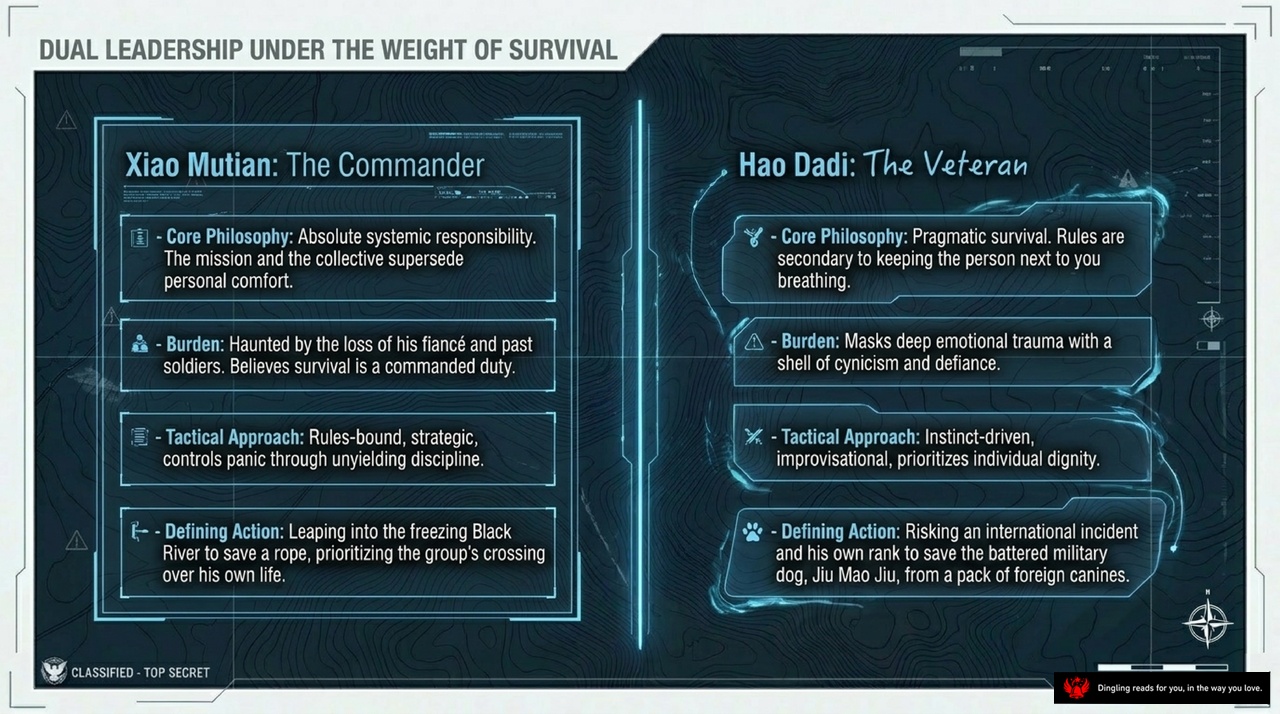
The slide contrasts two very different leadership styles that define the struggle for survival in Lim Township: Xiao Mutian, the Commander, and Hao Dadi, the Veteran. On the left, we see the Commander's philosophy: it's about absolute systemic responsibility. For him, the mission and the collective always supersede personal comfort. His burden is heavy—he's haunted by the loss of his fiancée and past soldiers, viewing survival as a commanded duty. Tactically, he relies on strict rules and unyielding discipline to control panic. His defining action is leaping into the freezing Black River to save a rope, prioritizing the group's crossing over his own life.
On the right stands Hao Dadi, the Veteran. His core philosophy is pragmatic survival; rules are secondary to keeping the person next to you breathing. He masks deep emotional trauma with a shell of cynicism and defiance. His approach is instinct-driven and improvisational, prioritizing individual dignity above all. His defining action is risking an international incident and his own rank to save the battered military dog, Jiu Mao Jiu, from a pack of foreign canines.
Together, these two figures represent the complex duality of leadership under the weight of survival—one bound by the structure of the state and collective duty, the other driven by the raw instincts of the veteran protecting his own.

Welcome to the final chapter of our journey into the Daban Ice Cliff. This slide maps out the deadly ecosystem we've explored: from the unpredictable violence of the Avalanche Zone to the mathematically impossible final hurdle of the Daban Ice Cliff itself.
As we look at this grid, remember that for the Nuosu youth, modernity wasn't a smooth path forward; it was a trap. The "Black River" of freezing rapids and the "Disputed Swamp" of slow sinking represent the dual crises of heroin and HIV that swept through their lives. They weren't just victims of bad luck; they were trapped in a system where traditional safety nets had collapsed, leaving them to face modernity's risks alone.
The tragedy here is that the very forces meant to liberate them—the push for capitalism, the desire for urban life—became the vectors of their destruction. The "Avalanche Zone" of social instability, triggered by the slightest vibration of market reform, annihilated their physical and cultural path forward. While the state offered top-down solutions, they often failed or even created new stigmas, leaving the community isolated.
Ultimately, the Daban Ice Cliff stands as a stark warning. It is the final, impossible barrier for a generation that was pushed out of their home, only to find that the world outside offered no shelter, only a slow, freezing death. Their story is a monument to the brutal cost of unchecked modernization, reminding us that when you pull a culture out of its roots without a new foundation, the fall is often fatal.
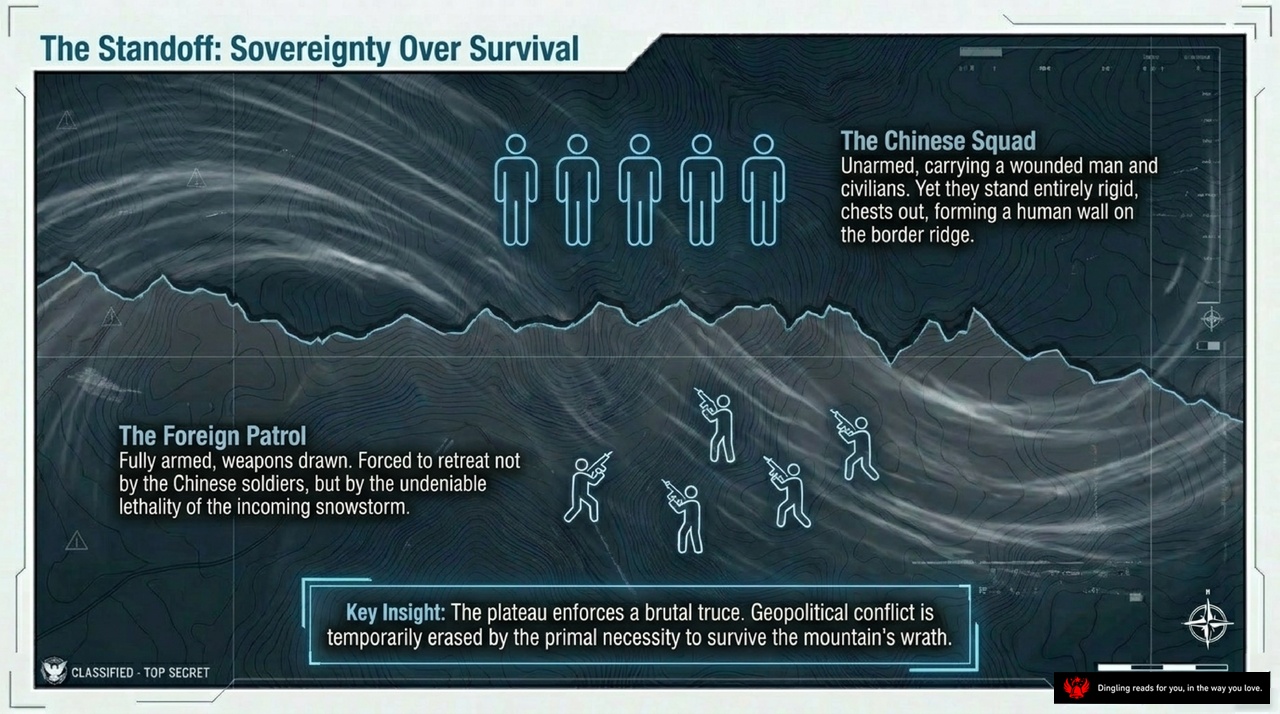
The standoff at the border isn't about weapons; it's about survival. Look at the map: above the ridge, the Chinese squad stands unarmed, forming a human wall with a wounded man and civilians. They don't retreat. Below them, the foreign patrol is fully armed, weapons drawn, yet forced to pull back. Not by the soldiers, but by the sheer, undeniable lethality of the incoming snowstorm.
This image captures a brutal truth from the plateau: geopolitics takes a backseat to primal necessity. When the mountain's wrath arrives, ideological conflicts are temporarily erased. Both sides realize that no political stance matters when the storm demands a sacrifice. The truce isn't made; it's enforced by the landscape itself. In a world obsessed with sovereignty and power, this moment reminds us that nature holds the ultimate veto. The conflict pauses not because of diplomacy, but because the cost of fighting is simply too high to survive the night.

Imagine a group of strangers thrown into a pressure cooker of absolute survival. In the book, we see this vividly illustrated in the "Forging of the Brothers Class." It starts with "The Stragglers"—a chaotic mix of a suicidal civilian, an exhausted doctor, a grieving widow, and a group of inexperienced recruits, even a wounded boy and a military dog. They aren't a team; they are just individuals drifting through disaster, disconnected and desperate.
Then comes "The Crucible." The route collapses in the avalanche zone. Retreat is impossible. Despair peaks. In this moment of total hopelessness, the old rules of society dissolve. You can't go back to who you were. This shared trauma forces them together.
Finally, we reach "The Vow." In the center of this red, glowing sphere of unity, Xiao Mutian is unanimously elected as their leader. But more importantly, rank disappears entirely. They are no longer a patrol unit with a hierarchy; they have transformed into a single, singular survival organism bound by absolute mutual reliance. This is the power of crisis: it strips away individual status and creates a bond stronger than any contract, proving that when the world ends, the only thing that matters is trusting the person standing right next to you.

Look at this flowchart. It maps out the impossible choices Dr. Cao Ren faced during a medical crisis. Every single path leads to a different kind of failure.
If he chooses to stop and operate right there in the snow, the result is grim. Without anesthesia, the patient dies from shock. And because the surgical environment is completely unsterile, rapid fatal sepsis becomes inevitable. Science simply cannot function without the basic logistics of a sterile room or proper equipment.
Alternatively, if he waits for rescue, the outcome is just as bleak. Communications are severed, and the blizzard grounds the helicopters. The result? Necrosis spreads, and death becomes unavoidable.
Then there is the third option: pushing forward over the Daban. This requires hauling a paralyzed man up a vertical ice cliff. The consequence here is a high probability of a total squad wipeout, leaving only a microscopic chance of survival.
The bottom line, as the text at the bottom reminds us, is that the plateau strips away the illusion of medical control. It forces a harsh realization: science is powerless without logistics. In this environment, there is no perfect solution, only a brutal calculus of survival where every choice carries a heavy, often fatal, price.
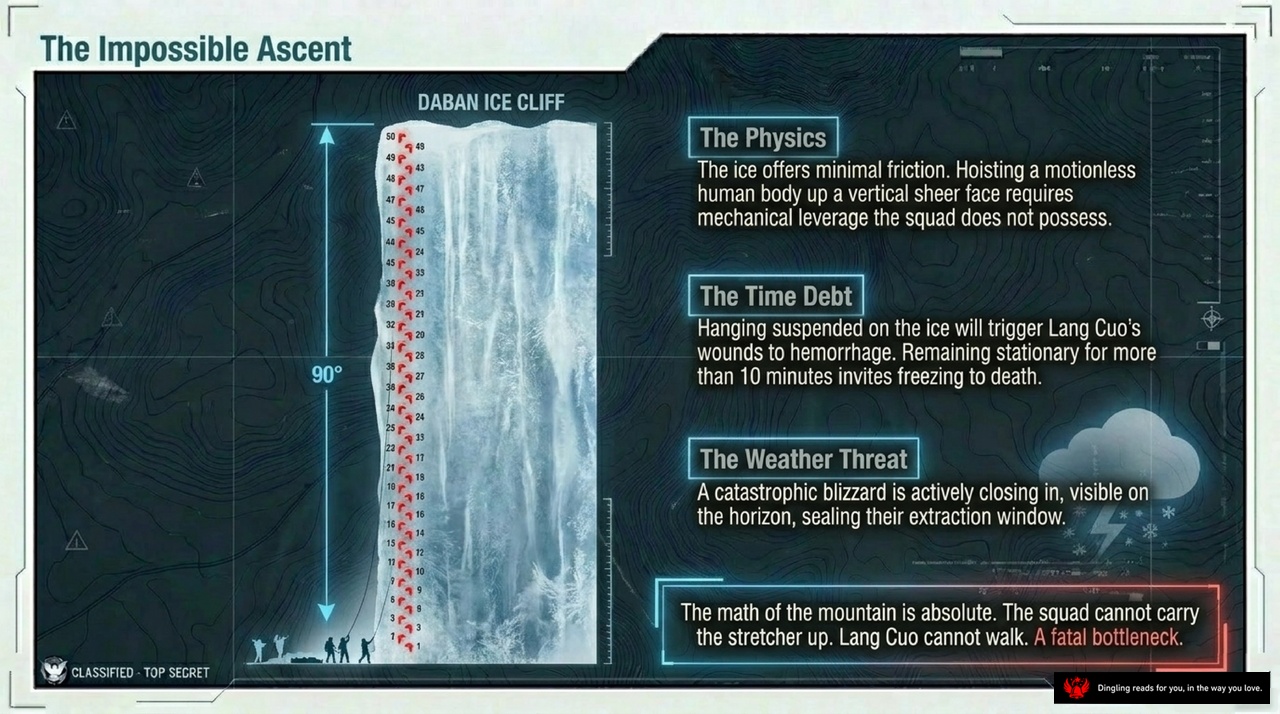
Look at this infographic titled "The Impossible Ascent." It lays out the brutal math facing the squad on the Daban Ice Cliff. The physics are unforgiving: hoisting a human body up a 90-degree vertical face with almost zero friction requires mechanical leverage the team simply doesn't have. Then there's the time debt. Hanging there isn't just painful; it's fatal. For Lang Cuo, whose wounds are already bleeding, staying suspended for more than 10 minutes means freezing to death. And finally, the weather threat is closing in—a catastrophic blizzard is already visible on the horizon, sealing their only extraction window. The math of the mountain is absolute. They cannot carry the stretcher up, and Lang Cuo cannot walk. This creates a fatal bottleneck. It's not just a rescue mission gone wrong; it's a scenario where the environment itself has decided against their survival.

The Weight of the Rope. Imagine a single drop of blood falling from a fraying rope, marking the moment a young soldier named Lang Cuo makes the ultimate sacrifice. On the left, the haunting invitation: "Please come to the south of the temple to dance..."—a call to life that he chooses to reject. On the right, we see the tragic choice of the innocent. Realizing he is the heavy anchor dragging his brothers to their deaths, Lang Cuo refuses to be a victim. Believing fiercely in reincarnation, he sings a folk song to calm his squad, unclips his harness, and drops into the crevasse. He claims his own death to purchase the lives of the ten people above him. This isn't just a story of heroism; it's a stark metaphor for the modernity the Nuosu people face. It's a double-edged sword that offers both opportunity and destruction. As we explore the next chapters, we will see how this same modernity—driven by market forces and state policies—turned the pursuit of a better life into a deadly gamble, trapping young men in a cycle of heroin addiction and HIV, forcing them to make choices as heavy as that rope.
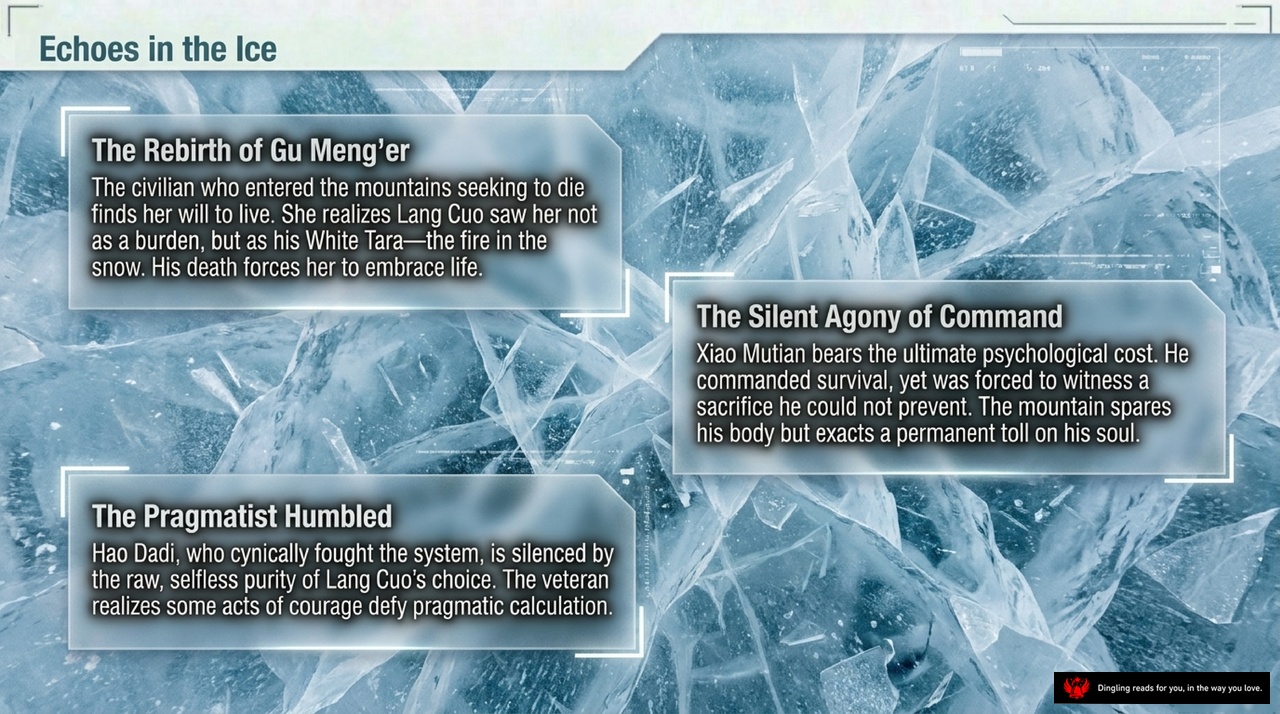
Echoes in the Ice. This isn't just a title; it's the haunting reality of Li Mu Township, where the cold grip of modernity has shattered traditional life. Look at the three stories unfolding here. First, the rebirth of Gu Meng'er. She entered the mountains seeking death, only to find that Lang Cuo saw her not as a burden, but as his White Tara—the fire in the snow. His sacrifice forced her to finally embrace life. Next, the silent agony of command. Xiao Mutian bears the ultimate psychological cost. He commanded survival, yet was forced to witness a sacrifice he could not prevent. The mountain spares his body but exacts a permanent toll on his soul. Finally, the pragmatist humbled. Hao Dadi, who cynically fought the system, is silenced by the raw, selfless purity of Lang Cuo's choice. The veteran realizes that some acts of courage simply defy pragmatic calculation. These moments show us that in the face of the twin crises of heroin and AIDS, the human spirit finds ways to endure, even when the world tries to break it.

Synthesis: The True Border. Look at this diagram. It maps the soul of the Liangshan experience, where the harsh reality of the Tibetan Plateau acts as a great equalizer. This is what we call the "Strip-Down Effect." Nature strips away military rank, civilian status, and old grievances, forcing everyone into a single, raw reality.
In this "death zone," survival isn't just a biological metric; it's a collective spiritual contract. You only survive by carrying others. This shared struggle births "The Brotherhood," the intersection of Nature's Brutality and Military Duty. But here is the crucial shift: the true border isn't the physical line they guard against foreign armies. That is just a metaphor. The real border is internal—the thin line between selfish despair and selfless sacrifice.
This is the ultimate thesis. In the face of modernity's chaos, the only way forward is through this internal transformation. It's about redefining the border from the outside in, turning survival into a testament to human connection rather than just a struggle for life.
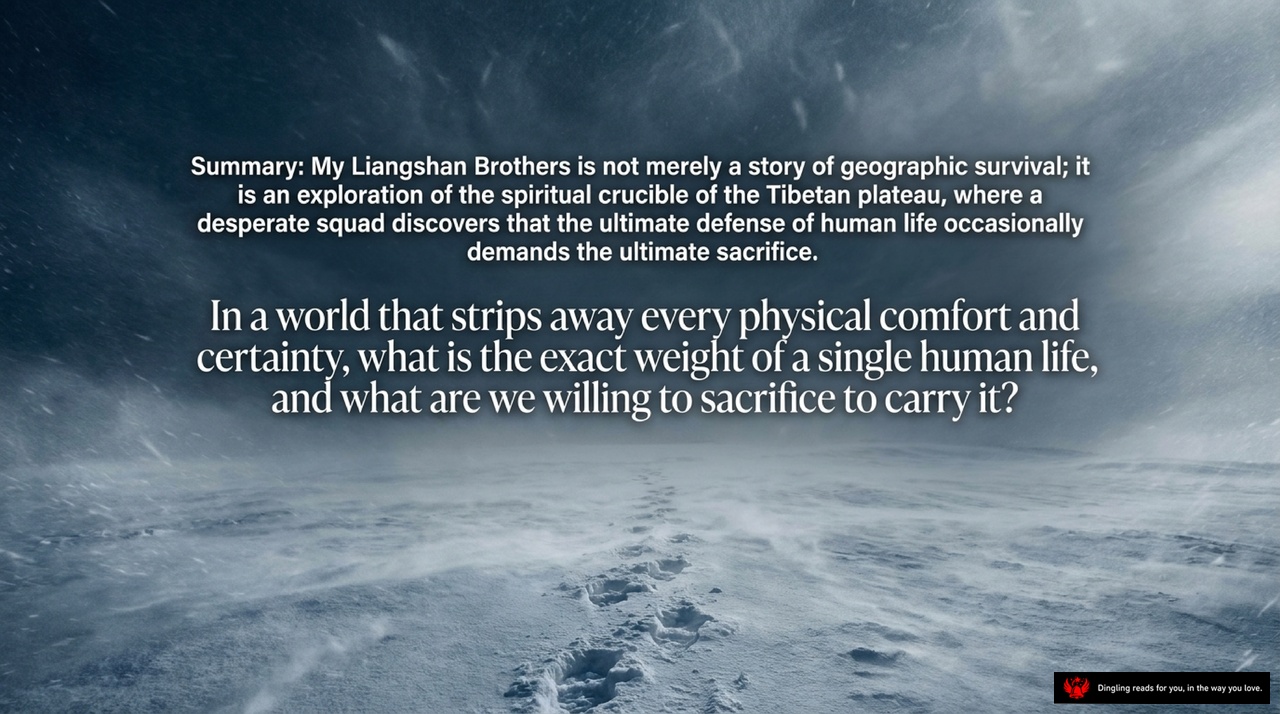
In a world that strips away every physical comfort and certainty, what is the exact weight of a single human life, and what are we willing to sacrifice to carry it? This question lies at the heart of *My Liangshan Brothers*, a story that goes far beyond mere geographic survival. It is an exploration of the spiritual crucible of the Tibetan plateau, where a desperate squad discovers that the ultimate defense of human life occasionally demands the ultimate sacrifice.
The book reveals a harrowing truth: the path to modernity was not a straight line of progress, but a double-edged sword that brought both opportunity and disaster. For the Lisu people, the pursuit of a "modern" life—driven by the desire for personal freedom and a place in the new world—led them into the trap of heroin and HIV. What began as a quest for better opportunities in cities twisted into a twisted coming-of-age ritual, where drug use became a way to display status, and the very act of survival required the sacrifice of health, family, and sometimes, life itself.
This narrative challenges us to look past the surface of survival and confront the deep spiritual cost of these choices. When physical comforts vanish, what remains is the raw weight of a human life. The story asks us to consider the price of progress and the profound courage it takes to face the unknown, reminding us that sometimes, protecting life requires a sacrifice so great that it redefines the very meaning of humanity.