
My Students: Complete Chapter-by-Chapter Summary
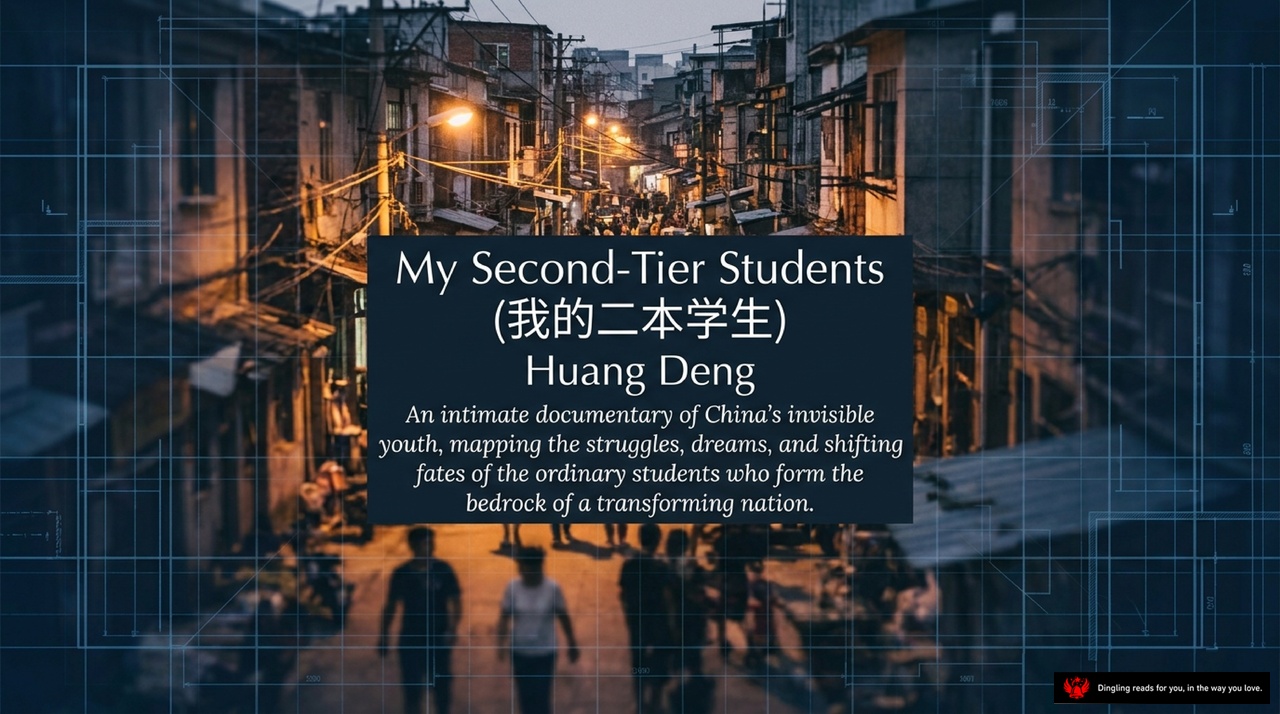
Welcome to the first stop of our journey. Imagine a narrow, winding alley in the heart of Guangzhou, illuminated by the warm, flickering glow of streetlights. It's a place that feels both timeless and urgently alive. This is Longdong, the setting for Huang Deng's powerful documentary, *My Second-Tier Students*.
The book promises an intimate look into China's invisible youth. It maps the struggles, dreams, and shifting fates of ordinary students who form the bedrock of a transforming nation. The image you see captures that very essence—a bustling, unpolished urban landscape where the future is being written in real-time.
Huang Deng uses this backdrop to explore a generation caught between the rapid modernization of the city and their own personal limitations. These aren't just statistics; they are real people navigating a world where opportunity is often tied to the invisible lines of family background and economic reality. From the bustling streets to the quiet corners of their rented rooms, this story invites us to see the humanity behind the headlines and understand the true cost and hope of growing up in a changing China.
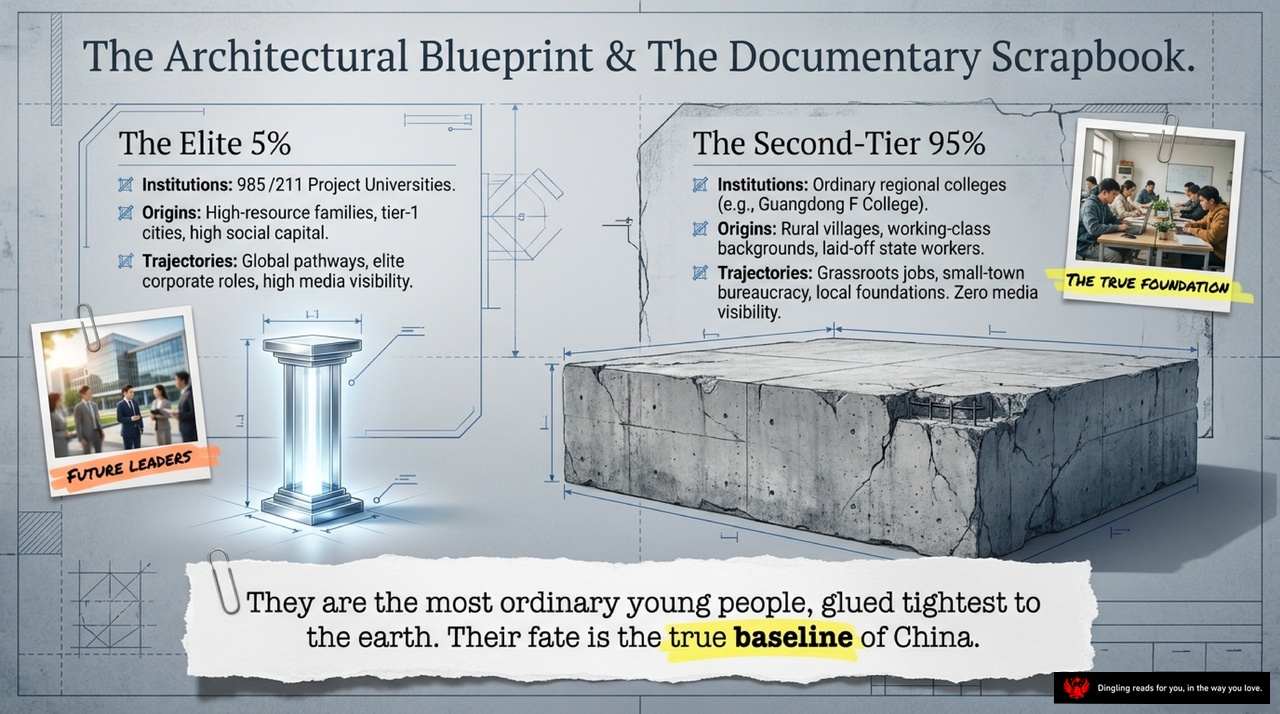
Look at this blueprint. It's not just a drawing; it's the unvarnished truth about opportunity in China. On the left, we have "The Elite 5%." These are the future leaders, sculpted in the top 211 universities. They come from high-resource families with deep social capital, destined for global pathways and high-visibility corporate roles. They are the polished columns of the city.
But look at the other side. This is "The Second-Tier 95%," labeled here as "The True Foundation." These are the most ordinary young people, glued tightest to the earth. They attend ordinary regional colleges, often coming from rural villages or working-class backgrounds. Their trajectories aren't global; they are local—grassroots jobs, small-town bureaucracy, and zero media visibility.
The image captures a stark reality: while the elite build their careers on a pedestal of privilege, the vast majority are building a life on a concrete block of sheer grit. As the text emphasizes, the fate of these 95% isn't just a statistic; it is the true baseline of China. They are the unsung backbone, the ones who make the system work, even if they never get to stand on top of it.

Look at this map of Longdong Station. It perfectly captures the dual reality of this neighborhood. On one side, you have Exits A, B, and C, representing the homeowners. For them, real estate is a rapidly appreciating financial asset, valued at 40,000 to 50,000 RMB per square meter. To them, Longdong is a booming investment, a place where property values have skyrocketed over the years.
But just across the 39 Bus Route, the story changes completely. Exit D leads to the renters, living in the urban village. Here, it's a cheap, chaotic haven—a necessary layover for people from rural origins facing an uncertain urban future. The photos on the left show exactly that: narrow alleys, crowded rooms, and bustling markets. It's a place of intense contrast, where the same train ride connects a high-value asset market with a survival economy for young dreamers.
This bus route isn't just transportation; it's the dividing line and the bridge between two worlds. It carries students rushing to class, workers heading to the city center, and families navigating the transition from rural life to urban survival. Longdong is no longer the "edge of the city" people used to whisper about. Thanks to the subway and rising property values, it has become a vibrant, albeit complex, hub. It holds the dreams of those who can't afford the city core yet, while simultaneously fueling the wealth of those who own the land beneath their feet. It's a microcosm of modern China, where prosperity and struggle exist side by side, connected by a single, busy bus line.

Look at these three sticky notes on the screen. They represent the starkly different economic realities faced by three generations of college graduates in China: the Class of 1995, the Class of 2006, and the Class of 2015.
Let's start with the left note, the Class of 1995, often called "The Teacher" generation. They stepped into a planned economy transitioning to a market one. The state assigned them jobs, guaranteeing stability. Their housing reality was secure; work units provided homes with absolute security. Psychologically, they felt elite, optimistic, and part of a collective stability. It was a time of defined paths and safety nets.
Move to the middle note, the Class of 2006, the "80s Generation." They entered a booming market economy where they had to hunt for jobs autonomously. Housing was affordable with early effort; they could buy homes if they worked hard. Their mindset was pragmatic and striving, hopeful for upward mobility. This was the era of the "hustle," where hard work seemed to directly translate into home ownership and success.
Now, look at the right note, the Class of 2015, the "90s Generation." The context has shifted dramatically. The job market is saturated, and degrees have inflated in value. The housing reality is brutal: astronomical prices make urban homeownership mathematically impossible for most. Consequently, their psychological state has shifted to anxiety and passivity. Instead of striving upward, many are retreating into digital escapism.
This progression from security to optimism, then to struggle, and finally to despair, illustrates the crushing weight of changing economic tides on a single generation. The promise that "hard work equals success" has vanished, replaced by a reality where the starting line keeps moving away from them.
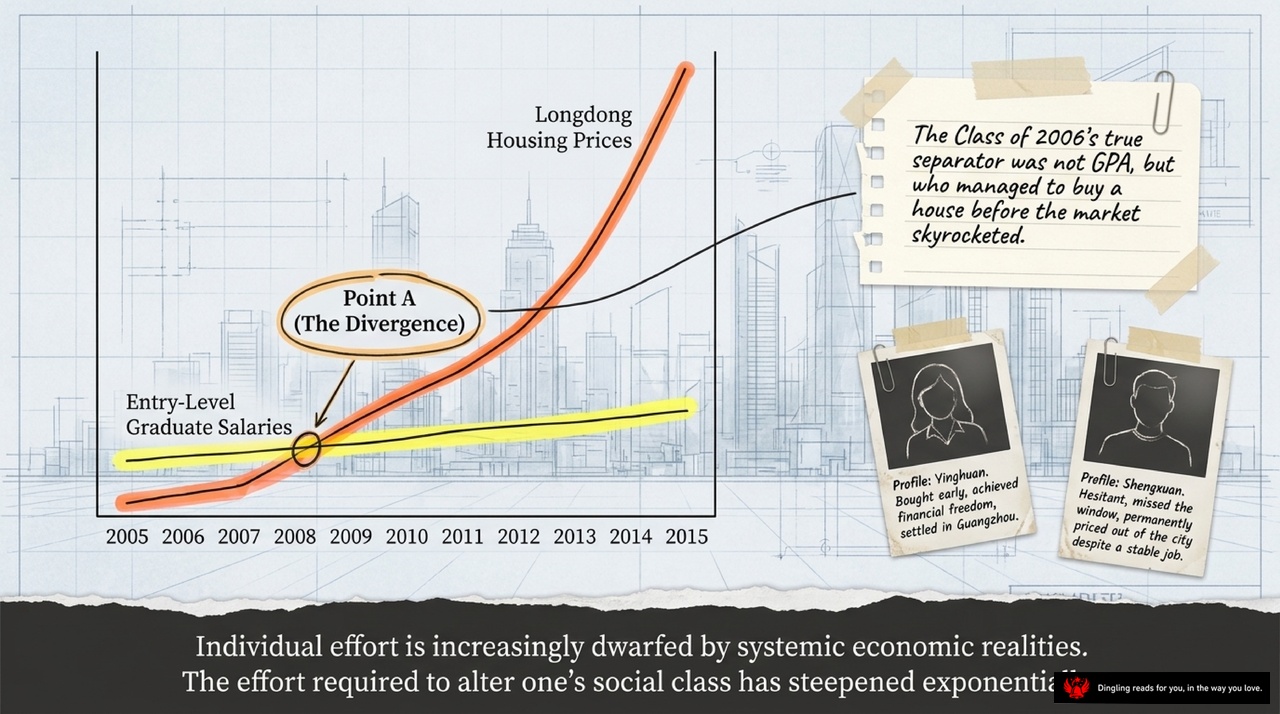
Look at this graph. It tells a stark story about the 2006 graduating class. The real divider wasn't their GPA, but who managed to buy a house before the market skyrocketed.
Notice Point A, labeled "The Divergence." Around 2008, the orange line for Longdong housing prices crossed the yellow line for entry-level graduate salaries. After this moment, the two trajectories pulled apart dramatically.
Take Yinghuan, for instance. She bought early, achieved financial freedom, and settled in Guangzhou. Now look at Shengxuan. Despite having a stable job, he hesitated. He missed the window. By the time he could afford to enter the market, prices had skyrocketed, permanently pricing him out of the city.
This visual captures a brutal truth: Individual effort is increasingly dwarfed by systemic economic realities. The effort required to alter one's social class has steepened exponentially. In an era where housing prices rise faster than wages, the playing field is no longer level. It's no longer just about studying hard; it's about timing the market perfectly, a privilege that often depends on something far beyond your control.

Today's slide, "The Invisible Weights," captures a reality that many of us know too well but rarely talk about openly. It visualizes the crushing burden carried by young people who start their lives without a safety net. Look at the three categories: the Psychological Deficit, the Social Capital Deficit, and the Economic Deficit. These aren't just abstract terms; they are the invisible weights holding down an entire generation.
Consider the story of Deng Huazhen, whose note is taped to the right side of our slide. Her family's monthly income was under 1,000 RMB. When she needed a student loan, she was denied simply because her parents were under 45. She wrote, "I was wrong to think I belonged in university." That moment of realization—that she didn't fit into the system—was a heavy weight she had to carry alone.
This connects directly to the "Economic Deficit" shown on the left. It's not just about personal poverty; it's about the total lack of safety nets. When parents are laid off, or when there are siblings to support, the financial pressure becomes insurmountable. Without that financial cushion, the "Social Capital Deficit" becomes fatal. If you have zero network for job referrals, you are forced to rely entirely on raw, unguided effort. In a competitive job market, that is a losing game.
Finally, there is the "Psychological Deficit." This is the deep sensitivity, the survivor's guilt, and the paralyzing fear of taking risks. When you are constantly worried about survival, you stop dreaming. You stop innovating. You become risk-averse.
The image of the person carrying those heavy concrete blocks perfectly illustrates this struggle. It shows how these invisible factors—money, connections, and mental resilience—combine to make the climb up incredibly steep for some, while others walk on flat ground. It's a stark reminder that success isn't always about hard work alone; it's often about the invisible weights you have to carry from the very beginning.
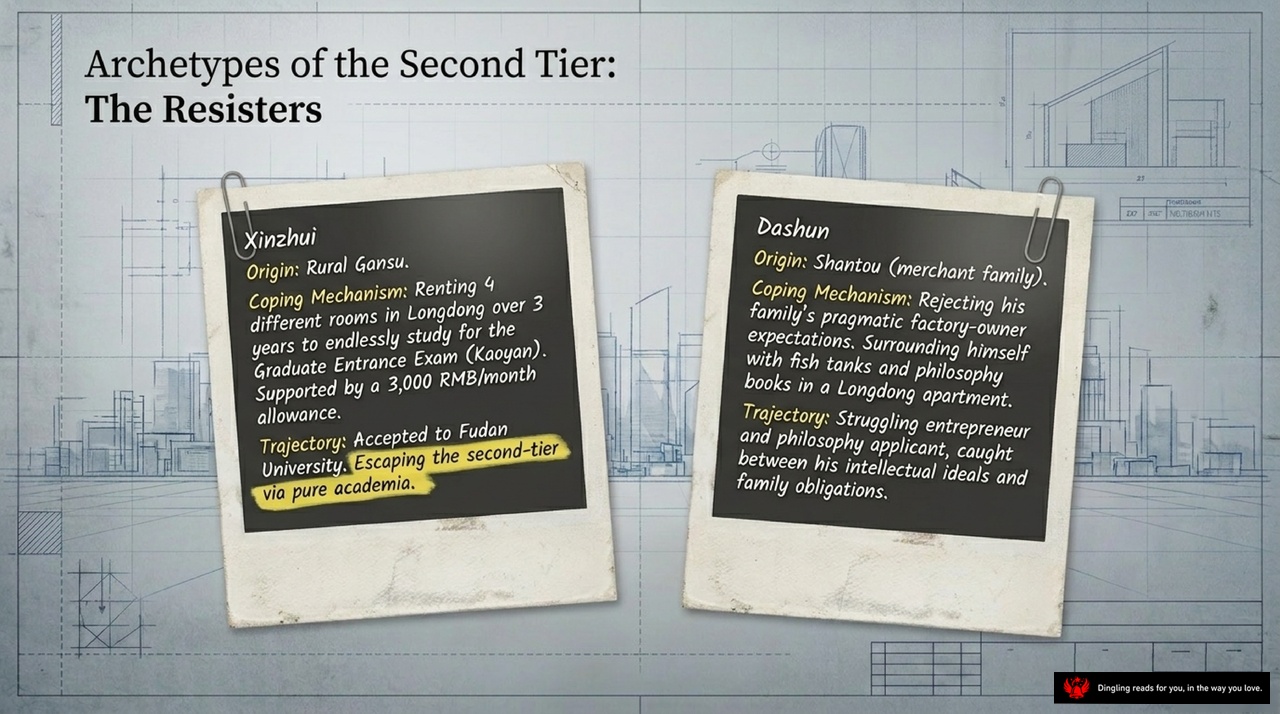
Look at these two profiles on the screen: Xinzhui and Dashun. They represent the "Resisters"—the second tier's most determined archetype.
Let's start with Xinzhui. He's from rural Gansu, a place far from the coast. His story is one of pure, relentless academic escape. He rented four different rooms in Longdong over three years, surviving on a tight 3,000 RMB monthly allowance. While others were working, he was grinding for the Graduate Entrance Exam. And it paid off: he escaped the second-tier trap entirely, landing a spot at Fudan University through pure academia. He didn't compromise; he just worked harder.
Now, look at Dashun. His story is more complex. He comes from a merchant family in Shantou, but he rejected his parents' pragmatic factory-owner expectations. Instead, he surrounded himself with fish tanks and philosophy books in a Longdong apartment. He's currently caught in a struggle between his intellectual ideals and his family's heavy obligations. He knows that most college startups are just playing with concepts, yet he's trying to balance a philosophy graduate exam with running a shared service platform. He's resisting the pressure to just "get rich quick," even if it means staying stuck in the middle.
Both Xinzhui and Dashun are fighting the same invisible war: the war against a system that tells them to play by the rules. Xinzhui won by doubling down on the rules until they broke open for him. Dashun is resisting by trying to carve out his own path, even when it's messy and uncertain. They are the proof that you don't have to accept your starting point as your ending point.
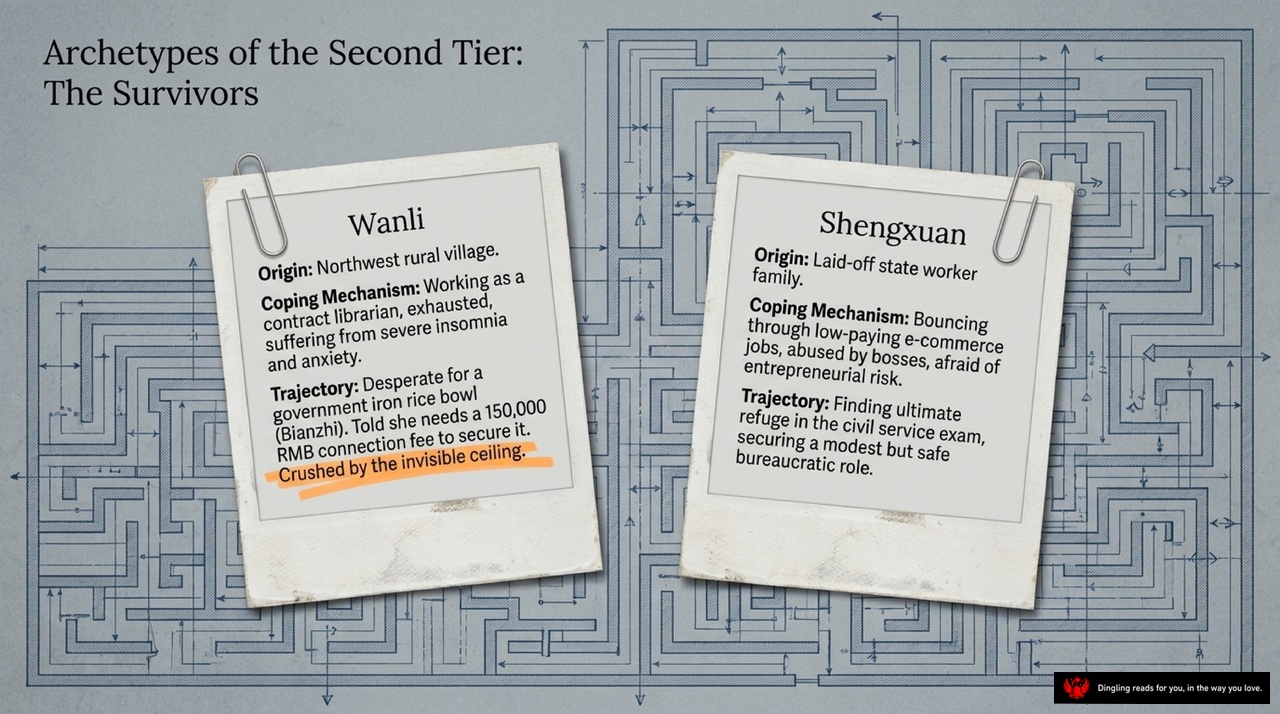
Welcome back to our deep dive into the hidden architecture of modern life. Today, we're peeling back the layers of what I call the "Second Tier" of society—specifically, the archetype of **The Survivors**.
Imagine a complex maze drawn in blueprints. That's the reality for two distinct characters we're looking at today: Wanli and Shengxuan. They represent the quiet, often invisible struggle of millions who are just trying to keep their heads above water.
First, let's look at **Wanli**. She comes from a rural village in the northwest. Her story is one of exhaustion. Working as a contract librarian, she suffers from severe insomnia and anxiety. Her dream? To secure a government job, that coveted "iron rice bowl." But here is the crushing reality: she was told she needs a 150,000 RMB connection fee just to get an interview. She is literally crushed by an invisible ceiling, no matter how hard she tries.
Now, turn your gaze to **Shengxuan**. His origin is a laid-off state worker family. His coping mechanism is a constant bounce from one low-paying e-commerce job to another, often facing abuse from bosses and terrified of entrepreneurial risk. Yet, like Wanli, he finds his ultimate refuge in the civil service exam. He secures a modest but safe bureaucratic role, finally finding stability after years of uncertainty.
Both Wanli and Shengxuan are trapped in this same maze. They aren't the heroes who change the world; they are the survivors who navigate a system that feels rigged against them. Their stories remind us that for many, the race isn't about ambition—it's about survival against an invisible wall.

Look at this phone screen. It's not just a device; it's a portal to a completely different world. For the 2015 graduates we studied, this digital space became their "Digital Refuge."
You see the phenomenon clearly here: these students appear silent and passive in the classroom, yet online, they are leading rich, intense lives. Why the disconnect? Because the reality they face in the physical world is crushing.
In the text, we read about how these students survive the pressure of a hyper-competitive reality by escaping into "Xianxia"—those fantasy martial arts web novels and immersive gaming worlds. It's a literature of escape. When they can't find agency, fairness, or upward mobility in the rigid urban economy, the digital realm offers them something the real world denies: a sense of power and possibility.
That quote on the screen, "Thirty years east of the river, thirty years west, do not bully the young and poor," captures their feeling of being pushed to the margins. But inside that phone, they aren't the victims of that hierarchy. They are warriors in their own right, fighting dragons and leveling mountains. This digital refuge isn't just about hiding; it's about finding a place where they can finally breathe, grow, and feel like the protagonists of their own stories.
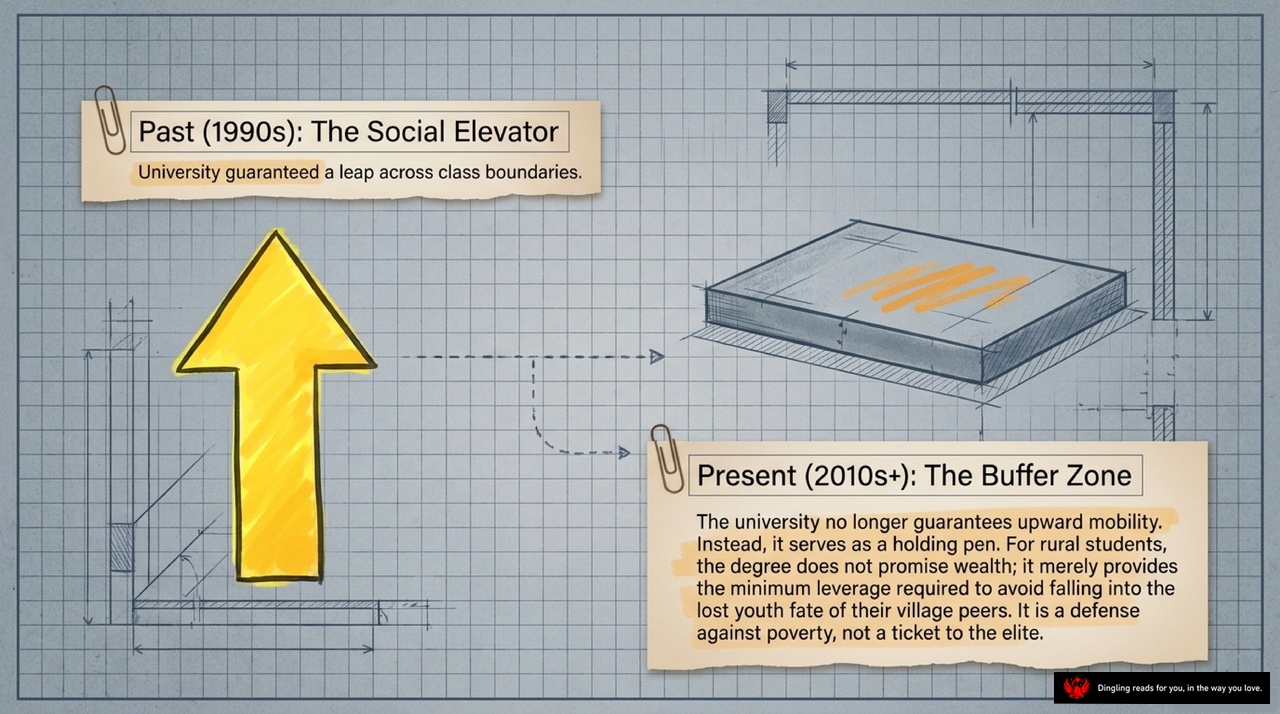
In the 1990s, university was the ultimate social elevator. For students from rural backgrounds, a degree wasn't just a piece of paper; it was a guaranteed ticket to cross class boundaries and secure a stable, upward trajectory. The system worked as a powerful engine, lifting individuals out of poverty with remarkable efficiency.
Fast forward to the 2010s, and that engine has stalled. Today, the university has transformed into a buffer zone. It no longer promises wealth or elite status. Instead, it serves as a holding pen—a defensive shield. For many rural students, the degree offers only the minimum leverage needed to avoid falling into the difficult fate of their village peers. It is a defense against poverty, not a golden ticket to the top. The era of the easy leap is over; now, the degree is simply the bare minimum required to stay in the game.

China's second-tier students are often the invisible engine of the nation. Their daily struggles expose how the promise of education as a great equalizer is slowly fading. Yet, through immense resilience, silent endurance, and quiet, relentless labor, they continue to carve out lives for themselves. These countless ordinary efforts are what truly sustain the country's foundation.
But we must ask ourselves a harder question: When personal effort is increasingly dwarfed by systemic inequality, how must we redefine the true purpose and promise of a university education?