
My Transformation: Complete Chapter-by-Chapter Summary

Welcome to this special reading session. Today, we are diving into the profound journey of Wang Shi, as outlined in his book, *My Changes: 40 Years of Personal Modernization*.
The cover sets the stage perfectly. Behind the title, you see a mountain range sketched in blueprint lines, symbolizing the structural yet personal climb of his life. This isn't just about climbing peaks; it's about dismantling the traditional constraints of the past to build a modern, globally responsible version of the self.
Wang Shi's story begins with a radical transformation of his own body and mind. From driving heavy trucks in the Gobi Desert as a teenager to enduring grueling physical labor in boiler rooms, and later scaling the world's highest peaks, he learned that the body and spirit are inextricably linked. Even a life-threatening diagnosis of a spinal tumor in 1995 didn't stop him; instead, it became the catalyst for his most dangerous expeditions, including reaching the summit of Everest in 2003. He faced moments where his intelligence at 8,000 meters dropped to that of a six-year-old, and the sweet illusion of near-death almost took him away. Yet, through sheer will and scientific discipline, he survived, realizing that the limits of the body are often just illusions broken by the power of the mind.
This journey reshaped his entire worldview. He learned to live with moderation, embracing a life of clarity over excess. Whether it was giving up sugar to align with his biology or choosing simple meals to honor resources, he found that true freedom comes from self-discipline. His philosophy extends beyond personal health into the corporate realm. As the founder of Vanke, he fought against the corruption and "human rule" that plagued many Chinese companies. He established a culture of transparency, where even executive salaries were public, and he refused to hire relatives, proving that a company can thrive without the founder's constant presence.
His modernization also meant expanding his horizons globally. He spent years studying in the US and Europe, not just to learn business, but to understand the roots of Western civilization and the essence of Eastern culture. He studied Japanese craftsmanship, Jewish history, and classical music, constantly challenging himself to overcome his weaknesses. Even at 68, he found new vitality in rowing, discovering the joy of physical exertion that he had missed for decades.
Ultimately, Wang Shi's story is a testament to the power of continuous evolution. He moved from a state of anxiety and suppression to one of open-mindedness and global responsibility. He embraced death not with fear, but with a deep appreciation for life, inspired by cultures from Egypt to Greece to modern Scandinavia. His legacy is a reminder that personal modernization is a lifelong journey—one where we constantly break old molds to build something better, more resilient, and more connected to the world.
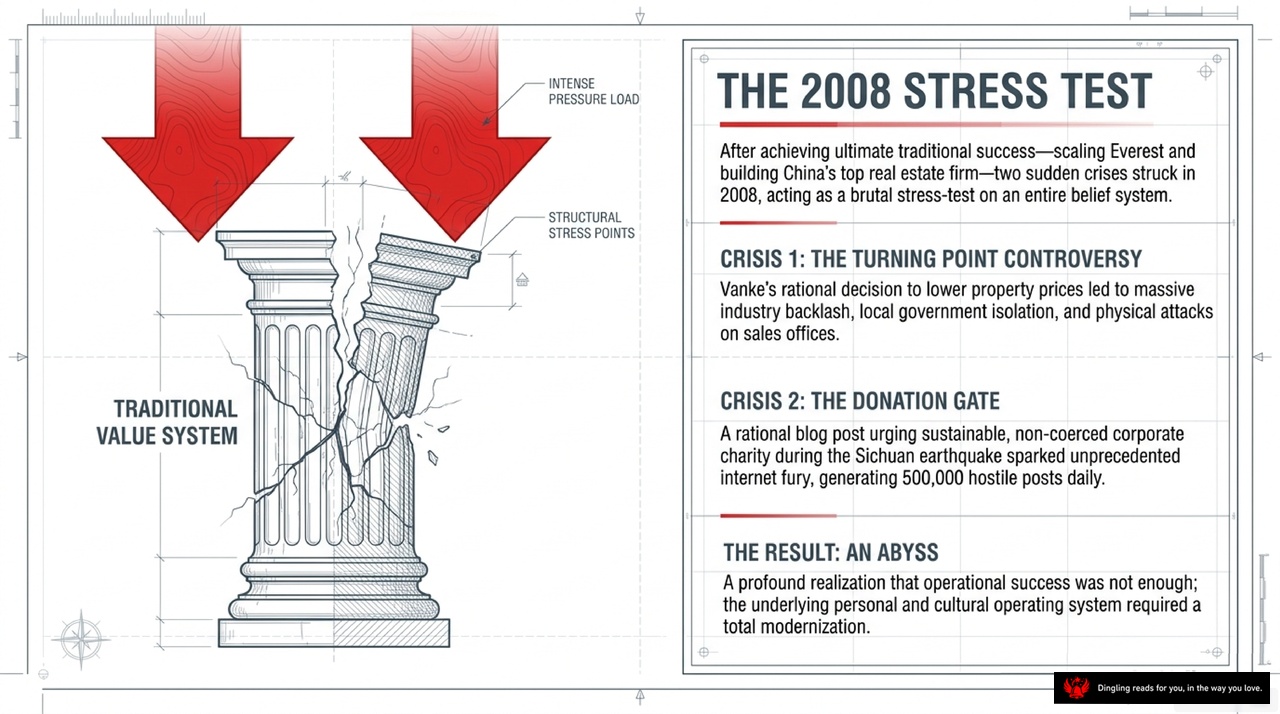
Imagine your entire belief system as a classical column, standing strong after scaling the highest peaks and building a top-tier real estate empire. But in 2008, two massive red arrows of "intense pressure load" slammed down, causing that once-solid structure to crack at its "structural stress points," leaving us with a broken pillar labeled "traditional value system." This was the brutal 2008 stress test.
The first crisis hit when Vanke rationally lowered property prices. Instead of praise, we faced industry backlash, government isolation, and even physical attacks on our sales offices. The second crisis came from a blog post urging sustainable charity during the Sichuan earthquake. A rational call for non-coerced giving sparked unprecedented internet fury, generating 500,000 hostile posts daily.
These shocks forced a profound realization: operational success was not enough. The underlying personal and cultural operating system required a total modernization. We had to move from an era of blind growth to one of deep reflection, understanding that true resilience comes not just from building tall buildings, but from rebuilding the values that hold us together.

Welcome back to our journey through the mind of a lifelong learner. Today, we dive into the very core of his intellectual evolution: the search for the philosophical roots of civilization.
Look at this diagram. It represents five distinct dimensions of growth, and right in the center stands Dimension 3: Intellectual Rebirth. This is about seeking the philosophical foundations that shape our world and ourselves.
Wu Yilin's path to this intellectual rebirth wasn't about sitting in a quiet room. It was forged in the fires of extreme experiences. He didn't just read history; he lived it. From climbing the Himalayas to studying in Harvard, every step was a lesson in understanding human nature and culture.
His realization came from a profound shift in perspective. In the past, he might have viewed traditional Chinese culture with a critical distance, influenced by modern skepticism. But during his time at Harvard, studying under scholars like Professor Puming, everything changed. He discovered that the "contract spirit" he once thought was missing from China actually existed deep within its tradition, rooted in the principle of protecting the vulnerable and maintaining trust.
This new understanding transformed his definition of success. It expanded from personal achievement to a broader responsibility: "taking the world as one's duty." He realized that the concept of "saving the world" wasn't just a slogan, but a bloodline trait inherited from his ancestors, now extending beyond China to the entire globe.
Intellectual rebirth, as he demonstrates, isn't about rejecting the past. It's about bridging the East and the West, understanding that modernization doesn't require erasing one's roots. By studying Japanese craftsmanship and Western management, he integrated the best of both worlds, creating a unique philosophy for business and life.
This dimension of intellectual rebirth is the engine that drives the other four dimensions. It gives purpose to his physical challenges, informs his corporate governance, guides his social evolution, and anchors his thoughts on mortality. It is the light at the center of the diagram, illuminating the path forward.

The evolution of rationality isn't just about climbing higher; it's about mastering the art of recovery. At age 52, I reached the "Everest Limit State." Without genetic advantages, I climbed to 8,550 meters, enduring extreme hypoxia that stripped my mind down to pure willpower. That struggle taught me a hard truth: the temptation to sleep and die is real, but rationality is the force that keeps you awake.
But what happens when you age? That's where "The Science of Rowing" comes in. Transitioning to age 62+, I moved from extreme survival to scientific optimization at Cambridge. Instead of fighting against my body, I used high-intensity anaerobic training to activate the C10 gene. This wasn't just about exercise; it was about stimulating neural coordination, delaying aging, and cultivating absolute physical rationality.
The graph on the right shows this rhythm. It's not a straight line of exhaustion, but a wave of controlled stress and recovery. By embracing this cycle, I didn't just maintain my health; I actually reversed signs of aging, even developing the six-pack I had always dreamed of. The lesson is clear: true rationality evolves. We stop relying on brute force and start using science to optimize our biology, turning our bodies into machines that can perform at their peak, no matter our age.

Life is not just about how we live, but how we face the end. My view on death wasn't shaped by abstract philosophy, but by real, terrifying moments. It started with my father's sudden passing in 1991, a loss that left me grappling with guilt and the harsh reality that life has a destination. But it was the mountains that truly taught me to accept it. From the altitude sickness on Yumruzhum to the terrifying near-misses on Bogda Peak and the blinding panic on Everest, I learned that death is a constant shadow, yet also a mirror that reveals our truest selves.
When I visited cemeteries in Moscow and Stockholm, I saw that graves aren't just about saying goodbye; they are spaces to understand life's meaning. The idea that death is the final period of a complete sentence resonated deeply. Even the quiet Quaker meetings, with their circle of silence and shared vulnerability, showed me that being human means finding peace amidst uncertainty.
I realized that the fear of death often paralyzes us, but acknowledging it liberates us. Just as I chose to stop climbing Everest to focus on my studies in Harvard, I learned that some battles are won by letting go. Whether it's the loss of my father, the challenges of a career, or the final breath, the key is to live fully in the present, knowing that our choices—always upward and forward—define our legacy. True courage isn't avoiding the end; it's living with such integrity that the end becomes a natural, peaceful conclusion.

Welcome back. Today, we're diving deep into the concept of "The Power Paradox," a counterintuitive idea that reshaped how I lead Vanke and how we can all approach success.
The paradox is simple yet profound: a truly successful entrepreneur doesn't build a system that relies on their constant presence. Instead, they build a system that thrives in their absence. Relinquishing absolute authority wasn't just a nice gesture; it was the precise mechanism that allowed Vanke to survive brutal corporate control battles and grow into a resilient institution.
Let's look at the two critical moments where I made this shift. In 1988, during Vanke's restructuring, I voluntarily yielded my personal equity. I chose to align purely as a professional manager rather than a wealthy owner. This move was crucial to avoid the traditional trap of wealth resentment and to build a culture based on merit, not ownership.
Then, in 1999, at the age of 48, I made the decision to resign as General Manager. I deliberately isolated myself on the mountains, hiking and climbing for weeks at a time. Why? To force the executive team to operate independently. I needed them to learn how to swim without me holding onto the rope.
This inverted pyramid visualizes that journey. As I stepped back from the top, the organization actually grew stronger and more stable. By giving up control, I gave the company its true power. It's a lesson for all of us: true leadership isn't about holding on tighter; it's about creating a structure so strong that you don't need to be there to hold it up.

The path to institutional invincibility isn't about building walls; it's about choosing a harder path that forces you to become stronger. As we see here, it starts with a single, non-negotiable rule: The Ethical Constraint. By publicly refusing to pay bribes, a company like Vanke inevitably pays more for land and gets less prime locations. But this "disadvantage" acts as a powerful evolutionary filter. Without the crutch of political favors or cheap land, the company is forced to survive purely on superior product design, industrialized construction quality, and elite property management. This pressure cooks out the weak competitors. Then, when anti-corruption sweeps hit major cities, those who relied on dirty tricks collapse, while the ethical company emerges unscathed. That is how an ethical constraint transforms into institutional invincibility, creating a globally recognized business model that no competitor can copy.

Today's map illustrates the "Geography of Transformation," a journey that took me from the raw execution of Shenzhen in the 1980s to the intellectual depths of the world's most prestigious institutions. It all began in **Shenzhen**, where we imported Japanese manufacturing discipline and pioneered residential industrialization, laying the groundwork for a new era. From there, the path led to **Jerusalem** at Hebrew University, where I studied Hebrew to decode the cultural DNA of innovation and survival at its absolute source. This was followed by a pivotal stop in **Cambridge** in 2013, where I expanded my intellectual bandwidth by studying the history of Jewish migration to seek the underlying drivers of civilizational resilience. Finally, the journey culminated in **Boston and Harvard** in 2011. There, I stripped away the CEO aura at age 60, enduring the humility of language barriers to study the religious roots of capitalism and Western institutionalism. This global arc wasn't just about travel; it was about systematically upgrading my own operating system, moving from building products to understanding the very foundations of civilization.

Modernization isn't just about adopting Western systems; it's about finding the right balance. Today, we explore the synthesis of modernization—a concept that emerged from a pivotal shift in thinking. For decades, the prevailing belief was that modernization required rejecting traditional Chinese culture in favor of Western rule of law, contracts, and individualism. This was "The Initial Rejection," a mindset that created a sharp divide between East and West.
However, a turning point came during the Harvard Realization. Professor Michael Puett's classes revealed the deep, often overlooked value of Eastern philosophy. We learned that while Western contracts prioritize efficiency, Chinese traditions prioritize empathy for the weak and societal cohesion. This insight challenged the old narrative. It showed that true modernization doesn't require choosing one side over the other. Instead, it demands a synthesis.
As our diagram illustrates, this synthesis blends the unbreakable systems of Western institutionalism with the profound Eastern ethos of "taking the world as one's duty"—a principle exemplified by early Chinese industrialists. It is the marriage of Western Rationalism and Eastern Responsibility. By embracing both, we create a more complete and sustainable path forward, moving beyond simple imitation to genuine integration.

Let's talk about how a company evolves from simply surviving to truly leading with purpose. Look at this pyramid, which illustrates "The Ascension of Purpose." It maps the journey of a leader, showing how vision expands from the ground up.
At the base, we see the traditional businessman focused purely on corporate survival, market dominance, and basic ethics. This is the foundation. Moving up to the middle layer, the mindset shifts to that of an Industry Pioneer. Here, the focus expands to building green supply chains and demanding environmental compliance from upstream suppliers like steel and timber. It's about setting standards for the entire industry.
But at the very top, we reach the Apex. This is where the transformation happens into a true World Citizen. This level isn't just about business; it's about global responsibility. It involves serving on boards like the WWF US Board and founding initiatives like C-TEAM, which unites over 800,000 enterprises to commit to carbon reduction at major UN Climate Conferences.
This visual perfectly captures the book's core message: success isn't just about personal achievement or market share. True leadership is about transitioning from a local operator to a global citizen who actively shapes a sustainable future for everyone. That is the ultimate ascent of purpose.

Good morning, everyone. Today, we are diving into a profound concept called "The Modern Death."
Look at this diagram. It illustrates a journey from "The Narrow Passage" into a "Sanctuary of Light." This isn't just about architecture; it's a metaphor for how we face the end of life.
Let's start with the first concept: The Everest Blindness. In 2010, mountaineer Wang Shi reached the summit of Everest but suffered temporary blindness. Instead of panic, he experienced a profound, unexpected calm—a total acceptance of his own mortality. He stared into the void and found peace.
This acceptance is perfectly mirrored in the design of Tadao Ando's South Temple, which we see in the center of our image. Visitors are plunged into absolute darkness within "The Narrow Passage." They are forced to wait patiently until their eyes adjust to perceive a faint, guiding light. This transition from darkness to light represents the modern approach to death.
The final point is "The Modern Death." We no longer view death as a traditional taboo or a terrifying void. Instead, it is seen as a natural, architectural progression of space. True personal modernization requires building a framework robust enough to outlive the self. Just as the soul moves from the dark passage into the sanctuary of light, our lives move from the struggle of the self into a state of acceptance and continuity.
In essence, whether through the silence of a temple or the darkness of a mountain peak, the goal is the same: to transform the fear of the end into a moment of clarity and peace.

True modernization isn't about stacking up wealth or climbing the highest peaks; it's about the deliberate, structural choice to dismantle and rebuild the self. As we've seen, whether it's the physical limits of Everest or the intellectual halls of Cambridge, the essence of progress lies in establishing the rule of law over the rule of man. We transform corporate power into lasting institutional legacy, expanding our responsibility from a single company to the global climate. This journey proves that transformation is a conscious design. So, if the ultimate measure of a modernized life is the courage to constantly rewrite your own blueprint, ask yourself: what obsolete structures are you still defending today?