
Natasha's Dance: Complete Chapter-by-Chapter Summary
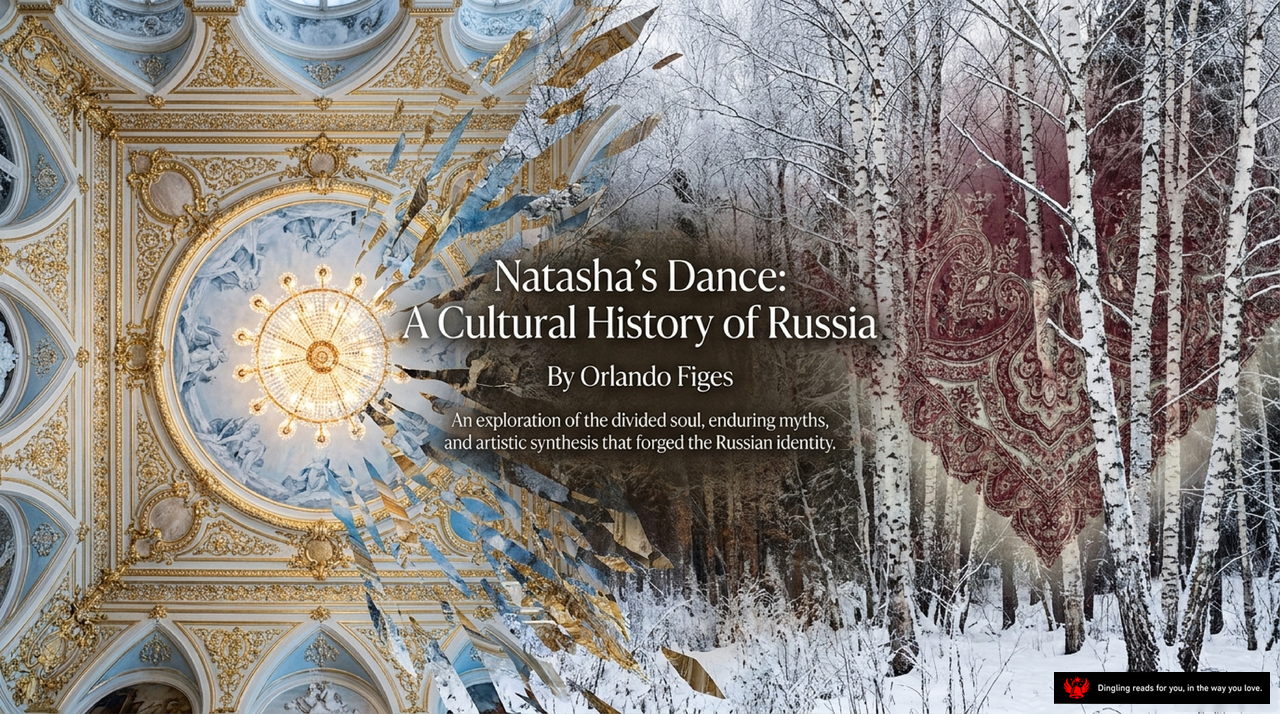
Welcome everyone. Today we're diving into a book that feels like a mirror to Russia itself. Orlando Figes wrote Natasha's Dance: A Cultural History of Russia. Look at the cover. It presents a striking split. On the left, you see the opulent, golden architecture of the Europeanized north. On the right, the stark birch forest and traditional patterns of the wild south. This visual perfectly matches the subtitle's promise: an exploration of the divided soul. Figes shows us how enduring myths and artistic synthesis forged the Russian identity from this tension. We're going to unpack how Russia became the complex country we know today. Let's get started.
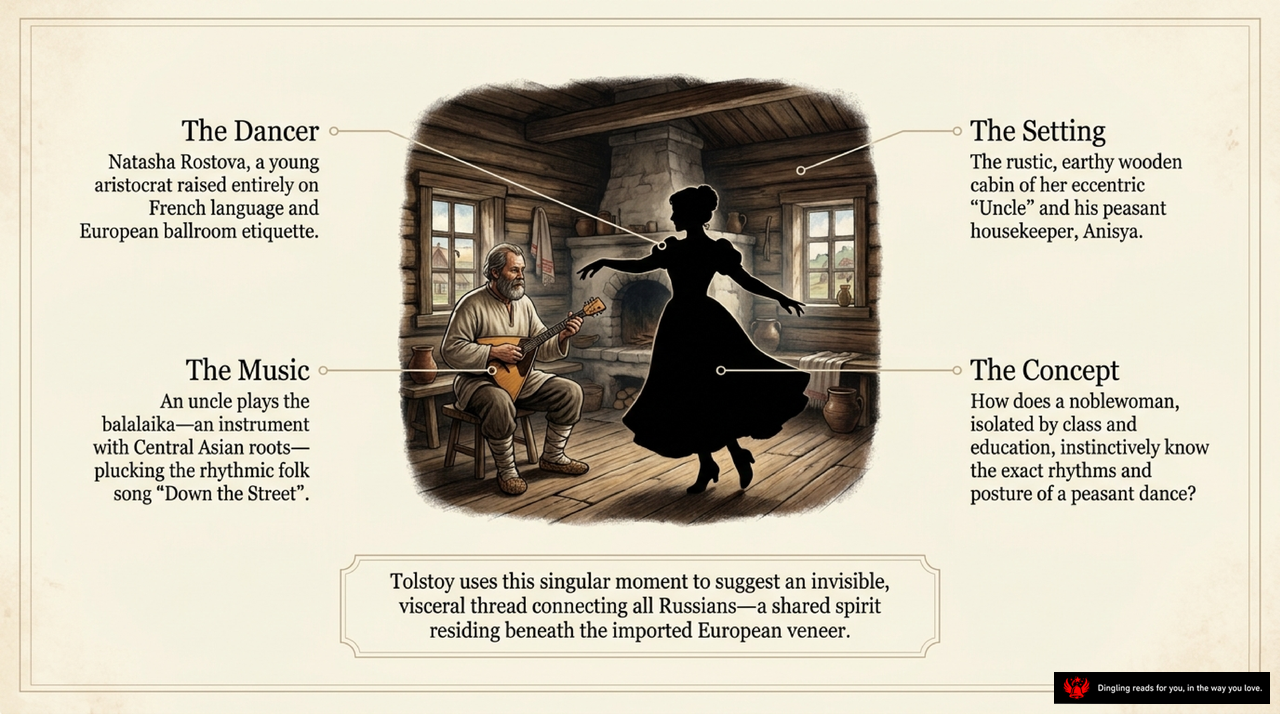
Check out this image. We see Natasha Rostova, a young aristocrat raised entirely on French language and European ballroom etiquette. She's dancing in the rustic, earthy wooden cabin of her eccentric Uncle, with her peasant housekeeper Anisya nearby. The music comes from an Uncle playing the balalaika, an instrument with Central Asian roots, plucking the rhythmic folk song "Down the Street".
Here's the fascinating question: How does a noblewoman, isolated by class and education, instinctively know the exact rhythms and posture of a peasant dance?
This isn't just a dance; it's a clue to the Russian soul. The text explains that this moment suggests an invisible, visceral thread connecting all Russians—a shared spirit residing beneath the imported European veneer.
Back in the 18th century, the Russian nobility was obsessed with becoming European. Peter the Great wanted to turn Russia into a modern European state, so they built palaces like the Shcheremetev Fountain Palace, imported furniture, and spoke French. They wanted to completely discard Moscow's old traditions. Yet, even in these palaces, the old Russian traces were hard to hide. Surface Europeanization, inner roots in Russian soil—this split personality became a deep theme in later Russian literature. On the surface, they were European gentlemen; inside, they were still rooted in the Russian earth.
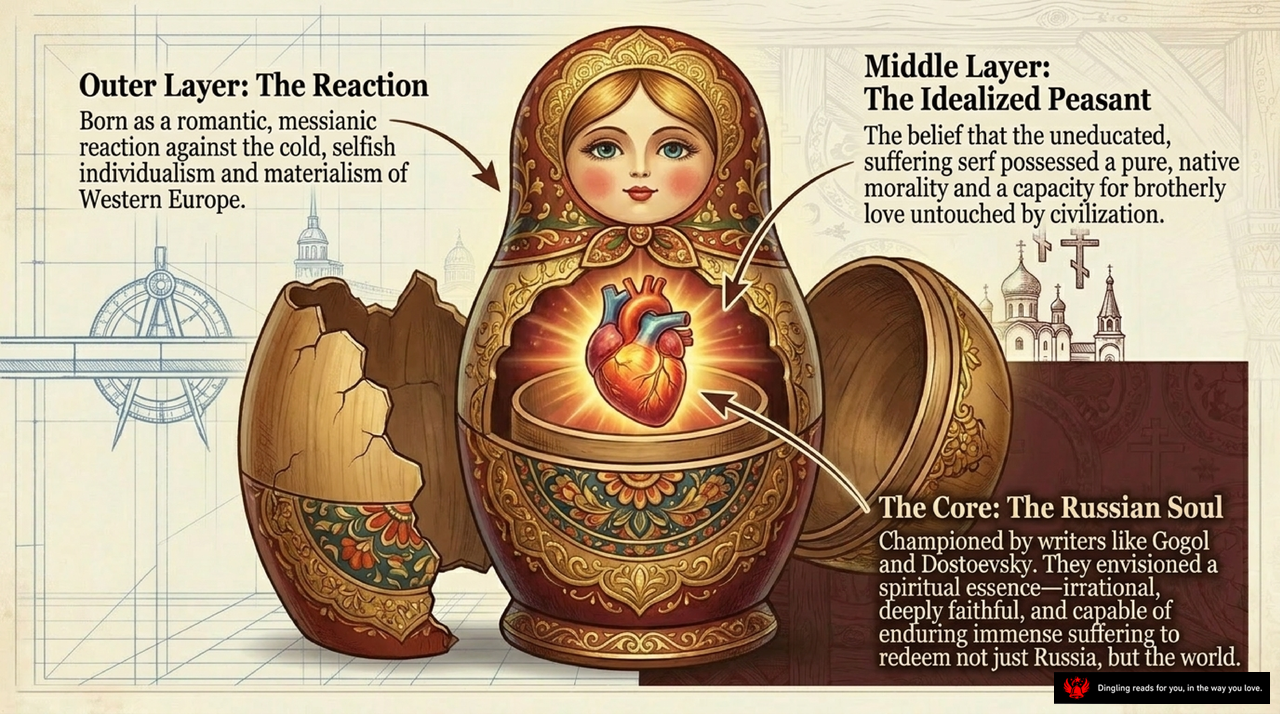
Tolstoy understood this duality better than anyone. He saw that despite the "European" education and the "imported" culture, the Russian spirit remained. This tension between the "European" and the "Russian" became the core theme of Russian literature. Dostoevsky and Tolstoy both struggled with this. They saw the "European" education as a mask, while the "Russian soul"—with its mix of faith, suffering, and communal spirit—was the true core.
Even Natasha, though educated in Europe, her body knew the Russian rhythm. It's a reminder that no matter how much you try to change, the culture you're born into leaves a mark.
This invisible thread is what makes the Russian experience so unique. It's a constant struggle between the desire to be European and the undeniable pull of the native land. Tolstoy understood that this duality isn't a weakness; it's the very heart of the Russian spirit. It's the reason why their art feels so intense, so deeply emotional, and so universally resonant. It's the "Russian Soul" at work, connecting the aristocrat to the peasant, the city to the village, and the past to the future.
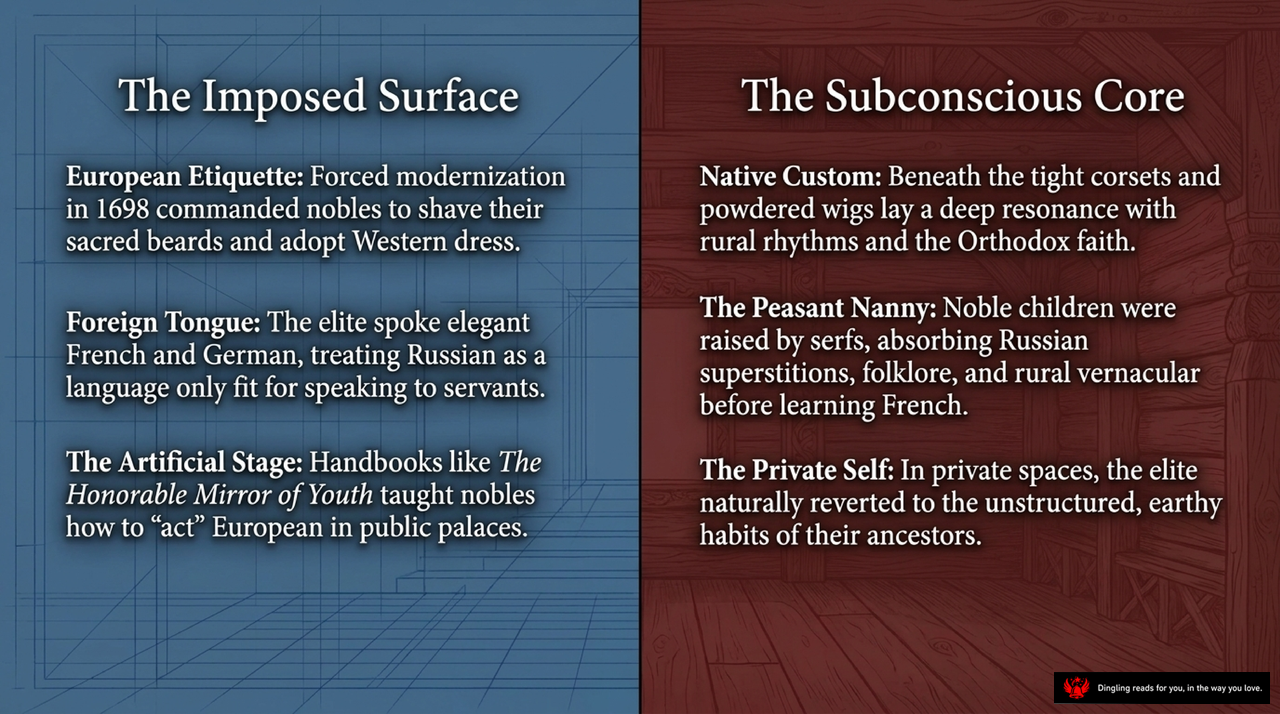
Let's dive into Slide 2. This image perfectly captures the psychological duality of the Russian elite during the 18th and 19th centuries. It's a visual metaphor for a nation torn between two worlds.
On the left, we have 'The Imposed Surface.' This was the mask the nobility wore to satisfy the West. Following Peter the Great's 1698 decree, they were forced to shave their sacred beards and adopt Western dress. They spoke elegant French and German, treating Russian as a language only fit for speaking to servants. To maintain this image, they relied on handbooks like *The Honorable Mirror of Youth* to teach them how to 'act' European in public palaces. It was a performance.
But look at the right side: 'The Subconscious Core.' Beneath the tight corsets and powdered wigs lay a deep resonance with rural rhythms and the Orthodox faith. Noble children were often raised by peasant nannies. Before they ever learned French, they absorbed Russian superstitions, folklore, and rural vernacular. In private spaces, the elite naturally reverted to the unstructured, earthy habits of their ancestors.
This created a fascinating split personality. Publicly, they were sophisticated Europeans. Privately, they were still rooted in the soil. This tension—between the artificial stage of the palace and the authentic self of the village—became a profound theme in Russian literature. It explains why Russian writers like Dostoevsky and Tolstoy were so obsessed with the 'Russian soul.' They were searching for that core beneath the surface, trying to reconcile the Western mask with the native heart. It wasn't just a cultural conflict; it was an internal one.
Think about the cost of this performance. The nobility built palaces like the Fountain Palace, filled with imported art, but this luxury was built on the sweat of serfs. Yet, even in these opulent homes, the nobles would retreat to private spaces with warm stoves and traditional saunas. They were living a lie on the outside while holding onto their true identity on the inside. This duality wasn't just a historical curiosity; it defined the very soul of Russian culture. It's a story of a people who learned to speak a foreign language while dreaming in their own, forever balancing between the European stage and the Russian stage.
Welcome to the heart of Russian identity. If you want to understand Russia, you have to understand its two souls: St. Petersburg and Moscow.
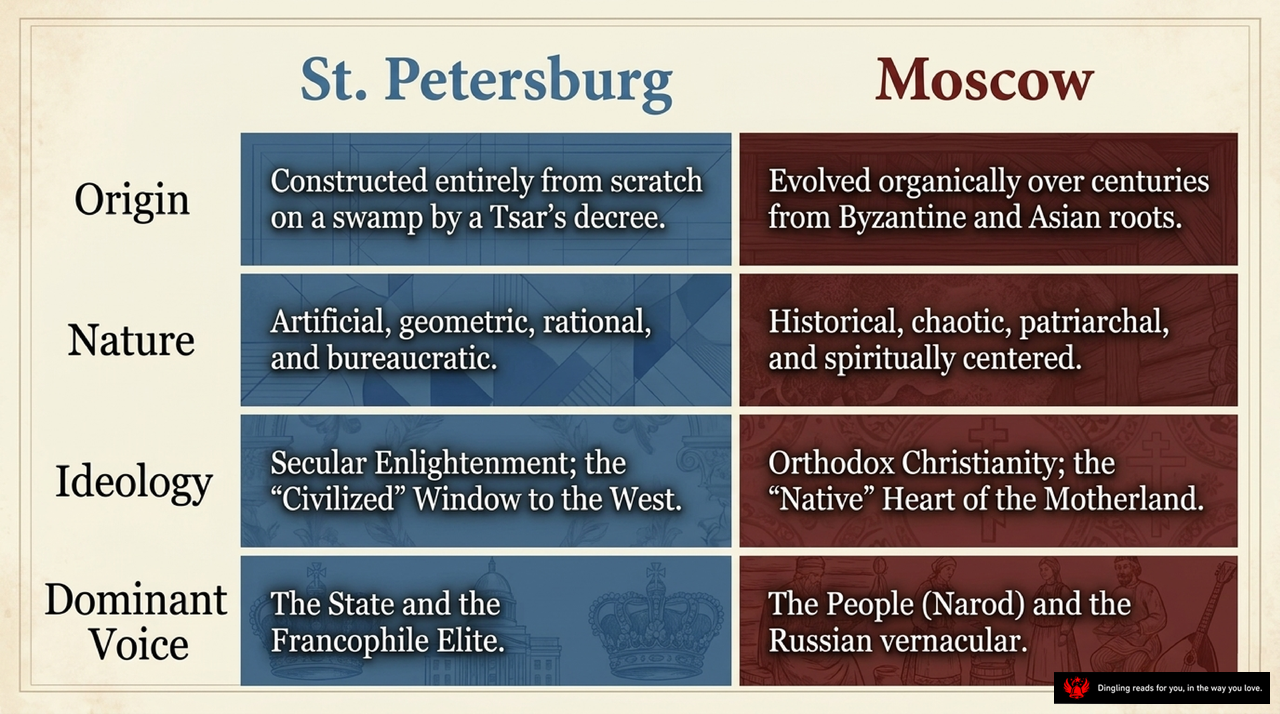
Look at this slide. It lays out the fundamental clash between them. On the left, St. Petersburg. On the right, Moscow.
St. Petersburg is the city of ambition. As the text tells us, it was "constructed entirely from scratch on a swamp by a Tsar's decree." Peter the Great didn't just find a city; he built one. He wanted a "window to the West." So, it became "artificial, geometric, rational, and bureaucratic." It was designed to look like Amsterdam or Venice, a modern European capital. Its dominant voice was "the State and the Francophile Elite." It was about order, Enlightenment, and mimicking Europe. The elite there spoke French, dressed European, and treated the city like a grand stage. They spent fortunes on imported art and fashion, creating a "civilized" facade that often felt cold and alien to the locals. It was the "Civilized" Window to the West, but often a mask for a rigid bureaucracy.
Now, look at the right side. Moscow. This is the "native heart." It "evolved organically over centuries from Byzantine and Asian roots." It wasn't built; it grew. It's described as "historical, chaotic, patriarchal, and spiritually centered." While St. Petersburg looked outward to the West, Moscow looked inward to the Orthodox faith and the "Russian vernacular." Its voice was "the People," the common folk, and the deep traditions of the countryside. It was the place where the "Motherland" lived. It was the "Native" Heart of the Motherland, often suppressed by the State.
This isn't just geography; it's a psychological split. St. Petersburg was the "head"—the rational, cold, bureaucratic mind. Moscow was the "heart"—the warm, chaotic, spiritual soul.
Throughout Russian history, these two cities fought for dominance. The elite in St. Petersburg often looked down on the "chaos" of Moscow, while the people in Moscow felt the "state" of St. Petersburg was alien and cold. This tension—between the "civilized" West and the "native" East, between the State and the People—created the deep cultural conflict that you see in everything from Tolstoy's novels to the Russian Revolution.
So, when you read about Russia, remember: there are two cities, and they are constantly arguing about what it means to be Russian.
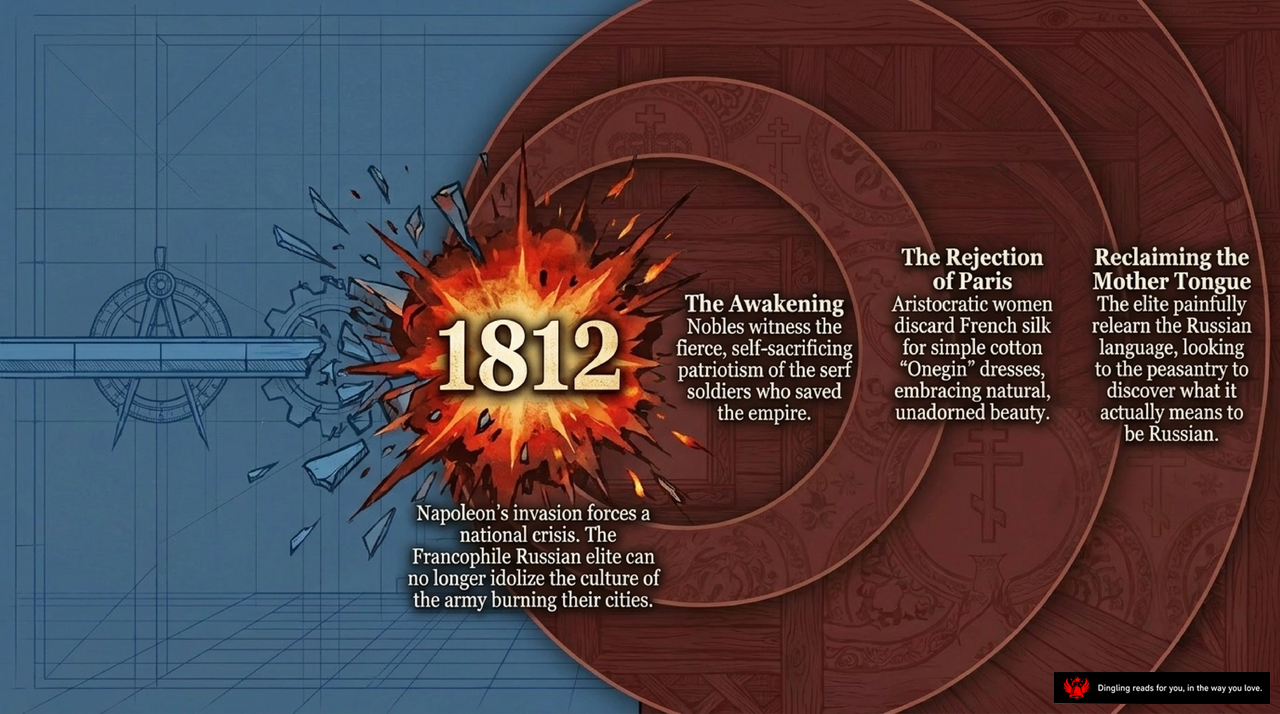
1812. Look at that explosion. It wasn't just a battle; it was a national rebirth. Napoleon's invasion forced a national crisis. The Francophile Russian elite, who had spent decades idolizing Parisian culture, suddenly found themselves on the wrong side of history. The French army was burning their cities, while the 'backward' serf soldiers were saving the empire.
This moment triggered a profound cultural awakening. Take the Duke of Volkonsky, a nobleman who fought alongside these peasants. He realized that the true patriots weren't the aristocrats, but the common people. This realization shattered the old hierarchy and sparked democratic thoughts among the officers.
Culturally, it was a total rejection of Paris. Aristocratic women, once draped in French silk, started discarding it for simple cotton 'Onegin' dresses. They embraced natural, unadorned beauty. It wasn't just fashion; it was a statement. They stopped speaking French in their salons. They painfully relearned the Russian language, looking to the peasantry to discover what it actually meant to be Russian. In fact, some families banned French entirely, with fines for speaking it. At first, they couldn't even find the word for 'fine' in Russian, so they used a French substitute. But eventually, they embraced the vernacular. Before the war, thinking in French was the norm. Afterward, they had to learn to think in Russian.
This shift reached the arts. Pushkin's 'Eugene Onegin' became a symbol of this new identity. The elite realized they couldn't continue to look west for answers. They had to turn inward. They began hunting in the countryside with their serf hunters, living in simple wooden villas, and cooking mushroom tea. They were reclaiming their roots.
This 1812 turning point is why Russian literature is so powerful. It wasn't just about writing; it was about finding a soul that had been lost. The crisis of 1812 created the foundation for a true Russian national consciousness, moving from a colonial imitation of Europe to a confident expression of their own heritage. This is the moment Russia found its voice.
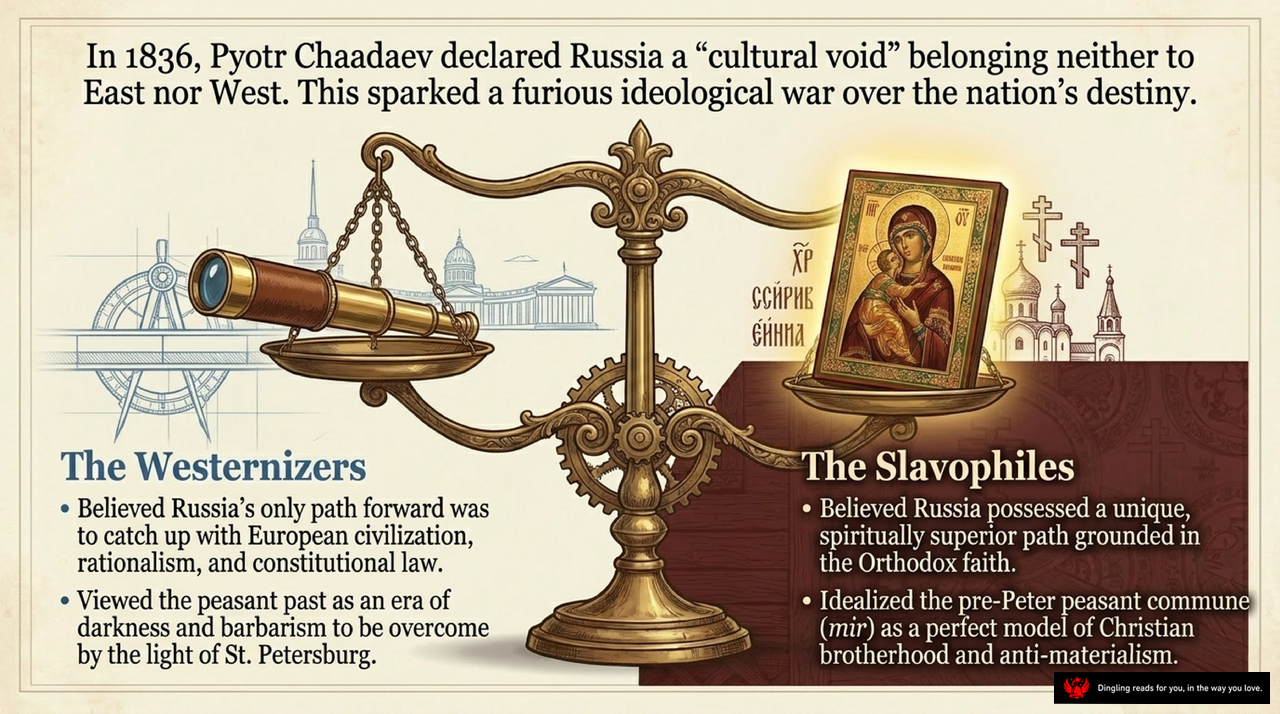
Look at this scale. It perfectly captures the defining struggle of Russian identity. In 1836, Pyotr Chaadaev declared Russia a "cultural void" belonging neither to the East nor the West. This statement didn't just spark a debate; it ignited a furious ideological war over the nation's destiny that would echo for centuries.
On the left side of this balance, you see the Westernizers. They were the visionaries with the telescope, looking toward Europe. They believed Russia's only path forward was to catch up with European civilization, embracing rationalism and constitutional law. To them, the peasant past was an era of darkness and barbarism that needed to be overcome by the bright light of St. Petersburg. This city, built by Peter the Great as a European window to the world, became the symbol of this ambition. They wanted to build a modern European state, even if it meant sacrificing the old traditions of Moscow and treating the peasant past as something to erase.
But on the right side, the Slavophiles stood firm. They held the icon and the Orthodox crosses, representing a different truth. They believed Russia possessed a unique, spiritually superior path grounded in the Orthodox faith. Unlike the Westernizers, they didn't see the peasant past as something to erase. Instead, they idealized the pre-Peter peasant commune, the mir, as a perfect model of Christian brotherhood and anti-materialism. They argued that Russia's soul was distinct from Europe's, rooted in a spiritual community that Europe lacked.
This conflict wasn't just about politics; it was about the very definition of what it meant to be Russian. One side wanted to become Europe, the other wanted to define a unique Russian soul based on faith and tradition. This tension created the deep cultural split we see in Russian literature and history today. It's the reason why Russian culture often feels so contradictory—caught between the desire for Western progress and the pull of its own spiritual roots. It created a split personality, where the surface was European but the heart remained Russian. This painful struggle for identity fueled the 19th-century literary explosion, as writers like Tolstoy and Dostoevsky wrestled with these very questions. This debate, sparked by Chaadaev, shaped everything from the art of the 19th century to the very soul of the Russian people, leaving a legacy that still resonates today.
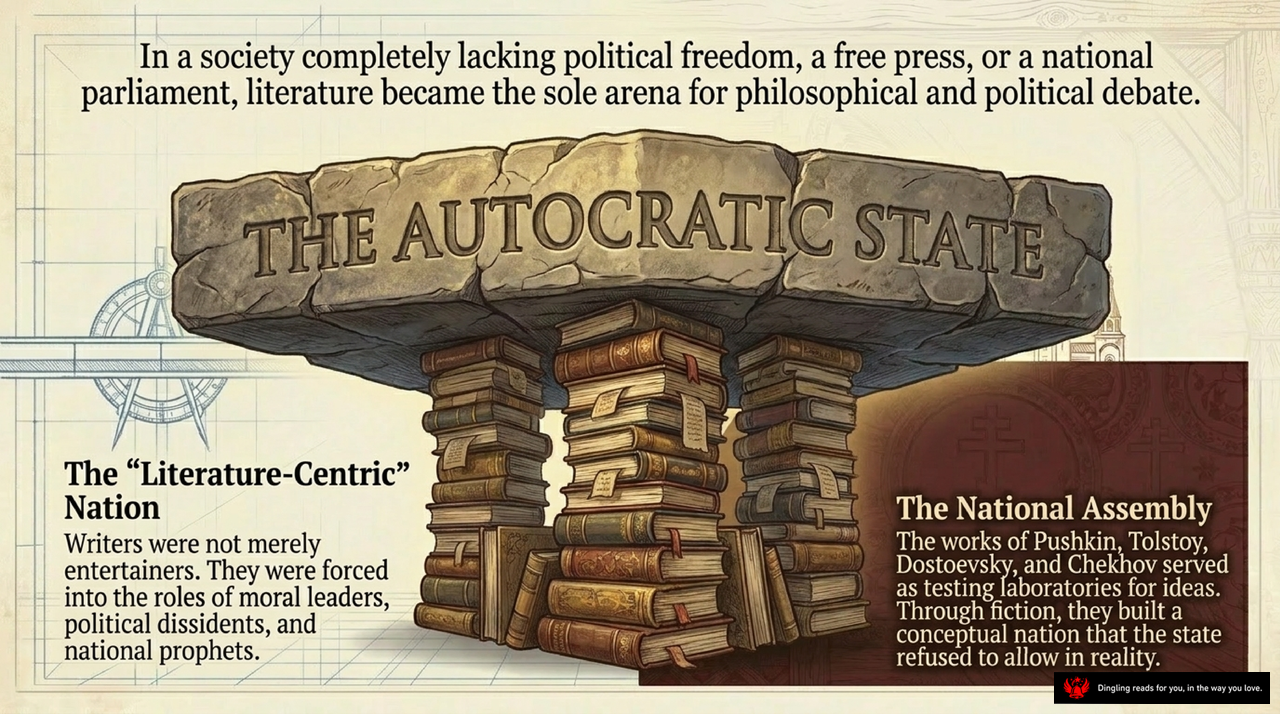
Take a look at this image. It captures a defining moment in Russian history: The Autocratic State. Imagine a society completely lacking political freedom, without a free press or a national parliament. In such an environment, where you couldn't speak out openly, where did ideas go? Literature became the sole arena for philosophical and political debate. This was the only place where truth could be spoken, even if it was disguised as fiction.
This is what we call The 'Literature-Centric' Nation. Writers were not merely entertainers. They were forced into the roles of moral leaders, political dissidents, and national prophets. Think about the pressure they were under. They had to navigate a system that demanded obedience, yet they used their stories to challenge it. They couldn't publish newspapers, so they published novels that asked the hard questions. They became the voice of the voiceless, carrying the weight of the nation's conscience on their shoulders.
Look at the right side of the slide. It mentions The National Assembly. The works of Pushkin, Tolstoy, Dostoevsky, and Chekhov served as testing laboratories for ideas. Through fiction, they built a conceptual nation that the state refused to allow in reality. This is why their work resonated so deeply. It wasn't just about storytelling; it was about survival and truth. They created a space where the Russian soul could be explored without the fear of censorship.
Consider the context of the 18th and 19th centuries. Peter the Great built St. Petersburg as a window to Europe, but the state remained autocratic. Writers like Pushkin and Gogol had to write between the lines. Later, Tolstoy and Dostoevsky took this further, exploring the soul of the nation. Chekhov showed the quiet suffering of ordinary people. They didn't have a stage to stand on, so they used the page.
This created a unique cultural dynamic. The state wanted control, but literature became the invisible parliament. Writers became the conscience of the nation. When the state tried to silence them, literature became even more powerful. This struggle is what makes Russian literature so intense. It wasn't just art; it was a lifeline for the people's spirit.
Think about Dostoevsky. He explored the depths of human suffering and faith. Tolstoy questioned the meaning of life and the role of the individual. Chekhov showed the banality of evil in everyday life. They were testing the limits of the human condition.
So, when we talk about the Autocratic State, remember that the books were the weapons, and the writers were the generals. They created a Russia that existed in the imagination, even when it was denied in reality. This is the legacy of the Autocratic State: a nation that found its freedom not in laws, but in literature.
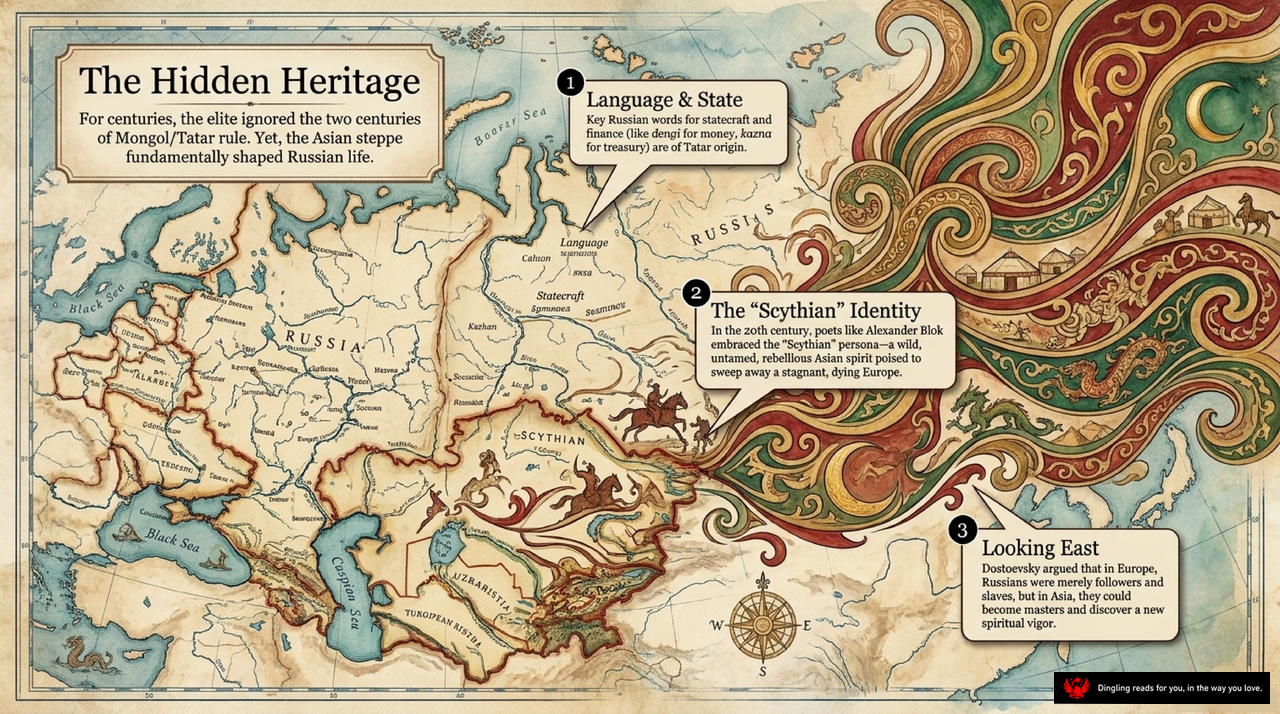
Let's look at this map. It tells a story that most Westerners ignore: The Hidden Heritage. For centuries, the Russian elite ignored the two centuries of Mongol and Tatar rule. They wanted to be purely European. Yet, the Asian steppe fundamentally shaped Russian life.
Let's start with the first point: Language and State. It's fascinating that key Russian words for statecraft and finance, like "dengi" for money and "kazna" for treasury, are actually of Tatar origin. It's not just vocabulary; the very structure of their administration came from the Mongols. It's as if there's a Tatar under the skin of every Russian, as Napoleon once famously said. This isn't just history; it's DNA. The bureaucracy, the tax systems, the very way the state was run, was borrowed from the conquerors, not the West. This means that even the way they govern is deeply rooted in the East.
Next, look at the second point: The "Scythian" Identity. This wasn't just history; it became a cultural myth. In the 20th century, poets like Alexander Blok embraced the "Scythian" persona. They didn't see themselves as tame Europeans. They saw themselves as wild, untamed, rebellious Asian spirits poised to sweep away a stagnant, dying Europe. It was a way to reclaim their power and identity. They wanted to be the masters of the steppe, not the servants of the court. This identity was a rebellion against the rigid, cold order of the West. Look at the dragons and horses on the right side of the map—they represent this wild, untamed spirit.
Finally, the third point: Looking East. Dostoevsky captured this tension perfectly. He argued that in Europe, Russians were merely followers and slaves. But in Asia, they could become masters and discover a new spiritual vigor. He believed that to find their true soul, they had to look East, not just West. This wasn't just about geography; it was about the spirit.
So, while Russia built its capital in the West, its spirit was forged in the East. This hidden heritage is the reason why Russian culture feels so unique, so intense, and so different from its Western neighbors. It's a constant tension between being a follower of Europe and a master of Asia. This duality is what makes the Russian soul so complex.
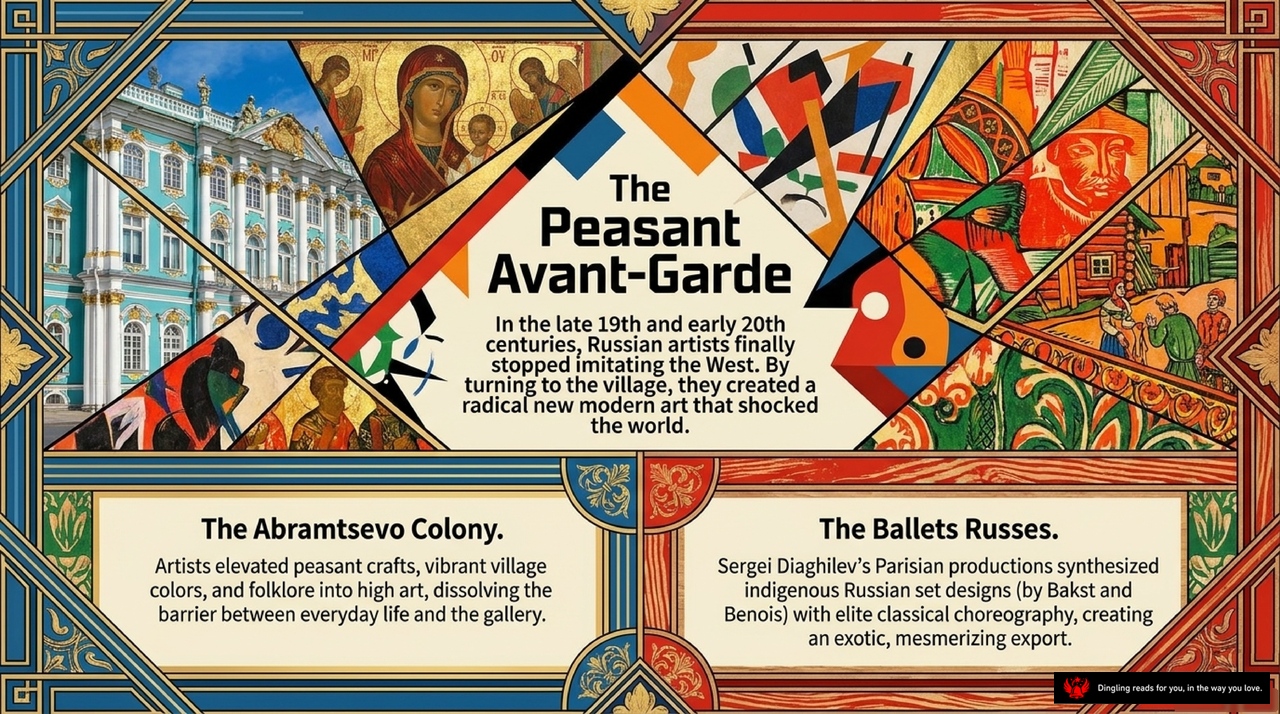
So, picture this: in the late 19th and early 20th centuries, Russian artists finally stopped imitating the West. For decades, they copied European styles, but then they turned their eyes to the village. By looking inward, they created a radical new modern art that absolutely shocked the world. It wasn't just a style change; it was a cultural revolution.
Let’s start with the Abramtsevo Colony. Think of this as a creative village where artists and craftsmen lived together. They didn't treat peasant crafts as something lowly; instead, they elevated them into high art. They took those vibrant village colors and folklore and put them on the same level as gallery art. Artists like Elena Polenova went deep into the countryside, collecting designs from wooden windows and household items. They weren't just copying old patterns; they were revitalizing them, creating a unique aesthetic that felt both ancient and modern. This movement dissolved the wall between daily life and the museum, making art something you could touch and feel.
But the real global explosion came with the Ballets Russes. Sergei Diaghilev took this indigenous Russian culture and packaged it for Paris. He synthesized set designs by masters like Bakst and Benois with elite classical choreography. It was exotic and mesmerizing, totally new to Paris audiences. Diaghilev was a visionary who understood the East was the new frontier for Western audiences. He brought composers like Stravinsky into the fold. First, they staged The Firebird, which was a massive hit. Then came The Rite of Spring. That 1913 premiere in Paris was legendary for its chaos—ugly movements, irregular drumming—but it became the defining moment of 20th-century innovation.
The impact was immediate. Western artists scrambled to understand this new style. It wasn't just about art; it was about identity. By looking inward at their own roots, Russian artists created an export that changed global culture. They proved that their heritage wasn't something to hide, but something to showcase. It was a moment where the village became the avant-garde, and Russia finally had a voice that resonated everywhere. This shift from copying to creating is why this era remains so important today.
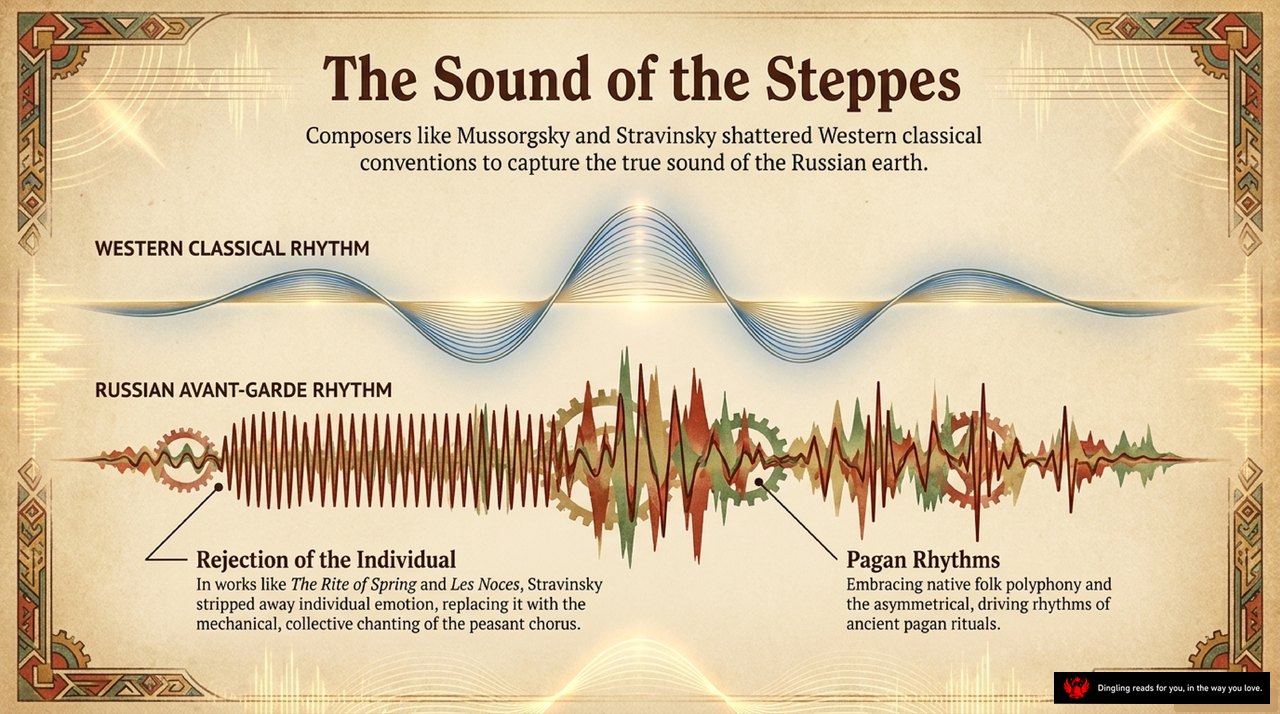
Welcome to the sound of the steppes. Imagine the vast, open plains of Russia. For centuries, Western classical music was all about smooth, predictable waves. It was elegant, but often distant. But Russian composers like Mussorgsky and Stravinsky wanted something different. They wanted to capture the true heartbeat of the Russian earth.
Look at this comparison on the screen. The top wave represents Western classical rhythm—ordered, symmetrical, and focused on the individual. But the bottom wave? That's the Russian avant-garde. It's jagged, irregular, and mechanical. It sounds like the wind blowing across the grass or the heavy boots marching on the frozen ground. It's not about perfection; it's about the raw pulse of life.
Stravinsky was a pioneer in this shift. In works like *The Rite of Spring* and *Les Noces*, he didn't just write music; he wrote the sound of a community. He stripped away the individual emotion that Western composers prized. Instead, he replaced it with the mechanical, collective chanting of the peasant chorus. It wasn't about one soloist shining; it was about the group moving as one force. It was a deliberate rejection of the individual ego.
He also embraced what we call pagan rhythms. Think about the ancient rituals of the steppes. There was no strict meter. The music was asymmetrical and driving, based on the rhythms of folk polyphony and ancient pagan ceremonies. It was raw and unpolished, which actually made it more powerful to a Western audience who were used to perfection.
This wasn't just about music; it was about identity. These composers rejected the European mold and dug deep into their own roots. They took the chaotic, beautiful noise of the Russian countryside and turned it into art. They drew inspiration from village songs and church chants, even mimicking the sound of church bells. Stravinsky later took this further with *The Wedding*, using mechanical ensemble and collective choreography to recreate the spirit of Russian peasants. It was a return to the source. This sound became the signature of 20th-century Russian art, loud, bold, and unmistakably Russian. It wasn't just music; it was a declaration of who they were, distinct from the West, rooted in the soil of their homeland. By shattering the conventions of the past, they gave the world a new voice, one that spoke directly from the steppes.

Look at this split image. On the left, you see the State Construct, gears and heavy industry, a machine of the state. On the right, there is the Subconscious Survival, glowing icons, the old soul. This perfectly captures the tension of the Soviet era.
The book tells us that after the 1917 Revolution, the state did not just change the government; it tried to change the people themselves. They wanted to forge a Soviet Culture, a mobilized mass culture designed to permanently erase the Europeanized elite. They were engineering a New Soviet Man. Think about the Constructivists mentioned in the text. They designed worker uniforms and furniture, trying to build a new proletarian civilization. It was a massive attempt to strip away the past and build a machine of ideology. Even the film industry was weaponized. Lenin saw cinema as the most important propaganda tool because so many could not read. He wanted to reach the masses where books failed.
But here is where the image gets powerful. The state thought they could wipe out the old world, but they underestimated the Subconscious Survival. The text notes that the old Russianness could not be entirely eradicated. It persisted beneath the red surface. The state tried to manufacture Synthetic Folk art, stripping peasant art of its soul to serve propaganda, but the real spirit hid underground. It was not just politics; it was about the soul. The state tried to control every story, but the people kept their myths alive in secret.
This is where we see the genius of filmmakers like Andrei Tarkovsky. As the book highlights, he used the medium to preserve ancient spiritual and communal myths. While the state demanded rational materialism, Tarkovsky's films like Solaris and Stalker turned space exploration into a search for self, love, and faith. He kept the spiritual fire alive even when the state tried to freeze it. So, while the gears of the state tried to crush the icons, the icons kept glowing in the dark. That is the true story. The machine could build, but it could not fully own the human heart.
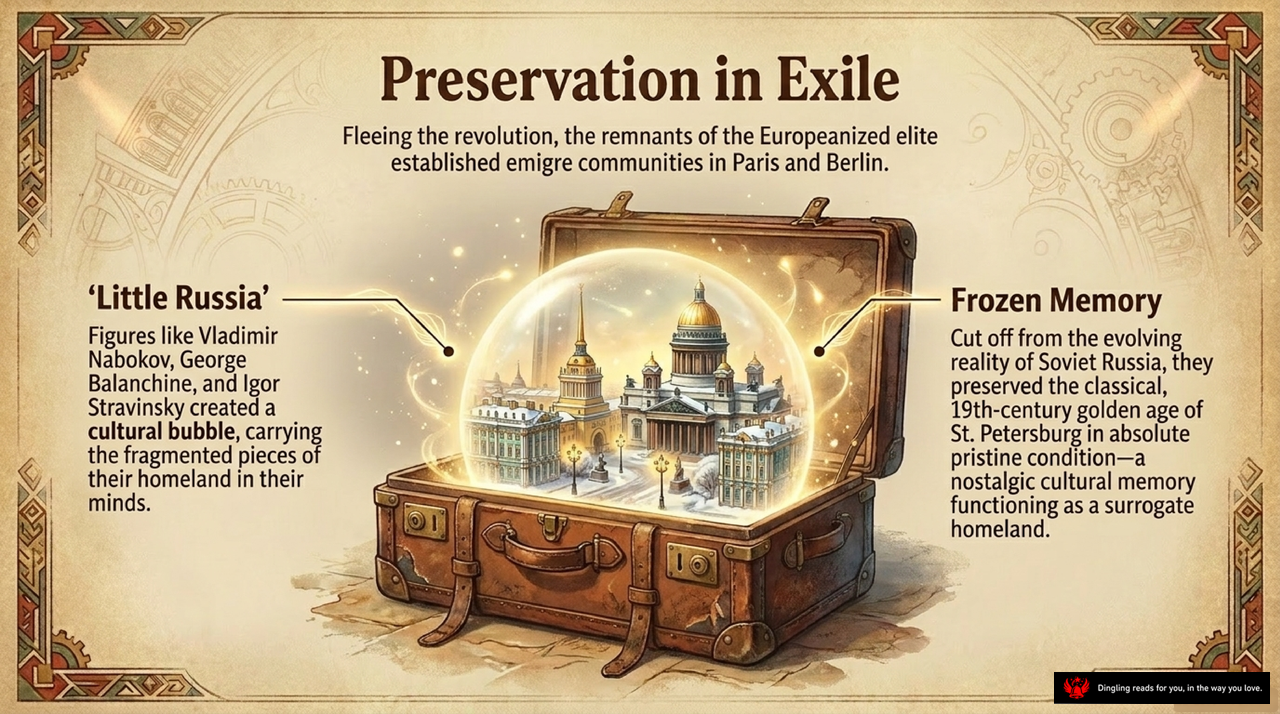
Picture this: an old, worn suitcase sitting open on a floor. Inside isn't just clothes, but a glowing snow globe of St. Petersburg. This image perfectly captures the life of the Russian emigres. When the revolution tore through their society, the remnants of the Europeanized elite didn't just vanish. They fled to Paris and Berlin, but they didn't leave their culture behind.
In those cities, they established emigre communities that became known as "Little Russia." Think of the giants among them: Vladimir Nabokov, George Balanchine, and Igor Stravinsky. These weren't just refugees; they were the architects of a new cultural bubble. They carried the fragmented pieces of their homeland in their minds, reconstructing a world that no longer existed physically.
But this wasn't just about memory; it was about preservation. Cut off from the evolving, often brutal reality of Soviet Russia, they chose to preserve the classical, 19th-century golden age of St. Petersburg in absolute pristine condition. It became a "frozen memory," a nostalgic cultural memory functioning as a surrogate homeland. They refused to let the new Soviet modernism erase the old traditions.
Stravinsky, for example, might have adapted his music for Western audiences, turning to neoclassicism, but he kept the Russian soul intact. Balanchine took the St. Petersburg ballet tradition to America, ensuring the art survived. Even Nabokov, writing in English, kept the Russian language and spirit alive in his fiction.
The suitcase in the image represents this portable culture. It wasn't just a bag for luggage; it was a vessel for their identity. They proved that a culture can survive even when its land cannot. For these exiles, the suitcase was the only thing that mattered, because it held the entire world they had left behind. They turned their exile into a museum, preserving a civilization that the revolution tried to destroy. In a way, they were the keepers of the flame, ensuring that the light of Russian culture wouldn't be extinguished by the darkness of the new world.
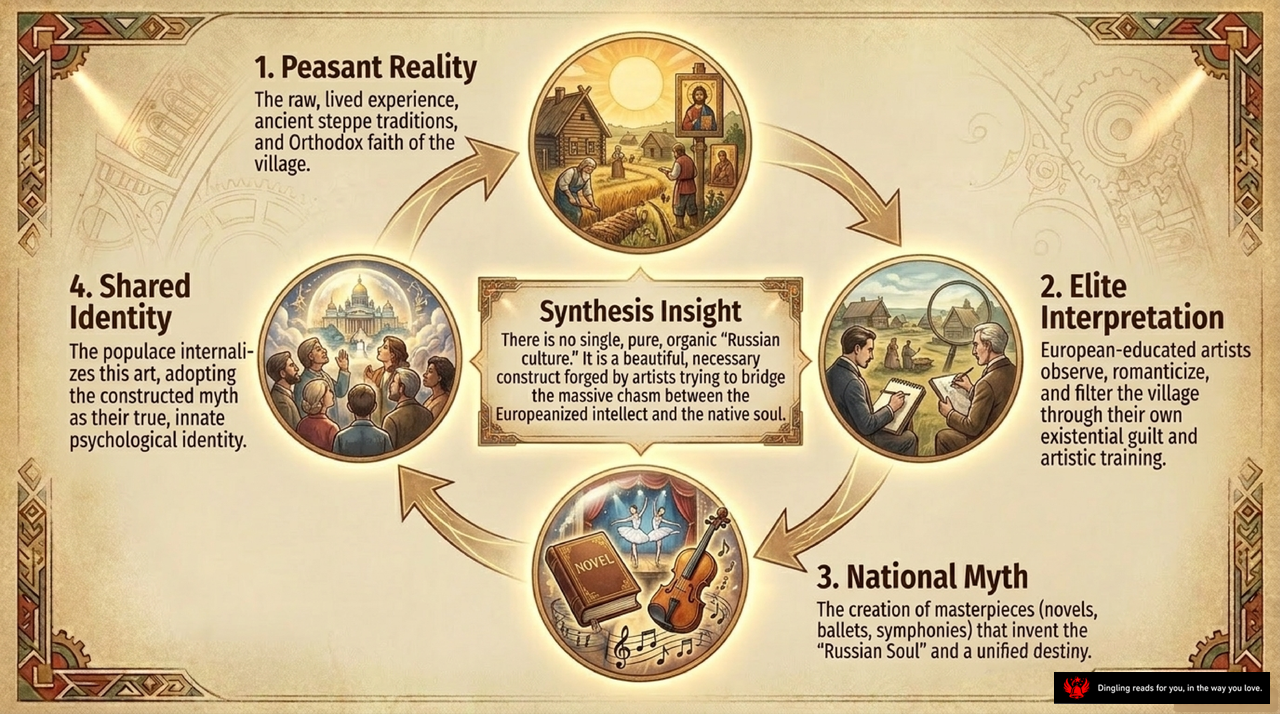
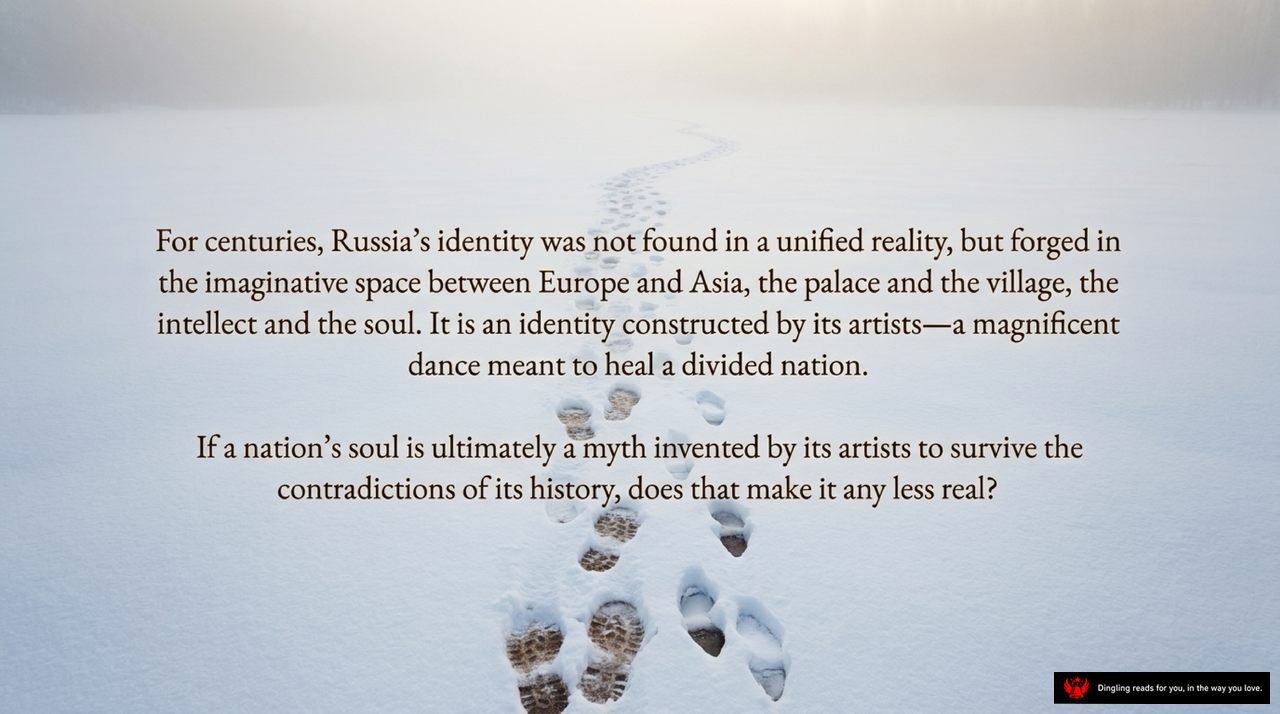
Look at these footprints. They disappear into the snow, just like the clear path of a national identity. But here is the thing about Russia: it never had a single, unified reality to walk on. Instead, for centuries, its identity was forged in an imaginative space between two worlds—Europe and Asia, the palace and the village, the intellect and the soul.
Think about it. You have St. Petersburg, built by Peter the Great as a European capital, modeled after Amsterdam and Venice. It was a city of glass and ice, designed to look like the West. But right underneath that, you have the vast, frozen steppe, the legacy of the Mongols and Tatars. Napoleon once said that a Tartar sleeps under every Russian's skin. It’s a physical reality, but it’s also a cultural tension.
This isn't just geography; it's a story written by artists. Dostoevsky, for instance, believed that the Russian soul was like a diamond buried in the mud. He argued that beneath the peasant's rough exterior lay a deep Christian spirit. Tolstoy tried to live like a peasant, and the writers of the 19th century tried to blend the European romanticism with the Russian folk tales. They were constructing a myth to heal a nation that felt divided between its Western ambitions and its Eastern roots.
So, we have this question on the screen: If a nation's soul is ultimately a myth invented by its artists to survive the contradictions of its history, does that make it any less real?
Consider the emigres who fled the revolution. They carried a "cultural Russia" in their pockets—memories of the snow in Moscow, the sound of the church bells in St. Petersburg. They created an "inner Russia" that was more real to them than the physical land they left behind. And look at the Soviet era, where artists like Stravinsky and Shostakovich used folk music and tragedy to speak a truth that the state couldn't silence.
The footprints in the snow are the proof. The identity might be a story we tell ourselves to make sense of the chaos, but when millions of people feel it, when they sing it, and when they bleed for it, does the story stop being real? In Russia, the answer is always a resounding yes. The myth is the only thing that kept them walking forward.