
New Structural Economics: Complete Chapter-by-Chapter Summary

Welcome to a new era in economic thinking. Today, we introduce "New Structural Economics" by Justin Yifu Lin. This isn't just another theory; it's a practical blueprint for sustainable growth. Imagine the global economy as a complex architectural project, where every nation needs a unique design based on its own resources, not a copy of a richer neighbor's blueprint.
The core idea is simple yet powerful: your economy's structure is determined by what you have—your land, labor, and capital. Poorer nations, rich in labor but poor in capital, should focus on labor-intensive industries. Wealthier nations, with abundant capital, should lead in capital-intensive sectors. This alignment creates a competitive advantage, allowing businesses to thrive naturally without constant government bailouts.
But markets alone aren't enough. While they allocate resources efficiently, they struggle with coordination and innovation risks. That's where the government steps in—not to pick winners, but to guide them. Think of the state as a skilled architect providing the necessary infrastructure, sharing vital information, and compensating early pioneers who take the risks. This partnership between market forces and strategic government support is the key to unlocking long-term growth and lifting millions out of poverty.
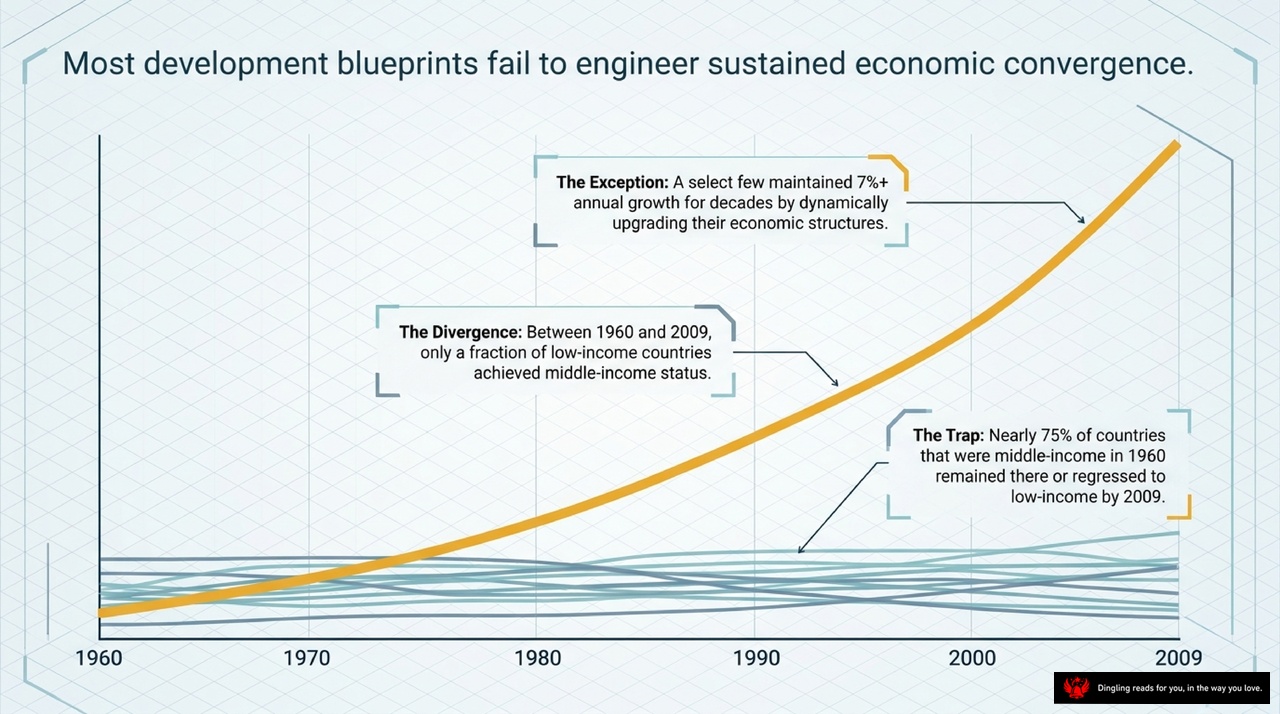
Most development blueprints simply fail to engineer sustained economic convergence. Look at this graph: from 1960 to 2009, the story is one of stark divergence. While a select few nations maintained 7%+ annual growth by dynamically upgrading their economic structures, nearly 75% of countries that were middle-income in 1960 either remained stuck or regressed to low-income status by 2009. Only a tiny fraction of low-income countries managed to achieve middle-income status.
Why does this happen? The core issue is structural transformation. Successful growth requires moving from agriculture and traditional sectors into manufacturing and modern industries. However, most developing nations lack the motivation for this shift. As the data shows, in many poor regions, a vast majority of the workforce remains trapped in agriculture, while manufacturing shares have actually declined over decades. This stagnation prevents the capital accumulation necessary for upgrading.
The lesson is clear: sustainable growth isn't about copying a blueprint. It's about following your comparative advantage. When countries ignore their current factor endowments—like labor abundance versus capital scarcity—and try to leapfrog into capital-intensive industries too early, their firms lack self-generating ability. They fail, and the economy stalls. Conversely, by starting with labor-intensive industries that match their resources, nations can accumulate capital, upgrade their structure, and naturally progress to higher-value industries. This dynamic process, driven by market forces and guided by smart government coordination, is the only path to lasting convergence.

Economic thought has evolved from rigid state control to a synthesized structural approach, moving through three distinct phases. On the left, we see Old Structuralism, rooted in import substitution. Its core logic was to defy comparative advantage to rapidly industrialize, relying on heavy state intervention to protect unviable, capital-intensive firms. While ambitious, this approach led to rent-seeking, market distortion, and eventual stagnation.
In the center lies the Washington Consensus, representing the neoliberal turn. Here, the state's role shrinks to minimal levels, ignoring structural differences between rich and poor nations. The belief was that spontaneous growth would emerge through privatization and liberalization. However, the result was frequent crises and a failure to generate true structural transformation.
Finally, on the right, we arrive at New Structural Economics—the synthesis. This framework argues that endogenous structural upgrading must be based on changing factor endowments. Instead of forcing a specific path, the state acts as a facilitator of coordination and infrastructure, letting the market remain the fundamental allocator. By following this logic, economies can achieve sustainable, dynamic, and inclusive growth, bridging the gap between the rigid controls of the past and the unregulated chaos of the middle era.
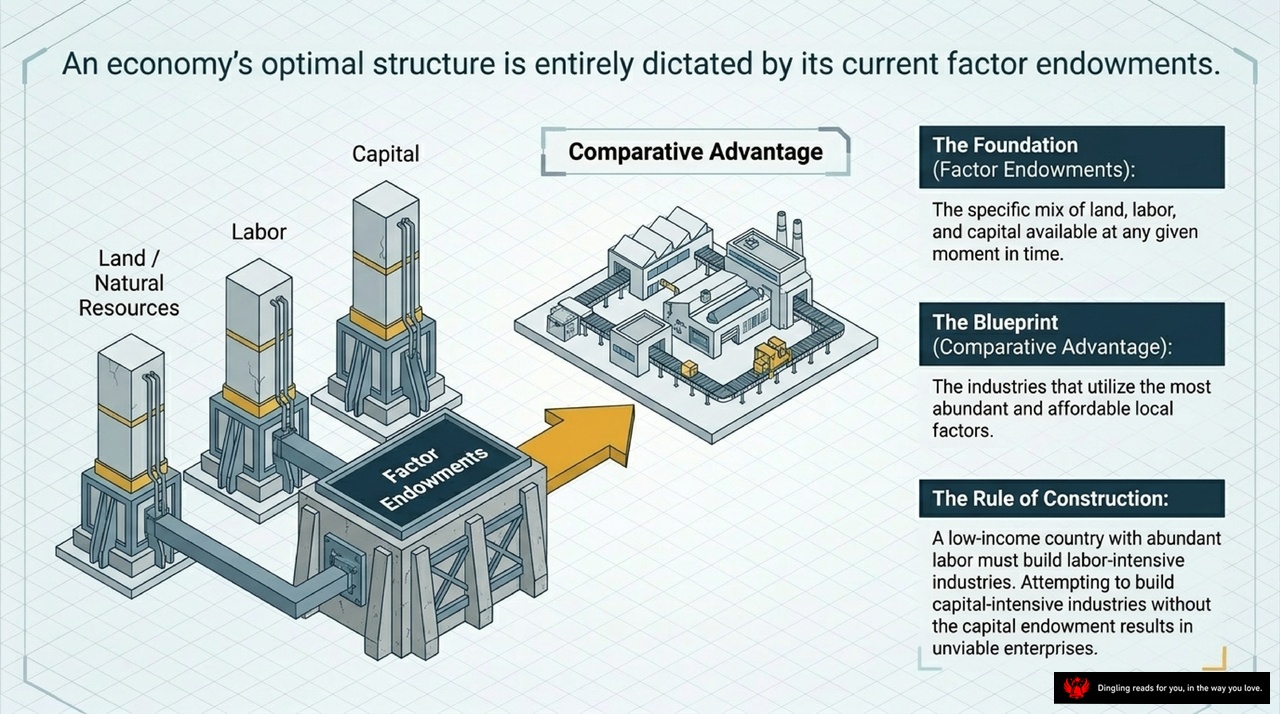
Let's look at how we actually build an economy. Think of it like constructing a factory: you need land, workers, and capital. The diagram on your screen shows that an economy's optimal structure isn't chosen arbitrarily; it is entirely dictated by its current factor endowments. This is the foundation. Every country has a specific mix of these resources at any given moment.
Now, look at the arrow pointing to the factory. That represents the blueprint: Comparative Advantage. The logic is simple—industries should utilize the most abundant and affordable local factors. If you are a low-income country with plenty of labor but little capital, the rule of construction is clear: you must build labor-intensive industries. Trying to force capital-intensive industries without the necessary capital endowment results in unviable enterprises that simply cannot survive.
The key takeaway here is that development isn't about copying the industrial structure of rich nations while you are still poor. It's about aligning your industries with your reality. By following this path, you create viable businesses, generate profits, and gradually upgrade your capital base, eventually moving toward more advanced industries. It's a step-by-step upgrade based on what you actually have, not what you wish you had.
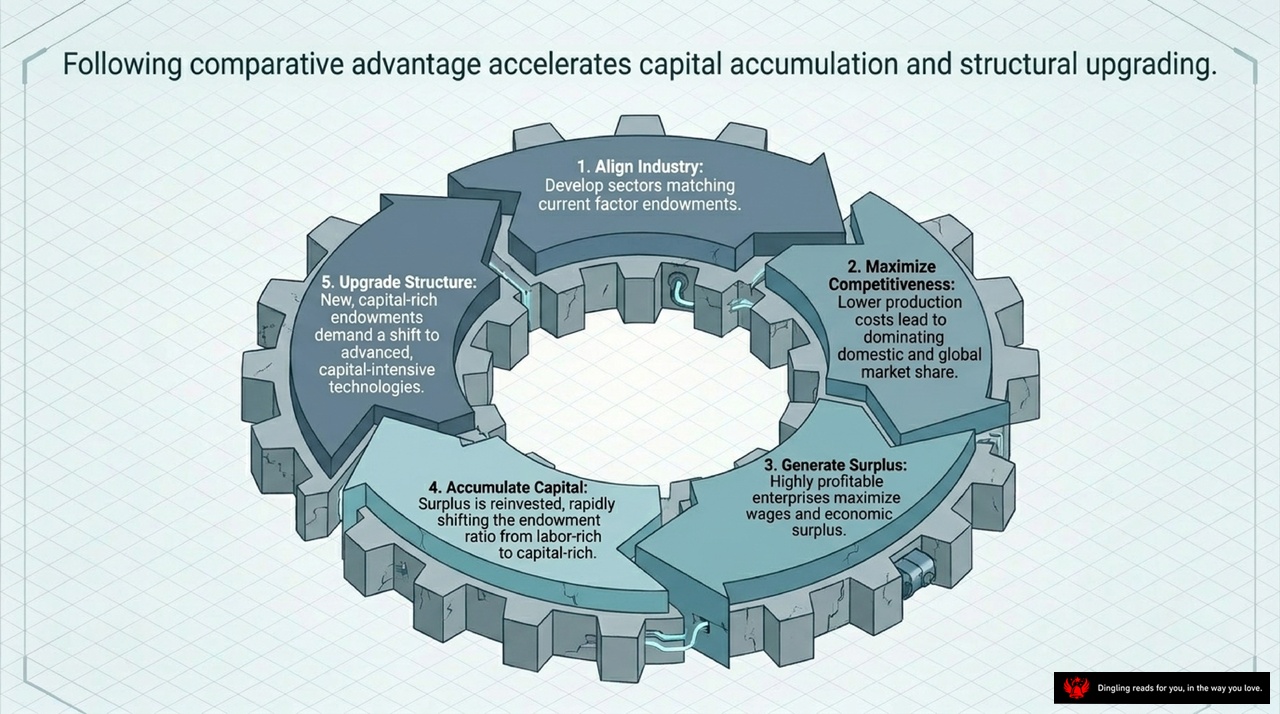
Different financial systems aren't one-size-fits-all; the best structure depends entirely on where your economy is right now. Think of it as matching your engine to your fuel. Developing nations are typically labor-rich but capital-poor, meaning they have lots of workers but not enough money to invest in massive factories. In this stage, small, local banks are the perfect fit. They excel at using "soft information"—knowing a borrower's character through long-term relationships—which allows them to lend to small, risky businesses that the stock market simply ignores.
As countries grow and accumulate capital, their industries shift toward large-scale, capital-intensive projects like advanced manufacturing and tech startups. At this point, the financial system needs to evolve too. Large corporations and innovative firms need huge amounts of funding and risk diversification that only a vibrant stock market can provide. This is why advanced economies tend to rely more on securities markets. The key insight is that there is no single "ideal" system. A mismatch—like forcing a developing country to mimic the market-dominated system of the US or UK—creates inefficiencies and financial instability. The optimal financial structure must dynamically adapt to the underlying industrial structure, ensuring that the money flows exactly where the economy needs it most.
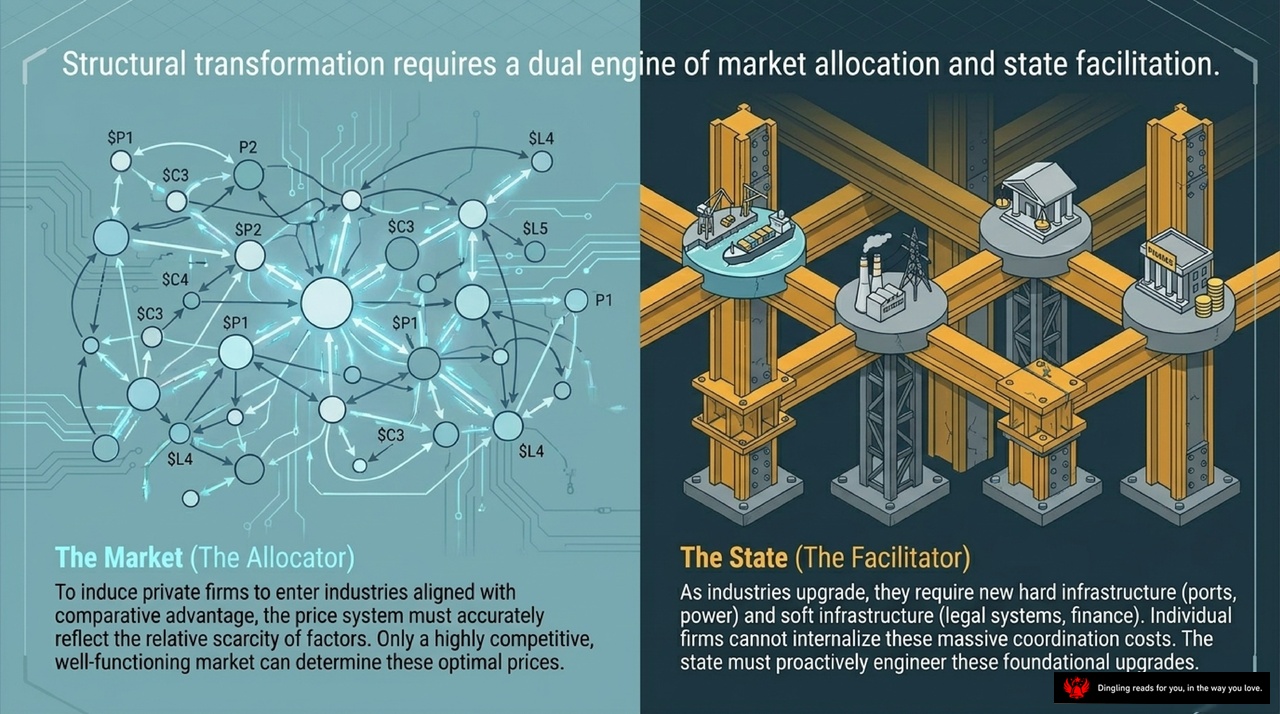
The slide clearly breaks down the dual engine required for structural transformation: a market that allocates resources efficiently and a state that facilitates the necessary upgrades. On the left, we see the market acting as the allocator, using price signals to guide private firms toward industries where they hold a comparative advantage. On the right, the state steps in as the facilitator, building the hard and soft infrastructure—like ports, power grids, and legal systems—that individual firms simply cannot afford to create on their own.
The core message here is that neither the market nor the government can do it alone. The market must accurately reflect the relative scarcity of factors like labor and capital to determine optimal prices, ensuring resources flow to the most competitive sectors. However, as industries upgrade, they face massive coordination costs and externalities that the market fails to solve. This is where the state becomes essential. It must proactively engineer these foundational upgrades, compensate pioneering firms for their risks, and coordinate the complex web of investments needed for progress.
In short, sustainable growth relies on this precise balance. The market drives efficiency and competition, while the state removes the bottlenecks that hold development back. Without this dual engine, structural transformation stalls, and countries risk getting trapped in low-value industries. Successful economies are those that let the market lead the way while ensuring the government provides the right conditions for that leadership to succeed.

The industrial golden age isn't a magic trick; it's a strategic opportunity for developing nations to leapfrog into the future. As advanced economies shift toward high-tech services and sophisticated manufacturing, a massive wave of labor-intensive and capital-light industries is flowing toward countries with abundant resources and lower costs. This isn't just about finding jobs; it's about triggering a virtuous cycle of technology spillover and local ecosystem growth that can rapidly close the gap with the developed world.
But seizing this moment requires one non-negotiable rule: stick to your comparative advantage. Don't try to build a Ferrari factory when you're best at making tires. Developing nations should prioritize industries that match their current reality—leveraging their labor and natural resources to accumulate capital and skills. As you upgrade your factor endowments, you naturally evolve toward more complex, capital-intensive sectors. This path isn't passive; it's an active strategy of digging deep into your potential and innovating through absorption and adaptation.
Success here depends on a powerful partnership between the market and the state. The market drives resource allocation based on price signals, but the government must act as the conductor. Think of the state's role as building the stage: fixing infrastructure to lower transaction costs, streamlining regulations to ensure fair play, and protecting intellectual property. Crucially, the government must compensate early movers—the "pioneers"—who bear the risks of innovation while competitors free-ride on their discoveries. Without this targeted facilitation, no firm will dare to innovate.
Finally, don't forget the human element. Industrial upgrading requires a skilled workforce. Governments must align education and vocational training with the specific needs of emerging industries, preventing a mismatch where high-tech factories struggle to find qualified workers. By combining a clear comparative advantage strategy with effective government facilitation, developing nations can not only grow their economies but also build a more equitable and sustainable future.

Industrial policy doesn't work by fighting against reality; it succeeds only when it anticipates it. As this slide illustrates, the path to growth isn't about choosing between doing nothing or forcing industries that don't belong in your economy.
On the far left, we see "Defying Reality," or Old Structuralism. Here, the state forces entry into highly capital-intensive sectors without the required endowments. The result? Endless subsidies and permanent unviability. It's a recipe for failure.
On the far right is "Passive Observation," the Neoliberal approach where the state does nothing. While this avoids bad mistakes, it leaves market failures unaddressed, causing upgrading to stall.
The sweet spot, highlighted in the center, is "Facilitated Upgrading"—the core of New Structural Economics. Here, state interventions precisely target industries that align with the nation's emerging comparative advantage. Instead of picking winners blindly, the government acts as a catalyst for natural transitions. By providing information, coordinating infrastructure, and compensating pioneers, the state helps firms enter industries where they are naturally competitive. This creates a virtuous cycle of growth, turning potential into actual development.

Today's slide introduces the Growth Identification and Facilitation Framework, or GIFF—a pragmatic, six-step roadmap designed to turn abstract economic theory into actionable policy for governments. Think of it as a navigation system for policymakers, helping them move away from guesswork and toward a rigorous methodology.
The core idea is simple yet powerful: identify winning industries based on a country's actual economic reality and surgically remove the exact constraints preventing private sector entry. Instead of trying to force industries that don't fit a nation's resources, GIFF helps leaders find the sectors where their country already holds a competitive advantage. By focusing on these natural strengths and clearing the roadblocks—whether they are infrastructure gaps, regulatory hurdles, or coordination failures—governments can unlock private investment and drive sustainable growth. It's about working with the economy's structure, not against it, ensuring that policy support actually leads to real-world results.

So, let's dive into the first phase of our growth strategy: identifying dynamic targets and eliminating the barriers that hold us back. Think of this as setting up a winning race track before the competition even starts.
Our very first move is to choose the right comparator. Instead of blindly looking up at the distant giants, we need to find countries that are dynamically growing right now, share similar resources with us, but currently have a per capita income roughly 100% higher. These are our benchmarks. We then focus on their mature industries—specifically those tradable sectors that are currently losing their edge due to rising labor costs. By targeting these, we position ourselves to leapfrog their current struggles and capture their next growth wave.
Once we've locked in our target industries, Step Two kicks in: removing domestic constraints. Here's the reality check: if companies already exist in these target sectors, they are likely stuck. We need to systematically dismantle the specific bottlenecks holding them back. Are they lacking the right technology? Are regulations too heavy? Is the infrastructure simply not there? It doesn't matter how good the idea is if the system won't support it. Our job is to identify these specific technological, regulatory, or infrastructure hurdles and tear them down.
By following this two-step process—finding the right benchmark and clearing the path for our own firms—we transform abstract potential into actionable growth. We aren't just hoping for success; we are engineering the conditions for it by aligning our domestic capabilities with the global opportunities that are already ripening in our comparator countries.
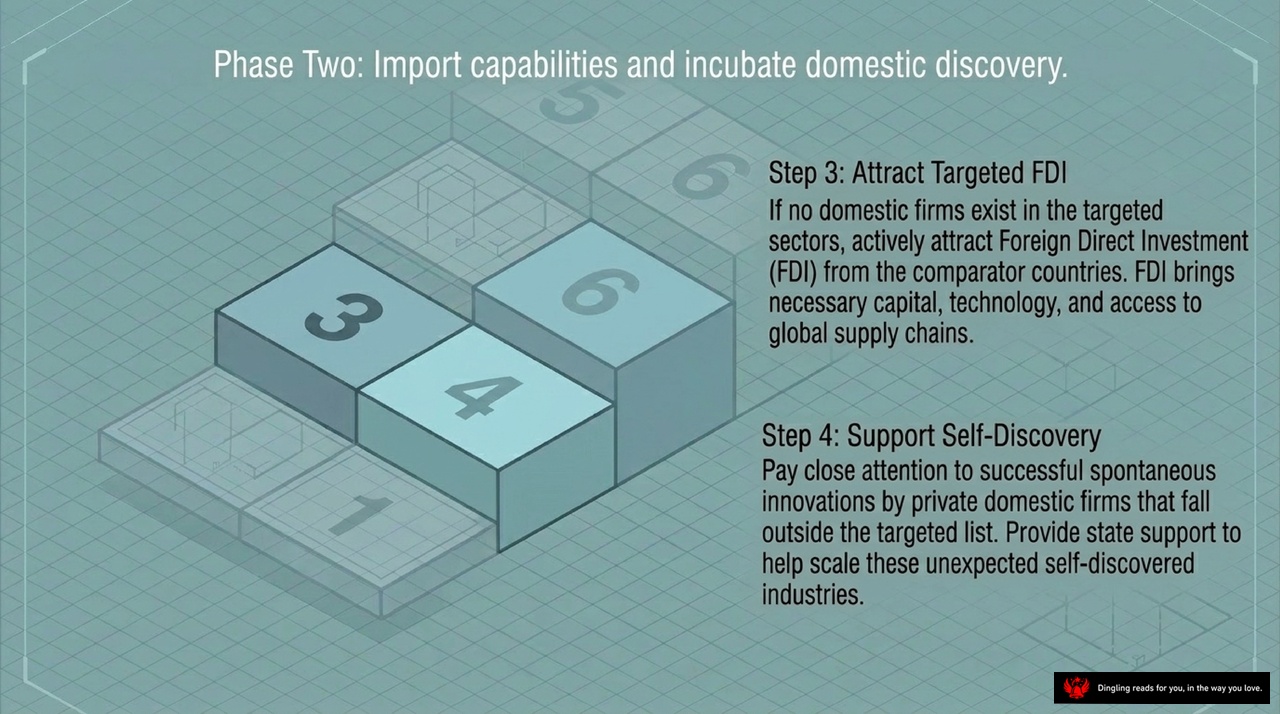
Phase Two focuses on importing capabilities while incubating domestic discovery. As we move forward, the strategy shifts to two critical steps. First, we must attract targeted Foreign Direct Investment. If domestic firms aren't yet present in specific sectors, we should actively bring in capital and technology from successful comparator countries. This isn't just about money; it's about accessing global supply chains and bringing in the know-how needed to jumpstart growth.
However, relying solely on external investment isn't enough. We also need to support self-discovery. This means paying close attention to spontaneous innovations coming from private domestic firms, even if they fall outside our initial target list. Sometimes, the best opportunities arise unexpectedly. The state's role here is to provide support, helping these emerging industries scale up and compete. By balancing imported expertise with nurturing local innovation, we create a robust ecosystem for sustainable development.

Now, let's talk about how to actually build these industries and reward the brave companies that take the first step. As we move into Phase Three, the focus shifts to constructing industrial clusters and compensating our pioneers.
Think of it this way: in many developing countries, the government simply cannot fix everything at once. The infrastructure is often too weak to support a full-scale industrial boom from day one. So, instead of trying to boil the ocean, we need to concentrate our limited resources into Special Economic Zones or dedicated industrial parks. By focusing on specific areas, we can create immediate, world-class hubs for targeted industries, giving businesses the infrastructure they need to succeed right away.
But building the park is only half the battle. You also have to incentivize the first-movers. These are the pioneer firms that take the risk to establish these new industries when the path is unclear. To encourage them, the government should provide limited-time financial incentives. This could look like tax holidays, co-investments, or even priority access to foreign exchange. The goal is to compensate these pioneers for the risks they take, making it safe enough for them to build the foundation that future competitors will eventually ride on.

Optimal financial structures must adapt to the underlying industrial reality, much like a building that changes its architecture as it rises from a simple foundation to a complex skyscraper. Think of it this way: the financial system isn't a one-size-fits-all solution; it's a custom suit tailored to the specific stage of a country's development.
In the early stages, when income is low, the economy is driven by labor-intensive industries dominated by small and medium-sized enterprises. These businesses often lack the standardized financial reports needed for stock markets. Instead, they thrive with a robust network of regional, small-scale banks. These local lenders excel at assessing entrepreneurial risk based on "soft information"—the kind of personal, relational data that only a neighbor or a local banker can gather. This structure is far superior to trying to replicate Wall Street in a developing economy; it's about matching the right financial tool to the job at hand.
As a nation advances into high-income stages, the industrial reality shifts. Frontier industries become capital-intensive and high-risk, requiring massive funding and sophisticated risk management. At this point, the optimal structure transforms into complex, risk-absorbing equity markets and large-scale commercial banks. These institutions are built to handle the scale and volatility of advanced innovation. The key takeaway is clear: there is no single "best" financial system. The most effective one is simply the one that aligns perfectly with the country's current industrial stage and resource endowments.
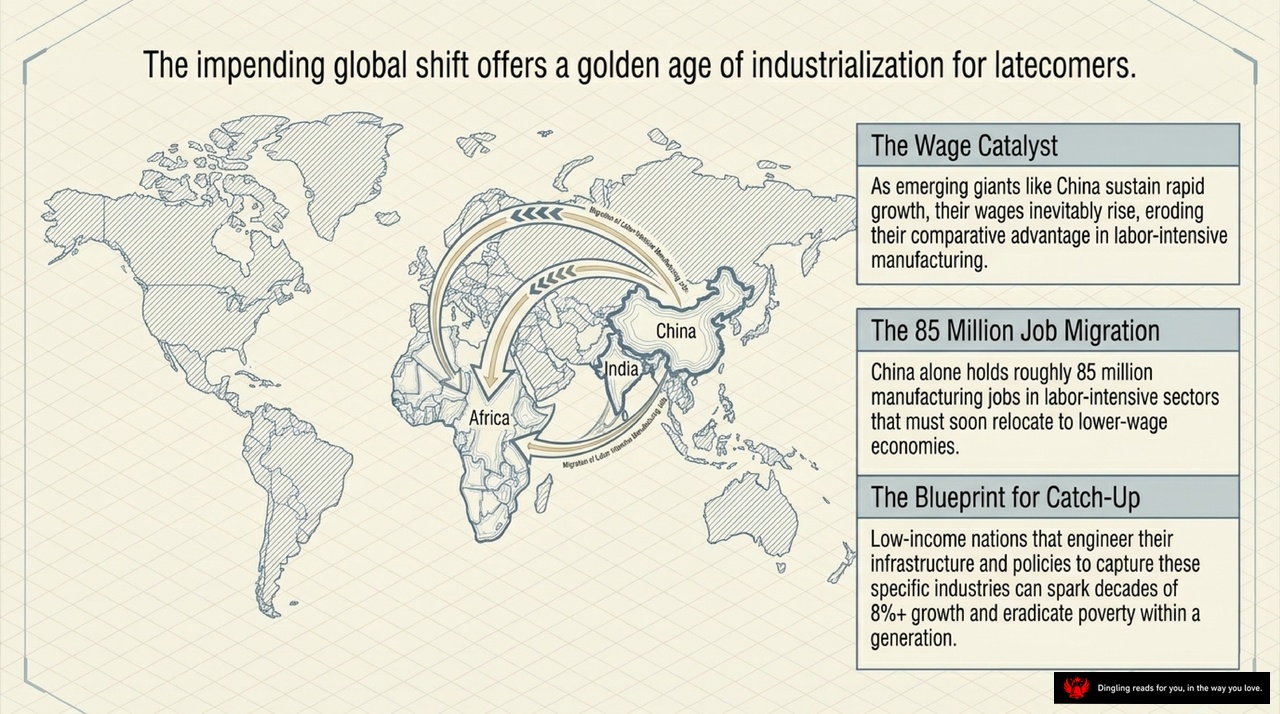
The slide presents a powerful vision: an impending global shift that offers a golden age of industrialization for latecomers. Look at the map; it illustrates a massive flow of opportunity moving from China and India toward Africa. This isn't just about geography; it's about economics.
The first key point here is "The Wage Catalyst." As emerging giants like China sustain rapid growth, their wages inevitably rise. This erodes their comparative advantage in labor-intensive manufacturing. Essentially, the old giants are getting too expensive to compete in low-cost production.
This creates a massive opening, leading to "The 85 Million Job Migration." China alone holds roughly 85 million manufacturing jobs in labor-intensive sectors that must soon relocate to lower-wage economies. This is a historic transfer of capital and jobs, creating a massive demand for labor in places like Africa.
Finally, this is "The Blueprint for Catch-Up." Low-income nations that engineer their infrastructure and policies to capture these specific industries can spark decades of 8%+ growth and eradicate poverty within a generation. The window is open, but it requires the right strategy to seize this moment.
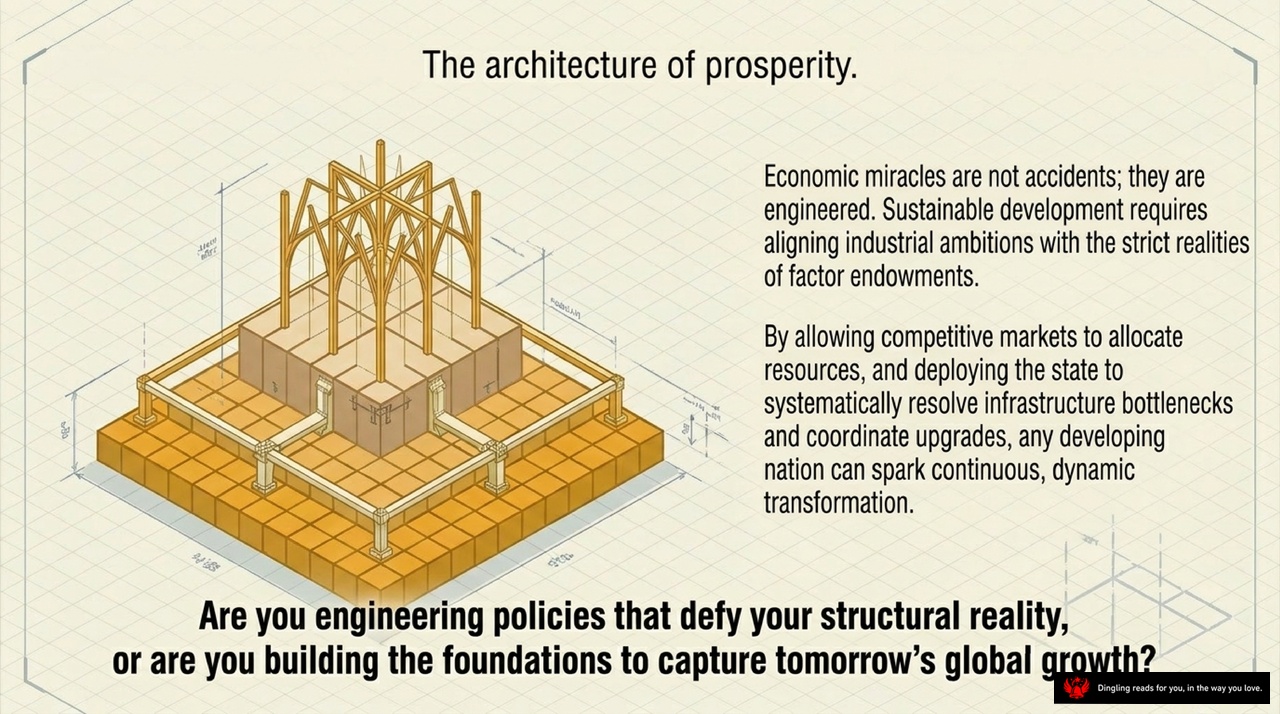
Look at this blueprint of prosperity. It's not about building castles in the sky; it's about engineering a solid foundation that matches your reality. The slide asks a tough question: Are you designing policies that defy your structural reality, or are you laying the groundwork to capture tomorrow's global growth?
The answer lies in understanding that economic miracles aren't accidents; they are engineered. Sustainable development requires aligning your industrial ambitions with the strict realities of your factor endowments. If you ignore this, you're building on sand.
The smart strategy is a two-pronged approach. First, let competitive markets allocate resources. They are the best judges of what your economy can do right now based on your labor, capital, and resources. Second, deploy the state strategically—not to pick winners, but to resolve infrastructure bottlenecks and coordinate upgrades that the market can't handle alone.
When you allow competitive markets to lead and the government to systematically fix the pieces that hold everything together, any developing nation can spark continuous, dynamic transformation. Stop trying to force a capital-intensive future before you have the capital to support it. Instead, build the foundations that allow you to grow naturally and capture the global growth wave.