
Nickel and Dimed: Complete Chapter-by-Chapter Summary
Welcome to a book that changes how we see the American Dream. Today, we're diving into *Nickel and Dimed* by Barbara Ehrenreich. The title itself is a powerful metaphor: "Nickel and Dimed" means getting by on the smallest possible coins, scraping together just enough to survive. This book is a rigorous, experiential teardown of the low-wage economy, shattering the comforting myth that hard work guarantees a living wage.
Ehrenreich doesn't just tell us about poverty; she lived it. She took a strict budget of $1,000 and tried to survive in three different American cities—Key West, Maine, and Minneapolis—working only minimum-wage jobs. What she found was shocking. She discovered that even when you work full-time, seven days a week, the system is designed to keep you just barely above the poverty line, not to lift you out of it.
In this journey, she faced everything from being tested for drugs before getting a job to working in a restaurant where the pay was so low she couldn't even afford to eat a decent meal. She found that the idea that "if you just try hard enough, you can make it" is a lie that keeps millions of Americans trapped in a cycle of exhaustion and debt. This isn't just a story about money; it's a wake-up call about the real cost of work in America.
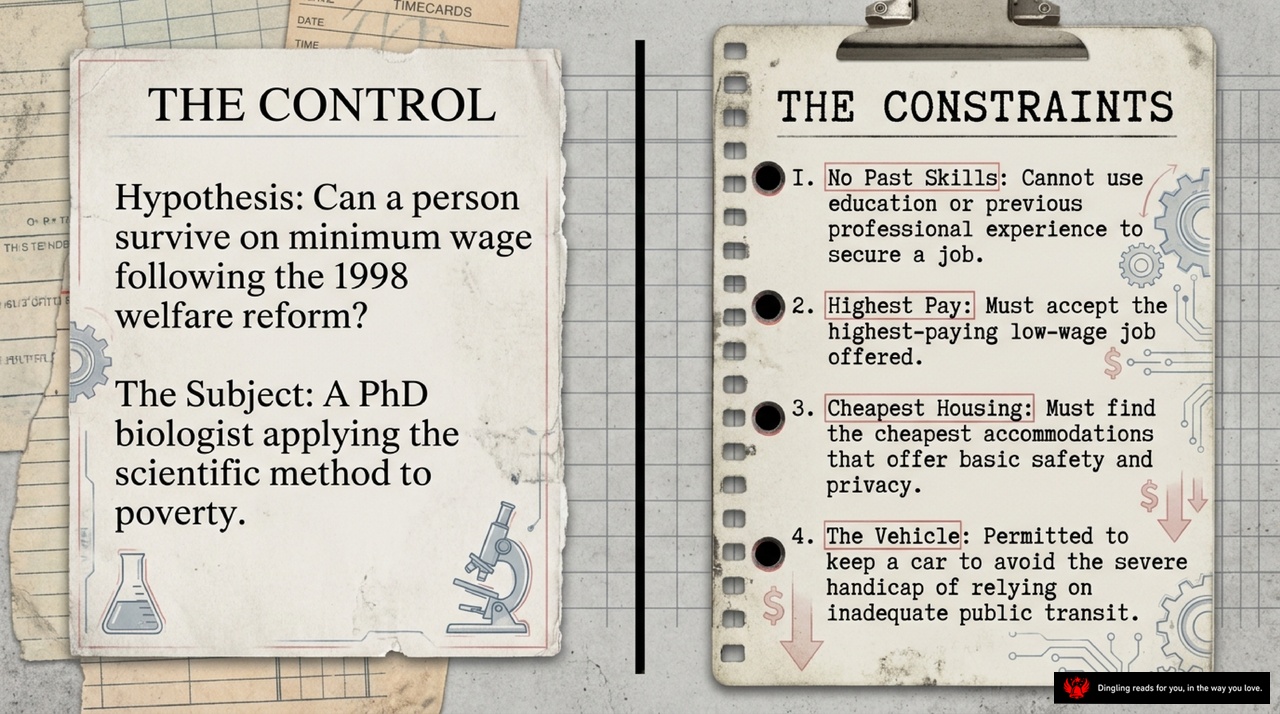
Today, we're stepping into a real-life scientific experiment. The hypothesis is simple but terrifying: Can a person survive on minimum wage after the 1998 welfare reform? To test this, the subject is a PhD biologist applying the scientific method to poverty. But to make the results valid, the experiment comes with strict controls and constraints.
On the left, we see the setup. The subject has no past skills to rely on; education and professional experience are locked out. On the right, the constraints define the battlefield. The subject must accept the highest-paying low-wage job offered, find the cheapest housing that still offers basic safety, and keep a car to avoid the severe handicap of inadequate public transit.
This isn't just about working hard; it's about surviving within a rigid system designed to limit mobility. By stripping away safety nets and forcing a reliance on the lowest rung of the economic ladder, this experiment exposes the brutal reality of the American workforce. It asks a hard question: When the rules are this stacked, how do you keep going?
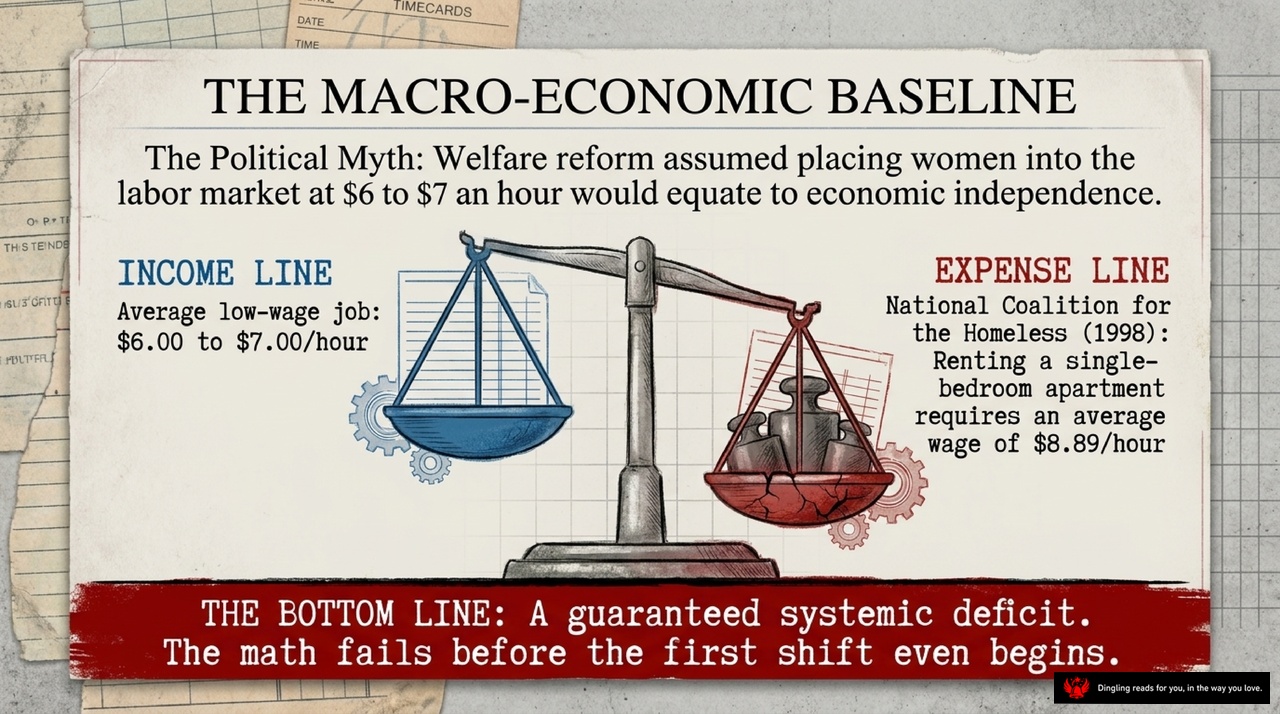
The slide you're seeing right now cuts straight to the heart of a political myth that's been driving policy for decades. It claims that if you just put women into the workforce at $6 or $7 an hour, they'd achieve economic independence. But look at the scale on this graphic: it's tipped heavily to one side.
On the left, the "Income Line," we have the average low-wage job, earning just $6 to $7 an hour. That's the promise of independence. But on the right, the "Expense Line," the reality of survival. According to the National Coalition for the Homeless from 1998, simply renting a single-bedroom apartment requires an average wage of $8.89 an hour.
The visual makes it painfully clear: the income side is lighter than the expense side. There is no balance here. The math fails before the first shift even begins. This isn't just a budgeting problem; it's a guaranteed systemic deficit. If we believe that a $7 wage solves poverty, we are fundamentally misunderstanding the economic baseline. The gap between what a low-wage worker earns and what it costs to simply exist in our society is too wide to bridge with current wages.

Welcome back to our deep dive into low-wage America. Today, we're looking at the harsh reality of working two jobs in Florida to simply survive.
The slide highlights the brutal math of the hospitality sector. On the income side, you see a waitress earning a base wage of just $2.43 an hour. While tips might push the effective rate to around $5.50, that number is a mirage. On the cost side, housing has become a luxury no one can afford. The options are stark: either a $675 monthly room with a grueling 45-minute commute, or a cramped, unlivable trailer for $1,100 that requires an impossible $500 deposit.
This imbalance creates the breaking point described at the bottom. To make ends meet, workers are forced to work simultaneously from 8:00 AM to 10:00 PM. This relentless schedule leads to total physical collapse and a state of mechanical exhaustion. Yet, despite the double shift, the result is still a mathematical deficit. The system demands so much energy that even working twice a day cannot bridge the gap between a paycheck and the cost of living.
Welcome back to our deep dive into the invisible costs of low-wage labor. Today, we're shifting our focus from Florida to the cold, industrial heart of Minnesota, specifically inside a Walmart.
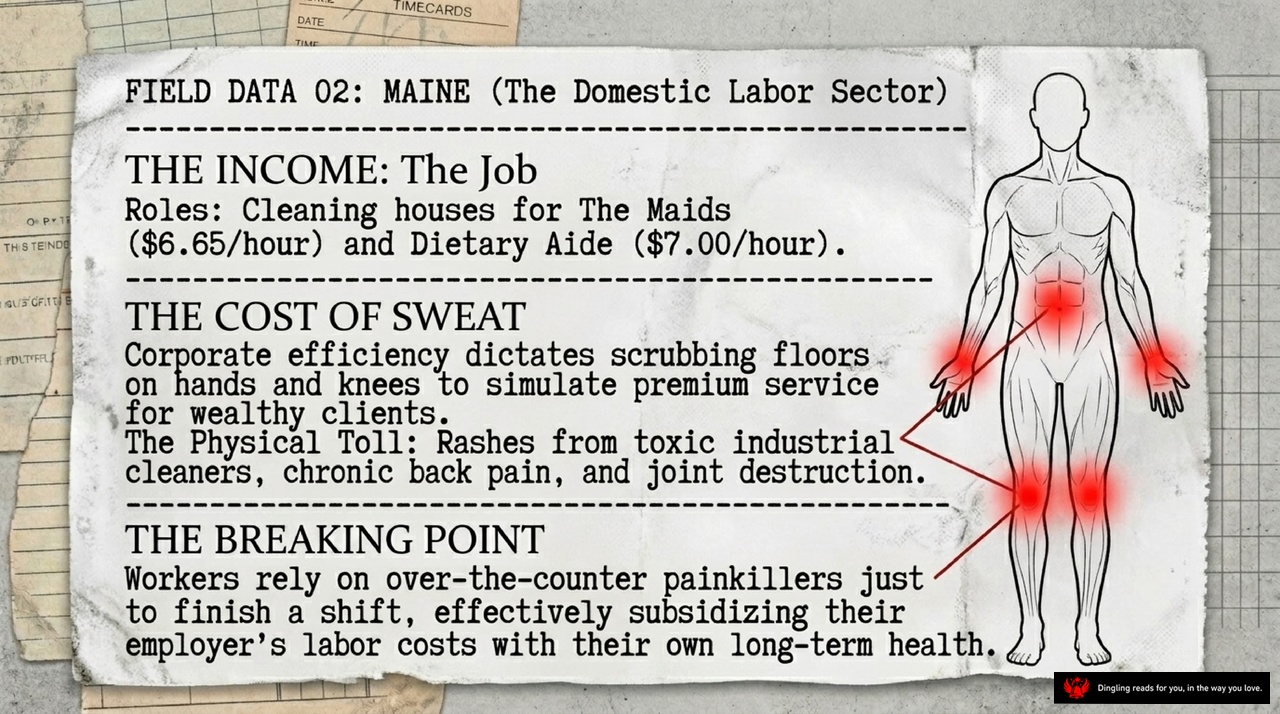
This slide highlights "Field Data 04: Minnesota," focusing on the Domestic Labor Sector within a massive retail environment. Look at the breakdown: "The Income" shows a stark reality. The roles here are essentially "cleaning houses" for the customers, with wages hovering around $6.65 to $7.00 an hour. It's a job that demands constant physical movement, yet pays less than a minimum wage in many other sectors.
Then we see "The Cost of Sweat." In this corporate efficiency model, the worker is the product. The text describes scrubbing floors on hands and knees to simulate premium service for wealthy clients. But the physical toll is severe: rashes from toxic industrial cleaners, chronic back pain, and joint destruction. The human body is treated as a disposable tool, worn down by the relentless pace of retail.
Finally, we hit "The Breaking Point." This is where the system truly fails the worker. Employees rely on over-the-counter painkillers just to finish a shift. They are effectively subsidizing their employer's labor costs with their own long-term health. The red zones on the body diagram—knees, back, hands—are the direct price of this work.
The story behind these numbers is one of survival. The author spent weeks trying to pass drug tests, only to find that the job itself is a trap. Once hired, the work becomes a mechanical loop of folding clothes and restocking shelves, with no time to recover. The pain isn't just physical; it's systemic. The company offers free donuts and a "family" atmosphere, but it refuses to raise wages or acknowledge the injury its efficiency demands.
This data point drives home a critical truth: when you strip away the corporate branding, the reality is that low-wage workers are being systematically overworked and underpaid. Their health is the hidden expense that keeps the profit margins up. As we move forward, keep asking: who is really paying the price for these low prices?

Look at this snapshot of life in Minnesota. Here, a worker earns just $7 an hour stocking clothes at Walmart. But here's the catch: apartment vacancy rates in the Twin Cities have dropped below 1%. With no available housing, this worker is forced into a motel without a kitchen, paying $49.95 a night. That's $245 a week.
The math is brutal. Living in that motel consumes more than the worker's entire post-tax weekly income. They are working just to survive, only to slowly bleed money every single day they clock in. This isn't just about low pay; it's about a total housing squeeze that makes working full-time impossible.
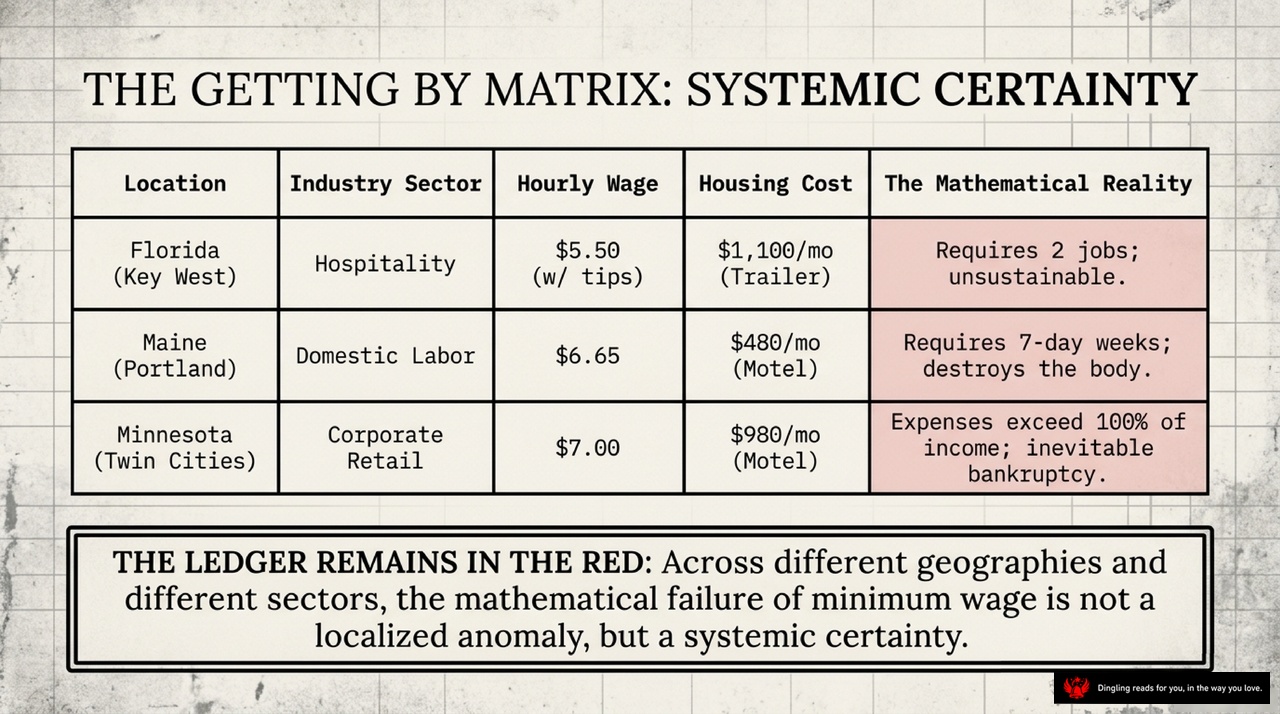
Look at this table. It's called "The Getting By Matrix," and it lays out a brutal mathematical reality for minimum wage workers across the country. Whether you're in Florida, Maine, or Minnesota, the numbers don't lie. In Key West, a $5.50 hourly wage simply cannot cover a $1,100 monthly rent, forcing workers to hold two jobs just to survive. In Portland, Maine, earning $6.65 an hour means you'd need to work seven days a week just to pay for a motel, which physically destroys the body. And in Minnesota, a $7.00 wage is mathematically impossible against a $980 rent, leading to inevitable bankruptcy.
The ledger remains in the red. This isn't a localized anomaly or a failure of a specific city; it is a systemic certainty. Across different geographies and sectors, the math simply doesn't add up. No amount of hard work or personal sacrifice can fix an equation that is fundamentally broken. The data proves that minimum wage, as currently structured, is not a path to stability, but a guarantee of failure.
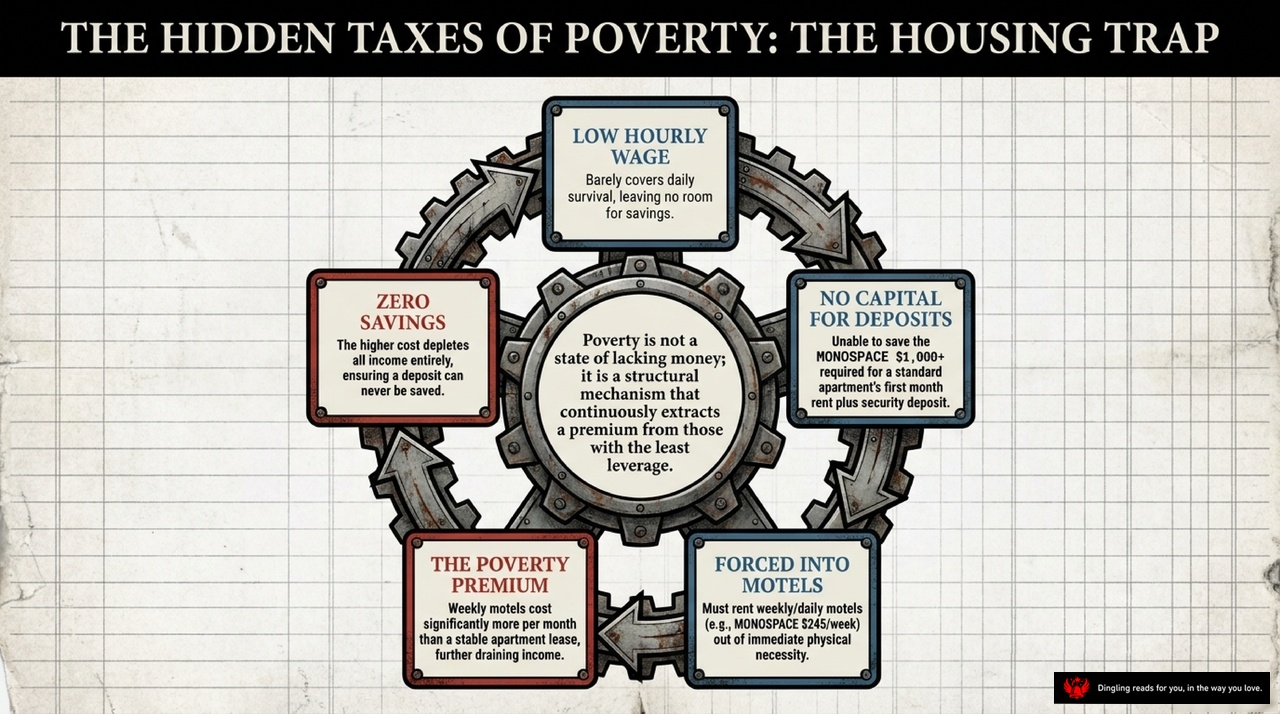
The image you see here captures a vicious cycle often called the "Housing Trap." It illustrates how poverty isn't just about lacking money, but a structural machine designed to extract value from those with the least leverage.
At the top, we start with a **Low Hourly Wage**. When you barely earn enough for daily survival, there is absolutely no room left for savings. This leads directly to **Zero Savings**. Because you can't save, you have **No Capital for Deposits**. A standard apartment requires a first month's rent plus a security deposit—often over $1,000—which is impossible to gather without savings.
Because you lack that capital, you are **Forced into Motels** or substandard housing. These places often charge weekly or daily rates that are significantly higher per month than a stable apartment lease. This creates **The Poverty Premium**, where you pay more just for the privilege of living somewhere. This high cost then depletes all your income, ensuring you can never save, which loops you right back to the start.
The central message is clear: Poverty is not a state of lacking money; it is a structural mechanism that continuously drains resources from the working poor, trapping them in a cycle where hard work doesn't lead to stability, but rather to a higher cost of living.

Look at this stark infographic titled "The Literal Extraction of Human Energy." It lays bare a brutal economic reality that often goes unspoken: the gap between what workers actually need to survive and what they are paid to consume.
On the top bar, labeled "Output," we see the demand. This is the energy a worker must expend to simply show up and do the job. For a standard 7-hour shift, that's roughly 2,100 calories burned just through raw physical labor—whether it's scrubbing floors, vacuuming, or carrying heavy trays. It's a high-intensity output that requires a fully fueled body.
But look at the bottom bar, labeled "Input." This represents the reality. The infographic shows that workers are often fueled by only 15% of what they need. They survive on half a bagel or a packet of crackers because they literally cannot afford more. Their bodies are running on empty, severely under-filled.
The red light on the output bar is flashing, signaling a deficit. This isn't just about feeling tired or sluggish; it's a physiological crisis. As the ledger note at the bottom explains, this is the literal consumption of the worker's own body to subsidize corporate profit margins. When a company pays a worker so little they can't afford fuel, the worker's body is forced to burn its own reserves—muscle, bone, and vital energy—to keep the shift going. This infographic isn't just data; it's a visual indictment of how low wages directly translate into physical exhaustion and long-term health destruction.
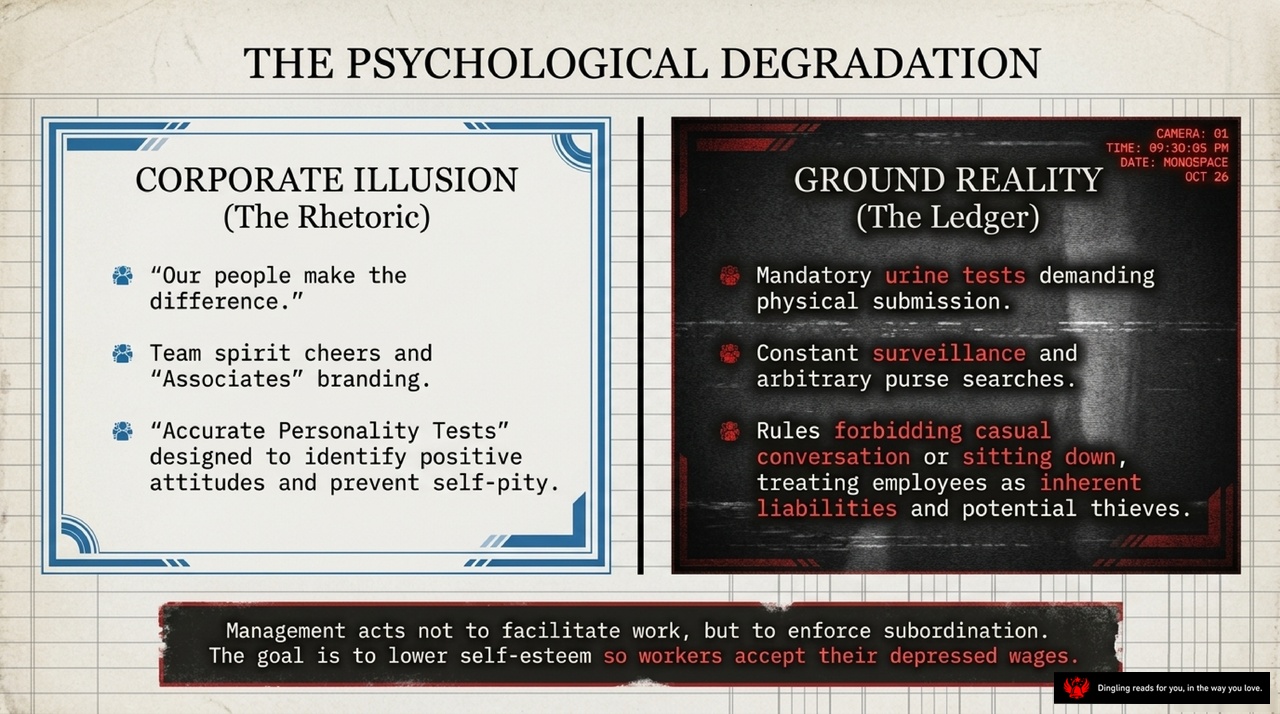
Look at this slide. It lays bare a harsh truth about corporate life: the gap between the "Corporate Illusion" and the "Ground Reality." On the left, companies sell us a dream with slogans like "Our people make the difference" and branding that calls us "Associates." They use fake personality tests to screen out anyone showing a bit of self-pity, creating an illusion of care and team spirit.
But flip to the right, and you see the ledger. This is the ground reality. Instead of cheerleading, we face mandatory urine tests demanding physical submission. We live under constant surveillance, with arbitrary purse searches treating us like potential thieves. Rules forbid casual conversation or even sitting down, forcing us to treat every moment as a liability.
The bottom line is clear: management isn't here to facilitate work; it's here to enforce subordination. The ultimate goal? To lower our self-esteem so we quietly accept depressed wages. The "illusion" is just a tool to make the "reality" easier to swallow.
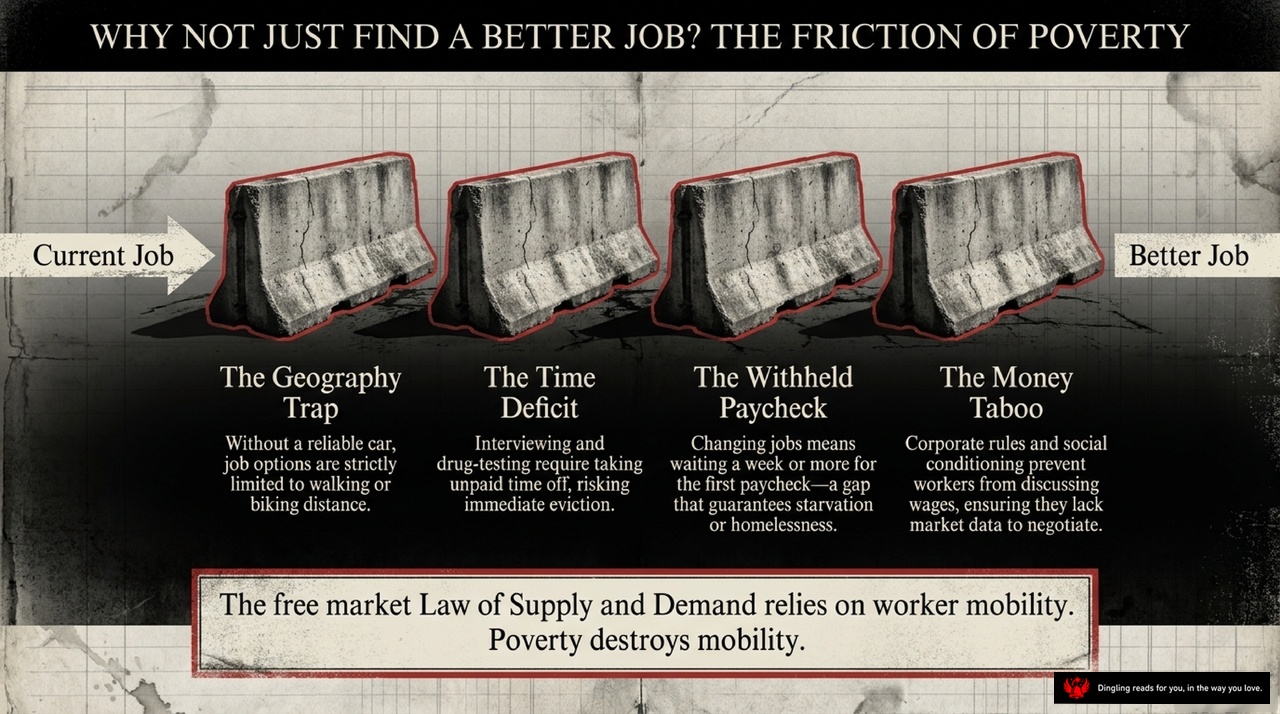
Why not just find a better job? The answer isn't laziness; it's the friction of poverty. Look at these barriers blocking the path from a current job to a better one.
First, there's the Geography Trap. Without a reliable car, your options are strictly limited to walking or biking distance. You can't reach the higher-paying jobs that are simply too far away.
Then comes the Time Deficit. Interviewing and drug-testing require taking unpaid time off, risking immediate eviction if you're already behind on rent.
Next is the Withheld Paycheck. Changing jobs means waiting a week or more for the first paycheck—a gap that guarantees starvation or homelessness for many.
Finally, there's the Money Taboo. Corporate rules and social conditioning prevent workers from discussing wages, ensuring they lack the market data needed to negotiate for fair pay.
The free market Law of Supply and Demand relies on worker mobility. But poverty destroys that mobility, trapping people in cycles of low-wage work.
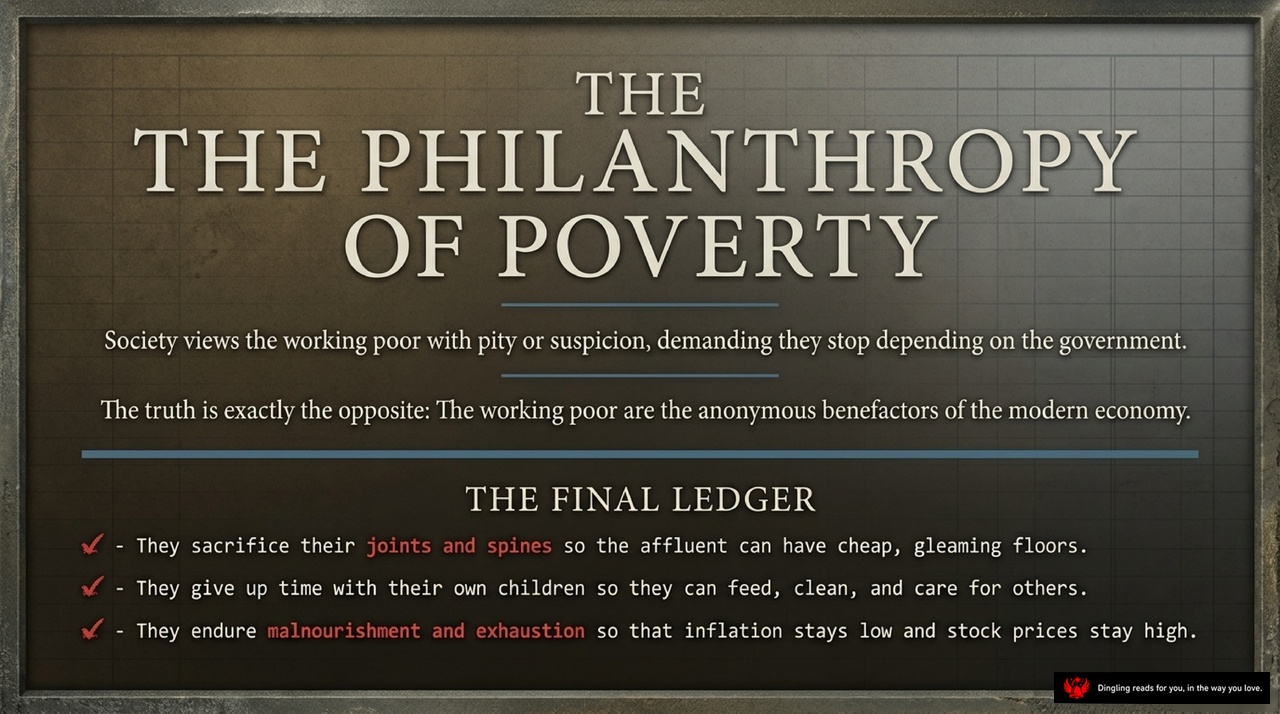
The slide reveals a stark truth that society often tries to hide: the so-called "working poor" aren't just dependent on the government; they are actually the silent benefactors of our entire economy. We tend to view them with pity or suspicion, demanding they stop relying on state aid. But the reality is the exact opposite. These workers are the anonymous backbone holding up the modern financial system.
Let's look at "The Final Ledger." This is the real cost we pay for our comfort. Consider the service workers in those fast-paced restaurants we visit. They sacrifice their joints and spines, enduring chronic pain and exhaustion, so that the wealthy among us can enjoy cheap, gleaming floors and luxury retail spaces. Think about the caregivers and nannies; they give up precious time with their own children to feed, clean, and care for others, ensuring our families run smoothly while we are at work.
Perhaps most chilling is the macroeconomic impact. These workers endure malnourishment and extreme fatigue to keep inflation low and stock prices high. By accepting wages that barely cover their survival, they effectively subsidize the cost of living for everyone else, allowing the wealthy to accumulate wealth without paying a fair price for labor. They are the invisible engine of our prosperity, working tirelessly while the system demands they stay poor.
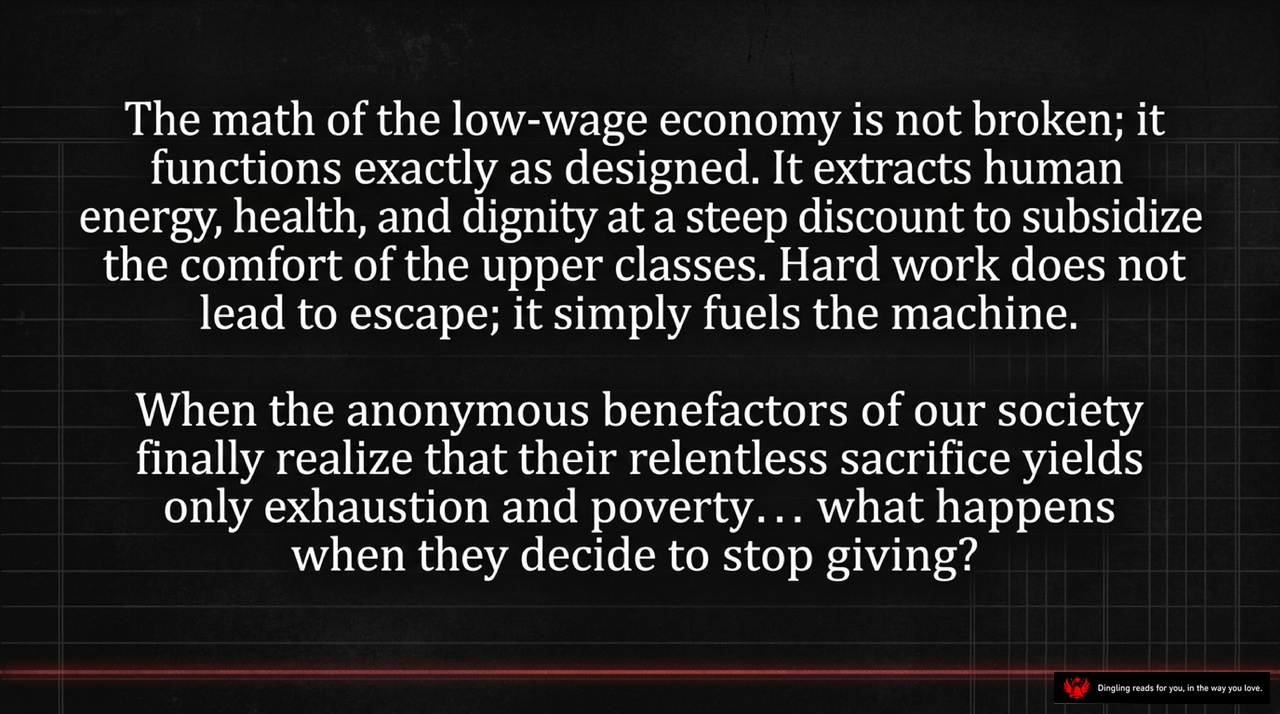
The math of the low-wage economy isn't broken; it's working exactly as designed. Look at the slide: it extracts our human energy, health, and dignity at a steep discount just to subsidize the comfort of the upper classes. Hard work here doesn't lead to escape; it simply fuels the machine.
When the anonymous benefactors of our society—those of us grinding every day—finally realize that our relentless sacrifice yields only exhaustion and poverty, what happens when we decide to stop giving? That moment of collective realization is the breaking point. We aren't just tired; we are being systematically drained to build someone else's wealth. The question isn't whether we can work harder, but whether we can ever afford to stop.