
No Retreat: Complete Chapter-by-Chapter Summary
Welcome to today's session on "Forge Ahead" by Fan Haitao. This cover sets the stage for an epic journey: the ten-year story of Xiaomi, chronicling its relentless rise from a visionary startup to a global technology powerhouse. We are about to explore how a single team dared to disrupt an industry, turning a simple idea into a movement that changed how the world thinks about technology and value.
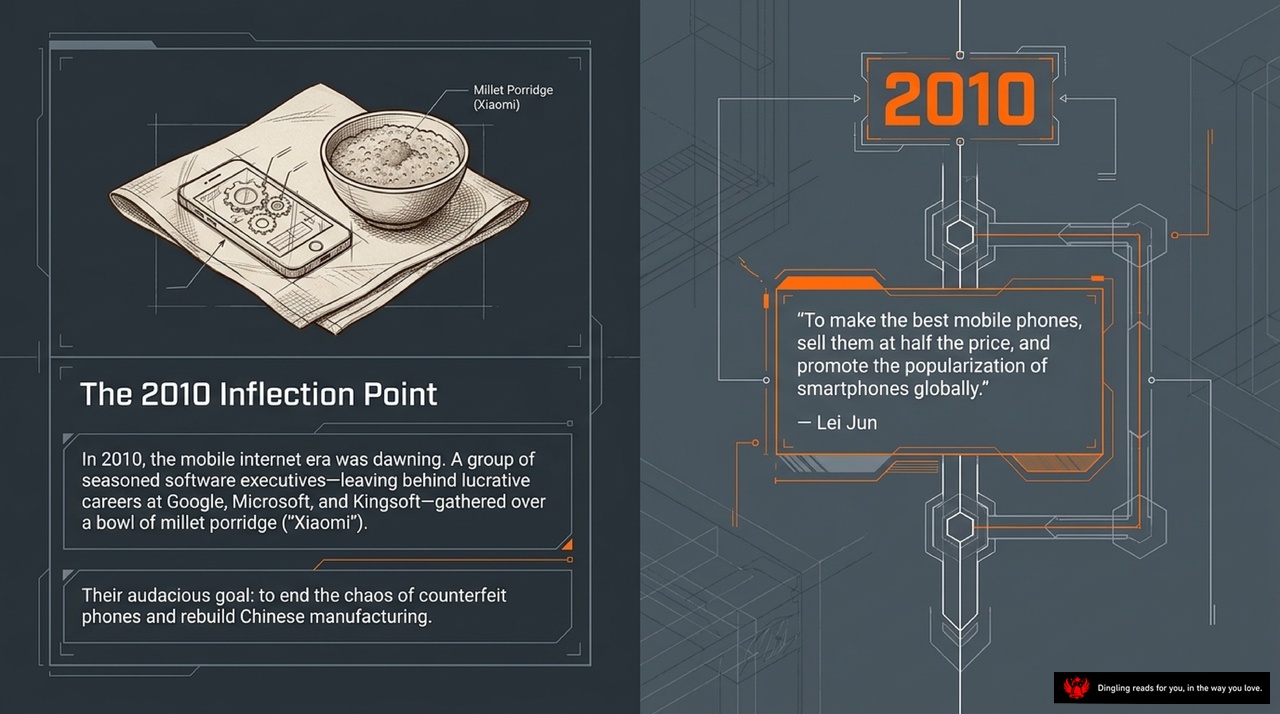
Back in 2010, the mobile internet era was just beginning to dawn, and a group of seasoned software executives—having left lucrative careers at giants like Google, Microsoft, and Kingsoft—gathered around a humble bowl of millet porridge. They named their new venture "Xiaomi," a nod to that simple, nourishing meal. Their audacious goal was clear: to end the chaos of counterfeit phones and rebuild Chinese manufacturing from the ground up.
Lei Jun, the visionary behind it all, had a powerful mantra for the team: "To make the best mobile phones, sell them at half the price, and promote the popularization of smartphones globally." This wasn't just a business strategy; it was a mission to democratize technology. By aiming to offer flagship-level performance at a fraction of the cost, they challenged the status quo and set the stage for a revolution that would soon change the world.
At the heart of Xiaomi's explosive growth lay a radical decision to go global, specifically targeting India as its primary battlefield. In 2014, the team led by Hugo Barra faced the daunting task of building from scratch with no office, no team, and no local presence. They started by renting a small office in a bustling cafe, where every interaction was a test of their "Xiaomi philosophy." Despite initial skepticism and logistical nightmares, their strategy of offering high performance at low prices resonated deeply. Within just five months, they secured an exclusive deal with Flipkart, India's largest e-commerce giant, and sold over 120,000 units in their first month, capturing 1.5% of the market share.
However, the path wasn't smooth. The company quickly ran into a wall of intellectual property disputes, with Ericsson suing them and seizing goods, forcing them to pay a deposit for every phone sold. More critically, a major miscalculation regarding 3G versus 4G technology led to a massive inventory backlog worth over 1 billion yuan, nearly choking the business. It was in these moments of crisis that Lei Jun took personal control, demanding daily reports and personally overseeing the inventory crisis. By deploying experienced leaders to clear out stock across Pakistan, Indonesia, and the Middle East, even at a loss, he turned a potential disaster into a foundation for future expansion.
By 2017, this relentless focus on localization and market understanding paid off spectacularly. Xiaomi didn't just enter India; they conquered it, becoming the number one smartphone brand in the country with a 25% market share, surpassing the giant Samsung. This success proved that the key to global expansion isn't just copying what works in China, but deeply understanding local needs, building local supply chains, and integrating online and offline channels. The lessons learned in India became the blueprint for Xiaomi's entire global strategy, transforming the company from a domestic player into a true global tech powerhouse.

Let's dive into how Xiaomi didn't just build a phone, but an entire operating system with the help of its users. The slide you see right now breaks down their unique "Crowdsourcing" strategy, a loop where the community isn't just a customer, but a co-developer.
At the top, we see the core concept: instead of working in secret, Xiaomi built MIUI in public. By turning users into co-developers, they achieved rapid iteration and fierce brand loyalty without spending a dime on traditional advertising.
The cycle starts on the left with "Listen." Here, engineers engage directly with users on forums, completely bypassing the usual product managers. This is where the magic happens—no corporate filters, just raw, honest feedback. Next, we move to "Develop." Features that the community requests and votes on are coded immediately. There is no waiting for quarterly reviews; if you want it, it gets built.
Moving clockwise, we hit "Orange Fridays." This is the heartbeat of their strategy. Every week, the system updates roll out to the public, and users get to vote on the next week's features. This creates a self-sustaining loop where the product evolves exactly how the users want it to. Finally, we reach "Feedback." Instant user response drives the next weekly cycle, closing the loop and ensuring that every single iteration is better than the last.
This approach created a loyal army of fans who felt ownership over the product. It wasn't just about selling software; it was about building a community where everyone had a voice, allowing Xiaomi to iterate faster than any traditional competitor ever could.
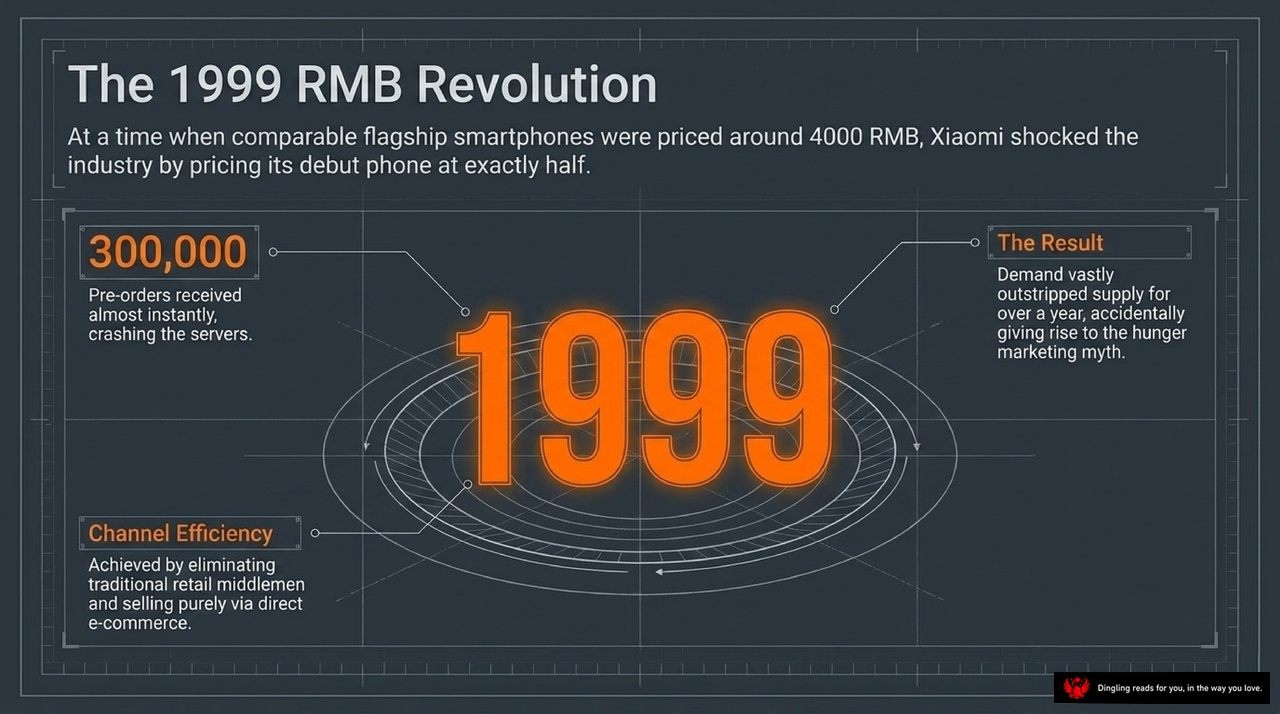
The 1999 RMB Revolution wasn't just a price tag; it was a complete disruption of the smartphone industry. While competitors were charging around 4,000 RMB for flagship devices, Xiaomi shocked the world by launching its debut phone at exactly half that price—1,999 RMB. This aggressive pricing strategy triggered an immediate frenzy, with pre-orders crashing servers within minutes as 300,000 orders flooded in almost instantly.
But how did they pull this off? The secret lay in channel efficiency. By eliminating traditional retail middlemen and selling purely through direct e-commerce, Xiaomi slashed costs that usually bloat a product's price. This bold move created a supply-and-demand imbalance that lasted for over a year. Demand vastly outstripped supply, accidentally giving rise to the "hunger marketing" myth that would later define the brand's early narrative.
This wasn't just about low prices; it was about redefining value. Xiaomi proved that you could deliver premium performance without the premium markup, forcing the entire industry to rethink how technology should be priced and distributed.
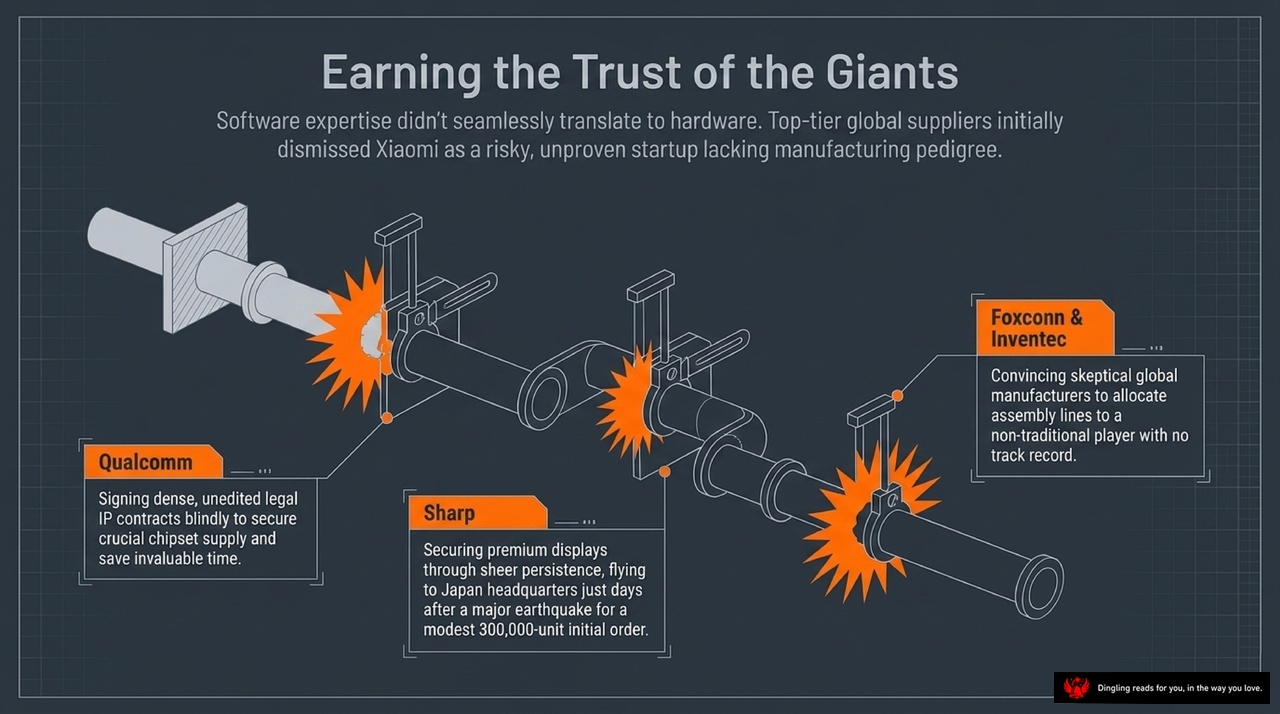
Earning the Trust of the Giants. When we talk about building a global brand, the hardest battle isn't usually the product itself—it's the people who make it. In the early days, top-tier global suppliers dismissed Xiaomi as a risky, unproven startup lacking any manufacturing pedigree. They didn't want to work with us.
But Xiaomi refused to back down. Look at the path we took to secure our supply chain. First, we convinced Qualcomm to sign dense, unedited legal IP contracts blindly, just to secure our crucial chipset supply and save invaluable time. Then, we went to Japan. Even after a major earthquake, our team flew to Sharp's headquarters to secure premium displays, flying in just days after the disaster to place a modest 300,000-unit initial order. Finally, we convinced skeptical giants like Foxconn and Inventec to allocate their assembly lines to a non-traditional player with no track record.
This wasn't just about persistence; it was about earning trust through sheer action. By securing these premium displays and chipsets, we built the foundation for everything that followed. We proved that even a small team could command respect from the world's biggest players. That trust allowed us to launch products that challenged the status quo, ultimately changing how the entire industry thinks about efficiency and value.

The Bamboo Forest Strategy isn't just a metaphor; it's the blueprint Xiaomi used to dominate the future. By anticipating the 5G and Internet of Things era, Xiaomi leveraged its capital, brand, and supply chain expertise to incubate over 100 hardware startups, creating a massive, interconnected ecosystem.
At the very center of this strategy lies the **Inner Core: The Hubs**. Think of smartphones, smart TVs, and smart routers as the primary data and control centers. These aren't just devices; they are the command posts that manage the entire network, ensuring everything stays connected and synchronized.
Surrounding that core is the **Middle Ring: Smart Hardware**. This layer includes smart home appliances and wearables like the Mi Band, air purifiers, and smart plugs. These products bring intelligence into your daily life, transforming your home into a responsive environment where devices work together seamlessly.
Expanding outward, we reach the **Outer Ring: Lifestyle**. Here, you find consumables and daily goods like power banks, luggage, and towels. Xiaomi realized that technology shouldn't be confined to gadgets; it should permeate every aspect of your routine. By integrating these everyday items into their ecosystem, they turned simple objects into smart solutions.
This three-tiered approach allows Xiaomi to offer a unified experience. Whether you're streaming a movie on your TV, checking your health with a wearable, or packing for a trip with a smart suitcase, everything is part of one cohesive system. It's a strategy that turns a collection of products into a lifestyle, ensuring that no matter where you are, you're always connected to the Xiaomi world.
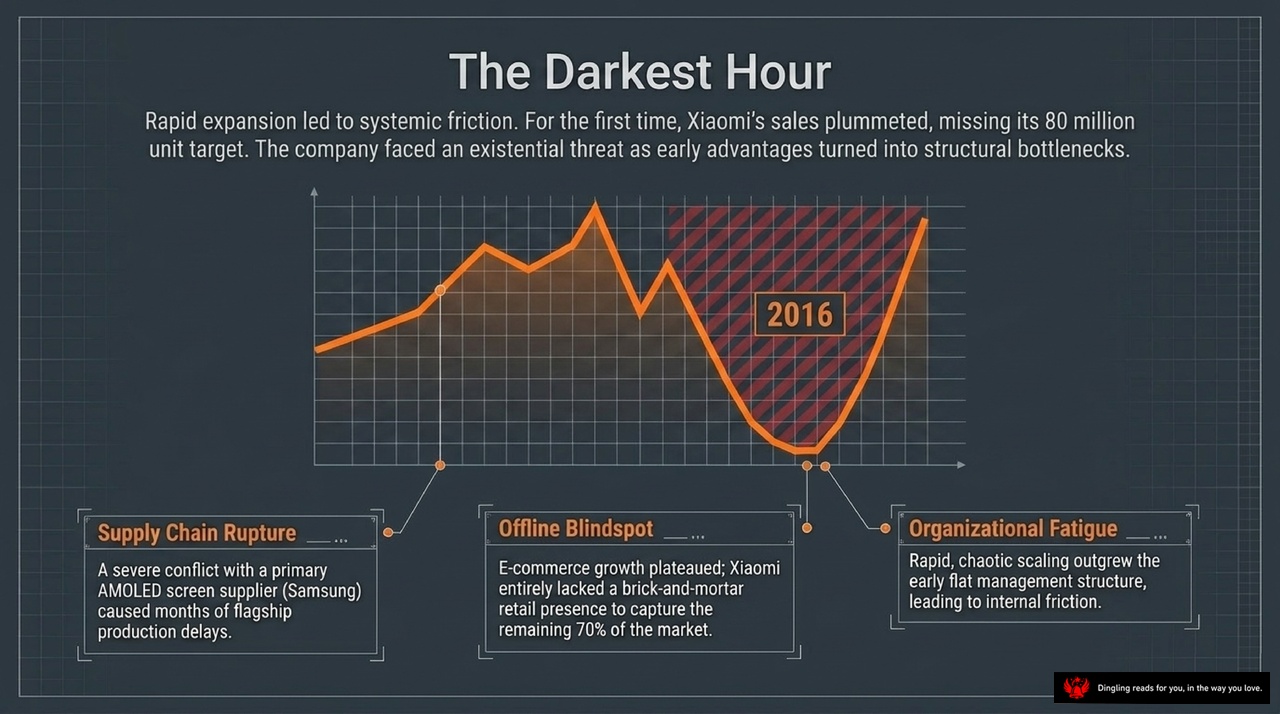
The Darkest Hour. This slide captures the most critical turning point in Xiaomi's history: the moment rapid expansion turned into systemic friction, threatening the company's very existence.
Look at that graph. By 2016, after years of soaring growth, Xiaomi hit a brutal wall. Sales plummeted, missing their 80 million unit target for the first time. The red shaded zone represents this existential crisis, where early advantages transformed into structural bottlenecks.
Why did this happen? The slide breaks it down into three fatal flaws. First, Supply Chain Rupture. Xiaomi's aggressive scaling led to a severe conflict with their primary AMOLED screen supplier, Samsung. This dispute caused months of production delays for their flagship phones, effectively choking off their supply.
Second, the Offline Blindspot. While online sales had plateaued, Xiaomi completely lacked a brick-and-mortar presence. They were trying to capture the remaining 70% of the market that was still offline, but they had no physical stores to reach those customers.
Finally, Organizational Fatigue. The company grew so fast that it outpaced its management structure. The early flat hierarchy collapsed under the pressure, leading to internal friction and chaos.
This was the "darkest hour." But it was also the necessary catalyst for everything that followed. Only by facing this crisis head-on could Xiaomi rebuild its foundation and eventually rise stronger than ever.
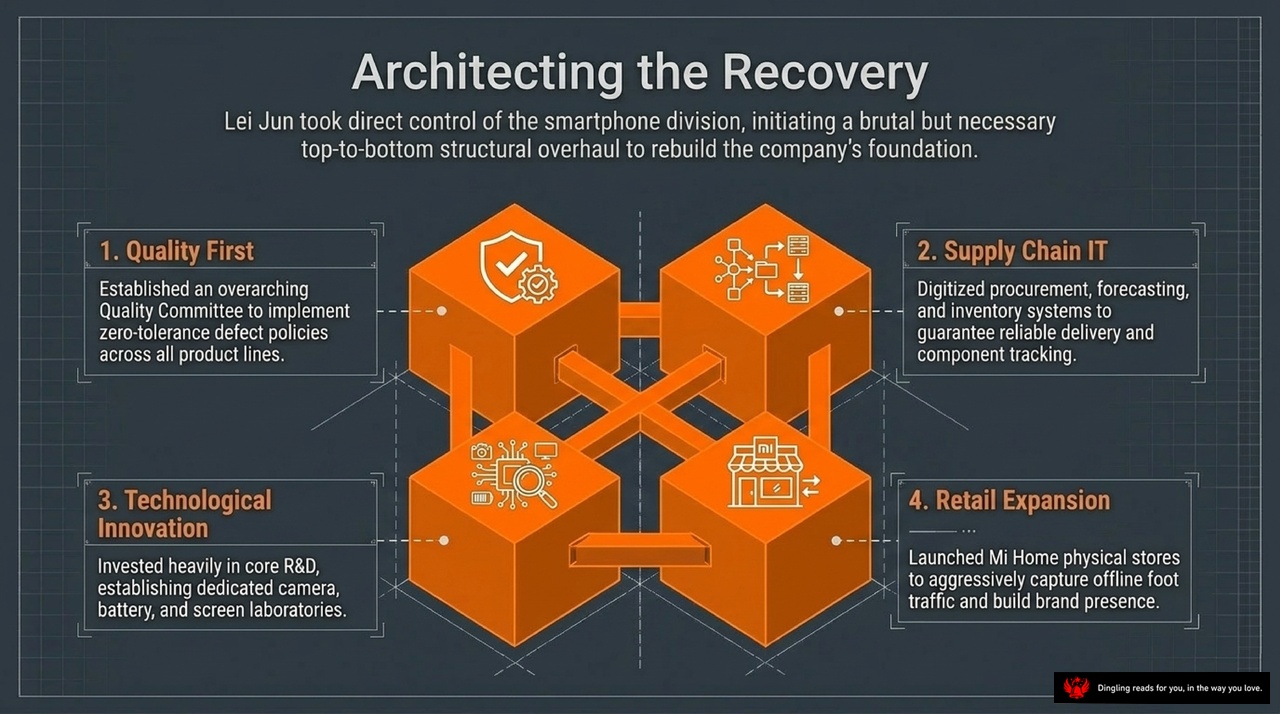
When Lei Jun took the helm of the smartphone division, he didn't just tweak the status quo; he initiated a brutal but necessary top-to-bottom overhaul to rebuild the company's foundation from the ground up. Think of it as an architect designing a skyscraper after discovering the structural beams were rotten—he had to tear things down to build something stronger.
The recovery strategy rested on four key pillars. First, Quality First. Lei Jun established an overarching Quality Committee to implement zero-tolerance defect policies across all product lines, ensuring that no subpar product ever left the factory. Second, Supply Chain IT. The company digitized procurement, forecasting, and inventory systems to guarantee reliable delivery and precise component tracking, turning chaos into data-driven efficiency. Third, Technological Innovation. Massive investments were poured into core R&D, specifically establishing dedicated laboratories for cameras, batteries, and screens to secure the tech edge. Finally, Retail Expansion. By launching Mi Home physical stores, Xiaomi aggressively captured offline foot traffic and built a tangible brand presence that online channels alone couldn't achieve.
This comprehensive restructuring wasn't just about fixing problems; it was about redefining Xiaomi's DNA. It transformed a struggling company into a resilient powerhouse, proving that even after hitting rock bottom, a clear vision and disciplined execution can lead to a complete comeback.
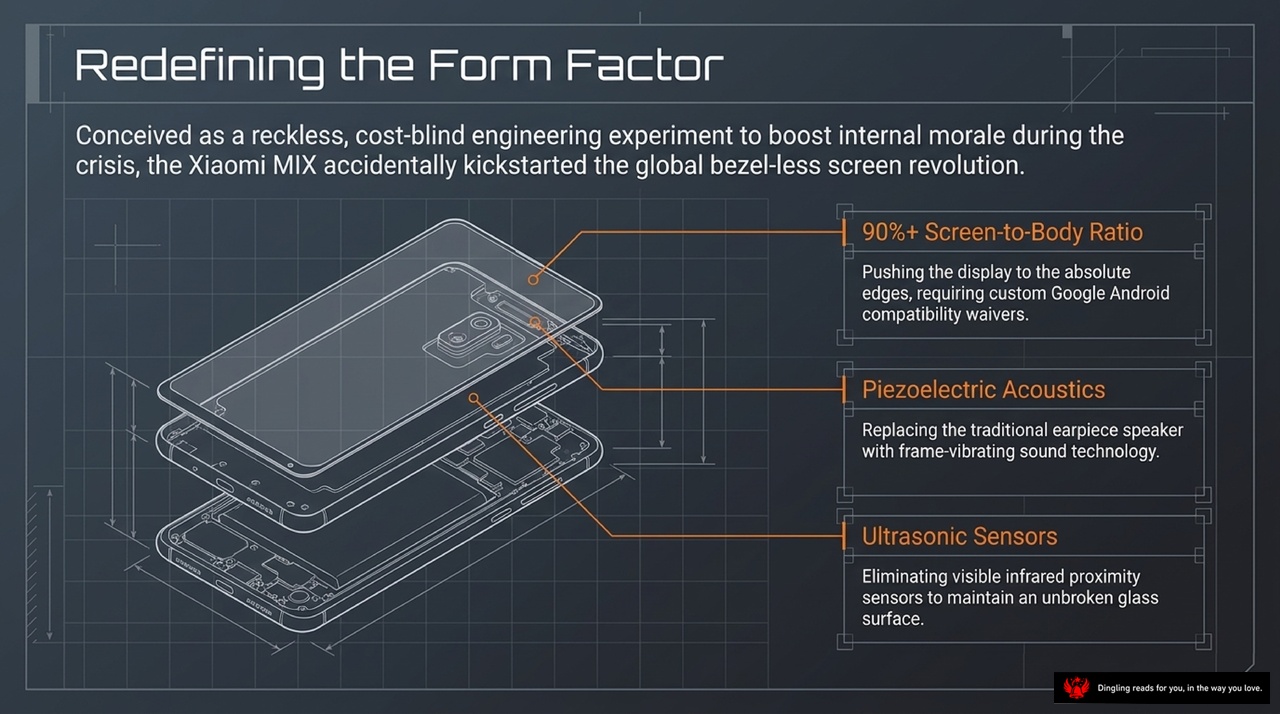
This blueprint isn't just a schematic; it's a story of how a bold, almost reckless idea accidentally changed the entire smartphone industry. As the slide states, the Xiaomi MIX was originally conceived as a "cost-blind engineering experiment" meant to boost morale during a crisis, but it ended up kickstarting the global bezel-less revolution.
Look at the first key feature: a 90%+ Screen-to-Body Ratio. This wasn't just about aesthetics; it required pushing the display to the absolute edges, which forced engineers to secure custom Google Android compatibility waivers just to make the technology work.
Then, notice the Piezoelectric Acoustics. Instead of a traditional earpiece speaker that eats up precious screen space, Xiaomi replaced it with frame-vibrating sound technology. This innovation allowed them to eliminate the notch at the top of the phone, creating a truly uninterrupted visual experience.
Finally, check out the Ultrasonic Sensors. By eliminating the visible infrared proximity sensors, they maintained a completely unbroken glass surface. Every single design choice here was a calculated trade-off to achieve that seamless look. The MIX proved that you could redefine the form factor without sacrificing functionality, setting a new standard for what a smartphone could look like.

Look at this blueprint of the future. We're moving away from the old, bloated distribution model where products get marked up at every single tier—manufacturer, distributor, retailer, and then the consumer. That's the "brick and mortar" trap that used to kill margins and slow down innovation.
But look at the solution on the right. This is how Xiaomi reimagined the physical store. By cutting out the middlemen and going direct, they created a lean, efficient ecosystem. The store isn't just a place to buy a phone; it's a hub. You have a dedicated Product Experience Zone, a Smart Home Area, and an Ecosystem Display. This layout drives high-frequency traffic. It's not just about selling phones anymore; it's about selling a lifestyle—towels, power banks, purifiers—all connected under one roof.
The key here is "Aesthetic Uniformity." Notice the clean, minimalist design with concrete and aluminum? That's intentional. It removes the noise so the products become the hero. And because they eliminated those tiered regional distributors, they can maintain honest, unified pricing across all locations. No more confusing price wars. This direct supply chain allows them to operate with the efficiency of an e-commerce website while delivering the tangible experience of a physical store. It's a perfect blend of digital speed and human touch, proving that the future of retail isn't choosing between online or offline—it's merging them seamlessly.

Today's slide highlights a pivotal shift in Xiaomi's global strategy: moving from a single global formula to a "Localized Global Ambition." Instead of forcing one playbook on over 90 different markets, Xiaomi learned that true global success requires deep adaptation to local economic, retail, and cultural realities.
Look at the two key examples on this map. In Europe, specifically in open markets like Spain and Poland, Xiaomi pioneered a hybrid approach. They didn't just rely on online sales; instead, they partnered directly with major telecom operators while simultaneously empowering grassroots distribution networks. This dual strategy allowed them to build trust and presence in mature markets that are often skeptical of new entrants.
On the other side of the map, the strategy for India was entirely different, tailored to a vastly different ecosystem. Here, Xiaomi mastered local e-commerce infrastructure, building what the slide describes as a "cult-like following." They aggressively localized their manufacturing facilities, ensuring that their products were not just sold in India, but made in India. This move was crucial for navigating complex local regulations and reducing costs.
The core message here is clear: there is no "one-size-fits-all" solution for global expansion. By learning painful but valuable lessons in each unique market, Xiaomi transformed from a Chinese brand into a truly global player, proving that localization is the ultimate competitive advantage.

Before its historic 2018 IPO, Xiaomi made an unprecedented move that redefined how we think about corporate profit. As the slide clearly shows, the company cemented its corporate values into a binding board resolution: "The overall net profit margin of Xiaomi's hardware business will never exceed 5%." If the margin ever goes above 5%, that excess profit is returned directly to the users.
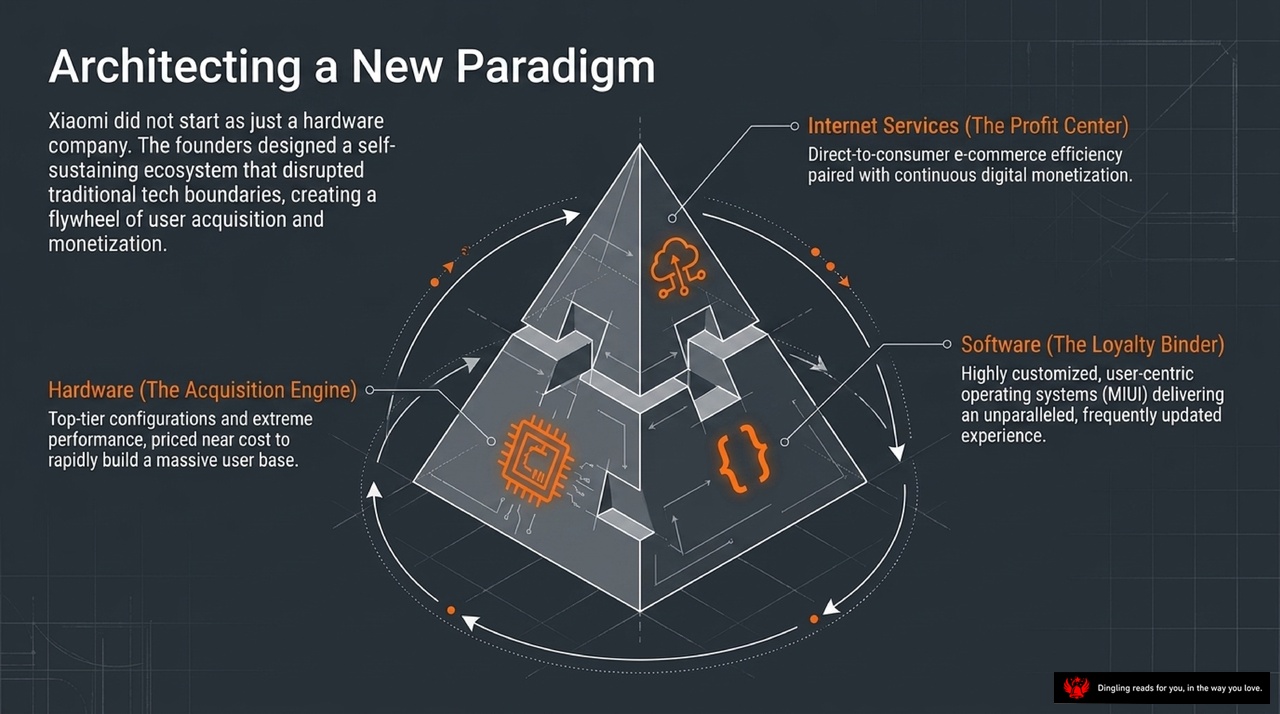
This isn't just a marketing slogan; it's a legal pledge. By capping their hardware profits at just 5%, Xiaomi fundamentally shifted the rules of the game. While other tech giants chase high margins, Xiaomi chose to use its hardware as a low-cost entry point to win users, then monetize through software and internet services. This bold commitment to "price kindness" built immense trust and loyalty, proving that a company can thrive without exploiting its customers. It stands as a powerful example of how aligning business success with user value can create a sustainable, long-term empire.

Today's slide, "Rewriting the Rules of Technology," captures the exact moment Xiaomi stopped playing by the old playbook. For decades, the traditional model was simple: maximize margins, keep secrets, and rely on expensive middlemen. But Xiaomi flipped every single one of these assumptions on its head.
Instead of charging a premium for a brand that didn't exist yet, Xiaomi priced its products at cost, betting that it could monetize later through software and services. They traded closed-door secrecy for transparent iteration, letting thousands of users help shape the product before it even launched. Rather than building siloed, proprietary products, they opened their ecosystem to incubate over 100 hardware startups. And instead of relying on a tiered distribution network that eats up profits, they went direct-to-consumer with high-efficiency experiential stores.
This wasn't just a business strategy; it was a cultural revolution. By cutting out the fat in the supply chain and putting the power directly in the hands of the user, Xiaomi didn't just sell phones—they rewrote the rules of how technology should be made and sold. This bold shift allowed them to offer flagship performance at a fraction of the price, disrupting the entire industry and proving that efficiency could be the ultimate competitive advantage.

Xiaomi didn't just change the rules of the tech game; they proved that world-class innovation and honest pricing can actually coexist. While other giants were busy extracting every possible dollar from their users, Xiaomi asked a different question: are we building a company that takes value, or one that empowers people?
The slide highlights this core truth perfectly. By showing that you don't have to choose between premium quality and fair prices, Xiaomi redefined the entire landscape. They challenged the status quo where high performance always meant high cost. Instead, they introduced a new standard where top-tier technology becomes accessible to everyone.
This shift wasn't just about selling phones; it was about changing the mindset of the entire industry. When competitors focused on maximizing profit margins, Xiaomi chose to reinvest savings into better materials and faster innovation. This approach built deep trust with consumers who were tired of being overcharged for features they already had.
Ultimately, the real story here is about the power of a company that puts its users first. In an era where tech giants often feel distant and profit-driven, Xiaomi reminded the world that technology should serve people, not the other way around. That simple yet powerful philosophy is what allowed them to rise from a startup to a global leader, proving that integrity and ambition can go hand in hand.