
No Rules Rules: Complete Chapter-by-Chapter Summary
Welcome to the first chapter of our deep dive into Netflix's culture. Today, we're looking at the title that defines everything: "No Rules Rules," by Reed Hastings and Erin Meyer. This isn't just a book about a streaming giant; it's a blueprint for how a company can thrive by doing the exact opposite of traditional corporate thinking.
The cover sets the stage immediately. We see the authors, Reed Hastings and Erin Meyer, and the subtitle: "Netflix and the Culture of Reinvention." This tells us that the secret to Netflix's success isn't rigid structure, but the ability to constantly reinvent itself. In fact, the book argues that the most effective management style is having no rules at all.
Think about it. Most companies are built on layers of bureaucracy, approval chains, and strict policies. Netflix flipped this script. They realized that true innovation comes from giving talented employees the freedom to make their own decisions, as long as they align with the company's core goals. It's a radical shift from controlling every detail to trusting your best people to do the right thing.
This philosophy of "No Rules" is the foundation for everything else we'll discuss: how they hire only the absolute best, how they pay top dollar to keep them, and how they create an environment where honesty and transparency drive performance. It's a culture built on the belief that when you empower smart, self-motivated people, they don't need a rulebook to succeed—they just need a clear vision and the trust to execute it.

Look at this split-screen comparison. On the left, we have the "Traditional Corporate" model, rigid and gray, filled with locks and strict controls. On the right, we see Netflix's "Freedom & Responsibility" system, glowing red and dynamic.
Notice how they handle expenses? Traditional companies rely on "Strict Policies & Approvals," forcing employees to jump through hoops for every penny. Netflix flips this script. Instead of a rulebook, they have a simple, powerful rule: "Act in Netflix's Best Interest."
It's about a fundamental shift in mindset. In the traditional world, you follow the rules to avoid punishment. At Netflix, you use your judgment to drive value. If you think spending money on a business class ticket will help you do your job better, you book it. If you think buying a TV on the spot will save a deadline, you do it.
But here's the critical takeaway at the bottom: You cannot simply adopt the right column. It requires an entirely new system architecture.
You can't just copy Netflix's policies; you have to build the trust, the high-performance team, and the transparency that makes those policies work. Without that foundation, freedom isn't a benefit—it's chaos. It's about moving from controlling people to empowering them to make smart decisions for the company.

The image you see here outlines what Netflix calls the "F&R Spiral Architecture"—the core engine behind their success. It's a three-step compounding loop that starts with building talent density, moves to increasing candor, and culminates in removing controls.
Let's break this down. The first step is simple but powerful: Build Talent Density. As the slide says, you must surround yourself with top performers. Netflix learned this the hard way after the 2001 dot-com bust. When they had to cut a third of their workforce, they didn't just fire anyone; they rigorously evaluated everyone and kept only the top 80. The result was transformative. In a team of high performers, excellence becomes contagious. One mediocre employee can drag down an entire group, acting like a "rat in the soup," but a room full of elites creates a self-sustaining cycle of high performance and mutual motivation.
Once you have that elite team, you move to the second step: Increase Candor. This means fostering radical transparency and feedback. In a high-density environment, you don't need micromanagement because your employees are smart enough to tell you when things are going wrong. They will speak up about mistakes or inefficiencies immediately, rather than waiting for a quarterly review. This creates a culture where problems are exposed and solved quickly, rather than hidden until it's too late.
And this leads us to the final, critical step: Remove Controls. The slide clearly states, "Eliminate policies to maximize speed." Netflix realized that when you have brilliant people and a culture of radical honesty, you don't need rigid rules, approval chains, or detailed policy manuals. You can't just delete controls overnight; you must first install the foundation of extreme talent and radical candor. Once that is in place, you can cancel vacation limits, remove expense approvals, and let employees make million-dollar decisions on the spot.
The beauty of this architecture is that it's a compounding loop. You cannot remove organizational controls without first installing the foundation of extreme talent and radical candor. If you try to give freedom to average performers without a culture of honesty, you get chaos. But when you combine high talent density with radical transparency, you create an environment where employees take massive responsibility for their choices, driving innovation and speed in ways traditional, controlled companies simply cannot match.
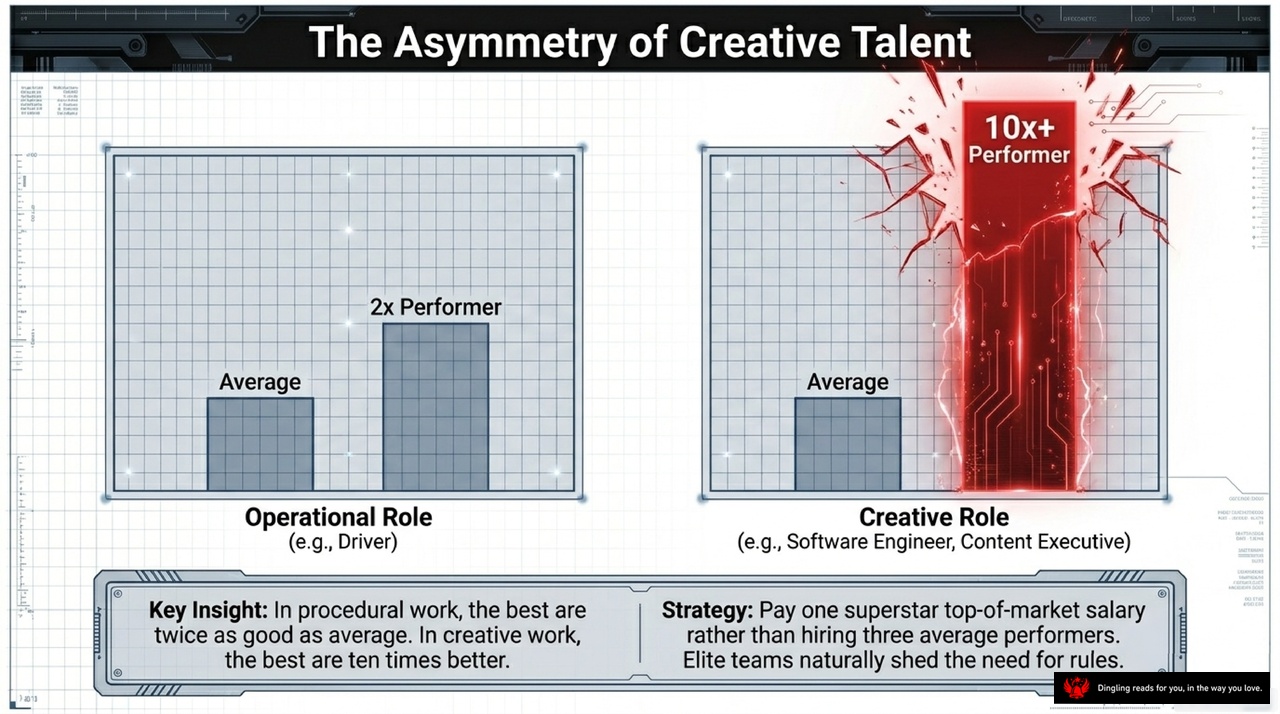
Look at this slide, "The Asymmetry of Creative Talent." It reveals a crucial truth about how we build high-performing teams: the difference between doing a job and creating something new.
On the left, we see an "Operational Role," like a driver. In procedural work, the best performer is only about twice as good as the average. The bar is modest. But look at the right side: the "Creative Role," such as a software engineer or content executive. Here, the asymmetry explodes. The top talent isn't just slightly better; they are 10 times more effective than the average. That massive gap is why we pay for it.
The key insight at the bottom explains it perfectly: in creative work, the best are ten times better. This changes our entire hiring strategy. Instead of hiring three average performers, elite teams like Netflix choose to pay one superstar a top-of-market salary. Why? Because that single genius generates far more value than a group of mediocrity ever could. As the slide notes, elite teams naturally shed the need for rigid rules. When you surround yourself with 10x performers, they drive each other to greatness, creating a culture of freedom and responsibility that simply doesn't exist with average talent.
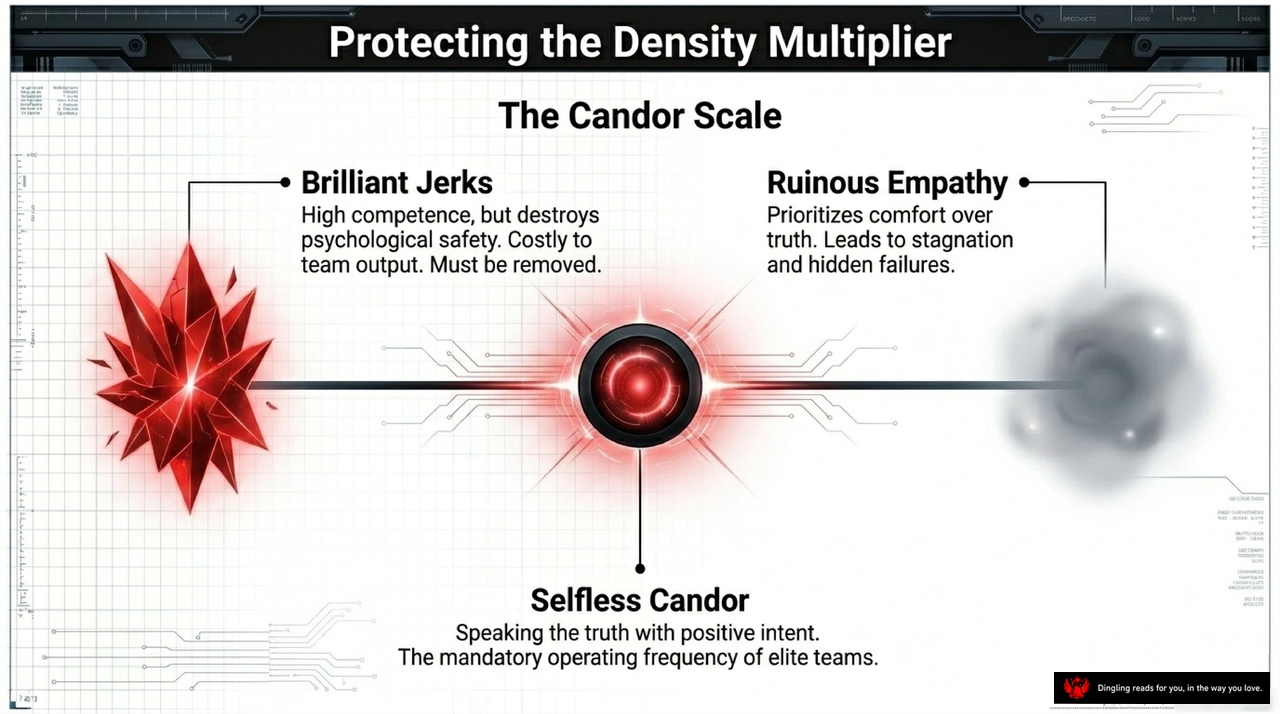
Imagine a scale balancing two extremes that destroy high-performance teams. On the left, you have "Brilliant Jerks"—individuals with undeniable competence who act as a ticking time bomb for psychological safety. They might be geniuses, but their arrogance, refusal to listen, and tendency to belittle others ultimately drive down team output. As the slide starkly warns, these people must be removed; they are the single point of failure that drags the entire ship down. On the opposite end lies "Ruinous Empathy," where comfort is prioritized over truth. This toxic kindness creates an environment of stagnation, allowing hidden failures to fester and preventing the team from ever reaching its true potential.
But what is the ideal operating frequency for an elite team? The answer sits right in the center: Selfless Candor. This is the mandatory standard for high performers. It isn't about being harsh or blunt; it is about speaking the truth with positive intent, strictly adhering to the 4A feedback criteria—helpful, actionable, and delivered with genuine care. Unlike the Brilliant Jerk who speaks to dominate or the Empath who speaks to soothe, the Selfless Cander speaks to elevate. They create a culture where psychological safety thrives because everyone knows that difficult truths are shared to help the team win, not to hurt individuals. Protecting this density multiplier means vigilantly removing the extremes and cultivating this balanced, courageous middle ground where truth and respect coexist.
Imagine a world where the rigid approval chains that slow down every other company simply don't exist. In this world, a single employee has the power to spend millions, sign binding contracts, and make strategic shifts—all without waiting for a signature from the CEO. This is the reality at Netflix, and it's built on a single, non-negotiable premise: you must hire the best people, or you don't hire anyone at all.
When you surround yourself with elite talent, you create a team that doesn't need micromanagement. Think of it like a high-performance sports team. A coach doesn't tell a star player exactly how to dribble or shoot; they set the game plan and trust the player to execute. If a player is average, they need constant instructions and supervision. But if you have a superstar, they know the rules, they understand the stakes, and they can make the right call instantly. Netflix operates on this "loose coupling" philosophy. Instead of a tightly wound system where every decision requires a chain of command, they build a flexible structure where individuals act as "informed commanders."
This freedom, however, isn't about chaos. It requires a clear "North Star" to keep everyone aligned. The leadership sets the strategic direction—perhaps it's "global growth" or "take big risks for big rewards"—and then trusts the team to figure out the execution. For example, when Netflix decided to acquire the documentary *Icarus*, the executive didn't ask for approval. He was simply given the scenario: "If you don't see the potential, don't buy it. If you do, bet big." He took the risk, spent $4.6 million, and the film eventually won an Oscar. That kind of speed and agility is impossible in a bureaucracy where you have to wait weeks for a budget approval.
But this model only works if the culture supports it. If you have great people but a culture of fear, they won't take the risks. Netflix reinforces this by making it safe to fail. If a decision goes wrong, the leader's job isn't to blame the employee, but to ask, "What did we learn?" This mindset encourages everyone to speak up, challenge ideas, and make bold moves without worrying about their job security.
However, scaling this globally adds a layer of complexity. Different cultures have different definitions of "direct." In some places, blunt feedback is seen as rude; in others, it's seen as honest. Netflix learned that while the core values of candor and responsibility are universal, the delivery must adapt. They adjusted their feedback styles for different regions—being more direct in some cultures and more nuanced in others—while keeping the ultimate goal of empowering the team intact.
Ultimately, this shift from control to context is what allows Netflix to innovate faster than anyone else. By trusting their best people to do their jobs without constant oversight, they turn every employee into a leader, every decision into an opportunity, and every failure into a lesson. It's a powerful reminder that true management isn't about controlling every detail, but about creating the conditions where great people can do their best work.

Imagine a world where you don't need permission to spend company money. In this slide, we see the bold move of "Removing Basic Controls," specifically targeting rigid "Expense & Vacation Policies." Think about it: how many times have you wasted hours on approval forms, only to realize the decision was trivial? Netflix realized that for top-tier talent, these bureaucratic hurdles are not just annoying; they are a signal that the company doesn't trust them.
Instead of micromanaging every dollar, Netflix shifted the mindset to "Act in Netflix's Best Interest." This isn't about letting employees run wild; it's about replacing rules with responsibility. The logic here is simple but powerful: high performers are self-motivated and responsible. When you remove the red tape, you rely on their judgment to make the right call—like choosing business class to stay productive, rather than economy to save a few dollars.
However, this freedom only works because of two critical foundations shown at the bottom of the slide. First, we need "The Prerequisites": a culture of self-motivation and "radical candor." In a high-performance team, peers will immediately call out anyone abusing the system. If someone tries to fake expenses, their colleagues won't stay silent; they will speak up because they care about the team's success. Second, we have "The Manager's Role." Leaders aren't gatekeepers here; they are models. If a manager wants employees to take actual vacations or spend wisely, the leader must do it first. They also act as the final audit, stepping in only when necessary to fire those who abuse the system.
This approach transforms the workplace from a place of constant surveillance into an environment of trust and agility. It empowers employees to act like entrepreneurs, making decisions that drive value without waiting for a signature. It's a shift from controlling behavior to cultivating character.
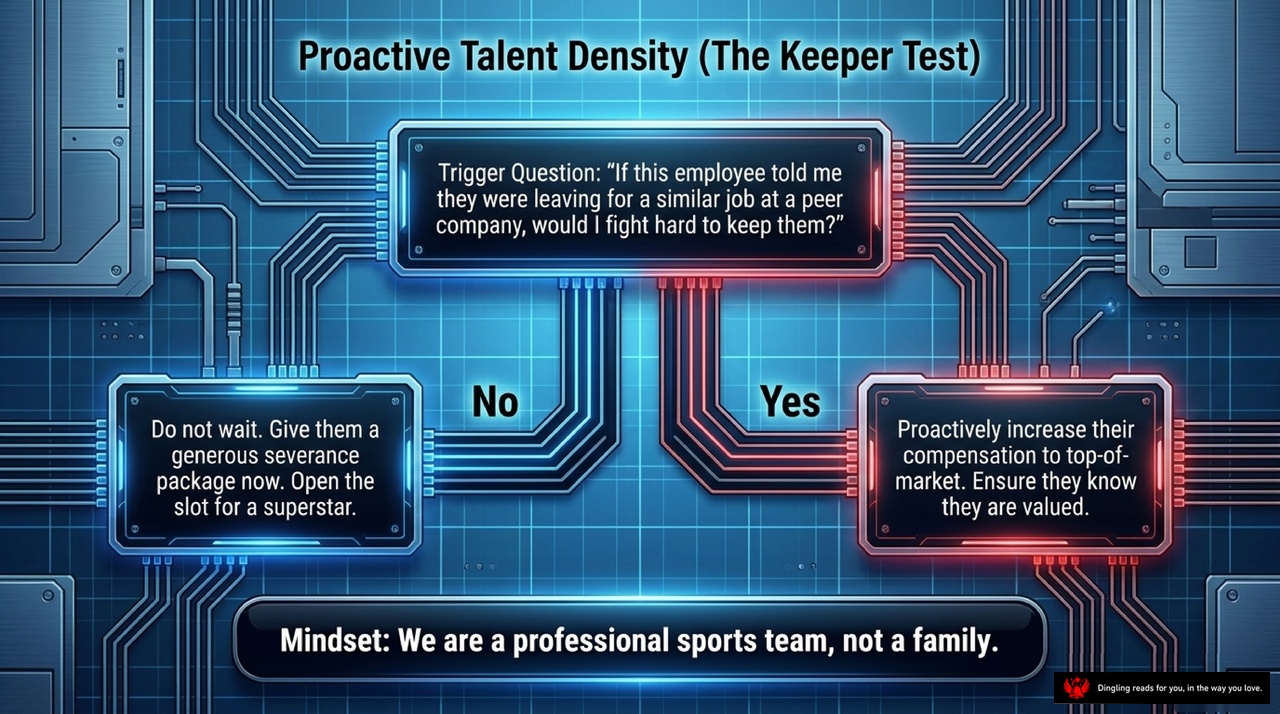
Imagine your team as a professional sports squad, not a family. In a sports team, the coach doesn't hesitate to cut a star player if they're no longer the best fit for the championship; the goal is always victory. Netflix operates on this same mindset.
The slide presents a critical tool called the "Keeper Test." Every manager must ask themselves one simple but powerful question: "If this employee told me they were leaving for a similar job at a peer company, would I fight hard to keep them?"
If the answer is "No," the logic is clear and immediate. Do not wait. Provide a generous severance package right away and immediately open that slot for a superstar. Holding onto an underperformer is like keeping a player who can't score; it drags down the entire team's performance.
If the answer is "Yes," you must proactively increase their compensation to the top of the market. Ensure they know they are valued. This isn't about hoarding talent; it's about paying the price to keep the best players on the field.
This strategy is all about maintaining high talent density. By constantly asking this question and making tough, fair decisions, you ensure that your team remains a collection of elite performers who push each other to greatness, rather than a group where mediocrity is tolerated.
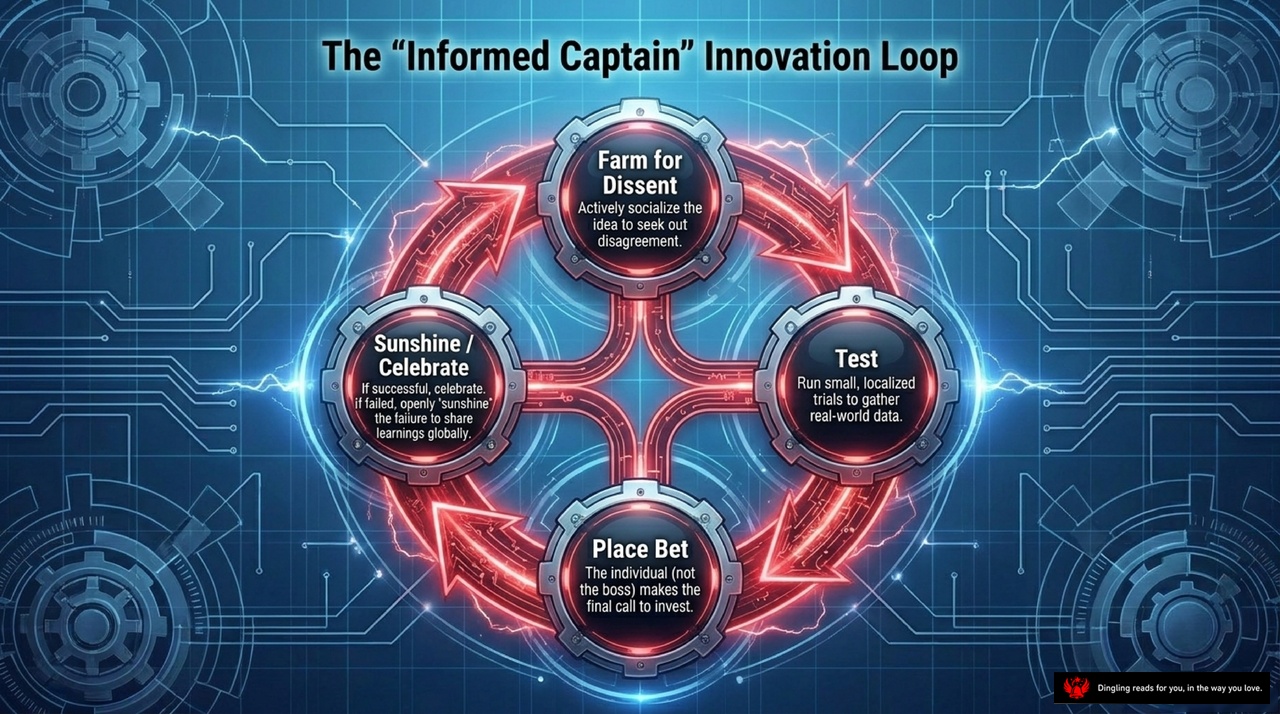
Imagine a high-tech command center where every decision flows from the front lines, not the top floor. This is the "Informed Captain" Innovation Loop, a four-step cycle that powers Netflix's unique culture. It starts at the top with **Farm for Dissent**. Instead of seeking agreement, leaders actively socialize ideas to find disagreement. Why? Because hidden objections are the biggest risk to innovation.
Once the tough questions are surfaced, the team moves to **Test**. They run small, localized trials to gather real-world data before committing resources. This prevents massive failures and keeps the company agile. If the data looks promising, the team **Places a Bet**. Crucially, this isn't the boss's call. The individual, armed with context, makes the final decision to invest. This shifts power from hierarchy to expertise.
Finally, the loop closes with **Sunshine or Celebrate**. If the bet succeeds, you celebrate. If it fails, you openly "sunshine" the results, sharing the hard lessons globally so the whole company learns. This creates a self-correcting system where no one is punished for honest mistakes, but everyone is rewarded for shared knowledge. It's a powerful engine for continuous growth.
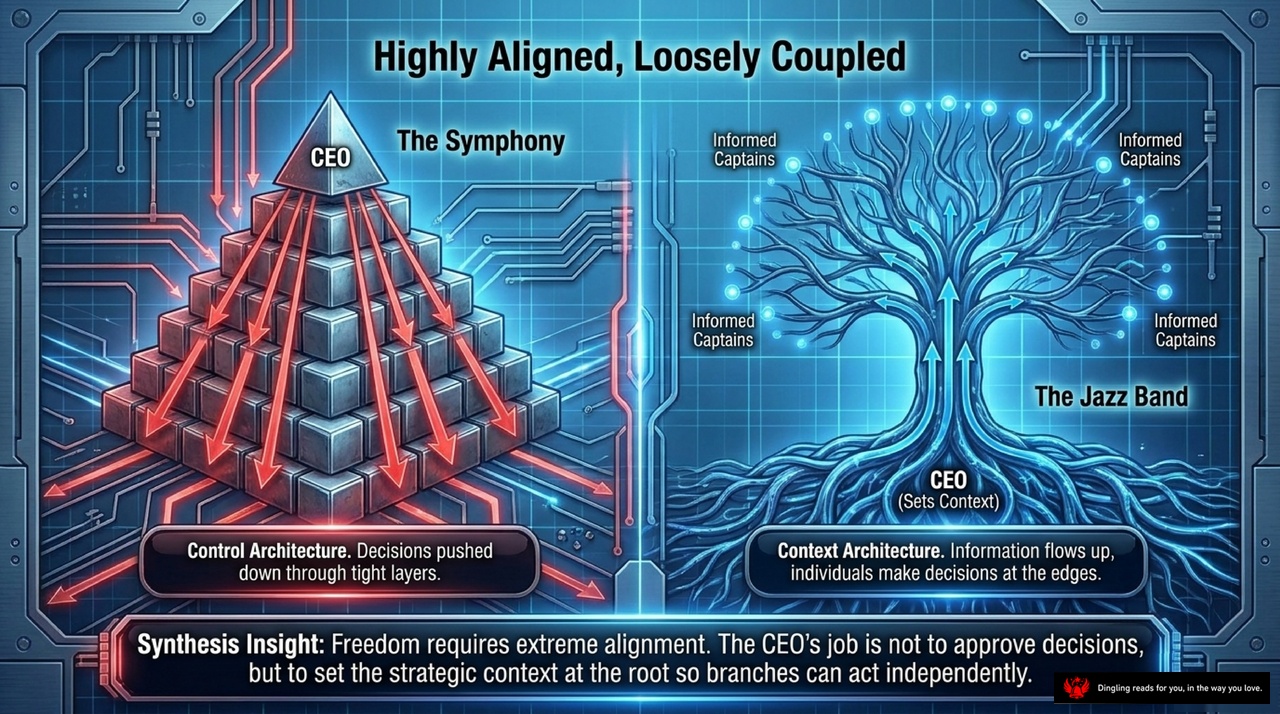
Look at this slide. On the left, we see "The Symphony"—a rigid pyramid where the CEO pushes decisions down through tight layers. That's Control Architecture. It's efficient for simple tasks, but it kills innovation because the people closest to the problem can't act.
On the right, we see "The Jazz Band"—a tree structure labeled "Highly Aligned, Loosely Coupled." Here, the CEO sets the context at the root, but informed captains make decisions at the edges. This is Context Architecture.
The synthesis insight at the bottom is crucial: Freedom requires extreme alignment. You can't just let people do whatever they want; they must be deeply aligned with the company's mission. The CEO's job isn't to approve every decision, but to set that strategic context so branches can act independently.
Think about your own team. Are you building a pyramid or a tree? If you want your employees to innovate and move fast like a jazz band, you need to stop micromanaging and start setting the right context. That's the only way to get high performance without bottlenecks.
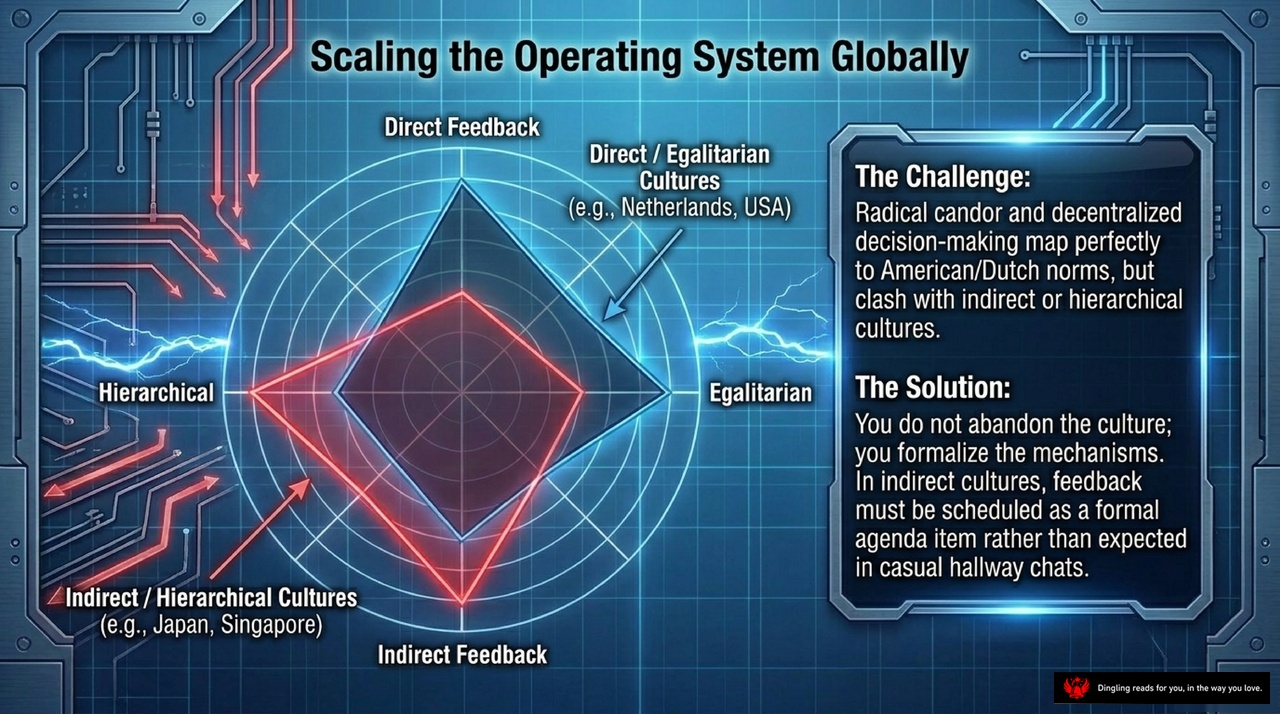
Scaling the Operating System Globally isn't just about exporting American rules; it's about engineering a feedback loop that works across different cultural DNA. Look at that radar chart: on one side, you have Direct, Egalitarian cultures like the US or Netherlands, where candor flows freely in hallway chats. On the other, you have Indirect, Hierarchical cultures like Japan or Singapore, where feedback is expected to be subtle and scheduled.
The challenge here is obvious: Radical candor maps perfectly to American norms but crashes into hierarchical ones. If you try to force direct feedback on an indirect team, it doesn't just fail—it creates friction. So, what's the solution? You don't abandon your culture; you formalize the mechanism. In indirect cultures, feedback must be scheduled as a formal agenda item rather than expected in casual moments. This isn't about changing who you are; it's about creating a safe container for the truth so that your global operating system can actually run.

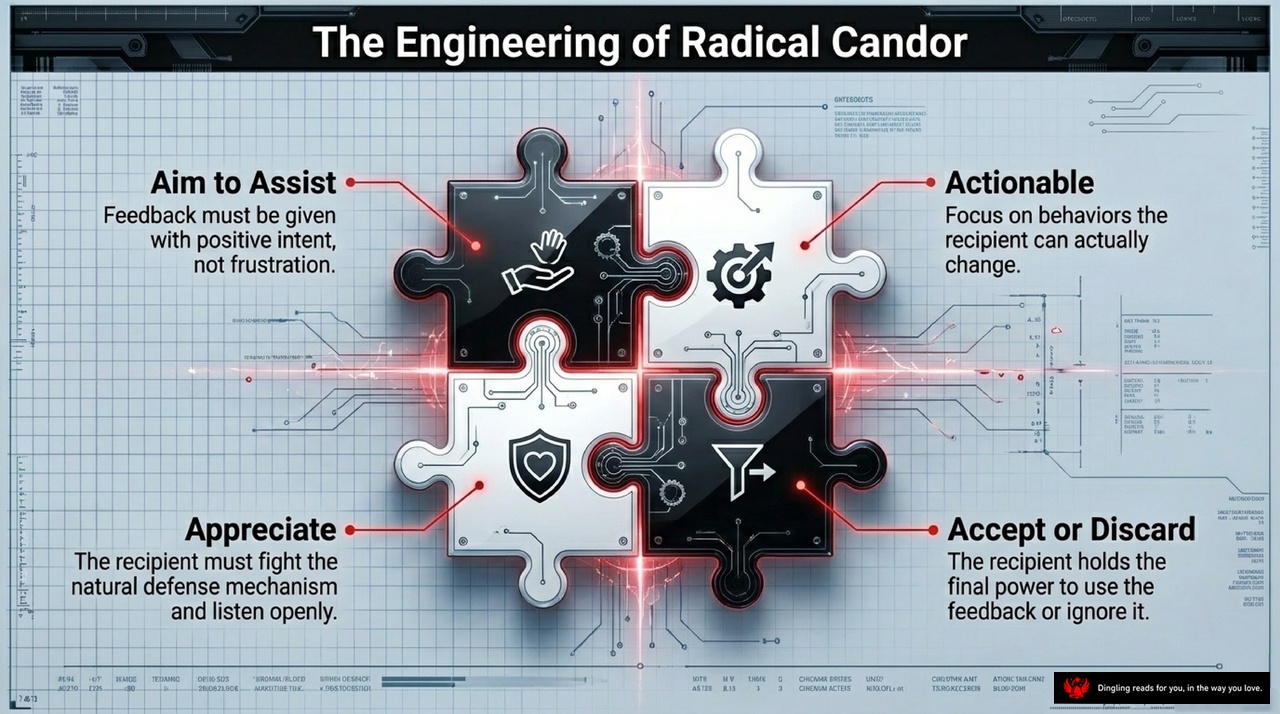
Look at this gear system on the screen. It visualizes the "5th A" for global scale, which is **ADAPT**. This stands for **Adjusting your delivery and reaction to the cultural context**. It's the critical piece that makes our global strategy work.
Surrounding this central gear are four others: **Aim to Assist**, **Actionable**, **Accept or Discard**, and **Appreciate**. These form the foundation of our feedback culture, but they don't work the same way everywhere.
As we expand globally, we hit a reality check. What feels like a mild suggestion in New York could be perceived as a devastating reprimand in Tokyo. If we just copy-paste our American feedback style, we risk shutting down communication or causing unnecessary offense. That's why **calibration is mandatory**.
We can't just be blunt everywhere. In indirect cultures, we need to soften our delivery, perhaps by praising first or using a gentler tone, while still keeping the core message clear and actionable. We aim to assist, not to criticize. By flexing our approach to fit the local context, we ensure our feedback is received as intended, allowing our high-performance culture to thrive across borders without creating friction.
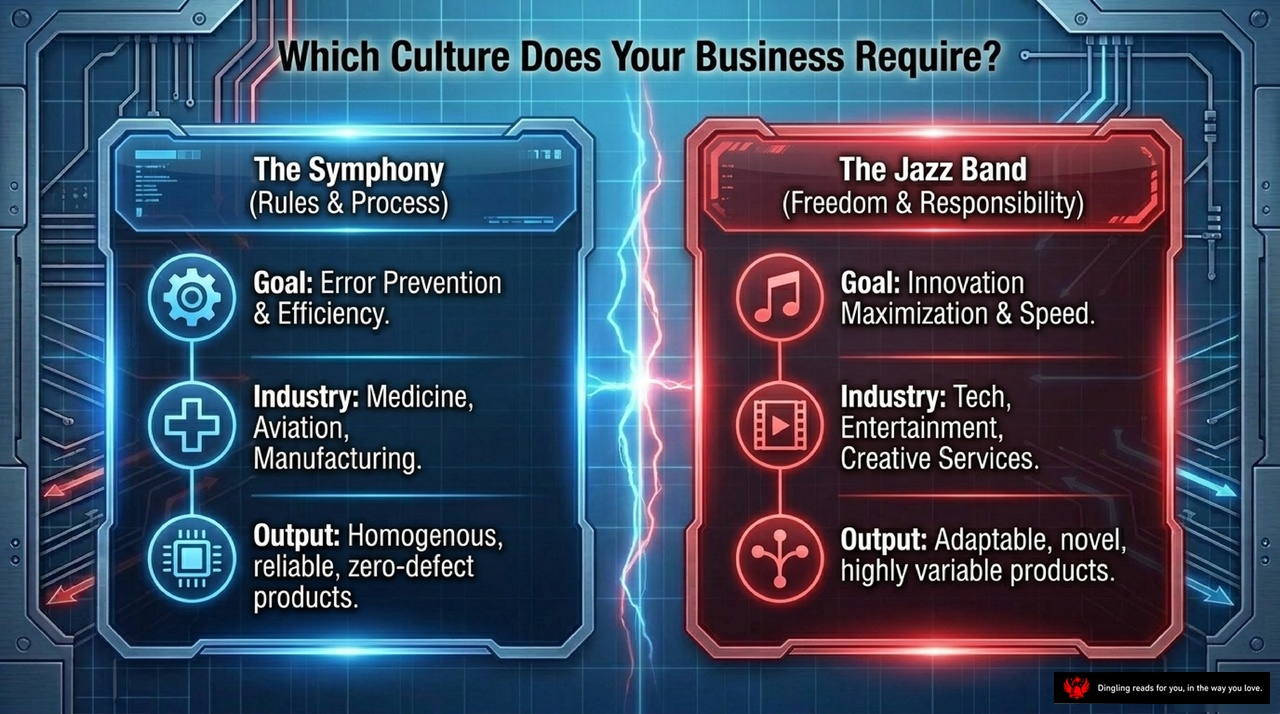
Which culture does your business actually require? The answer isn't one-size-fits-all; it depends entirely on what you're trying to build.
On the left, you have "The Symphony." This is the culture of rules and process, designed for industries like medicine, aviation, and manufacturing. Here, the goal is error prevention and efficiency. You need homogenous, reliable, zero-defect products. Think of it as a tightly orchestrated piece where every instrument plays its exact part at the exact time. If you deviate from the score, the result is chaos and potential danger.
On the right, you have "The Jazz Band." This represents a culture built on freedom and responsibility, essential for tech, entertainment, and creative services. The goal here is innovation maximization and speed. You need adaptable, novel, and highly variable products. In this environment, you don't follow a rigid sheet music; you improvise. You need people who can think on their feet and create something unique in the moment.
The key takeaway? Don't force a symphony mindset onto a jazz band. If you are in a creative industry, strict rules and process controls will kill your innovation. You need to empower your employees with the freedom to experiment, knowing that their responsibility is to act in the company's best interest. Conversely, if safety and precision are paramount, you need the structure of a symphony. Choose the culture that matches your output, or you will fail.

Imagine a world where your company isn't a symphony orchestra, meticulously rehearsed to prevent a single wrong note, but rather a jazz band improvising to invent the future. This is the fundamental choice Netflix makes between control and freedom.
To make this work, they follow a clear, three-step evolution. First, you must **maximize talent density**. You don't just hire anyone; you hire the absolute best, paying them top market rates so they don't leave. Why? Because one superstar is worth more than a dozen average workers, and their presence alone raises the standard for everyone around them.
Second, you must **engineer radical candor**. In a high-performing team, you don't hide problems behind polite lies. You give direct, helpful feedback, and you admit your own mistakes loudly and quickly. This creates an environment where truth travels faster than bureaucracy, and problems get solved before they become crises.
Finally, and most importantly, you must **remove controls**. Once you have the best people and a culture of honesty, you stop micromanaging. You cancel approval processes for travel, expenses, and even major decisions. You give employees the freedom to act like entrepreneurs, trusting them to use company resources wisely because they care about the outcome, not just following a rulebook.
But this freedom isn't chaos; it's a cycle of responsibility. When you trust your team, they rise to the occasion. They take bold risks on content, they optimize spending without needing a signature, and they innovate without waiting for permission. The result? A company that moves faster than anyone else, constantly creating the future instead of just protecting the past.