
Noise: Complete Chapter-by-Chapter Summary

Welcome to the book club for "Noise: A Flaw in Human Judgment" by Daniel Kahneman, Olivier Sibony, and Cass R. Sunstein.
Imagine a target with four teams shooting at it. Team A hits the bullseye with perfect precision. Team B consistently misses to the left; that's a systematic bias. But look at Team C. Their bullets scatter wildly in all directions, hitting nowhere near the center, yet there's no common direction to their error. That is noise. And Team D? They have both bias and noise.
This simple metaphor captures the core flaw in our thinking. While we often obsess over bias—like everyone aiming at the wrong target—we ignore noise, which is the unnecessary variation between judgments. Even if two doctors aim at the same patient, or two judges face the same crime, their results can be wildly different. This isn't just a minor inconsistency; it's a systemic error that corrupts professional judgment across medicine, law, business, and education.
This book is a groundbreaking exploration into that unseen variability and the structural frameworks required to systematically eradicate it. We're going to uncover how this invisible flaw affects everything from life-and-death decisions to your daily choices, and how we can start fixing it.
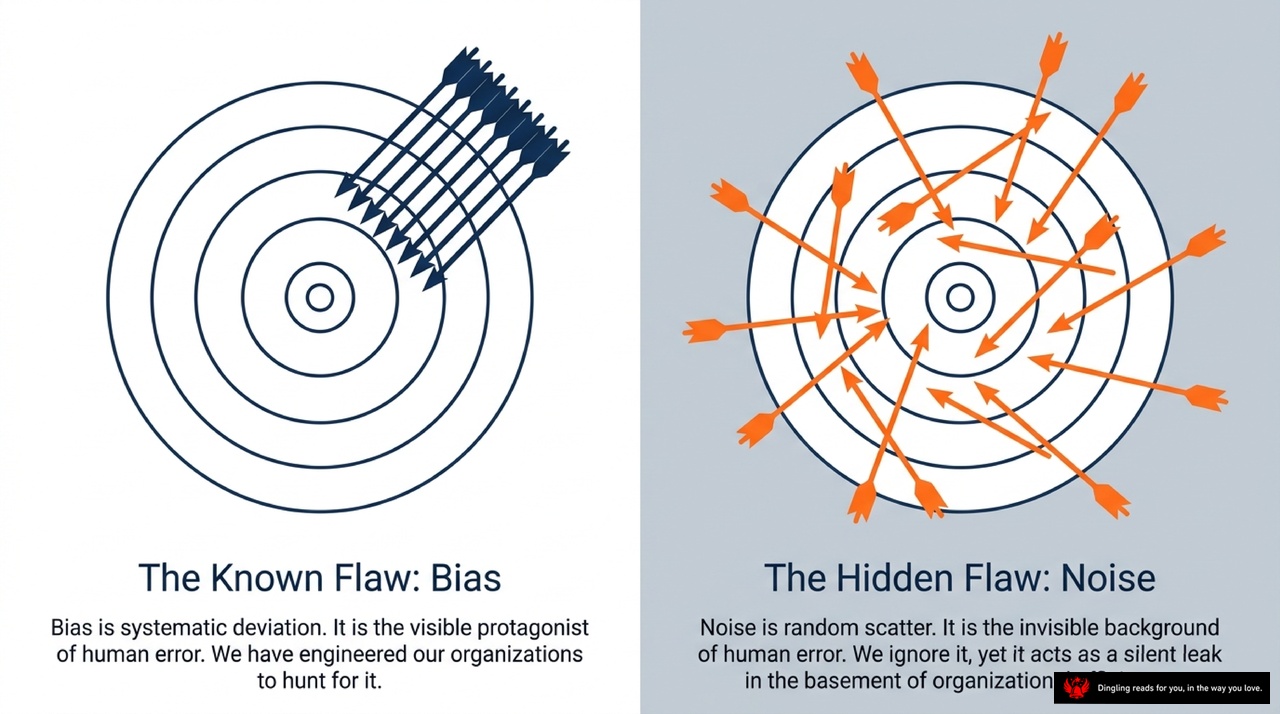
Look at this classic target analogy. On the left, we see "The Known Flaw: Bias." Notice how all the arrows hit the same spot, but it's off-center. This represents systematic deviation. It's visible, predictable, and we've spent decades engineering our organizations specifically to hunt for it. We know where the error is pointing.
Now, look at the right side. This is "The Hidden Flaw: Noise." Here, the arrows are scattered all over the target. They aren't hitting the same off-center point; they are missing the bullseye in completely different directions. This is random scatter. It's the invisible background of human error. We tend to ignore it, yet it acts as a silent leak in the basement of our organizations, draining value without us ever noticing.
The core message here is that while bias is a villain we can name and fix, noise is a chaotic force that makes even our best experts unreliable. In the real world, this means two doctors might diagnose the same patient differently, or two judges might sentence the same crime to vastly different lengths. It's not just about aiming the wrong way; it's about everyone missing the mark in their own unique, unpredictable way. To build fairer and more accurate systems, we have to stop obsessing only over bias and start tackling the invisible chaos of noise.

Imagine four teams shooting at a target. One team hits the bullseye every time—accurate. Another consistently misses to the left—biased. A third team's shots scatter wildly all over the place, with no clear direction—noisy. And the fourth mixes both errors. This visual perfectly captures the core distinction between bias and noise. Bias is a predictable error, like aiming at the wrong spot. Noise, however, is unpredictable variation. It's when everyone aims at the same target, yet the bullets land in a chaotic mess.
Here is the key insight from the slide: you can recognize and measure noise without even knowing where the target is, or whether anyone is biased. You just have to look at the scatter. If the dots are tightly clustered, your system is reliable. If they are spread out, noise is destroying your accuracy.
This concept applies everywhere. Think of doctors diagnosing the same patient, judges sentencing similar crimes, or investors valuing the same stock. Even without knowing the "correct" answer, you can see the problem immediately. If ten doctors give ten wildly different diagnoses for the same condition, that's noise. It doesn't matter if they are all wrong in the same direction (bias); the lack of agreement is a critical failure.
In the real world, this scatter causes massive harm. It leads to unfair prison sentences, missed cancer diagnoses, and inconsistent hiring decisions. The solution isn't just to aim better (fix bias); it's to stop the bullets from scattering in the first place (reduce noise). By simply looking at how much our judgments vary, we can measure the hidden cost of inconsistency and start building systems that are fairer and more accurate.

The illusion of agreement is one of the most dangerous traps in professional judgment. We often look at an average and assume fairness, but averages are deceptive. They hide the chaotic reality underneath.
Imagine a courtroom where the average sentence for a crime is five years. On the surface, that sounds consistent. But look closer at what's happening below the surface. In one case, a criminal gets seven years. In another, with similar circumstances, a different criminal gets only three years. The math balances out to five, but the justice is completely compromised.
This is the core problem with noisy systems: errors do not cancel each other out. When you have too much noise, the individual injustices don't disappear just because the average looks okay. Instead, they mask the truth that operational precision has been destroyed. A criminal might face a drastically different fate simply because of who happens to be the judge that day, or what their mood was at the moment.
We need to stop trusting the average and start demanding precision for every single individual case. Because in a noisy system, fairness isn't about the group average; it's about ensuring that no one is left in the dark, and that justice isn't just a matter of luck.

The chart you see here breaks down the hidden architecture of "System Noise." Think of it as a map of where our judgment goes off track. At the top, we have System Noise itself—the total messiness in how we make decisions. This messiness splits into two main branches: Level Noise and Pattern Noise.
Level Noise is about the difference between people. It's the variation between different individuals. Imagine one judge is naturally stricter than another; that's a stable difference in their baseline. It's like using two rulers with different scales to measure the same object; you'll get different numbers not because the object changed, but because the tools are different.
Then, moving to the right, we have Pattern Noise. This is about how people react to specific cases. It's the variation in how we handle different situations. Under Pattern Noise, the slide highlights two critical sub-components. First, there's Stable Pattern Noise. This refers to consistent personal quirks and unique cognitive styles. It's the fact that some of us naturally prioritize certain factors over others, creating a distinct fingerprint in our decision-making that stays the same across time.
The second component is Occasion Noise. This captures transient external factors—things like mood, weather, or fatigue. These are temporary shifts that make even the same person inconsistent on different days. It's the human element that fluctuates.
The key takeaway from this diagram is that noise isn't just random chaos. It's structured. It comes from who we are as individuals, how we process specific types of problems, and the temporary state we're in right now. Understanding these three layers—Level, Stable Pattern, and Occasion—is the first step to actually fixing the errors in our judgment.
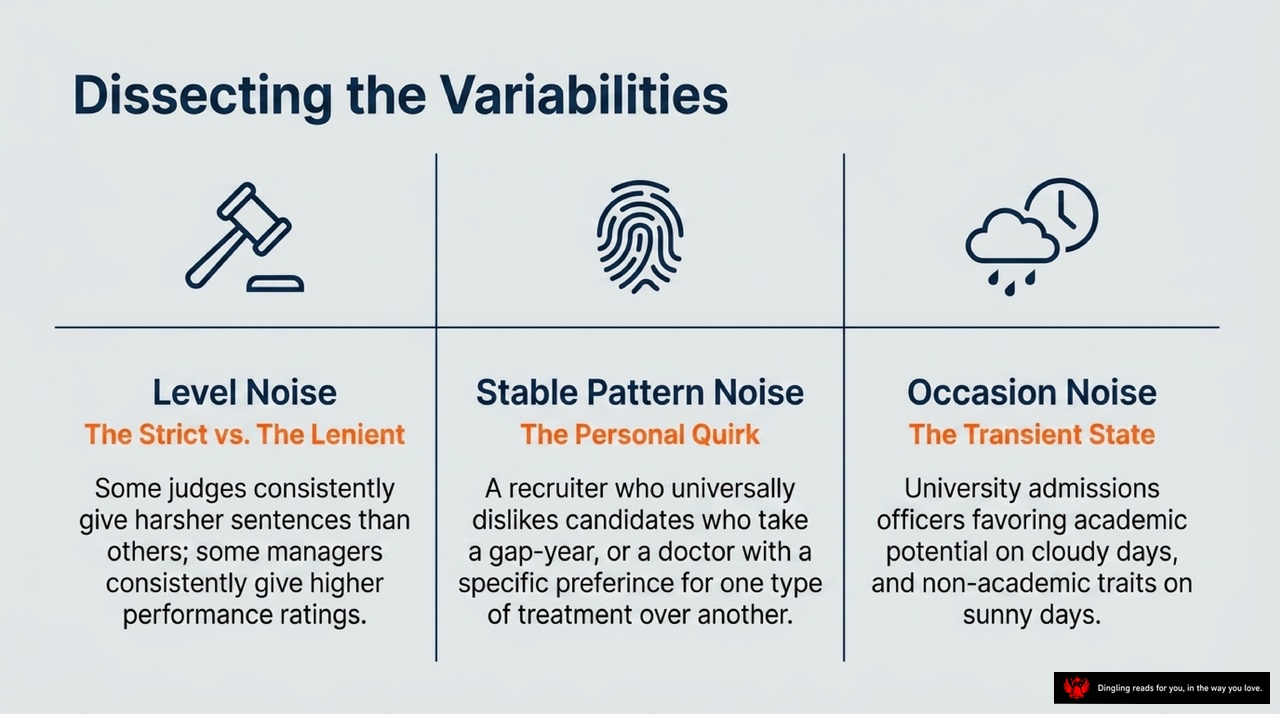
Imagine you're on a jury, tasked with sentencing a criminal. Now, picture two different judges handling the exact same case. One might hand down a sentence of 15 years, while the other gives just 30 days. This isn't about the severity of the crime; it's about the invisible noise in our judgment system. Today, we're dissecting these variabilities to understand where they come from.
Our slide breaks this down into three distinct types of noise. First, we have Level Noise, often called "The Strict vs. The Lenient." Think of it like different judges having different baselines. Some are naturally harsher, consistently giving heavier sentences or higher performance ratings, while others are more lenient. It's like measuring the same object with two rulers that have different scales.
Next is Stable Pattern Noise, or "The Personal Quirk." This is about how individuals react differently to specific situations. A recruiter might universally dislike candidates with a gap year, while another loves them. Or a doctor might prefer one type of treatment over another. This isn't about being generally strict or loose; it's about having a unique, stable preference for certain types of cases.
Finally, we have Occasion Noise, labeled "The Transient State." This is the noise that happens to us all from time to time. It's about how our mood, fatigue, or even the weather affects our decisions. A university admissions officer might favor academic potential on cloudy days but switch to valuing non-academic traits on sunny days.
The scary truth is that all three of these factors are at play every single time we make a professional judgment. Whether you're a doctor diagnosing a patient, a judge sentencing a defendant, or a manager evaluating an employee, these variabilities are silently distorting your results. Recognizing them is the first step to building a fairer, more accurate decision-making process.

Imagine you're looking at four different industries, and what you see might shake your confidence in experts. In medicine, we have a startling reality: experts reading the exact same X-rays months apart often contradict their own initial diagnoses up to 92% of the time. In law, forensic experts examining the identical fingerprint can reverse their match decision just because they are given misleading background context.
Move to HR and hiring, and the numbers drop even further. Unstructured interviews have near-zero predictive validity. Essentially, these interviews are lotteries based on first impressions and random noise. Finally, look at business forecasting. Software developers estimating completion times for the exact same task two days apart show a massive 71% variance in their estimates.
These aren't just minor errors; they represent a systemic cost of noise across every industry. The takeaway is clear: even with high-level expertise, human judgment is incredibly fragile. Whether you are diagnosing a patient, sentencing a defendant, or hiring a new employee, the variation between different experts is often far greater than we care to admit.

Look at this graph. It perfectly captures a psychological trap we all fall into: the illusion of predictability.
The jagged orange line represents reality. It's messy, unpredictable, and full of surprises. But look at the straight dashed line underneath it. That's hindsight. Once an event happens, our brains love to draw that smooth line, making the outcome look inevitable as if it was always on track. This is the "Valley of the Normal." We mistake the smooth line we draw in retrospect for the path we actually saw coming.
This leads to a dangerous result. Because we can easily explain the past, we falsely believe we can predict the future. We ignore a hard truth called "Objective Ignorance." We think we have the answers, but we are actually tolerating highly noisy judgments. Our brains erase the memory of that initial uncertainty, making us feel confident when we're actually just guessing.
The lesson here is simple but vital: just because we can make sense of history doesn't mean we can foresee the future. We need to stop trusting that smooth line and accept the messy, unpredictable nature of reality.

Imagine a seesaw balancing two very different ways of making decisions. On one side, we have "Clinical Human Judgment." It's messy, complex, and tries to weigh every subtle nuance. But here's the catch: because humans are so vulnerable to noise—like having a bad morning or getting distracted by irrelevant details—this side often tips lower in predictive accuracy. On the other side sits "Simple Mechanical Models." These rely on basic rules with equal weights applied mechanically. They have zero noise. Because they don't have bad mornings or emotional fluctuations, they universally outperform human experts.
The image at the bottom captures this perfectly: "Algorithms don't have bad mornings." This simple truth is the game-changer. While experts might feel confident in their intuition, their judgment is often distorted by temporary states, fatigue, or mood swings. Simple models, however, remain rock-stable. They strip away the human error that plagues our best intentions, proving that sometimes, the simplest approach is actually the most powerful.

Imagine you wash your hands every morning. You don't need to know exactly which specific germ will make you sick. You just perform a simple, preventative action to stop invisible threats before they cause infection. This is the power of "Decision Hygiene."
Now, let's apply that same logic to how we make decisions. Just like your hands, our judgments are constantly exposed to unseen noise. This noise isn't about whether we are right or wrong in a specific direction; it's about the chaotic, unnecessary variation that creeps into our thinking. Whether it's two doctors diagnosing the same patient, two judges sentencing the same crime, or two recruiters evaluating the same candidate, these invisible differences corrupt our judgment just as germs corrupt our health.
The slide illustrates this perfectly. On the left, we see a cloud of chaotic orange dots representing this unseen noise. In the middle, we have a structured wall—our "Decision Hygiene." This represents the preventative, structural defenses we build into our processes. By implementing these checks, we stop that chaotic noise from passing through and corrupting our final decisions. On the right, we see a clean, organized grid of white dots. This is the result: consistent, reliable judgment that isn't distorted by hidden variables.
The reality is that we often ignore this noise, thinking our professional intuition is always consistent. But without these structural defenses, the invisible errors accumulate, leading to unfair outcomes, wasted resources, and a loss of trust. The cure isn't to predict every single error, but to build a system that filters out the chaos before it ever reaches our conclusion.

So, we've established that noise isn't just a random glitch; it's a structural flaw in how we make decisions. But here's the hard truth: we often don't even know it's there.
Look at this diagram. It outlines the "Six Pillars of Decision Hygiene"—a toolkit to clean up our judgment process. Let's break down how these pillars actually work in practice.
First, notice **Sequence Information** and **Independent Judgments**. We've learned that noise thrives on social pressure and early consensus. That's why the first two pillars are about isolation. By revealing data sequentially and forcing people to judge independently before discussing, we prevent the "information cascade" where everyone just follows the crowd.
Next, we have **Wisdom of Crowds** and **The External View**. These remind us that individual intuition is often noisy. Instead of relying on gut feelings, we should aggregate independent estimates to cancel out the noise and anchor our judgments in base rates and statistics rather than our own biases.
Then, consider **Relative Scaling**. We've seen how using vague scales like "high anger" or "good performance" creates massive noise because everyone interprets them differently. These pillars push us to use comparative judgments—comparing A to B—instead of trying to assign absolute labels.
Finally, **Structured Decomposition**. Complex problems are where noise hides best. By breaking a big, messy issue into smaller, factual sub-components, we make the noise visible and manageable.
Think of these six steps not as rigid rules, but as a hygiene routine. Just like washing your hands prevents invisible germs, applying these pillars helps you wash away the invisible noise in your decisions. It's about building a system where the truth has a better chance of winning.

The Power of the Independent Crowd isn't just about gathering opinions; it's about mathematically engineering better decisions. Look at this funnel. On the left, we have chaos—scattered, noisy arrows representing independent judgments. But as they enter the funnel, something powerful happens.
First, we have Mechanic 1: External Crowds. The text tells us that averaging just four truly independent judgments mathematically shrinks noise variance by half. It's a simple but profound truth: diversity of thought acts as a filter, canceling out individual errors to reveal the signal.
But what if you can't ask others? That's where Mechanic 2 comes in: The Crowd Within. If you can't consult a team, you must consult yourself twice. The slide suggests delaying a second guess by three weeks or forcing yourself to argue against your initial assumption. This creates a high-quality "second opinion" from your own brain, effectively simulating that external crowd and reducing the noise before you even make a final call.

Let's talk about how we actually make complex judgments. On the left, we see the unstructured approach, which creates high noise. Think of it like a traditional holistic interview where someone just says, "I have a good feeling about this candidate." It relies on vague intuition, making it highly vulnerable to halo effects and random distractions. There's no structure, just a swirling cloud of subjective impressions.
Now, look at the structured approach on the right, which aims for zero noise. Instead of guessing, we decompose the judgment. We break it down into specific, isolated traits—like appearance, pulse, grimace, activity, and respiration—and score them independently on a rigid grid. We only allow a final holistic evaluation after these specific scores are locked in. This method forces us to look at the data rather than our gut feelings, significantly reducing the chaos that leads to unfair or inconsistent decisions.

Let's talk about how we actually make decisions. We often think our judgment is a straight line, but the reality is more like a scatter plot. Imagine a team trying to hit a target. Ideally, everyone's shot lands right on the bullseye. But in the real world, things get messy. Sometimes everyone aims in the same wrong direction; that's what we call **bias**. But often, everyone is aiming at the right spot, yet their shots land all over the place. That's **noise**.
This slide outlines exactly how we can fix that chaos using what we call the **MAP Blueprint**, or the Mediating Assessments Protocol. It's a five-step process designed to bring order to our messy judgments.
It starts with **Step 1: Define Traits**. Before we even make a single judgment, the team needs to agree on exactly what dimensions matter for success. We can't just guess what's important; we need a shared standard.
Once we have those standards, we move to **Step 2: Independent Scoring**. This is the critical moment. Each team member scores the dimensions individually, and here is the rule: absolutely no talking. No sharing opinions, no trying to influence each other. We need to capture everyone's raw, unfiltered perspective first.
Next, in **Step 3: Reveal Data**, we plot the variance. We look at the scores side-by-side to see where the disagreement lies. Who thinks the candidate is a 5, and who thinks they are a 2? We need to visualize the gap.
Then comes **Step 4: Discuss Variance**. This is where the magic happens. We talk, but we talk *only* about why the scores differ on specific traits. We focus on the evidence, not on personalities or status. We ask, "What specific fact led you to give that higher score?"
Finally, we reach **Step 5: Final Judgment**. Only after all this structured data is mapped do we apply human intuition to make the holistic call. By separating the raw data from the final decision, we ensure that our final judgment is grounded in reality, not just the loudest voice in the room. This protocol turns subjective guessing into a structured, fair, and accurate decision-making process.

We've spent decades engineering our organizations to relentlessly hunt for bias. We obsess over correcting the obvious, the directional errors where everyone aims at the same wrong target. But here's the uncomfortable truth: we remain dangerously blind to the arbitrary, silent scatter of system noise.
Look at the text on your screen. We are so focused on bias that we ignore the invisible lotteries currently deciding the fate of your organization. These aren't just random mistakes; they are systematic variations that creep into every professional judgment.
Think about it: in a courtroom, why does one defendant get 15 years for a minor offense while another gets 30 days for a similar crime? In hiring, why does one candidate get rejected while another gets the job, based solely on which interviewer is having a good day? In medicine, why do different doctors prescribe completely different treatments for the same patient?
These are the invisible lotteries. They happen because we rely on human judgment, which is inherently noisy. We assume our experts are consistent, but often, their judgments vary wildly without any logical reason. This noise isn't just a nuisance; it leads to unfair outcomes, wasted resources, and lost trust.
The question isn't whether this exists—it does. The question is: how many of these invisible lotteries are running your organization right now? If you don't measure and manage this noise, it will continue to dictate your results, often in ways you never see coming.