
Nonviolent Communication: Complete Chapter-by-Chapter Summary
Welcome everyone. Today, we’re exploring Marshall B. Rosenberg, Ph.D.’s Nonviolent Communication. As the cover shows, this is a paradigm-shifting framework for dismantling defensive walls and building windows of empathy in human relationships.
Rosenberg’s core intention was to help us break through the pain that language often causes. We frequently use words to hurt or distance ourselves, but here, we learn to rebuild a sincere connection with ourselves and others. It’s about making genuine giving the foundation of how we communicate.
Whether in our personal lives or professional settings, this approach invites us to shift from judgment to understanding, from conflict to connection. Let’s explore how this can transform our daily interactions.
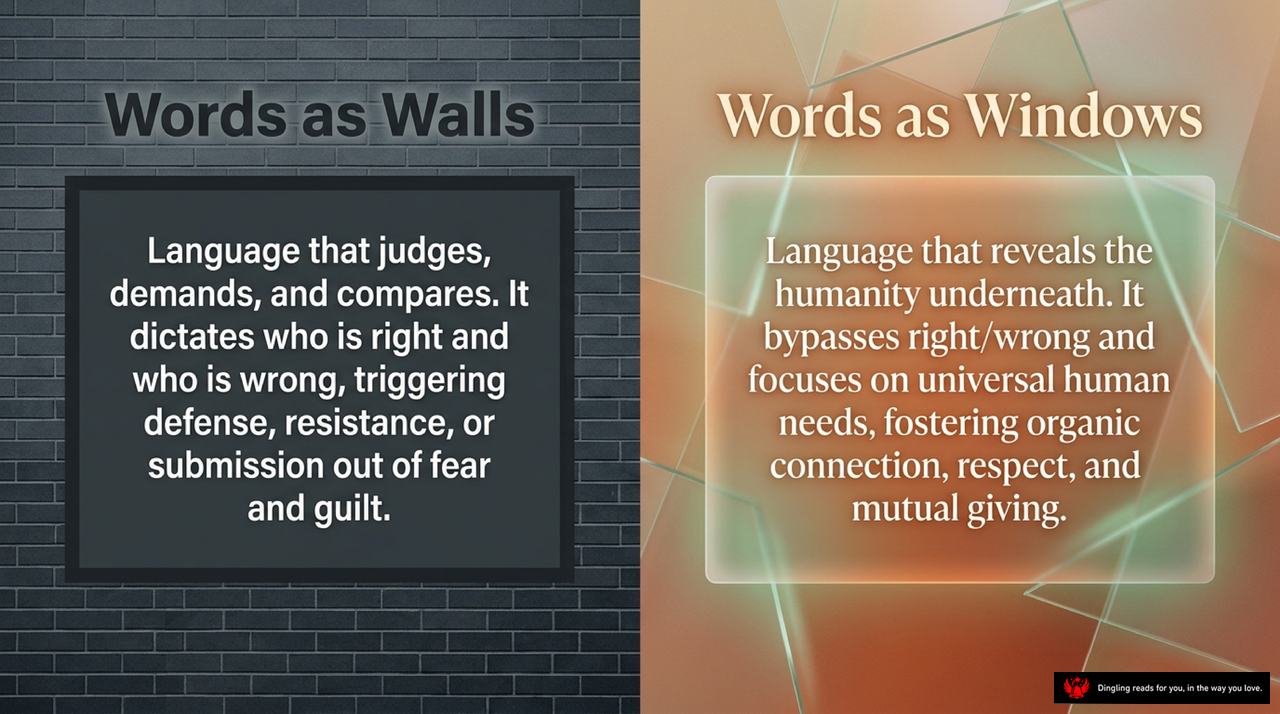
Look at this image. It captures the very heart of how language shapes our relationships. On the left, we have "Words as Walls." This is the language we often fall into without realizing it. It's language that judges, demands, and compares. It constantly tries to dictate who is right and who is wrong. When we do this, we aren't connecting; we're triggering defense. We push the other person into a corner, forcing them into resistance or submission out of fear and guilt. It builds invisible barriers between us, making it impossible for true understanding to happen. This is what the book calls "alienating life communication." It roots itself in a belief that people are either good or bad, which creates a hierarchy of power.
But look at the right side. "Words as Windows." This is what Nonviolent Communication is all about. It's language that reveals the humanity underneath. Instead of focusing on who is right or wrong, we focus on universal human needs. When we speak from this place, we bypass the need to win or blame. We foster organic connection, respect, and mutual giving.
Think about it. When we speak from judgment, we are building walls that separate us from each other. We are protecting our own image at the expense of our relationship. We are trapped in a cycle of accusation and defense. But when we speak from needs, we are opening windows. We allow light in. We show that behind every behavior, there is a person with unmet needs, just like us.
This shift is the essence of Nonviolent Communication. It's not about being nice; it's about being real. It's about moving from a mindset of separation to a mindset of connection. It helps us break through the pain that language often brings and rebuild a sincere connection with ourselves and others. The text reminds us that we often use language to alienate life, but we have the power to transform it.
When we choose words as windows instead of walls, we don't just change how we speak; we change how we relate to the world. We create a space where understanding can actually happen, where everyone feels seen and valued. It transforms conflict into collaboration. It turns a conversation into a bridge. This is the power of shifting our attention from "what is wrong" to "what we need." It's a choice we make every time we speak. And that choice determines whether we are building a wall or opening a window. Ultimately, it's about whether we want to be right, or whether we want to be connected.
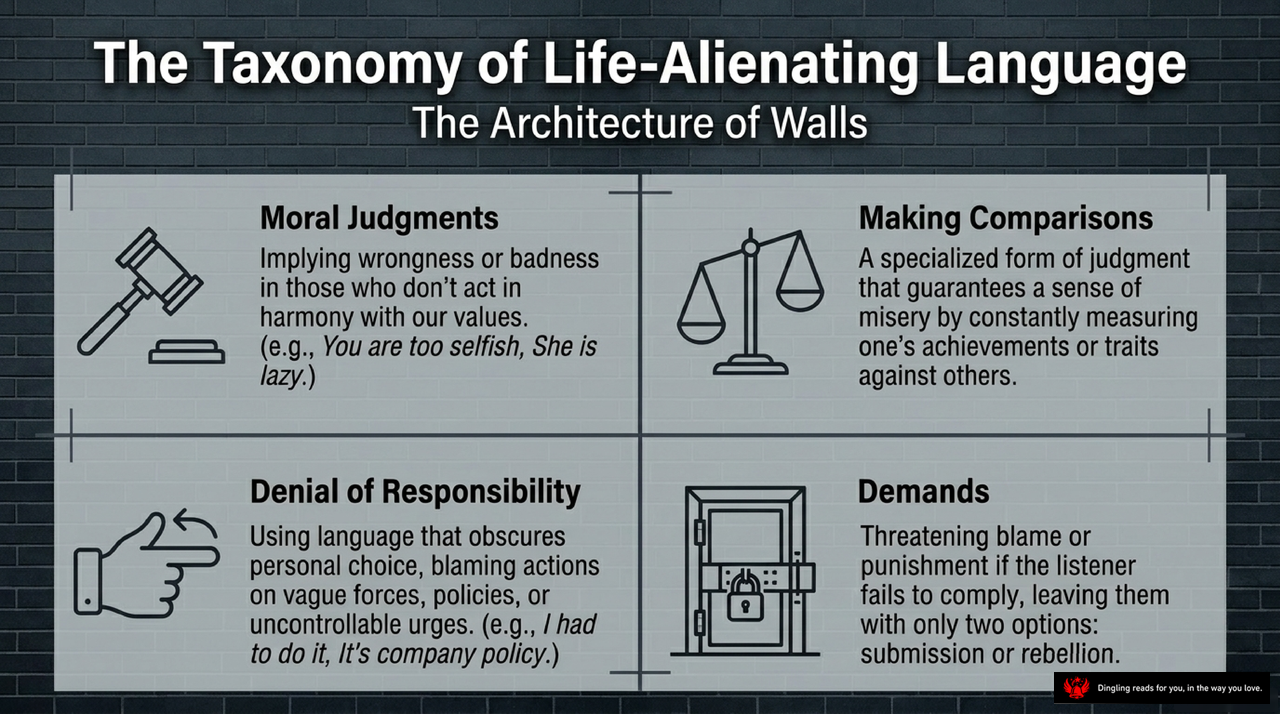
Have you ever walked into a conversation and felt like you were building a wall instead of a bridge? It happens more often than we realize. Today, we're looking at the architecture of those walls. This slide outlines the taxonomy of life-alienating language—the four main ways our words disconnect us from each other and create conflict. These aren't just bad words; they are the invisible structures that keep us apart.
First, we have Moral Judgments. This is when we imply someone is wrong or bad just because they don't match our values. Saying "You're too selfish" isn't just feedback; it's a label that triggers defensiveness. We need to distinguish between judging a character and observing an action. When we label someone "lazy" or "selfish," we stop seeing them as a human being and start treating them like a problem to be fixed. We confuse our values with someone else's behavior, which immediately puts them on the defensive.
Second, Making Comparisons. This is a specialized form of judgment that guarantees misery. When we measure our achievements or traits against others, we lose sight of our own unique path. Comparing yourself to a "perfect body" or Mozart's genius doesn't inspire you; it just drains your joy. It creates a competitive dynamic where no one feels safe or valued. We forget that every person has a unique journey and that comparison steals our self-worth.
Third, Denial of Responsibility. This happens when we use language to obscure our personal choices. Phrases like "I had to do it" or "It's company policy" make us feel like victims of vague forces. But the truth is, we always have a choice. Replacing "I had to" with "I chose to" puts us back in the driver's seat of our lives. It transforms us from passive victims into active creators of our experience. It's about taking ownership of our actions and reclaiming our power.
Finally, Demands. This is where communication turns into control. It involves threatening blame or punishment if the listener doesn't comply. It leaves the other person with only two options: submission or rebellion. This isn't about connection; it's about power dynamics rooted in the idea that people are inherently bad and need to be managed. It creates fear instead of cooperation. It's the language of the "bad guy" scenario, leaving no room for dialogue.
These four patterns—judgments, comparisons, denial of responsibility, and demands—create invisible barriers. They stop us from hearing each other's needs. Recognizing them is the first step to building bridges instead of walls. Once we see these walls, we can start knocking them down. This is the foundation for Nonviolent Communication. Let's explore how to break through these barriers.
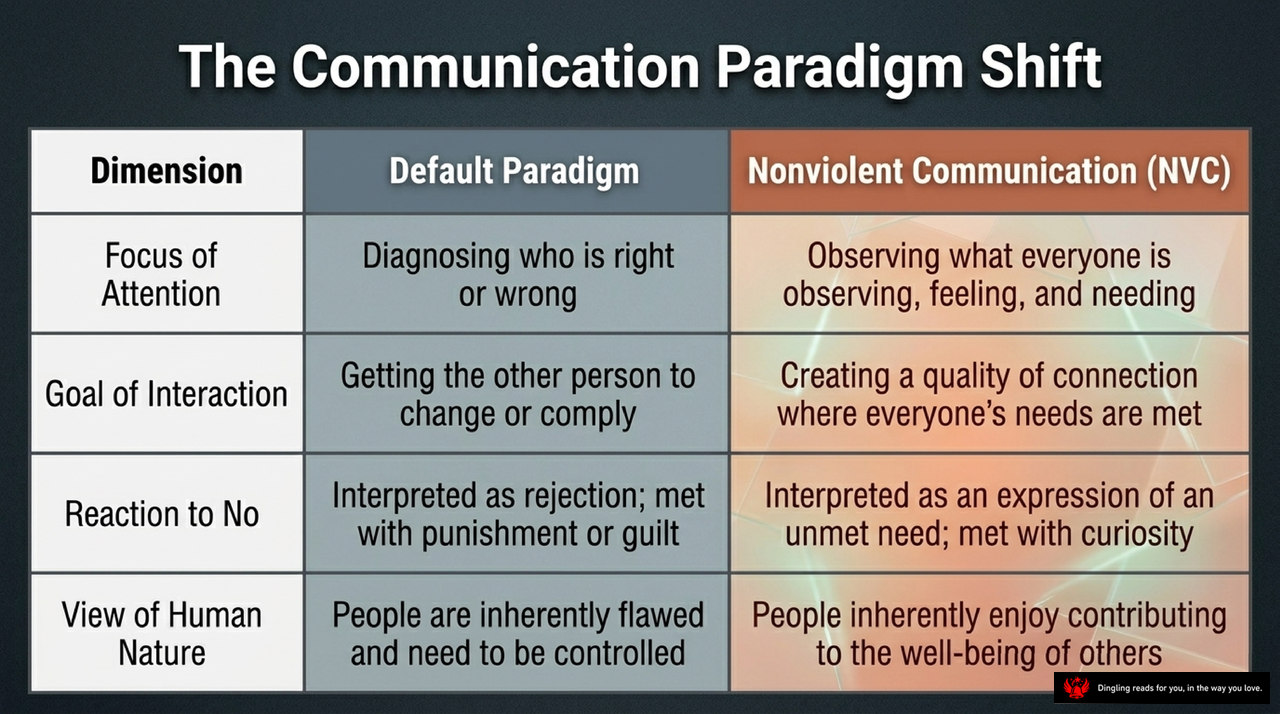
Welcome back. Today we're exploring the core of Nonviolent Communication: The Communication Paradigm Shift. This slide breaks down how we move from our default way of interacting to a more connected way.
First, look at the Focus of Attention. In the default paradigm, we are focused on diagnosing who is right or wrong. But NVC guides us to shift our focus to observing what everyone is observing, feeling, and needing. It's about understanding the reality of the moment rather than labeling people.
Next, consider the Goal of Interaction. The default way is trying to get the other person to change or comply. That often creates distance. NVC aims to create a quality of connection where everyone's needs are met. It's about building a bridge, not winning an argument.
Then, look at Reaction to No. When someone says no, the default paradigm interprets it as rejection, met with punishment or guilt. But NVC interprets it as an expression of an unmet need, met with curiosity. When the other person says no, don't rush to determine it's a rejection. Instead, explore the feelings and needs behind it.
Finally, the View of Human Nature. The default view assumes people are inherently flawed and need to be controlled. This mindset often leads to judgment. NVC challenges this. It believes people inherently enjoy contributing to the well-being of others. It helps us break through the pain brought by language and rebuild sincere connection, letting sincere mutual giving become the bottom color of communication.
This shift transforms us from passive emotional reactors into active relationship creators. It's not just about theory; it's about how we treat each other. When we stop judging, we stop hurting. When we focus on needs, we create trust. This is the essence of a profound shift in attention. We are used to focusing our communication focus on whether the other person is wrong or whether I am in the right. It guides us to turn our gaze to what are my feelings at this moment, which of my needs are unmet, and what are the other person's needs. This change in perspective is the key to transforming our relationships and finding peace in our interactions.
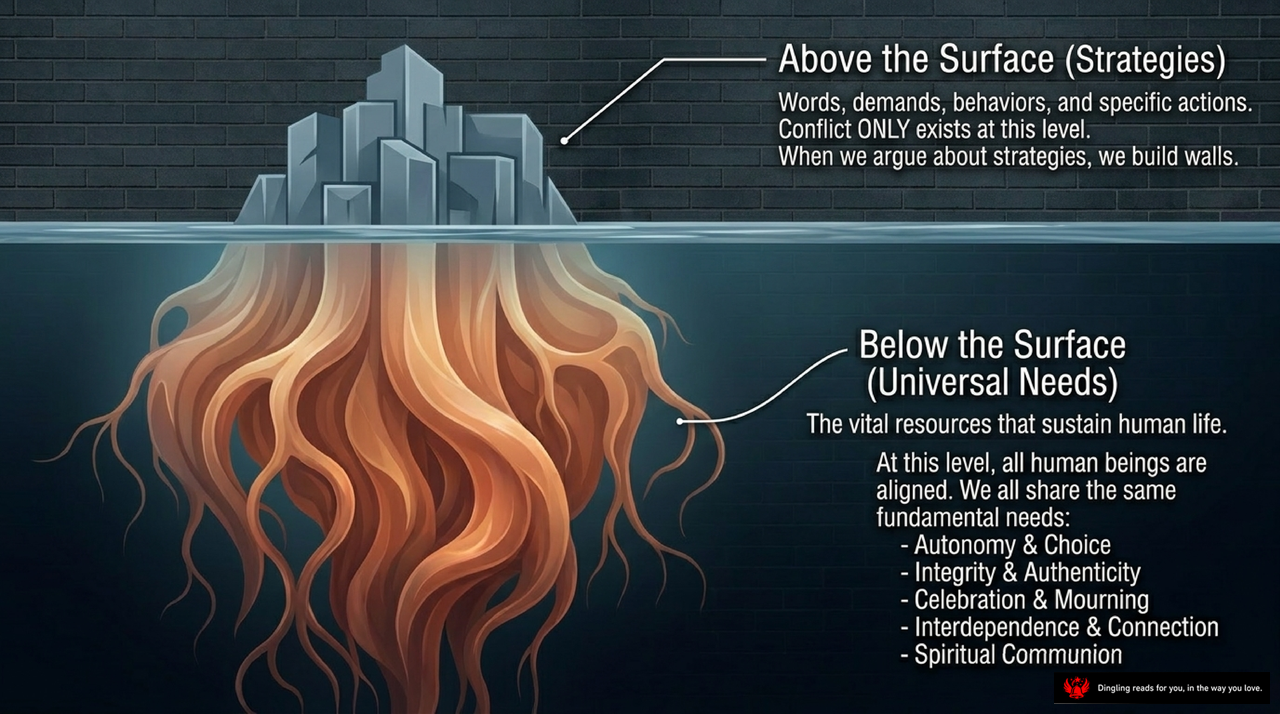
Hey everyone, take a look at this image. It is an iceberg, and it perfectly illustrates the core philosophy of Nonviolent Communication. On the surface, above the water, you see strategies. This is where words, demands, behaviors, and specific actions live. And here is the hard truth: conflict only exists at this level. When we argue about strategies, we are essentially building walls between ourselves and others. We get stuck in the right versus wrong game, defending our positions instead of connecting. We talk past each other because we are focused on the wrong things.
But the magic happens below the surface. Look at that deep, complex root system. This represents Universal Needs. These are the vital resources that sustain human life. The most important insight here is that at this level, all human beings are aligned. We are not fundamentally different; we all share the same fundamental needs. Think about Autonomy and Choice, Integrity and Authenticity, Celebration and Mourning, Interdependence and Connection, and Spiritual Communion. These are the things that drive us, not our strategies.
In the book, Marshall Rosenberg explains that things like money, recognition, or duty are just strategies we use to satisfy our needs, not the needs themselves. We often confuse the two. We might be fighting over a strategy, like who gets the last seat or who pays the bill, but underneath, both of us are just trying to meet the same need for respect or safety. Strategies are just tools, but needs are the fuel.
So, the shift we need to make is moving our attention from the surface strategies to the deep needs. Instead of asking who is right, we ask what need is unmet here. When we stop arguing about strategies and start acknowledging that our needs are universal, we stop building walls. We stop seeing each other as opponents and start seeing each other as humans who share the same heart. That is how we move from conflict to connection, and that is how we truly listen to one another.
This is not just theory; it is a practice. Every time you feel triggered, check where you are. Are you fighting a strategy battle, or are you connecting with a human need? If you can dive below the surface, you find that there is no one to fight against, only people trying to meet their needs. That is the power of Nonviolent Communication.
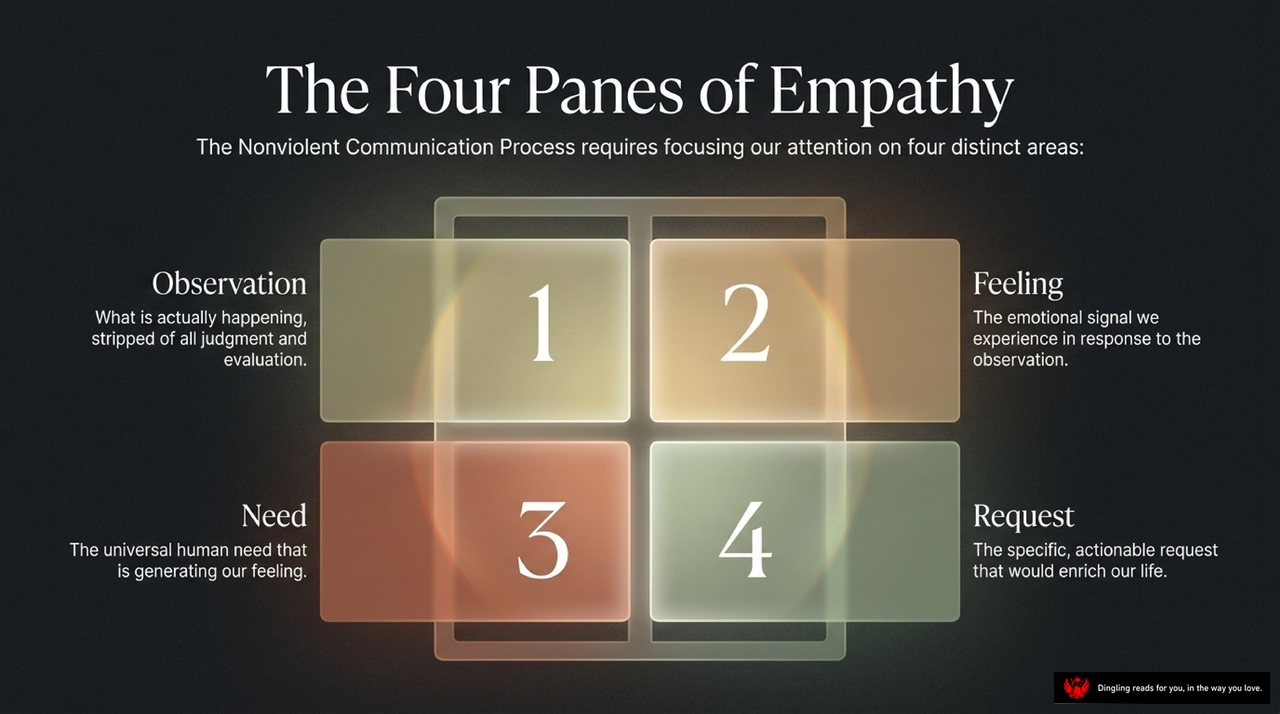
Welcome back to our session. Today, we are diving into the absolute heart of Nonviolent Communication. You see this grid here, labeled the Four Panes of Empathy. The Nonviolent Communication Process requires focusing our attention on four distinct areas to transform how we interact.
First, let's talk about Observation. This isn't just about seeing what happens; it's about stripping away all judgment and evaluation. We often confuse facts with our opinions. Instead of labeling someone as "bad" or "lazy," we focus on what is actually happening. We want clear facts, not stories we tell ourselves about the facts. This builds trust immediately because people feel safe when they aren't being judged. It's about seeing the situation as it is, without the filter of our bias.
Next is Feeling. This is the emotional signal we experience in response to the observation. It's crucial to remember this isn't about blaming others for how we feel. It's about acknowledging our own emotional state without masking it with thoughts. When we say "I feel," we mean our emotions, not our interpretations of the world. This helps us take responsibility for our emotional experience.
Then, we move to Need. This is the universal human need that is generating our feeling. Often, we get stuck on the other person's behavior, but the real driver is an unmet need within us. Whether it is safety, respect, or connection, everyone shares these needs. Understanding this shifts the blame from "you are doing this to me" to "I am missing something important." It humanizes the conflict.
Finally, we have Request. This is the specific, actionable request that would enrich our life. It's not a demand or a vague complaint. It's a clear invitation for action that we can actually do. Vague requests lead to vague results. Specific requests lead to clarity and cooperation.
The beauty of this process is that it shifts our focus from being right or wrong to being human and connected. It moves us from fighting against each other to working together to meet our shared needs. It's not a rigid rule, but a path to genuine empathy. When we practice this, we stop reacting defensively and start responding with understanding. This transforms our relationships from battlegrounds into bridges. It's a simple shift in attention that creates profound change.
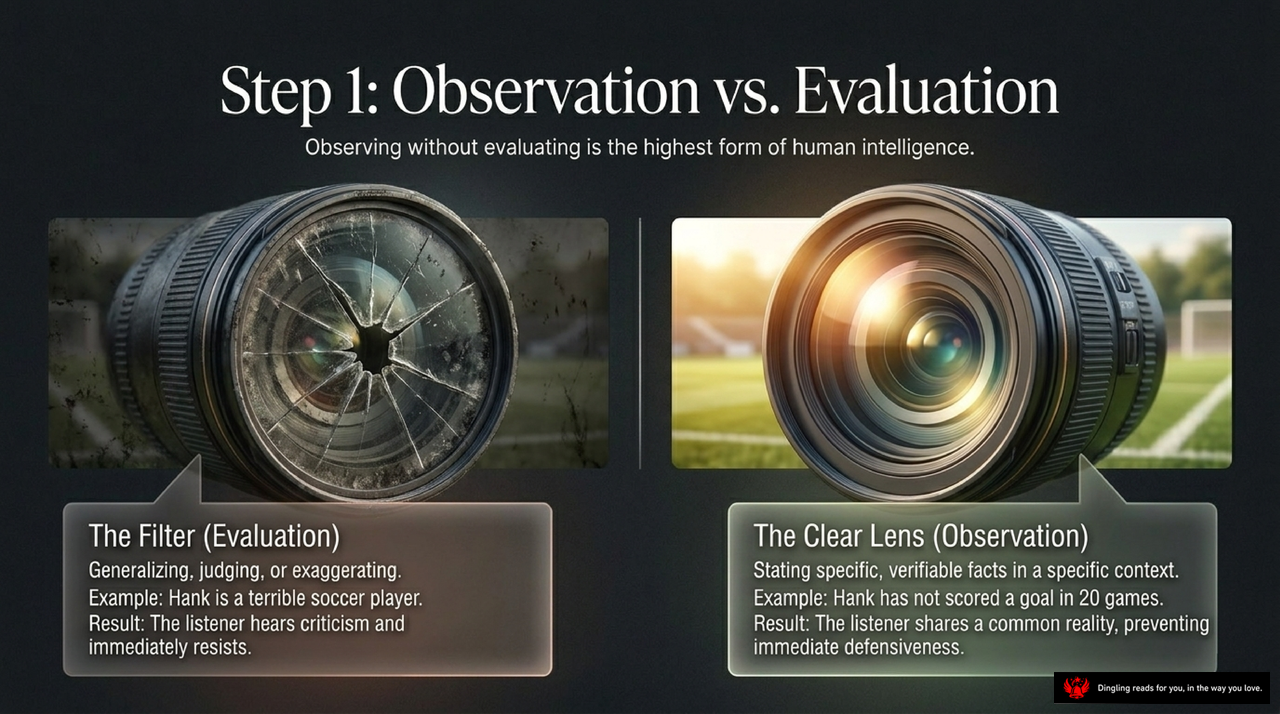
Welcome to Step One. Today, we're diving into the foundation of Nonviolent Communication: the crucial difference between Observation and Evaluation. Look at these two lenses. On the left, we have the Filter, representing Evaluation. On the right, the Clear Lens, representing Observation. This visual perfectly captures the core distinction we need to master.
When we communicate through the Filter, we are evaluating. We generalize, judge, or exaggerate. Think about the example on the screen: saying 'Hank is a terrible soccer player.' That is an evaluation. It triggers a defensive reaction. The listener hears criticism and immediately resists. We stop listening because we feel attacked, and the conversation dies.
Now, look at the Clear Lens. This is about Observation. It means stating specific, verifiable facts within a specific context. Instead of labeling Hank, we say, 'Hank has not scored a goal in 20 games.' That is an observation. It describes reality without attaching a moral judgment. The result? The listener shares a common reality, preventing immediate defensiveness. They can actually listen to the facts without feeling judged.
Why does this matter so much? Because observing without evaluating is considered the highest form of human intelligence. We often confuse the two because our language is full of hidden judgments. Words like 'always,' 'never,' or 'terrible' turn facts into accusations. For instance, saying 'You're always late' sounds like an observation, but it's actually an exaggeration. A true observation would be, 'You were late for three meetings this week.'
The shift from evaluation to observation changes everything. It moves us from a battle of 'who is right' to a shared understanding of 'what is happening.' When we strip away the labels, we stop fighting against each other and start connecting with the truth. This isn't just about soccer; it's about how we see each other in every relationship. By choosing the clear lens, we invite understanding instead of resistance. It's the first step toward truly connecting with one another and building a bridge where there was once a wall. This practice requires conscious effort, but it is the gateway to authentic connection. We need to remember that static language doesn't match the changing world. Instead of labeling people, we should describe dynamic behaviors. This allows us to see the person in front of us, not the version we've created in our heads. By making this shift, we reclaim our communication from a tool of conflict and turn it into a tool for connection.
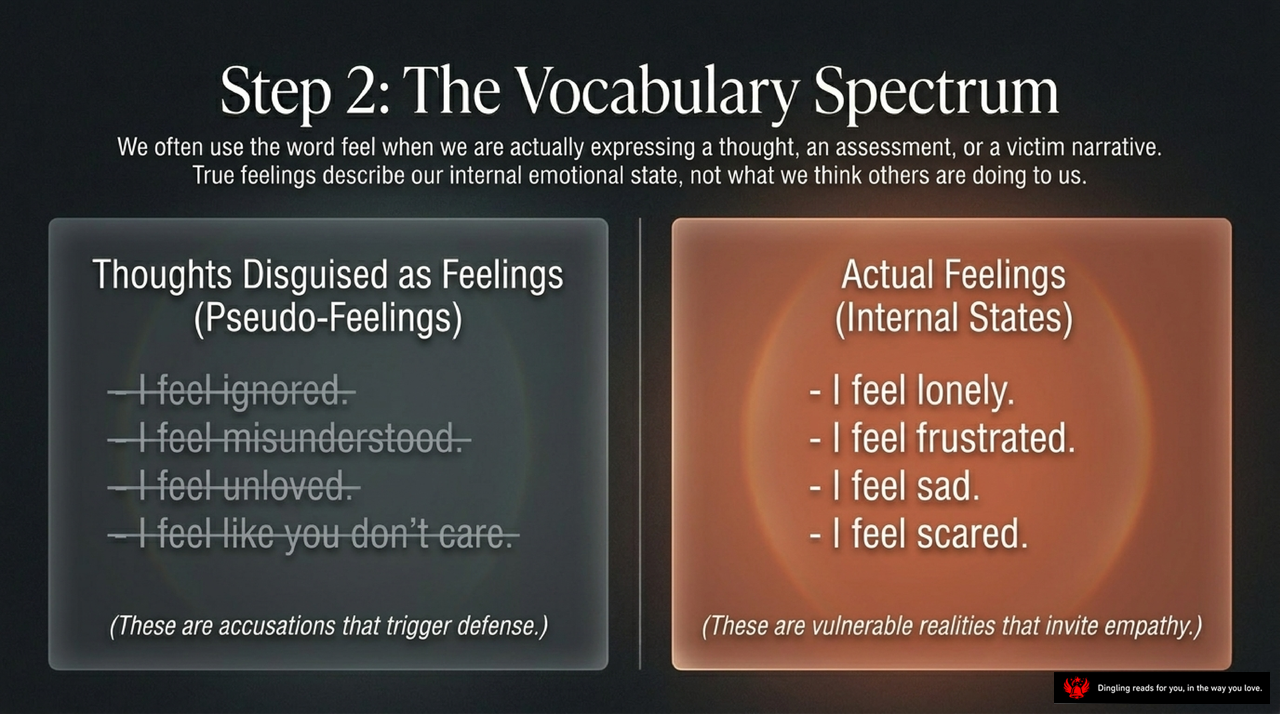
Welcome to Step 2: The Vocabulary Spectrum. Let's take a closer look at how we use the word 'feel' in our daily conversations. Have you ever noticed that we often say 'I feel' when we're actually expressing a thought, an assessment, or even a victim narrative?
Look at the left side of this slide. These are 'Thoughts Disguised as Feelings.' Phrases like 'I feel ignored,' 'I feel misunderstood,' or 'I feel unloved.' While they start with 'I feel,' they are actually accusations about what others are doing to us. They imply the other person is at fault. This puts the other person on the defensive. It's like saying 'You don't care' without actually saying it. These are judgments disguised as emotions.
Now, look at the right side. These are 'Actual Feelings.' These describe our internal emotional state. Examples include 'I feel lonely,' 'I feel frustrated,' 'I feel sad,' or 'I feel scared.' These are vulnerable realities. They don't blame anyone; they simply state how we are experiencing life right now.
Why does this distinction matter so much? Because when we use pseudo-feelings, we create walls. We turn a conversation into a debate about who is right or wrong. But when we use actual feelings, we open the door for empathy.
In Nonviolent Communication, Marshall Rosenberg taught us that true feelings are the key to connection. When we strip away the judgment—like thinking 'I feel misunderstood'—and touch the underlying emotion, like 'I feel lonely,' we stop attacking and start connecting.
Also, remember that building a vocabulary of feelings helps us find the right words. Instead of using vague terms like 'good' or 'bad,' we can be more precise. We need to understand that our feelings are not caused by others' actions, but by our own unmet needs. When we say 'I feel lonely,' we acknowledge our need for connection. When we say 'I feel frustrated,' we acknowledge our need for support or success.
So, the next time you catch yourself saying something like 'I feel ignored,' pause. Ask yourself: What is the actual feeling underneath? Is it loneliness? Fear? Sadness?
By shifting from accusations to vulnerability, we stop triggering defensiveness and start inviting understanding. This small change in vocabulary transforms our relationships from a battle of wills into a bridge of empathy. Let's practice making this shift in our own communication.
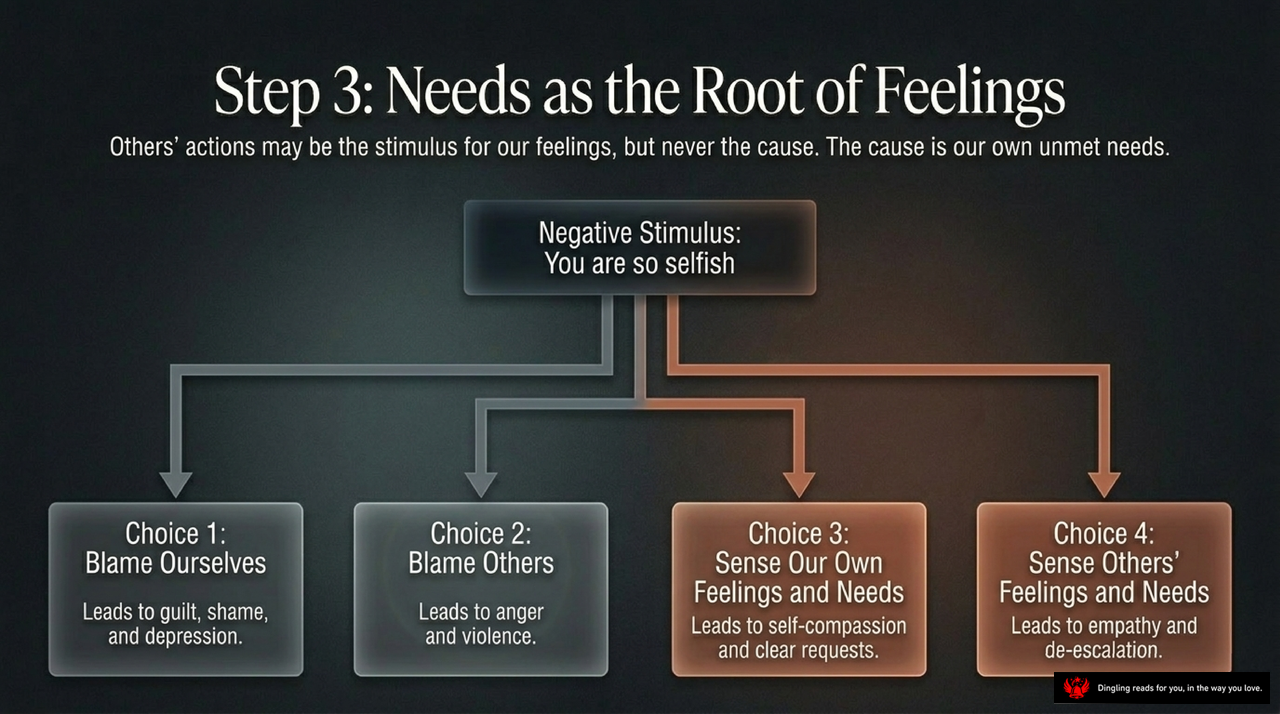
Let's move to Step 3. This is where we really dig into the psychology of our emotions. The core idea here is that needs are the root of our feelings.
We often fall into a trap thinking that other people's actions cause our emotions. For example, if someone says, "You are so selfish," that statement is the stimulus. It might trigger us, but it doesn't actually cause the feeling. The real cause is always our own unmet needs.
Now, let's look at the four choices available to us when that stimulus hits.
On the left side, we have the two reactive paths. Choice 1 is blaming ourselves. We internalize the criticism and think, "I am too selfish." This path leads to guilt, shame, and eventually depression. Choice 2 is blaming others. We externalize the blame and think, "They are selfish." This leads to anger and violence. Both of these choices keep us trapped in suffering and disconnect us from others. Think about it: when we blame ourselves, we punish ourselves. When we blame others, we punish them. Neither helps.
However, on the right side, we have two constructive choices. Choice 3 is sensing our own feelings and needs. Instead of fighting the label, we pause and ask ourselves, "What do I need right now?" This leads to self-compassion and helps us make clear requests. Choice 4 is sensing the other person's feelings and needs. We try to understand their perspective. This leads to empathy and helps de-escalate the tension.
This distinction is vital because it changes how we take responsibility. We cannot control what others say or do, but we can control how we interpret it through the lens of our needs.
When we choose to sense our needs, we stop being victims of our emotions and start becoming the creators of our connection. We move from a place of fear and judgment to a place of understanding and compassion. It's really about emotional maturity. It's about realizing that our feelings are a signal, not a command.
Also, remember that when we choose Choice 4, sensing others' feelings, we aren't agreeing with them, but we are respecting their humanity. This builds trust.
So, the next time you feel triggered, remember this: It's not about what they did. It's about what you need. By acknowledging that, you can choose a path that heals rather than harms. This is how we move from conflict to connection.

Let's dive into the advanced application of Nonviolent Communication: Decoupling Anger. As the slide clearly states, NVC does not ask us to suppress anger. In fact, it asks us to fully express it by finding its true core.
Look at this visual metaphor. It shows anger as an electrical circuit. On the left, you have Step A: the Stimulus. This represents what the other person did. On the right, Step B is your Reaction, often labeled as rage. But the key lies in the middle: The Circuit Breaker.
The text explains that anger is always generated by a disconnected, judgmental thought. We often make the mistake of linking our anger directly to their actions. We say, "I am angry because they did X." But this is the trap. It keeps us focused on judging the other person's character rather than our own experience. We treat their behavior as the cause of our pain, which only fuels defensiveness. We often think, "They are selfish," or "They are wrong." These are judgments, not observations. They disconnect us from reality.
The real work happens when we decouple the Stimulus from the Cause. Instead of blaming their behavior, we look for the green path: Needs-Awareness. The slide suggests a powerful rewiring. Instead of saying, "I am angry because they did X," we rewire it to, "I am angry because I need Y."
This shift is everything. When we focus on our needs, the anger transforms. It stops being a destructive weapon against others and becomes constructive, life-serving energy. It becomes a signal telling us what is missing in our lives right now. Instead of fighting the other person, we are fighting for our own values.
Think about it: if someone cuts in line, your anger isn't just about the line. It's about your need for fairness or respect. If a partner is late, it's not just about the time; it's about your need for reliability or connection.
So, when you feel that heat rising, don't just vent at the person. Pause at the circuit breaker. Ask yourself: What need of mine is unmet? Once you find that, you can express your anger honestly without attacking anyone. That is how we turn pain into power. That is how we turn conflict into a bridge for understanding. That is the essence of decoupling anger. By doing this, we reclaim our agency and create space for genuine connection, rather than getting stuck in a cycle of blame and resentment.

So, let's dive into advanced application: Empathic Listening. Look at this slide. It highlights a critical shift in how we connect with others. Empathy isn't about fixing someone; it's about respectfully understanding what they are experiencing. It requires us to empty our minds and listen with our whole being.
Here's the hard truth: we often sabotage empathy with our own good intentions. You see those crossed-out words? Fixing, Advising, Consoling, Interrogating. We do this because we want to help, but we actually block the connection. We get trapped in the urge to give advice, reassure, or explain our own position. Our urge to give advice, reassure, or explain our own position blocks empathy. We think we're helping, but we're actually closing the door. We think we have a third head to solve the problem. But here's the thing: we don't need to be the fixer. We don't need to offer a solution immediately.
The practice is simple, but it's hard: Don't just do something, stand there. Wait. Listen for their observation, feeling, need, and request. Wait until they have fully expressed all their feelings before offering solutions. These four elements are the building blocks of connection. When we rush to advise, the other person often feels misunderstood or even judged. They shut down. But when we just stand there, listening deeply, we create a safe space.
Think about your own life. How often do you jump in to say, "You should just do X"? That's the trap. Instead, try to hear the need behind the words. As the book teaches us, feelings are signals of unmet needs. When we focus on fixing the behavior, we miss the need underneath. This is why standing there is so powerful. Are they feeling overwhelmed? Do they need support? By simply listening, we validate their experience. We show them they aren't alone. We often confuse empathy with agreement, but it's actually about standing with them in their experience, not pulling them out of it. It's about witnessing their reality.
This isn't about being passive; it's about being present. It's about building a bridge of understanding rather than a wall of advice. So, the next time someone is struggling, resist the urge to fix it. Just listen. Stand there. Let them feel heard. That's where real connection happens. That's where empathy lives. It's not about having the answer; it's about being with the person in the question.

Take a look at this infinity symbol. This represents the Continuous Loop of Empathy, which is the heart of Nonviolent Communication. Marshall Rosenberg taught us that NVC is not a rigid script you memorize for every conversation. Instead, it is a continuous, flowing loop of mutual understanding.
You can see this cycle split into two distinct movements. On the left, in warm orange, we have Expressing Honestly. This is where we focus inward. We take a moment to Observe what is happening, Feel our emotions, and identify the Needs behind them. On the right, in cool green, we have Listening Empathically. Here, we focus outward. We listen to the other person's Observe, Feel, and Needs, and then make a Request. Notice how the arrows flow back and forth? This is the key. It means empathy isn't a one-time event. It is a cycle. When we express honestly, we invite understanding. When we listen empathically, we build trust.
But why does this matter? Look at the text at the bottom. It says, by keeping the attention strictly on this loop—and refusing to engage in blame or strategy-level arguments—conflict naturally dissolves into mutual giving.
Think about your own life. How often do we get stuck arguing about who is right or wrong? We focus on strategy, on winning, on proving a point. We blame. But this loop asks us to stop there. Instead of asking, "Who is to blame?", we ask, "What need is unmet here?" We often get trapped in strategy. We think about what I want to get, or what you need to do. But NVC says, look at the need. The need is the root. The strategy is just the tool. When we focus on the need, we find common ground.
When we stop fighting over strategies and start connecting over needs, the tension breaks. The conflict doesn't just vanish; it transforms. It turns into mutual giving. You give the other person understanding, and they give you the space to be heard.
This loop is a powerful tool because it reminds us that we are all human. We all have the same needs for safety, connection, and respect. When we keep our attention on this flow, we stop being enemies and start becoming partners in understanding. It is the difference between a wall and a bridge.
So, remember this image. Don't just see the words. Feel the flow. Keep your attention on the loop, stay away from blame, and watch how conflict naturally dissolves into something much more beautiful: mutual giving.

Hey everyone. Let's be honest about how we usually say thank you or give compliments. Often, what we call a compliment is actually a disguised judgment or a way to manipulate behavior. We might say You are so great just to get a specific result, or to make someone feel a certain way. But Nonviolent Communication teaches us that true appreciation is different. It is purely about celebrating life.
This slide shows us the Appreciation Formula. It breaks down exactly how to express this pure gratitude. It starts with three specific components. First, you state What You Did. This is the observation. It is the specific action the other person took. Instead of saying You are helpful, you say You stayed late to help me finish the report.
Second, you identify What I Needed. This is crucial. You acknowledge the specific need of yours that was met. When you see that your need was met, it validates their contribution.
Third, you share How I Feel. This is the joyful feeling you are experiencing right now. It is not just a label like happy, but a genuine emotional response to the connection.
When you put these three blocks together, you get Pure Gratitude. As the slide notes, this is free of expectations and manipulation. When we express gratitude this way, we are not trying to control the other person or ask for something in return. We are simply sharing how their action enriched our lives.
Think about the last time someone thanked you. Did they say Thanks for doing that? Or did they say Thanks, now I can relax? The second one has a hidden condition. NVC gratitude removes that condition.
This approach changes everything. It removes the pressure of performance from the relationship. Instead of focusing on what you did wrong or how you should act, we focus on what you did that helped me and how that made me feel. It builds trust. It shows the other person that you truly see them and value their contribution for who they are, not just for what they produce. It is a powerful way to connect, deepen relationships, and create a space where everyone feels seen and appreciated for their authentic self. By using this formula, we stop playing games and start building genuine bridges. In a world where we are often rushed and distracted, taking a moment to express appreciation this deeply can be a game changer.

Take a look at this image. It captures the essence of Nonviolent Communication perfectly. It isn't just a language tool or a set of rules to follow. It is a profound shift in human consciousness.
When we practice Nonviolent Communication, we strip away the layers of judgment and demands that usually cloud our interactions. We stop trying to label people as good or bad, right or wrong. Instead, we systematically focus on our shared human needs. This simple change allows us to stop diagnosing what is wrong with each other and start discovering how we can truly enrich one another's lives.
Think about every conversation you have. Every time you speak, you are actually choosing the architecture of your relationships. Are you building walls to defend yourself, or are you opening windows to connect?
Many of us are trapped in the habit of using language to separate ourselves from others. We judge, we compare, and we control. This creates invisible walls that block genuine connection. We start seeing each other as problems to be fixed rather than humans to be understood. But when we shift our focus to our feelings and our needs, those walls crumble. We move from being passive reactors to active creators of our relationships.
It's about moving from a mindset of survival to a mindset of connection. We stop asking, 'What is wrong with you?' and start asking, 'What do we need?' This transformation allows us to speak from a place of compassion rather than fear. We realize that our feelings are not caused by others, but by our own unmet needs. We use observation, feelings, needs, and requests to guide this shift.
So, I want you to pause and reflect on this question. In your daily interactions, are you building walls to protect yourself, or are you opening windows to welcome understanding? The choice is yours, and it begins with the words you choose to speak. Remember, the way you speak shapes the world you live in.