
Nudge: Complete Chapter-by-Chapter Summary
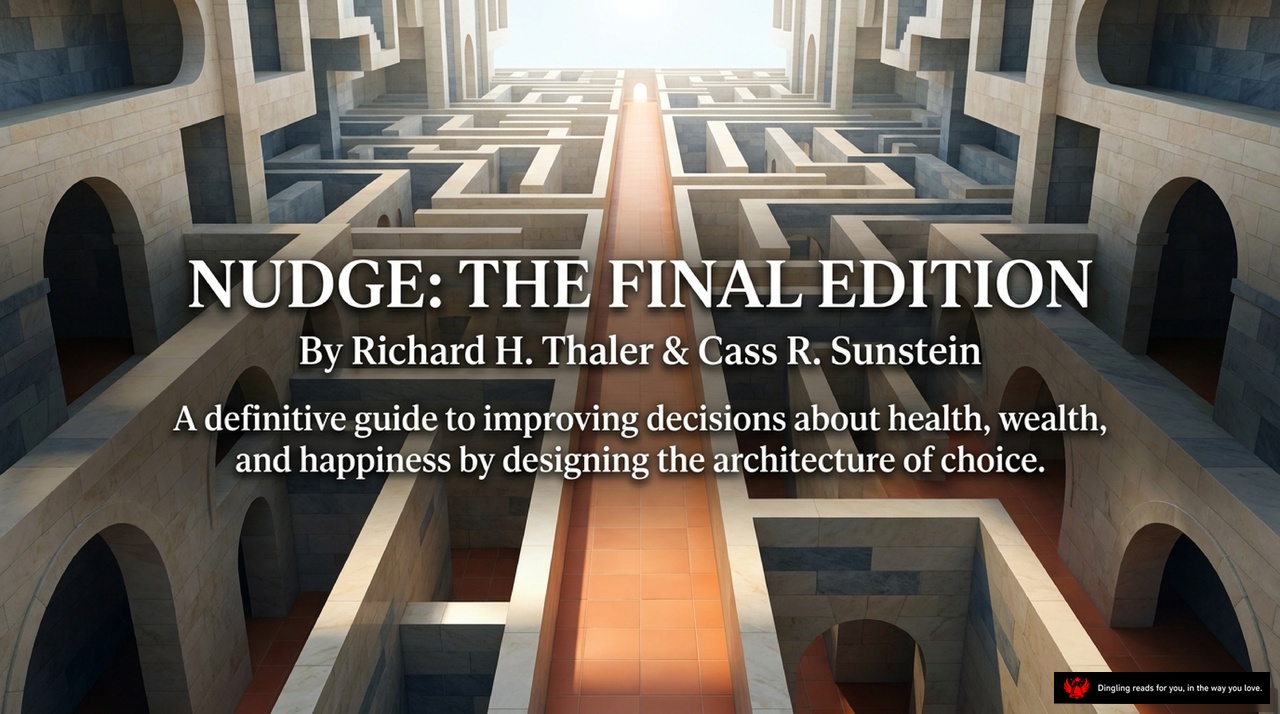
Welcome to *Nudge: The Final Edition*, the definitive guide by Richard Thaler and Cass Sunstein on how we can improve our decisions about health, wealth, and happiness.
Look at this image behind us—a vast, intricate maze with a single, bright path leading straight to the light at the end. This perfectly captures the core idea of the book: we are all navigating complex life choices, often lost in the twists and turns of confusion and bias. But the good news is that we don't have to wander blindly forever.
This book is about "designing the architecture of choice." It teaches us how to gently reshape the environment around our decisions so that the right choice becomes the easy choice. Think of it as building that clear, illuminated path through the maze, making it natural for everyone to find their way to better outcomes without needing to be forced or coerced.
Whether you are trying to save for retirement, make smarter investments, or simply live a healthier life, this book provides the tools to turn that chaotic maze into a straightforward journey toward a better life. Let's dive in and start designing a world where making good decisions is as simple as following the light.

Libertarian Paternalism might sound like an oxymoron, but it is actually the core philosophy behind this entire framework. Think of it as a Venn diagram where two distinct worlds meet. On one side, we have the Libertarian principle: total freedom of choice, no bans, and absolutely no mandates. You must always have the option to say "no." On the other side, we have Paternalism: the genuine desire to improve human welfare and design for longer, healthier lives.
The magic happens right in the center, where these two circles overlap. This intersection is called "The Nudge." It is the ultimate design philosophy. The idea is simple yet powerful: we deliberately design our environments to guide human behavior toward positive outcomes, but we never restrict your freedom to do otherwise. It's about influencing choices, not forcing them.
This leads us to our Golden Rule: Nudge for Good. Every intervention must be fully transparent and easily avoidable. If a choice is hard to undo, or if people don't know why they are being guided, it's not a nudge; it's manipulation. We want to help people make better decisions—whether that means saving for retirement, eating healthier, or being more environmentally friendly—while respecting their autonomy. We are not trying to control you; we are simply making it easier for you to be your best self.

Have you ever wondered why you follow the crowd, even when your gut tells you something is off? We're not alone in this. Classic experiments show that social pressure can easily override our own judgment. In one famous study, a group of people were asked to judge the length of a line. When the first few people in the group gave the wrong answer, one-third of the participants blindly followed suit, despite having clear eyesight. It wasn't about being stupid; it was about the fear of standing out.
We operate under two powerful forces: the need for information and the fear of rejection. When we're unsure, we assume the majority must be right. But here's the twist: even if we know we're being pressured, we often still go along with it. This is the "spotlight effect" at work. We tend to think everyone is watching our every move, noticing our mistakes like a magnifying glass. In reality, most people are too focused on themselves to notice our small blunders.
So, how do we use this? Smart designers don't fight the crowd; they guide it. By tapping into social norms, they can nudge us toward better choices. For instance, simply telling a group, "90% of people in this area pay their taxes on time," dramatically increases compliance compared to threatening with fines. It's not about shaming you; it's about showing you what "normal" looks like. When we see that our peers are making healthy choices, we're more likely to do the same. It's a powerful reminder that while we love our independence, we're also deeply wired to connect with others.

Have you ever stopped to wonder why you sometimes make decisions that feel wrong, even when the math is clear? Today, we're diving into the "Engine of Error"—the two distinct systems running your brain.
On the left, you see **System 1: Automatic**. This is your fast, intuitive, effortless lizard-brain. It's the part that instantly guesses that a ball costs 10 cents when you're told a bat and ball together cost $1.10. It handles everything from ducking a flying object to speaking your native language without thinking. But here lies **The Intuitive Trap**: it often leads us astray, like instantly answering 10 cents for the ball, which is actually incorrect.
On the right is **System 2: Reflective**. This is your slow, deliberate, and conscious gear. It kicks in when you need to solve complex math or choose a mortgage. In our classic **Bat & Ball Test**, the real answer is that the ball costs **5¢**. Only System 2 can catch the error that System 1 misses.
The key takeaway? Nudges protect us precisely when our reflective system is asleep at the wheel. By understanding when to trust your gut and when to engage your brain, you can avoid these built-in errors and make better choices every day.

Imagine you're standing in front of a menu with dozens of options, or perhaps you're trying to pick the right investment fund for your retirement. It feels overwhelming, doesn't it? We often think we're making rational choices, but our brains are actually running on autopilot, falling into predictable traps.
This slide breaks down three major cognitive pitfalls that hijack our decision-making process. Let's look at the first one: Anchoring. As the image shows with that anchor and the credit card terminal, we tend to rely too heavily on the first piece of information we see. For example, if a credit card suggests a 20% tip, you're likely to tip around that number, even if it feels high. That initial number acts as an anchor, skewing your judgment and leading to decisions that don't match your true intentions.
Next, we have Availability. The graphic here uses a shark and an inhaler to make a powerful point. We judge risks based on how easily examples come to mind. A shark attack is terrifying and vivid, so we overestimate the danger of the ocean. But asthma, which kills far more people, is quiet and often goes unnoticed, so we underestimate it. We fear what we can easily visualize, not what is statistically most likely to happen.
Finally, look at Loss Aversion on the right. The scale clearly shows that the pain of losing $100 is twice as heavy as the pleasure of gaining $100. This is why we cling to bad investments, keep unused subscriptions, or hesitate to make necessary changes. We would need to gain twice as much to feel the same satisfaction as losing that amount.
Understanding these three biases—Anchoring, Availability, and Loss Aversion—is the first step toward taking control. By recognizing these mental shortcuts, we can step out of the dashboard's red zone and make choices that truly serve our long-term well-being.

Imagine you're walking through a maze designed not to test your intelligence, but to exploit your natural tendency to take the path of least resistance. This slide illustrates exactly that: the hidden power of defaults. Look at the diagram; on the left, there's a smooth, wide ramp labeled "The Default." On the right, there's a steep, obstacle-filled staircase labeled "The Alternative."
This visual captures a fundamental truth about human behavior: we are creatures of habit who crave the path of least resistance. The "Whatever" Heuristic explains this perfectly. When faced with overwhelming choices—like complex 401(k) forms or software terms—our brains simply shut down and default to doing absolutely nothing. We aren't lazy; we're just trying to conserve mental energy.
Now, look closely at the staircase on the right. Why is it so hard to climb? It's designed with "High Friction." This is the essence of the Subscription Trap. Companies build barriers like these intentionally. They rely on the friction of cancellation—what we call "sludge"—to keep us stuck. They exploit our status quo bias, making it incredibly annoying to leave, which artificially inflates their retention rates.
But here's the game-changer, highlighted in the bottom right corner: "The Architect's Move." If you want to dictate an outcome, don't just offer a choice; make your preferred outcome the default. Never assume defaults are neutral. As we've seen in previous chapters, whether it's auto-enrolling employees in retirement plans or setting renewable energy as the standard, the default setting silently guides billions of dollars and behaviors every single day.
The lesson is clear: design matters. If you want people to act, remove the friction. If you want them to stop, add the barriers. By understanding this path of least resistance, we can stop fighting human nature and start using it to create better outcomes for everyone.

We often assume that the best way to get people to do the right thing is to tell them the truth or rely on their logic. But as we've seen, human behavior is deeply driven by social norms. We look to our peers to figure out what's normal, and if everyone else is doing it, we assume it must be right. This is the "herd effect."
Look at the diagram here. You have a network of people, and a ripple effect spreading through them. When we perceive that a certain behavior is the norm, we tend to follow it, even if our private beliefs say otherwise. This is what psychologists call "pluralistic ignorance." We all think everyone else agrees with the status quo, so we stay silent and follow along, creating a cycle where nothing ever changes.
But here's the good news: we can break this cycle. The UK's "Nudge Unit" proved this with a simple experiment regarding tax compliance. They didn't change the tax laws or send threatening letters. They just added one sentence to reminder letters: "9 out of 10 people in the UK pay their taxes on time." By revealing the true social norm, they drastically increased compliance.
This shows the power of "nudging with norms." When we make invisible social standards visible, we can shift behavior without forcing anyone. Whether it's reducing litter, encouraging recycling, or improving health outcomes, showing people what their neighbors are actually doing can be a powerful tool to guide them toward better choices. It's about using social influence not to manipulate, but to help people align their actions with their own best interests.

The Prime Directive is simple but powerful: if you want people to take action, remove the friction. The core message here is "Make It Easy." When choices are too complicated, our brains simply shut down.
Let's look at the three pillars that make this happen. First, Channel Factors. These are the tiny, seemingly trivial barriers that kill our intent. Think about needing a stamp or hunting for an obscure link just to get something done. By removing these small obstacles, we dramatically increase compliance. It's about making the path clear.
Next, we have Forcing Functions. These are design choices that prevent user error before it happens. A classic example is an ATM that forces you to remove your debit card before dispensing cash. This simple friction actually protects you from leaving your card behind. It designs the environment to stop mistakes.
Finally, Smart Disclosure. Complex data must be standardized. We need mandated pricing and clear terms so humans can accurately compare choices without cognitive overload. When information is messy, we make bad decisions. By standardizing the data, we empower people to choose wisely.
In short, whether it's saving for retirement, choosing a health plan, or simply buying groceries, the goal is the same: reduce the friction, make it easy, and let people make the right choice naturally.

Have you ever stood in a pharmacy aisle, staring at dozens of prescription plans, feeling completely paralyzed? That's exactly the trap the Part D drug plan in the U.S. created. While it was designed to offer rich options, the complexity actually trapped millions of seniors. In cities like McAllen, Texas, elderly residents faced over 47 choices and simply gave up, leaving 4 million eligible Americans uninsured.
The problem wasn't just too many options; it was the lack of clear feedback. The plan randomly assigned low-income individuals to basic plans without considering their actual medication needs. As a result, over 22% of these patients were forced to stop their essential drugs because their assigned plan didn't cover them. Worse, due to inertia and the status quo bias, most people never bothered to switch, even when the right plan could have saved them hundreds of dollars a year.
But there is a better way. Look at Maine's "smart allocation" model. Instead of leaving people to guess, the state automatically enrolls patients in a plan that covers 80% or more of their current prescriptions, while still keeping the right to opt out. This simple shift boosted coverage to nearly 100%. Furthermore, tools like RECAP can make costs transparent, showing exactly how much you pay versus what you save. By making the invisible visible and turning complex choices into clear, immediate feedback, we can help people make decisions that truly protect their health and their wallets.

Imagine a world where the best choice is actually the hardest one to find. This is the reality of the U.S. Part D prescription drug plan. Designed to give seniors more freedom, it actually traps them in a maze of confusion. With dozens of options in some states and a confusing "donut hole" where coverage stops, the average senior feels paralyzed. In fact, millions of eligible Americans go without insurance simply because the choice is too overwhelming.
But there is a smarter way. Look at Maine's "smart allocation" model. Instead of forcing people to pick blindly, the state automatically assigns them a plan that covers 90% to 100% of their specific medications based on their recent history. It respects their freedom to change later, but it removes the initial barrier of confusion.
The lesson here is clear: when choices are too complex, true freedom becomes an illusion. By using smart defaults and transparent information, we can guide people toward the best outcome without forcing their hand. It's not about taking away choice; it's about making the right choice the easy one.

Application I: Saving for Tomorrow. Think about your retirement savings. It's a classic battle between your short-term "Doer" and your long-term "Planner." Costs feel immediate, but the benefits are decades away, so our brain's default is to procrastinate. But what if we could hack that? The solution lies in a powerful psychological lever: the default option.
Look at this graph. It shows the power of inertia. In Sweden's Premium Pension Plan, people who simply stayed in the state's carefully designed default fund actually outperformed those who actively tried to manage their own portfolios. Why? Because inertia is powerful. By switching the mechanism from "Opt-in" to "Opt-out," participation rates skyrocket effortlessly. The chart on the left illustrates this journey from age 25 to 65. Instead of waiting for you to make a complex choice, the system automatically enrolls you. This isn't about removing your freedom; it's about making the right choice the easy one. It turns a profound self-control problem into a simple habit. As the slide notes, the architect's responsibility is to design these systems so that doing good becomes the path of least resistance.

Imagine a world where the default setting for organ donation is "Opt-Out." On the surface, this seems like a triumph of autonomy, right? But here's the catch: it relies on you to take action. And as we know from human nature, doing nothing is often the path of least resistance. When the default is "Off," most people stay silent, and the system fails to capture the true intent of those who actually care.
Now, look at the middle option: "Opt-Out" or Presumed Consent. It flips the switch to "On." This creates a high non-refusal rate, making it look like everyone agrees. But don't be fooled by the numbers. A high non-refusal rate doesn't equal a high donation rate. Why? Because when the moment comes—often during a medical crisis—families override the default. They panic. They say no. The passive default masks the true intent, leaving us with a gap between what people say they want and what actually happens.
So, what is the superior architecture? It's the third option: "Prompted Choice." Notice how this switch is glowing and labeled "Active & Autonomous." This isn't about assuming; it's about forcing a simple, mandatory yes or no decision at a highly relevant, friction-free moment, like when you renew your driver's license. By making the decision mandatory, we shatter inertia and eliminate ambiguity. There is no passive default to hide behind. No family can claim they didn't know. This design preserves true autonomy because it requires an active, conscious choice, ensuring that the donation rate reflects the genuine will of the donor, not just the silence of the majority.

Imagine a world where solving climate change relies on millions of individuals acting in isolation versus a world where systems are designed to guide us toward collective good. This slide contrasts those two realities. On the left, we see "Fragmented Individual Action," a planet choking on smoke, representing the classic "Tragedy of the Commons." Here, the costs of inaction are immediate and local for us, but the benefits of a clean environment are distributed globally and invisible. This disconnect is why individual willpower often fails against a global crisis.
But look at the right side: "Systemic Nudges." Instead of relying on scattered personal choices, we shift to a connected network. This is where our toolkit comes in. We can use "Green Defaults" to automatically enroll households in renewable energy plans, removing the friction of decision-making. We can leverage "Social Norms" by sending energy reports that compare a home's usage to its neighbors, triggering immediate reductions through peer pressure.
However, we must be realistic. As this slide notes, nudges are like Swiss Army knives—versatile, but not enough for a tsunami. When the challenge is as massive as climate change, we cannot rely solely on gentle guidance. We also need "bulldozers": hard mandates, carbon taxes, and heavy regulation. The most effective strategy isn't choosing between the two, but combining them. We use systemic nudges to shift the baseline behavior of the population, while using hard regulation to set the non-negotiable boundaries necessary to actually save the planet.

So, we've reached the final synthesis of our journey through the ethics of influence. The big question driving everything we've discussed is simple yet profound: If our environments inevitably shape our choices, what actually separates a helpful nudge from outright manipulation?
The answer lies in two non-negotiable principles. First is what we call "The Public Principle," rooted in the philosophy of John Rawls. It demands that anyone designing these choice architectures must be willing to publicly defend their policies. If a nudge relies on deception, hides friction, or crumbles under public scrutiny, it has crossed the line into manipulation.
Second, transparency builds trust. In our libertarian paternalism model, there is absolutely no room for subliminal messaging. Transparency doesn't weaken a nudge; it validates it. Good architecture belongs completely in the open.
Think of the brain in that glass box on your screen. It represents our human mind, vulnerable to biases and impulses. When we design systems to guide it—whether it's setting a default for retirement savings or simplifying a medical form—we must do so with integrity. We are not trying to trick people; we are trying to help them see options they might have missed, using their own values to make better decisions.
Ultimately, the difference between a nudge and manipulation isn't the outcome, but the process. It's about whether the design respects the individual's freedom to choose and whether the architect is honest about why they made those specific design choices. If we keep our strategies transparent and our intentions clear, we can create environments that empower people rather than control them, ensuring that the ethics of influence always serve the public good.

Imagine a world where the choices you make every day—from what you eat to how you invest your money—are not entirely your own. In reality, they are being quietly shaped by the invisible architecture around you. As the slide beautifully illustrates, choice architecture is inescapable; every interface, menu, and environment inevitably influences our behavior.
Think of life as a complex maze. By understanding our own human fallibility, we can stop designing traps and instead create transparent nudges that preserve your freedom. The goal is to eliminate that frustrating "achebidass sludge"—the mental clutter that makes good decisions feel hard—and make doing the right thing the absolute easiest path to take.
Consider this: if every policy, platform, and system you interact with is quietly guiding your behavior, who is actually designing your decisions today? Are you steering the ship, or are you just drifting along a course laid out by someone else? The power lies in recognizing that while we can't escape this influence, we can choose who designs our world.