
Old Man's War: Complete Chapter-by-Chapter Summary

Welcome to *Old Man's War* by John Scalzi. Imagine this: you're seventy-five years old, your body is failing, and your wife has just passed away. Instead of sitting in a nursing home, you trade your old self for a superhuman clone to fight an endless war for humanity's survival. That's the hook. This isn't just sci-fi; it's a story about second chances. The image you see captures the essence perfectly—an older man, armed and ready, standing against the vast, starry unknown. It asks a simple but powerful question: What would you do if you could live again? If you could have one more shot at life, would you use it to fight for the future of our species? Join us as we dive into this thrilling tale where age is just a number, and the stars are calling.

Earth citizens surrender their past to purchase a second youth. Look at the stark contrast here: on the left, the quiet, overgrown silence of a cemetery where your life ends, and on the right, the cold, digital precision of a space elevator, the Beanstalk, where your life begins anew. This slide defines the core bargain of the Colonial Defense Force.
What you surrender is everything you know. Within seventy-two hours of signing, you are legally declared dead. Your original body is left behind on Earth to die naturally, a discarded shell. You face permanent exile, total quarantine from the planet you loved, with no contact ever possible with the family you left behind. You trade your mortality and your memories for a chance at survival.
In exchange, what you gain is a completely transformed existence. You receive Rejuvenation: a transfer of consciousness into a biologically perfect, twenty-year-old apex body. You gain Colonial Citizenship, a promise of a new life on a distant colony world, though that future is contingent on surviving a brutal two-to-10-year tour of duty. Finally, you step into The Unknown. You enter a vast, dangerous galactic ecosystem controlled by the Union, leaving the safety of Earth for the front lines of a cosmic war. It is a terrifying trade, but for those like John Perry, it is the only way to reclaim their youth.

The Colonial Defense Force isn't just building soldiers; they are engineering a biological chassis designed strictly for galactic survival. Look at this schematic: it's a complete upgrade from human biology. First, notice the Chlorophyll-Infused Skin. That deep green pigmentation isn't just for show; it harnesses solar energy, providing emergency cellular nourishment and rapid recovery in the field. Then, check out the Feline Optical Enhancements. Slit pupils grant superior night vision and drastically heightened visual acuity across foreign planetary atmospheres.
But the real game-changers are inside. You have SmartBlood™, a synthetic blood designed to clot instantly upon contact with air, preventing explosive decompression and drastically reducing the risk of bleeding out. Finally, there's The BrainPal™. This neural computer implant provides instantaneous language translation, tactical HUD overlays, weapon synchronization, and even telepathic squad communication. This isn't just a new body; it's a fully integrated, hyper-efficient war machine ready for the unknown.

The Colonial Union doesn't just rely on the elderly; it weaponizes their wisdom to enforce a brutal Darwinian reality across the stars. As the military map reveals, Earth is intentionally kept ignorant and isolated, serving merely as an incubator for desperate, dying elders willing to do the dirty work of galactic expansion. This system creates a profound experience deficit: while a nineteen-year-old fights for glory, a seventy-five-year-old fights because they understand that the survival of future generations is actually worth dying for. To fuel this war machine, the Union imposes a strict fertility cap, engineering upgraded CDF bodies to be sterile. The military requires expendable protectors on the front lines, not breeders. These soldiers are designed to be disposable, sacrificing their biological future to secure a distant one for humanity's children, ensuring that while they perish in the vacuum of space, the next generation has a chance to thrive in the new colonies.

Humanity faces a hostile galaxy demanding constant xenobiological warfare. This slide breaks down the terrifying diversity of our enemies. First, there's the Consu: crustacean-like apex predators who are technologically supreme but fight for religious reasons, viewing combat as a ritual to recycle souls rather than for territory, making their motives entirely unpredictable. Then we have the Whaid, an avian-reptilian communal culture that relies on synchronized city-wide chanting and swarm tactics; they proved diplomacy is fatal when an ambassador was instantly vaporized during a peace attempt. Next are the Covandu: tiny, one-inch-tall mammals who are highly artistic yet launch micro-assaults and airborne swarms that force soldiers to crush sentient beings under their boots, causing severe psychological trauma. Finally, there are the Rraey: bipedal, cannibalistic survivalists who are technologically stagnant but ruthless. They use stolen Consu tachyon technology to ambush fleets and view humans as a culinary delicacy, as seen in the Coral massacre where humans were cooked and served on TV. These four species represent the brutal reality of our struggle for survival in the stars.

Look at this tactical timeline. It's a stark, unglamorous reality check for the Colonial Defense Forces. The headline says it all: "Physical rejuvenation cannot prevent the staggering attrition." Even with their advanced tech, three-quarters of these soldiers will be dead by year ten. This isn't a glitch; it's the grim standard operating procedure.
The graph tracks "The 'Old Farts' Cohort," showing a 75% casualty trajectory. It maps out five specific deaths that define this brutal war. First, Maggie gets blown into the vacuum of space during a failed orbital defense. Then Thomas dies before combat even begins, poisoned by an alien fungus on Colony 622. Susan is thrown to giant marine scavengers while working on an offshore platform. Alan falls in action during the devastating ambush at the Battle of Coral. And finally, there is John Perry—the sole survivor of that squad, forced to carry the memories of everyone he lost.
This timeline illustrates the sheer cost of survival in the colonies. No matter how much they upgrade their bodies or how hard they fight, the attrition rate remains terrifyingly high. It's a reminder that in this war, living is just as dangerous as dying.

Infinite war against bizarre species forces soldiers to sacrifice their human empathy.
Look at this tactical dossier. It captures the brutal psychological toll of our existence in a hostile galaxy. The core truth here is simple yet terrifying: to survive, we must stop being human.
Consider the concept of "Empathy Erosion." When you spend decades slaughtering species that are only an inch tall, or those who sing religious hymns while dying, your moral framework shatters. You built seventy-five years of humanity on Earth, but the war strips it away rapidly. You begin to feel like a monster, just like the quote says: "I'm a monster, you're a monster, we're all barbaric monsters."
But how do we hold on? That is where "The Anchor of Memory" comes in. To prevent total psychological collapse, we actively cling to mundane Earthly memories. The smell of baking cookies, the safety of a decades-long marriage, reading a book in peace. These are the only things keeping us from becoming the very monsters we fight.
And finally, we face "The New Normal." It is a harrowing realization that to secure the survival of the human race, the protectors must willingly become the monsters they fear. We trade our empathy for survival. We trade our humanity for the future. As John Perry wrote, "I miss feeling safe. I miss being meaningful to someone else." But in this infinite war, that safety is a luxury we can no longer afford. We have no choice but to accept this new reality.

The Ghost Brigades represent the terrifying, vat-grown evolution of human warfare. Unlike the soldiers we left behind, these warriors are born in classified vats from the DNA of individuals who died before reaching the enlistment age of 75. They possess no past, no childhood, and no Earthly memories. They are "born" into physical 20-year-old apex bodies but possess the emotional maturity and impulsiveness of toddlers.
Despite their engineered perfection, they long for the human histories and connections they never had, viewing the standard CDF soldiers with a complex mixture of awe and resentment. Entirely free from the psychological baggage, fear, and hesitation of "Realborn" humans, they act as perfect, networked, lethal pack-hunters. These are not just soldiers; they are the ultimate weapon, a paradox of cold efficiency and deep, unfulfilled longing.

Look at this dossier. It captures the absolute core of our story: the ghost of Kathy Perry forcing a profound collision of identity and memory. On the left, we see John Perry—an old mind inside a new body, driven entirely by 75 years of memories, love, and grief, fighting relentlessly to preserve his humanity. On the right stands Jane Sagan, a new mind inside Kathy's cloned body. Chronologically only six years old, she possesses Kathy's physical form and impulsiveness, but absolutely none of her memories or emotional attachments.
This is the emotional collision at the heart of the conflict. When John looks at Jane, he sees his dead wife resurrected, a ghost in a green skin. But when Jane looks at John, she sees the living key to an Earthly past she desperately wants but can never truly possess. It's a tragedy written in DNA, where love becomes a haunting, and the only way to find oneself is to carry the weight of someone else's life.

The Battle of Coral wasn't just a battle; it was a tactical masterpiece where raw instinct met elite precision. Look at this map: the Rraey fleet didn't just attack; they used stolen Consu tachyon technology to predict our jump coordinates, leading to a catastrophic ambush where 62 cruisers and 95,000 soldiers were wiped out in an instant. But amidst that chaos, John Perry survived not by luck, but by pure tactical instinct, forcing a hard drop to the planet's surface to become the sole survivor.
Once rescued, Perry was temporarily drafted into the Special Forces, using his unique "Realborn" ingenuity to guide Jane Sagan's strike team. This integration was the turning point. In the final raid, they executed a stealth infiltration that successfully disabled the Consu tachyon array without destroying it, preserving the vital technology for humanity while Perry saved Jane's life under heavy fire. This mission forced a deep integration of instinct and efficiency, securing the future for Earth.
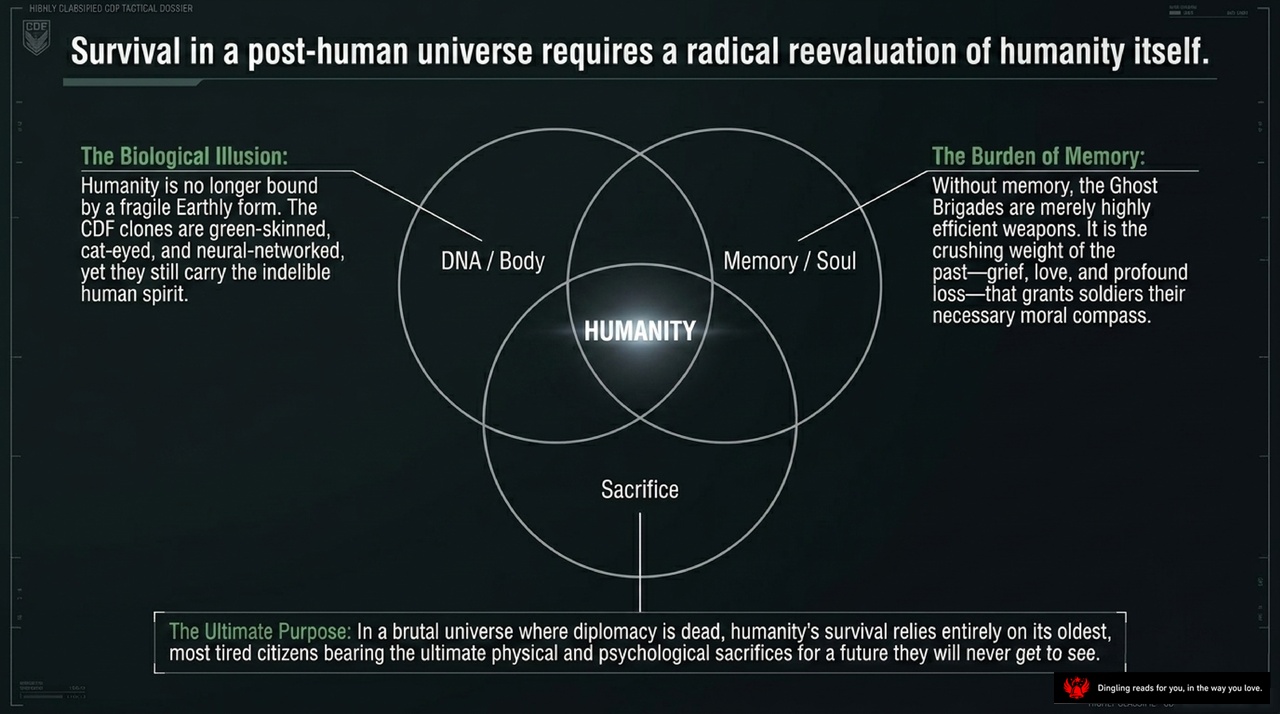
Survival in a post-human universe demands a radical reevaluation of what it means to be human. As we stand on the precipice of a new era, the boundaries between biology and memory begin to blur.
Look at the diagram: humanity is no longer defined solely by our fragile, Earth-bound DNA. The CDF clones—green-skinned, cat-eyed, and neural-networked—carry an indelible human spirit despite their alien forms. This is the biological illusion we must embrace; the vessel has changed, but the soul remains.
Yet, without memory, these warriors would be nothing more than highly efficient weapons. It is the crushing weight of the past—grief, love, and profound loss—that grants them their necessary moral compass. This is the burden of memory we carry.
In a brutal universe where diplomacy is dead, our survival relies on these transformed citizens bearing the ultimate physical and psychological sacrifices for a future they may never get to see. We are the bridge between the old world and the stars, proving that even when the body evolves, the capacity to sacrifice remains the core of our humanity.

In the end, Old Man's War is not merely a tale of intergalactic conquest, but a profound meditation on aging, identity, and the cyclical nature of sacrifice. The Colonial Defense Forces offer a miraculous escape from the inevitability of death, granting the elderly perfect bodies and superhuman abilities. Yet, the true cost of this rejuvenation is exacted on the soul. The soldiers are thrust into a merciless, Darwinian universe where survival requires stripping away the very empathy and morality that defined their earthly lives. They fight, bleed, and die on forgotten worlds, transforming themselves into monsters so that the rest of humanity might live in ignorance and peace.
If the price of a second youth was losing your humanity to protect a universe you will never live in, would you still sign your name?