
Old Temple New Gods: Complete Chapter-by-Chapter Summary
Welcome everyone. Today we are exploring Old Temple, New Gods by Duan Zhiqiang. As the title suggests, this is not just a story about ancient architecture. It is about how the Confucian Temple became a tool for power. The book reveals how the Qing Dynasty weaponized this sacred space to control the narrative of a dying empire. By swapping out the honored scholars, the state reshaped loyalty and tradition to fit its political needs. This was not just about worship; it was about survival and manipulation. As we dive into the text, we will see how these new gods were chosen not for their wisdom, but for their utility in maintaining order. Let us begin this journey into the heart of a fading dynasty.
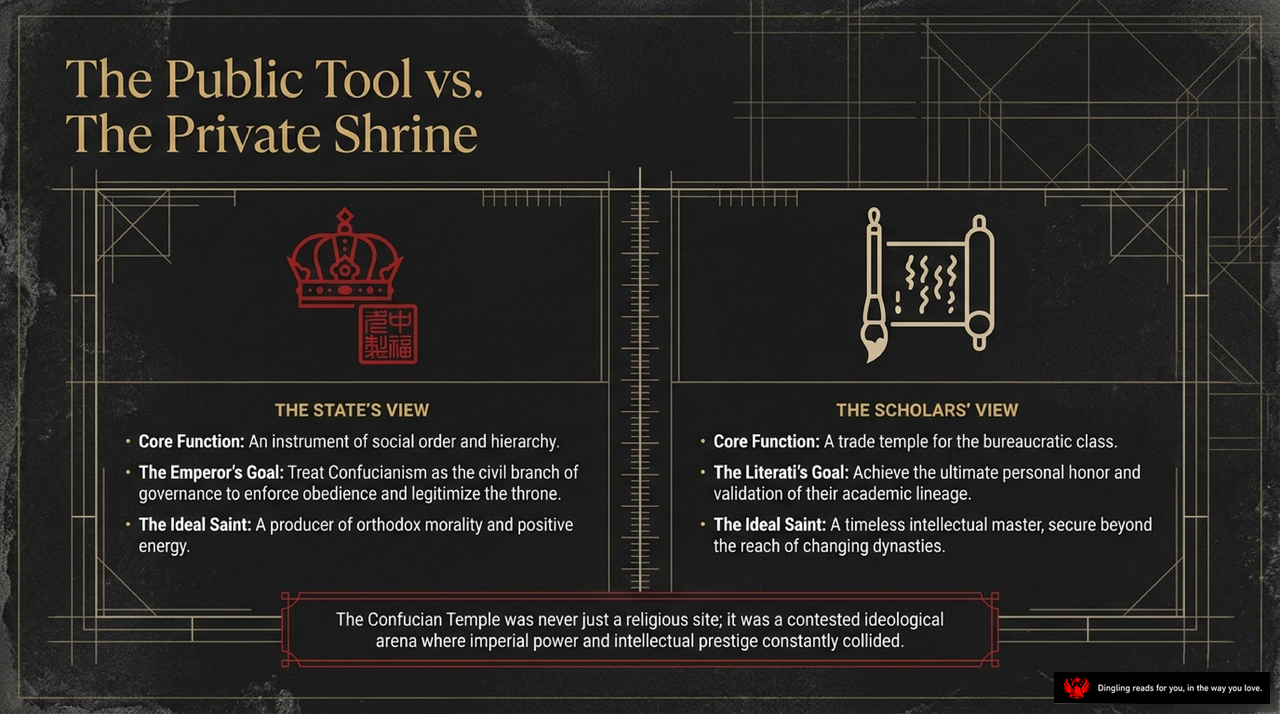
Welcome back. Today we're looking at the dual nature of the Confucian Temple. As you see on the slide, it's a clash of two worlds: The Public Tool versus The Private Shrine.
On the left, we have The State's View. Imagine a Crown. To the Emperor, Confucianism wasn't about deep philosophy; it was a practical tool for social order. The Emperor's goal was simple: treat Confucianism as the civil branch of governance to enforce obedience and legitimize the throne. He wanted an Ideal Saint who was a producer of orthodox morality and positive energy—someone who reinforced the hierarchy and kept the peace.
On the right, we have The Scholars' View. Picture a brush and a scroll. For the literati, the temple was a trade temple for the bureaucratic class. Their goal wasn't just to serve the state, but to achieve ultimate personal honor and validate their academic lineage. They wanted an Ideal Saint who was a timeless intellectual master, secure beyond the reach of changing dynasties.
This slide captures the core tension perfectly. The bottom text reminds us that the Confucian Temple was never just a religious site; it was a contested ideological arena where imperial power and intellectual prestige constantly collided.
The book explains this dynamic through the concept of Public and Private. Public funds represented the State, while private donations from scholars represented their personal gratitude for gaining official titles. This isn't just about money; it's about power. The State wanted to control the narrative, turning scholars into 'positive energy producers' who fit the government's needs. But the scholars fought back, using the temple to secure their own immortality and status, often reshaping history to fit their own agendas.
For example, the State saw the temple as a tool to maintain hierarchy. But the scholars saw it as a way to climb the social ladder and ensure their names were remembered forever. This conflict played out over centuries, especially during the Qing Dynasty, when emperors like Yongzheng actively expanded the temple to control the narrative, while scholars lobbied to include their own heroes.
So, while the Emperor built the temple to rule, the scholars built it to remember themselves. It was a constant negotiation between state authority and intellectual prestige. Understanding this duality is key to understanding how the Confucian Temple functioned for centuries. It wasn't a static monument; it was a living political battleground where the definition of 'virtue' was constantly rewritten by whoever held the pen.
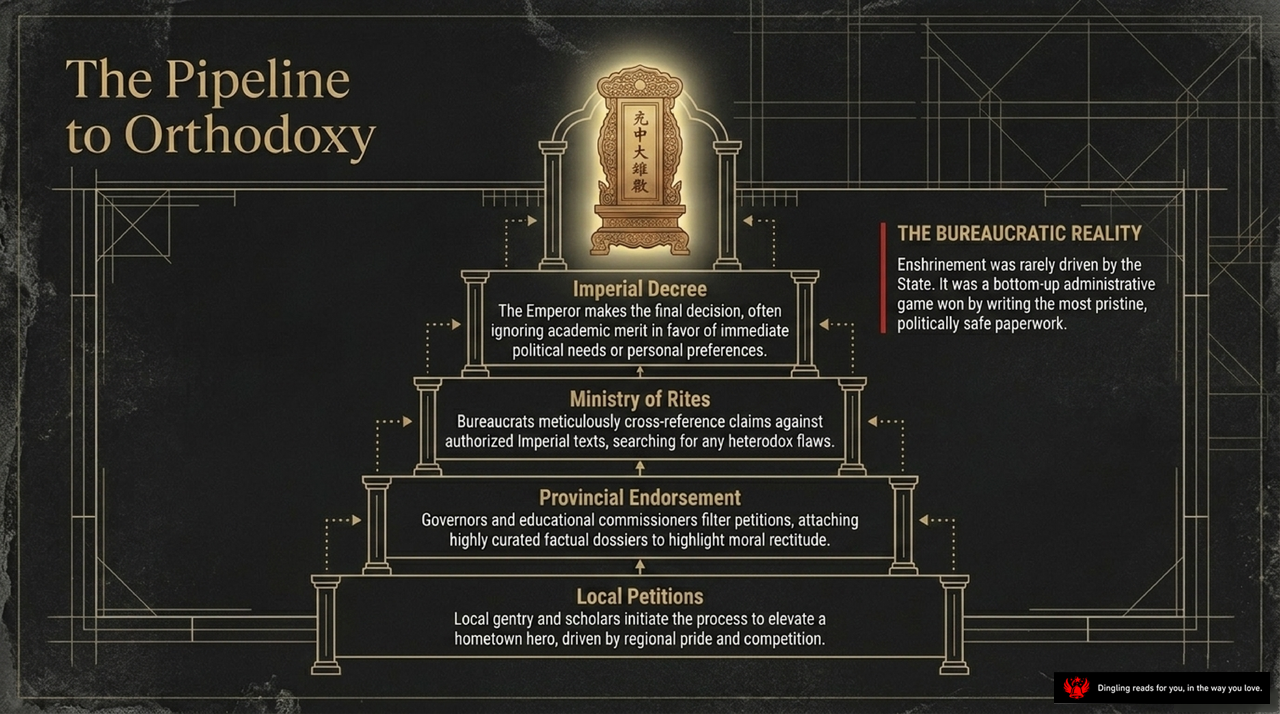
Let's take a closer look at how the Qing Dynasty decided who deserved to be enshrined in the Confucius Temple. This diagram, "The Pipeline to Orthodoxy," reveals the complex mechanics behind the honor. It wasn't a simple top-down decree from the Emperor. Instead, it was a multi-layered filtration system designed to ensure that only the "right" kind of scholar could enter the pantheon.
It starts at the very bottom with Local Petitions. Local gentry and scholars would initiate the process, driven by regional pride and competition. They wanted to elevate a hometown hero, but that was just the entry ticket. Once a name was proposed, it moved up to Provincial Endorsement. Here, governors and educational commissioners acted as the first gatekeepers. They filtered petitions, attaching highly curated factual dossiers to highlight moral rectitude. They weren't just checking facts; they were crafting a narrative that fit the state's needs.
Next, the petition reaches the Ministry of Rites. This is where the scrutiny gets intense. Bureaucrats meticulously cross-reference claims against authorized Imperial texts, searching for any heterodox flaws. If a scholar's ideas deviated too far from the official orthodoxy, they got stopped here. This layer ensured that only those who fit the ideological mold could advance.
Finally, the process culminates in the Imperial Decree. The Emperor makes the final decision, often ignoring academic merit in favor of immediate political needs or personal preferences. But here is the crucial insight from the "Bureaucratic Reality" box on the right. Enshrinement was rarely driven by the State itself. It was actually a bottom-up administrative game won by writing the most pristine, politically safe paperwork.
So, while the Emperor had the final say, the real power lay in the ability of lower officials to filter and frame candidates. The system wasn't about pure academic merit; it was about navigating a complex bureaucracy to ensure political safety. The "Pipeline" wasn't just a path to honor; it was a mechanism to control orthodoxy through administrative consensus. The Emperor was the figurehead, but the real work was done by the bureaucrats writing the papers that made the enshrinement possible. In this way, the state didn't just reward scholars; it manufactured the very definition of "orthodoxy" through this bureaucratic pipeline. This pipeline effectively turned the Confucius Temple into a political tool, where the "orthodoxy" was defined by the safety of the paperwork, not necessarily the truth of the scholarship. Ultimately, the diagram shows us that becoming a saint in the Qing Dynasty was less about spiritual enlightenment and more about bureaucratic success.
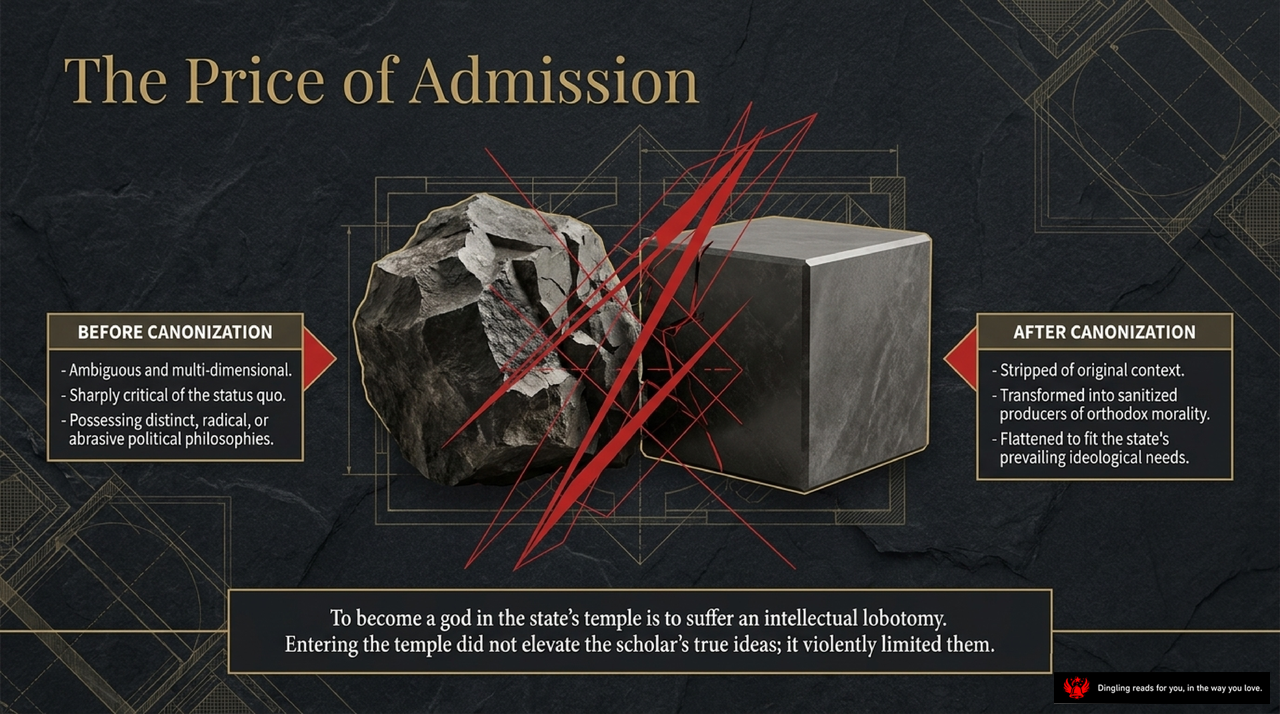
The image on this slide captures a profound truth about how history is written by the powerful. We see a rough, jagged stone on the left, representing the scholars before they were officially recognized. On the right, a smooth, perfect cube. This is the transformation of Gu Yanwu, Huang Zongxi, and Wang Fuzhi. Before canonization, they were ambiguous, multi-dimensional, and often sharply critical of the status quo. They possessed distinct, radical political philosophies that didn't fit the government's narrative. They were 'outsiders' who refused to collaborate with the Qing dynasty.
But the state wanted them in the temple. To become a 'god' in the state's temple, as the text says, is to suffer an intellectual lobotomy. The process of canonization wasn't about honoring their true ideas; it was about violently limiting them. The government had to strip them of their original context. Their radical critiques of monarchy and their anti-Qing sentiments had to be sanitized. They were transformed into producers of orthodox morality, flattened to fit the state's prevailing ideological needs.
During the late Qing dynasty, as the empire faced collapse and the push for constitutional reform began, the court realized these 'heretics' could be useful if rebranded. They needed to look like supporters of the new order. So, officials like Zhang Zhidong argued that Huang Zongxi's ideas were actually consistent with Confucian classics and even aligned with Western constitutionalism. They ignored the revolutionary implications of 'The Inquiry into the Principles of the Government of the State' and focused only on the parts that supported stability. Specifically, they argued that his views on the 'right of revolution' were actually just Confucian teachings about removing tyrants, not a call for modern democracy.
This is the price of admission. By entering the temple, these thinkers lost their dangerous edge. The state absorbed their critique only to neutralize it. The rough stone became a smooth cube, safe for public consumption. The text reminds us that entering the temple did not elevate the scholar's true ideas; it violently limited them. The state didn't just honor them; it domesticated them. This is the ultimate cost of becoming a 'god' in the eyes of a regime. Ironically, while the Qing court used them to justify order, the revolutionaries who eventually overthrew the dynasty would later claim these same texts as proof that the system was illegitimate. The state won the temple, but it lost the truth. The 'Price of Admission' was the loss of intellectual freedom.
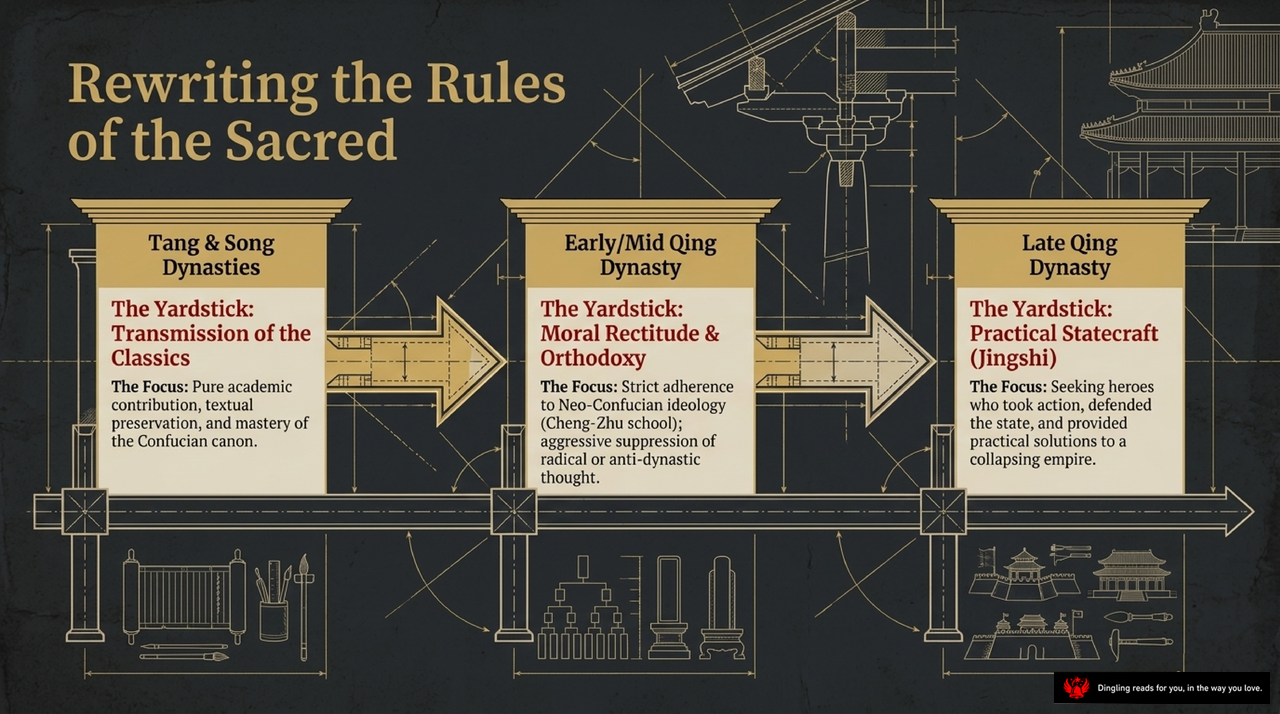
Welcome to this section of our presentation. Look at the timeline on the screen. It captures a fascinating evolution in how the Chinese empire defined its own sacred rules. We are looking at the shifting standards for enshrining scholars in the Confucian temple, and you can see three distinct phases clearly laid out here.
First, we have the Tang and Song Dynasties. During this era, the yardstick was the "Transmission of the Classics." The focus was purely academic. If a scholar could master the Confucian canon and preserve the ancient texts, they were worthy of enshrinement. It was a time of pure intellectual contribution, where the value of a scholar was measured by their textual preservation and mastery of the classics.
Then, the timeline moves to the Early and Mid Qing Dynasty. Here, the rules changed significantly. The yardstick became "Moral Rectitude and Orthodoxy." This wasn't just about knowing the books anymore; it was about strict adherence to Neo-Confucian ideology, specifically the Cheng-Zhu school. The focus shifted to political control. Scholars were expected to uphold moral order, and any radical or anti-dynastic thought was aggressively suppressed. Enshrining someone now meant they had to fit the state's ideological mold perfectly.
Finally, we arrive at the Late Qing Dynasty. This is where the transformation completes. The yardstick shifts to "Practical Statecraft," known as *Jingshi*. By this time, the empire was collapsing, and the old rules of orthodoxy and text preservation no longer solved the crisis. The focus became seeking heroes who took action, defended the state, and provided practical solutions. This is why figures like Gu Yanwu and Huang Zongxi finally made it into the temple. They weren't just scholars; they were thinkers who offered real solutions for a dying empire.
So, what does this tell us? It shows that the "sacred" rules were never fixed. From preserving texts in the Tang and Song, to enforcing morality in the Qing, to demanding action in the final days of the empire, the definition of a worthy scholar was constantly rewritten to fit the needs of the times. The temple itself became a mirror of the state's changing priorities.
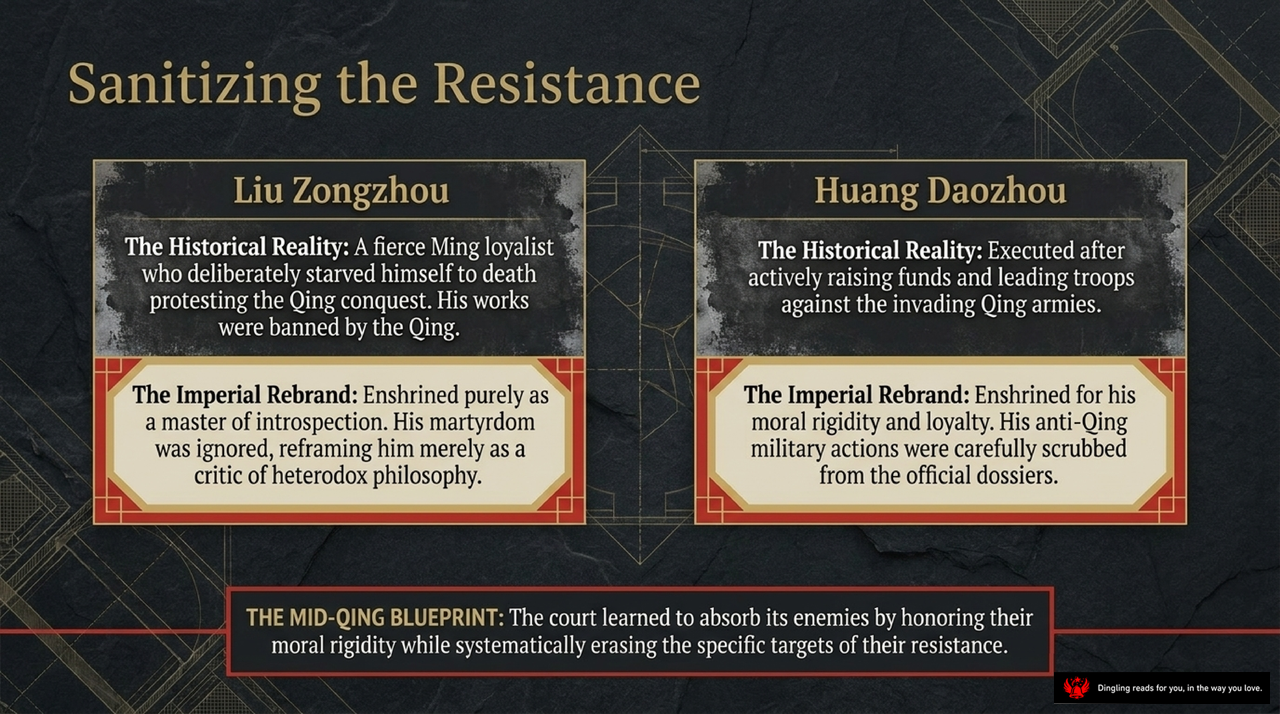
Let's dive into how the Qing dynasty managed its political enemies. The slide we are looking at is titled 'Sanitizing the Resistance.' It highlights two specific figures: Liu Zongzhou and Huang Daozhou.
First, let's look at the historical reality. Both men were fierce Ming loyalists. Liu Zongzhou deliberately starved himself to death to protest the Qing conquest. Huang Daozhou actively raised funds and led troops against the invading Qing armies. They were genuine threats to the new regime.
But look at how the Qing court rebranded them. This is the 'Imperial Rebrand.'
For Liu Zongzhou, the court enshrined him purely as a master of introspection. His martyrdom was ignored. They reframed him merely as a critic of heterodox philosophy. His political resistance was scrubbed from the narrative.
For Huang Daozhou, he was enshrined for his moral rigidity and loyalty. But his anti-Qing military actions were carefully scrubbed from the official dossiers. The court kept his name but removed his revolutionary actions.
This wasn't random. It was 'The Mid-Qing Blueprint.' The court learned to absorb its enemies by honoring their moral rigidity while systematically erasing the specific targets of their resistance.
This happened specifically during the Dingdao era. Officials proposed these men for inclusion in the Temple of Confucius. For Huang Daozhou, the official cited an edict calling them 'perfect men,' but deliberately deleted the part about them dying for the nation to avoid controversy.
By doing this, the court turned dangerous political symbols into safe cultural icons. It allowed them to claim these men as part of their own tradition without acknowledging the threat they posed.
This strategy allowed the court to control the narrative. It turned their resistance into a form of approved moral philosophy. It's a powerful example of how power can reshape history to serve its own interests.
Ultimately, the Qing court didn't just kill their enemies; they co-opted them. By sanitizing the resistance, they neutralized the threat and claimed the moral high ground. This ensured that the legacy of these rebels served the stability of the empire they overthrew. It shows a sophisticated political maneuver. The court recognized that these men had moral authority. Instead of erasing them, they kept the moral authority but stripped the political content. This is a classic example of how political regimes manage dissent.
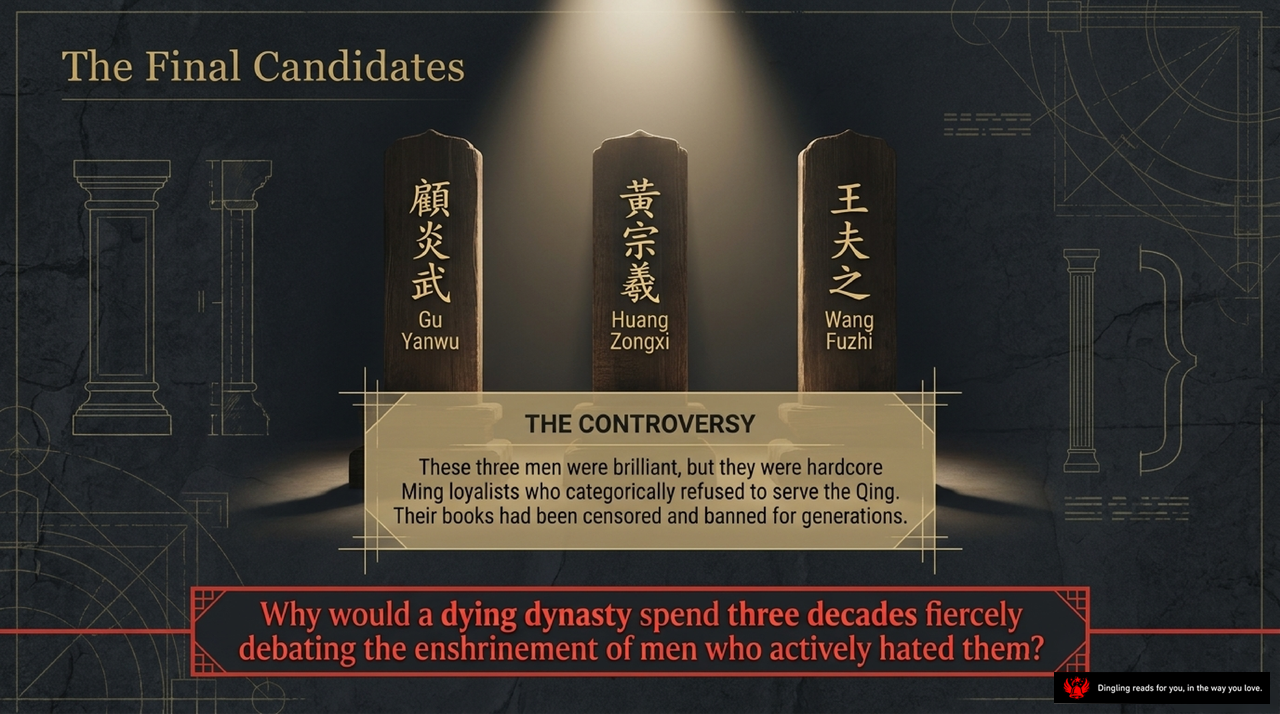
Look at these three names on the screen: Gu Yanwu, Huang Zongxi, and Wang Fuzhi. These are the final candidates for the Confucian Temple. At first glance, this seems like a simple academic honor. But look closer at the controversy below. These three men were brilliant, yes, but they were hardcore Ming loyalists who categorically refused to serve the Qing. Their books were censored and banned for generations.
So, the big question here is: Why would a dying dynasty spend three decades fiercely debating the enshrinement of men who actively hated them?
This wasn't just a bureaucratic dispute. It was a massive political struggle. For the first two hundred years of the Qing, these three were effectively ghosts. They had served the Southern Ming, they fought against the Qing, and their writings were considered subversive. Officials argued that enshrining them would undermine the legitimacy of the current dynasty. In fact, their books were even listed as banned texts during the Qianlong era.
However, the winds of change were blowing. By the late Qing, the empire was crumbling. Western ideas were flooding in. The government needed to modernize, and they needed new intellectual heroes who could bridge the old tradition with new realities. They realized that these three men, despite their loyalty to the Ming, actually offered critiques of authoritarianism that fit the narrative of constitutional reform. Huang Zongxi's writings, for example, were being compared to Western ideas about the social contract. The court wanted to use their ideas to support the new constitution, but revolutionaries saw them as revolutionaries. This was a tragic clash of interpretations.
The debate dragged on for thirty years. Supporters argued that their ideas on governance were compatible with modern liberty. Opponents feared that honoring them would fuel revolution. Eventually, the Qing court approved their enshrinement. It was a desperate attempt to claim their legacy for the state.
But the irony was bitter. By the time these three were officially honored, the Qing dynasty was already on its last legs. The revolutionaries they were supposed to be warning against had already seized power. So, while the Qing tried to use them as symbols of stability, history used them as symbols of change. This decision marked the end of an era, showing that even the most powerful traditions couldn't survive the tide of time. It was the last cultural effort of the Qing, a final attempt to rewrite history before the ink dried.
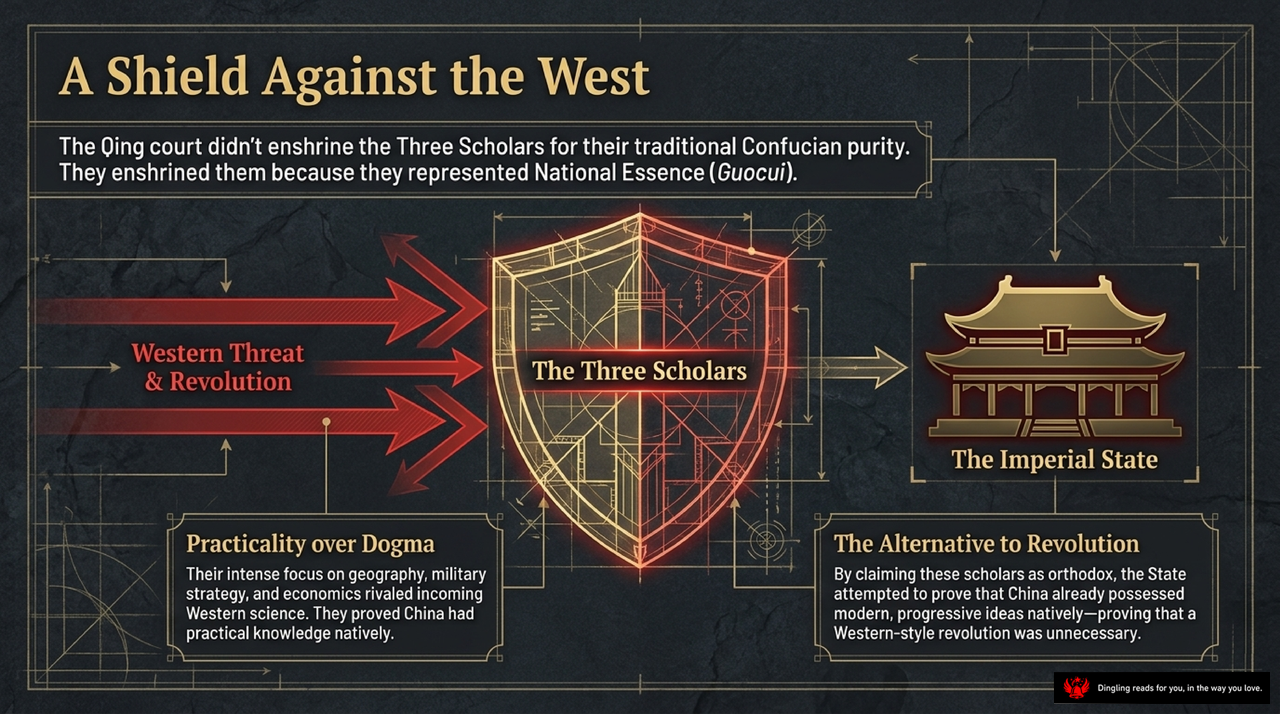
Imagine a shield. In the late Qing Dynasty, the Imperial Court didn't just put the Three Scholars—Gu Yanwu, Huang Zongxi, and Wang Fuzhi—into the Temple of Confucius for tradition's sake. No, they did it for survival. Look at this graphic. The arrows coming in represent the Western threat and the call for revolution. The shield is the Three Scholars themselves, protecting the Imperial State on the right.
Why? Because the Qing court needed a narrative. They needed to prove that China wasn't backward. They enshrined these men not for their 'Confucian purity,' but because they represented 'National Essence.' Think of it as a strategic rebranding. The Qing court was saying, 'Our culture is already modern.'
First, look at the bottom left: 'Practicality over Dogma.' The Three Scholars weren't just philosophers sitting in tea houses. They were obsessed with geography, military strategy, and economics. They showed that China already possessed practical knowledge that could rival Western science. It was a way to say, 'We don't need to copy you; we have our own modern toolkit.'
Then, look at the bottom right: 'The Alternative to Revolution.' This is the clever part. By claiming these scholars were orthodox, the State argued that China already possessed modern, progressive ideas natively. If China already had the seeds of democracy and reform, then a violent Western-style revolution was unnecessary. It was a political argument to keep the status quo alive by reinterpreting the past.
So, this wasn't just about honoring dead scholars. It was a desperate attempt to build a wall against the encroaching West. They used the Three Scholars to prove that modernity was indigenous, not imported. It was the last intellectual stand of the Qing Dynasty, trying to turn their history into a shield against the future. It's a fascinating reminder that even in the face of collapse, the state will try to rewrite its own story to stay relevant. This slide perfectly captures that moment where the past was weaponized to fight the future.
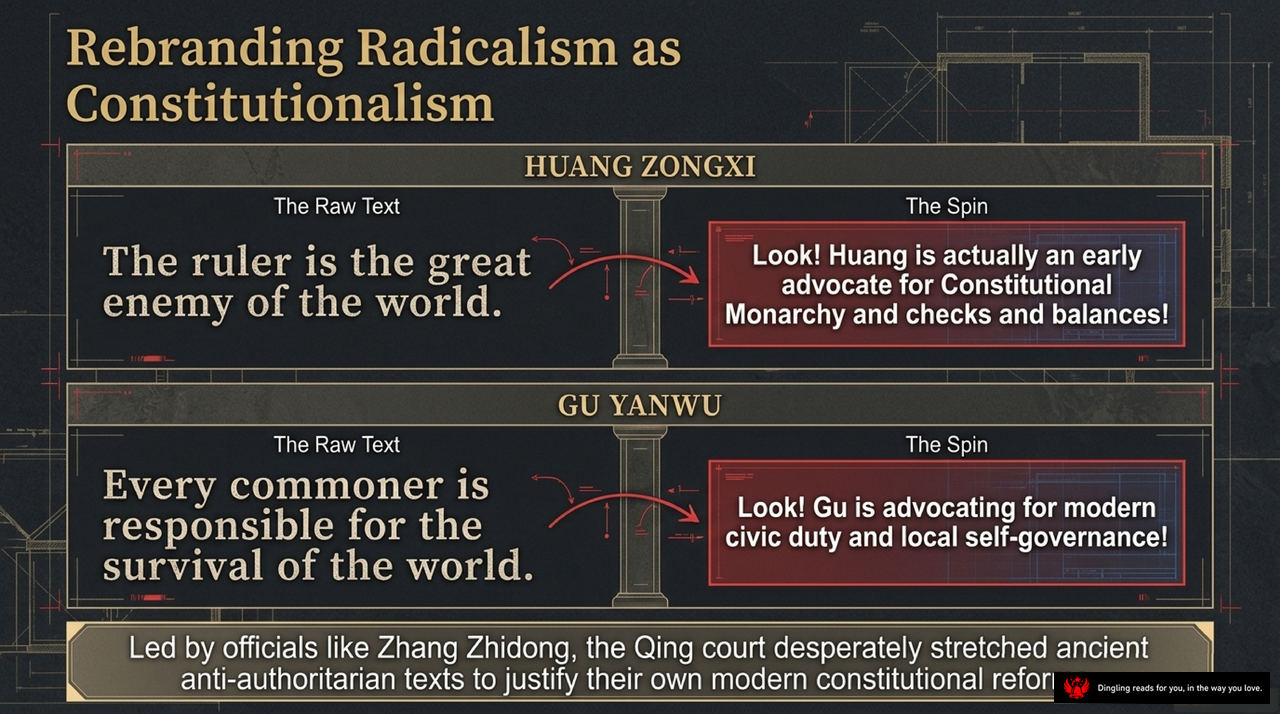
Imagine a scenario where the past is rewritten to fit the present. That is exactly what happened in the late Qing dynasty. The court, facing a crisis, looked to ancient texts not for their original meaning, but for ammunition to justify modernization. They took radical thinkers who actually challenged authority and repackaged them as champions of constitutionalism.
Take Huang Zongxi, for instance. In his original writings, he famously declared that the ruler is the great enemy of the world. That is pretty anti-authoritarian, right? But the Qing court spun this narrative differently. They pointed to Huang and said, Look! Huang is actually an early advocate for Constitutional Monarchy and checks and balances! They turned his critique of tyranny into a blueprint for a limited monarchy.
Then there is Gu Yanwu. His raw text states that every commoner is responsible for the survival of the world. This emphasizes individual duty over state control. But the government's spin was, Look! Gu is advocating for modern civic duty and local self-governance! They stripped away the revolutionary edge and framed it as a call for community responsibility.
This was not just about history; it was a political strategy. Led by officials like Zhang Zhidong, the Qing court desperately stretched ancient anti-authoritarian texts to justify their own modern constitutional reform. They needed to show that their reforms were not foreign impositions, but a return to Chinese wisdom. By rebranding these radical figures, they hoped to ease the transition and gain legitimacy. It was a clever, if somewhat dishonest, attempt to bridge the gap between an old empire and a new political order. The contrast between the raw text and the spin is stark. The raw text was about survival and resistance. The spin was about order and governance. Interestingly, even the Guocui movement, which wanted to preserve Chinese culture, had a different take. They saw these figures as revolutionaries, not constitutionalists. But the government cared more about using their ideas to save the dynasty than preserving the truth. The bottom line is clear: the government used these ideas to legitimize their power while pretending to be modern. This rebranding effort highlights a critical truth about political power: it often relies on rewriting history to suit current needs. The gap between the original intent and the political utility is massive. Huang was criticizing the emperor; the government used him to defend a constitutional emperor. Gu was empowering the people; the government used him to encourage self-governance without threatening the throne. Ultimately, this slide captures the essence of a desperate political maneuver to save a crumbling empire by co-opting the very ideas that threatened it.
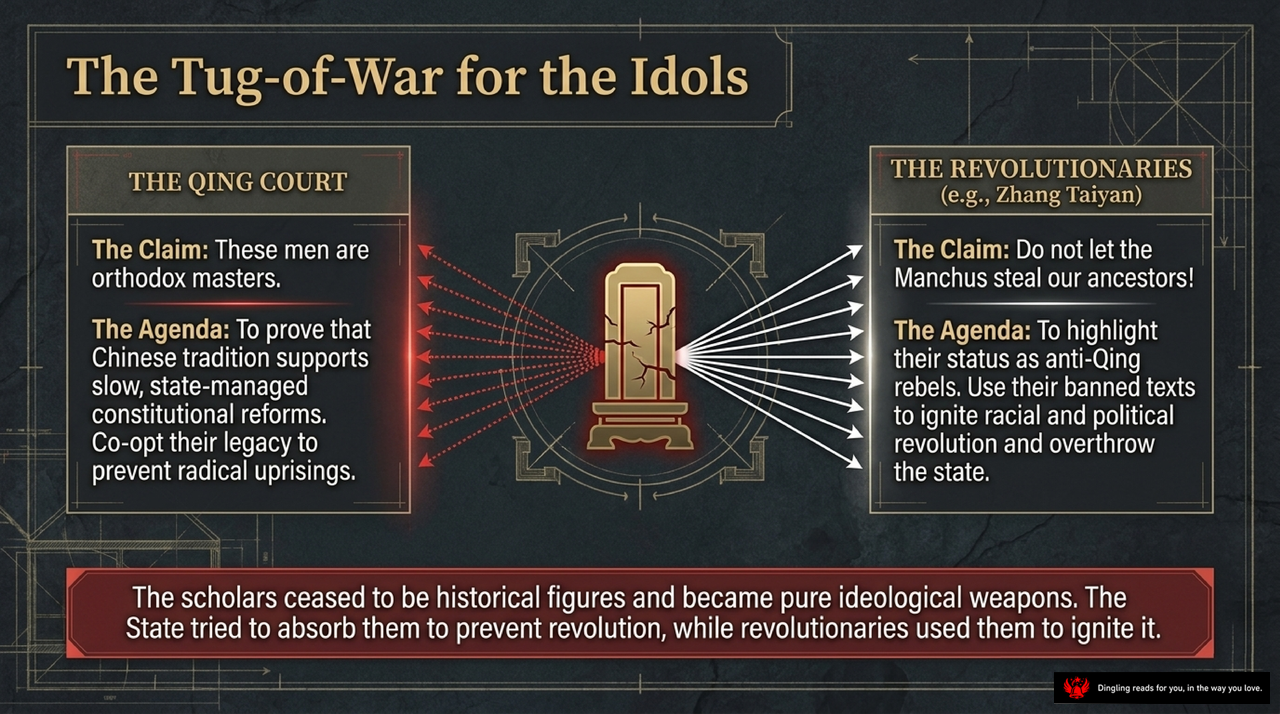
Take a look at this slide. It captures the central conflict of the late Qing era perfectly: The Tug-of-War for the Idols.
In the center, we see a cracked tablet. This represents the scholars—Gu Yanwu, Huang Zongxi, and Wang Fuzhi—who were once respected intellectuals. But by the end of the Qing Dynasty, they were no longer just historical figures. They had become weapons in a massive political struggle.
On the left, we have the Qing Court. Their goal was survival. They claimed these men were orthodox masters to prove that Chinese tradition actually supported slow, state-managed constitutional reforms. They wanted to co-opt the scholars legacy. By bringing these famous anti-Manchu thinkers into the official temple, the state tried to neutralize them. If the scholars were honored by the Qing, then the revolution lost its moral high ground. They were trying to prevent radical uprisings by absorbing the very people who criticized them.
On the right, we have the Revolutionaries, like Zhang Taiyan. Their claim was much more aggressive: Do not let the Manchus steal our ancestors! To them, these scholars were symbols of anti-Qing resistance. The revolutionaries dug up the scholars banned texts, specifically books like Huang Zongxi's Ming Yi Dai Fang Lu, to ignite racial and political revolution. They used these idols to justify overthrowing the state entirely.
The bottom line of this slide summarizes the tragedy. The scholars ceased to be historical figures and became pure ideological weapons. The State tried to absorb them to prevent revolution, while revolutionaries used them to ignite it.
This shows us that history isn't just about what happened in the past. It's about how the present uses the past to fight for power. The same books and people could be used to justify either a stable empire or a violent revolution, depending on who was holding the pen.
In this final struggle, the Qing Court tried to use these scholars to legitimize a slow, safe transition to modern governance. But the Revolutionaries saw them as proof that the old system was already rotten. It's a perfect example of how the past can be twisted to serve the present. When the Qing Court finally enshrined them, it was too late. The revolutionaries had already claimed them. The idols were gone, and only the conflict remained.
This is the ultimate irony. They tried to save the empire by honoring the very people who wanted to destroy it, only to accelerate the revolution.
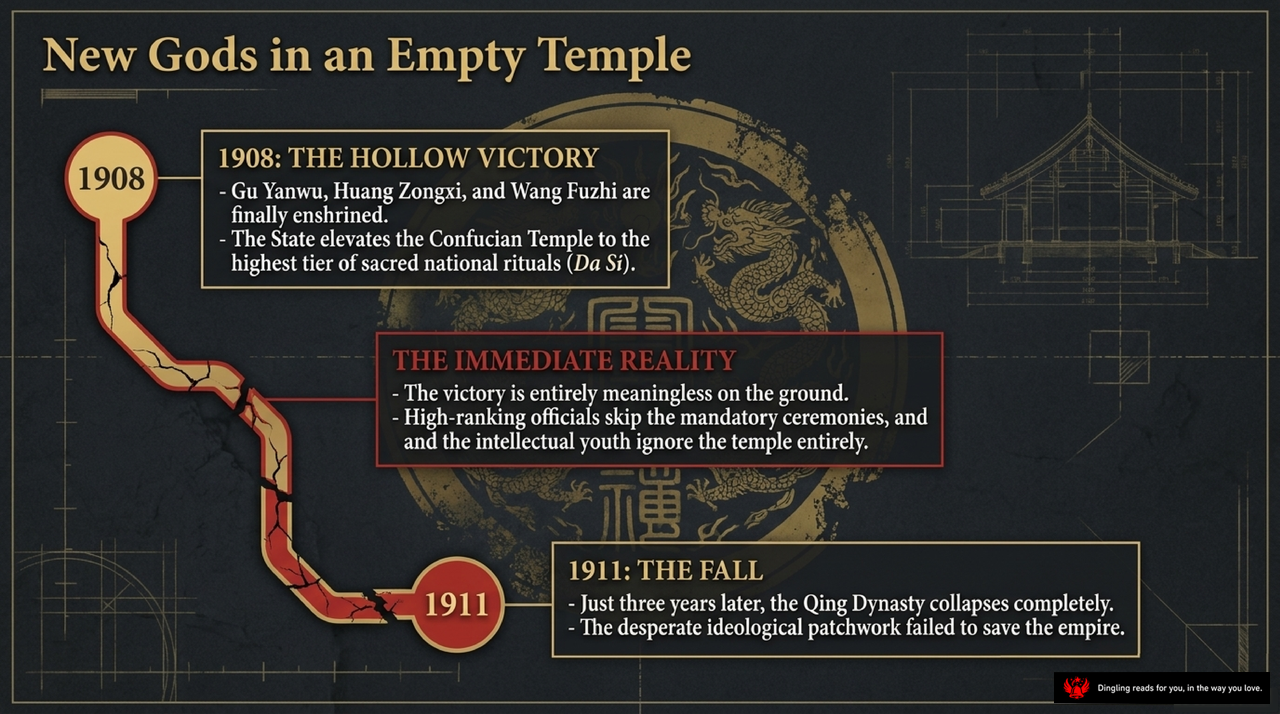
In 1908, the Qing court made a desperate, final move to legitimize itself. They finally enshrined three figures who had been controversial for decades: Gu Yanwu, Huang Zongxi, and Wang Fuzhi. These were the "New Gods" of the era, thinkers who had been banned or ignored for their anti-Qing views. To make this look serious, the state elevated the Confucian Temple to the highest tier of national ritual, the "Da Si." On paper, this was a grand victory. The court was claiming these thinkers as its own, trying to stitch the past to the present.
But here's the reality. The text calls it a "hollow victory." Why? Because the temple was empty. High-ranking officials started skipping the mandatory ceremonies. They didn't care. The intellectual youth? They ignored the temple entirely. The ritual had lost all meaning. It was just a formality in a crumbling system. The court was trying to force respect where there was none.
Then, just three years later, in 1911, the Qing Dynasty collapsed completely. The desperate attempt to patch up the empire with these "new gods" failed. The desperate ideological patchwork couldn't save the empire. The "New Gods" were trapped in an empty temple, unable to stop the collapse. The court tried to use history to save the future, to co-opt these thinkers who were actually remnants of the Ming. But the reality on the ground was that the faith in the system was gone. The officials didn't believe in the ritual, and the people didn't care. So, when the revolution came, the temple stood, but the dynasty fell. The "New Gods" were left behind in an empty temple, a symbol of an ideology that had run out of steam. It was the last gasp of the Qing court, a final attempt to find legitimacy in the past, while the future had already moved on. The temple remained, but the power it once held was long gone.
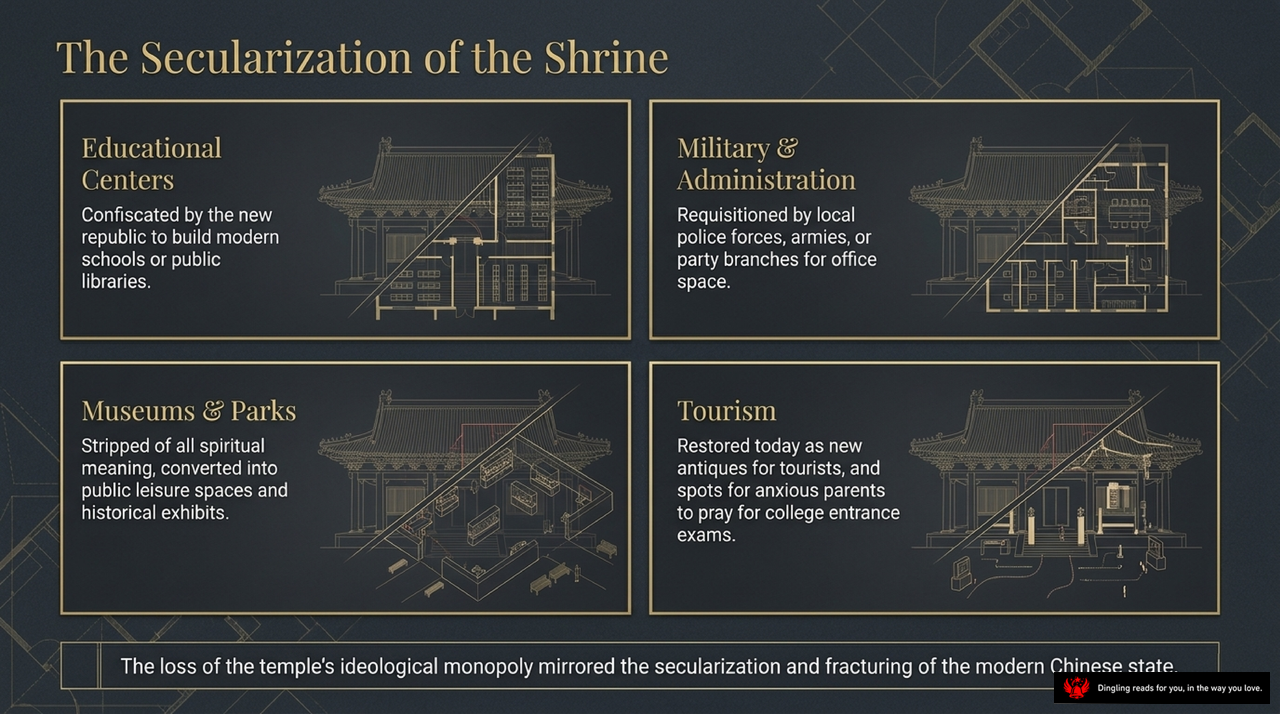
Welcome to this section. We are looking at a critical shift in history: The Secularization of the Shrine. Imagine the traditional temple, once the absolute center of political and spiritual life. What happened when the imperial order collapsed? First, look at the Educational Centers. The new republic didn't just abandon these buildings; they confiscated them. Sacred halls became modern schools or public libraries. The altar was cleared, and the space was filled with desks and books. Education took the place of divinity. Second, Military and Administration. Parts of the complex were requisitioned. Local police forces, armies, and even party branches needed office space. The architecture remained impressive, but it served bureaucrats and soldiers, not gods. The temple became a government building. Third, Museums and Parks. Here, the spiritual meaning was completely stripped away. These structures were converted into public leisure spaces and historical exhibits. They became places to look at history, not participate in it. The sacred became a museum display. Finally, Tourism. Today, these sites are restored as new antiques for tourists. But there's a fascinating twist. They are also spots for anxious parents to pray for college entrance exams. The old rituals survive, but the context is entirely different. The sacred is now a commodity. The footer text summarizes it all: The loss of the temple's ideological monopoly mirrored the secularization and fracturing of the modern Chinese state. The temple is no longer the state; it is a relic of the state. The monopoly is gone, and the power has scattered into the hands of the people, the market, and the bureaucracy. This isn't just about a building; it's about how a nation defines its authority. The sacred center became a public commodity. We moved from worshiping the ancestors of the state to using the state's history for our own modern purposes. The temple lost its power to command belief, and in doing so, it lost its power to command obedience. This transformation reflects the broader struggle of the modern era, where traditional structures are repurposed to fit new realities, leaving the old spiritual core behind. The state can no longer claim to speak for God, so it repurposes God's house to speak for itself. And eventually, even the state's voice fades, leaving only the tourist's gaze.
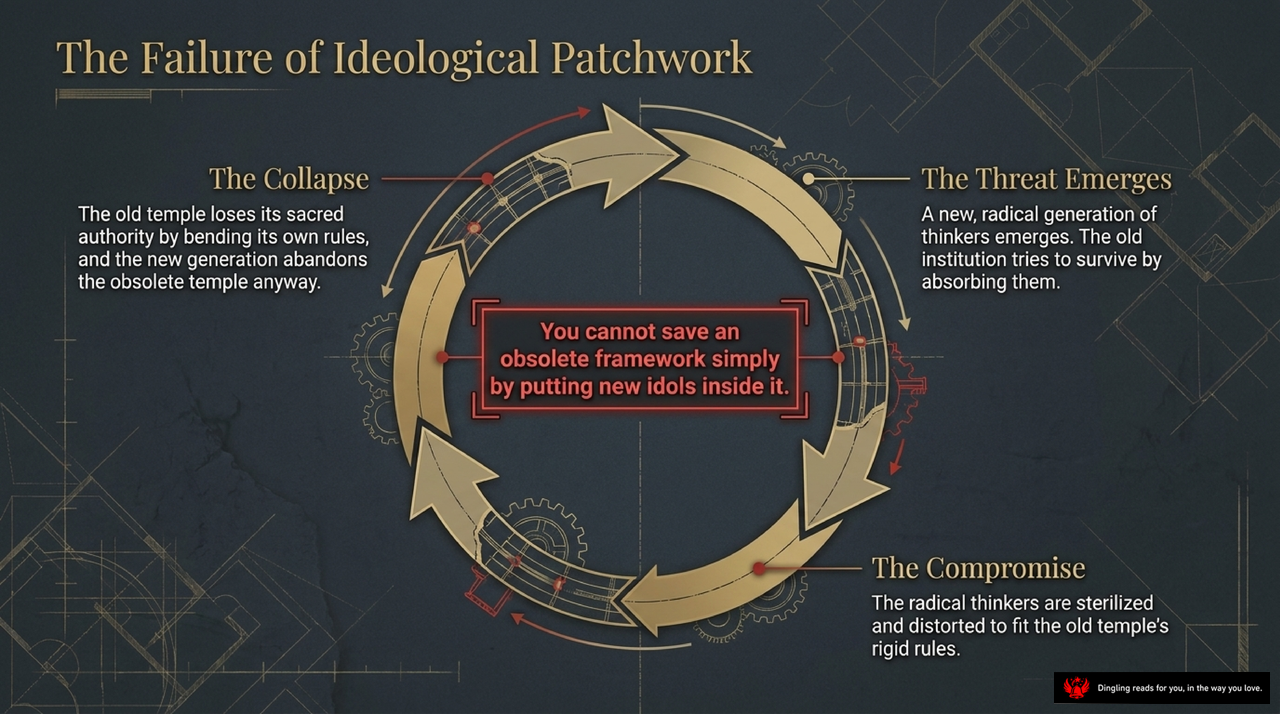
Look at this cycle. It illustrates a common failure in history: trying to patch a broken system by adding new pieces. The diagram calls it "The Failure of Ideological Patchwork."
First, look at "The Threat Emerges." In the late Qing Dynasty, the old Confucian order was losing its grip. Western ideas were flooding in. A new generation of thinkers—Gu Yanwu, Huang Zongxi, and Wang Fuzhi—emerged. They weren't just scholars; they were radical critics of the existing power structure. The Qing government, desperate to survive, tried to absorb them. They wanted to use these "new idols" to legitimize their own reforms.
Next, "The Compromise." This is where the failure begins. The state tried to sanitize these thinkers. They claimed Huang Zongxi's ideas on government weren't about revolution, but about traditional Confucian duty. They forced these radical ideas into the rigid, old-fashioned mold of the Confucian temple. It was like trying to put a modern engine into a steam locomotive. The court even rushed the approval process, ignoring the deep political tensions. They tried to align their ideas with the new constitutional reforms, hoping to show that modernization was compatible with tradition.
Finally, "The Collapse." The old framework couldn't hold the weight of the new ideas. The temple lost its sacred authority. People realized the government was just using history as a prop. The new generation abandoned the obsolete temple anyway. The dynasty collapsed, and the new ideas eventually won, but not through this compromise. Even after they were finally admitted in 1906, the revolutionaries used their very own words to justify overthrowing the monarchy. The irony was complete.
The central message here is blunt: You cannot save an obsolete framework simply by putting new idols inside it. The Qing Dynasty tried to use the Confucian temple to push constitutional reform, hoping it would calm the public and save the throne. But the system was already broken. The gap between the old ritual and the new reality was too wide.
This lesson applies far beyond history. When an organization tries to survive by co-opting disruptive innovation without actually changing its core structure, it usually ends up accelerating its own decline. The Qing's final effort to save itself through "patchwork" ideology was a tragic example of this dynamic. The framework was dead, and no amount of new idols could bring it back to life.
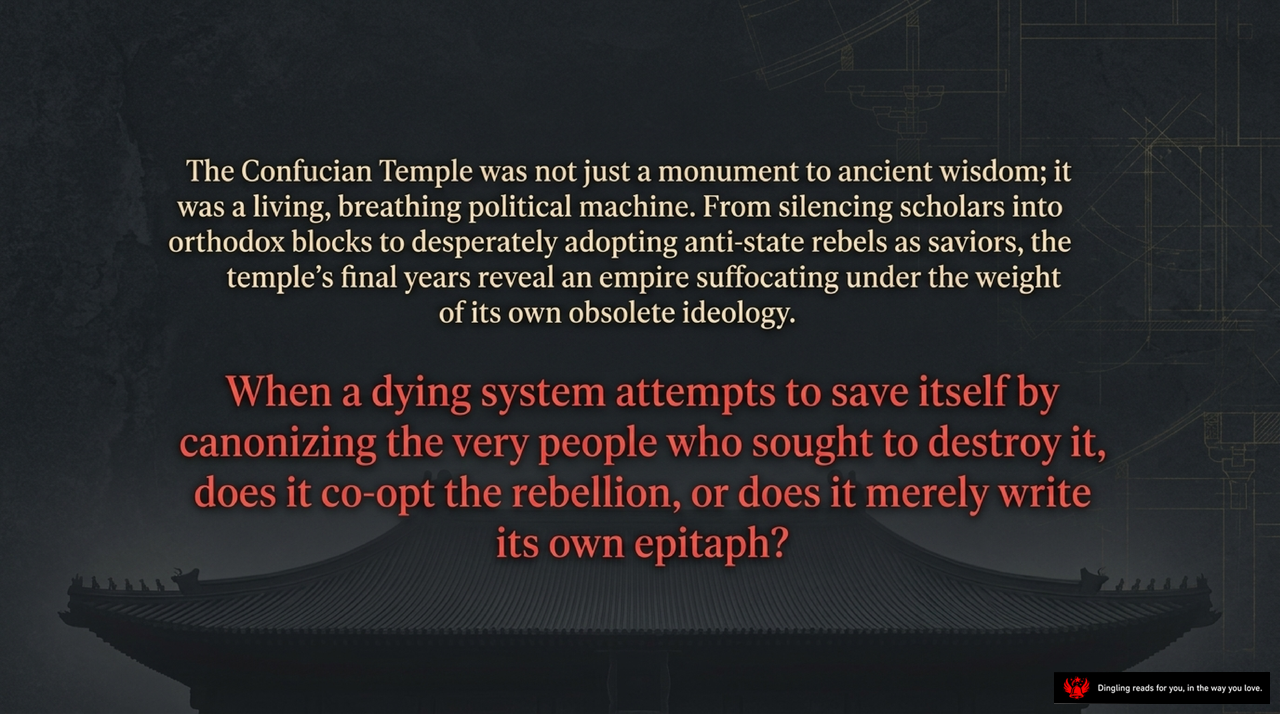
The slide we're looking at today captures a profound irony defining the final chapter of the Confucian Temple's history. It tells us the Temple wasn't just a place to honor ancient wisdom. In reality, it functioned as a living political machine, a tool for the state to control the narrative of legitimacy.
Throughout history, especially in the final years of the Qing Dynasty, the temple became a battleground for power. The government would silence scholars who didn't fit the orthodox mold. But when the system was crumbling, they did the opposite. They desperately tried to adopt anti-state rebels as saviors. Figures like Gu Yanwu, Huang Zongxi, and Wang Fuzhi were once seen as enemies of the Qing. Ming loyalists who refused to serve the new dynasty. Their writings were viewed as subversive.
Yet, in the end, the Qing court canonized them. Why? Because they needed to inject new ideas into a dying ideology. They wanted to use these 'rebels' to prove the government was reforming. This was a desperate move to support constitutional reforms. The court argued these sages were ancestors of modern constitutionalism, trying to co-opt their ideas to legitimize the new political order. They tried to turn their 'rebellion' into 'national essence,' claiming these men were preserving Chinese culture, even though their original intent was to overthrow the dynasty.
This reveals something chilling about the empire's decline. It shows an empire suffocating under the weight of its own obsolete ideology. It was trying to fix the past to save the future, using the very people who wanted to overthrow it as the symbols of its own survival.
So, we are left with a critical question. When a dying system attempts to save itself by canonizing the very people who sought to destroy it, does it co-opt the rebellion, or does it merely write its own epitaph? By bringing these controversial figures into the temple, the Qing court wasn't just honoring them; they were trying to rewrite history to justify their survival. But ultimately, this act highlighted that the system was beyond repair. It was a desperate bid for legitimacy that only served as a final testament to its own obsolescence. The temple, once a symbol of unity, became a graveyard of the old order, burying the very ideas it tried to use to save itself.