
On Becoming a Person: Complete Chapter-by-Chapter Summary
Welcome to our deep dive into Carl R. Rogers' masterpiece, *On Becoming a Person*. Imagine a journey not toward a fixed destination, but a fluid, authentic evolution toward your truest self. This book is a therapist's profound view of psychotherapy, revealing the universal journey toward a fluid, authentic, and fully functioning self.
Rogers challenges us to rethink what it means to be human. He argues that we don't need to be fixed or corrected; instead, we have an innate drive to grow and become more complete. When we stop pretending to be who others expect us to be, and start embracing our real feelings—even the uncomfortable ones—we unlock our potential. It's about trusting your own experience over external rules or labels.
The core of this transformation lies in the relationship itself. When we offer genuine acceptance and deep empathy to others, we create a safe space where they can truly be themselves. This same principle applies to education, parenting, and leadership. When people feel truly seen and valued, they naturally move toward creativity, autonomy, and maturity.
Rogers reminds us that becoming a person isn't about reaching a final state of perfection. It's a continuous process of opening up to life, trusting your inner compass, and courageously shedding the masks we wear to fit in. It's an invitation to stop hiding and start living as your authentic, evolving self.

The Core of Human Nature is Positive.
Imagine the human psyche not as a broken machine, but as a complex, layered sphere. On the outside, we often wear thick, cracked defensive masks—armor built to protect us from pain, judgment, and chaos. But look deeper, past those fractures, and you'll find something entirely different.
Through thousands of hours of clinical psychotherapy, a surprising truth emerges: when these defensive masks are stripped away, the innermost core of a human being is not destructive or chaotic. It is not a dark void waiting to consume us. Instead, the underlying organism is inherently positive, forward-moving, and constructive.
Think about it. We often fear our own emotions, thinking they are dangerous. But the reality is far more friendly. As the slide reminds us, "The facts are friendly." Every aspect of reality, even the most painful internal truths, is friendly if we are open to experiencing it.
We are not designed to be at war with ourselves. We are wired for growth, for expansion, and for connection. When we stop fighting our feelings and stop pretending to be someone else, that hidden, positive core begins to shine through. It's a natural, constructive force waiting to guide us toward a more authentic and complete life. The truth is, we are already on the side of good; we just have to take off the mask to see it.
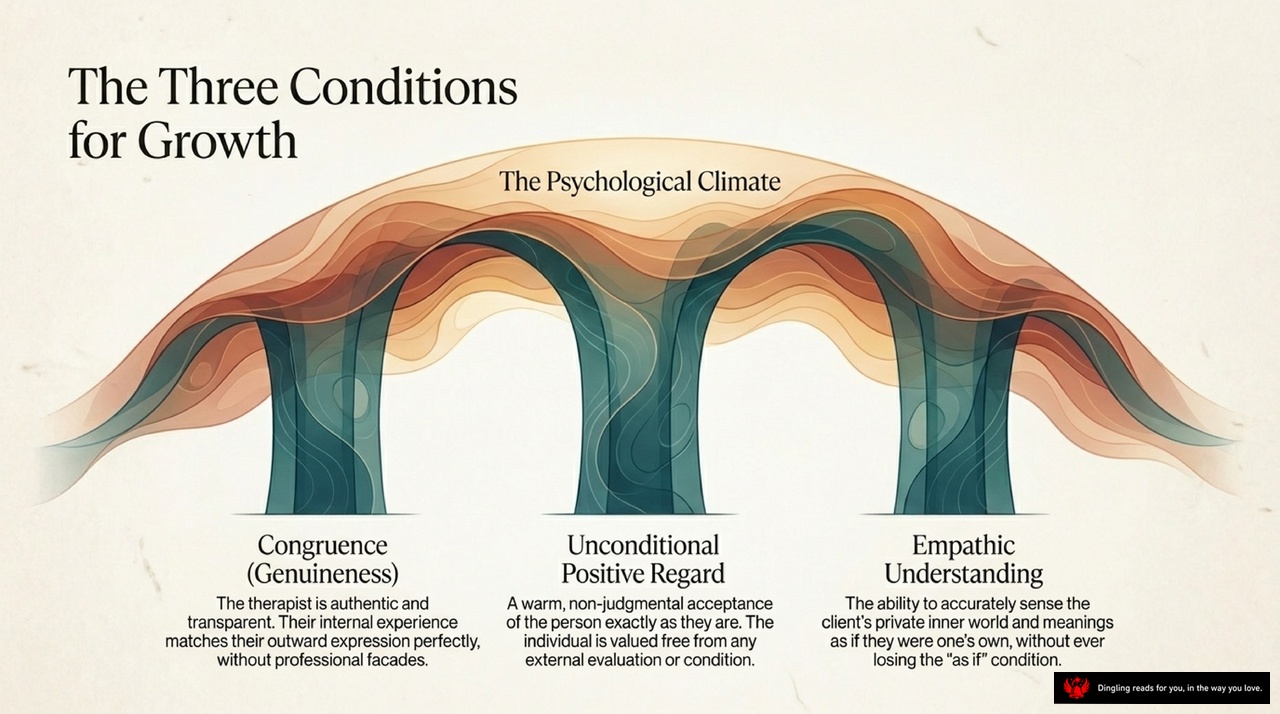
The slide we're looking at breaks down the "Three Conditions for Growth"—the exact psychological climate Carl Rogers believed was essential for anyone to truly flourish. Think of these three pillars not as rigid rules, but as the foundation for any relationship where real change can happen.
First, we have Congruence, or Genuineness. This is about authenticity. It means the therapist—or in any helping relationship, the person guiding the interaction—is transparent. Their inner experience matches their outward expression perfectly. There are no professional facades. When you feel safe enough to drop your mask, that's when real connection begins.
Second, there's Unconditional Positive Regard. This is the idea of warm, non-judgmental acceptance. It's valuing someone exactly as they are, free from any external evaluation or condition. It's not about agreeing with everything they say, but about accepting their worth regardless of their feelings or actions. This creates a space where people feel safe to be imperfect.
Finally, we have Empathic Understanding. This is the ability to accurately sense another person's private inner world. It's seeing the world through their eyes, understanding their meanings as if they were your own, without ever losing the boundary of "as if." It's the difference between sympathy and truly getting it.
When these three conditions align, they create a powerful environment. It's not about fixing someone; it's about unlocking their innate potential to grow, just like a plant reaching for the sun when the soil is safe and nurturing.
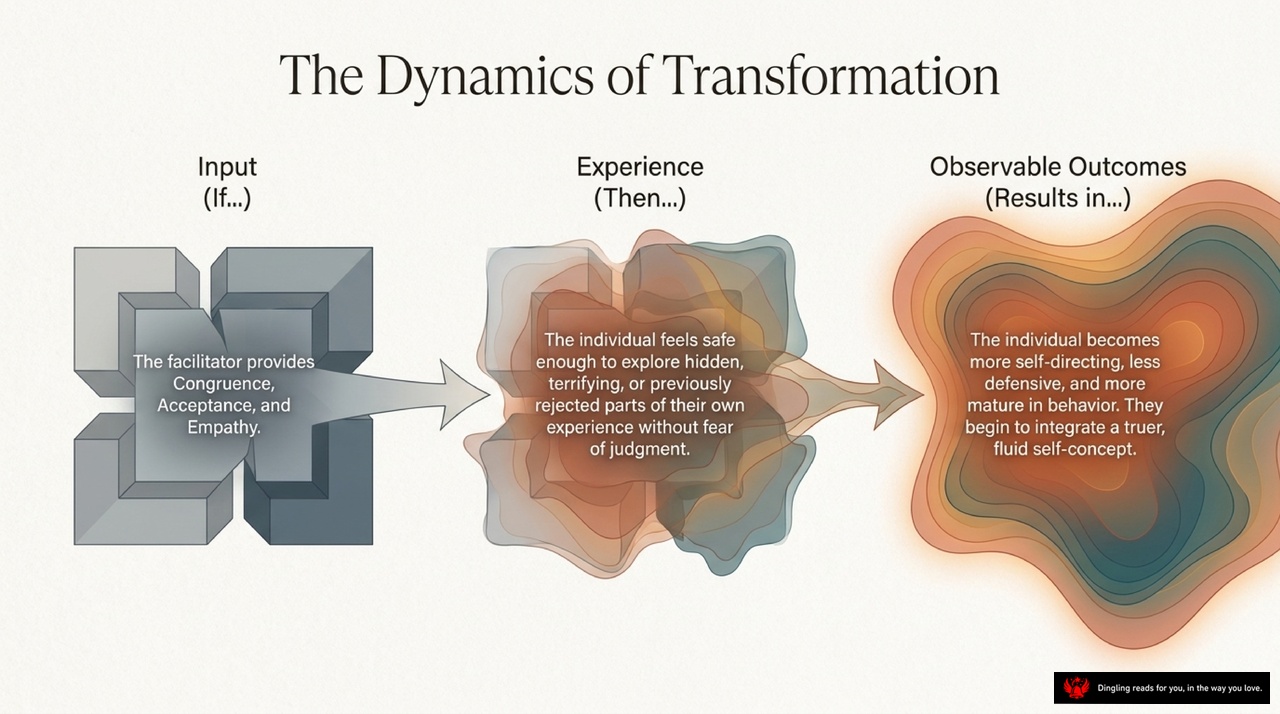
So, we're looking at the "Dynamics of Transformation," a visual map of how real change actually happens. It breaks down into three distinct phases: Input, Experience, and Observable Outcomes.
Let's start with the Input. The slide shows a structured block labeled "If..." where the facilitator provides congruence, acceptance, and empathy. Think of this as the foundation. Without these three elements, nothing else can take root. It's the safety net we create first.
When that safety is established, we move to the Experience phase, marked as "Then..." Here, the individual feels safe enough to finally explore those hidden, terrifying, or previously rejected parts of their own experience without the paralyzing fear of judgment. This is the messy, crucial work of letting go of the masks we wear.
Finally, we see the Observable Outcomes, labeled "Results in..." This is where the transformation becomes visible. The individual becomes more self-directing, less defensive, and more mature in their behavior. They stop trying to control everything and start integrating a truer, fluid self-concept.
The core message here is simple but powerful: transformation isn't about forcing change. It's about creating the conditions—safety, acceptance, and empathy—so that people can naturally unlock their own potential and grow into their authentic selves.

Moving Away from the Oughts. The journey to authenticity often begins negatively—by discovering what one is not.
Look at this visual metaphor. On the left, we see "The Facade." This is the false front we construct to please parents, teachers, or society. We wear masks that say, "I should be this," "I must be that." But deep inside, there's a terrifying realization we often avoid: "Who am I if I am not what they want me to be?" That is The Fear.
When we finally drop those false fronts, we enter The Shift. It's the difficult task of ceasing to live by external expectations and starting to listen to our own organism. We stop asking, "What should I do?" and start asking, "What do I feel?"
This slide captures the core struggle of becoming real. We are trapped in a world of "oughts"—rules about how we *should* behave. But true growth happens only when we move away from those rigid rules and embrace our messy, authentic selves. As we peel back the layers of the facade, we find that the most powerful force isn't an external command, but our own innate drive to grow and be who we truly are. It's a brave step, but it's the only way to live with integrity.
Have you ever felt like your life is running on autopilot, driven by invisible scripts written by everyone else? We often live in a state of constant performance, trying to fit a mold that isn't ours. But what if the most radical act of rebellion is simply to stop performing and start being?
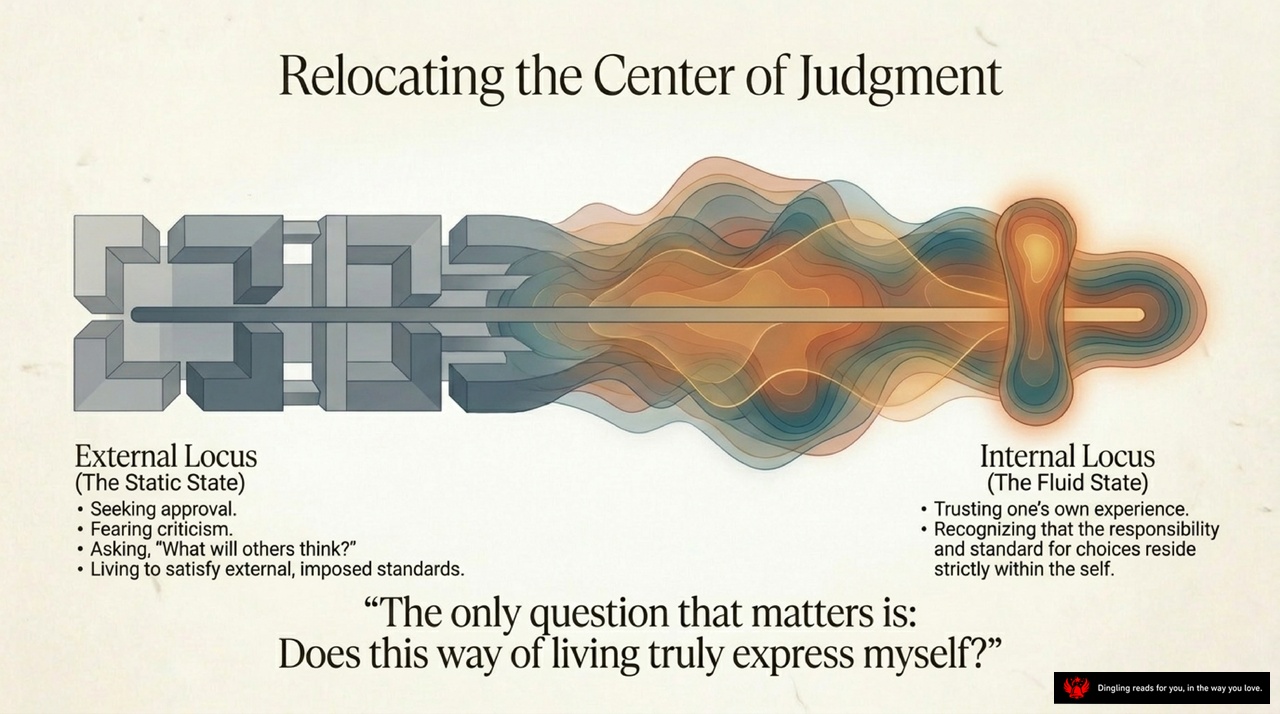
The slide we're looking at today captures this pivotal shift: "Relocating the Center of Judgment." On the left, we see the "External Locus," a rigid, gray structure representing a static state where we seek approval, fear criticism, and constantly ask ourselves, "What will others think?" In this mode, we live to satisfy external standards, effectively outsourcing our sense of self to the world around us.
But look at the right side: the "Internal Locus," or the fluid state. This is where true freedom begins. It's about trusting your own experience and recognizing that the responsibility for your choices resides strictly within the self. As the text reminds us, "The only question that matters is: Does this way of living truly express myself?"
This isn't just about psychology; it's about reclaiming your life. When we move from that rigid, external box into this fluid, internal space, we stop reacting to the noise and start creating our own rhythm. It's the difference between being a puppet and being the puppeteer. The goal isn't perfection; it's authenticity. It's about aligning your actions with your inner truth, not with someone else's expectations.

We often get it wrong when we think about what a "good life" actually is. We tend to view it as a destination—a fixed state of virtue, a final nirvana where everything stops changing and we just sit in perfect contentment. But that's a trap. The good life isn't a static object you arrive at; it's a fluid process you live into.
Look at the contrast here. On the left, we have the "Static Object" view. This is how we often see ourselves: a fixed entity made of rigid traits, predetermined characteristics that never change. We defend against reality, distorting facts to fit our preexisting beliefs just to feel comfortable. Our ultimate goal in this mindset? Tension reduction. We seek homeostasis, comfort, and closure. We want the world to stop shaking so we can feel safe.
But on the right, we have the "Fluid Process." This is the reality of human growth. We are a continuous, ever-changing stream of becoming. Instead of defending against reality, we stay open to all experience, letting raw facts constantly reshape our beliefs. We don't seek comfort; we seek meaning. We embrace challenges and the continuous stretching of our potential.
The bottom line is clear: The "Good Life" is not a destination. It is a direction. It's about moving forward, staying open, and trusting that your capacity to grow is limitless.
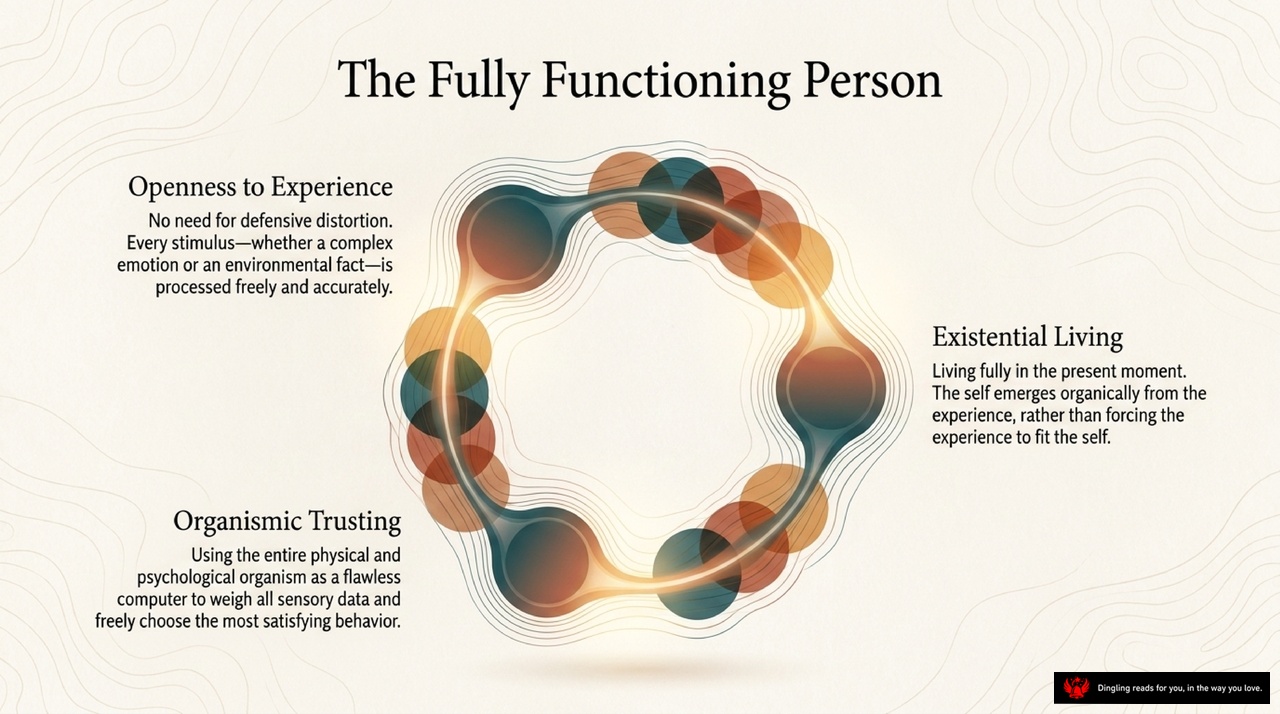
Imagine a person who isn't just reacting to the world, but fully engaging with it. This is what Carl Rogers calls "The Fully Functioning Person." It's not about perfection; it's about a specific way of being alive.
First, think about **Openness to Experience**. A fully functioning person doesn't filter reality through a lens of fear or defensiveness. Whether it's a complex emotion or a harsh environmental fact, they process it freely and accurately. They don't distort their world to make it comfortable; they see it exactly as it is.
Next, look at **Existential Living**. This means living fully in the present moment. Instead of forcing their experiences to fit a pre-existing image of themselves, their sense of self emerges organically from what is happening right now. They aren't stuck in the past or anxious about the future; they are deeply present.
Finally, consider **Organismic Trusting**. These individuals trust their entire being—their physical and psychological organism—as a flawless computer. They use all their sensory data to weigh options and freely choose the behavior that feels most satisfying and authentic to them. They don't need an external authority telling them what to do; they trust their own inner compass.
Together, these three traits create a cycle of growth. When you stop defending yourself, you live more fully in the moment, and that allows you to trust your own intuition even more. It's a journey from rigidity to flow, where you stop trying to control life and start letting life unfold through you.
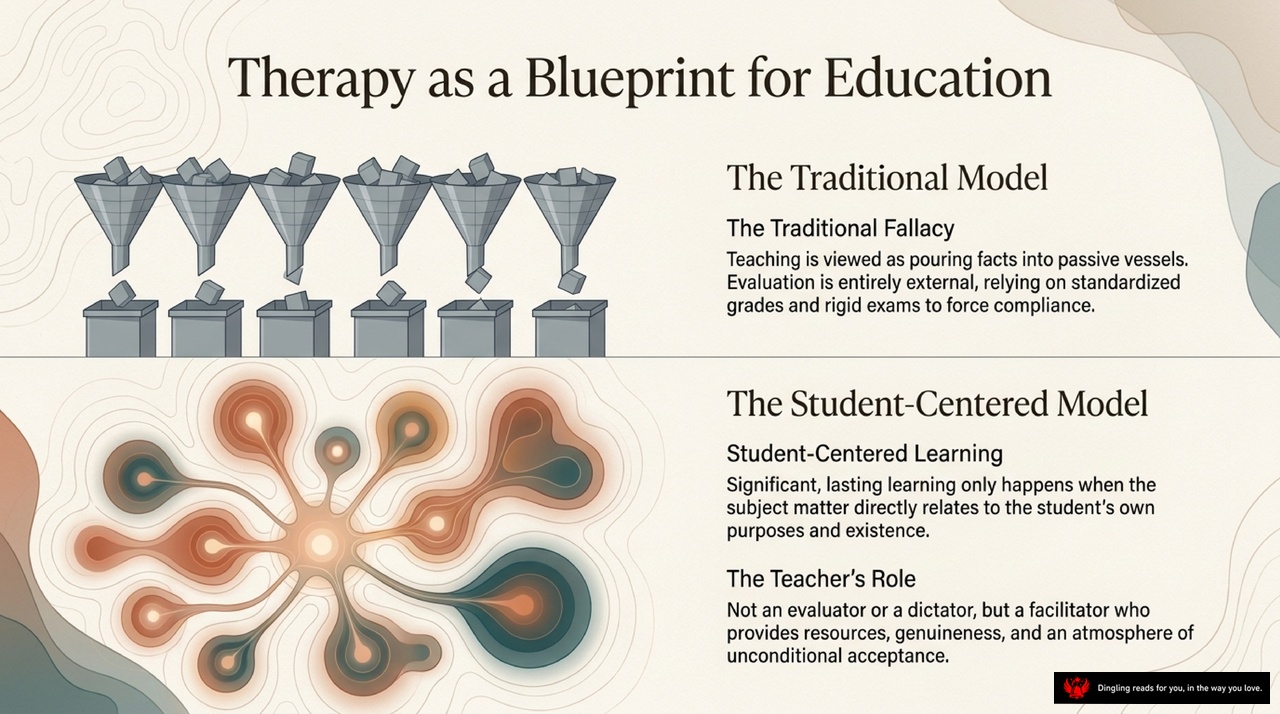
Imagine a classroom where learning feels less like filling empty buckets and more like tending a garden. This slide contrasts two very different worlds: the Traditional Model and the Student-Centered Model.
On the top, you see a row of funnels pouring facts into rigid boxes. This represents the traditional fallacy we often see in schools. Here, teaching is viewed as simply pouring information into passive students, while evaluation relies entirely on external grades and rigid exams to force compliance. It treats students like containers waiting to be filled.
But look at the bottom. The image shifts to a vibrant, organic web of connections. This is the Student-Centered Model. Research shows that significant, lasting learning only happens when the subject matter directly relates to the student's own purposes and existence. When education connects to a student's real life, the mind wakes up.
In this model, the teacher's role changes completely. They stop being an evaluator or a dictator. Instead, they become a facilitator. Their job is to provide resources, show genuine care, and create an atmosphere of unconditional acceptance. When students feel safe and understood, their natural drive to grow takes over. They stop waiting to be told what to do and start exploring the world with curiosity and creativity. This shift from controlling students to trusting their potential is the key to unlocking true learning.
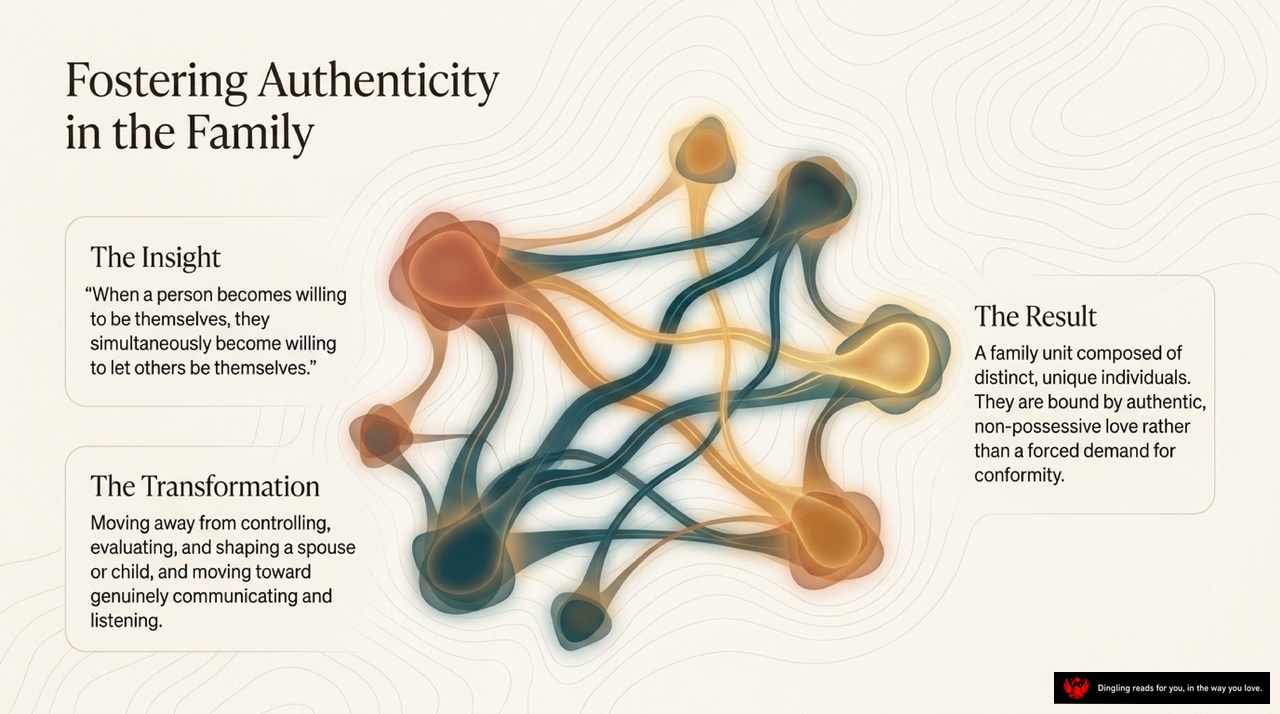
Look at this intricate web in the center of our slide. It represents the delicate, interconnected nature of a family that has truly found its rhythm. The title, "Fostering Authenticity in the Family," captures the heart of what we're exploring today: moving away from the old ways of control and performance, and stepping into a space where everyone can just *be*.
The slide breaks this down into three powerful parts. First, "The Insight." It reminds us that authenticity is contagious. When one person becomes willing to be themselves, it creates a ripple effect, making others feel safe enough to drop their masks too. It's a simple but profound truth: if we stop pretending, others can stop pretending with us.
Then, we see "The Transformation." This is the practical shift we need to make. It means letting go of the urge to control, evaluate, or shape our spouses and children into who we think they should be. Instead, we move toward genuine communication and deep listening. We stop trying to fix them and start trying to understand them.
Finally, look at "The Result." When we make this shift, the family unit changes entirely. It becomes a collection of distinct, unique individuals rather than a group trying to look the same. The bonds holding us together aren't based on forced conformity or fear, but on authentic, non-possessive love. We stop demanding perfection and start celebrating the real, messy, beautiful people sitting right next to us.
This isn't just about theory; it's about creating a home where no one has to hide. It's about realizing that our strongest connection comes not from how well we play our roles, but from how freely we can be ourselves.
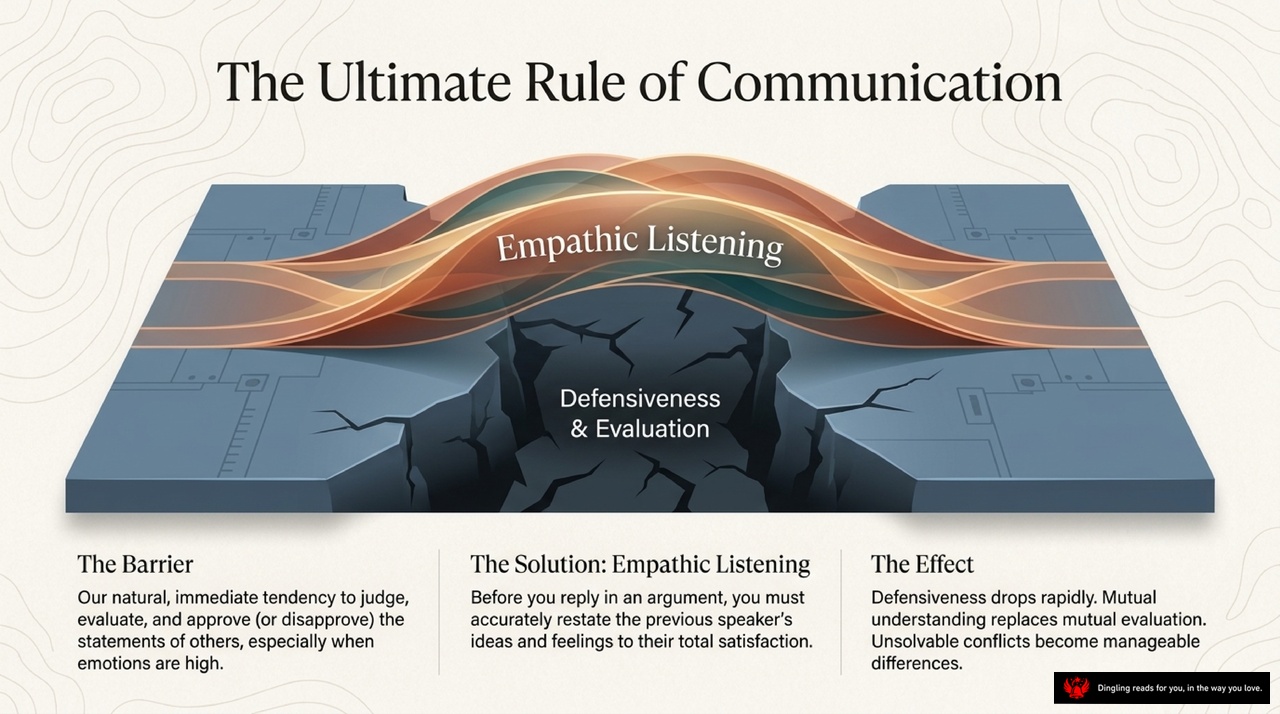
The Ultimate Rule of Communication isn't about being the loudest voice in the room; it's about how you bridge the gap between us. Look at this image: on one side, we have a deep chasm of defensiveness and constant judgment. This is our natural default—especially when emotions run high, we immediately evaluate, approve, or dismiss what others say, building walls instead of bridges.
But there is a way across. The solution is Empathic Listening. Before you even think about your reply or try to fix the problem, you must stop and accurately restate the other person's ideas and feelings until they feel truly understood. It's not about agreement; it's about connection. When you do this, something magical happens: defensiveness drops rapidly. Mutual understanding replaces mutual evaluation, and even unsolvable conflicts become manageable differences. In a world full of noise, the ultimate power move is simply listening with your whole heart.

The slide we see right now captures a terrifying yet fascinating tension that defines our modern world: the clash between the "Skinnerian Paradigm" and the raw reality of human "Subjectivity & Choice."
On the right, you have the Skinnerian view. It treats humans like programmable machines. The idea is that if we use operant conditioning—rewards and punishments carefully designed—we can engineer a "utopian" society of happy, productive citizens. It's a seductive promise, isn't it? A world where everything is predictable, controlled, and efficient. But look closely at the cost: it creates citizens who are completely controlled and, most importantly, un-free.
Then, look at the flow on the left, labeled "Behavioral Science." This is the engine driving that control. It relies on "Prediction & Control," trying to map out exactly how to trigger specific behaviors in others. It assumes that if we understand the conditions, we can dictate the outcome.
But here is the paradox that the slide highlights so beautifully. Look at the bottom left. Science claims that all behavior is predetermined by external causes. Yet, the very initial decision of what to research, what goals to pursue, and which experiments to run relies entirely on human, subjective, free choice.
This is the core conflict. The tools we use to study and control behavior are built on the very freedom we claim to be eliminating. We are trying to build a cage using the same blueprint of choice that we claim to be trapping. As we move forward, we need to ask ourselves: are we designing a world of efficient machines, or are we honoring the messy, unpredictable, and ultimately free nature of being human?
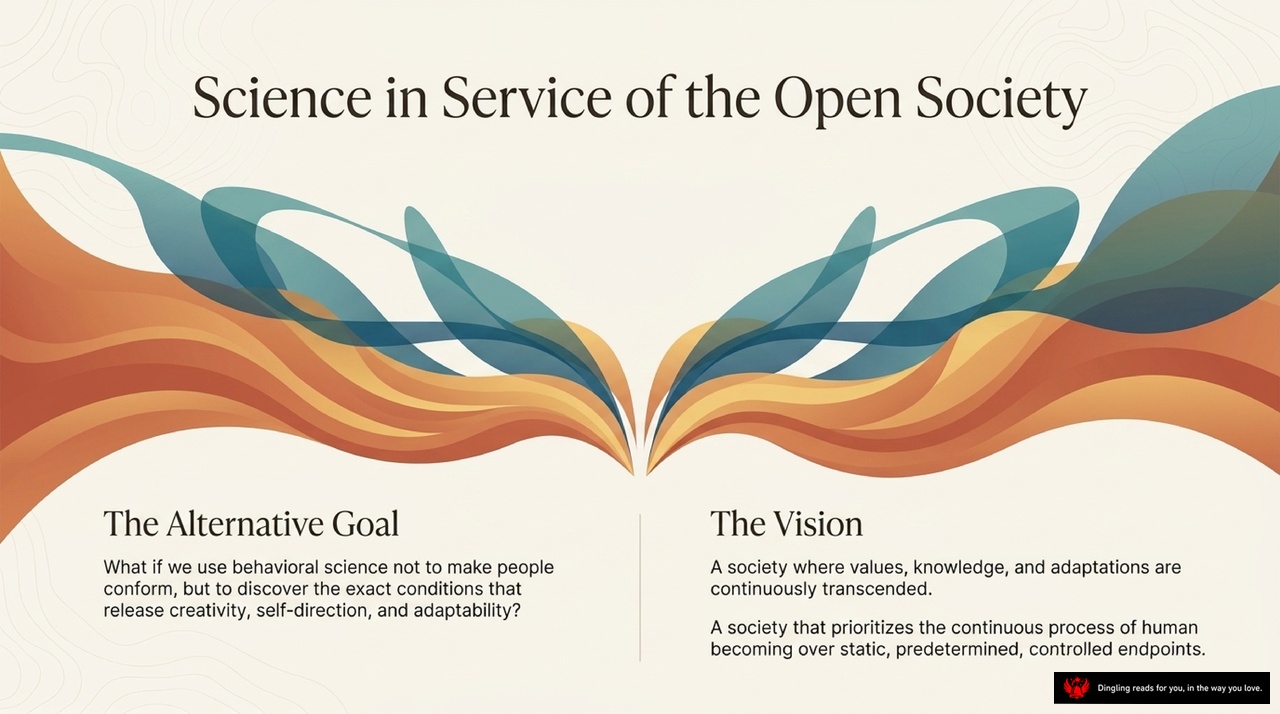
Imagine a world where science doesn't just tell us how to control people, but how to help them flourish. That's the heart of what we're exploring today. Look at this slide: "Science in Service of the Open Society." It's not about making everyone fit into the same mold. Instead, it's about using behavioral science to uncover the exact conditions that spark creativity, self-direction, and adaptability. Think of it as flipping the script.
On the left, we have "The Alternative Goal." Instead of forcing conformity, we ask: What if we designed environments where people feel safe enough to be their authentic selves? When we stop trying to fix people and start providing the right soil, their natural drive to grow takes over. It's about releasing potential, not suppressing it.
On the right is "The Vision." We're aiming for a society where values, knowledge, and ways of living are constantly evolving and transcending. It's a place that prioritizes the journey of becoming over a fixed, predetermined endpoint. In this vision, people aren't static products on an assembly line; they are dynamic, living processes. We value the continuous act of human becoming far more than any static goal we might set for them.
Ultimately, this approach shifts the focus from control to connection. When we create relationships based on trust and understanding, we unlock a human capacity for growth that no amount of external pressure could ever achieve. This is the future we are building—a future where science serves the open society, empowering every individual to define their own path.
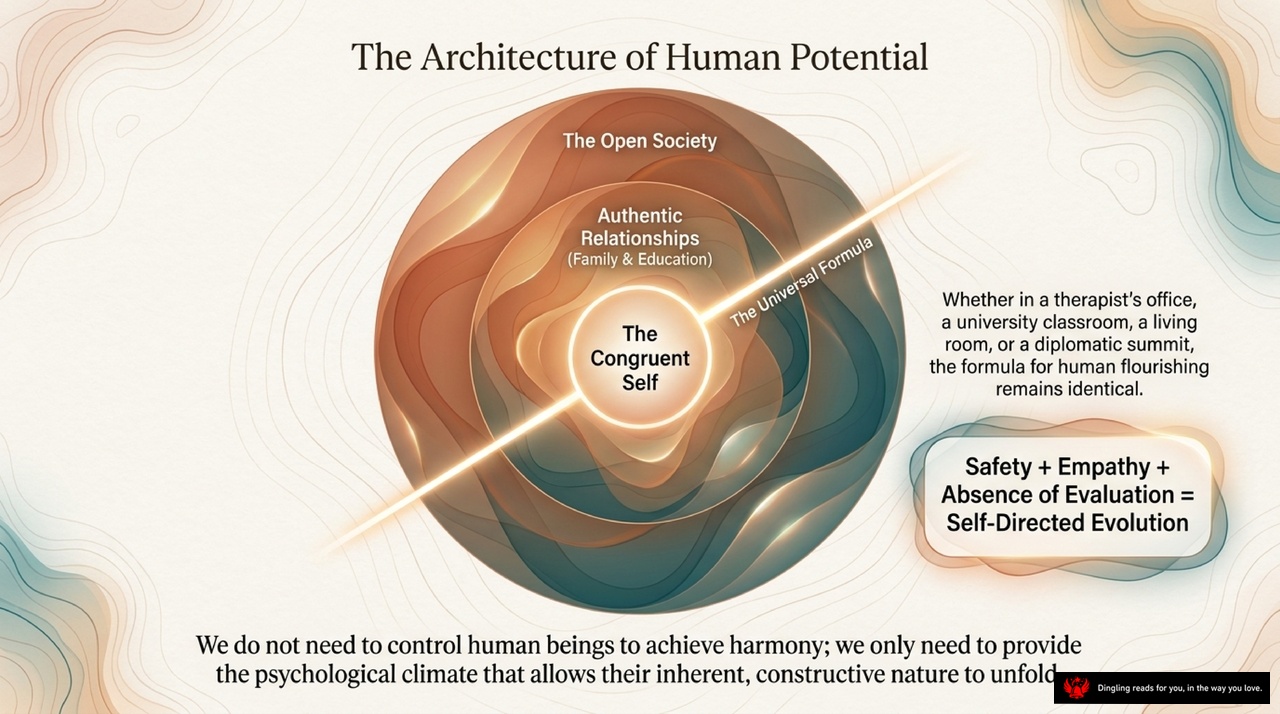
Imagine a world where human potential isn't something we force, but something we cultivate. This slide outlines what I call "The Architecture of Human Potential." Think of it as a series of concentric circles, starting from the very core: The Congruent Self. This is the essence of who you are when you stop performing for others.
Surrounding that core is the Universal Formula. Whether you are in a therapist's office, a university classroom, a living room, or even a high-stakes diplomatic summit, the recipe for human flourishing remains identical. It's simple but profound: Safety plus Empathy, minus Evaluation, equals Self-Directed Evolution. When we create an environment free from judgment and filled with genuine understanding, people naturally begin to evolve on their own terms.
Moving outward, we see Authentic Relationships, rooted in family and education. These are the bridges that connect us to the wider world. And at the outermost layer, we have The Open Society. This is the ultimate expression of human potential—a society where individuals, having found their authentic selves and trusted their own growth, can collaborate freely and creatively.
The bottom text on the slide reminds us of a crucial shift in mindset: We do not need to control human beings to achieve harmony. Instead, we only need to provide the psychological climate that allows their inherent, constructive nature to unfold. It's about trusting that when we offer safety and empathy, the rest follows naturally.

To truly become a person, we have to stop wearing the static masks society forces us to put on. Instead of trying to fit into a rigid box of expectations, we need to embrace the messy, fluid uncertainty of continuous growth. It's about trusting the profound wisdom of our own inner organism rather than relying on external rules.
When we practice genuine acceptance and empathetic understanding, we unlock a powerful potential—not just for ourselves, but for our classrooms, our families, and our entire global society. But here is the real question we all face: If we truly know how to cultivate human freedom instead of just enforcing behavioral control, do we have the courage to let go of our need to mold others? Can we instead allow them the profound freedom to simply become who they are?