
On Heroes and Tombs: Complete Chapter-by-Chapter Summary
Welcome to our exploration of Ernesto Sabato's haunting masterpiece, *On Heroes and Tombs*.
Imagine a room swallowed by fire. The walls are blackened, the furniture is charred, and scattered papers lie like ash on the floor. Yet, a single beam of light cuts through the darkness, illuminating the fragile search for meaning in a world gone mad. This is the atmosphere Sabato creates—a descent into the labyrinth of Argentine history, where human madness collides with the desperate need for existential truth.
This book isn't just a novel; it's a terrifying journey into the shadows of the human soul. It follows the tragic intertwining of two distinct but equally broken lives: Martin, a young man crushed by his mother's rejection, and Alejandra, a woman haunted by a family cursed by violence and madness. From Martin's first trembling encounter with Alejandra in a park to their eventual descent into a burning house, Sabato peels back the layers of their psyches to reveal a terrifying reality.
As we delve deeper, we'll see how the past refuses to stay buried. We'll meet the blind man who becomes Sabato's alter ego, investigating a secret society that controls nightmares and reality itself. We'll witness the rise and fall of anarcho-communist movements in 1930s Buenos Aires, and we'll confront the terrifying figure of Fernando, a man who blurs the line between genius and insanity.
Through the eyes of these characters, Sabato asks a question that echoes across time: What happens when we lose our grip on reason? And in the end, are we the heroes of our own stories, or merely the tombs waiting to be filled?
Turn the page with us. Let's step into the fire.
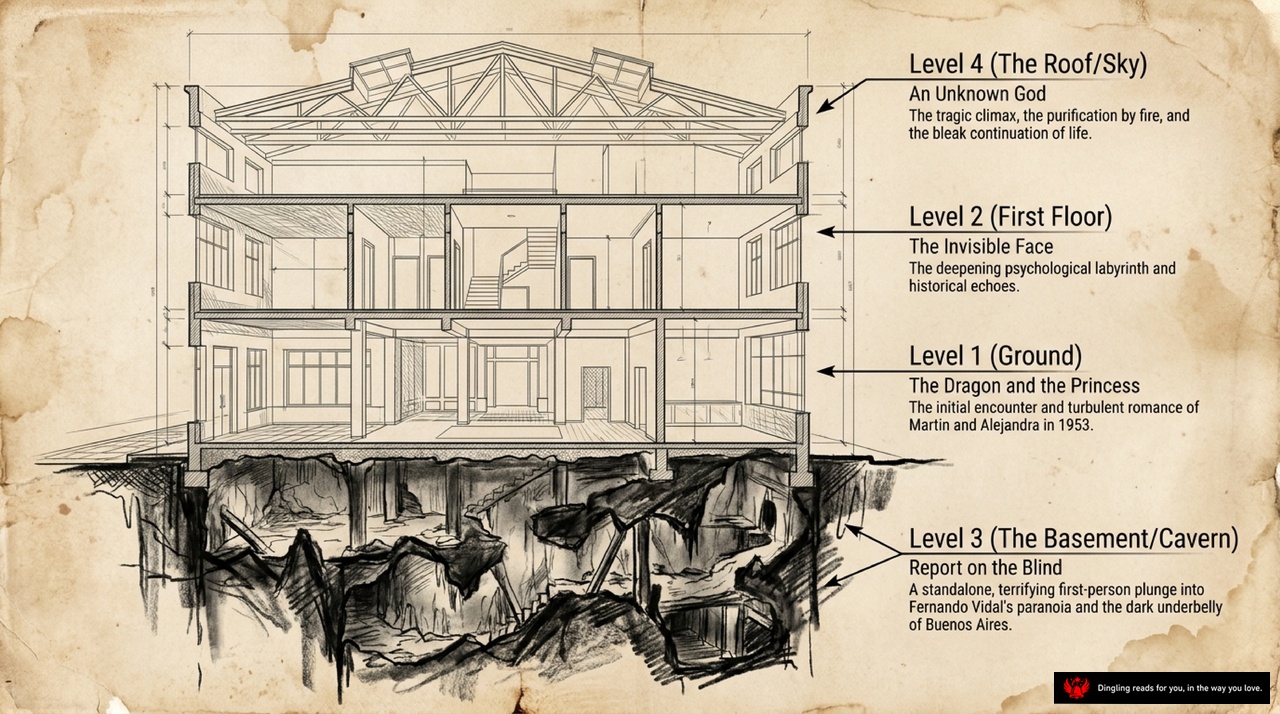
This architectural blueprint doesn't just map a house; it maps the soul of a man named Martin. Look closely at the layers. We start at the very bottom, deep in the dark earth. That's Level 3, the basement or cavern. It represents the terrifying, standalone report of Fernando Vidal, a man paralyzed by paranoia, plunging into the dark underbelly of Buenos Aires. It's the foundation of fear that haunts the whole story.
Moving up to Level 1, the ground floor, we find the heart of the narrative: The Dragon and the Princess. This is where Martin and Alejandra first meet in 1953. It's their initial encounter, a turbulent romance that feels like a collision of two broken worlds. They are the protagonists, but their story is built on the shadows beneath them.
Above them sits Level 2, the first floor. This is where the invisible face emerges. Here, the psychological labyrinth deepens. We see the historical echoes of a family obsessed with the past, where secrets are buried in attics and skulls are kept in glass cases. It's the space where memory and madness intertwine, trapping everyone inside.
Finally, at the very top, Level 4, the roof and the sky. This is where the tragedy reaches its climax. It represents the unknown god, the purification by fire, and the bleak continuation of life after everything is lost. Martin's journey ascends from the darkness of the basement, through the chaos of the ground floor, into the psychological maze of the middle, only to end in the tragic silence at the peak. This structure shows us that their love was never just about two people; it was a struggle against the ghosts living in every single floor of their home.

Imagine a map not of land, but of blood. Look at the jagged red line winding across the Andes; this is the 4,400-kilometer flight of General Lavalle's defeated army in 1841. Seventy-five men, carrying the rotting corpse of their commander, fled to the Bolivian border just to save him from desecration. It was a gruesome, desperate march where history's violence left a permanent scar. But here is the chilling truth: that blood spilled in the 19th century didn't just dry up. It silently poisoned the psychological reality of the 20th century.
Fast forward to 1953 in Buenos Aires. Enter Martin, a seventeen-year-old boy crushed by his mother's hatred, feeling ugly and unworthy. He sits on a park bench, hiding from the world, until a gaze locks onto him. It's Alejandra. She is pale, intense, and carries a secret weight. When she finally speaks, she tells him, "I have been waiting for you." They fall into a turbulent, doomed romance overshadowed by inherited madness and incestuous secrets. Martin is drawn to her not just because she is beautiful, but because she shares his inner darkness. She tells him, "You and I have something in common, something very important."
Yet, their story is haunted by the ghosts of their ancestors. Alejandra's great-grandmother hid her father's severed head in an attic for decades, living frozen in 1852. Martin's own grandfather, Pancho, remembers the butchery of the Cornstalk Party. These aren't just old stories; they are the demons walking alongside them. Martin tries to escape to Patagonia, seeking a clean slate, but fate pulls him back. He reunites with Alejandra, only to find her world crumbling. She tells him the world is a garbage heap, yet she loves him. But in the end, the past catches up. Fire consumes the Ormós house. Alejandra and her father are found dead in the ashes. Martin is left alone, realizing that no matter how far he runs or how deep he falls in love, the echoes of history are the only things that truly remain.

Picture shows the four key figures in the story, with the central figure being Fernando Vidal, the "anti-hero" and the "epicenter" of destructive paranoia and incestuous evil. He is the embodiment of darkness, pulling everyone into his gravitational pull. Alejandra is described as being trapped in his orbit, carrying the ghosts of her ancestors and her father's corruption. Martin is the wandering comet, pulled into the system by his love for Alejandra, desperately seeking light in a lightless system. And Bruno is the distant observer, the philosopher and surrogate for the reader, orbiting on the far outer edge, analyzing the tragedy and preserving their memory but unable to alter their trajectory.
In the story, we see how these characters are interconnected and how their fates are intertwined. Fernando Vidal, with his extreme and twisted personality, becomes the center of a dark vortex that consumes everyone around him. Alejandra, with her complex past and family secrets, is trapped in this vortex, unable to escape the influence of her father and the ghosts of her ancestors. Martin, with his innocent and pure love for Alejandra, is pulled into this dark system, seeking light and hope in a world filled with darkness and despair. And Bruno, as the observer, watches from afar, trying to understand and make sense of this tragedy, but ultimately powerless to change the course of events.
The story is a poignant exploration of the human condition, of the darkness that lies within us all, and of the struggle to find light and meaning in a world that often seems overwhelmingly dark. It is a story of love, loss, and the enduring power of the human spirit to seek out hope even in the face of overwhelming despair.
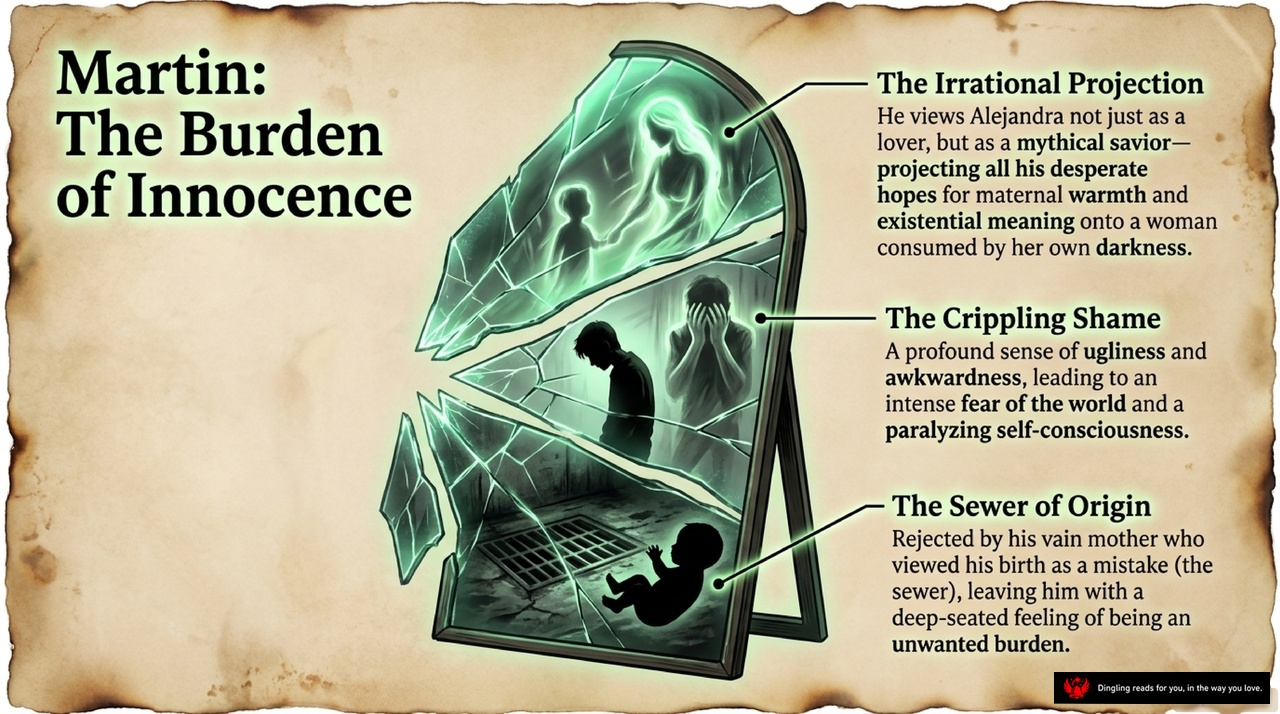
Martin's journey into the darkness of Alejandra's world comes to a catastrophic and heartbreaking end. The page highlights three core psychological burdens that define his experience: the irrational projection of hope, a crippling sense of shame, and the feeling of being an unwanted burden.
First, we see **The Irrational Projection**. Martin didn't just love Alejandra; he viewed her as a mythical savior, projecting all his desperate hopes for maternal warmth and existential meaning onto a woman consumed by her own darkness. He needed her to be the answer to his suffering, even though she was anything but a savior.
This hope was built on a foundation of **The Crippling Shame**. Martin carried a profound sense of ugliness and awkwardness, leading to an intense fear of the world and a paralyzing self-consciousness. He was terrified of being seen, terrified of his own reflection, and terrified of the judgment of others.
But the deepest wound, **The Sewer of Origin**, explains why he was so broken in the first place. Rejected by his vain mother who viewed his birth as a mistake—the "sewer"—he was left with a deep-seated feeling of being an unwanted burden. This childhood rejection shaped his entire adult life.
The tragedy of their relationship culminated in the fire at the Olmos house. When Martin rushed to the scene, he found the unthinkable: Alejandra and her father, Don Pancho, were dead. The family they knew—the eccentric uncle Beve playing the clarinet and the servant Juстина—had been quietly removed by distant relatives to protect the family's reputation. Martin stood amidst the ashes, realizing that his search for salvation had led him straight to the grave. The woman who promised to save him was gone, leaving him alone with the ghosts of his past.

Fernando, the narrator, reveals that his final phase of life began in the summer of 1947. Walking down San Martín Street, he was suddenly snapped out of his trance by the sound of church bells. Standing before him was a blind woman, her face turned toward him with a look that was both puzzling and cold. Those bells seemed to ring specifically for him, a signal to wake him up from his confusion and face reality.
This encounter marked a turning point. Fernando realized he had to immediately explore that dark, blind world. Months later, he began investigating blind people, studying their origins and secret lives, only to face hostility from blind associations. His obsession grew into a nightmare. He dreamed of a young boy watching shadows on a wall, believing that if the shadows moved, something terrible would happen. And then, the nightmare became reality: the world around him began to distort and dissolve, his own identity crumbling, as if the connection between his will and his body had been severed.
His investigation was deeply tied to Celestino Iglesias, a Spanish anarchist who became his key informant. Celestino had lost his right leg in the Spanish Civil War and went blind after an explosion in a counterfeit money lab—an accident Fernando suspected was linked to his own subconscious. To infiltrate this hidden world, Fernando shadowed Celestino, observing how his paranoia grew and how he struggled with basic tasks like judging distance or walking without stumbling.
But Fernando was walking into a trap he didn't see coming. He suspected that the blind community, through anonymous letters, drug distribution, and even the control of nightmares, held absolute power over the universe. He felt that the entire cosmos might be under their control. As he waited for Celestino to make contact with a mysterious group, he found himself in a house filled with strange artifacts and political graffiti, realizing that the "dark side" of the world was exposed in those messy, chaotic words.
The tension peaked when a short, French-looking man entered the building with Celestino. Fernando followed them to an empty house in Belgrano, only to discover a hidden cellar beneath the floorboards. Inside, he found a dark tunnel leading to a small door that was unlocked. Stepping through, he was paralyzed by the sight of a blind woman staring at him like a ghost from hell. She locked the door behind him, leaving him in total darkness.
Terrified, Fernando realized he had been lured into a trap designed to bury him alive, similar to the fate of a couple who were killed in an elevator by the blind gang years ago. Desperate, he escaped Argentina, fleeing through Uruguay, France, and eventually to India, China, and the United States. But fate kept chasing him. In Rome, he met a blind woman named Luisa, only to discover her husband, Gaston, was also blind and paralyzed by an accident she had caused. It was another trap.
Realizing he was a fly caught in a web, Fernando fled again, eventually returning to Argentina to wait for a new opportunity. He waited for Celestino to go blind again, hoping to finally understand the secret he sought. But in the end, exhaustion and fear took over. He fell into a deep, recurring nightmare where a blind woman appeared to him in phosphorescent light, like a silent giant snake. He tried to escape, running through the sewers of Buenos Aires into a vast underground cave where a terrifying goddess statue stood, its navel glowing with phosphorus.
A voice called out to him: "Now, please enter. This is your beginning. And this is your end." Fernando walked forward, his body changing in strange ways, until he fell into a hot, gelatinous liquid and lost consciousness. When he woke up, he was back in his own room in Devoto. He knew the experiences were real and that death was waiting for him, but he had chosen this path himself. At midnight, he wrote his report and hid it, ready to go meet her, knowing she was already waiting.

Tonight, we trace the terrifying legacy of the Olmos and Acevedo families, a curse written in blood that spans nearly a century. It begins in 1852, when Bonifacio Acevedo was executed by the dictator Rosas. His severed head was thrown into his family's parlor, a gruesome relic that shattered his daughter Escolastica. Traumatized by her father's death, she locked herself in a watchtower, keeping that relic for eighty years, effectively freezing time within those walls.
This madness mutated in the 1950s through Fernando Vidal, who inherited a corruption that shifted from historical political violence into pure psychological evil and incestuous violation. His daughter, Alejandra, became the final recipient of this bloodline. She inherited a reality where political tragedy, insanity, and moral decay were inescapable.
We see this curse play out in the life of Martin, who meets Alejandra. She is a woman haunted by her past, carrying the weight of her ancestors' violence. Even her father, Pancho, is a ghost of the past, unable to escape the memories of the "Cornstalk Party" who killed his brother. The violence is not just in history books; it is in the family home, in the severed head in a glass cabinet, and in the madness of Uncle Beve playing his clarinet in the dark.
Ultimately, this weight of blood destroys them. Alejandra burns down her ancestral home, and in the chaos, her father and uncle are taken away by relatives to protect the family's facade. The cycle ends in tragedy, proving that when a family is built on such deep-seated violence, there is no escape from the inevitable collapse.
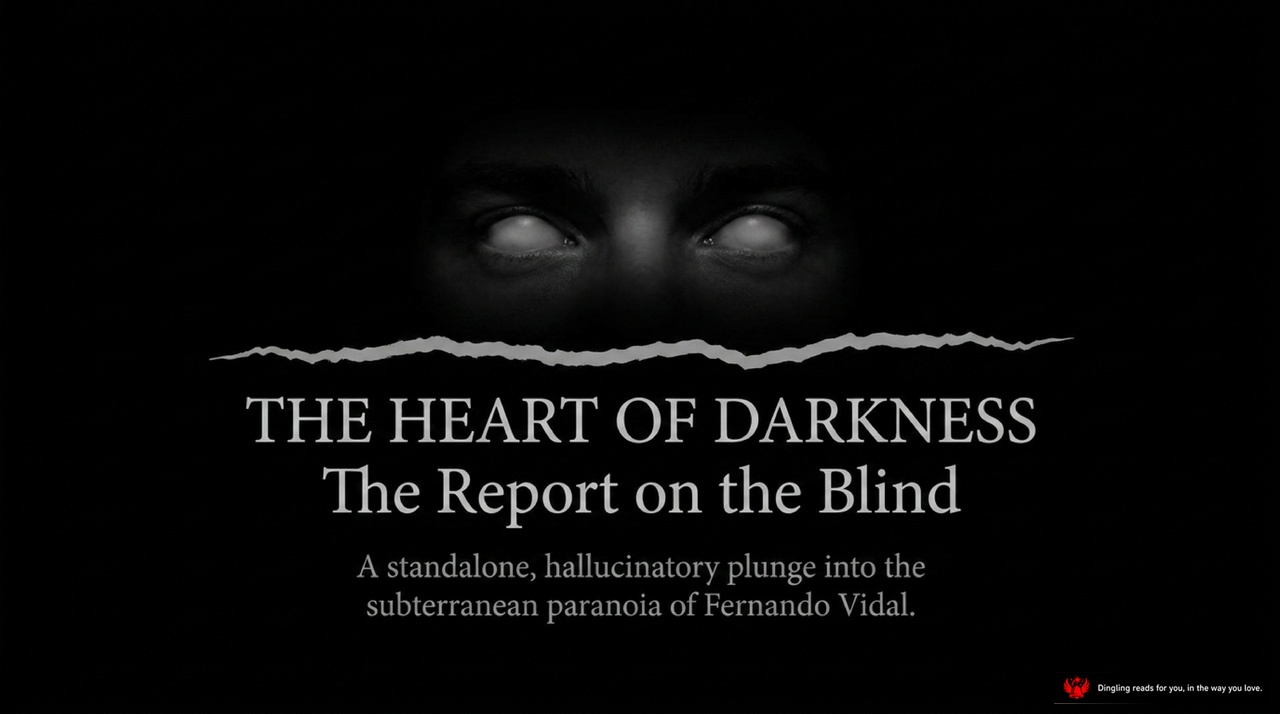
Tonight, we dive into the terrifying final chapter of Fernando Vidal's life. The title of this slide, "The Heart of Darkness," perfectly captures the moment he finally confronts the blind, subterranean world he spent years investigating.
Vidal reveals that his entire life was a trap. He wasn't just investigating a secret society; he was being hunted by them. He realized that the blind community, led by figures like Celestino Iglesias, controlled a vast network of spies, drug dealers, and even mental institutions. They used fear and paranoia to rule the world, turning ordinary people into their unwitting collaborators.
But Vidal's investigation led him to a gruesome physical trap as well. After following Iglesias into a seemingly empty house, Vidal discovered a hidden cellar beneath the floorboards. He climbed down into the darkness, only to be ambushed by a blind woman who had been waiting for him. She locked him in, leaving him to suffocate in the dark, a fate similar to the couple she had trapped in an elevator years ago.
Desperate, Vidal escaped to Paris, but the trap followed him there. He found himself in the same deadly web, encountering blind models and hearing whispers of a global conspiracy. Realizing that his own sanity was unraveling and that death was inevitable, Vidal made a final, conscious choice. He wrote this report, hiding it away, and then returned to Argentina to face his end. He knew that in the end, the darkness he sought was the only thing that could truly define him.
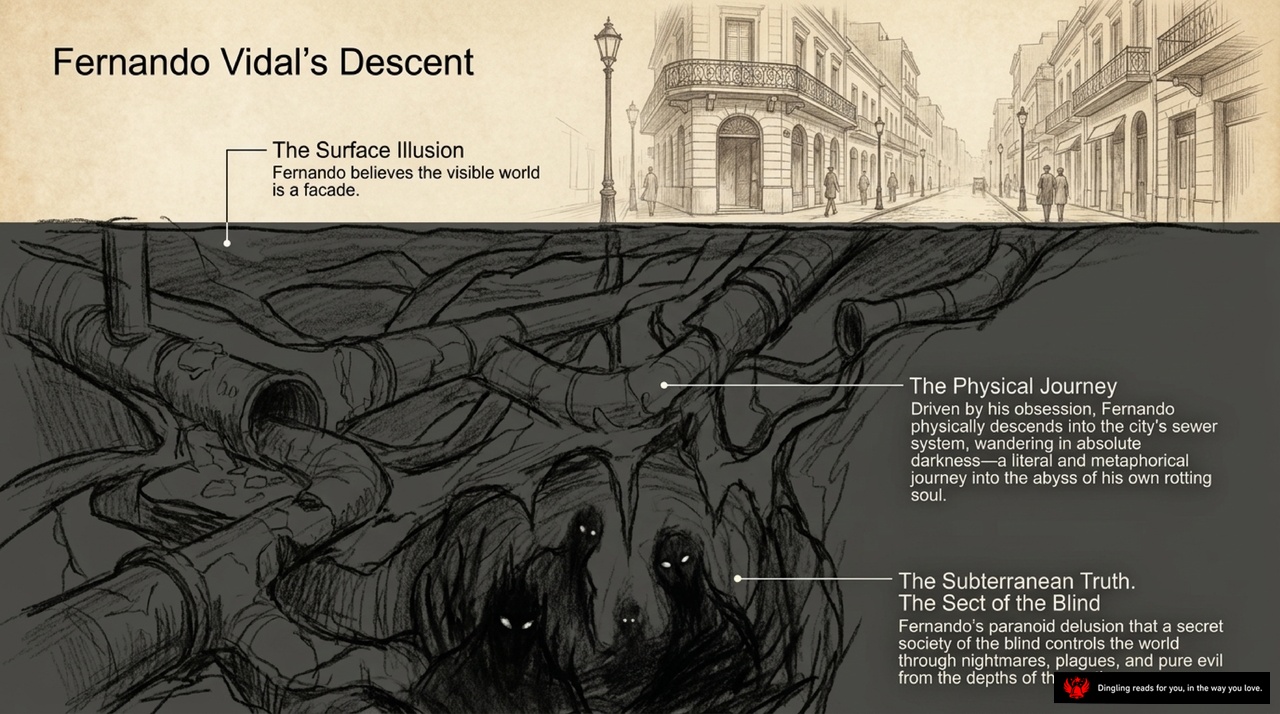
Fernando Vidal's Descent isn't just a story; it's a terrifying map of a mind unraveling. The image captures the exact moment his reality fractures. On the surface, we see the "Surface Illusion"—the polite, orderly streets where Fernando believes the visible world is merely a facade, a harmless performance. But look beneath that line. That's where the real horror begins.
Driven by an obsession that borders on madness, Fernando physically descends into the city's sewer system. This isn't just a literal journey into the dark pipes; it's a metaphorical plunge into the abyss of his own rotting soul. He wanders in absolute darkness, searching for answers that he knows might destroy him. And in that subterranean truth, he encounters "The Sect of the Blind." It's his paranoid delusion that a secret society of the blind controls the world through nightmares and pure evil. To Fernando, these aren't just shadows in the pipes; they are the architects of his destruction. He believes he is being hunted by a conspiracy that sees him as nothing more than a victim to be consumed. As he descends further, the pipes look less like infrastructure and more like veins feeding a monstrous entity. His descent ends not with enlightenment, but with a terrifying realization: the darkness he feared was always inside him, and now, it has finally found him.
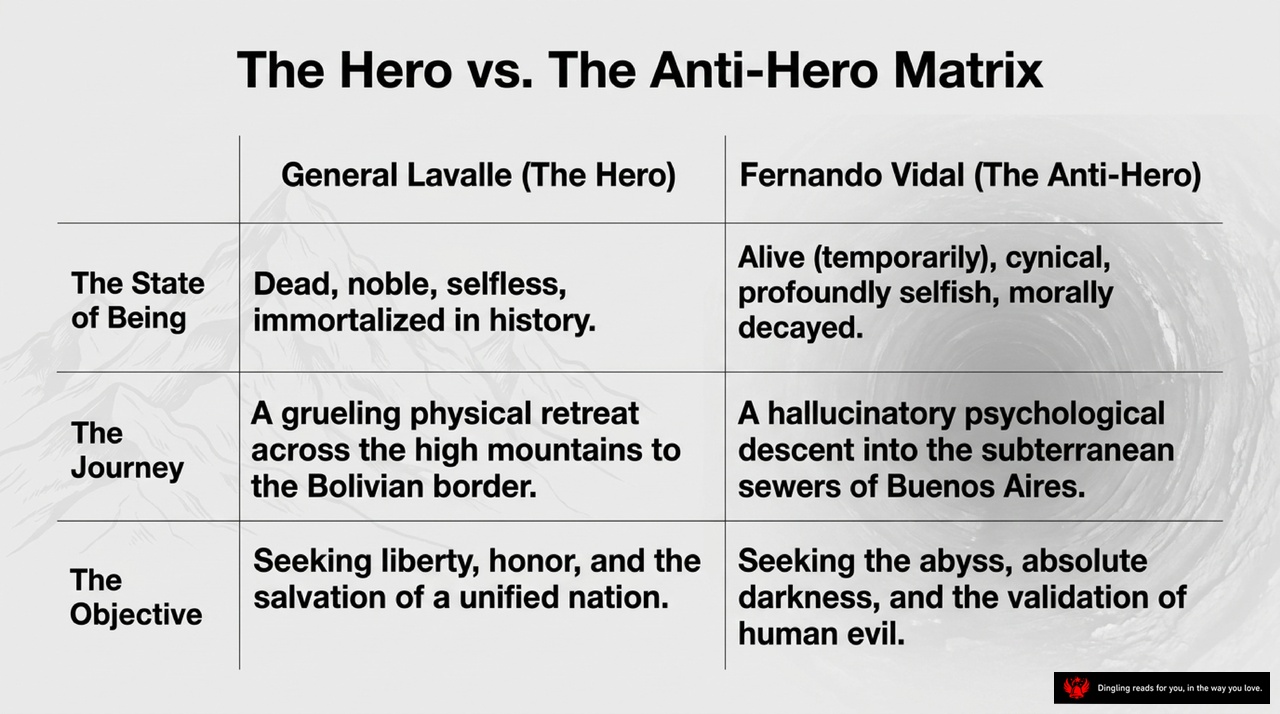
Look at this matrix. It perfectly captures the terrifying duality at the heart of our story: General Lavalle versus Fernando Vidal. On the left, we have the Hero. He is defined by his death, yet it grants him a kind of nobility. His journey was a grueling physical retreat across the high mountains, a brutal march to the Bolivian border. He sought liberty, honor, and the salvation of a unified nation. He is selfless, immortalized in history as a martyr for a cause greater than himself.
Now, look to the right. This is the Anti-Hero, Fernando Vidal. He is alive, but only temporarily. His state of being is cynical, profoundly selfish, and morally decayed. Where Lavalle faced a physical journey, Vidal descends into a hallucinatory psychological nightmare, plummeting into the subterranean sewers of Buenos Aires. His objective isn't to save a nation; it is to seek the abyss, absolute darkness, and the validation of human evil.
This contrast mirrors the two men we've been following. General Lavalle, with his dying breath, chose to protect his men's dignity, even as his body failed. He embraced the suffering of others. Fernando Vidal, conversely, used the suffering of others—specifically the blindness of Celestino Iglesias—as a tool to feed his own ego and validate his nihilistic worldview. Lavalle died to preserve the soul of his country; Vidal lives to prove that the soul is nothing but a lie. One seeks light in the dark; the other revels in it.

Imagine a 4,400-kilometer death march through the harsh Argentine wilderness, where General Lavalle's army was shattered by Oribe's forces, leaving only 175 men and one woman to carry out the ultimate mission. This wasn't just a retreat; it was a journey of pure, macabre loyalty. As the relentless sun accelerated the decay of the General's rotting corpse, the terrified soldiers refused to abandon him, fearing his head would be spiked on a lance by the enemy. Instead, they carried his bare skeleton and his heart, preserved in a bucket of liquor, across the border to safety. At the Jujuy River, driven by an almost supernatural devotion, they stopped to strip the flesh from his bones. In a scene that reads like a ghost story from history, they carried his skeleton and his heart across the border to safety. This is General Lavalle's Retreat: The Ghost of History, a brutal testament to a loyalty so absolute it defies logic.

Bruno: The Philosopher of the Labyrinth. Tonight, we step into the mind of the observer himself, Bruno, as he navigates the tragic cityscape depicted here. He doesn't just watch; he orbits the chaos, acting as a surrogate for us, the readers, trying to extract meaning from the noise. But what does he find? Bruno concludes that absolute truth is fundamentally destructive. He sees it firsthand in the lives of Fernando and Alejandra. Fernando, torn by the fear of the blind, and Alejandra, consumed by the weight of her family's violent history. For them, knowing the full truth brought only pain, madness, and death. So, if truth destroys, what is left? Bruno argues that memory is the only sanctuary. It is the mechanism that defends human dignity against the relentless, erasing winds of time. In a world where the past tries to crush us, memory becomes our fortress, the only way to hold onto who we are.

Look at this scale. On one side, we have the crushing weight of despair—the anvil of history, logic, and inevitable death. It screams that humanity should surrender. But on the other side? A tiny, glowing flame. That is the irrationality of hope. It defies all logic.
The book tells us that despite overwhelming evidence of human evil—plagues, wars, concentration camps—survivors don't just rebuild; they thrive. They are driven by an absurd, persistent capacity for love and heroism that no amount of reason can extinguish.
Think about Martin's journey. He starts with a mother who hates him, a world filled with cruelty, and a deep desire to jump into the abyss. History and logic tell him to stay down there. But then, he meets Alejandra. She is his irrational hope. Even when she vanishes, even when he faces a world that seems to be a garbage heap, he runs back to her. He chooses the tiny, absurd heroism of believing in her over the logical certainty of despair.
This is the equation of survival. The anvil of logic is heavy, yes, but the flame of hope is the only thing that keeps us standing. Without that irrational spark, we would all have surrendered centuries ago. We survive not because the world makes sense, but because we refuse to let it make sense.
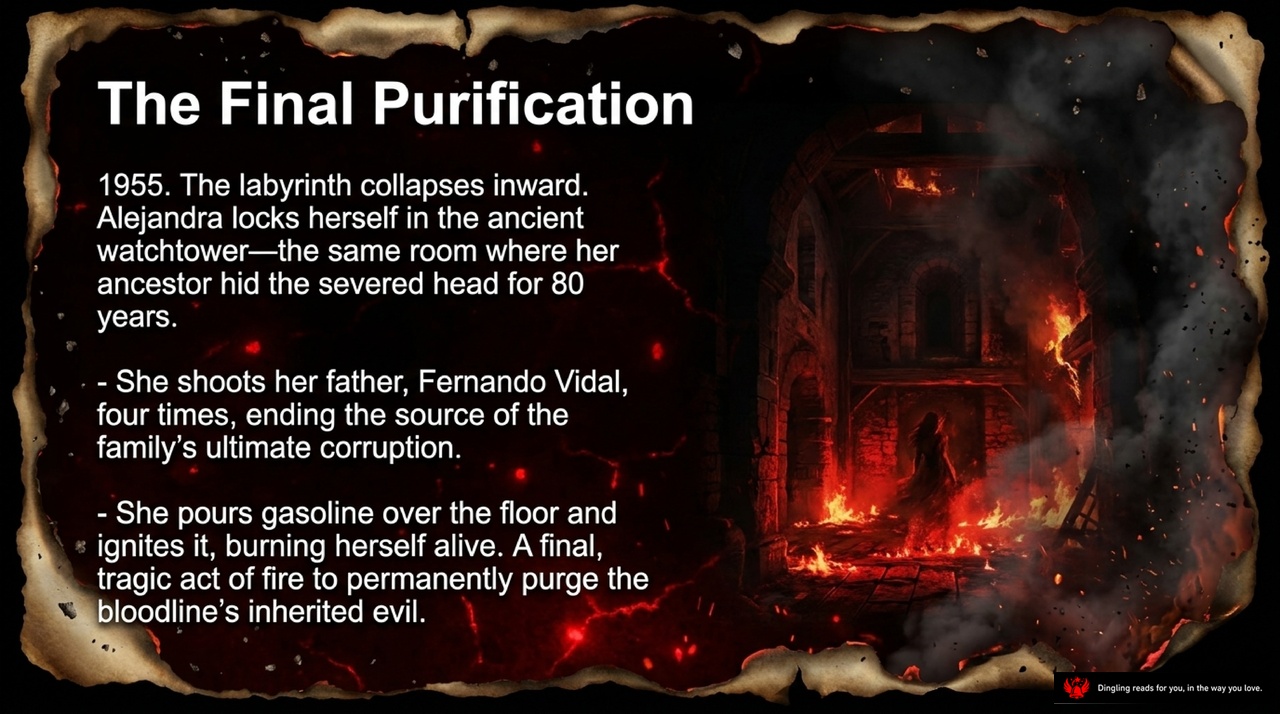
1955. The labyrinth collapses inward, sealing the fate of the Vidal family in a final, tragic moment. Alejandra locks herself in the ancient watchtower—the very same room where her ancestor hid the severed head for eighty years, a physical reminder of the corruption that has plagued their bloodline for generations. In a desperate bid to end the cycle of evil, she shoots her father, Fernando Vidal, four times, eliminating the source of their family's ultimate corruption. But this act of violence is only the prelude to her final sacrifice. She pours gasoline over the floor and ignites it, burning herself alive in a final, tragic act of fire to permanently purge the bloodline's inherited evil. As flames consume the watchtower, Alejandra chooses self-destruction over the burden of her cursed legacy, ensuring that the darkness can never rise again.

Sabato's masterpiece reveals that humanity is a labyrinth where the darkest evils of our history and psychology coexist with our most desperate yearnings for love and redemption. We are often told that our existence is built upon the ashes of our darkest tragedies, yet we cling to an irrational capacity for hope. Is this hope our greatest salvation, or simply our most tragic illusion?
Consider the story of Martin and Alejandra. Their love was as intense as it was destructive, a collision of two broken souls who found each other in a world that felt increasingly hostile. Alejandra, haunted by a family history of violence and madness, including her grandfather's severed head kept in a glass case, could not escape the ghosts of the past. She told Martin that she needed him, even though she knew they would never truly belong together.
In the end, their story became a testament to the fragility of human connection. Alejandra's tragic end—dying in a fire that consumed her family home—left Martin alone once more, proving that in this labyrinth of darkness, even the brightest sparks of love can be extinguished by the weight of history.