
On The Top of Tides: Complete Chapter-by-Chapter Summary
Welcome to the top of the tides. Today, we're diving into the story of how the world's greatest technology empires rise and fall. This isn't just about gadgets or code; it's about decoding the historical cycles, technological laws, and corporate DNA that dictate success.
Imagine a giant wave. Standing on its crest requires more than just luck; it demands a deep understanding of the forces beneath the surface. As we explore the journeys of giants like AT&T, IBM, and Apple, you'll see a clear pattern: innovation is the engine, but strategic transformation is the steering wheel. When companies cling to the past, they drown. When they embrace the future with courage, they soar.
In this session, we'll break down the core rules of the tech industry, from Moore's Law to the harsh reality of market saturation. We'll look at how visionary leaders like Gates and Jobs outmaneuvered their competitors, and why even the most dominant players can suddenly become yesterday's news if they lose touch with the changing times.
So, let's dive in and see what it really takes to stay on top of the tides.

Riding the Technological Tide. Look at this wave chart. It tells a harsh but essential truth: no tech empire lasts forever. Growth is rarely organic; it is environmental. When a company catches a technological wave, it can drift forward effortlessly for decades. But when the tide recedes, even giants drown. Survival requires recognizing when the underlying current of the industry has fundamentally shifted.
Notice the four peaks here: the Mechanical Era, the Telecom Era, the PC Era, and the Internet Era. IBM is the perfect example of catching the wave. They successfully caught the transition from Mechanical to Electronic, riding that surge to become a giant. But look at AT&T. They missed the transition from Telecom to Internet. While others surged, AT&T stayed stuck in the old paradigm, and eventually, the tide turned against them.
This visual isn't just history; it's a warning for today. If you are riding a wave, you must watch the horizon. When the water starts to pull back, you need the courage to jump off the boat before it sinks. The difference between a legend and a footnote often comes down to one thing: the ability to see the shift before it happens.
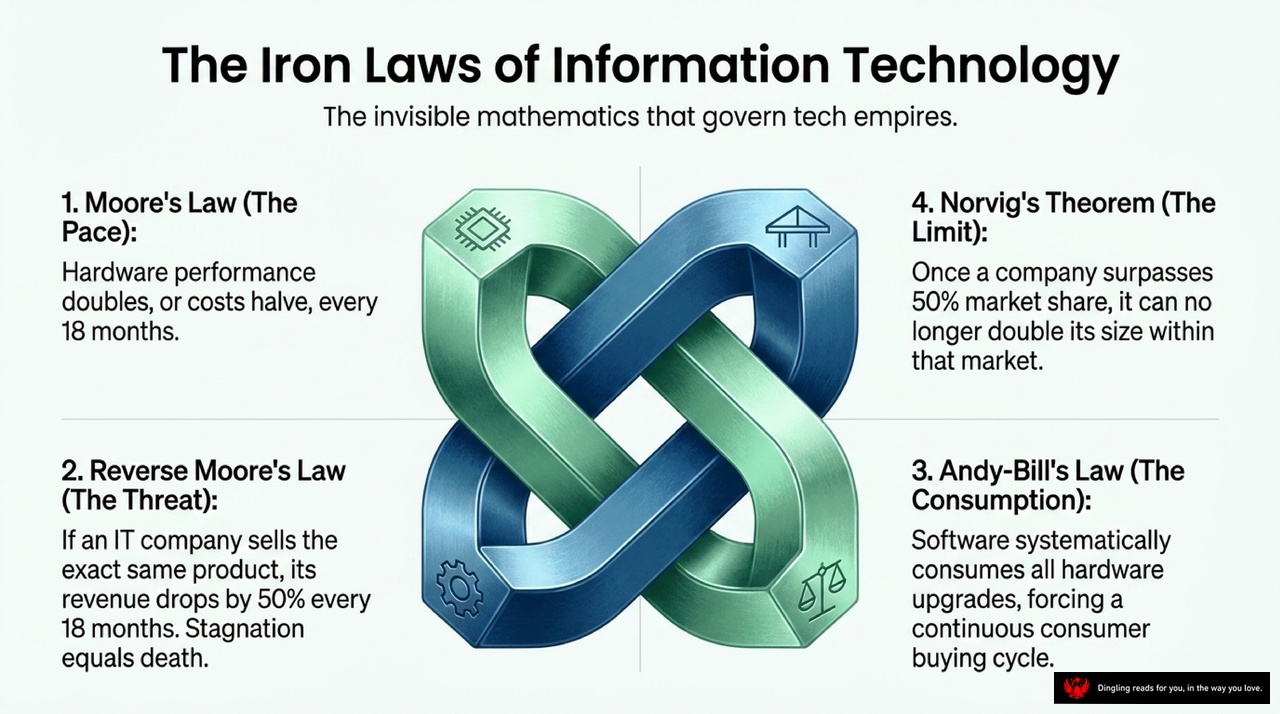
The Iron Laws of Information Technology aren't just catchy titles; they are the invisible mathematics governing the rise and fall of tech empires. Let's break down the four forces shaping our industry.
First, there's Moore's Law, the engine of progress. It states that hardware performance doubles, or costs halve, every 18 months. This relentless pace is what allows us to go from mainframes to supercomputers, turning yesterday's impossible tasks into today's everyday apps.
But with great power comes a threat: Reverse Moore's Law. If an IT company sells the exact same product without innovation, its revenue drops by 50% every 18 months. Stagnation equals death. You cannot rely on yesterday's technology to sell tomorrow's products.
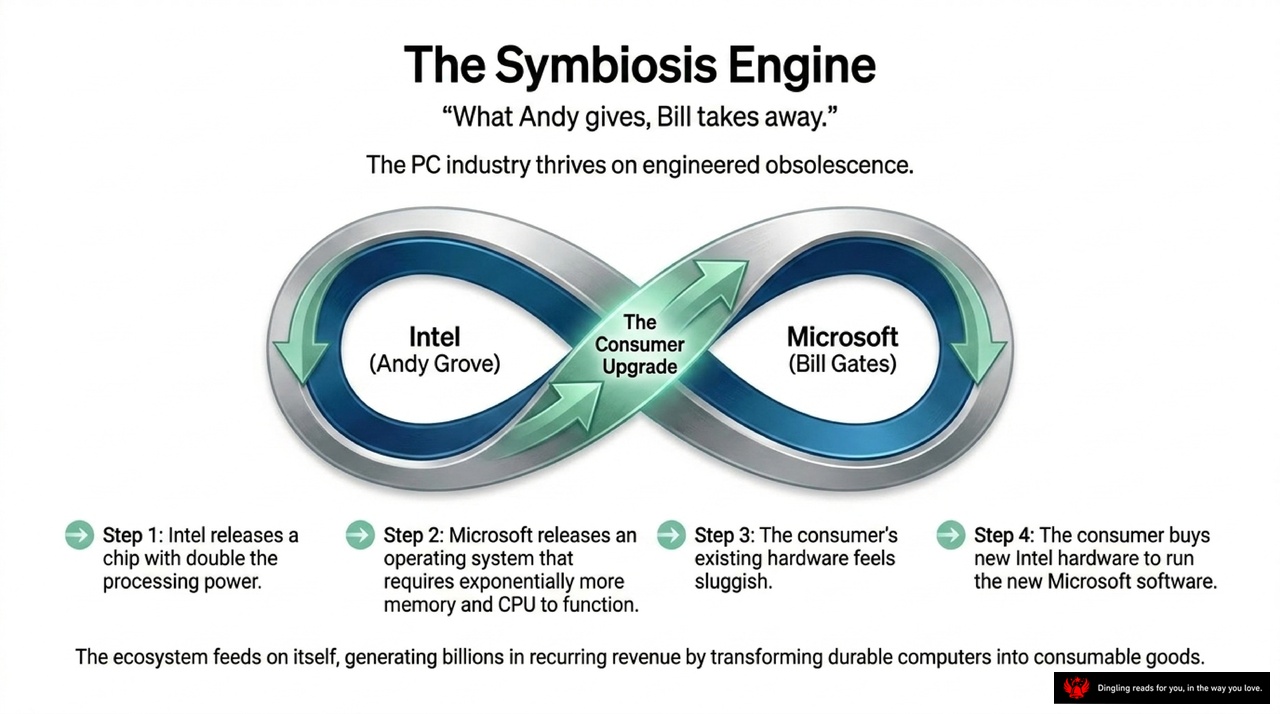
Then we have Andy-Bill's Law, the consumption cycle. Software systematically consumes all hardware upgrades. As software gets heavier, it forces a continuous consumer buying cycle, creating a strange but powerful ecosystem where users must upgrade just to keep up.
Finally, there's Norvig's Theorem, the hard limit. Once a company surpasses 50% market share, it can no longer double its size within that market. To grow, you must find a new domain. This is why giants like Intel or Microsoft must constantly look outward; staying in one lane eventually hits a wall.
These four laws—pace, threat, consumption, and limit—form the DNA of the tech industry. Understanding them is the only way to navigate the chaos and find your place in the future.
The story of Cisco is a masterclass in how to ride the internet wave. Born out of Stanford University, the company didn't just build routers; it invented the very language of the digital age. In the mid-80s, when data transmission was exploding but no one knew how to manage it, a pair of Stanford engineers created the multi-protocol router. It was the perfect solution, and Cisco was the perfect partner.
But here's the secret to Cisco's dominance that you can't find in any textbook: it's their internal startup culture. Cisco didn't just build products; they built an ecosystem for their own employees. When early employees wanted to start new ventures, Cisco didn't fire them. Instead, they acted as investors, providing capital and letting the projects run independently. If a project succeeded, Cisco had the first right to buy it out. This strategy was genius because it kept the brightest minds from leaving for competitors. They were essentially creating a pipeline for their own innovation.
This approach paid off massively. Cisco acquired over a hundred companies, including a former executive's startup that they bought for a staggering $7 billion. By doing this, they didn't just acquire technology; they acquired entire teams and ideas. This allowed them to maintain a 65% gross margin, which is incredibly high for a hardware company, rivaling Microsoft's profitability.
However, every giant faces the "Noah's Ark" theorem. Once a company's market share hits a certain point, it struggles to grow further without finding a new direction. Cisco has now become the dominant player in internet routing, but the question is: can they find the next growth engine? If they can't evolve beyond their current hardware dominance, they risk facing the same fate as other giants who got stuck in their old ways. The internet is always changing, and Cisco must keep changing with it.

The Power Pyramid of Tech Markets isn't just a chart; it's the DNA of the entire digital age. Look at this structure: it reveals why the tech world feels so dominated by a few giants while everyone else struggles just to survive.
At the very top, occupying a massive 70% of the market, sits "The Monkey King." This is the dominant player—the absolute ruler who dictates the rules, defines the ecosystem, and captures the vast majority of the profits. Think of Microsoft in the OS world or Google in search. They don't just compete; they set the stage for everyone else.
Just below them is "The Primary Challenger," holding about 20% of the market. This is the sole viable alternative. Companies like Apple or early Yahoo lived here, surviving not by copying the leader, but by offering a distinct, differentiated philosophy. They were the only real threat to the King, but they still couldn't dethrone them.
And at the very tip, a tiny 10% fragment, we have "The Swarm." These are niche players fighting for scraps on the margins. In traditional industries, you might see many competitors coexisting, but in tech, the market gravitates toward a "Winner-Takes-Most" state. Why? Because replication costs are minimal, and once you lock in an ecosystem, it's incredibly hard for anyone else to break in.
So, the lesson here is clear: if you aren't the Monkey King or the Challenger, you're in the Swarm. And in this pyramid, the only way to escape the bottom is to fundamentally change the game before the King decides the rules no longer favor you.

Why do the world's biggest companies consistently miss the next big thing? The answer lies in something invisible but powerful: their corporate DNA. Look at the graphic on the right. It shows a double helix, but instead of biological code, it represents a company's culture, business model, and operational structure. These elements are optimized for the specific technological wave that created them, much like a species adapted to a specific environment.
This creates a dangerous trap. The very traits that guaranteed dominance in one era become the exact vulnerabilities that lead to failure in the next. Think about AT&T. For decades, their DNA was built around high-margin legacy products like long-distance calls. When the internet arrived with low-margin disruptive technologies, AT&T's executives prioritized their profitable past over the uncertain future, until it was too late. Their DNA literally could not digest the new wave.
The same curse hit IBM. They were the masters of mainframes, but when the personal computer revolution exploded, their internal structure and culture were too rigid to pivot quickly. They held onto their old ways, clinging to high-margin hardware while the world moved toward software and services.
Even Apple almost fell into this trap. When Steve Jobs was gone, Apple tried to compete with Microsoft by copying their model, selling software licenses and trying to be everything to everyone. But their true DNA was about creating integrated, premium consumer electronics. Once they drifted away from that, they lost their way.
So, what is the symptom of this curse? It's when executives fall in love with their own success. They prioritize high-margin legacy products because they are safe and predictable. They ignore emerging, low-margin technologies because they look risky and don't fit the current financial model. This leads to a slow, inevitable decline. The companies that survive aren't the ones that are the biggest today; they are the ones brave enough to rewrite their own DNA, to break their own rules, and to reinvent themselves before the market does.
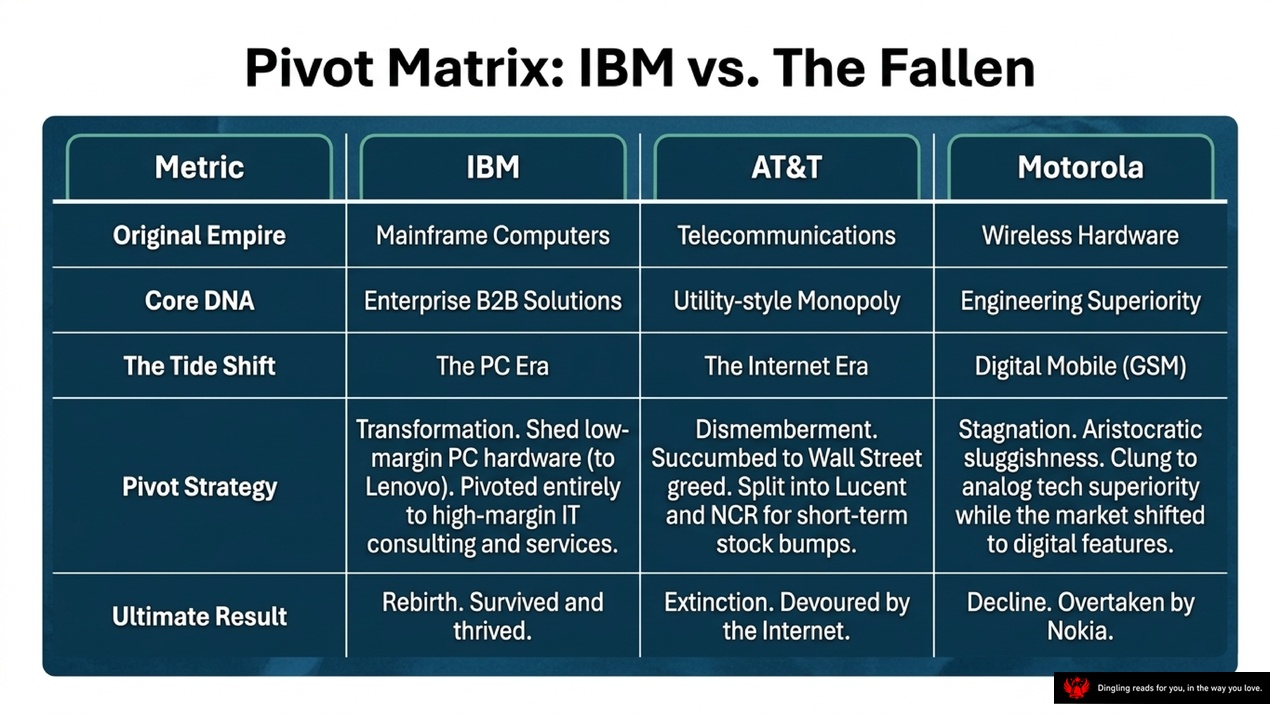
The pivot matrix we just looked at tells a stark story: IBM survived while AT&T and Motorola fell. Why? It all comes down to how each company handled the inevitable shift in technology and strategy.
Take IBM first. When the PC era hit, instead of fighting it, they made a bold move. They shed their low-margin hardware business, even selling it off to Lenovo, and pivoted entirely to high-margin IT consulting and services. This wasn't just a change; it was a rebirth. By transforming from a hardware manufacturer into a service giant, IBM didn't just survive the disruption; they thrived in it.
Now look at the other side of the matrix. AT&T is the classic example of what happens when you get stuck in the past. Once the internet era arrived, they refused to let go of their legacy telephone business. Their strategy was derailed by short-term greed, leading them to split into smaller pieces like Lucent and NCR just to boost stock prices temporarily. In the end, that strategy led to their extinction, completely devoured by the very internet they ignored.
Motorola had a similar fate, though for slightly different reasons. They were the kings of wireless hardware, built on engineering superiority and analog technology. But when the market shifted to digital mobile and software features, they clung to their old ways. They suffered from aristocratic sluggishness, unable to adapt to the new digital reality. This stagnation allowed competitors like Nokia to overtake them, turning a once-dominant giant into a declining shadow of its former self.
The lesson here is clear: in the tech world, your original empire is not a shield. Whether you are a monopoly like AT&T or an engineering powerhouse like Motorola, if you fail to pivot your core DNA to match the new tide, no amount of past success can save you. Only those who embrace change and reinvent themselves, like IBM, can stand the test of time.
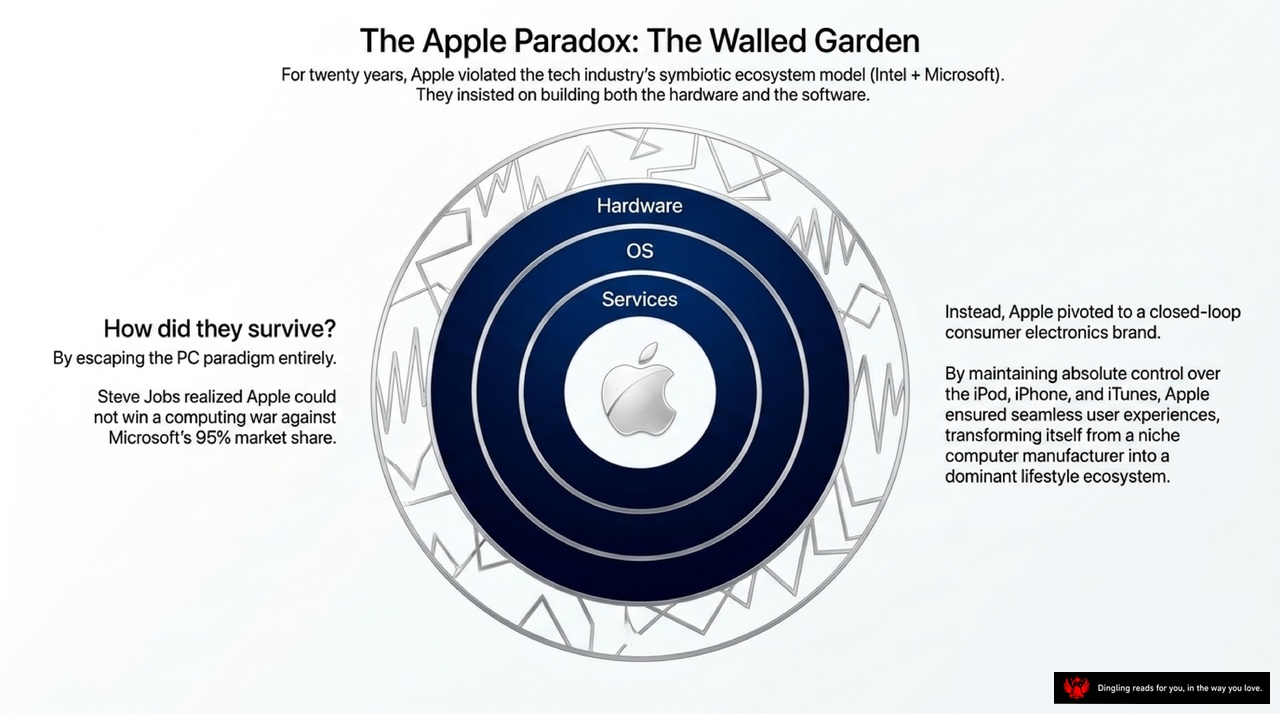
The Apple Paradox: The Walled Garden. For twenty years, Apple defied the entire tech industry's playbook. While everyone else relied on the symbiotic model—Intel making chips and Microsoft writing software—Apple insisted on building both the hardware and the software. They essentially created a "walled garden," a closed-loop consumer electronics brand where they maintained absolute control over everything from the iPod and iPhone to iTunes.
Steve Jobs realized early on that Apple couldn't win a direct computing war against Microsoft's 95% market share. So, instead of fighting on the PC battlefield, he escaped the paradigm entirely. By keeping the hardware, OS, and services tightly integrated, Apple ensured seamless user experiences that competitors simply couldn't match. This strategy transformed Apple from a niche computer manufacturer into a dominant lifestyle ecosystem.
But here's the catch: this "walled garden" is a double-edged sword. It creates incredible loyalty and a premium brand, but it also limits the ecosystem's growth. When Apple eventually decided to open up its platform, allowing third-party developers and apps, they unlocked a massive new wave of innovation. This shift proved that even the most successful closed systems eventually need to evolve to survive. It's a powerful reminder that while control can build a empire, flexibility is what keeps it alive.
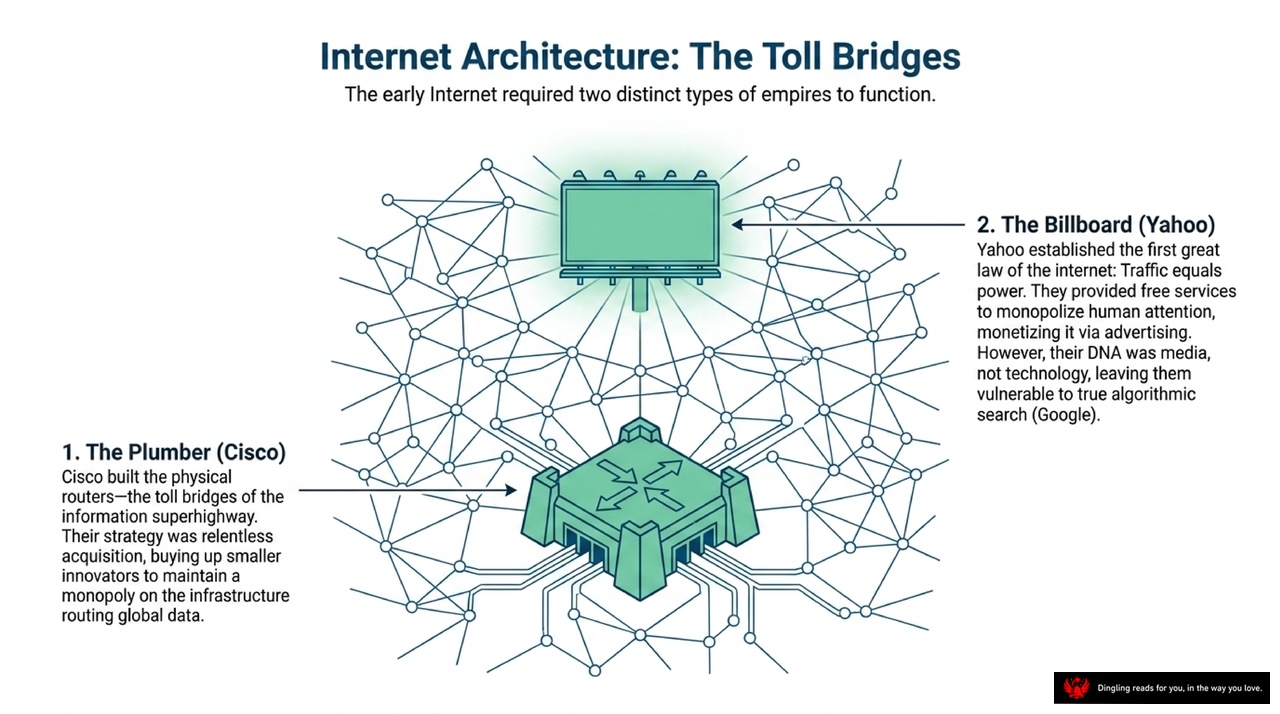
Let's talk about the two distinct empires that built the early internet. Think of the internet not just as a network of cables, but as a massive ecosystem powered by two very different types of players: the Plumber and the Billboard.
First, we have the Plumber, represented by Cisco. They built the physical routers—the actual toll bridges of the information superhighway. Their strategy was one of relentless acquisition, buying up smaller innovators to maintain a monopoly on the infrastructure that routes global data. They were the ones who made sure the pipes were wide enough for the traffic to flow.
Then, on top of those pipes, we have the Billboard, best exemplified by Yahoo. They established the first great law of the internet: traffic equals power. Yahoo provided free services to monopolize human attention and monetized it via advertising. They were the media giants of the digital age. However, their DNA was media, not technology. While they dominated the early days, this reliance on attention rather than algorithmic superiority eventually left them vulnerable to true algorithmic search, paving the way for competitors like Google to rise and take over.
So, the story of the internet's rise was a dance between building the infrastructure and capturing the eyeballs. But as we'll see, when the rules of the game changed, only one of those empires was truly ready for the next chapter.
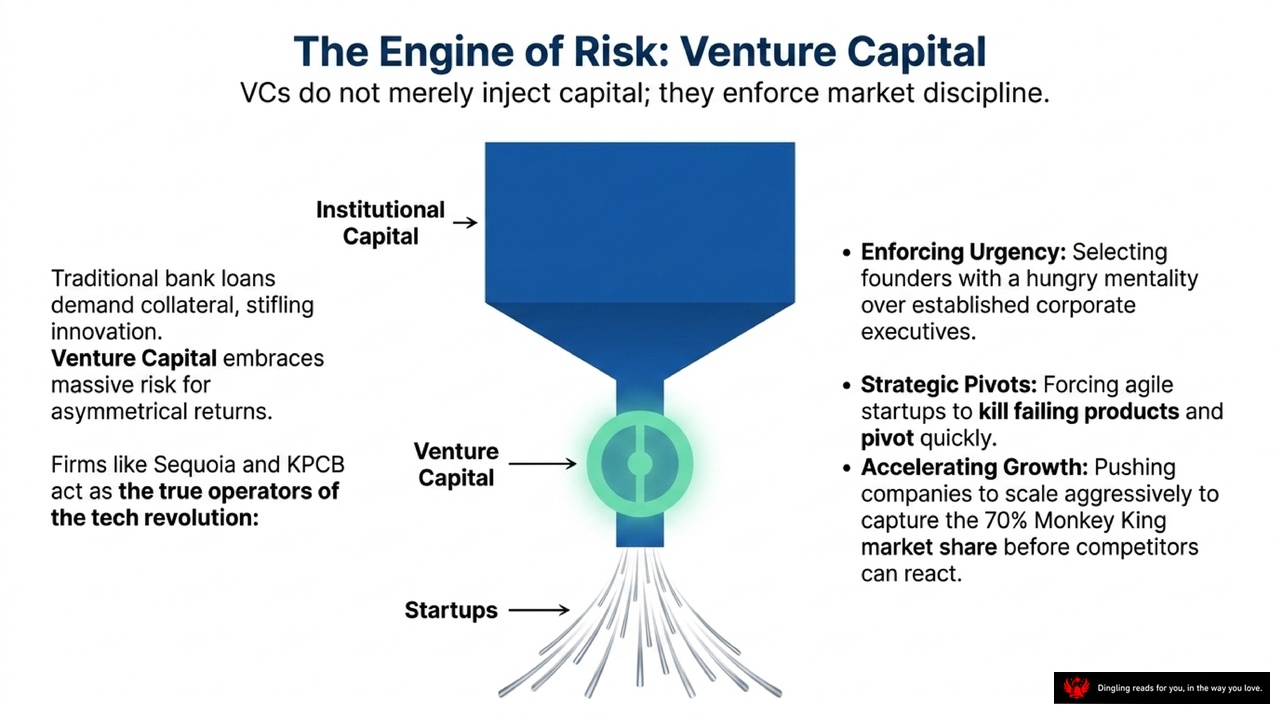
Venture Capital isn't just about writing checks; it's about enforcing a brutal form of market discipline that traditional banks simply can't match. Think of the VC fund as a high-pressure engine. On one side, you have institutional capital pouring in, but unlike a bank that demands collateral and stifles innovation with risk aversion, VCs like Sequoia or KPCB embrace massive risk specifically for those asymmetrical, life-changing returns.
This engine works by transforming passive investors into active operators. First, they enforce urgency, selecting founders with a hungry, almost desperate mentality over safe corporate executives. Second, they force strategic pivots, compelling agile startups to kill failing products immediately and turn quickly before it's too late. Finally, they accelerate growth by pushing companies to scale aggressively, aiming to capture that massive 70% market share—what we call the "Monkey King" position—before competitors can even react.
The result? Instead of just funding startups, VCs are the true operators of the tech revolution, shaping the very DNA of innovation by demanding speed, agility, and the courage to fail fast.
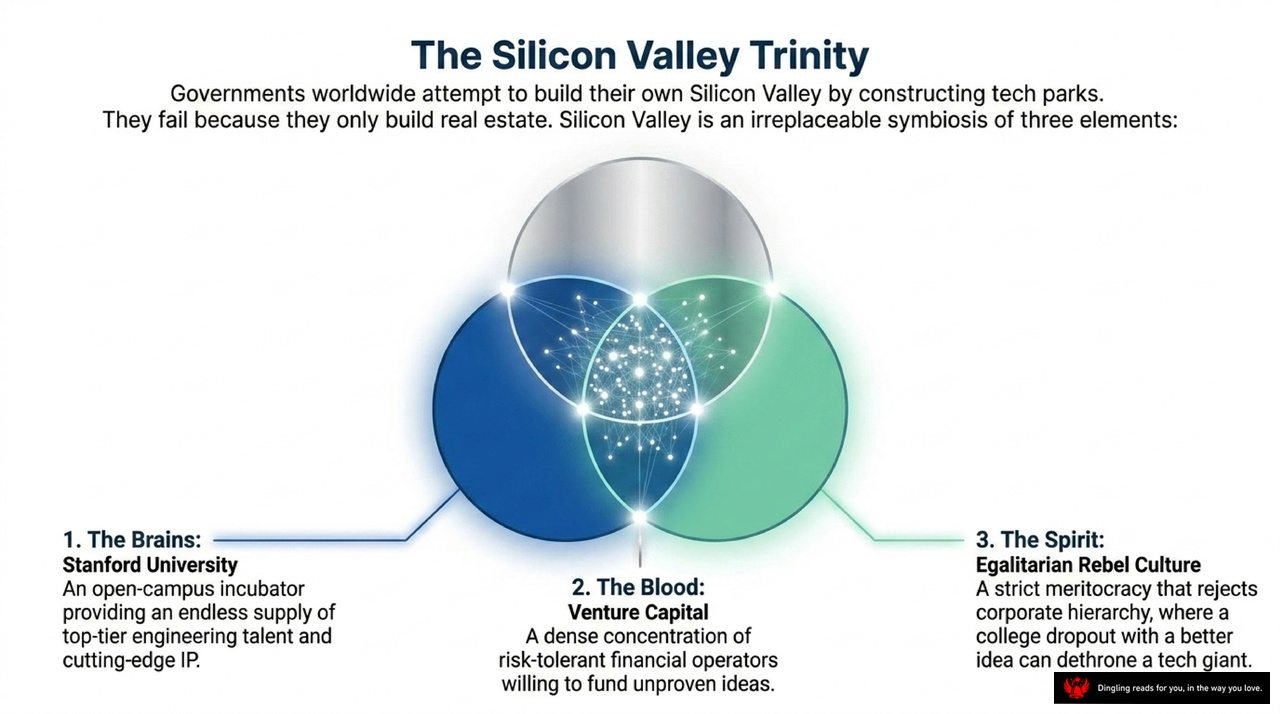
Why do so many governments fail when trying to build their own Silicon Valley? The answer is simple yet profound: they only build real estate. They treat innovation like a construction project, ignoring the fact that Silicon Valley is actually an irreplaceable symbiosis of three distinct but interconnected elements.
Look at the diagram on your screen. The first element is **The Brains**, represented here by Stanford University. Think of this as an open-campus incubator that provides an endless supply of top-tier engineering talent and cutting-edge intellectual property. It's the fuel that starts the engine.
Next, you have **The Blood**, which is Venture Capital. This is a dense concentration of risk-tolerant financial operators who are willing to fund unproven ideas. Without this capital, even the brightest ideas would starve before they could take flight.
Finally, there is **The Spirit**: an Egalitarian Rebel Culture. This is perhaps the most critical piece. It's a strict meritocracy that rejects traditional corporate hierarchy. In this environment, a college dropout with a better idea can dethrone a tech giant. It's a culture where ideas matter more than titles.
When you combine these three—the brilliant minds, the bold capital, and the rebellious spirit—you get something that cannot be replicated by simply buying land. It is the unique alchemy that makes Silicon Valley the Silicon Valley.

Wall Street often plays a double-edged sword for the companies it funds. On one side, investment banks pour in massive capital through IPOs, acting as the engine that accelerates corporate growth. But on the other side, they bring a relentless pressure for short-term greed. Public markets demand constant quarterly wins, forcing CEOs to sacrifice long-term research and development just to please the stock market.
Take AT&T as a stark example. Once a century-old telecommunications empire built on the Bell Labs, it was dismantled by this very pressure. Executives, desperate to beat Wall Street's expectations, sold off high-value infrastructure for quick stock boosts. This short-sighted decision left the company defenseless against the internet tide, turning a tech giant into a relic. The story of AT&T teaches us a hard lesson: while venture capital builds empires, Wall Street often dismantles them if you can't balance today's profits with tomorrow's innovation.

Think about the most efficient machine money has ever invented: a printing press. In the old world, you had to wait weeks for a book to be printed, shipped to a warehouse, and then sold by a middleman. But when technology commoditizes, the game changes. Engineering superiority suddenly loses to capital efficiency. Look at this diagram: the traditional path from factory to user involves factories, warehouses, distributors, and retailers—seven steps that slow everything down and pile up inventory risk.
But what if you cut the middleman out entirely? That's exactly what Dell did. In the mature PC era, Dell didn't invent better computers; they invented a better business model. By condensing that complex seven-step process into just two steps—factory directly to user—they eliminated inventory risk and middleman markups. It's like bypassing the entire supply chain to get from the source straight to the customer.
This is the ultimate model. The best business model is a money-printing machine. Imagine taking consumer cash before you even assemble the product. You get the money upfront, then you build what they ordered. This creates unprecedented capital velocity, allowing you to scale faster than any competitor who is still stuck managing warehouses and distributors. When you master this flow, you aren't just selling products; you're running a high-speed financial engine.

When a tech giant hits the 50% market share mark, the era of effortless scaling ends. This is what Peter Norvig calls "Norvig's Trap." To survive, an empire must choose one of two painful paths: leverage or transformation.
The first path is leveraging your core. You take your existing technological dominance and use it to conquer adjacent markets. Think Google: they utilized their core search algorithm and server infrastructure to dominate mobile via Android and video via YouTube. They didn't abandon what worked; they expanded it.
The second path is transformation, which often means destroying the core. This involves shedding your historical business entirely to enter a new paradigm. Look at IBM: they had to shed their PC manufacturing legacy to become a global IT services and consulting behemoth. It was a painful pivot, but it saved the company.
This graphic, labeled "Norvig's Ceiling," illustrates the hard limit where growth stalls. If you can't choose between expanding your core or radically reinventing yourself, you will eventually hit a wall. The giants we've studied—AT&T, IBM, Apple, and others—show us that clinging to the past is a death sentence. Only those brave enough to either leverage their strengths or destroy them to build something new can escape the trap and thrive in the next cycle.

Look at the horizon. The text on your screen asks a terrifying question: If your company's core DNA is the very thing that brought you to the top of today's tide, what must you destroy to survive tomorrow's?
This isn't just a rhetorical thought experiment; it's the brutal reality of the tech industry. As the slide states, technology empires are ephemeral. They are built on the iron laws of computation, accelerated by capital, and ultimately bound by their own corporate DNA. But no matter how strong that DNA is, it is always subjected to the relentless tides of innovation.
Think about the giants we've studied. AT&T built its entire identity on the monopoly of long-distance telephone service. When the internet arrived, that very DNA became its shackle. They couldn't let go of the phone lines that made them rich, so they missed the mobile revolution and the digital shift, leading to their inevitable decline. Similarly, IBM spent decades perfecting the mainframe. When the personal computer era exploded, their deep commitment to that old architecture made it hard to pivot quickly. They were too successful in the past to survive the future.
The lesson here is clear: success is often a trap. The specific strengths that got you here—the proprietary software, the hardware you built, the business model you perfected—are often the exact things that will kill you if the market changes. To survive, a company must have the courage to cannibalize its own products. You have to be willing to destroy the engine that drove your growth today, even if it feels like self-harm.
Look at the companies that did it right. Nokia didn't just adapt to the shift from analog to digital; they actively dismantled their old analog strategy to embrace the new, even when it meant giving up short-term profits. Apple is the ultimate master of this. They took the iPod, which was their golden cow, and then built the iPhone, a device that eventually made the iPod obsolete. They destroyed their own hardware empire to build a new, even larger one.
The tides of tech never stop. They only get stronger. If you cling to the DNA that made you a leader yesterday, you will be the first to drown tomorrow. The only way to stay on top is to constantly evolve, to break your own rules, and to find the new wave before everyone else does. What will your company destroy next to survive?