
One Hundred Years, Many People, Many Things: Complete Chapter-by-Chapter Summary

Hello everyone, welcome to our reading session. Today, we are diving into a century of transformation, captured in the oral autobiography titled *One Hundred Years, Many People, Many Things* by Yang Yi and Yu Bin.
As you can see on this cover, the imagery blends the grandeur of traditional Chinese architecture with a modern, contemplative portrait. This book is not just a history of a family; it is a vivid journey from the heart of a feudal Chinese household to the vibrant pulse of modern intellectual life. It captures the dramatic shift from a rigid, hierarchical past to a world defined by freedom and choice.
Through the voices of Yang Yi and Yu Bin, we step into a century where empires rise and fall, where families expand and contract, and where personal identity is constantly reshaped by the tides of history. This is a story of resilience, of navigating complex family dynamics, and of finding one's own path amidst the chaos of war and peace.
We invite you to turn the page and begin this unforgettable journey through time.

Today's slide, "A Century in Focus," maps out the dramatic arc of my life across four distinct eras. It begins in 1919 to 1937, a time I call "The Feudal Microcosm." Born during the May Fourth Movement, I grew up navigating the rigid, complex hierarchy of a Tianjin banking family. My father, Yang Yuzhang, was a former official turned businessman who ran the Bank of China, yet his early death left us vulnerable. My mother, born a concubine, carried the heavy stigma of her status, constantly fighting to teach her children that true security came from ability, not just ancestral wealth.
Then came 1937 to 1938, "The Intellectual Awakening." This was the year I graduated from Zhongxi Girls' School, a prestigious institution that felt like an ivory tower. But as the war loomed, that tower began to crack. The slide moves to 1938 to 1945, "The National Crucible." This was my most transformative period. I fled the chaos of the war, traveling from Shanghai to Hanoi, finally reaching Kunming. There, I joined the Southwest Associated University, where I met luminaries like Shen Congwen and Mu Dan. It was here, amidst the constant air raids and the struggle for survival, that I found my voice through literature and poetry, transforming from a sheltered girl into a writer.
Finally, the last section, "1945-Beyond," represents "The Architecture of Memory." After the war, I moved to Chongqing and then Nanjing, raising my children and continuing my translation work. But more than just surviving the post-war era, I spent a lifetime distilling those fragmented, chaotic memories into a cohesive history. Today, I am telling you that story—not just as facts, but as the living, breathing experience of a century.

Let's pull back the curtain on the complex architecture of a feudal household. As you can see in the diagram, at the very top sits the Patriarch, Yang Yuzhang, the ultimate authority—a distant figure representing the clan's power. Directly beneath him are the two pillars of the domestic sphere: the Main Wife, or Niang, who acts as the official matriarch and mother to the privileged Big Princess, and the Concubines, whose status is secondary but essential.
This hierarchy isn't just about names; it's enforced by a strict ranking system. On the right, you see the distinction between the "Da Pai Hang," or Big Ranking, which orders all males across the entire extended clan, and the "Xiao Pai Hang," or Small Ranking, used strictly for females to highlight their subordinate position. This rigid structure defined every relationship. Take my mother, Xu Yanruo, known as the "Da Yi Tai" or First Concubine. She was sold into the family at fifteen, a former maidservant who became the mother of Yang Yi, yet her origin as an illegitimate child cast a long shadow over her life. Unlike the Main Wife, she lived with a constant sense of inferiority, constantly reminded that she was a secondary branch in a tree that demanded absolute order.
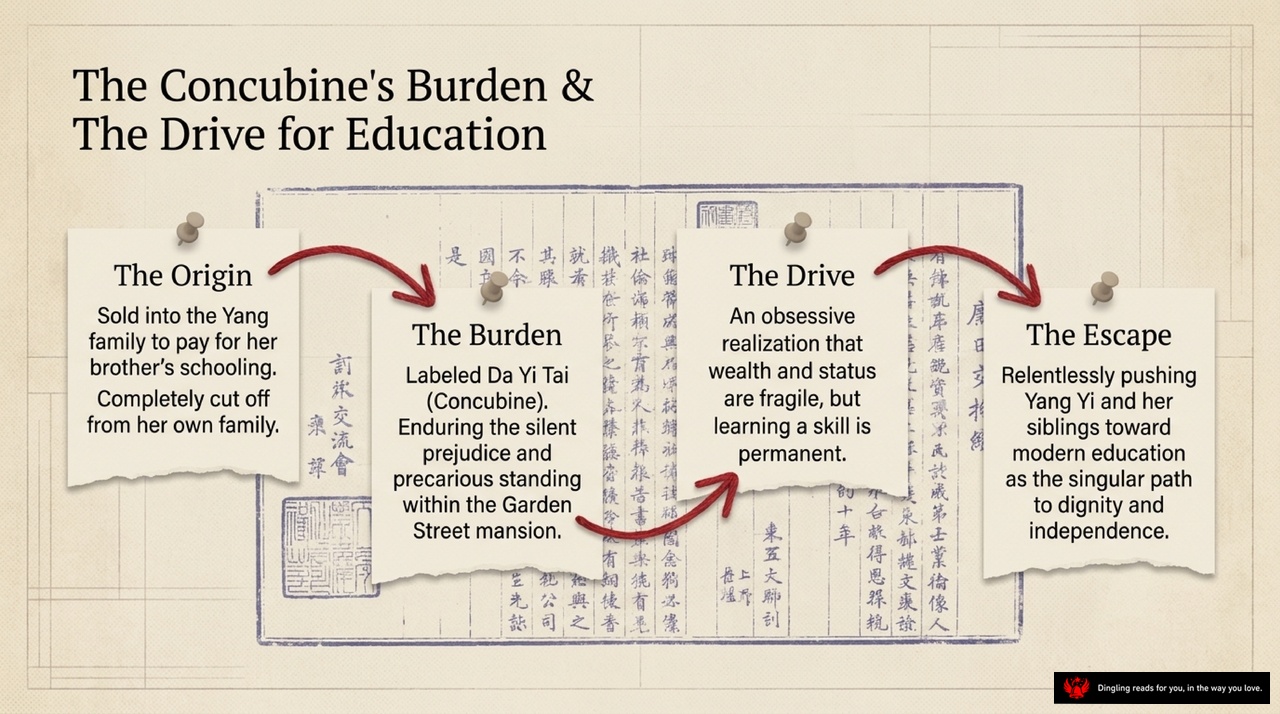
The Concubine's Burden & The Drive for Education
Let's dive into the turning points of my life, starting from where it all began. My origin is a story of sacrifice. I was sold into the Yang family to pay for my brother's schooling, which meant I was completely cut off from my own family. This harsh start defined my early years.
As I grew up, I carried the heavy label of "Da Yi Tai," or concubine. It wasn't just a title; it was a burden. I endured silent prejudice and a precarious standing within the Garden Street mansion. My mother, who was a concubine herself, knew this pain well. She hated her own father for selling her but refused to rely on her family's wealth. Instead, she had an obsessive realization: wealth and status are fragile, but learning a skill is permanent. This was the core of her philosophy.
So, she relentlessly pushed my brother, Yang Xianyi, and me toward modern education. She saw it as the singular path to dignity and independence. She insisted we learn English, study literature, and develop our minds, refusing to let our concubine status define our future. This drive transformed us from children of a fallen household into respected scholars who could stand on our own merits. That relentless push for education was the key to our escape from the shadows of our past.

In the heart of Tianjin, amidst the chaotic "Chinese Land" surrounded by foreign concessions, stood a sanctuary that felt worlds away: the Zhongxi Girls' School. While the outside world was defined by opium smoke, bound feet, and the suffocating isolation of the Garden Street mansion, this school offered a window to a different reality. It was a place of Christian egalitarianism, where students like me found a community that valued intellect over tradition. We weren't just taught English literature and Shakespeare; we were immersed in a culture of piano recitals and female friendship, realizing for the first time that we possessed individual agency.
But this freedom wasn't without its contradictions. We were raised to be "ladies"—eating without noise, sitting with perfect posture, and singing hymns that taught us that death was merely a promise of a better land. Yet, beneath these rigid rules, a vibrant, rebellious spirit thrived. We staged productions of *A Doll's House* in Chinese, defying the colonial language of our education, and we fell in love with the very idea of breaking free. Whether it was my secret crush on a senior or my eventual rebellion against my mother's control, the school was the crucible where I learned that I could be more than just a daughter or a wife. It was the place where the cage of my home finally cracked, allowing the light of the outside world to pour in.
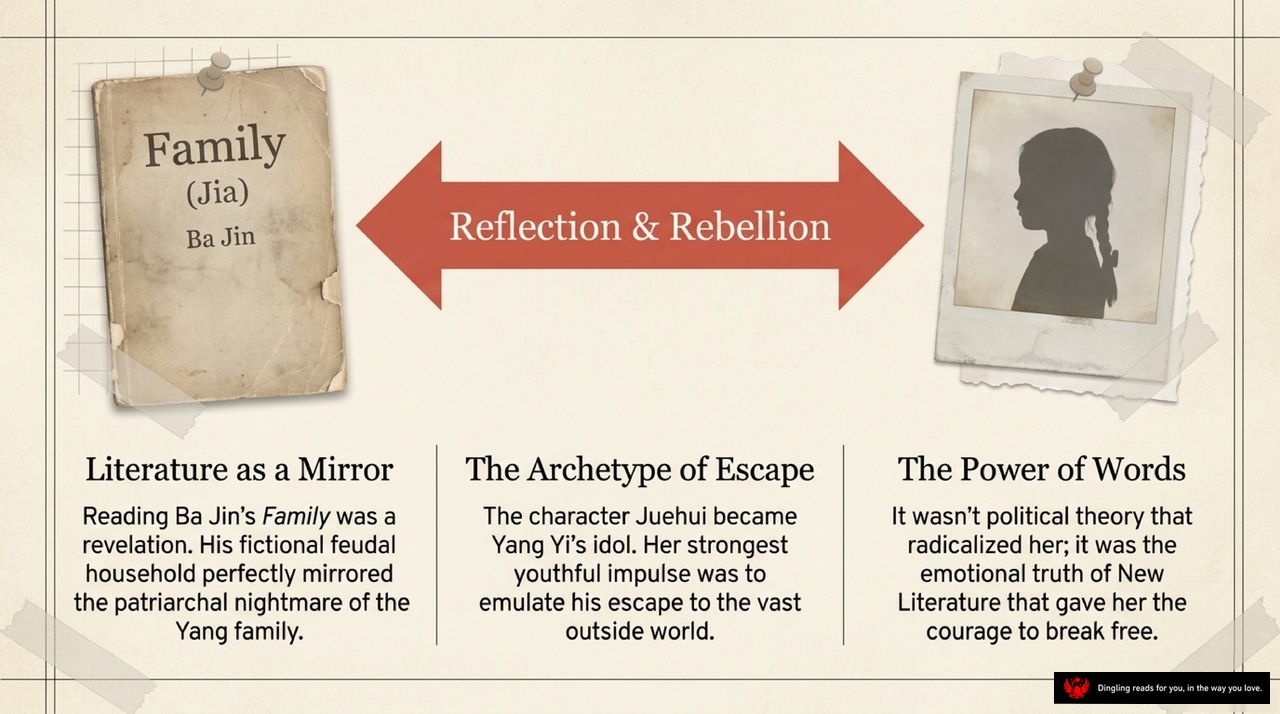
From a quiet dorm room in Chongqing to the chaotic decks of a ship heading home, my life in those final war years was a blur of waiting, loss, and eventual relief. When I finally arrived in Chongqing, the city felt like a second home for my family, even though we lived in a modest two-story building that had once belonged to a university president. My mother, despite her difficult past as a concubine, carried us with a strength that never wavered, placing her children above all else, even when she felt like a stranger in this new chapter.
While I taught English at a nearby middle school, earning the nickname "Little Miss Yang," my heart was often elsewhere. I was living a double life, physically present but emotionally distant from my husband, Zhao Ruiling. The marriage had been a desperate decision made under pressure, and the reality was far from the romantic ideal we had briefly imagined. I found myself longing for the intellectual freedom I had known in Kunming and the connection I once shared with Li Yaolin, the man who had become a ghost in my life. Though we had cut off communication years ago, he remained a silent presence in my thoughts, a symbol of the life I could not live.
The atmosphere in Chongqing was thick with political tension. The Central University was a microcosm of the nation's turmoil, filled with students from powerful families and strict party discipline. I tried to stay out of the political storms, following the advice of my mentor Chen Jia to keep my head down, but the pressure was everywhere. It was during this time that I received the devastating news that Li Yaolin had passed away in Shanghai. Holding his letter, I wept for three days, feeling the weight of a life unfulfilled and a friendship severed by time and circumstance. His death marked the end of an era for me, shattering any remaining hope of a different future.
When the war finally ended in 1945, the celebration was brief and overshadowed by the urgent need to return home. We packed our meager belongings onto a crowded ship, traveling down the Yangtze River in squalid conditions. Watching the boatmen pulling the vessel with their bare feet, I felt a profound empathy for the suffering of the common people. As we disembarked in Nanjing, the city felt both familiar and strange. It was a moment of closure, a chance to finally put down roots after years of wandering. Yet, looking back, I realized that while the war had ended, the challenges of life and the complexities of my own heart remained, carrying me into the next chapter of my journey.

1937 to 1938: The Great Exodus. It was a time when the entire Chinese family was forced to run for its life. My journey began in Tianjin, fleeing the Japanese invasion of the northern concessions. We didn't have a choice; we had to leave everything behind.
The escape was a nightmare. We were crammed into stifling boxcars on the French railway, a harrowing transition from the life of a sheltered young miss to a wartime refugee. The journey took us from Haiphong to Kunming, a route that would define the rest of my life.
But before we could reach safety, there was one final, terrifying leg of the trip. We had to make a ten-day layover via the Yunnan ship, crossing the treacherous Black Water Ocean. That voyage was a gamble with death, navigating the unpredictable waters between war-torn lands. This was the Great Exodus, a chaotic, dangerous, and unforgettable flight for millions of us.
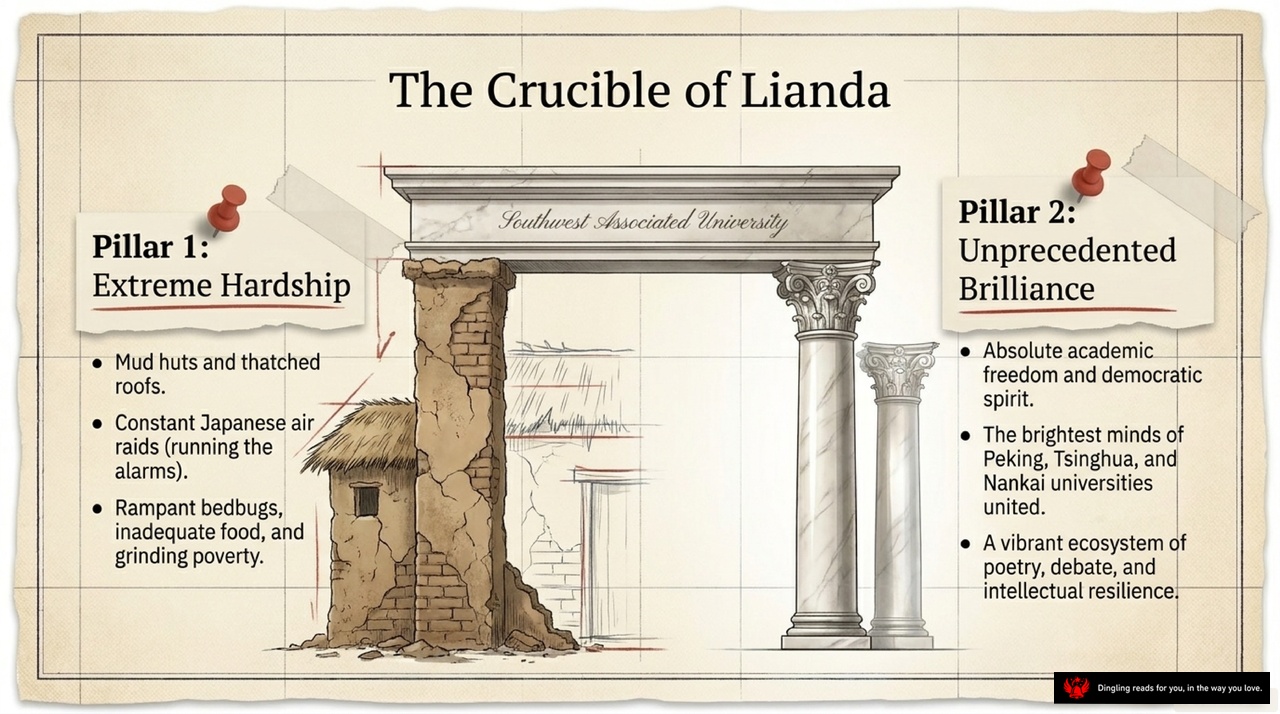
Picture this: a crumbling mud hut standing in stark contrast to towering, pristine marble columns. This visual perfectly captures the dual reality of Lianda—the "Crucible of Lianda." On one side, we see "Extreme Hardship." Imagine living in a thatched-roof shack, constantly running for cover from Japanese air raids, battling bedbugs, and surviving on inadequate food amidst grinding poverty. It was a brutal environment. Yet, look at the other side: "Unprecedented Brilliance." Right next to that ruin stood the Southwest Associated University, a sanctuary of absolute academic freedom and democratic spirit. Here, the brightest minds from Peking, Tsinghua, and Nankai universities united. Despite the chaos outside, they built a vibrant ecosystem of poetry, debate, and intellectual resilience. It was a paradox where the most difficult conditions produced the most extraordinary results, proving that the human spirit could thrive even in the darkest times.
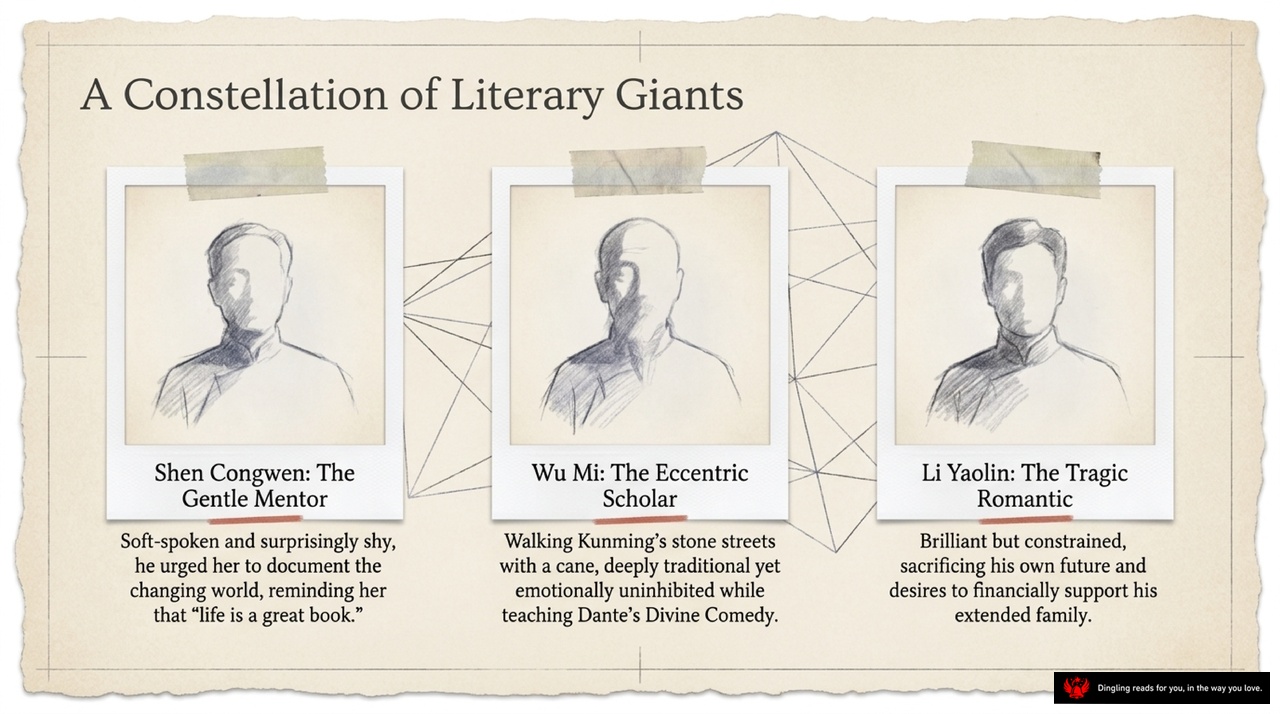
Welcome back. Today, we are stepping into a world where literary giants shaped a generation, not just with their books, but with their very souls.
On this slide, we see "A Constellation of Literary Giants." This isn't just a list of names; it's a map of the mentorship and relationships that defined my life.
First, there is Shen Congwen, labeled here as "The Gentle Mentor." He was soft-spoken and surprisingly shy, yet he had the courage to tell me that "life is a great book." He urged me to document the changing world around me, reminding me that the world itself is the ultimate story. His influence was quiet but profound, planting the seed that my life mattered.
Then we have Wu Mi, "The Eccentric Scholar." He was a man of contradictions—deeply traditional yet emotionally uninhibited. You can almost picture him walking Kunming's stone streets with a cane, teaching Dante's *Divine Comedy* to students while the war raged outside. He taught me that one can honor tradition while embracing the freedom of the spirit.
Finally, there is Li Yaolin, "The Tragic Romantic." He was brilliant but constrained by duty. He sacrificed his own future and desires to financially support his extended family. He represents the quiet heroism of the era—the man who gave everything to others, often without expecting anything in return.
These three men formed a constellation in my sky. They weren't just authors; they were fathers, teachers, and friends who showed me different ways to live, love, and endure. Shen Congwen gave me the courage to write; Wu Mi gave me the freedom to be myself; and Li Yaolin taught me the weight of responsibility. Together, they helped me navigate a turbulent time, proving that even in chaos, there is a path to meaning.
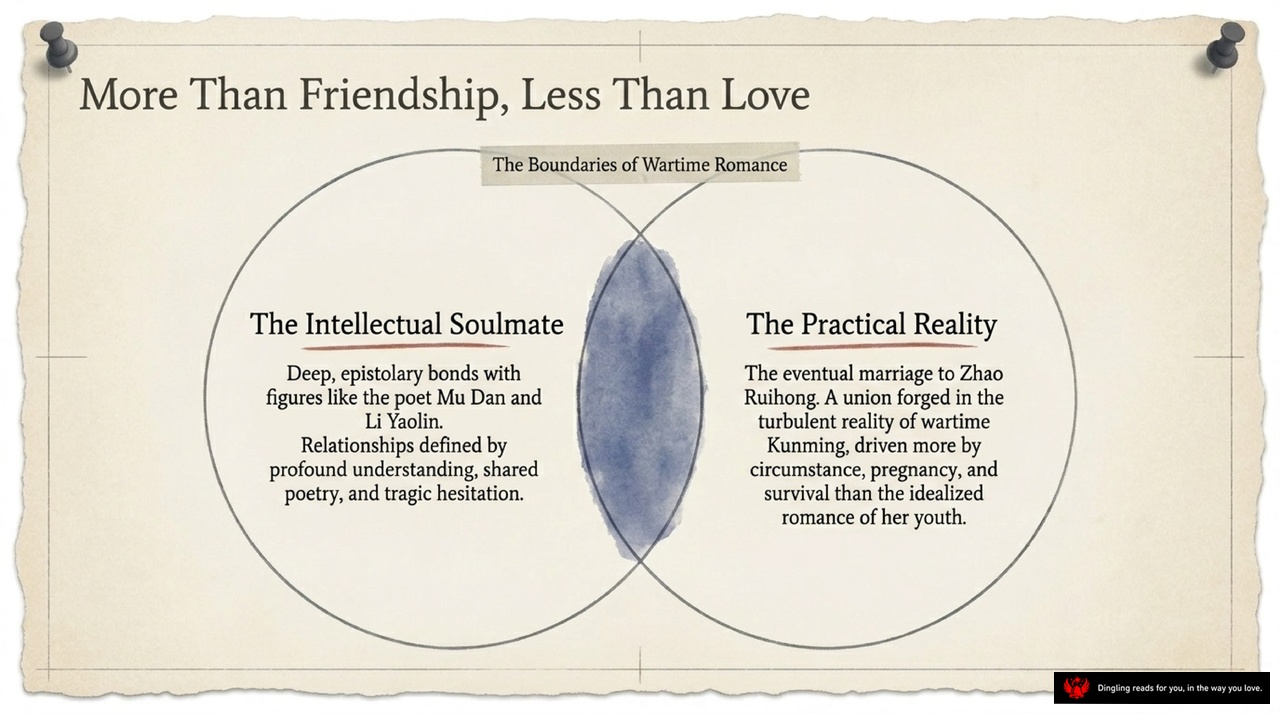
More than friendship, less than love. This slide captures the complex emotional landscape of my wartime romance. On the left, we see "The Intellectual Soulmate"—a deep, epistolary bond with figures like the poet Mu Dan and Li Yaolin. These relationships were defined by profound understanding, shared poetry, and a tragic hesitation that never fully crossed the line into conventional love. On the right lies "The Practical Reality": the eventual marriage to Zhao Ruihong. This union was forged in the turbulent reality of wartime Kunming, driven more by circumstance, pregnancy, and survival than the idealized romance of my youth. The overlapping space in the middle represents the boundaries of wartime romance itself—a delicate, often invisible line between what the heart desires and what history demands. My life became a testament to living in that intersection, where intellectual companionship and practical survival coexisted, creating a love that was real, yet forever distinct from the fairy tales we read about.

Youth in the Shadow of War isn't just a title; it's the brutal reality lived by three young lives trapped in a crumbling world. Look at Xu Zhang. He was brilliant, yet hopelessly ensnared by unrequited love and rigid class lines, a tragedy that ultimately led him to end his life with cyanicide. Then there is Chi Tai-tai, whose story is one of sheer desperation. Driven to madness and suicide by marital betrayal and the suffocating weight of traditional expectations, her fate serves as a stark warning about the cost of conforming. Finally, we see Gu Cheng, a young student whose life was cut short senselessly during a campus altercation. His death was tragically brushed aside by a bureaucratic university administration, leaving no voice behind. These three stories—love, betrayal, and injustice—form the heartbreaking core of this era, showing us how war and social pressure erased the future of an entire generation.
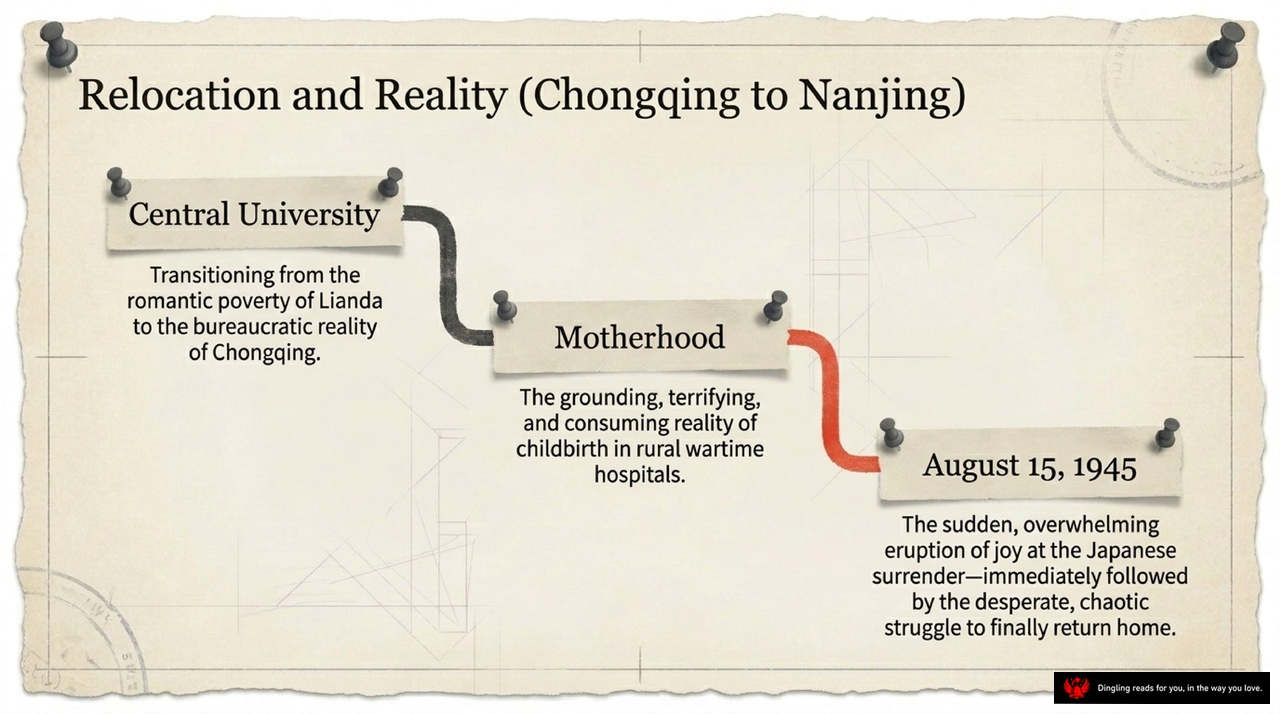
Relocation and Reality: From Chongqing to Nanjing. This slide maps the final, turbulent chapter of my life, a journey defined by sudden shifts and hard-won realities.
First, the transition to **Central University** in Chongqing. It wasn't just a move; it was a collision of worlds. I was leaving the romantic, albeit poor, life of Lianda behind and stepping into the rigid, bureaucratic reality of wartime Chongqing. The atmosphere changed from the intellectual freedom of the Southwest Associated University to the strict, often suffocating rules of a national university under government oversight.
Then came the profound and terrifying experience of **Motherhood**. In those rural wartime hospitals, childbirth was not a celebration but a grounding, consuming struggle. The lack of resources and the constant threat of air raids made every moment of becoming a mother a battle for survival. It was a reality that stripped away all illusions and demanded absolute resilience.
Finally, we reach **August 15, 1945**. The date of the Japanese surrender brought a sudden, overwhelming eruption of joy that shook the very foundations of our lives. But this joy was fleeting. Immediately following the celebration was a desperate, chaotic struggle to finally return home. With the war over, the question of "where home is" became urgent. We had to navigate the chaotic aftermath, dealing with the return of refugees and the uncertainty of a country rebuilding itself. This final leg of our journey was about reclaiming a sense of normalcy after years of displacement.

The Methodology of Memory. This slide outlines the unique alchemy that turned my scattered childhood into a cohesive historical narrative. It all starts with the Input: decades of what I call "Sui Sui Nian"—fragmented chatter. Think of it as a mental archive of seemingly random, repetitive oral memories, personal grievances, and micro-details that we often dismiss as insignificant.
But raw memory isn't enough. That's where the Process comes in: Verification. This is the critical filter. It involves intersecting those personal recollections with hard historical timelines and surviving documents. Without this cross-referencing, my story would just be subjective fiction. By anchoring my personal experience in verified history, I transform the ephemeral into the enduring.
Finally, the Output: The Oral History. This is the result of that rigorous process. It transforms the highly subjective human experience into a cohesive, historical narrative. It's not just about remembering; it's about reconstructing truth from fragments, ensuring that my life—and the lives of others like me—remains part of the collective memory rather than being lost to time.

History is rarely experienced as grand strategy by those living through it. It is experienced through daily survival. When we look at the nation, we often see sweeping political narratives, but the true texture of history lies in the micro. It is found in what ordinary people ate, the fabric of their clothes, their petty grievances, and their daily joys. These are not footnotes to history—they are the very substance of it.
Yang Yi's granular memories rescue the fragile, ordinary humanity that grand political textbooks systematically erase. By focusing on the individual, the family, and the nation in this layered way, we reclaim the real human experience from the shadows of the macro narrative.
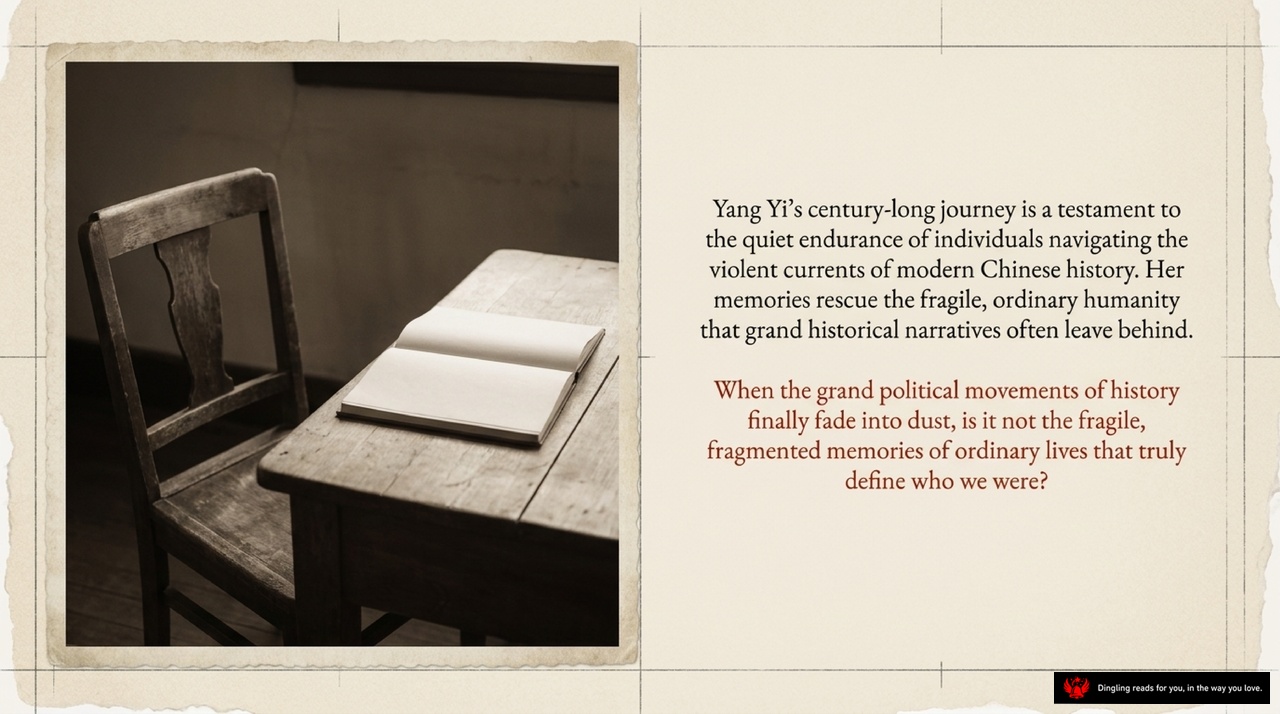
When the grand political movements of history finally fade into dust, is it not the fragile, fragmented memories of ordinary lives that truly define who we were?
Look at this quiet scene: a simple wooden desk, an empty chair, and an open book waiting to be read. This image captures the essence of Yang Yi's century-long journey—a testament to the quiet endurance of individuals navigating the violent currents of modern Chinese history.
While grand historical narratives often leave behind the ordinary, Yang Yi's memories rescue the fragile, everyday humanity that usually gets lost. Her life wasn't defined by empires or wars, but by the small, resilient choices of a single person. From the bustling streets of Tianjin to the war-torn campuses of Kunming, she witnessed it all, yet her story remains grounded in the human experience. It is a reminder that history is not just written by the powerful, but lived by everyone.