
One Up On Wall Street: Complete Chapter-by-Chapter Summary
Welcome to today's session on *One Up On Wall Street* by Peter Lynch and John Rothchild. This isn't just another finance book; it's a manifesto for the everyday investor. The core message is simple yet powerful: you don't need a degree or a crystal ball to beat the pros. In fact, relying on their advice is often your biggest mistake.
The authors argue that your greatest advantage lies right here, in your daily life. While professional analysts are bogged down by complex models and lagging data, you are already doing fundamental analysis without even realizing it. When you shop at the grocery store, you know which brands are flying off the shelves. When you drive past a struggling business or see a popular new tech gadget everyone is using, you are spotting the next big winner before the stock market even knows it exists.
This book is your ultimate guide to using that common sense to outsmart the experts. It teaches you how to identify "ten-baggers"—stocks that can multiply your money tenfold—by looking at the companies you already know and love. Whether it's a familiar coffee shop, a beloved car brand, or a service you use every day, the potential for massive wealth is hiding in plain sight, waiting for you to notice. So, put down the complex charts and pick up your eyes; the market's best secrets are written all over the world around you.
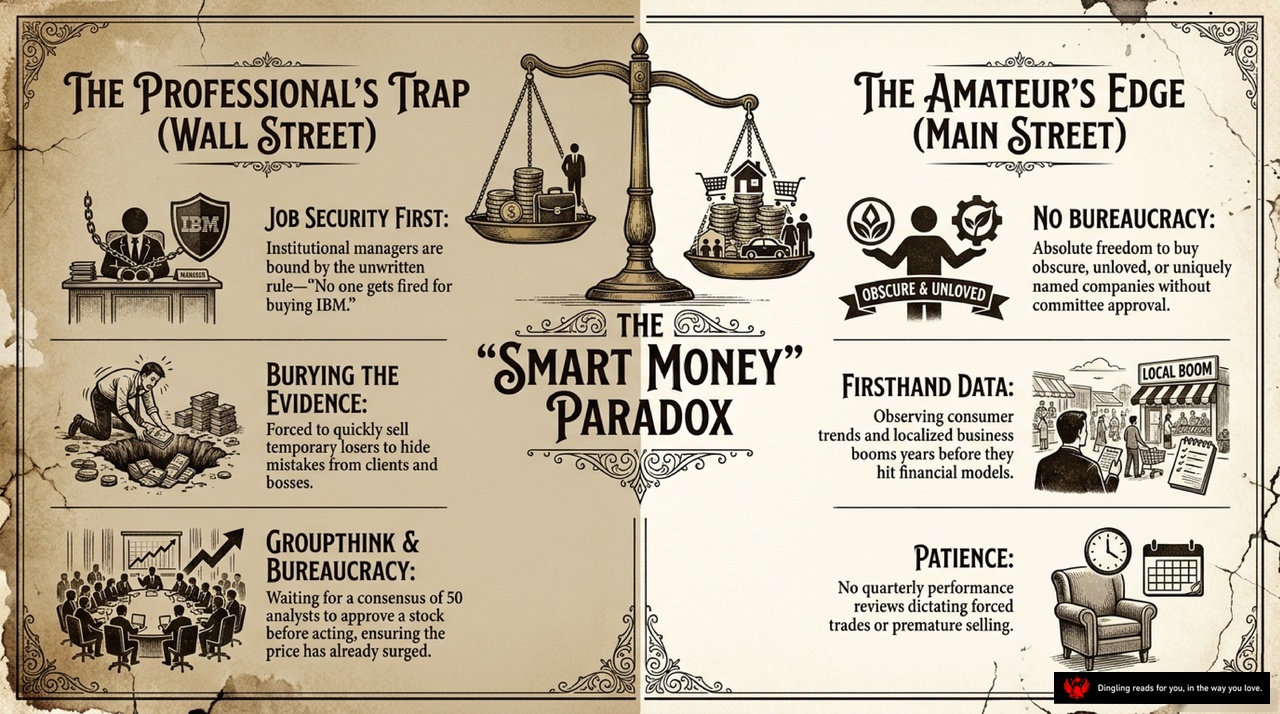
On this slide, we're diving into the core tension of investing: The Professional's Trap versus The Amateur's Edge. Look at the center; this is the "Smart Money" Paradox. It sounds counterintuitive, right? We often assume that "smart money" means Wall Street experts are the brightest, and everyone else is just guessing. But the data tells a different story.
Let's look at the left side first: The Professional's Trap. On Wall Street, the biggest enemy isn't the market itself; it's the system. Notice the point about "Job Security First." Institutional managers are often bound by an unwritten rule: "No one gets fired for buying IBM." They prioritize safety over returns, burying evidence of mistakes to hide from clients, and falling into groupthink where fifty analysts must agree before acting. By the time they buy, the price has already surged. They are trapped by bureaucracy and quarterly reviews, forced to play it safe.
Now, flip your gaze to the right side: The Amateur's Edge. This is where Main Street investors hold the secret weapon. There is no bureaucracy here. You have the freedom to buy obscure, unloved companies without committee approval. You don't need to wait for consensus; you have access to firsthand data. Think about your local supermarket or the office where you work. You see consumer trends and business booms years before they hit the financial models. You have patience because you aren't forced to sell by a quarterly deadline.
The central image of the scales illustrates this perfectly. The side with the professional is weighed down by constraints, while the amateur side, filled with everyday opportunities, is lighter and more agile. The lesson is clear: You don't need complex financial models to beat the pros. You just need to use your eyes, observe the real world, and take advantage of the freedom they lack. Your life experience is the most valuable asset you have, and it is the key to unlocking those hidden "10-baggers" that Wall Street misses.

Imagine a $10,000 portfolio sitting on the table. Now, picture it as a baseball diamond. Most investments are like routine grounders or fly balls—steady, safe, but ultimately ordinary. They follow the crowd, offering modest returns that barely outpace inflation. But then, one path diverges. It starts slow, blending in with the noise, but then it curves upward with explosive force, soaring to a "10x Multiplier." This is the genesis of the "Tenbagger"—a stock that turns your initial investment into ten times its value.
Think of a Tenbagger as the financial equivalent of hitting two home runs and a double at once. You only need just one of these golden seeds to transform an otherwise mediocre portfolio into a legendary success. While the downside of any single stock is capped at 100% loss, the upside is literally infinite.
The secret to finding these outliers isn't in complex financial models or waiting for Wall Street analysts to catch up. In fact, professional investors are often too slow. They rely on lagging data and strict institutional rules that force them to buy only "safe," boring giants. They miss the real opportunities because they are constrained by regulations, like limits on how many shares they can buy, or internal mandates to only hold "approved" companies.
But you have a massive advantage: your life. The best Tenbaggers are often hiding in plain sight within your daily routine. It could be the donut shop you visit every morning, the car brand your family loves, or the software your colleagues rave about. While experts wait for quarterly reports, you are already doing the fundamental analysis. You see the lines of customers, you feel the brand's momentum, and you notice the growth before the stock price ever reflects it.
When you find one of these hidden gems, don't let market panic stop you. History shows that even when the entire market crashes, the fundamentals of a great company remain untouched. The key is to ignore the short-term noise and focus on the long-term growth. If you can spot these opportunities early and hold them through the volatility, you aren't just investing; you're playing the game with a scorecard the pros don't even have.

Finding a ten-bagger doesn't mean you have to look across the globe or dig through complex financial reports. In fact, the best opportunities are hiding right next to you. Whether you're shopping at the grocery store, commuting to work, or hanging out with friends, your daily life is actually a free, real-time fundamental analysis session that Wall Street analysts can't compete with.
Think about it: if you work in an industry, you see the trends before the numbers hit the press. If you're a consumer, you know which products are flying off the shelves and which are gathering dust. Peter Lynch discovered massive winners like Dunkin' Donuts and The Limited not because he had a secret formula, but simply because he paid attention to the places he already visited. He noticed long lines at a coffee shop or customers raving about a new car, and those small observations turned into life-changing investments.
However, not every company you see is a winner. You need to know how to spot the right ones. Look for boring, unglamorous businesses that everyone else ignores. If a company's name sounds unexciting, or if its product seems mundane, that's often a good sign. When Wall Street is too busy chasing the latest hot tech trend, they are leaving these overlooked, solid companies on the table. By focusing on simple, understandable businesses and ignoring the hype, you can find the hidden gems that eventually become ten-baggers while the rest of the market is distracted.
When we talk about building a portfolio, the first rule is to ditch unrealistic expectations. While the historical average for stocks hovers around 9% to 10%, you should aim for a more realistic 12% to 15% annual return by doing your own research. Remember, frequent trading just eats up your profits through costs; long-term holding is the real secret to compounding wealth.
Now, how many stocks should you actually hold? The debate between diversification and concentration is old, but the answer is simple: it's about quality, not quantity. For a smaller portfolio, holding between 3 to 10 stocks is sweet spot. It protects you from a single disaster without diluting your gains with too many mediocre choices. Concentrating on companies you truly understand actually boosts your chances of hitting those 10-baggers.
Your mix should also evolve with your life. Young investors can afford more risk, so lean into high-growth or turnaround stocks that have the potential to explode. As you get older and prioritize safety, shift your focus toward stable, slow-growth companies that provide a steady income.
But here is the biggest trap you must avoid: the mistake of "pulling flowers to water weeds." Many investors sell their winners because they've gained value, only to buy their losers hoping to catch a rebound. This is backwards logic. You shouldn't sell because the stock went up, or buy because it went down. You should sell if the company's fundamentals are rotting—like losing market share or bloating with bad acquisitions—and buy more if the business is thriving but the price has dipped.
Think about Taco Bell. If you had set a stop-loss order, you would have missed out on a ten-bagger. The risk isn't the stock price dropping temporarily; the risk is buying a broken business. If you know the company is solid, a price drop is actually a gift. It gives you a chance to add to your position at a cheaper price. And never set a fixed profit target like "I'll sell when it doubles." The best companies often keep climbing long after you've sold. Let your winners run, and let your losers go only when the business itself is no longer good.

The chart in front of us outlines what Peter Lynch calls "The 6-Species Taxonomy of Stocks," a simple but powerful way to categorize every company you might ever encounter. Think of it as a field guide for investors, helping you instantly identify which type of business you are looking at and, more importantly, how to treat it.
First, we have the **Slow Growers**. These are the mature, large-cap giants that are essentially aging. As the slide describes, they are best bought for steady, reliable dividends. They won't make you rich quickly; they are the boring, stable trees that provide shade and fruit year after year.
Next are the **Stalwarts**. These are the defensive giants, like the castle in the icon, offering steady 10-12% growth. They are excellent for portfolio protection, but the key rule here is to sell them once they've gained 30-50%. Don't hold them forever; once they've done their job, move on.
Then we have the **Fast Growers**, the rockets and leaping deer of the market. These are small, aggressive new enterprises growing at 20-25%. They are the native habitat of the legendary "Tenbaggers"—stocks that grow ten times. They come with high risk and high reward, but they are where the real wealth is made.
Below that, we have the **Cyclicals**. Represented by the gear and the wave, these companies expand and contract with the economy. Timing is everything here. If you buy a cyclical stock at the peak of the boom, you are guaranteed to lose money. You must know when the business cycle is turning.
Then there are the **Asset Plays**. This is the treasure chest hidden in the sand. These are companies sitting on hidden value—like real estate or cash—that the market has completely ignored. They require immense patience. You are essentially buying the asset at a discount, waiting for the market to eventually realize what you already know.
Finally, we have the **Turnarounds**. The phoenix rising from the ashes. These are battered, depressed companies making a comeback. There is no expected growth from the top down, but a successful rescue can provide massive upside. It's a high-stakes game of chess where you bet on management's ability to fix a broken machine.
The beauty of this taxonomy is that it forces you to stop treating every stock the same. A Slow Grower and a Fast Grower require completely opposite strategies. By understanding which "species" you own, you can align your expectations with reality and avoid the most common mistake investors make: expecting a fast grower to behave like a slow grower.

Imagine a sieve designed to filter out the noise of Wall Street and leave only the purest gold. This is the "Perfect Company Sieve," a visual map of how Peter Lynch identifies the stocks that can turn into ten-baggers. Instead of chasing hot tips, you want companies that are boring, obscure, and ignored by the big institutions.
Start at the top of the funnel with the name. You want a dull or ridiculous name—think "Pep Boys" or "Safety-Kleen." These unglamorous titles repel the hype machine, keeping the stock price low while you quietly accumulate shares. Next, look for a business that is boring or even disagreeable. Companies that handle hazardous waste or produce mundane items like bottle caps face less competition because nobody wants to cover them.
As the stock moves down the sieve, it must pass the "Spinoffs" filter. Newly independent subsidiaries are often overlooked by their former parent companies, creating a hidden opportunity for growth. Then, the stock needs to be ignored by institutions. If no Wall Street analysts are covering it, you have maximum upside potential before the crowd discovers it.
Further down, the company must have a niche. Local monopolies or companies with exclusive rights possess unmatched pricing power that big competitors can't touch. Finally, the product must be recurring. Think razor blades or soft drinks; customers must buy it repeatedly to generate stable, predictable cash flow.
When a stock passes all these layers—boring name, unglamorous business, no analyst coverage, niche dominance, and recurring revenue—it hits the bottom of the sieve and emerges as the Perfect Stock. This is where you find the hidden gems that the rest of the market misses until it's too late.
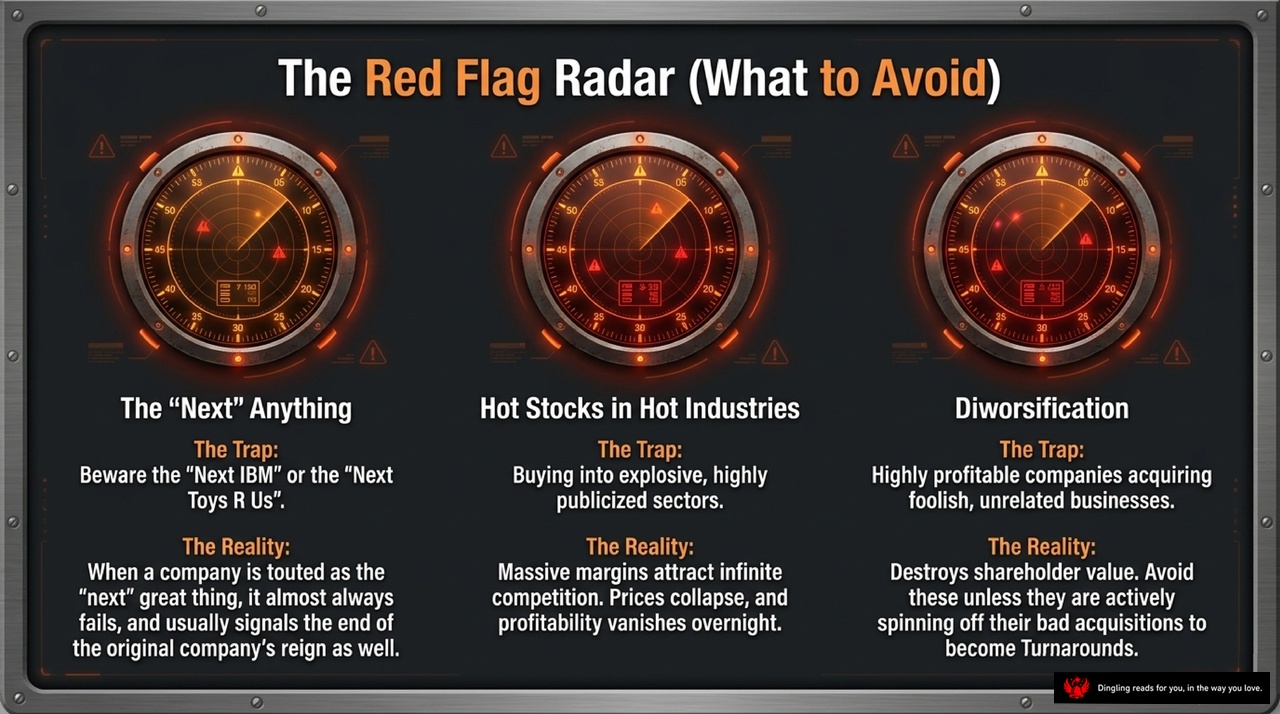
So, let's talk about the "Red Flag Radar." Think of your investment portfolio as a radar screen, and your job is to spot the dangerous signals before they crash into you. Today, we're looking at three specific traps that even smart investors often fall into, and how you can avoid them.
First up, we have the "Next" Anything. This is the classic trap of chasing the "Next IBM" or the "Next Toys R Us." Whenever you hear a company touted as the next big thing, your instinct might be to jump in immediately. But here's the reality: when a company is hyped as the "next great thing," it almost always fails. These are often just imitators trying to copy a legend, and they usually signal the end of the original company's reign. Don't bet on the copycat; bet on the original.
Second, avoid the hot stocks in hot industries. It's tempting to buy into explosive, highly publicized sectors where everyone is talking. But the trap here is that massive margins attract infinite competition. As soon as everyone sees the opportunity, prices collapse, and profitability vanishes overnight. Just because an industry is hot today doesn't mean it's a good place to park your money for the long haul.
Finally, steer clear of "diversification" traps. Many profitable companies get caught up in foolish, unrelated business acquisitions. They spend their cash buying things they don't know how to run, which destroys shareholder value. Unless a company is actively spinning off these bad acquisitions to become a turnaround story, avoid them. You want to see focused growth, not scattered distractions.
So, keep your radar on. Ignore the hype, avoid the crowded trades, and don't let companies distract you with irrelevant acquisitions. Your goal is to find the solid, undervalued companies that are quietly building value, not the noisy ones that are burning through it.

Before buying, can you explain the story to a child in two minutes? That is the ultimate litmus test for any investment. If you can't articulate your thesis simply, don't buy the stock.
Let's break down how to pass this final gate. First, identify the category. Is this a stalwart, a fast grower, or an asset play? Your expectations depend entirely on this. A slow-growth utility pays dividends but won't turn your money into ten times its value overnight. A rapid-growth tech stock might skyrocket, but it carries massive risk. You must know which lane you're in.
Next, identify the catalyst. Why will earnings grow? Are they cutting costs, raising prices, or entering new markets? Without a clear engine driving the business forward, the stock is just a guess. Finally, identify the obstacles. What could halt the growth or break the balance sheet? You need to know the downside before you commit your capital.
This simple three-step framework forces you to think clearly. If you can't explain the company's story, its growth drivers, and its risks to a child, you don't have enough conviction to hold it through a market downturn. Stick to companies you truly understand, and let your simple logic beat the complex models of the pros.

Let's cut through the noise and look at the ultimate truth of investing: over the long run, earnings equal price. As this chart illustrates, if you ignore the macroeconomic noise—things like money supply, recessions, and global anxiety—the relationship is simple. If corporate earnings go up, the stock goes up. Period.
Look at the graph. The jagged black line represents the actual stock price, which often dances wildly above or below the smoother green line of corporate earnings. When the price dips below earnings, like in that orange zone around year four, it's a buying opportunity because the stock is undervalued. Conversely, when the price spikes far above earnings, creating that blue shaded area around year eight, you are in the danger zone where the stock is overvalued.
The lesson here is profound: don't get distracted by the short-term volatility of the market. Your job isn't to predict the daily ups and downs of the stock price. Your job is to focus on the company's actual earnings. If you stick with a business that is growing its earnings consistently, the stock price will eventually follow, smoothing out the chaos along the way. Ignore the panic, ignore the hype, and just watch the earnings. That is the only path to long-term success.

So, let's talk about building your portfolio like a well-oiled machine. Think of it as a pyramid, where every layer has a specific job to do. At the very bottom, you have "The Foundation," which makes up about 30 to 40% of your holdings. These are your "Stalwarts"—steady growers that provide essential downside protection and reliable capital when the market turns recessionary. They are the ballast that keeps your ship steady.
Just above that sits "The Growth Engine," also accounting for roughly 30 to 40% of your portfolio. This is where you hunt for "Fast Growers." These are the high-risk, high-reward opportunities, the pursuit of the "Tenbaggers." This is where the massive portfolio multipliers live. If you want your wealth to compound quickly, this is the layer you need to focus on.
At the very top, making up only 10 to 20% of your stack, is "The Opportunistic Edge." This is your playground for Turnarounds, Cyclicals, and Asset Plays. These require deep value and often demand specific industry knowledge or extreme patience, but the upside can be enormous.
Now, look at that Field Note on the right. It's a crucial reminder: don't just blindly add random companies to hit a numerical quota. True diversification comes from the quality of the story and the strength of your research. Stick to just 3 to 10 well-researched stocks. It's better to have a few excellent, deeply understood winners than a basket of mediocre, unrelated companies. Your portfolio's success depends on the quality of your choices, not just the quantity of your tickers.
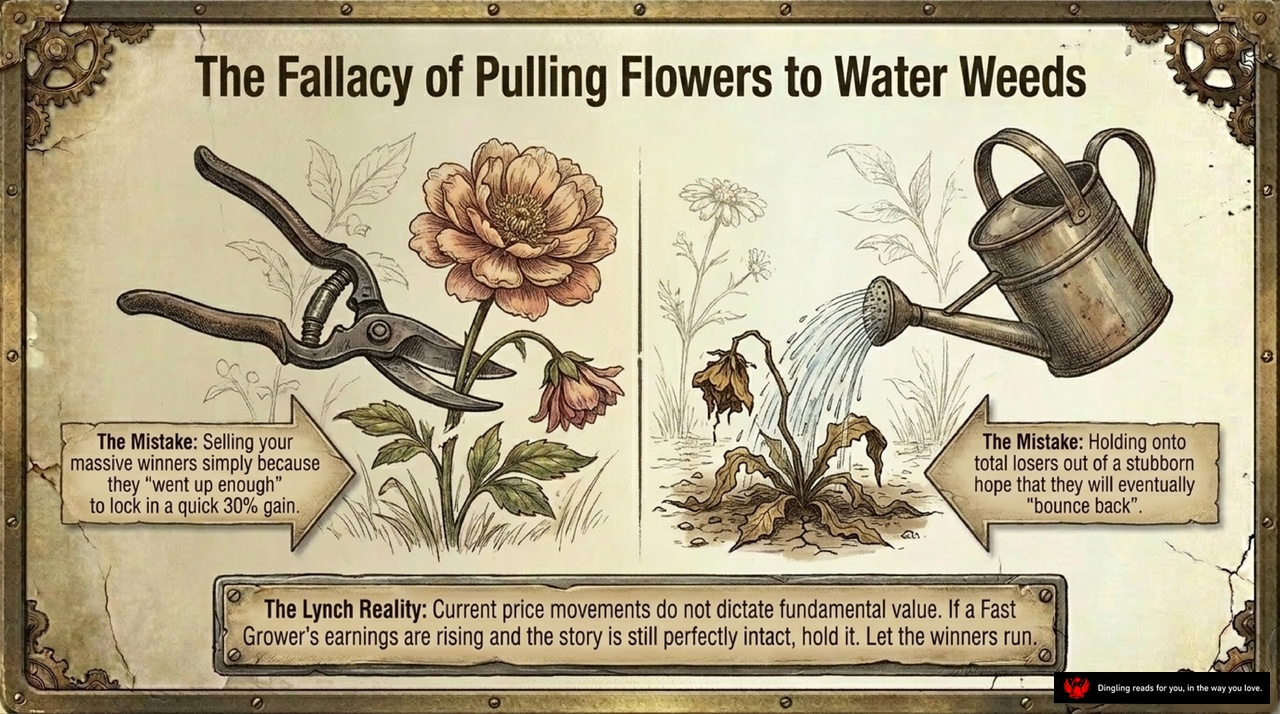
Imagine you're tending a garden, but instead of nurturing your plants, you're making two fatal mistakes. On the left, you see shears cutting off a beautiful, blooming flower. The mistake here is selling your massive winners simply because they "went up enough" to lock in a quick 30% gain. You're trimming the branches of your biggest opportunities just because they got tall. On the right, a watering can pours water onto a withered weed. This represents the other error: holding onto total losers out of a stubborn hope that they will eventually "bounce back." You're feeding the weeds, hoping they'll turn into flowers, while ignoring the real blooms.
The hard truth, labeled as "The Lynch Reality," is that current price movements do not dictate fundamental value. If a fast grower's earnings are rising and the story is still perfectly intact, hold it. Let the winners run. Don't pull the flowers to water the weeds. The market will reward you for your patience, not for your panic selling of success or your desperate clinging to failure.
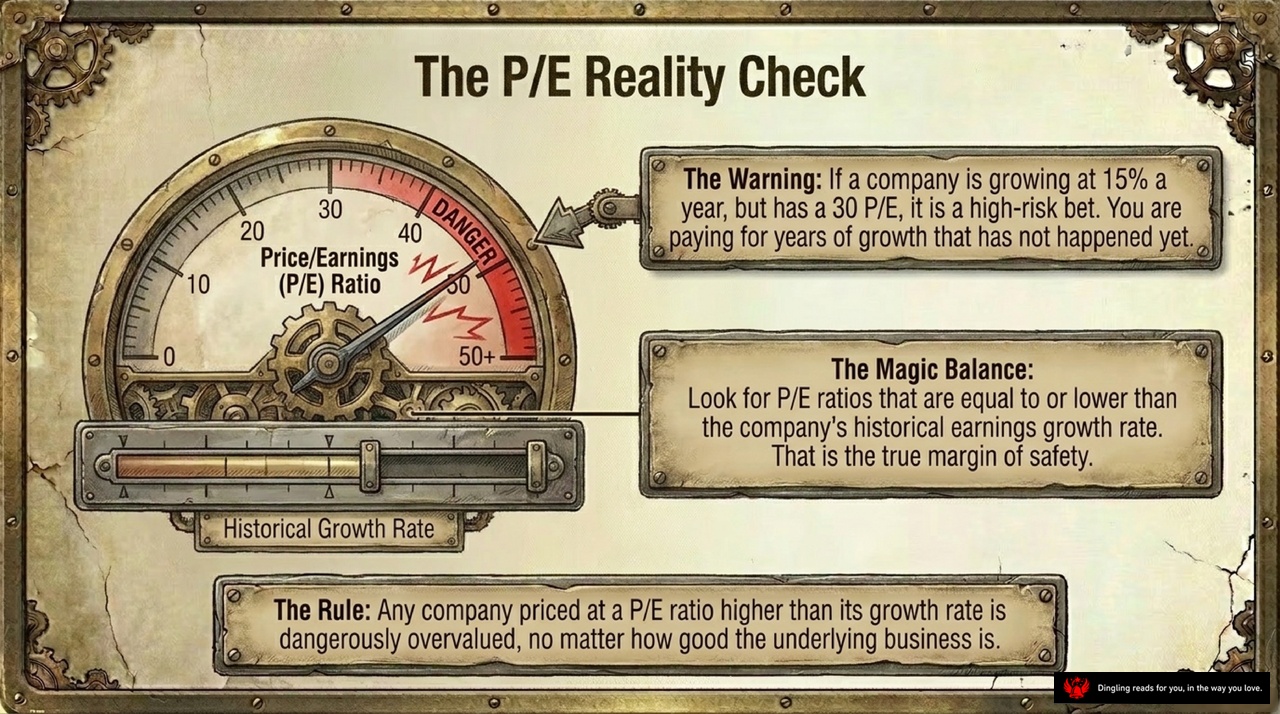
Let's talk about the most dangerous trap in investing: paying too much for a company that isn't growing fast enough. Look at that gauge on the screen. It's measuring the Price-to-Earnings, or P/E ratio. This single number tells you exactly how expensive a stock is relative to what it actually earns.
The slide gives us a clear warning. If a company is growing at 15% a year, but you're buying it at a P/E of 30, you are making a high-risk bet. Why? Because you are paying for 30 years of growth that hasn't happened yet. You are essentially buying 15 years of future growth at the price of today, which is a recipe for disaster.
So, what is the magic balance? The rule is simple: look for P/E ratios that are equal to or lower than the company's historical earnings growth rate. If a company grows 12% a year, you should ideally pay no more than 12 times its earnings. That is your true margin of safety.
But here is the hardest rule to follow: any company priced at a P/E ratio higher than its growth rate is dangerously overvalued. It doesn't matter how good the underlying business is, how great the CEO is, or how popular the product. If the price is too high compared to the growth, the stock is a bubble waiting to burst. Remember, the market can stay irrational longer than you can stay solvent, but eventually, math wins. Don't let the story behind the company fool you; always check the numbers on the gauge.
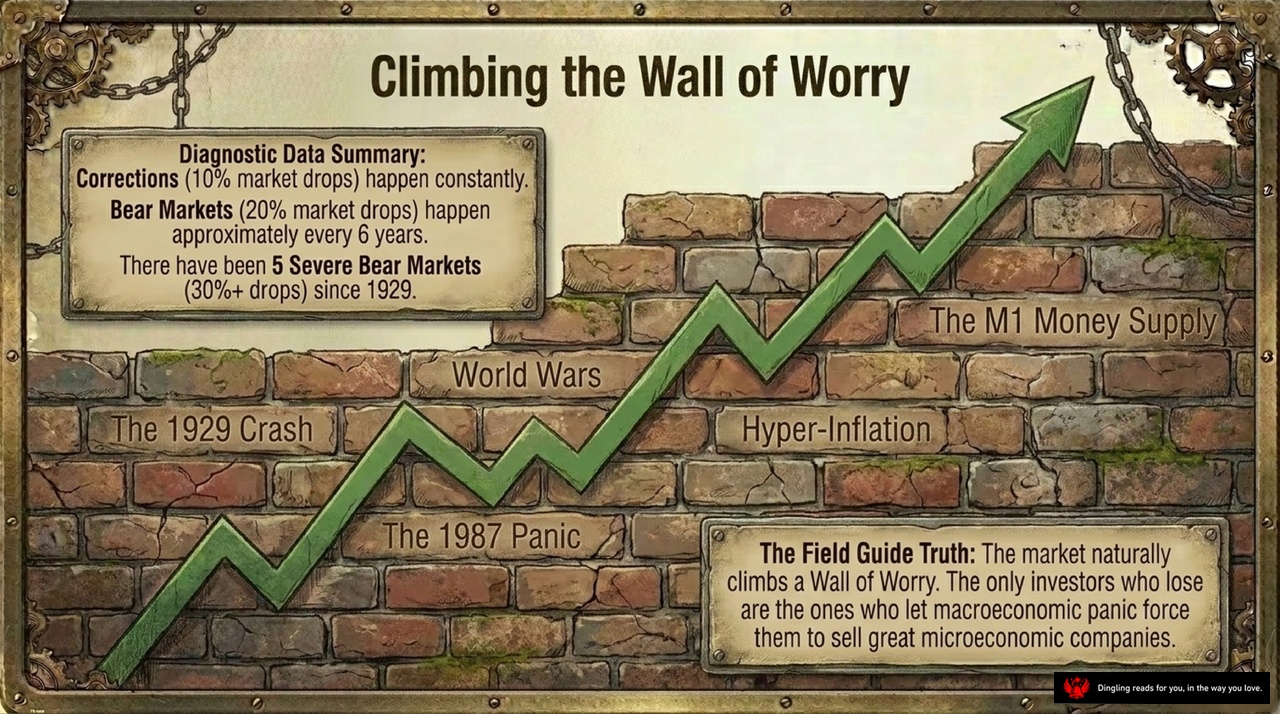
Imagine a green arrow slicing through a brick wall, zigzagging upward against the odds. This is the "Wall of Worry"—the terrifying reality that markets naturally climb over every crisis, from the 1929 Crash to the 1987 Panic, and even through hyper-inflation. But here is the hard truth: while the market climbs this wall, the only people who lose money are those who let macroeconomic panic force them to sell great microeconomic companies.
Look at the diagnostic data on the left. Corrections happen constantly, but severe bear markets drop only about 30% every six years or so. If you panic and sell at the bottom of a drop, you aren't avoiding risk; you are handing your cheap, high-quality shares to the very people who are desperate to buy them. The market's natural cycle is to recover. The 1987 crash was a classic example; those who held steady saw their portfolios rebound within months, while those who fled missed the entire recovery.
So, what is the secret to climbing this wall without falling off? It's simple: ignore the noise of the macro economy and focus entirely on the micro reality of the companies you own. When the world is burning, remember that your specific business might be thriving. Don't let a global panic dictate your personal strategy. The investors who survive and thrive are the ones who realize that while the market is climbing the Wall of Worry, their solid companies are building the ladder to get them over the top.

Investing isn't about being a genius with complex models; it's about spotting the extraordinary earning potential hidden in your everyday life. If you already buy the best products, shop at the busiest stores, and work in the fastest-growing industries, why are you letting Wall Street professionals reap all the profits from your discoveries?
Think about it: when you walk through a supermarket and see a specific brand flying off the shelves, or when you notice your coworkers obsessed with a new software tool, you are conducting real-time fundamental analysis. You have an edge that analysts in Manhattan simply cannot match. They rely on lagging quarterly reports and crowded research notes, while you are right there in the moment, feeling the pulse of the market before the data even hits the news.
This is the secret to finding those legendary "10-baggers"—stocks that multiply your money tenfold. These aren't always high-tech giants or obscure startups; they are often the Dunkin's Donuts you grab a coffee at, the car brand your family loves, or the clothing store where your friends always shop. By leveraging your daily life as a research tool, you can identify these golden seeds while the rest of the market is still asleep. Don't wait for an expert to tell you what to buy; trust your own eyes and ears, because the best investment opportunities are often hiding in plain sight, waiting for someone with common sense to notice them.