
From the Opium War to the May Fourth Movement: Complete Chapter-by-Chapter Summary
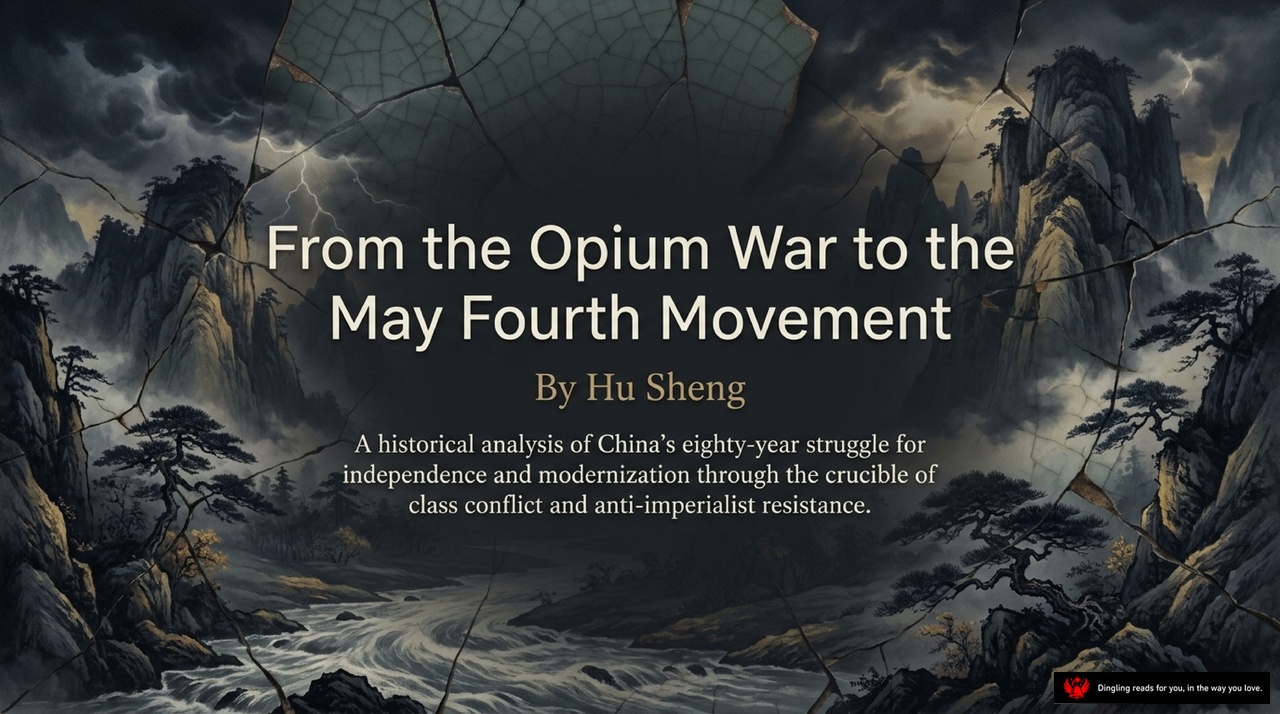
Welcome to today's session. We are diving into a pivotal era in Chinese history, as presented by Hu Sheng in his work, *From the Opium War to the May Fourth Movement*. This book offers a profound historical analysis of China's eighty-year struggle for independence and modernization, set against the crucible of class conflict and anti-imperialist resistance.
The title itself, "From the Opium War to the May Fourth Movement," encapsulates a transformative journey. It marks the transition from a stagnant feudal society to a modern nation-state grappling with foreign aggression and internal decay. The cover art, with its cracked porcelain motif, beautifully symbolizes the fragility of the old order and the inevitable shattering that preceded a new dawn.
Hu Sheng's narrative begins by contrasting pre-19th century China with the rapidly industrializing West. While Europe was transforming into a capitalist powerhouse, China remained entrenched in a rigid feudal system where the economy was dominated by small-scale agriculture and family handicrafts. The social fabric was woven around the landlord-peasant relationship, characterized by severe exploitation and land consolidation that left the majority of farmers in near-serfdom conditions.
As the 19th century unfolded, the world changed beneath China's feet. Western colonial powers, led by Britain, sought to break through China's closed doors. Despite early setbacks, the British East India Company eventually found a ruthless solution: the opium trade. By the 1830s, opium had become a massive drain on China's silver reserves, destabilizing the economy and society. The British response to the Chinese government's ban on this trade was the Opium War, which forced China into a semi-colonial status and opened its markets to foreign exploitation.
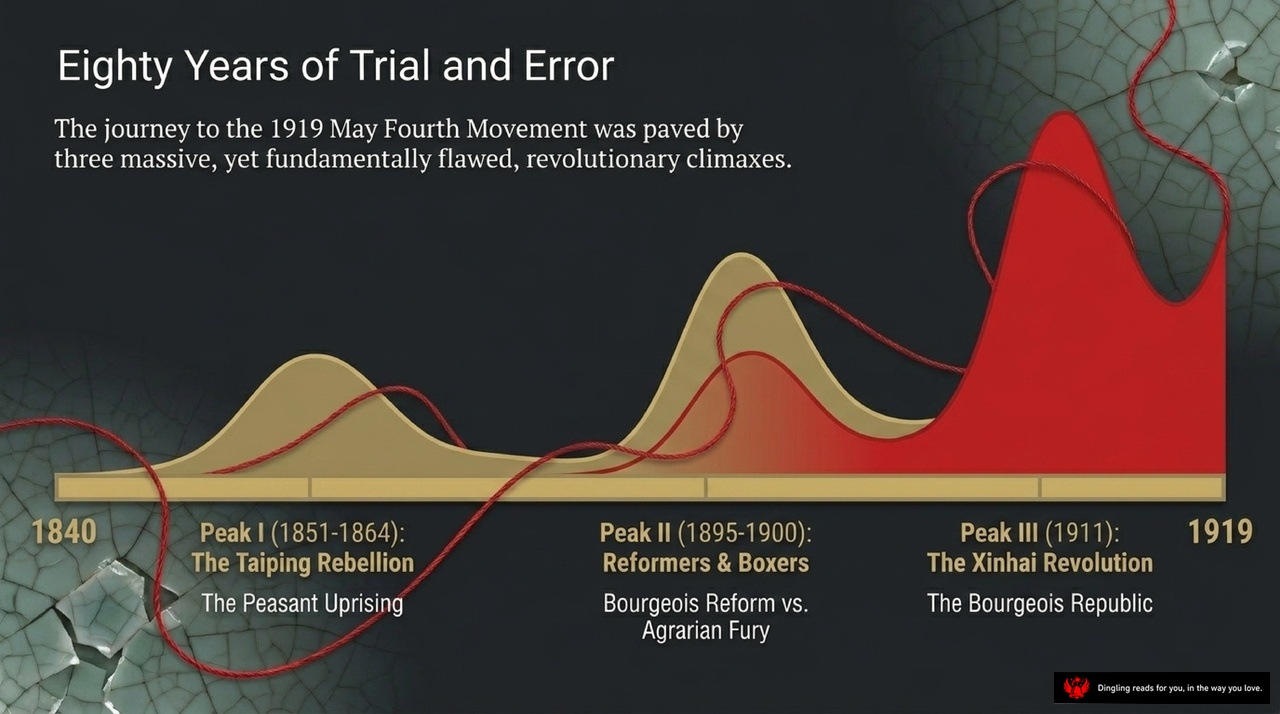
This period was not just about military defeat; it was the beginning of a long, painful awakening. The defeat shattered the illusion of China as a "Middle Kingdom" and sparked a slow, often bloody, evolution toward modernization. From the Taiping Rebellion, which sought to reshape society through peasant revolution, to the Self-Strengthening Movement that tried to adopt Western technology while keeping feudal traditions intact, China struggled to find its path.
Ultimately, as the book suggests, this long arc of struggle laid the groundwork for the revolutionary changes that would follow. The seeds of change were sown in the soil of suffering and resistance, leading eventually to the May Fourth Movement and the rise of a new political consciousness. Today, we will explore how these events reshaped the destiny of a nation.

The Modernization Paradox is one of the most painful truths in Chinese history: what looked like an open door was actually a trap. On the left, we see the illusion—Western powers pretending to offer "open doors," free trade, and wealth to a backward China. But on the right, the reality is starkly different. Imperialism didn't want a strong, independent China; they needed a semi-colonial, semi-feudal state. Why? Because a truly modernized nation would stop being a captive market and a source of cheap raw materials. Western powers deliberately stifled China's industrialization to keep it dependent, ensuring they could extract resources and sell goods without competition.
This slide highlights the core conflict: true modernization is impossible without absolute national sovereignty. The 80-year struggle from 1840 to 1919 wasn't just about fighting wars; it was a bloody, painful trial of error to find the right class vanguard to lead the fight for true independence. From the Opium War to the Taiping Rebellion, from the Self-Strengthening Movement to the Revolution of 1911, every attempt failed because the fundamental issue—the loss of sovereignty—was never solved. Only when China finally reclaimed its independence could it truly begin its journey toward modernization. This paradox defines the entire era, reminding us that without freedom, there can be no progress.
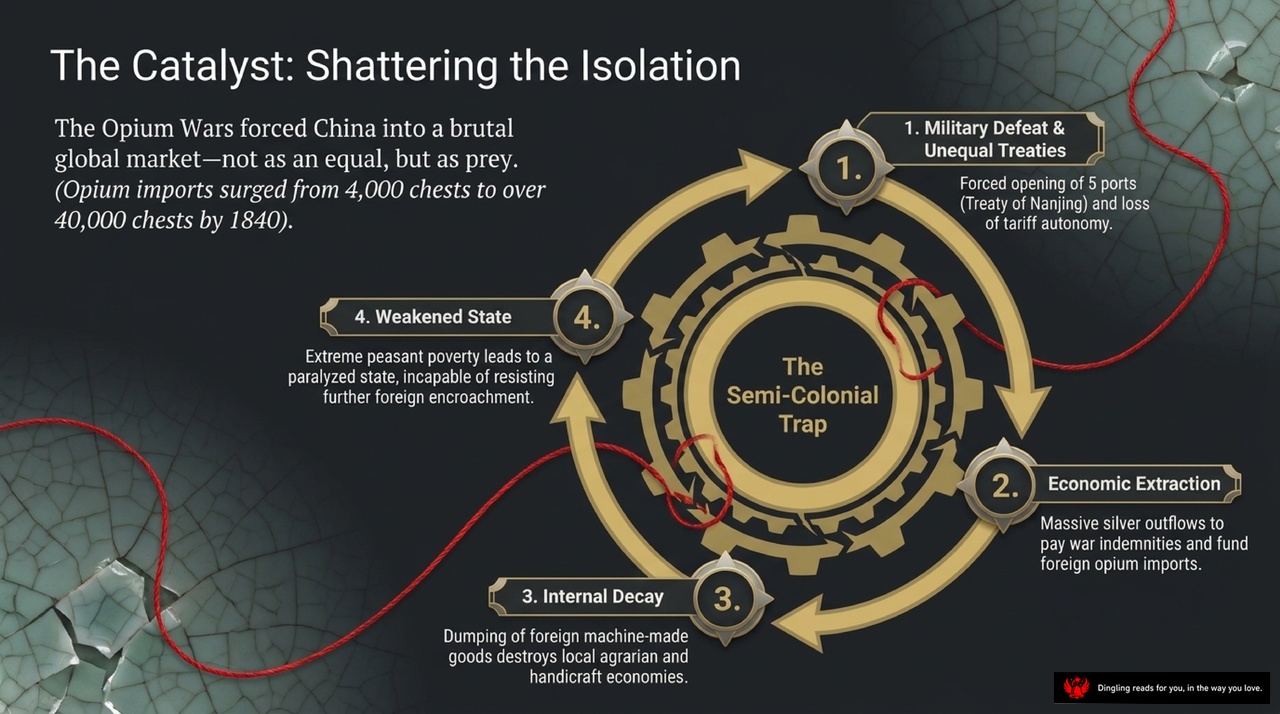
The Opium Wars didn't just change China's borders; they shattered its isolation and forced the nation into a brutal global market where it was treated as prey, not a partner. As the slide illustrates, this catalyst triggered a deadly cycle known as the "Semi-Colonial Trap."
It all began with military defeat and unequal treaties. The Treaty of Nanjing forced the opening of five ports and stripped China of its tariff autonomy, leaving the door wide open for foreign exploitation. This led directly to massive economic extraction. To pay for war indemnities and fund the addictive trade of opium imports, China suffered a hemorrhage of silver, draining its wealth.
Next came internal decay. The flood of foreign machine-made goods destroyed local agrarian and handicraft economies, leaving farmers with no income and no means of production. This economic collapse created extreme peasant poverty, which paralyzed the state. A weakened state, incapable of resisting further foreign encroachment, completed the trap. The result was a nation trapped in a cycle of exploitation, its sovereignty slowly eroded by the very forces it had once tried to keep at bay.

Look at this crumbling structure titled "The Architects of Submission." This image perfectly captures the tragic reality of 19th-century China: a fragile throne held up by two broken pillars, representing the forces that allowed foreign powers to dominate our nation.
On the left, we see "Pillar 1: The Feudal Qing Court." Their philosophy was a fatal mistake: "Using Barbarians to Control Barbarians." Instead of strengthening their own military, figures like Prince Gong and Zeng Guofan chose compromise. They relied on foreign military aid to crush domestic peasant uprisings, effectively becoming tax collectors for imperialist powers. They traded sovereignty for temporary stability.
On the right stands "Pillar 2: The Comprador Class." This was a new elite merchant class born in the treaty ports. Their origin was foreign influence, and their action was betrayal. They didn't build independent national industries. Instead, they facilitated foreign economic exploitation, linking international capital directly to domestic, high-interest agrarian exploitation. They became the middlemen who drained China's wealth.
Together, these two pillars—the corrupt court and the treacherous compradors—supported a crown that was already cracked. This alliance didn't liberate China; it built a cage of submission, allowing foreign powers to rule from Beijing while the Chinese people suffered the consequences.
After the crushing defeat of the Taiping Heavenly Kingdom and the suppression of other peasant uprisings, China didn't just recover; it descended into a period of unprecedented darkness and devastation. The war had left the once-wealthy regions of southern Jiangsu, Anhui, and Zhejiang in ruins, described by contemporaries as landscapes of "yellow grass and white bones." The violence was so extreme that in cities like Wuxian and Jiaxing, populations plummeted by more than half, leaving vast tracts of land barren and untended.
But the physical destruction was only the beginning. In the aftermath, land consolidation intensified as a new class of military landowners—like the families of Zeng Guofan and Li Hongzhang—ruthlessly seized land, often reclaiming it from displaced farmers. The feudal system, rather than reforming, tightened its grip, with officials colluding with landlords to enforce brutal tax collection and usury, leaving the peasantry on the brink of starvation.
As the central government struggled to maintain order, a new faction emerged from within the ruling elite: the self-styled "Westernizers." Led by figures like Prince Kung, Zeng Guofan, and Li Hongzhang, they argued that while the foreign powers posed an external threat, the internal rebellion was the immediate danger. Their solution was the Self-Strengthening Movement, or the Yungchu Movement. Their slogan was simple: "Chinese learning as the foundation, Western learning for practical application." They believed that by adopting Western military technology and industrial methods—building shipyards, arsenals, and mines—they could preserve the feudal order while defending against imperialism.
In the 1860s and 1870s, these leaders established massive state-run military enterprises like the Jiangnan Manufacturing Bureau. However, these projects were plagued by inefficiency and corruption. They were not businesses; they were extensions of the feudal bureaucracy, reliant on government funding and staffed by officials who prioritized personal gain over production. The management structure remained that of a traditional衙门 (yamen), with bloated hierarchies and rampant embezzlement. While these factories did produce some modern weapons and ships, they could never compete with foreign powers or drive genuine economic development.
Realizing that military strength required economic wealth, the Westernizers shifted their focus to civilian industries, launching projects like the China Merchants Steam Navigation Company and the Han Yang Iron Works. These enterprises adopted a "government-supervised, merchant-operated" model, allowing private capital to participate. Yet, the government still held the reins, often using these companies to stifle independent competition and line its own pockets. The result was a system that introduced modern technology but failed to create a modern society. Ultimately, the Self-Strengthening Movement proved to be a dead end. It could patch the cracks of the old system but could never replace it, leaving China vulnerable to the inevitable storm of the future.

Following the crushing defeat of the Taiping Rebellion, China didn't just suffer a military loss; it was plunged into a nightmare of total collapse. The very regions that had been the country's economic heart—rich Jiangnan, Anhui, and Zhejiang—were left as desolate wastelands. Historical records describe streets piled with the bodies of the elderly, women abducted, and cities burned to the ground. The human cost was staggering: populations in places like Wujiang and Jiaxing plummeted by half or more, leaving vast tracts of fertile land completely abandoned.
But the destruction wasn't just physical; it was a reinforcement of the old, brutal order. In the aftermath, a new class of "military merit" landlords rose to power, led by the very men who had crushed the rebellion, like Zeng Guofan and Li Hongzhang. These warlords didn't care about rebuilding; they cared about seizing the land. Zeng Guofan's family alone claimed 6,000 acres, while Li Hongzhang's family hoarded an unimaginable 600,000 acres. They used every means possible to squeeze the remaining peasants, from predatory rent hikes to inflated grain prices, often with the government's full support.
This era marked the solidification of a semi-colonial, semi-feudal society. The Qing ruling class, having learned their lesson, didn't seek to empower the people; they sought to modernize only enough to survive. This led to the rise of the "Self-Strengthening Movement." Figures like Zeng Guofan and Li Hongzhang realized that traditional Chinese weapons couldn't fight modern ones, so they began building arsenals and shipyards. However, these "self-strengthening" efforts were deeply flawed. They were funded by the very taxes they were supposed to protect, managed with feudal corruption, and utterly dependent on foreign technology. They created a shell of modernity that couldn't hold up the weight of a dying feudal system.
Realizing that military strength needed economic backing, they shifted to "wealth-seeking," launching civilian enterprises like the Jingshan Arsenal and the Jiangnan Manufacturing Bureau. Yet, these businesses were strangled from the start. They were run by corrupt bureaucrats who treated them as personal fiefdoms, and they were often forced to grant monopolies that suffocated genuine private enterprise. The goal was to save the Emperor, not to liberate the nation. Ultimately, this movement failed to save China from its decline, proving that you cannot patch a rotting feudal system with a few modern guns; the fundamental structure had to change.
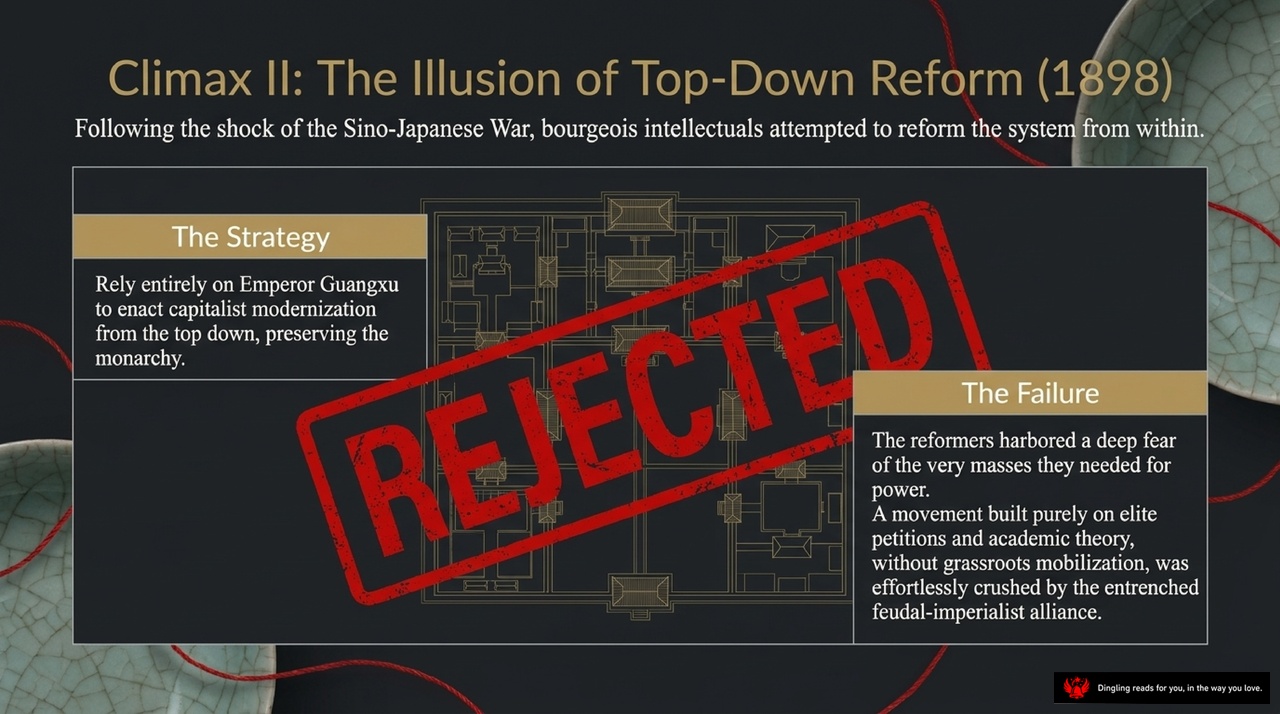
Following the devastating loss of the Sino-Japanese War in 1895, a wave of humiliation swept through China, shattering the illusion that modernizing our military and industry was enough to save the nation. The elite intellectuals, particularly the bourgeoisie, realized that "self-strengthening" under the old feudal system had failed. They looked inward and proposed a radical new path: the Hundred Days' Reform of 1898.
The core strategy was ambitious yet deeply flawed. Led by Emperor Guangxu, they attempted to enact capitalist modernization from the top down. Their plan relied entirely on the Emperor to push for political reforms, including opening up parliament and establishing a constitutional monarchy, all while trying to preserve the imperial throne. However, this movement was built purely on elite petitions and academic theory, lacking any grassroots mobilization among the very masses they needed for power.
Because the reformers harbored a deep fear of the common people and refused to challenge the entrenched power of the conservative bureaucracy and the feudal-imperialist alliance, their movement was effortlessly crushed. Within just a few months, Empress Dowager Cixi staged a coup, imprisoning the Emperor and executing the reformers. The tragedy of 1898 proved a harsh lesson: without the support of the people and a fundamental break from the old feudal structure, top-down reform in a semi-colonial society is nothing more than an illusion destined to fail.
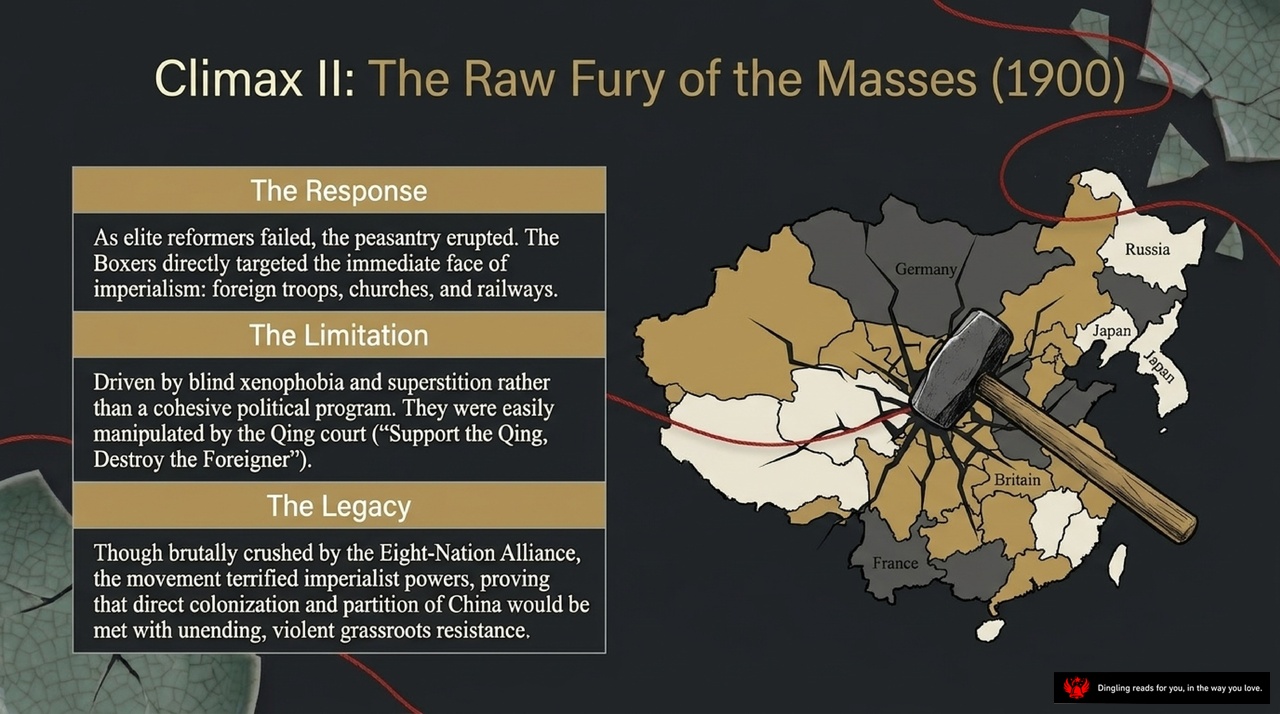
So, we've reached the climax of this era: 1900. The slide calls it "The Raw Fury of the Masses," and honestly, that's exactly what it felt like for everyone involved.
Look at that map. You see China, but it's being hammered by a giant sledgehammer. That hammer represents the Eight-Nation Alliance—Germany, Russia, Japan, Britain, France, and others—pouring into Beijing after the Boxers took the city. But look at the text on the left. It breaks down exactly *why* this happened and what it meant.
First, "The Response." When the elite reformers failed, the peasantry erupted. The Boxers didn't care about politics; they targeted the immediate face of imperialism: foreign troops, churches, and railways. They burned them down. It was a direct, violent strike against foreign presence.
But then, "The Limitation." This is crucial. This movement wasn't driven by a cohesive political program. It was fueled by blind xenophobia and superstition. They were easily manipulated by the Qing court with the simple slogan: "Support the Qing, Destroy the Foreigner." It wasn't a modern revolution; it was a chaotic outburst of anger that the ruling class could actually use to its own advantage.
Finally, "The Legacy." Even though they were brutally crushed, the movement terrified the imperialist powers. They realized that direct colonization and partition of China would meet with unending, violent grassroots resistance. The Boxers proved that you couldn't just take over China without facing a wall of human fury.
So, while the movement failed militarily, it changed the game forever. It forced the powers to abandon the idea of carving up China entirely and instead settle for a "Open Door" policy where everyone gets a piece of the pie, but the Qing dynasty stays in charge. It was a tragic, violent lesson that the Chinese people would not be easily subdued.

After the tragic failure of the Boxer Rebellion, the Qing court tried to save its crumbling empire through the "New Policies," but it was too late to stop the rising tide of revolution. Enter Sun Yat-sen, the father of modern China. Born into a peasant family in 1866, he studied in Hawaii and was deeply inspired by the ideals of the Taiping Heavenly Kingdom. After realizing that reform from within was impossible, he founded the Xingzhonghui in 1894 with a clear goal: drive out the Manchus, restore China, and establish a republic.
By 1905, Sun united various revolutionary groups to form the Tongmenghui, proposing the famous slogan: "Drive out the Tartars, restore China, establish a republic, and average the land." This marked a turning point, giving the revolutionary movement a unified leadership and a clear vision for an Asian republic. But the Qing government wasn't ready to give up power easily. They tried to co-opt the reformers with a fake constitutional movement, which only made the people more suspicious.
The real clash came in 1911 with the Wuchang Uprising. When revolutionary soldiers in Hubei seized control of the city, the spark ignited a fire that spread across the entire country. Within two months, provinces from Hunan to Zhejiang declared independence, and the 2,000-year-old imperial system collapsed. On January 1, 1912, the Republic of China was officially born, and Sun Yat-sen was elected as its first provisional president.
However, the victory was short-lived. The revolution's fruits were quickly stolen by Yuan Shikai, a former Qing general who used his military power to force the emperor to abdicate and then took the presidency for himself. He soon abandoned democracy, dissolved the parliament, and tried to restore the monarchy. But his ambitions were short-lived. As the nation faced a new crisis with Japan's "Twenty-One Demands," Sun and other revolutionaries rose up again to oppose him. Yuan's dream of an emperor ended with his death in 1916, leaving China in a chaotic era of warlord rule. Yet, the dream of a republic had taken root, setting the stage for the next great transformation.
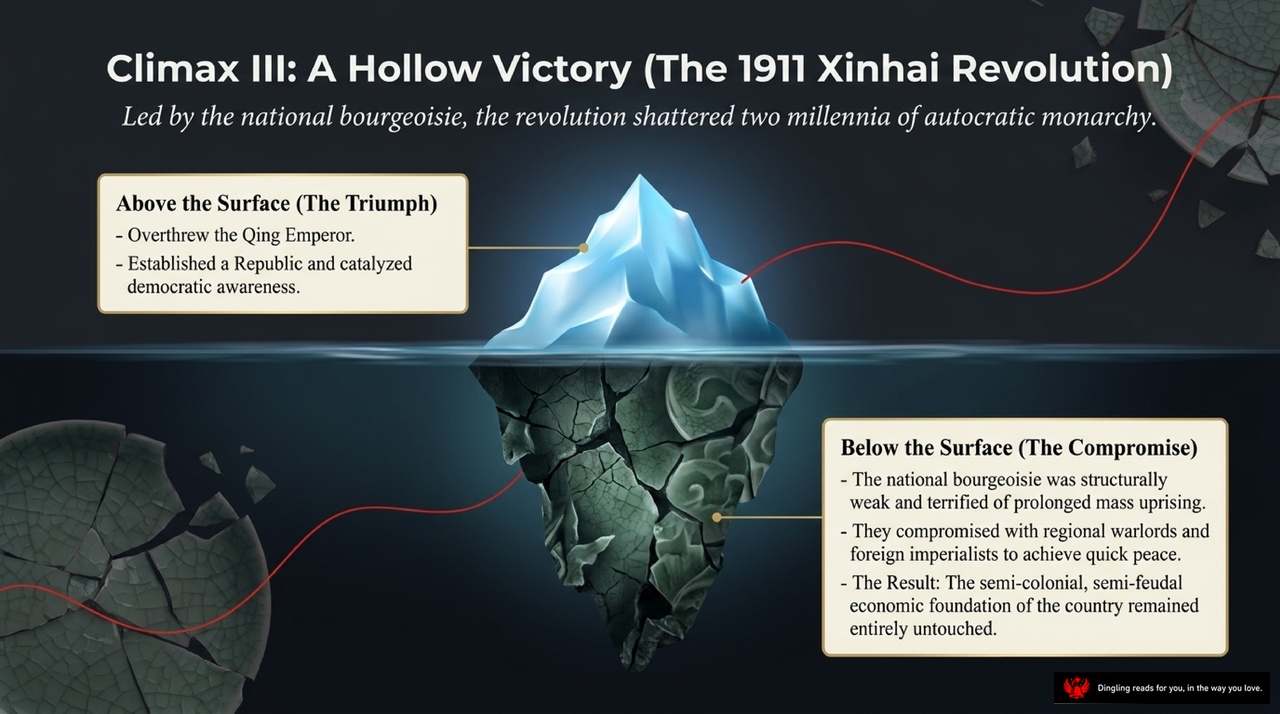
Welcome to the final chapter of our journey through China's modern history. Today, we look at the very moment the Qing Dynasty fell, marking the birth of the Republic of China.
On the surface, this looked like a total triumph. The revolution successfully overthrew the Qing Emperor and shattered two millennia of autocratic monarchy. A republic was established, and for the first time, democratic awareness took root in the minds of the Chinese people. It felt like the dawn of a new era.
But look deeper, below the surface. This victory was hollow. The national bourgeoisie that led the revolution was structurally weak and terrified of prolonged mass uprisings. Instead of digging deep for real change, they compromised with regional warlords and foreign imperialists to achieve a quick peace.
The result? The semi-colonial, semi-feudal economic foundation of the country remained entirely untouched. The revolution changed the name on the door, but it failed to transform the structure underneath. The old problems of poverty and inequality remained, setting the stage for the struggles that would follow in the decades to come.

The Imperialist Paradox reveals a harsh truth: Western powers claimed they wanted a "modern" China to trade with, yet their actions deliberately stunted China's growth. Look at the balance in the center. On one side, "Imperialism" is weighed down by heavy chains, representing the strategy of fostering internal division, supporting warlords, extracting raw materials, and dumping manufactured goods. All of this was designed to prevent the rise of an independent national industry. On the other side, "China's National Capital" remains light and suppressed. The conclusion is clear: capitalist nations will never shepherd a colonized nation into becoming a powerful capitalist competitor. Take the US 1899 "Open Door" policy as an example; it was merely an agreement to share the colonial spoils equally, not a path to salvation. Real salvation required an entirely new paradigm, because the old system was built to keep China weak and dependent.
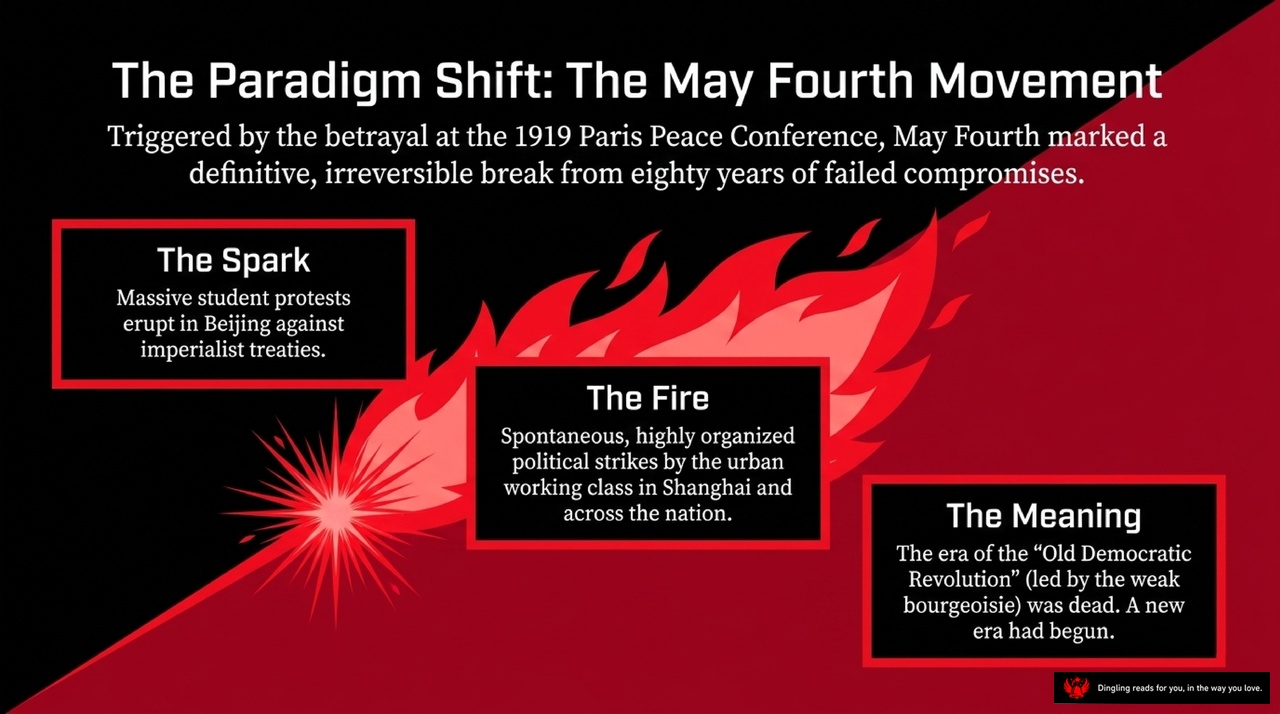
The May Fourth Movement wasn't just a protest; it was a total system crash for the old order. Picture this: after the humiliating betrayal at the 1919 Paris Peace Conference, where China's sovereignty was traded like a pawn, eighty years of failed compromises finally snapped. That's the spark. Massive student protests erupted in Beijing, burning down the illusion that the "Old Democratic Revolution"—led by a weak, ineffective bourgeoisie—could save the nation. But the fire spread far beyond the campuses. What started as student outrage quickly ignited a spontaneous, highly organized political strike among the urban working class in Shanghai and across the country. This wasn't a riot; it was a disciplined uprising that paralyzed the economy and forced the government to listen. The meaning? The era of the old, timid revolution was dead. A new era had begun, one where the working class took center stage, and the path to true national salvation was no longer blocked by empty promises.

The emergence of the new vanguard marks a defining turning point in history: for the first time, the Chinese working class stepped onto the political stage as an independent, conscious force. This wasn't just a shift in power dynamics; it was a fundamental ideological realignment. As the slide illustrates, the illusion of Western bourgeois democracy shattered, and advanced intellectuals turned firmly toward Marxism, realizing that true liberation required a different path.
At the core of this revolution stood the proletariat, emerging as the uncompromising core of the struggle. This wasn't a spontaneous uprising of isolated individuals; it was a strategic union where advanced scientific theory finally merged with grassroots agrarian and urban power. The fight transformed from fragmented, spontaneous rebellions into a unified, scientifically guided revolution. This synthesis of theory and practice empowered the working class to challenge the old order with unprecedented clarity and resolve, setting the stage for a new era in Chinese history.
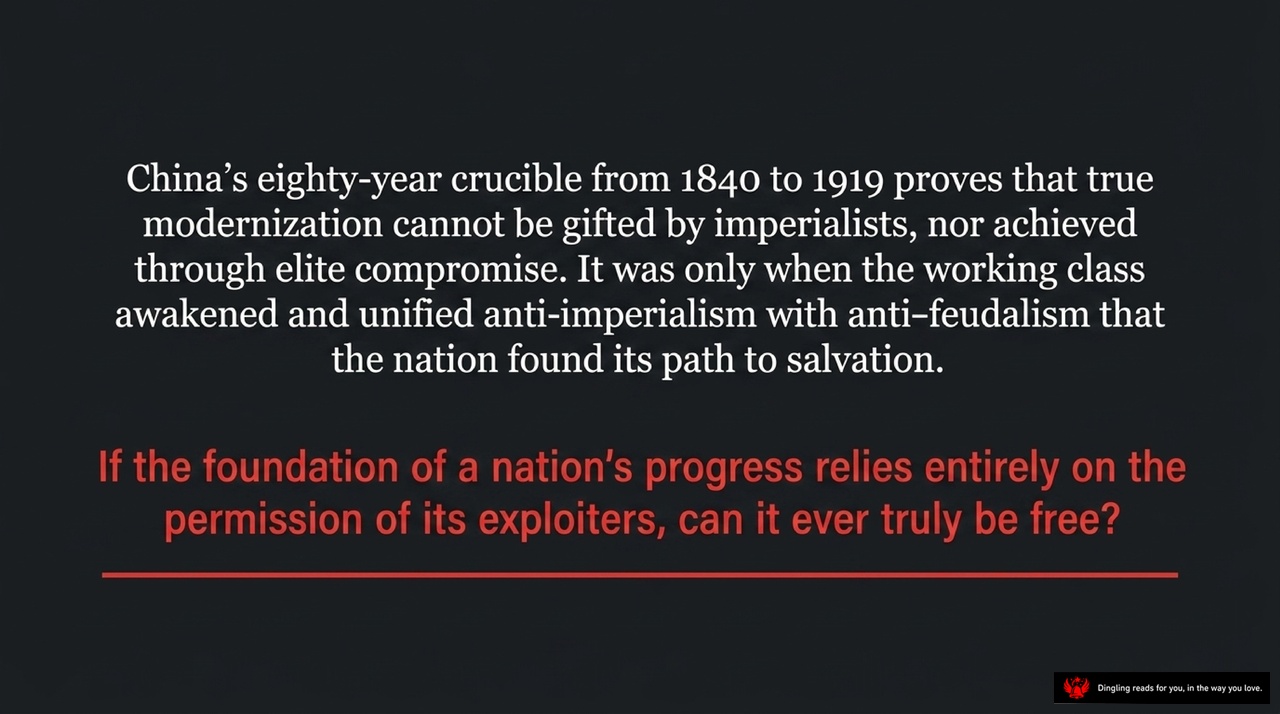
Look at this powerful question: If a nation's progress relies entirely on the permission of its exploiters, can it ever truly be free? This slide captures the brutal lesson learned from China's eighty-year crucible between 1840 and 1919. It proves a fundamental truth that resonates globally: true modernization cannot be gifted by imperialists, nor achieved through elite compromise. History shows us that when the working class awakens and unifies anti-imperialism with anti-feudalism, the nation finally finds its path to salvation. This was the hard-won realization that transformed a passive victim into an active force for change, breaking the cycle of dependency and forging a destiny defined by the people themselves.