
Ordinary World: Complete Chapter-by-Chapter Summary

Welcome to our book club session on *Ordinary World* by Lu Yao. Today, we're stepping into the rugged, sun-baked landscape of the Loess Plateau, where life is as tough and beautiful as the earth beneath our feet.
Imagine a vast, ancient canyon at sunset, with layers of soil carved by centuries of wind and rain. This is the backdrop for our story—a tale of dignity, struggle, and the unyielding resilience of the human spirit amidst crushing poverty. It's not just a novel; it's an epic tapestry woven from the lives of ordinary people who refuse to be defined by their hardships.
In this world, survival is a daily battle. Students queue in the cold rain for meager meals, while families grapple with loss and uncertainty. Yet, even in the darkest moments, hope flickers like a candle in the wind. Whether it's a young man leaving his village to chase a better life, or a wife standing strong through tragedy, these characters remind us that true strength isn't about having everything—it's about holding on when everything feels like it's falling apart.
Join us as we explore how love, family, and an unbreakable will can transform even the most ordinary world into something extraordinary.

Welcome to the darkest winter of 1975 on the Loess Plateau. This isn't just a season; it's a relentless siege on human dignity. The image before you captures that brutal baseline: a landscape where survival is dictated entirely by unforgiving soil. But look closer at the cross-section beneath the snow. This is the "Hierarchy of Hunger," a rigid social pyramid that defined life back then.
At the very top, reserved for the wealthy and the powerful cadres, sits the "European" and "Asian" tier. They enjoy white and yellow steamed buns—luxurious, soft, and reserved. Now, drop your eyes to the bottom layer. This is the "African" tier, the reality for the vast majority of rural families. Here, the staple food is black sorghum buns, dark and dense, paired with plain boiled radishes and just a drop of chili oil. This isn't just a meal; it's the ultimate mark of rural poverty.
In the novel, characters like Sun Shaoping and Hao Hongmei had to eat this secret diet to preserve their fragile dignity. They stood in the freezing rain, shivering, swallowing these hard black buns while the wealthy enjoyed their steamed bread above them. This stark divide wasn't just about food; it was the invisible wall that separated the future of a nation. It was the crucible that forged the resilience of a generation, teaching them that even when you are at the bottom, your spirit must remain unbroken.

On the left, we see the crushing weight of "Physical Famine"—a cracked bowl of black sorghum, ragged clothes, and backs bleeding from carrying stones. This was the daily reality for Shaoping and countless others in the modernizing city, surviving on the bare minimum while dignity was stripped away. Yet, look to the right. Despite the starvation, there is a "Spiritual Feast." Shaoping devours books like *How the Steel Was Tempered*, *The Gadfly*, and *Red Rock*. These stories become his lifeline, transforming his suffering into something noble. Literature teaches him that while his body may be trapped in poverty, his spirit can remain expansive and free. As the text reveals, it is through these words that Shaoping realizes he is not defined by his hunger, but by the strength of his inner world.

The slide before you captures a pivotal turning point in the story: the shifting winds of an era. At the top, we see the macro society transitioning from the chaotic political fanaticism of 1975 to the hopeful dawn of Reform and Opening Up in the 1980s. But how did this grand historical shift impact a single family? Look at the bottom layer, the Sun Family.
In the early years, they were defined by extreme poverty, where elder brother Shaoran had to sacrifice his education to work on the farm. Then came a moment of pragmatic risk-taking: Shaoran launched a village brick kiln. This bold move was the bridge between the old and the new. By the 1980s, the result was economic triumph and social contribution. Shaoran's brick kiln not only grew into a household worth 10,000 yuan but also funded the rebuilding of the collapsed village school.
This visual perfectly illustrates the core theme of this chapter: individual courage meets historical opportunity. While the country was finally loosening its grip on the collective, Shaoran didn't just wait for orders. He seized the moment, taking a risk that transformed his family from survivors into contributors. His success wasn't just about money; it was about lifting his entire village, proving that when the winds of change blow, those brave enough to build something new can change the world around them.

Sun Shaoan, Sun Shaoping, and Sun Lanxiang: The Sun Siblings' Trajectories.
Look at this visual map of their lives. On the left, we see Sun Shaoan, "The Roots." His domain is the Loess Earth, his weapon is pragmatic entrepreneurship like running a brick kiln, and his ultimate realization is that wealth is only meaningful when returned to the community. He built a new school, literally rebuilding the future for his village.
In the center is Sun Shaoping, "The Wanderer." His domain is the deep coal veins. His weapon is a mix of brutal physical labor and intellectual literature. His ultimate realization is that dignity is forged through self-reliance and enduring the hardest crucibles. He chose the darkness of the mine not to escape, but to find his own strength.
On the right stands Sun Lanxiang, "The Star-Gazer." Her domain is the cosmos. Her weapon is astrophysics and academia. Her ultimate realization is transcending earthly suffering by looking outward to the universe. She chose the stars because she could not bear to look at the pain of the earth.
These three paths show us that life isn't about choosing the easy road. It's about finding where your specific pain can be transformed into a unique strength. Whether you build a school, dig for coal, or look at the stars, your journey defines you.

Sun Shaoan: Transforming the Earth. This isn't just a story about one man; it's a blueprint for how an ordinary family rises from the ashes of poverty to build a legacy that outlasts them.
Look at this cycle. It starts with **The Burden**. At just 13 years old, Shaoan took over his family's survival, sacrificing his own childhood to keep the roof over their heads. But that sacrifice wasn't in vain. He learned resilience, and eventually, he learned to invest in the future. That's **The Legacy**: he poured 15,000 RMB into rebuilding the ruined Double Water Village elementary school, proving that education is the ultimate escape from the cycle of poverty.
But the road wasn't straight. Shaoan faced **The Gamble**. He rode the wave of economic reform to start a brick kiln, betting everything on his new life. Of course, he hit **The Collapse**. The kiln initially failed, crushing debt piled up, and he faced bankruptcy and village mockery. It was a moment where his dream nearly died.
Yet, from that darkness came **The Resurrection**. Shaoan rebuilt the business, paid off every debt, and broke the generational curse of poverty. He didn't just save his family; he became the engine for his entire village's transformation. His journey shows us that while we may start with nothing, our ability to persevere and reinvest in our community is what truly transforms the earth.

Sun Shaoping: The Philosopher in the Dark. Imagine a man walking from the surface into the earth, only to find his soul ascending. This is the story of Sun Shaoping, a day laborer whose physical descent becomes a spiritual ascent. On the surface, he endures the brutal reality of carrying stones, his back rubbed raw and bleeding, invisible to society. But then, he makes a daring descent into the Dayawan Coal Mine. It's a brutal, dark, and highly dangerous underground world where the air is thick with dust and the silence is deafening. Yet, it is in these darkest depths that he finds profound clarity. By candlelight in a freezing, unfinished building, he reads "The Red and the Black." This act transforms the physical descent into the ultimate forge for his philosophical soul. While others see only darkness, Shaoping sees the light of human resilience. He realizes that true freedom isn't escaping the hard life, but mastering it with an unyielding spirit. His journey teaches us that even in the deepest pit, we can rise above our circumstances.
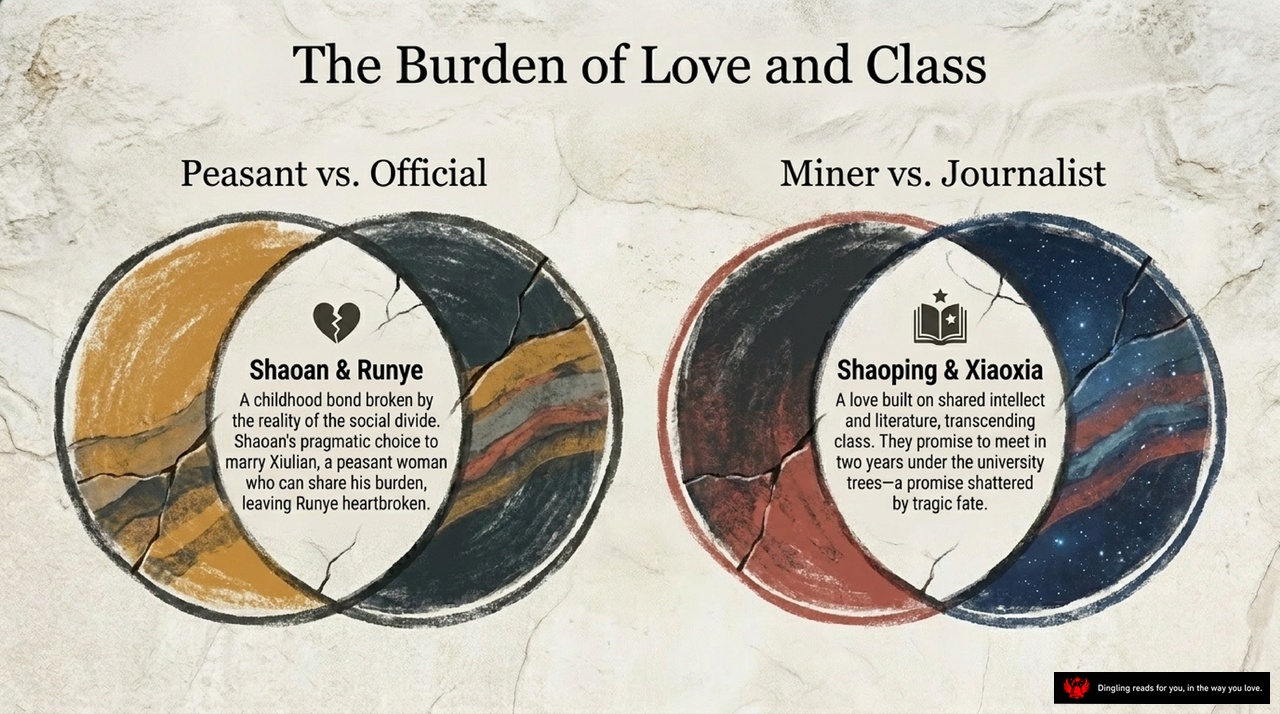
The Burden of Love and Class isn't just a metaphor; it's the harsh reality of two broken hearts, torn apart by the invisible walls of society.
Look at the first circle: Shaoan and Runye. Their story is a classic tragedy of "Peasant versus Official." They share a childhood bond forged in the dirt, but when adulthood hits, the gap widens. Shaoan makes a pragmatic, heartbreaking choice. He leaves Runye to marry a peasant woman who can share his burden, because he knows he can't drag her down into his poverty. It's a sacrifice of love for survival.
Now, look at the second circle: Shaoping and Xiaoxia. This is "Miner versus Journalist." Their love is built on shared intellect, trying to transcend class. They promise to meet under the university trees, believing their minds are equal. But tragic fate shatters that promise. Just like the first pair, they are victims of the divide between their worlds.
One couple sacrifices love for duty; the other sacrifices love for an impossible dream. Both are left with the heavy, crushing weight of what could have been.
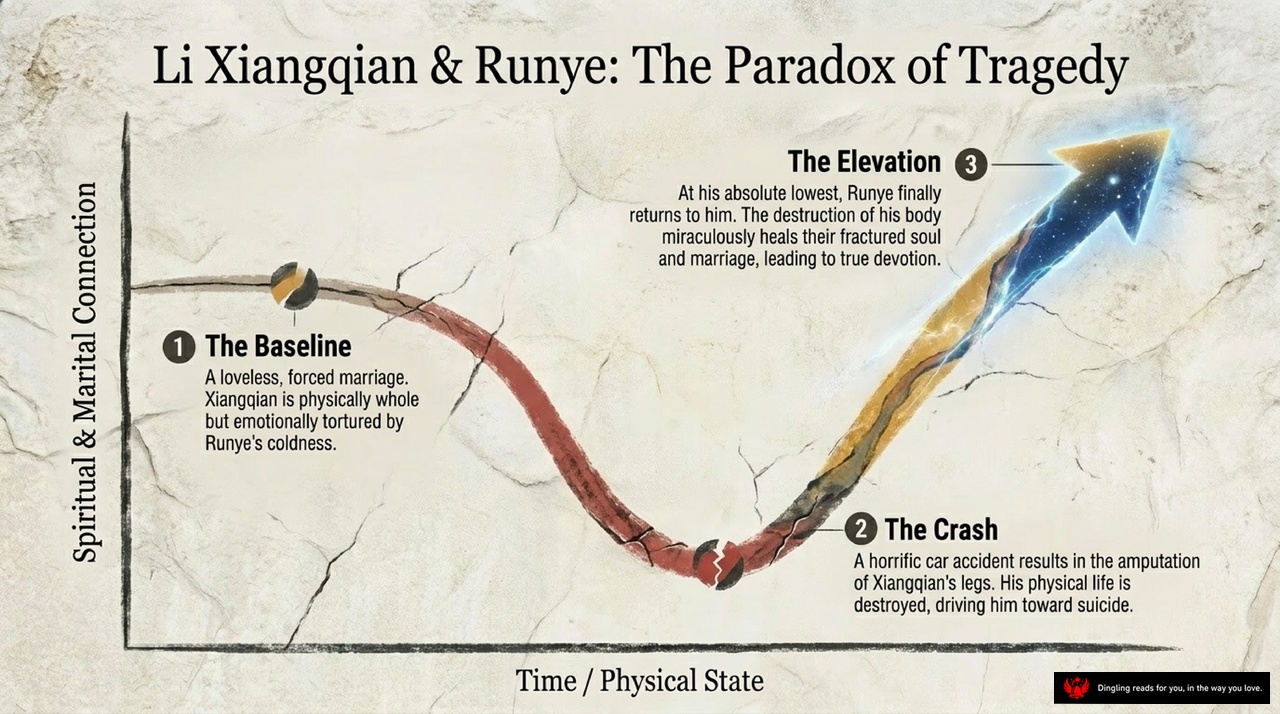
Li Xiangqian and Runye: The Paradox of Tragedy. This chart maps their emotional journey, showing how total physical destruction unexpectedly healed a fractured soul. It begins with The Baseline: a loveless, forced marriage where Xiangqian is physically whole but emotionally tortured by Runye's coldness. Then comes The Crash: a horrific car accident that amputates his legs, destroying his physical life and driving him toward suicide. Yet, at this absolute lowest point, Runye finally returns to him. The destruction of his body miraculously heals their fractured souls and marriage, leading to true devotion. In the end, the tragedy becomes the very thing that saves them, proving that sometimes you must lose everything to find your true self.

Tian Xiaoxia: The Shooting Star
Imagine a life not as a straight line, but as a brilliant meteor streaking across the night sky. This is the story of Tian Xiaoxia, a woman whose impact burned so bright it illuminated the darkest corners of her friends' lives.
It all began with **The Spark**. Xiaoxia didn't just introduce Shaoping to radical ideas; she ignited his soul, lifting him from a village mindset to a world of boundless possibility. She was the catalyst that turned his potential into a flame.
Then came **The Promise**. Amidst the chaos of their times, they carved out a sanctuary for each other. A deeply romantic pact to reunite in two years at university became their anchor, a steady star guiding them through the turbulence of youth.
But every shooting star faces a tragic end. **The Extinguishment** arrived with devastating force. Her fearless journalism led her to the front lines of a devastating southern flood. In a moment of pure, selfless courage, she sacrificed her own life to save a drowning child. That final act wasn't just an end; it was the definition of her character.
Finally, **The Aftermath**. Though she left behind nothing but her diaries, her spirit cemented itself as an eternal, guiding light in Shaoping's heart. She proved that even when a star falls, its light can shine forever.

The Alien Dream: A Cosmic Perspective. Look at this spiral. At the very center, we see Shaoping's unbearable grief over losing Xiaoxia. It feels so heavy, so real, as if it could crack the earth beneath us. But step back. Expand your view. Move outward to Geological Time. Here, we see the 2.4 million-year history of the Loess Plateau's formation, revealed through an extraterrestrial dialogue. That personal pain is now just a ripple in deep time. Keep expanding. Out into The Cosmos. The vastness of the universe frames human existence within infinite time and space. In this grand cosmic timeline, human suffering is infinitesimally small. Yet, paradoxically, it remains the ultimate, profound reality of what it means to be human. This perspective teaches us acceptance without surrender. We are tiny, but our love and our pain are the only things that truly matter in this endless void.

The Scars of the Ordinary Hero. This isn't just about a man; it's about the invisible weight carried by those who build our world. Look at the face. Disfigured by a brutal mining accident, he bears the physical scars of his labor, a permanent reminder of the danger he faces every single day. But the true scars are deeper. Look at the heart. Broken by the loss of his beloved Xiaoxia, yet miraculously healed by a quiet, protective love for Huoying and her son, Mingming. He finds redemption not in forgetting pain, but in caring for others. Now, look at the hands. Calloused and scarred, they refuse the easy, comfortable city life arranged for him by his sister and his sister-in-law. These hands chose the hard earth over the soft carpet. And finally, the feet. Walking willingly back to the Dayawan coal mine, they embody ordinary greatness. They find peace not in escape, but in duty, labor, and survival. This is the story of the ordinary hero.
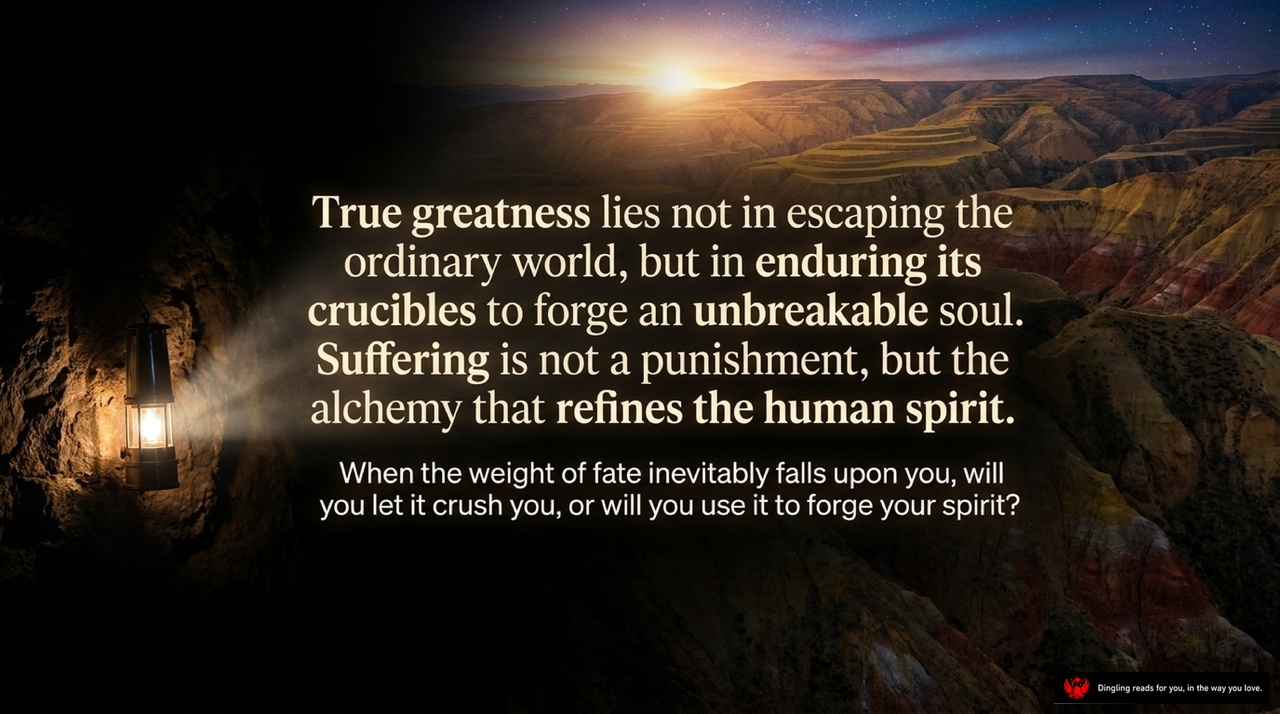
True greatness isn't about escaping the ordinary world; it's about enduring its crucibles to forge an unbreakable soul. Look at the journey of these characters. When the weight of fate inevitably falls upon you—whether it's the crushing loss of a loved one like Xiao Xia, or the devastating collapse of a brick kiln, or the physical trauma of losing a limb—will you let it crush you, or will you use it to forge your spirit?
For Sun Shaoping, the darkness of the mine was not a prison but a refining fire. When his mentor Wang Shicai died saving a colleague, Shaoping didn't break; he stepped up to care for the orphaned mother and child, turning tragedy into a new purpose. Similarly, Sun Shaan faced the ruins of his business, debts, and the pain of unrequited love, yet he rebuilt his kiln and his village school, proving that suffering is not a punishment, but the alchemy that refines the human spirit. Even Li Xiangqian, who lost his legs, found redemption in love and responsibility when Runye returned to care for him. Their stories teach us that when life tries to break us, we have the power to rebuild ourselves into something stronger, proving that our greatest victories are won not in the spotlight, but in the quiet, unyielding courage to keep going when all else falls apart.