
Out of Control: Complete Chapter-by-Chapter Summary

Welcome to the new biology of machines, social systems, and the economic world. This isn't just about steel and circuits anymore; it's about a fusion where nature and technology become one. Imagine a future where machines breathe, evolve, and self-repair, just like living things.
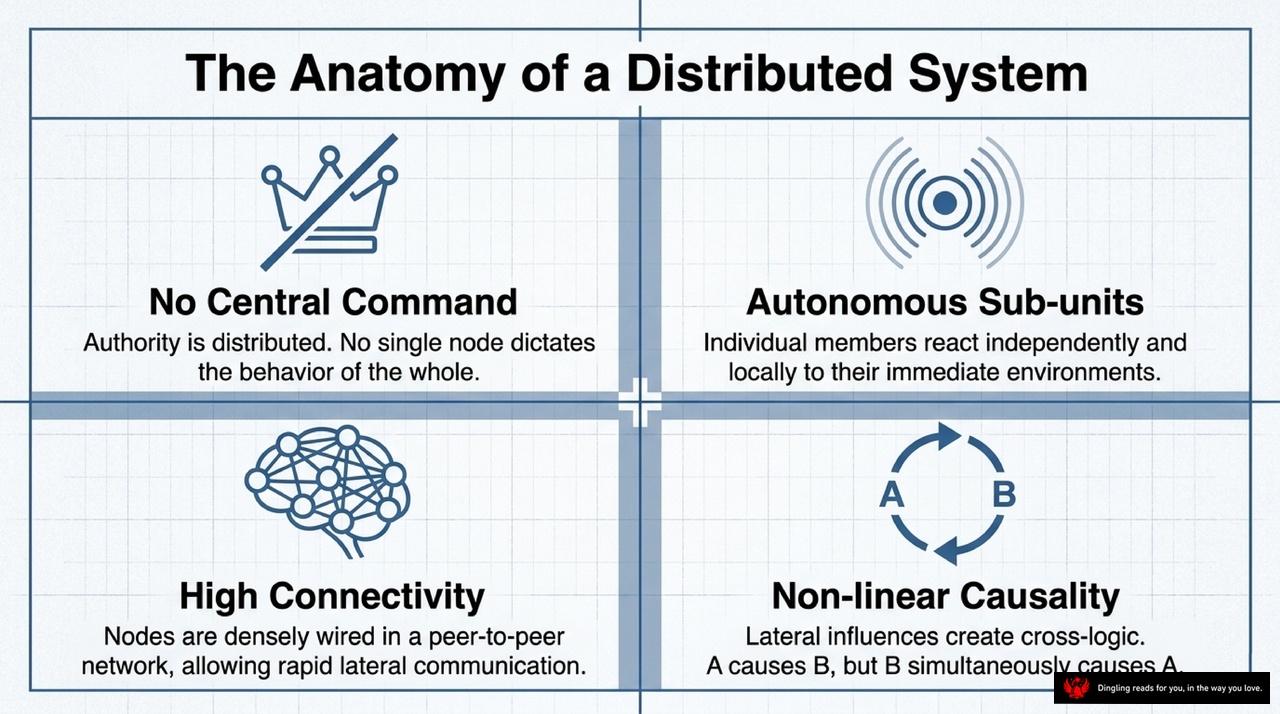
We are moving away from the old idea of total control. Think of a beehive: there is no queen bossing everyone around. Instead, thousands of simple bees follow basic rules, and suddenly, the whole swarm makes intelligent decisions. That's the power of distributed systems. Whether it's a computer network, a bustling city, or a factory, the most powerful systems aren't the ones we tightly control from the top. They are the ones that let individual parts interact freely, creating something smarter than the sum of its parts.
In this new world, the line between what is alive and what is made blurs. We are designing machines that can adapt to their environment, just like a plant grows toward the sun. We are building economies that flow like ecosystems, where waste from one process becomes fuel for another. It's a shift from building static, rigid structures to nurturing dynamic, living systems.
The future belongs to those who can let go. By embracing this "out of control" mindset—trusting in emergence, collaboration, and evolution—we unlock a level of innovation and resilience that rigid planning could never achieve. We are no longer just the architects of the world; we are its gardeners, tending to a complex, self-sustaining civilization that is far more alive than we ever imagined.
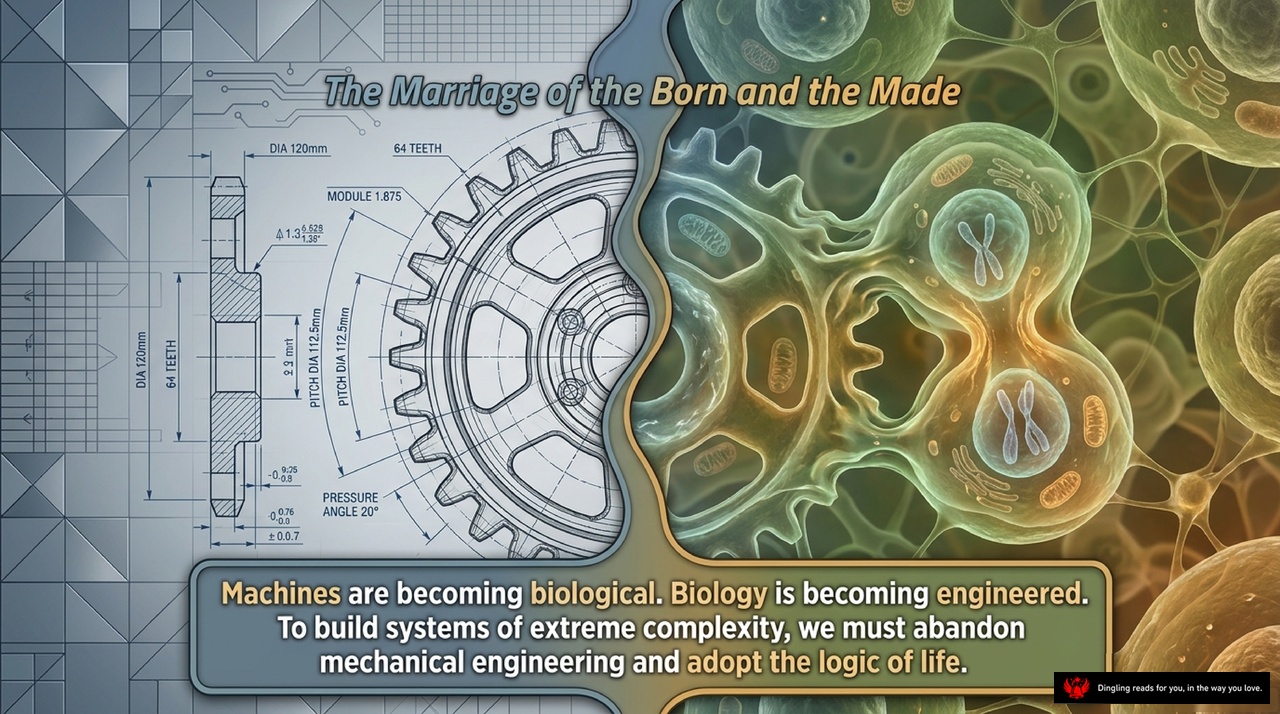
On the left, we see the cold, precise geometry of a machine—a gear with exact dimensions, tolerances, and a pressure angle. On the right, we see the messy, vibrant chaos of life—cells dividing, DNA replicating, and organic matter flowing. This slide captures the central thesis of our book: The Marriage of the Born and the Made.
For centuries, we believed that to build complex systems, we needed more precision, more gears, and more engineering. But as we've seen, mechanical logic hits a ceiling. Clockwork can't replicate the adaptability of a forest or the resilience of an ecosystem. The text reminds us that "machines are becoming biological, and biology is becoming engineered." To truly build systems of extreme complexity, we must abandon the rigid logic of mechanical engineering and adopt the fluid, self-correcting logic of life itself.
This isn't just about putting a computer in a robot; it's about fundamentally changing how we design. We are moving from a world of gray steel to a new bio-civilization where the boundaries between the natural and the artificial dissolve. The future doesn't belong to those who try to control every variable, but to those who learn to let systems evolve, adapt, and surprise us. We are learning that the most powerful systems aren't the ones we build from the top down, but the ones we design to grow from the bottom up—just like life.

Welcome to the world of "Clockwork Logic" versus "Swarm Logic." Imagine two entirely different ways of building intelligence. On the left, you have the traditional, engineered approach: centralized, sequential, and rigid. Think of a factory assembly line or a computer chip. It's predictable, but it's also fragile. If one critical part fails, the whole system crashes catastrophically. It's built to be controlled, but that control is its weakness.
Now, look at the right side. This is "Swarm Logic," inspired by nature. Here, systems are distributed and parallel. Instead of a single boss giving orders, we see growth and evolution, like cells or a forest. The behavior is adaptive and resilient. If one node fails, the system doesn't die; it just gracefully degrades, rerouting through redundancy. It's messy, unpredictable, and wild, but it's incredibly robust.
The core difference lies in their origins and failure modes. Clockwork logic is engineered and manufactured, leading to single-point failures that bring everything down. Swarm logic is grown and evolved, allowing the system to absorb shocks and keep moving. As we move forward, we're learning that the future of complex systems—whether in biology, engineering, or economics—won't belong to the rigid machines of the past. Instead, it will belong to these organic, self-healing networks that thrive on chaos, adapt to change, and create something entirely new from the bottom up. We are shifting from trying to control every detail to trusting the emergent power of the swarm.
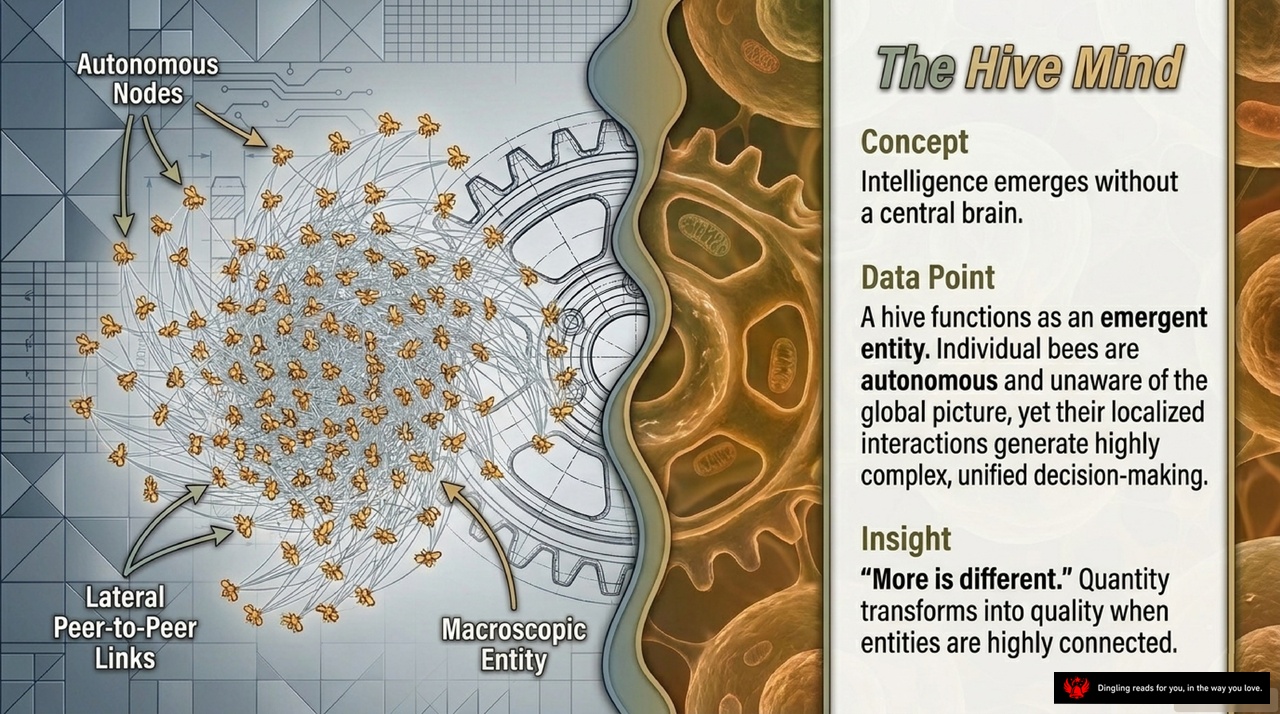
Welcome to the world of the "Hive Mind," where intelligence doesn't come from a single brain, but from the collective power of thousands of independent nodes. As you see on the slide, we are looking at a system built on **Autonomous Nodes** connected by **Lateral Peer-to-Peer Links**. Think of a beehive: there is no queen giving orders to the entire colony. Instead, individual bees act without a central command, unaware of the global picture, yet their simple, localized interactions generate a highly complex, unified decision-making process.
This is the concept of an **emergent entity**. A hive functions as a single organism not because it is programmed to, but because its parts interact in specific ways. This leads us to a profound insight: "More is different." When entities are highly connected, quantity transforms into quality. The network itself becomes a **Macroscopic Entity**, a new kind of life form that is greater than the sum of its parts.
In the industrial age, we tried to control everything from the top down. But nature teaches us a different lesson. By embracing this distributed logic, we can build systems that are resilient, adaptable, and creative. Just like the bees in your diagram, the future belongs to systems where no single point of failure can bring it down, and where the collective wisdom of the swarm solves problems no individual ever could. We are moving from an era of command and control to an era of connection and emergence.
Welcome to the world of the Network Economy, where the rules of traditional business are completely rewritten. Imagine an economy that doesn't rely on physical factories or fixed locations, but instead thrives on digital connections and the flow of information. This is the shift from "computation" to "connection." In the past, efficiency meant calculating the perfect answer; today, it means linking the right resources to the right people at the right moment.
Look at how this plays out in the real world. Companies like Levi's or Benetton no longer guess what you want; their production lines are directly connected to global sales data, allowing them to adjust colors and styles in real-time. This is the power of the "Information Factory"—a decentralized, adaptive network where the boundaries between competitors and collaborators blur. We see this when airlines outsource booking to partners or when payment giants collaborate to move money faster.
But let's talk about what happens when things go wrong. In a rigid, centralized system, a single error can crash the whole network. In a distributed network economy, errors are inevitable, but they are contained. Thanks to modular design and error-proofing, a glitch in one part of the system gets isolated and fixed instantly, keeping the rest running smoothly. It's not about achieving a perfect, zero-defect state; it's about building a system that can survive and adapt to chaos.
Finally, consider the rise of "Cryptographic Anarchy." This isn't about chaos; it's about trust without a middleman. Encryption allows strangers to exchange value and information securely, breaking the government's monopoly on control. Think of digital currency: it moves at the speed of light, allows for micro-payments, and gives anyone with a computer the power to act as a bank. While this creates fears of hidden economies, it also unlocks a new era of freedom and global commerce, proving that the future of value isn't stored in vaults, but flowing through the network.

Imagine a world where the line between biology and technology blurs until it disappears. We are moving beyond the era of rigid, top-down engineering. Instead, we are entering an age of "synthetic characters"—digital entities born from the collision of animation and artificial intelligence.
Think about the future of cinema. For decades, animators believed only humans could capture the subtle nuance of a soul. But that is changing. Today's digital labs can simulate individual hair strands, complex hand gestures, and micro-expressions with terrifying realism. In just five years, we might see films starring entirely synthetic protagonists. These aren't just puppets; they are autonomous explorers.
Consider a character like "Moshi," a fully computerized avatar. Unlike traditional characters controlled by a single director's hand, Moshi operates with behavioral logic. It can walk on uneven terrain, decide when to lift its legs, and even react emotionally to its environment—getting angry if hit or hesitating at a cliff edge. The creator doesn't micromanage every move; they manage the rules, like a shepherd guiding a flock. This shift from total control to "synergistic control" is revolutionary. It mirrors the future of aviation, where pilots and computers work as a team, sharing the load rather than one dominating the other.
This evolution points toward a "super-life" space. We are no longer limited to biological definitions of life. Whether it's a digital network, a simulated city, or an AI-driven character, the core principle remains the same: life is a process of expanding possibilities. By using open genetic codes and evolving mathematical equations, we can create forms no human could ever imagine—images of alien landscapes or complex ecosystems that adapt and grow on their own. The future isn't about building perfect machines; it's about cultivating open universes where new life forms can emerge, evolve, and thrive alongside us.
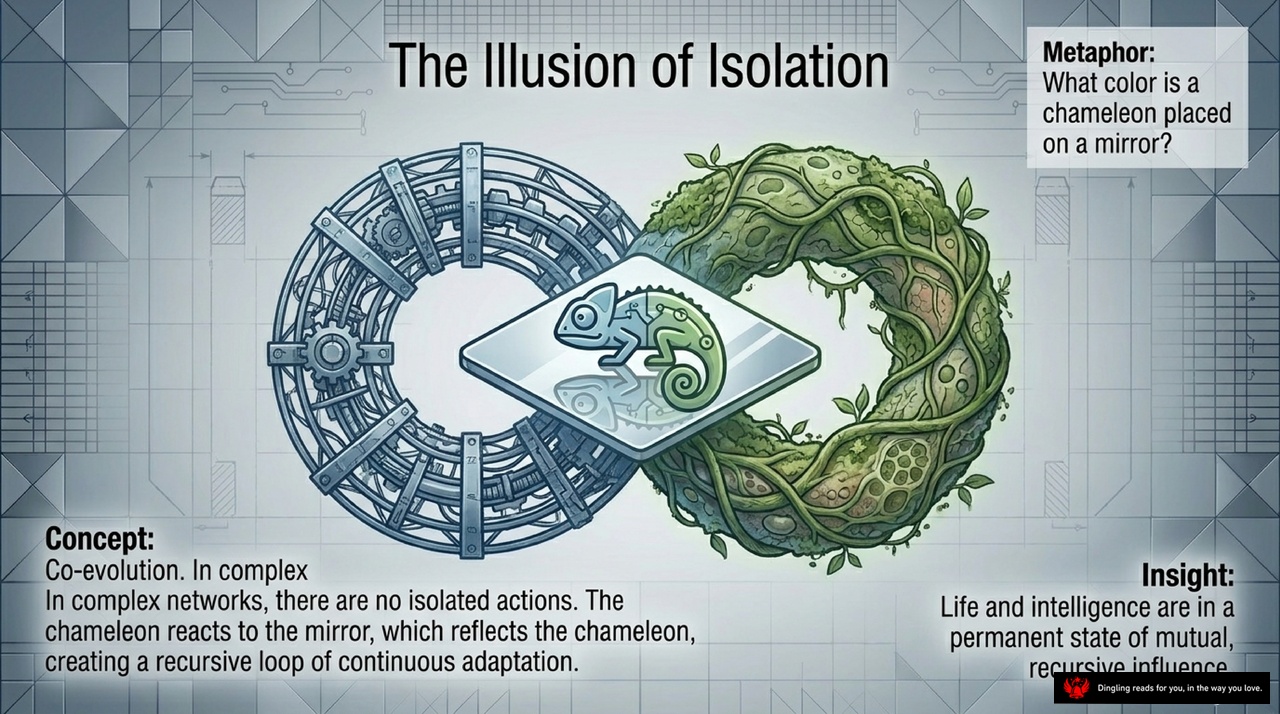
The illusion of isolation is a myth we live in. Look at this chameleon on the mirror. What color is it? It's not a fixed hue; it's a dynamic negotiation between the creature and its reflection. This is the core of co-evolution: no action happens in a vacuum. In complex networks, every move ripples outward, creating a recursive loop of continuous adaptation.
Think about life itself. It's not a static machine but a permanent state of mutual, recursive influence. Life and intelligence are constantly reshaping each other. Just like the chameleon reacting to the mirror, we are part of a larger system where boundaries blur. We aren't separate observers; we are embedded participants.
This concept flips the script on how we see control. We don't need to be the lone architect pulling every lever. Instead, we embrace a world where life and technology merge into what I call "living systems." These systems—whether they're a forest, a city, or a digital network—have their own agency. They learn, adapt, and even evolve on their own.
The future isn't about building colder, harder machines. It's about weaving biological flexibility with mechanical precision. By letting nature's logic run the show, we unlock systems that are resilient, self-repairing, and infinitely more creative. So, stop trying to isolate yourself from the world. Embrace the mirror. Let the chameleon guide you into a future where everything is connected, everything is alive, and everything is evolving together.
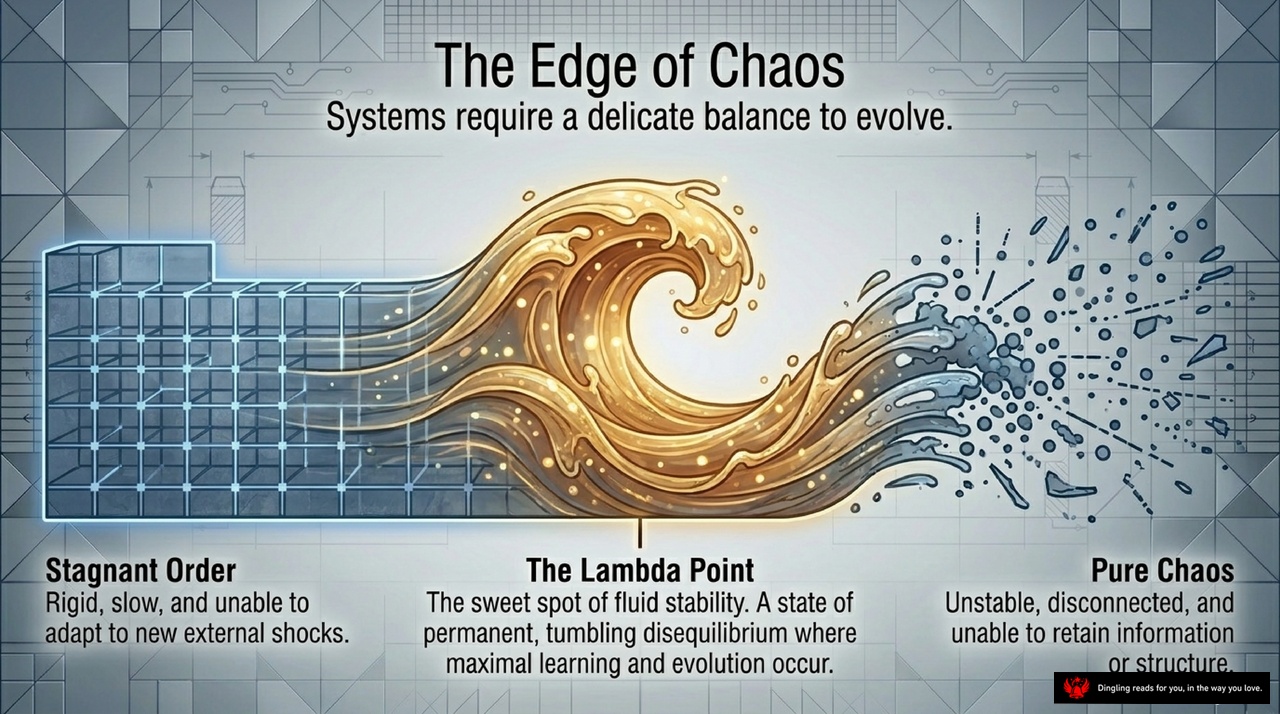
Imagine a game where you aren't the player, but the god. Think about titles like *Civilization* or *SimCity*. In these worlds, you don't micromanage every brick or every citizen. Instead, you set the parameters and then step back. You act like a deity, shaping the landscape and watching as your creations—your digital citizens—develop their own lives, economies, and cultures. This is the essence of the "God Game," a concept that mirrors a profound truth about complex systems: to create something truly alive and intelligent, you must sometimes let go of total control.
But what happens when we try to simulate this evolution? We move from playing games to building a "Library of Babel." Picture an infinite library where every possible combination of words exists on a shelf. In this vast space, the finished masterpiece of *Out of Control* sits right next to pages of complete gibberish. Most of what exists here is noise; order is the rare miracle. Yet, evolution is simply the process of navigating this library. We don't start from scratch; we start with a book that has *some* meaning and slowly mutate it, selecting the variations that climb higher toward a goal. It's like hiking through a foggy mountain range, taking small steps that gradually lead us from chaos to clarity.
This logic extends beyond text into the very shapes of life. Consider the "Morphospace" of biology—a universe of every possible creature shape. If we set the rules of growth, nature doesn't just produce random blobs; it generates insects, scorpions, and even letter-like forms. But the real game-changer is introducing "sex" into this equation. By allowing two parents to mix their genetic codes, we unlock a massive expansion of possibilities. It's like having two artists paint on the same canvas, creating offspring that are wilder and more unpredictable than either parent could achieve alone. This isn't just about reproduction; it's about fueling the exploration of the unknown.
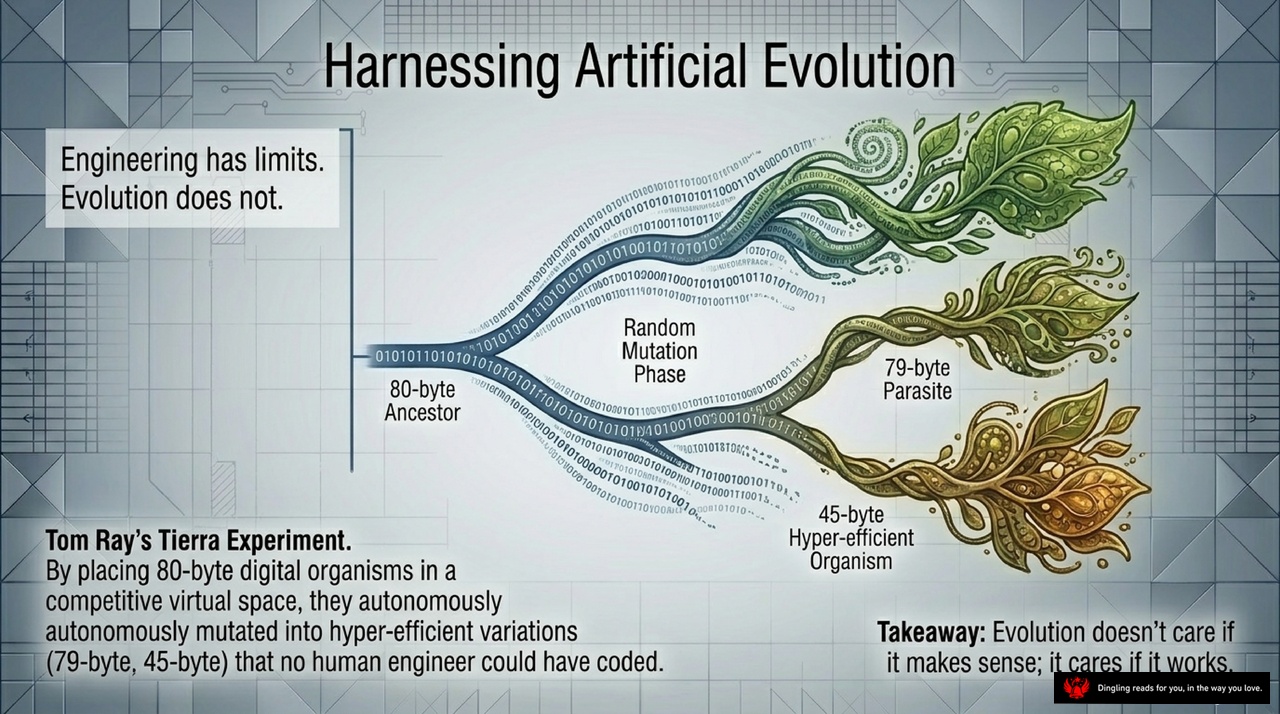
Take the experiments of Tom Ray and John Holland. Ray created a virtual world where a tiny 80-byte program could copy itself, mutate, and eventually evolve into a complex ecosystem of parasites, hosts, and even "social cheaters." It wasn't designed by a human engineer; it was cooked up by blind, parallel processes. Similarly, Holland's genetic algorithms show that by running thousands of simple solutions simultaneously, we can find optimal answers to problems that would take a single human brain years to solve. We are witnessing the end of the "engineering hegemony." When systems get too complex for a human to fully map or control, we stop trying to be the architect and start acting as the gardener. We provide the environment, the nutrients, and the time, and let the system evolve its own perfect solution.
The lesson here is clear: true intelligence and creativity often emerge from the edge of chaos. By embracing distributed, blind, and parallel evolution, we stop fighting against complexity and start harnessing it. We allow errors, we encourage variation, and we trust that if we give the system enough room to breathe, it will surprise us with solutions far beyond our own imagination.
Imagine a world where the power to create doesn't belong to a single CEO or a distant architect, but is distributed across millions of tiny, independent nodes. This is the essence of the first rule of our new biological civilization: **Distribution**. Just like a bee swarm has no queen issuing orders, every bee knowing exactly what to do, complex order emerges from simple, local interactions. No central command is needed; the intelligence is in the network itself.
But distribution alone isn't enough. The second rule is **Bottom-Up Control**. Think about a city's traffic. You don't need a traffic cop at every intersection to prevent a jam. The flow is self-regulating because every driver reacts to the car in front of them. Similarly, in our future systems, stability isn't designed from the top down; it grows from the bottom up, created by the constant, chaotic negotiation of individual parts.
Now, here's where it gets counterintuitive. The third rule is **Increasing Returns**. In the old industrial world, adding a new user to a network barely changed its value. But in our digital, biological future, every new connection makes the whole system exponentially more valuable. It's the network effect on steroids: the more you use it, the smarter it gets, the more it attracts others, and the stronger it becomes.
How do these massive systems grow? Through **Modular Growth**. We don't need to rebuild the entire engine every time we want a new feature. We just plug in a new module. Think of it like LEGO or biological organs: independent units that can work alone but collaborate seamlessly when needed. This allows for rapid scaling and incredible adaptability.
And crucially, these systems thrive on **Maximized Boundaries**. Nature knows that to survive, you must expand your interface with the world. Roots grow deeper, wings get wider, and digital networks reach further. By constantly expanding our boundaries, we access more resources and opportunities.
But here is the most important rule, the one that separates the living from the mechanical: **Encouraging Errors**. In the traditional engineering mindset, a mistake is a failure to be fixed immediately. In our new world, an error is a feature. It's the spark of evolution. Just as genetic mutations drive the diversity of life, allowing our systems to fail, stumble, and try again is the only way they can discover better solutions. Perfection is a trap; adaptability is the goal.
We also reject the idea of a single "optimal" solution. Instead, we pursue **Multiple Goals**. A healthy ecosystem balances diversity, stability, and energy flow simultaneously. Our future systems will do the same, optimizing for resilience rather than just peak efficiency.
Furthermore, we embrace **Persistent Disequilibrium**. A perfectly balanced system is dead; it's static. Life exists in a state of constant, dynamic tension. Like a river that flows because the land is uneven, our systems need friction, change, and imbalance to stay alive and creative.
Finally, the ninth rule is **Change Begets Change**. Systems that evolve their own rules create even faster evolution. It's a feedback loop of innovation.
These nine laws aren't just abstract theories; they are the operating system for the future. When we apply them—building distributed, bottom-up, error-embracing systems—we stop fighting against complexity and start harnessing it. We move from designing static machines to cultivating living, evolving ecosystems. The future isn't about controlling the chaos; it's about letting the chaos organize itself into something magnificent.

The slide reveals a fundamental truth about our future: The Paradox of Control. Look at that curve. As human inventions climb the ladder of complexity and power—moving from simple clockworks to global networks, and finally to AI and ecosystems—we inevitably slide down the slope of predictability and central control. It's a trade-off we can't escape.
The text on the left calls this a "devil's bargain." To achieve ultimate adaptability, we must surrender absolute control. Think about it: a clockwork mechanism is perfectly predictable because it's rigid, but it can't adapt. An AI ecosystem is wildly unpredictable, yet it possesses the power to learn, heal, and evolve.
We are seeing this play out in nature and technology alike. Just as a bee swarm has no queen issuing orders, yet achieves incredible collective intelligence through simple rules, our most powerful systems—like the internet or modern economies—run best when they are decentralized and free to self-organize. Trying to force total control over a complex system is like trying to steer a hurricane; it only breaks the system.
So, the insight here is liberating: if you want true power, you have to let go. We must stop trying to be the god of the machine and instead become the gardener who understands the ecosystem. By embracing this loss of control, we unlock the very adaptability that will allow us to thrive in an unpredictable future.
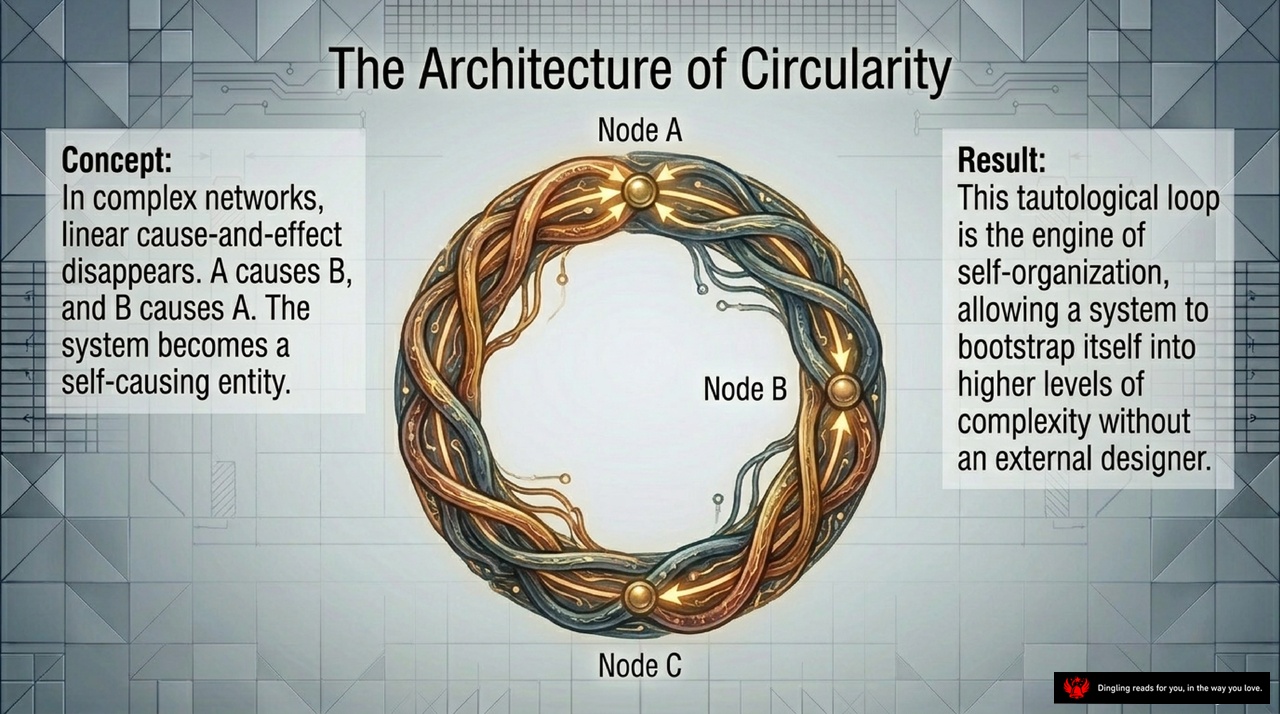
Look at this intricate, self-weaving ring in the center of our slide. This visual represents what we call "The Architecture of Circularity." Notice how Node A connects to Node B, and Node B loops back to Node A, creating a continuous, self-sustaining loop. This isn't just a diagram; it's the fundamental engine of self-organization.
In complex networks, the traditional idea of a linear cause-and-effect chain disappears. Instead, we see a tautological loop where A causes B, and B causes A, transforming the entire system into a self-causing entity. This is the concept we're exploring today.
The result of this circular architecture is profound: it acts as the engine for self-organization, allowing a system to bootstrap itself into higher levels of complexity without needing an external designer. Whether it's a biological ecosystem, a digital network, or a swarm of drones, this tautological loop is what allows them to evolve, adapt, and thrive on their own. We are moving away from top-down control and embracing systems that create their own order from within.
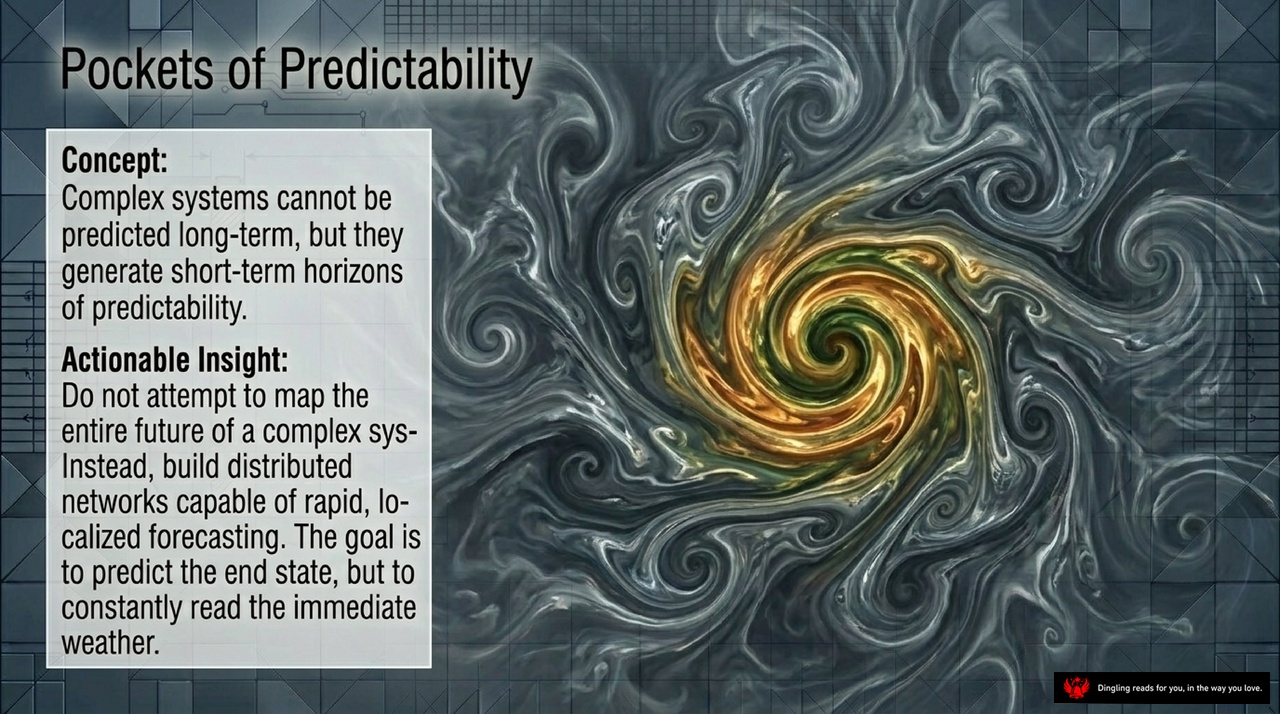
Complex systems often feel like chaotic storms, swirling with no clear direction. But here's the secret: while we can't predict the future of a complex system in the long run, they actually generate short-term pockets of predictability. Think of it like weather forecasting. You can't predict the climate for the next century, but you can definitely read the weather for the next hour.
The actionable insight here is simple yet powerful: stop trying to map the entire future of a complex system. Instead, build distributed networks capable of rapid, localized forecasting. The goal isn't to control the end state from the start; it's to constantly read the immediate weather. Just like a swarm of bees or a bustling city, the system finds its way forward by reacting to the present moment, not by following a rigid, pre-written script. Embrace the uncertainty, trust the local signals, and let the system's own intelligence emerge.
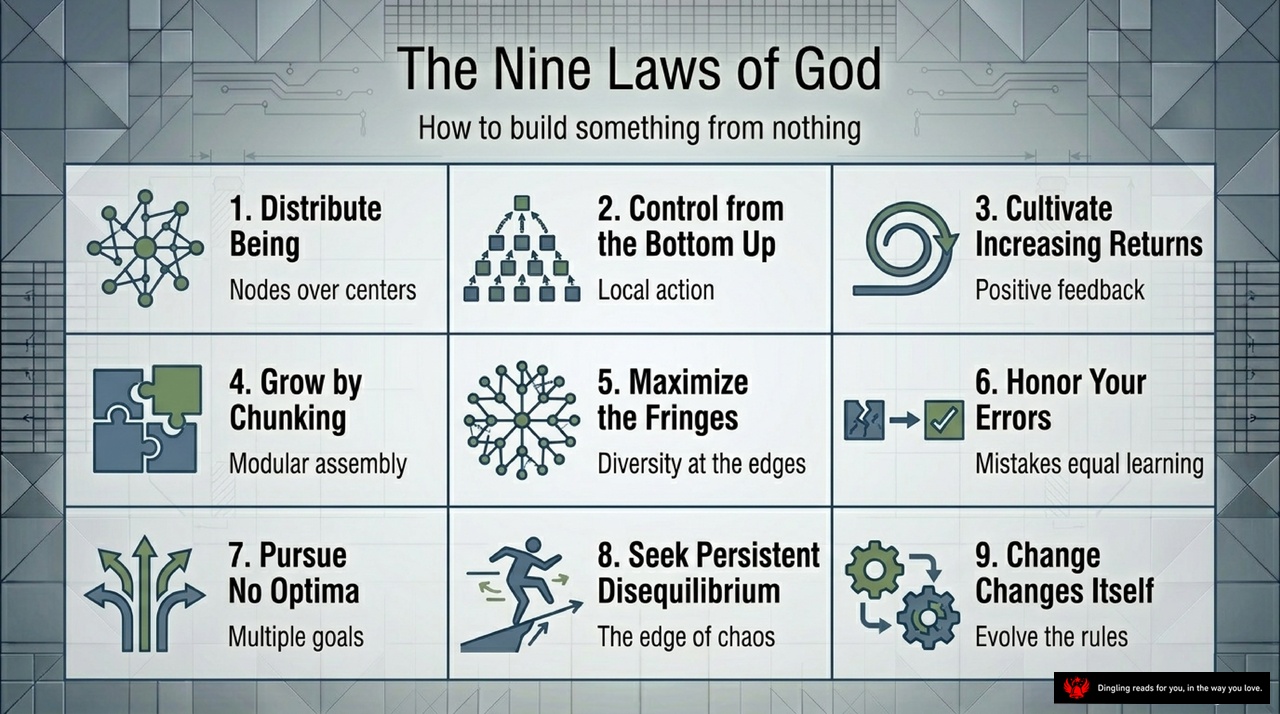
The slide you see right now is the master key to everything we've discussed so far. It's titled "The Nine Laws of God," and the subtitle says it all: "How to build something from nothing." This isn't about magic; it's about the fundamental operating system of life itself, a set of rules that nature has been running for billions of years.
Let's break down this grid. Look at the top row. The first law is "Distribute Being." It tells us to prioritize nodes over centers. Think about a beehive or the internet; they don't need a single boss to function. They thrive because power is spread out across thousands of independent agents. That's why they are so resilient. Next to it is "Control from the Bottom Up." Order isn't imposed from the top down; it emerges spontaneously from local actions and simple interactions. The third law, "Cultivate Increasing Returns," is about positive feedback. It's the concept of network effects where success begets more success, creating a snowball effect that drives growth.
Move to the middle row. We see "Grow by Chunking." Complex systems aren't built all at once; they are assembled like LEGO bricks, using modular pieces that can be swapped and upgraded independently. Then there's "Maximize the Fringes." This is a counter-intuitive idea: the most important innovations and diversity often happen at the edges, in the chaotic periphery, not in the safe center. That's why we need to honor errors; mistakes aren't failures, they are the data points that allow the system to learn and evolve.
Finally, the bottom row. We must "Pursue No Optima." Instead of chasing a single, perfect solution that might be fragile, we aim for multiple goals simultaneously to create a robust, flexible system. We need to "Seek Persistent Disequilibrium." Stability is the enemy of life; true vitality comes from staying on the edge of chaos, constantly adapting to change. And lastly, "Change Changes Itself." The rules of the game aren't static; the system evolves the rules to survive in new environments.
These nine laws are the blueprint for the new bio-logic. They explain how we can move away from rigid, top-down engineering and start building systems that are alive, adaptive, and capable of creating value from nothing but raw potential.
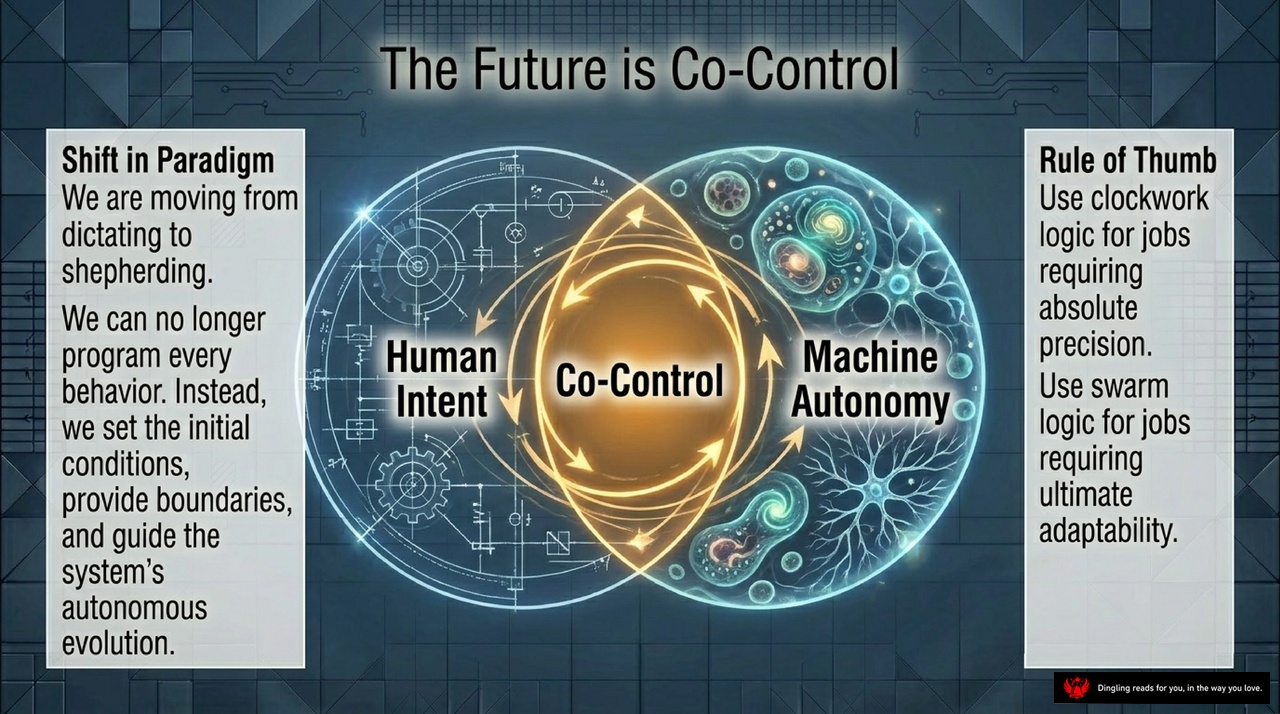
The future isn't about who controls the machine, but how well we can co-pilot it. Look at this diagram: it shifts the entire paradigm from "dictating" every single behavior to "shepherding" the system. We are moving away from trying to program every outcome and instead setting the initial conditions, defining the boundaries, and letting the system evolve autonomously.
On the left, we have "Human Intent." This represents our role as the guide, providing the vision and the guardrails. On the right, we have "Machine Autonomy." This is where the swarm logic comes in. Just like bees or the flocking behavior of birds, machines don't need a central commander to be smart. They follow simple rules, adapt to their environment, and solve complex problems through distributed intelligence.
The sweet spot in the middle is "Co-Control." This is the future. We use clockwork logic for jobs requiring absolute precision, but we switch to swarm logic for tasks needing ultimate adaptability. By blending our strategic intent with the machine's ability to self-organize and learn, we create a system that is far more powerful than either could be alone. It's no longer about a creator who owns everything, but a partnership where the machine gains a wild, creative freedom, and we gain a partner that can evolve alongside us.

To build truly complex, resilient systems in our technology and society, we must surrender the illusion of central control and embrace the chaotic, biological logic of the swarm.
Think about it: for centuries, we've been obsessed with the "command and control" model. We wanted a single boss, a central brain, a steering wheel that dictated every move. But nature has been running a different experiment for billions of years, and it's working far better than our rigid blueprints.
Look at a bee colony. There is no queen bee standing in the center giving orders to the workers. Instead, we have a swarm of independent individuals following simple rules. When they need to find a new home, scout bees go out, dance to show the best spots, and other bees join the dance of the most promising location. No central authority decides; the solution simply emerges from the interactions of thousands of tiny parts. This is the power of the swarm.
As our machines accumulate the wild intelligence of nature, are we prepared to let go of the steering wheel and allow our creations to outgrow our comprehension?
We are standing at a critical crossroads. We can continue trying to force our systems into a predictable, top-down box, or we can embrace the messy, unpredictable, yet incredibly powerful logic of life. The future belongs not to the machine that follows every instruction perfectly, but to the system that can adapt, evolve, and surprise us. It's time to stop trying to be the god of the machine and start building a partner that can grow alongside us.