
Peace Under Heaven: Complete Chapter-by-Chapter Summary
Welcome to a journey through *Peace Under Heaven* by Hou Bo. Set against the dramatic backdrop of modern China's turbulent dawn, this story weaves together themes of love, law, and liberation. Imagine a landscape where tradition clashes with revolution, and where a young woman named Yue Xiu finds herself at the center of a life-altering struggle. As the narrative unfolds, we see how personal choices intersect with sweeping historical changes, challenging the old ways and paving the way for a new understanding of freedom and justice.
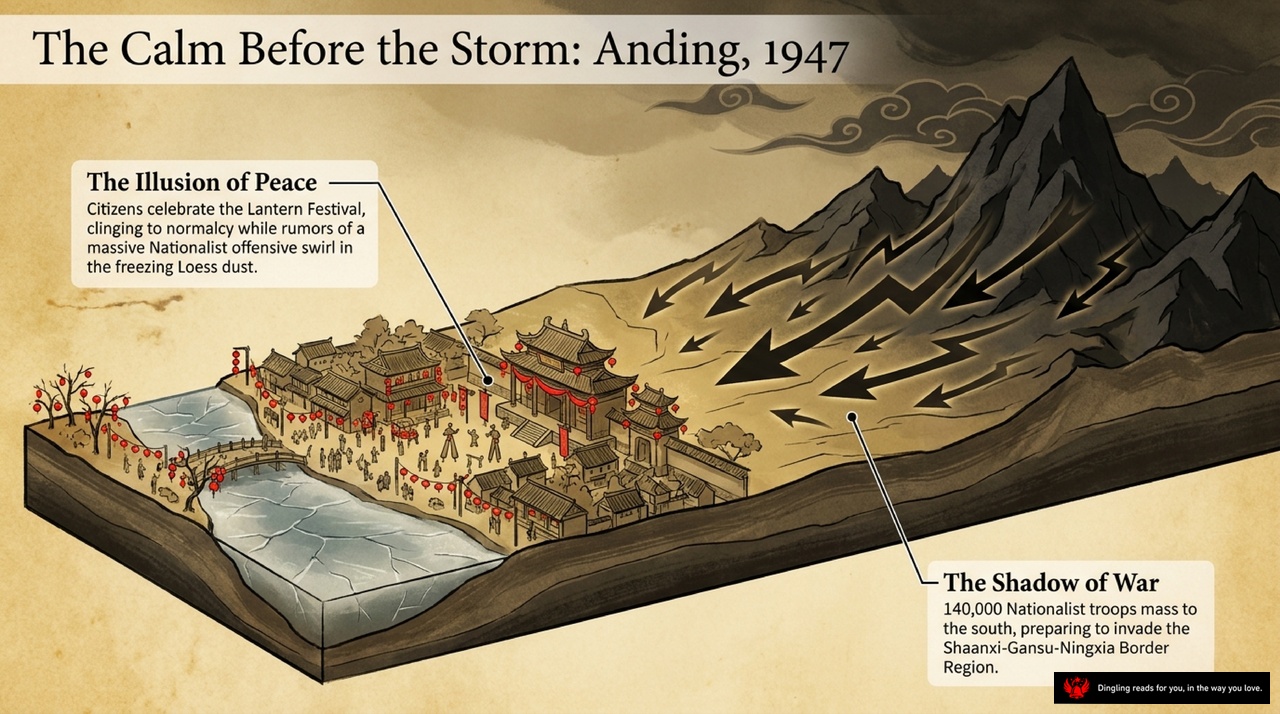
The calm before the storm is always the most deceptive. In Anding, 1947, the villagers were celebrating the Lantern Festival, hanging red lanterns and dancing in the snow, convinced that life had returned to normal. But while they clung to this illusion of peace, a terrifying reality was brewing just beyond the horizon.
Look at the shadows in the background. The Nationalist forces were massing 140,000 troops, preparing a massive offensive to invade the Shaanxi-Gansu-Ningxia Border Region. They were sweeping south like a dark tide, hiding in the freezing Loess dust, waiting for the perfect moment to strike.
Inside the village, the festive music masked the coming danger. Families were busy storing grain and hiding valuables, unaware that the war had already arrived. This wasn't just a story of distant battles; it was a personal crisis for every family. For young Yuexiu, the celebration was cut short by the realization that her father was planning to sell her to a gambler to pay his debts, while the real enemy was marching on her doorstep.
The contrast between the joyous festival and the approaching destruction captures the terrifying truth of that era. Peace was fragile, and the storm was about to break.

Look at this four-quadrant map of a world in transition. On the left, we see the "Old Feudal World," defined by poverty and struggle, while the right side represents the "New Progressive World," built on power and wealth, but with a different kind of justice.
In the bottom left, trapped in the old world, is Ren Yanggui. He's not just a poor tofu maker; he's a man crushed by debt, desperate enough to sell his daughter, Ren Yuexiu, for 30 silver dollars. But look at the top right. That's where the new power lies: Commissioner Ma and District Head Deng. These aren't just officials; they are the Communist leaders wielding the new law to dismantle the very feudalism that was crushing families like the Rens.
But the real story is in the bottom right quadrant. Here stand Ren Yuexiu and Qian Chengcheng. They are penniless, living in the shadow of the old world, yet they are the future. They represent the promise of free will and mutual affection that the new Progressive World offers. While their father sells daughters, these young lovers are awakening to a truth: that love should be chosen, not bought. This slide captures the entire conflict of the story—the brutal struggle between a father's greed and a daughter's right to choose, set against the backdrop of a nation being reborn.

Look at this split screen. On the left, we see the "Old Way": heavy chains, a padlock, and gold ingots. This represents a time when women were treated like commodities, forced into blind arranged marriages, and sold to pay off family debts. There was no concept of individual consent.
But on the right, we see the "New Law." This is the 1939 Regulations. The government stepped in to ban arranged and mercenary marriages, prohibit child brides, and most importantly, put a total ban on bride prices or dowries. The core principle here is simple but revolutionary: it mandates absolute mutual consent.
This collision of two worlds changed everything. It moved women from being objects of trade to being the masters of their own destiny.

Look at this domino effect. It starts with a father's addiction and ends with a daughter's captivity. The PPT title, "A Father's Debt, A Daughter's Price," perfectly captures this tragic chain reaction.
First, we see **The Vice**. Ren Yanggui, our protagonist's father, is drowning in gambling debts. Desperate and broken, he decides to sell his 18-year-old daughter, Yuexiu, to pay them off. That's the first stone falling.
But the story doesn't end there. We move to **The Rejection**. Yuexiu's true love, Chengcheng, is poor but honest. When Ren Yanggui tries to extort an exorbitant amount of money—30 silver dollars and 10,000 fabi—Chengcheng's family simply refuses. They won't be blackmailed.
This forces the desperate father into **The Transaction**. He turns to the wealthy but notorious thug, Tian Yuangang. Ren secretly agrees to sell Yuexiu to Tian as a bride just to secure the debt.
And finally, we reach **The Realization**. The domino falls completely. Yuexiu is no longer a person; she is trapped inside a cage, a literal and metaphorical prison built by her father's greed. This graphic illustrates the brutal cost of one man's vice on an entire family's future.

Look at this powerful cycle. It illustrates the tragic paradox of "Qiangqin"—the feudal kidnapping method. You see, desperate to save Yuexiu from the thug Tian, Chengcheng's family resurrects this brutal tradition, raiding her house at midnight to "kidnap" her. This was their only hope to escape the legal trap of a feudal arranged marriage. To survive, the young lovers had to resort to the ultimate feudal crime. By making the bride and groom "stolen," they forced the new Communist legal system to finally address the messy reality of their survival.
But what was the outcome? The result was a broken heart. The "kidnapping" didn't save her; it destroyed her future. The government declared their marriage invalid, stripping them of their rights and love. The very act they did to escape oppression only deepened their suffering. This image reminds us that sometimes, using the enemy's rules to fight back can lead to a dead end. True freedom requires more than just breaking the law; it requires a system that truly values human dignity.

Look at this scale. On one side, we have the "Letter of the Law"—punishing the Qian family for kidnapping or punishing the father for the illegal bride price. On the other, the "Spirit of the Law"—protecting human rights and mutual consent. This was the impossible balance Commissioner Ma and District Head Deng had to strike.
They ruled that the kidnapping method was illegal, demanding penal labor for the perpetrators. Yet, they also recognized that the marriage itself was valid because it was rooted in genuine, mutual consent. The father's mercenary betrothal was voided. It was a bold decision: punishing the crime of coercion while honoring the freedom of the couple's choice. In a time when law often felt rigid and cold, this ruling proved that true justice isn't just about following rules; it's about protecting the humanity behind them.

Picture this: The chains of feudal oppression are finally snapping. On this slide, we see the moment Yuexiu transforms from a traded commodity into a protected citizen. That marriage certificate in the center isn't just paper; it's her birthright as a sovereign individual, issued by the state, not her father. Look at the broken chains breaking away from the document—that visual tells us her fear is over. No man can snatch her away anymore.
And let's talk about those red shoes. They aren't just superstition about fertility anymore; they symbolize her active choice to claim her own destiny. This is the shift from "Property" to "Citizen." She's no longer a pawn in her father's gambling debts or a bride for sale. She is the master of her own life, standing tall with the courage to say, "I choose my own love." This is true liberation.
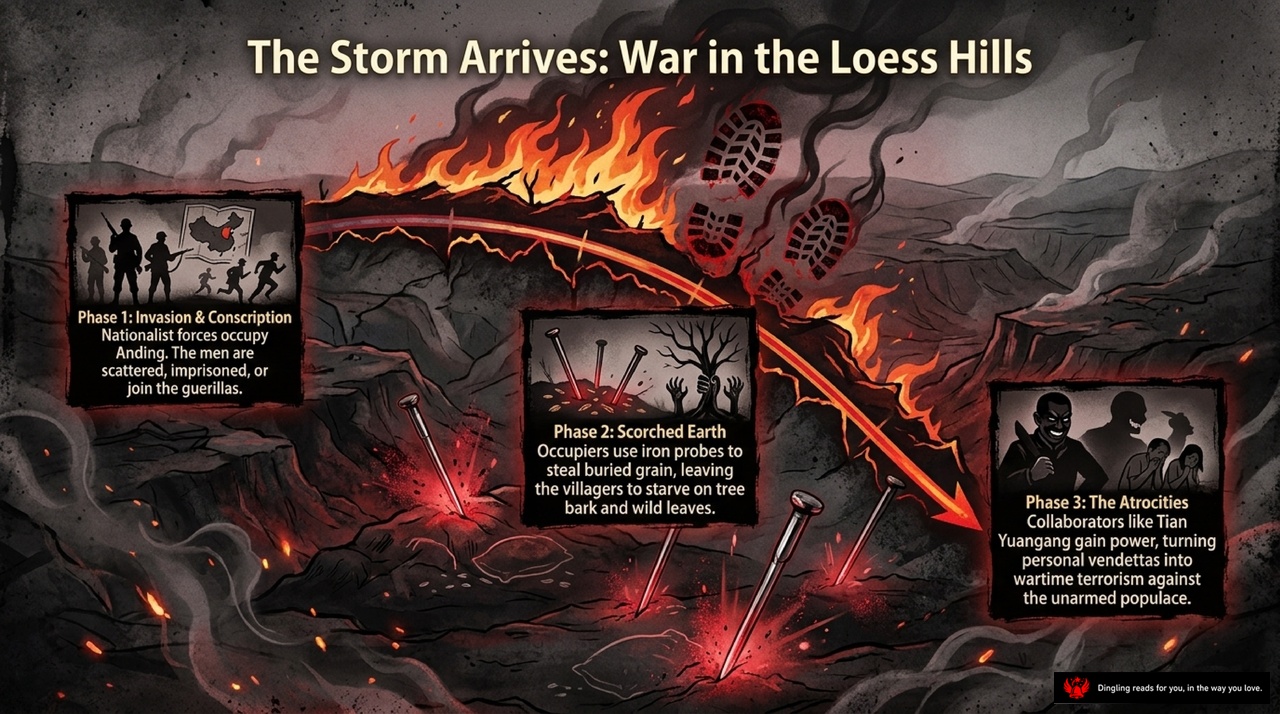
The storm has finally arrived in the Loess Hills, bringing with it fire, blood, and the darkest kind of war. This slide maps out the terrifying three phases of the invasion.
First, we see **Invasion & Conscription**. Nationalist forces didn't just occupy Anding; they tore the community apart. Men were scattered, imprisoned, or forced into the guerrilla fight, leaving families behind in chaos.
Next, the occupiers turned to **Scorched Earth tactics**. Look at those iron probes in the ground. They used them to steal buried grain, leaving villagers to starve on tree bark and wild leaves. They were systematically destroying the very life force of the land.
Finally, we reach **The Atrocities**. Collaborators like Tian Yuangang gained power, turning personal vendettas into wartime terrorism against the unarmed populace. This wasn't just fighting soldiers; it was terrorizing the innocent.
This is the reality the villagers faced: a landscape of burning fields, stolen food, and unchecked violence. The war had arrived, and there was no place left to hide.
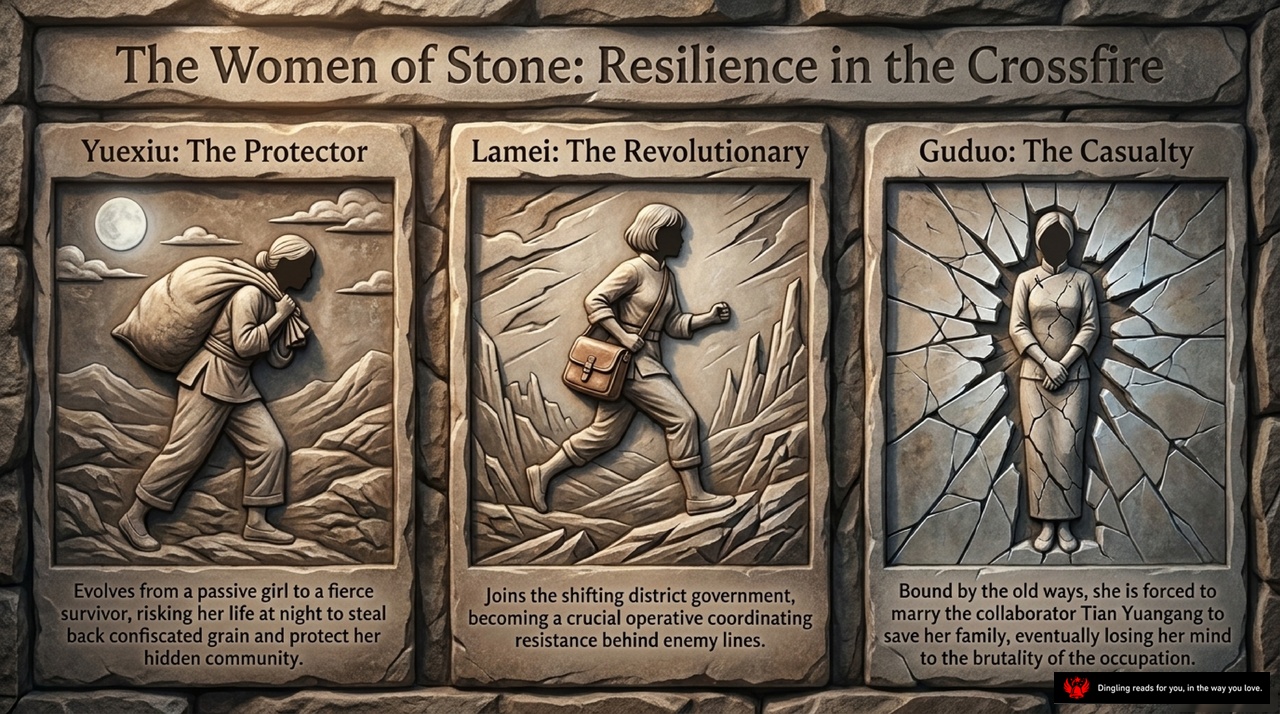
The Women of Stone: Resilience in the Crossfire. This slide honors three women whose lives defined an era of survival and sacrifice.
First, Yuexiu, the Protector. She evolves from a passive girl into a fierce survivor, risking her life at night to steal back confiscated grain and protect her hidden community. Her journey is one of quiet courage, standing firm when others might have fled.
Next, Lamei, the Revolutionary. She joins the shifting district government, becoming a crucial operative coordinating resistance behind enemy lines. Her story represents the shift from local struggle to organized, strategic action against oppression.
Finally, Guduo, the Casualty. Bound by the old ways, she is forced to marry the collaborator Tian Yuangang to save her family, eventually losing her mind to the brutality of the occupation. Her tragedy is a stark reminder of the human cost of war and the shattering of innocence.
Together, their stories illustrate that resilience isn't just about enduring pain, but about the choices we make in the face of impossible odds.

Look at this dramatic shift in the story. We've moved from a pressure cooker of despair to a sunrise of hope. The gauge on the left reads "DANGER," symbolizing the unbearable weight the villagers carried: starvation, extortion, and the looming threat of the collaborators. But look at the right side—the earth is cracking open, and a new dawn is breaking. This is "The Turning Tide."
It all starts with "The Pressure Builds." The villagers are pushed to their absolute limits by the cruelty around them. But then comes "The Ignition." Remember Yuexiu's teenage brother, Ronger? He was just a bystander, wrapped in his quilt, refusing to wake up. But when the situation became critical, he picked up a rifle to defend his sister. That single act symbolized the total mobilization of the peasantry. The people were no longer waiting to be saved; they were waking up to save themselves.
Finally, we see "The Release." The Nationalist forces, starved of local support and battered by guerrillas, were forced into a chaotic retreat. As they fled, they left the land back to the people. This isn't just a military victory; it's a liberation. The sun is rising over a landscape that is finally free to breathe again. The tide has turned, and the people are taking control of their own destiny.

Resolution: Carving Peace from the Earth. Look at this image. It shows men digging into the earth, not just to build caves, but to rebuild the very foundation of their society. This is the resolution of the story.
In the book, the men of the village, sentenced to penal labor for their past crimes like kidnapping, are tasked with digging seven new cave dwellings for the expanding democratic government. But this labor is far more than just a punishment. It is a powerful metaphor.
The very people who were once divided by feudal greed and violence are now forced to literally rebuild the foundation of their new society, shoulder to shoulder. They are working from the dirt of their own crimes, turning that very soil into the infrastructure of peace. As they dig, they are carving a future where cooperation replaces conflict, proving that even from the darkest ground, peace can be built.

Synthesis: What Does "Peace" Mean?
True peace isn't just the absence of war; it's a layered ecosystem that starts within us and expands outward. At the very core lies Personal Peace. As the novel illustrates, true stability begins with bodily autonomy—the fundamental right to choose who you love, free from commodification or coercion. Without this inner freedom, any external order is built on shaky ground.
Expanding outward, we find Social Peace. A society is only truly stable when the law protects the vulnerable, upholding the spirit of justice rather than merely preserving the hierarchies of the powerful through the letter of the law. This is the bridge between individual liberty and community safety.
Finally, at the widest circle, we reach National Peace. As the novel's epigraph beautifully states: "When the people's hearts are at peace, the world under heaven is settled." This ancient wisdom reminds us that global stability is ultimately rooted in the collective emotional and moral well-being of its citizens. When we secure our personal autonomy, ensure our social fairness, and nurture our inner calm, we naturally build a peaceful nation.
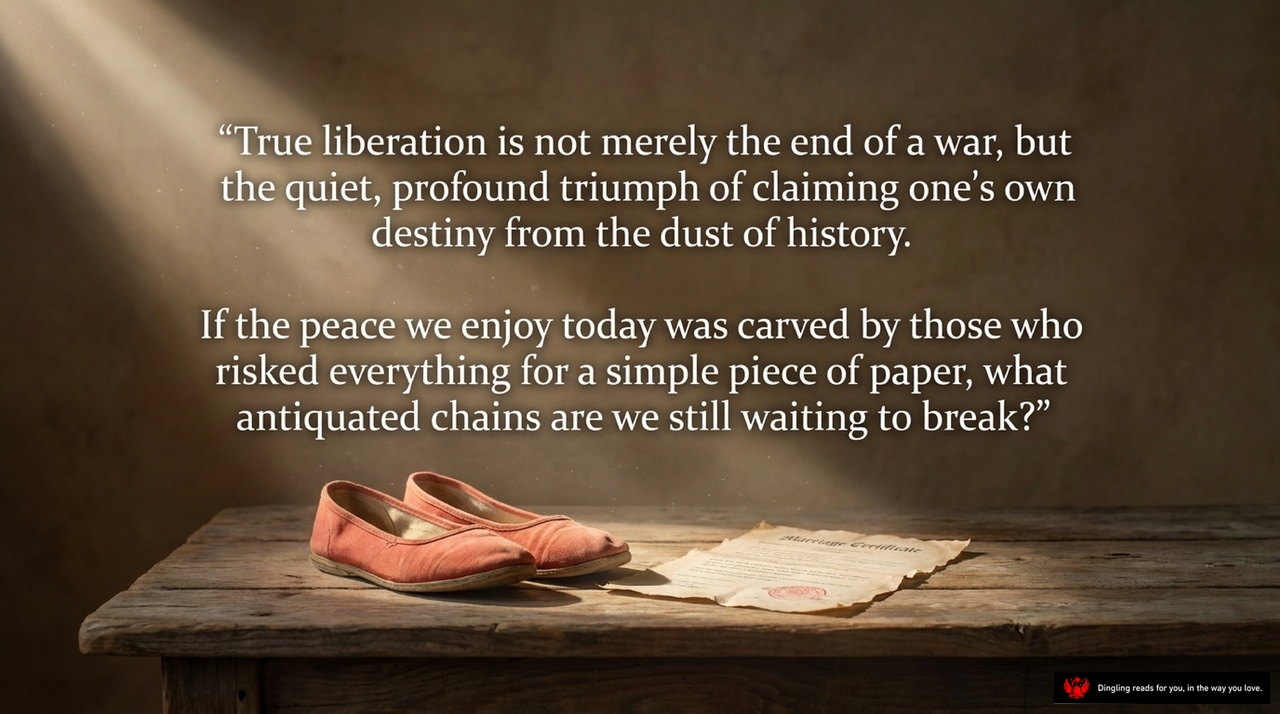
True liberation isn't just about the war ending; it's about the quiet, profound triumph of claiming your own destiny from the dust of history. Look at these simple shoes and that marriage certificate—they represent a choice, a break from the past, and a step toward freedom.
If the peace we enjoy today was carved by those who risked everything for a piece of paper, what outdated chains are we still waiting to break? In this story, Yue Xiu fights for her right to marry the man she loves, not the one her father sold her to. Her journey teaches us that real freedom comes from within, from the courage to define your own future, even when the world tries to dictate it. That's the true victory.