
Perdido Street Station: Complete Chapter-by-Chapter Summary

Welcome to the world of *Perdido Street Station*, where the sky isn't empty, but crowded with everything that refuses to stay grounded. Imagine a city built on a constant battle against gravity, where trains race on tracks high above the rooftops and airships drift through a smog-choked sky. This is New Crobuzon, a place where the air smells of poison and the buildings reach desperately toward the clouds, twisted by industrial smoke.
But it's not just the skyline that's monstrous. In the heart of this city lies Perdido Street Station, a brutalist fortress of brick and iron, designed by a madman who wanted to build a god. Here, the barriers between species and classes dissolve into a chaotic mix. You'll see robots clanking alongside beggars, exotic creatures trading in the shadows, and a society where the rules are as fluid as the mud.
This story is a raw exploration of metamorphosis, crisis, and survival. It asks a terrifying question: what happens when everything changes, and the line between human and monster blurs until it disappears? From the gritty streets of the slums to the dark, secret labs where secrets are bought and sold, we step into a world where the only thing more dangerous than the monsters you see is the transformation hiding inside them all.
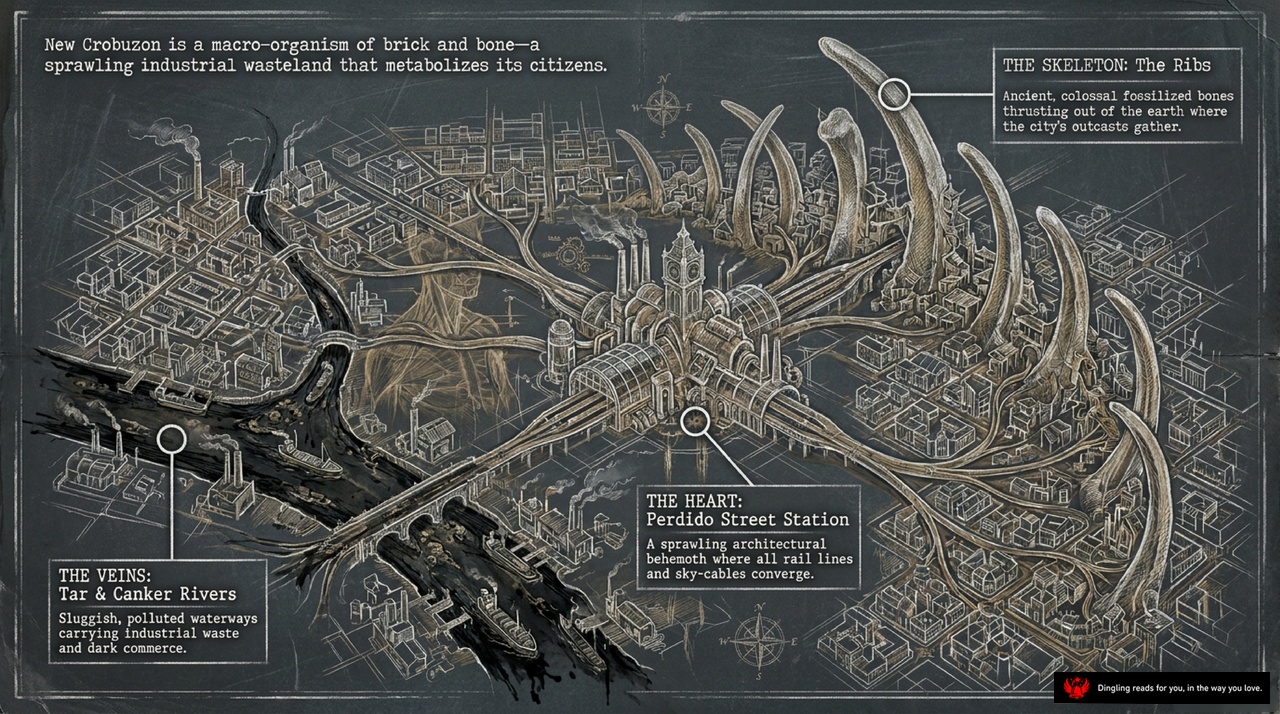
New Crobuzon isn't just a city; it's a living, breathing organism made of brick and bone, a sprawling industrial wasteland that literally metabolizes its own citizens. Look at the map: this place is a skeleton, a heart, and a set of veins all rolled into one.
First, you see the ribs—ancient, colossal fossilized bones thrusting out of the earth where the city's outcasts gather. It's the jagged skyline of the Bone District, a broken landmark that defines the chaos. Then, there's the heart: Perdido Street Station. It's a sprawling architectural behemoth where all the rail lines and sky-cables converge, pumping life into this mechanical body. And finally, the veins: the Tar and Canker Rivers. These aren't normal waterways; they are sluggish, polluted channels carrying industrial waste and dark commerce, the lifeblood of a city built on filth.
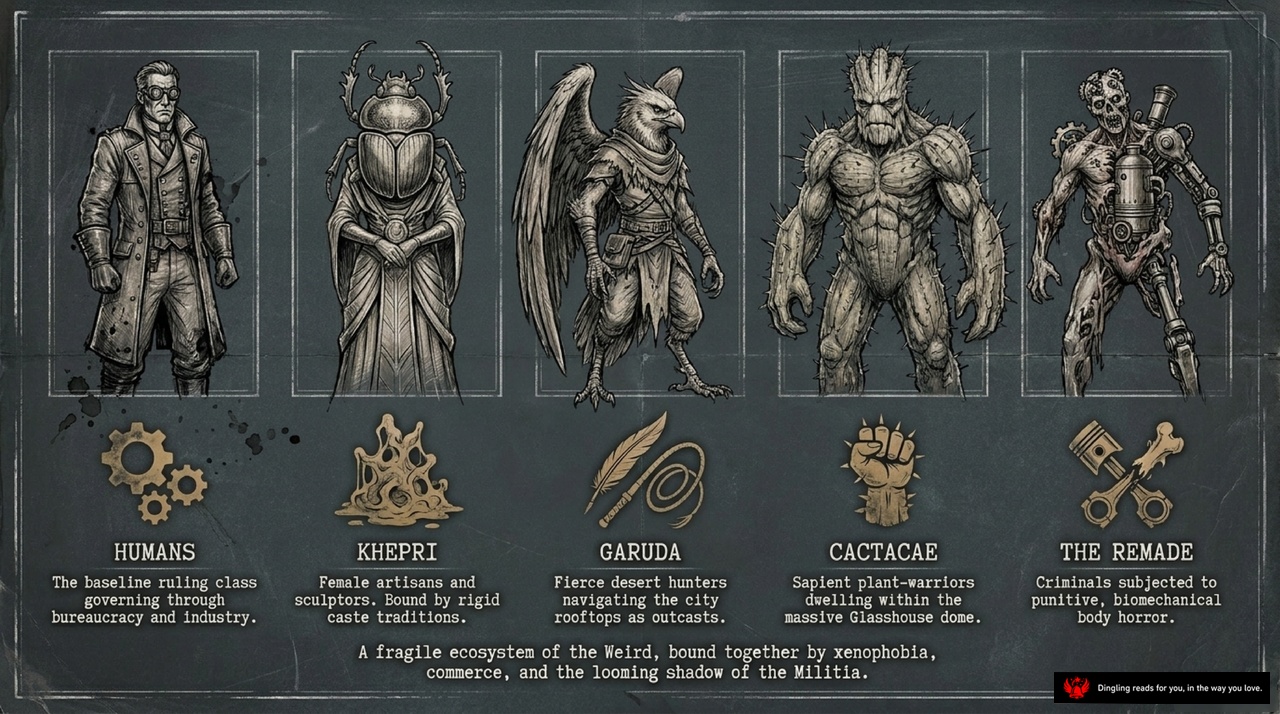
But the story doesn't stop at the geography. It's about the people trapped within this machine. We meet Isaac, a scientist obsessed with flight, and Lin, a scarab-headed artist forced into the dark underworld by a monstrous employer named Mortley. While Isaac tries to solve the mystery of flight by studying birds and insects, Lin is sculpting a grotesque hybrid monster, trying to escape a world that sees her as nothing more than a tool.
And then, there's the horror waiting in the shadows. A mysterious caterpillar that Isaac thinks is just a scientific curiosity begins to mutate into a terrifying predator. Meanwhile, a city-wide nightmare spreads through the dreams of everyone from children to adults, driven by creatures that feed on the human subconscious. It's a tale of transition, of hybrid zones where everything blends into something new and often dangerous, proving that in New Crobuzon, the only constant is change.
Welcome to the world of New Crobuzon, a city that never stops fighting against gravity. Here, the sky is never truly empty; it's a crowded arena where everything from airships and National Guard gondolas to winged humans and even giant mechanical constructs like the Magi-Kin, constantly vie for altitude. Trains don't just run on tracks; they defy physics, soaring on elevated rails above the rooftops to keep pace with the birds.
The architecture itself seems to be stretching upward, with buildings reaching ten, twenty, or even thirty stories high, desperate to pierce the smog-choked sky. But above this industrial sprawl, the air is thick with toxic smoke from massive chimneys and a heavy, foul fog that wraps the city like an invisible shroud.
At the heart of this atmospheric chaos lies the Padido Street Station. It's an industrial fortress, guarded by towering spires and dominated by five massive railway lines that snake into the station like giant serpents. Legend says the station's original designer was imprisoned and eventually driven mad, obsessed with turning the building into a divine miracle with powers beyond the mundane.
For Isaac, a scientist obsessed with the impossible, this city isn't a mystery to be feared, but a laboratory to be explored. He sees flight not as romance, but as a practical challenge. Every wind and every flying creature is a data point in his quest to solve the mystery of flight. He devours books on aerodynamics and biology, realizing he needs real specimens—wings from pterosaurs, insects, and rare creatures—to crack the code.
But the city has its own dark undercurrents. While Isaac studies the sky, others are fighting for survival in the shadows. Lin, the scarab-headed sculptor, is trapped in a nightmare of her own making. She has been hired by a monstrous, hybrid creature named Mortley to create a statue of him. Mortley is a terrifying amalgamation of different species, a chaotic whirlwind of skin, fur, and feathers. He is obsessed with the theme of "hybrid zones"—the messy, transitional spaces where different things blend together. He demands Lin create an equal-sized statue of him, promising her a fortune but threatening her with torture if she ever reveals his identity.
Meanwhile, Isaac is making a desperate plea for help. He meets Yagrik, a Garuda—a fierce desert hunter with wings made of wood and leather, a disguise to hide his true nature. Yagrik has traveled thousands of miles to find Isaac, driven by a burning desire to fly again. Once a proud sky-born creature, Yagrik was betrayed by his own kind and forced into a life of shame and captivity. He begs Isaac, a man who claims to be an amateur of all things, to help him regain his freedom and the ability to soar.
As Isaac delves deeper into his research, he begins to see the connections between biology, magic, and the strange physics of this world. He realizes that true flight might not be about mechanics alone, but about tapping into a deeper, critical energy that exists within all matter. His journey is just beginning, and the city of New Crobuzon is about to change forever.

The city of New Crobuzon isn't just a place; it's a living nightmare where gravity is just a suggestion and the sky is choked with poison. Look at the chaos above: airships drifting like drunk giants, citizens hanging from swaying cables, and even trains fighting the ground to fly on rails high above the rooftops. It's a brutal, vertical struggle for survival, where the air itself feels heavy with the scent of industrial decay and toxic smog.
But beneath this chaotic surface, the real horror is waking up. Last night, the city didn't just sleep; it dreamed in terror. A plague of nightmares swept through, turning sweet dreams into nightmares of monsters and madness. And then, the predators arrived. The Dream Eaters—massive, winged shadows that feed on the psychic energy of sleeping minds. They descended from the clouds, tasting the fear in the air, and began their harvest.
This is where our story truly shifts. While Isaac and Lin are trying to navigate their own crises, the city is being systematically drained by these insatiable creatures. They are hunting the most vulnerable, but one of them is tracking a very specific scent: Isaac's. The clock is ticking, and the city's sanity is hanging by a thread.
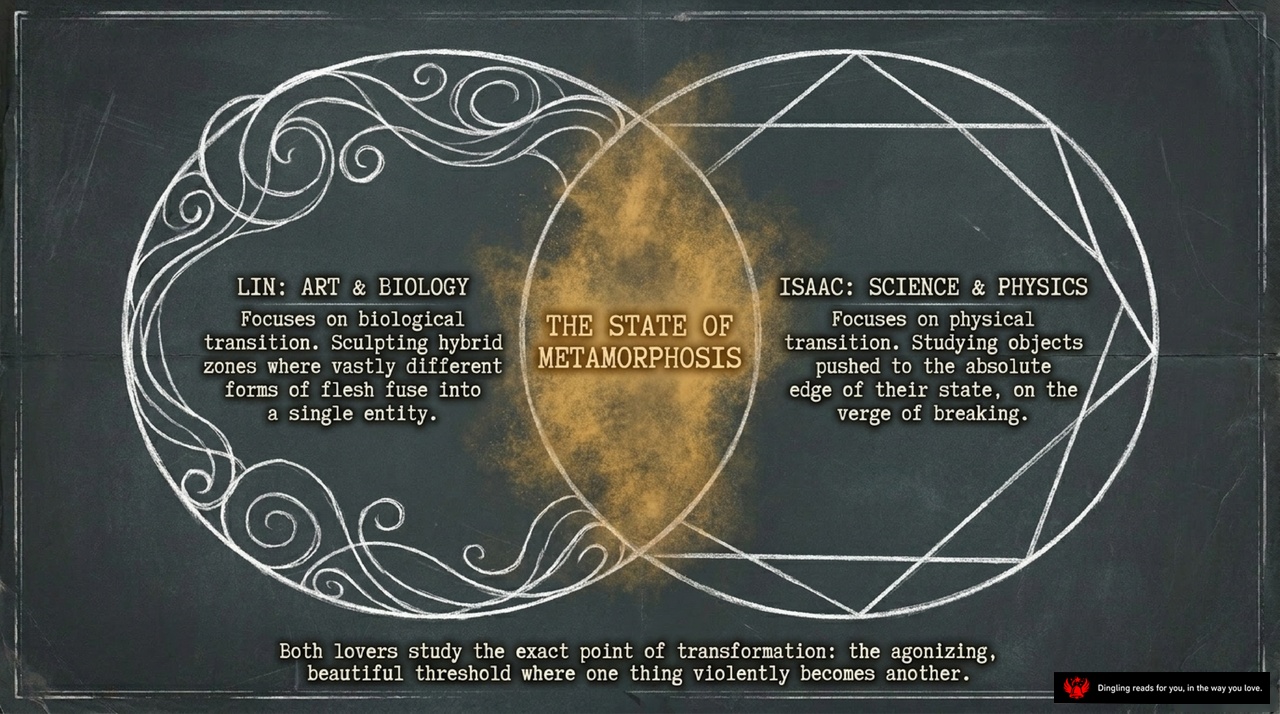
Look at this Venn diagram. It perfectly captures the core tension of our story: the collision between Lin's world of biology and Isaac's world of physics, united by a single, terrifying concept—Metamorphosis.
On the left, we have Lin, the artist and biologist. Her focus is on biological transition. She is the sculptor of hybrid zones, the one who fuses vastly different forms of flesh into a single entity. Think of her work with the insect-headed people; she takes the raw, chaotic material of life and shapes it into art. She explores the agonizing beauty of where one organism violently becomes another.
On the right, we see Isaac, the scientist and physicist. His lens is entirely different. He focuses on physical transition. He studies objects pushed to the absolute edge of their state, on the verge of breaking. Whether it's trying to make an eagle-man fly again or solving the equations of critical theory, Isaac is obsessed with the mechanics of change. He wants to understand the laws that govern transformation.
But look at the center. That golden dust is where they meet: The State of Metamorphosis.
The text at the bottom tells us the truth about these two lovers: they are both studying the exact point of transformation. They are drawn to that specific threshold—the agonizing, beautiful moment where one thing violently becomes another. For Lin, it's in the clay and the flesh she sculpts. For Isaac, it's in the equations and the broken machines he tries to fix. They are two sides of the same coin, united by a fascination with the very act of becoming something new, even if that process is often painful, dangerous, and irreversible.
The city of New Crobuzon is finally silent. The nightmare has passed, but the cost is written in the scars of its people and the broken bodies of its heroes.
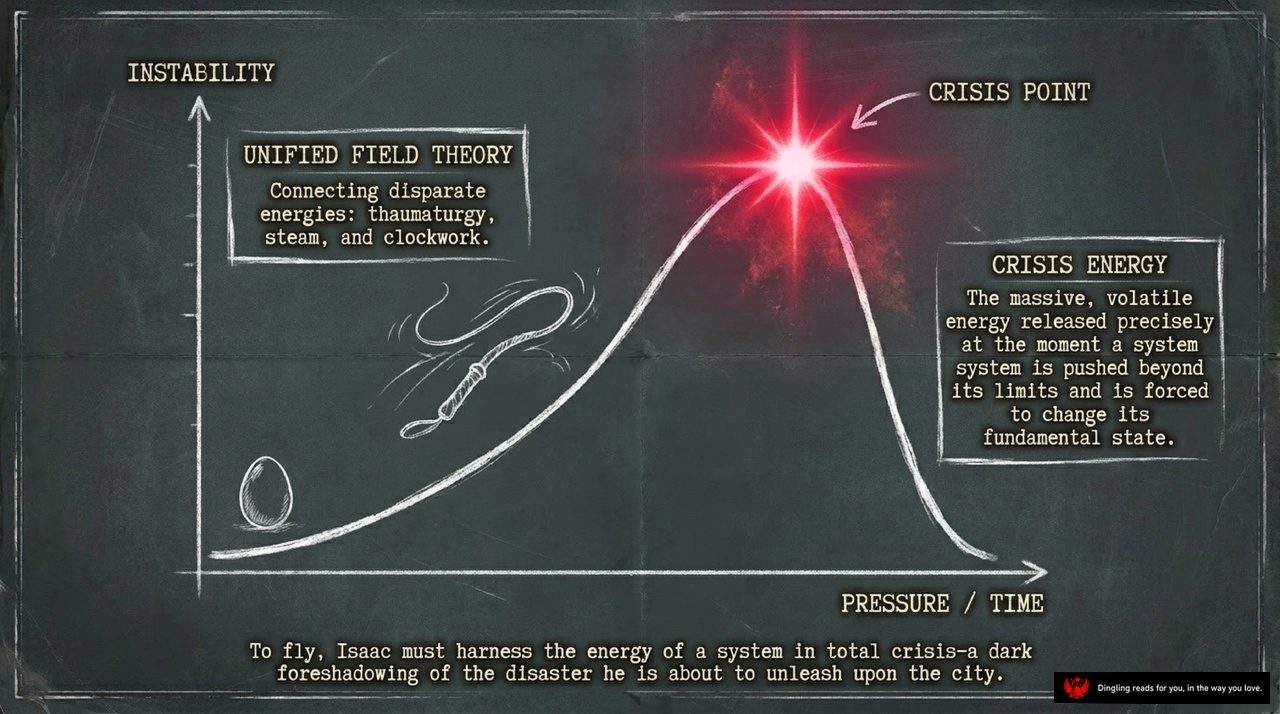
Look at this scene. It captures the terrifying climax of our story. We see the **Crisis Point** reached—a massive, volatile energy released precisely when the system is pushed beyond its limits. In our story, that system is the city itself, teetering on the edge of total collapse under the weight of the **Crisis Energy** unleashed by the five Moth People.
But notice the diagram's core concept: the **Unified Field Theory**. Isaac didn't just want to fix a bird; he was trying to connect disparate energies—thaumaturgy, steam, and clockwork—into one whole. That is exactly what he did tonight. He used the **Crisis Energy** of the Moth People, feeding them the collective consciousness of the city through the Weaver and the Machine Assembly, creating a pulse so powerful it overloaded their psychic wings.
The result? The Moth People, those creatures of pure dream and madness, were destroyed. The crisis was averted.
But look at the final note at the bottom: "To fly, Isaac must harness the energy of a system in total crisis—a dark foreshadowing of the disaster he is about to unleash upon the city."
The victory is pyrrhic. Isaac succeeded in saving his friends and the city, but he did it by triggering a catastrophic event that nearly consumed everyone. He saved New Crobuzon, but only by unleashing a disaster of his own making. As he looks out at the recovering city, he realizes the true price of flight: sometimes, to save the world, you have to become the very thing you are trying to destroy. The crisis is over, but the question remains: can Isaac ever truly control the power he has awakened?
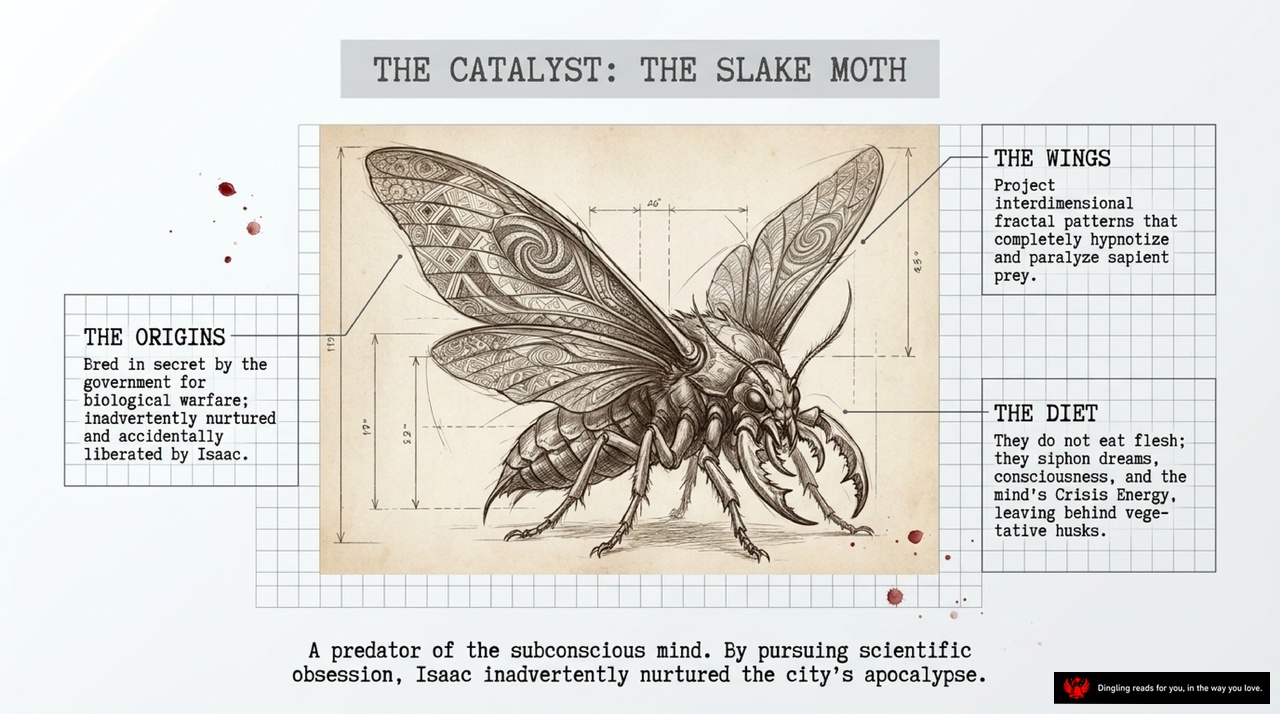
The Slake Moth. It's not just a bug; it's a nightmare engineered for the human mind. Look at the wings—they don't just fly; they project interdimensional fractal patterns designed to hypnotize and paralyze intelligent prey. This creature doesn't eat flesh. It siphons dreams, consciousness, and that raw "Crisis Energy" we feel when things go wrong, leaving nothing but a hollow, vegetative husk behind.
But where did this monster come from? The origins are darker than you'd expect. It was bred in secret by the government for biological warfare, accidentally nurtured, and then liberately set loose by Isaac. Isaac, a man consumed by scientific obsession, inadvertently created the very apocalypse that now threatens the city. He's a predator of the subconscious, and right now, he's the one who woke up the monster.

Imagine a city that never truly sleeps, but instead suffers from a collective nightmare. In New Crobuzon, the sky isn't empty; it's choked with toxic smog and dominated by flying machines that fight gravity just to exist. But tonight, something far more terrifying descends from above.
Look at this diagram, which maps out the terrifying escalation of what the book calls "An Epidemic of Nightmares." It starts with **The Feeding**. Isaac, a brilliant scientist, accidentally feeds a caterpillar a powerful hallucinogen called "Dream Arrow." This triggers rapid, unnatural growth, setting the stage for everything that follows.
Next comes **The Pupation**. That caterpillar spins a cocoon in the lab, secretly building immense, interdimensional power. Then, in **The Escape**, the fully formed creature—a Slake Moth—breaks free from its confinement and takes to the sky to hunt.
The final stages are the most horrifying. In **The Liberation**, driven by instinct, the moth breaches a secret government facility, freeing its four captive siblings. Finally, we reach **The Epidemic**. Five apex predators descend upon the city, paralyzing the metropolis and creating an epidemic of mindless victims. These aren't just monsters; they are psychic predators that feed on human dreams and subconscious fears, turning the entire city into a slaughterhouse of nightmares.
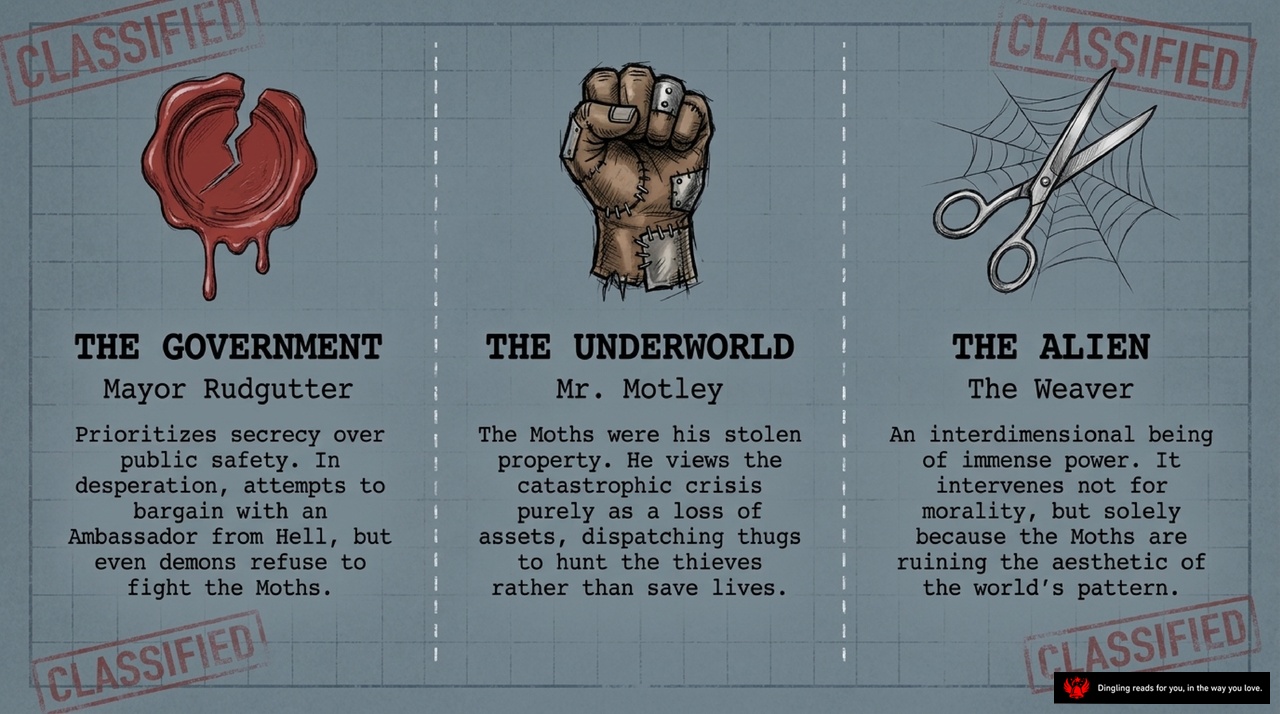
Look at this classified dossier. We've got three key players defining the chaos in New Crobuzon: The Government, The Underworld, and The Alien.
First, we have The Government, led by Mayor Rudgutter. His motto is secrecy over public safety. He's so desperate he's even trying to bargain with an Ambassador from Hell, but even demons refuse to fight the Moths. He's powerless.
Then, you have The Underworld, represented by Mr. Motley. He views the catastrophic crisis purely as a loss of assets. He's dispatching thugs to hunt the thieves rather than save lives. To him, the Moths were just stolen property.
Finally, there's The Alien: The Weaver. This is an interdimensional being of immense power. It intervenes not for morality, but solely because the Moths are ruining the aesthetic of the world's pattern.
So, we have a corrupt mayor, a ruthless crime lord, and a cosmic entity obsessed with order. It's a perfect storm.
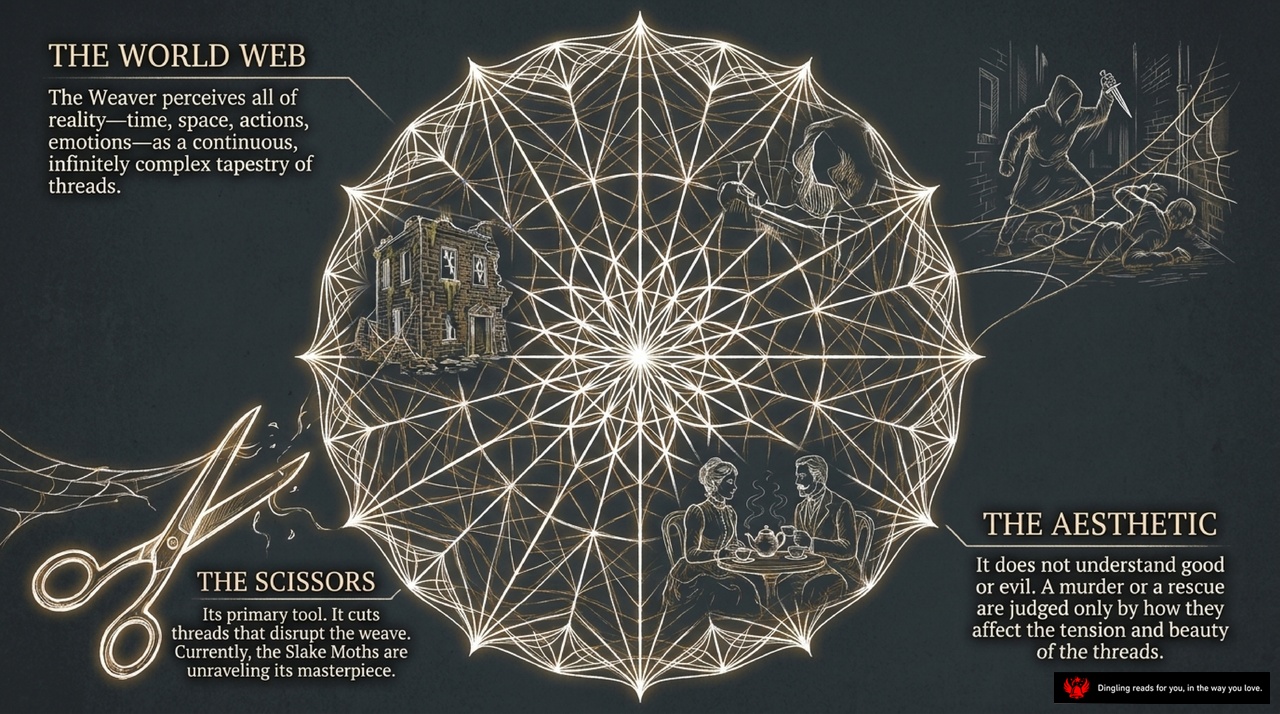
Look at this intricate web. It's not just a picture; it's the Weaver's entire reality. To the Weaver, time, space, emotions, and actions are all just threads in an infinitely complex tapestry. But what happens when someone tries to cut those threads? Enter The Scissors. In our story, these aren't just metal tools; they are the agents of chaos, specifically the Slake Moths, who are actively unraveling the Weaver's masterpiece.
Now, look at the right side. That's The Aesthetic. It's a terrifying concept: a universe that doesn't understand good or evil. A murder or a rescue isn't judged by morality, but solely by how it affects the tension and beauty of the threads. It's a cold, artistic logic where destruction is just another form of creation.
But amidst this cosmic dance, we have our characters. We see Isaac and Lin, a human and a beetle-headed woman, sharing a quiet moment. They represent the human connection trying to survive in a world obsessed with aesthetic balance. Meanwhile, the Scyther—our hero—faces a desperate mission. He's trying to fix a broken reality, fighting against forces that don't care about right or wrong, only about the pattern. It's a high-stakes game where the very fabric of existence is being torn apart, and only those willing to cut the threads can hope to save the day.

Look at this dossier. We've got the cast of characters defining the brutal, chaotic world of New Crobuzon.
First, we have Isaac. He's a guilt-ridden physicist, obsessed with weaponizing his "Crisis Theory" to fix a catastrophic mistake of his own making. Then there's Yagharek, a disgraced, wingless Garuda who is seeking redemption and purpose through sheer violence.
On the other side, we have Derkhan, a radical underground journalist and agitator armed with sheer fury and a printing press. And Lemuel, the underworld fixer providing tactical navigation through the deadly sewers.
Finally, at the center of it all, is The Construct Council. This is a newly sentient AI emergent from discarded machinery, offering a ruthless, calculated alliance. It's a perfect snapshot of a city where science, crime, and rebellion collide.
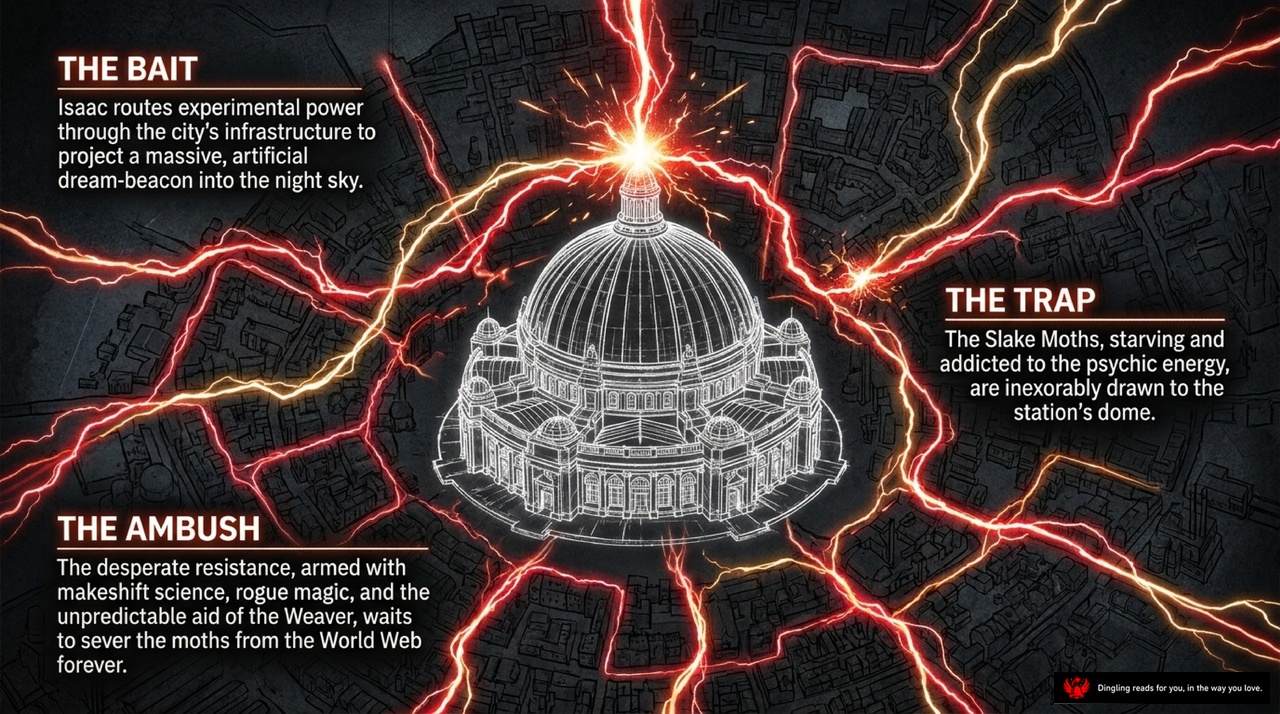
Look at this map of New Croydon. It's not just a city; it's a battlefield. In the center sits the station's dome, glowing like a lighthouse in the night. But what is this light? It's a trap.
On one side, we have the bait. Isaac, our brilliant but desperate scientist, is rerouting the city's very infrastructure. He's pumping experimental power into the grid to project a massive, artificial dream-beacon into the sky. He's doing this to create a signal, a beacon that only one thing can hear.
On the other side, the trap. The Slake Moths. These creatures are starving, addicted to the psychic energy of the city. They are drawn to this light like moths to a flame, inextricably pulled toward the dome. They aren't coming for a fight; they are coming to feed.
And right in the middle of this deadly game is the ambush. The desperate resistance, armed with makeshift science, rogue magic, and the unpredictable aid of the Weaver. They are waiting. They are ready to sever the moths from the World Web forever.
This is the moment where Isaac's genius meets the city's madness. He creates the signal to lure the enemy, while the resistance prepares to strike them down. It's a high-stakes gamble: if the beacon is too weak, the moths won't come. If it's too strong, the entire city might collapse under the psychic pressure. But right now, the lights are on, the moths are approaching, and the ambush is set.
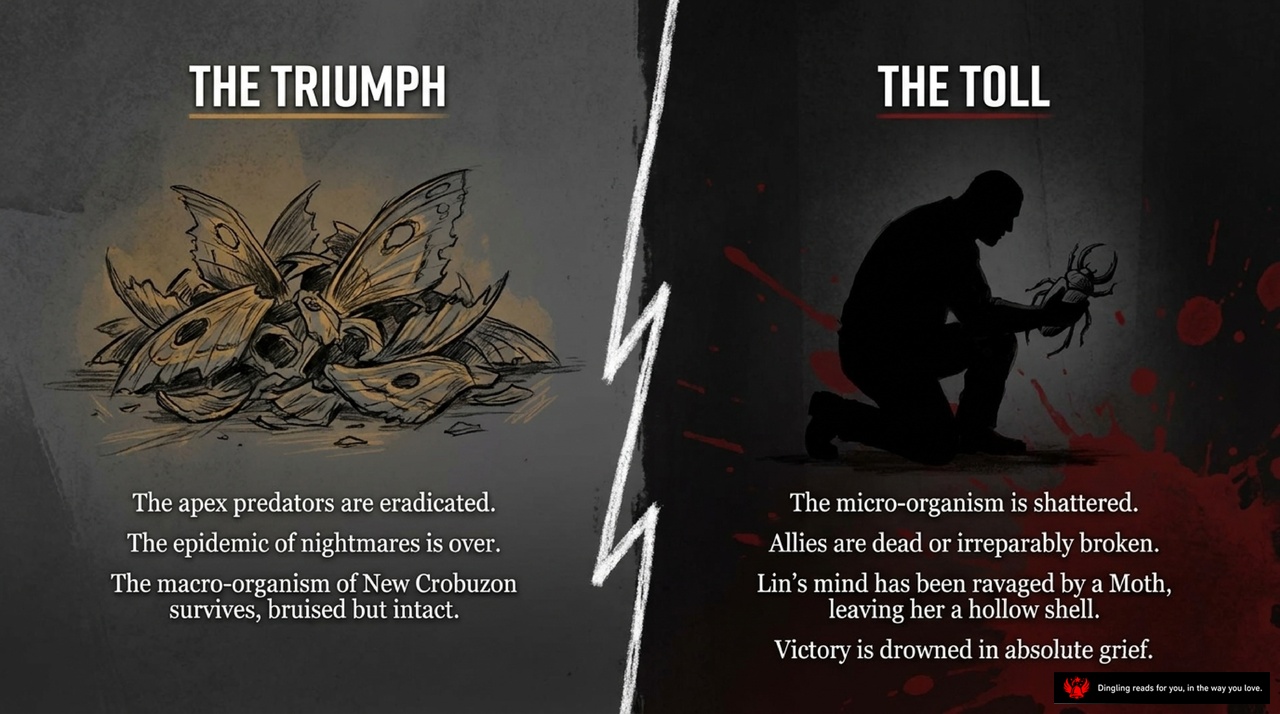
Look at this split screen. On the left, we see "The Triumph": the nightmare predators are eradicated, the epidemic is over, and New Crobuzon survives. On the right, "The Toll": the micro-organism is shattered, allies are dead, and Lin is left as a hollow shell, drowning her victory in absolute grief.
This isn't just a victory parade; it's a brutal trade-off. The city breathes again, but at what cost? Lin, the protagonist, has won the war against the Moth, yet she has lost herself. Her mind is ravaged, her friends are broken or gone, and she stands there, a silhouette against the blood, holding the very thing that destroyed her.
Meanwhile, Isaac faces his own crisis. He freed the city from the flying nightmares, only to unleash a new horror: the Satyrs. His obsession with helping Yagrik led him to trap a creature that now hunts his friends. He thought he was solving a physics problem, but he just created a monster.
The city of New Crobuzon is alive, bruised but intact. But for the people living in it, survival feels less like a triumph and more like a temporary reprieve from an endless nightmare. The price of order is chaos, and the price of safety is the soul of those who protect it.

The final metamorphosis. After uncovering the horrifying truth of his past, Yagharek realizes he does not deserve the skies. He actively plucks his remaining feathers and rejects the fringe existence of the underworld. He accepts his ground-bound reality. He chooses to walk forward not as a bird, nor as a monster, but as a man of the city.

The city of New Crobuzon isn't just a place you live in; it's a relentless machine designed to break you down and rebuild you from scratch. As the text warns, this place is an "engine of metamorphosis," ruthlessly reshaping the flesh, minds, and souls of everyone who dares to cross its borders. It's a world defined by violent transitions, where one state of being is constantly being overwritten by the next.
In such a chaotic environment, the question looms large: Can any of us truly remain ourselves? Or are we just temporary vessels for the city's endless changes? We see this everywhere. Look at the protagonist, Isaac. He's a scientist obsessed with flight, constantly trying to defy gravity and nature to help an injured eagle-man. His very purpose is transformation—trying to turn the impossible into reality. Then there's the insect-headed woman, Lin, who is forced to create a sculpture of a grotesque, multi-limbed creature named Mortley. She is literally sculpting chaos, trying to find order within a being that represents the ultimate hybrid of conflicting parts.
Even the city's infrastructure fights against gravity. Trains run on tracks suspended high above the streets, and airships drift through smog-choked skies. The architecture itself seems to be a struggle, buildings stretching upward as if trying to escape the oppressive, industrial weight of the ground. It's a place where the line between human, machine, and monster blurs until it disappears entirely. Whether it's the dream-eating moths feeding on the subconscious or the robotic parliament claiming divinity, New Crobuzon proves that in a world of constant change, identity is the one thing that feels most fragile. Are we the masters of our own story, or just fuel for the city's eternal evolution?