
Poor Charlie's Almanack: Complete Chapter-by-Chapter Summary
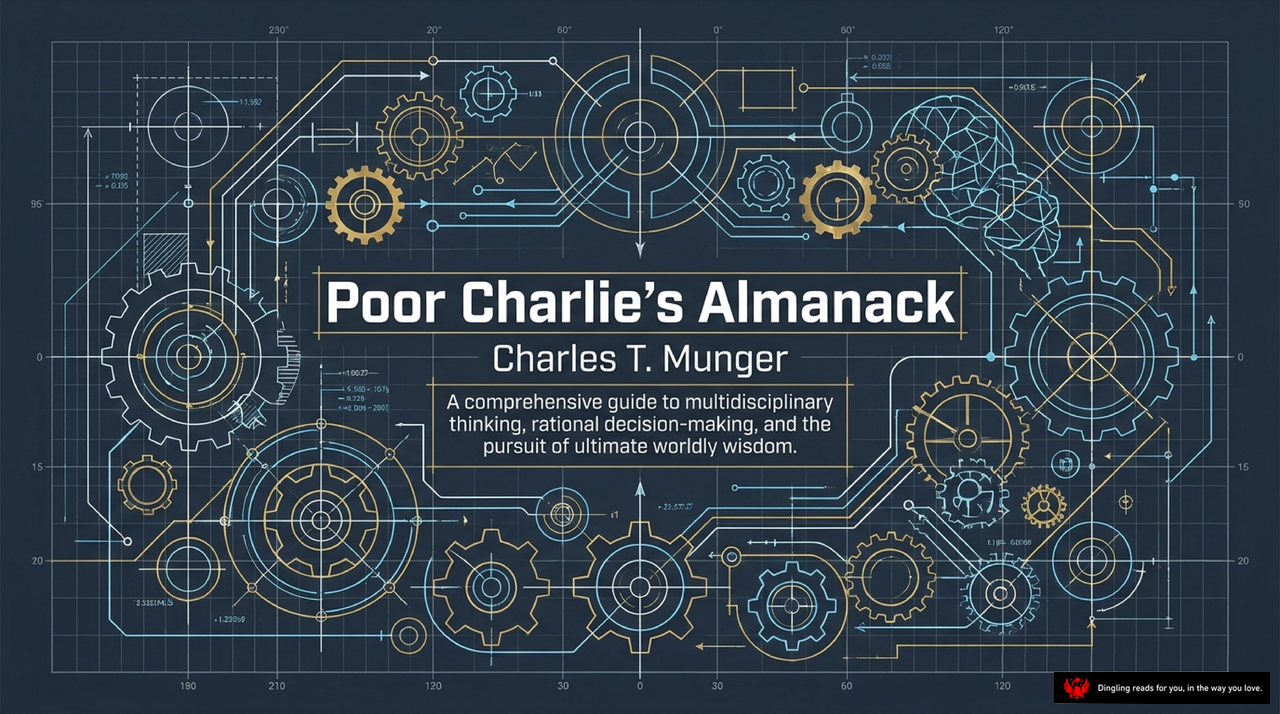
Welcome everyone. Today we're opening the pages of a true classic: "Poor Charlie's Almanack" by Charles T. Munger.
Notice the cover art—it's filled with gears and blueprints. That's no accident. Munger believed that wisdom is a mechanical system, something you can learn and build, not just a feeling.
This book serves as a comprehensive guide to multidisciplinary thinking. Munger argues that to make truly rational decisions, you need more than just business knowledge. You need to understand psychology, history, and the natural world.
It's all about the pursuit of ultimate worldly wisdom. Whether you are looking to build wealth or simply live a better life, these pages offer the mental models you need to navigate a complex world. Let's explore how Charlie Munger built his unique philosophy of success.
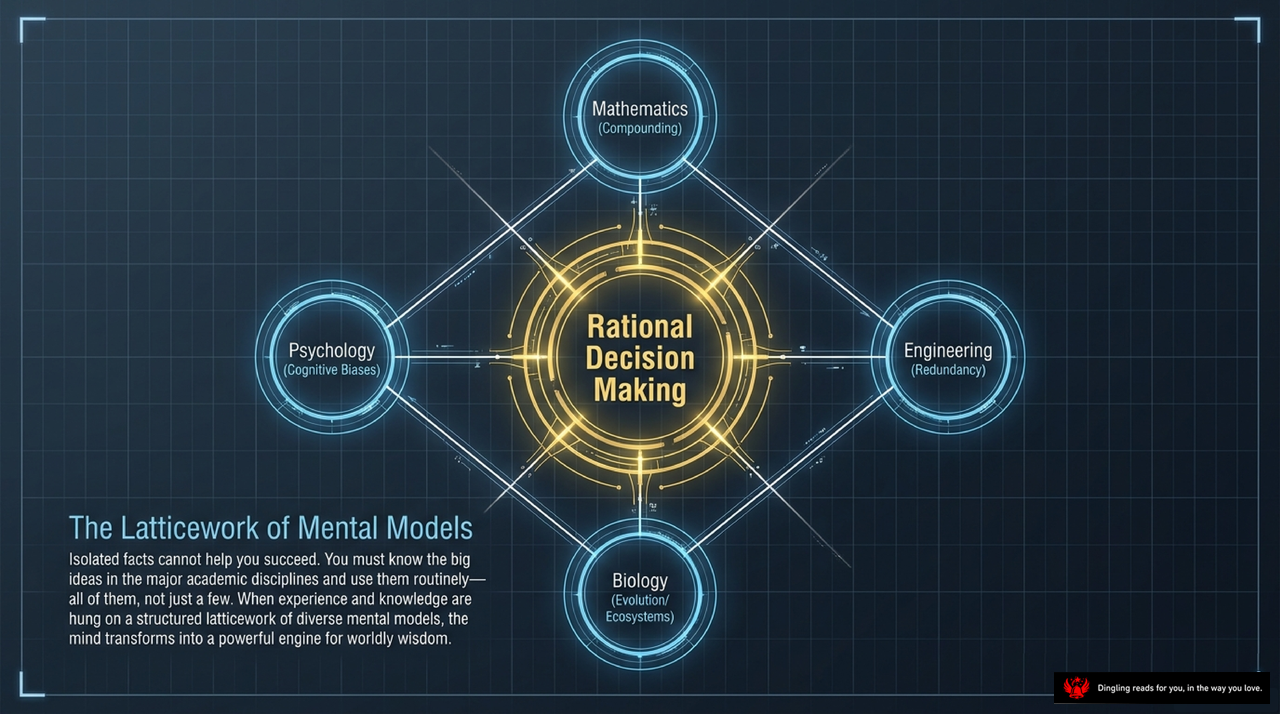
Have you ever stopped to ask why some people make better decisions than others, even when they have access to the same information? The answer often isn't about having more data. It's about how you connect the dots. Charlie Munger, the legendary investor, calls this the "Latticework of Mental Models."
As you see on this slide, rational decision making isn't built on isolated facts. In fact, Munger famously said, "Isolated facts cannot help you succeed." You need to know the big ideas from major academic disciplines and use them routinely. You must not just know a few; you need all of them.
Munger warned against the "Iron Hammer" tendency. He said that if you only have one tool, like a hammer, you tend to see every problem as a nail. That's why you need a diverse toolkit. Look at the four circles surrounding the center. First, Mathematics. This isn't just about crunching numbers; it's about understanding the power of compounding. It teaches you how small, consistent advantages can grow into massive results over time. Second, Engineering. This discipline teaches us the value of redundancy. In a complex world, having a backup plan isn't a luxury; it's a fundamental requirement for resilience.
Third, Psychology. This is perhaps the most critical for understanding human behavior. We are prone to cognitive biases—hidden traps in our thinking that make us act against our own best interests. Munger spent years studying these misjudgments to help us avoid them. Finally, Biology. This teaches us to view the market or a company as an ecosystem. It's about evolution, competition, and finding your unique niche, much like species in nature.
When you combine these models, something powerful happens. They don't just sit side by side; they reinforce each other. This creates what Munger called the "Lollapalooza effect," where different forces align to produce massive results. At the center of this framework is Rational Decision Making. It's the ultimate goal of integrating all these disciplines.
The slide text reminds us that when experience and knowledge are hung on a structured latticework of diverse mental models, the mind transforms into a powerful engine for worldly wisdom. It allows you to see the underlying logic of complex situations, helping you avoid obvious traps and spot opportunities that others miss.
Munger believed that this approach is the only way to navigate a chaotic world. By integrating these diverse perspectives, you stop reacting to symptoms and start understanding the root causes. You become less reactive to market noise and more focused on what truly matters.
So, don't just collect facts. Build your mental model. That's the real secret to making rational decisions and achieving long-term success.
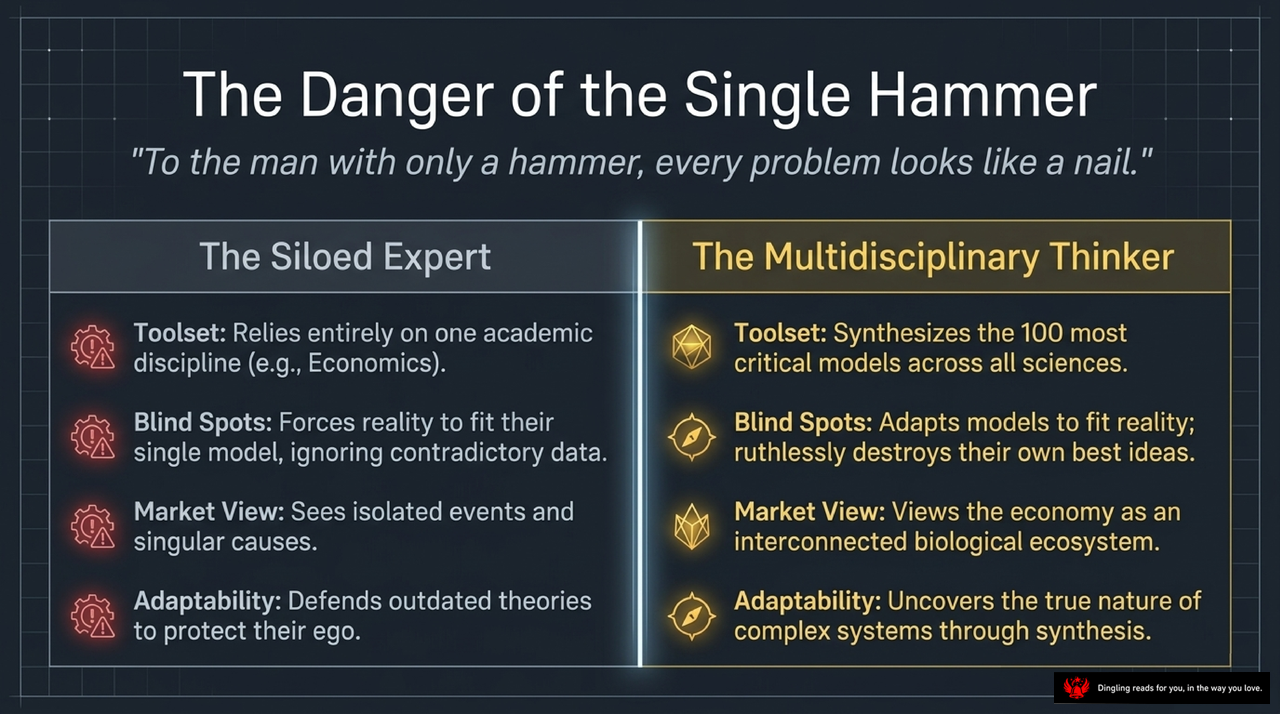
We often hear the famous quote attributed to Charlie Munger: "To the man with only a hammer, every problem looks like a nail." This isn't just a metaphor; it's a serious warning about the danger of relying on a single mental model in business and life.
Look at this slide. On the left, we see "The Siloed Expert." This person relies entirely on one academic discipline. Maybe they are a pure economist or a psychologist. Their biggest blind spot? They force reality to fit their single model, ignoring any contradictory data. In the market, they see isolated events and singular causes, missing the bigger picture. Worse, when things go wrong, they defend outdated theories just to protect their ego. They are stuck in the past, unable to evolve. For the Siloed Expert, the blind spot is their own model. For the thinker, the blind spot is the model itself.
Now, look at the right side. This is the "Multidisciplinary Thinker." Munger's core philosophy. Instead of one tool, they synthesize the 100 most critical models across all sciences. Math, physics, biology, psychology, economics—it's all connected.
Here's the critical difference. The Siloed Expert forces reality to fit the model. The Multidisciplinary Thinker adapts the model to fit reality. They are ruthless about destroying their own best ideas if new evidence proves them wrong. They don't see the economy as a collection of isolated numbers; they view it as an interconnected biological ecosystem.
This shift in perspective is everything. It changes how you see adaptability. The expert defends old theories. The thinker uncovers the true nature of complex systems through synthesis. In a world that is constantly changing, relying on a single lens is a recipe for failure. You need a mental toolkit that can handle complexity, not a single key that only fits one lock.
Munger didn't just want you to know more facts. He wanted you to think differently. Stop looking for a single answer. Start synthesizing. Because the truth is rarely found in one discipline. It's found where they all intersect. This is the power of the multidisciplinary approach. It requires humility to admit you might be wrong, and courage to change your mind. That is the real edge in any competitive field.
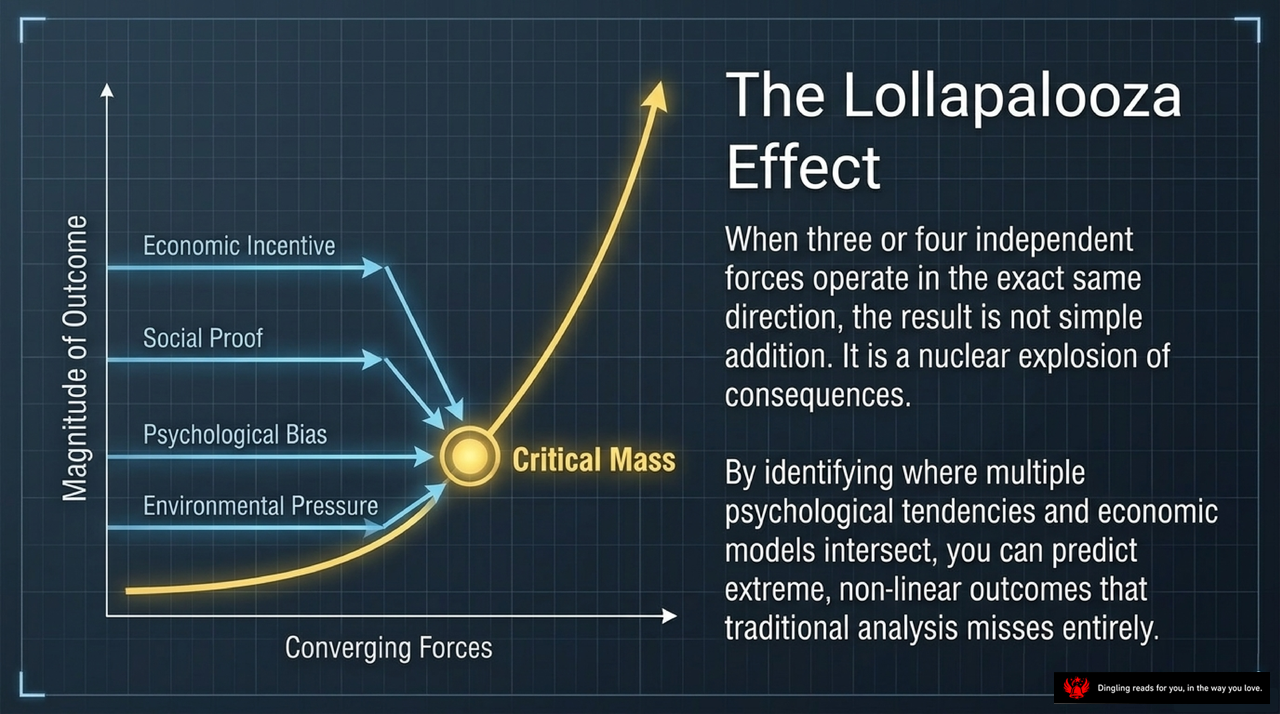
Let's talk about the Lollapalooza Effect. Look at the graph here. You see four arrows pointing inward: Economic Incentive, Social Proof, Psychological Bias, and Environmental Pressure. They all converge at a single point labeled Critical Mass. From there, the curve shoots straight up. Charlie Munger calls this the Lollapalooza Effect. He explains that when three or four independent forces operate in the exact same direction, the result is not simple addition. It is a nuclear explosion of consequences. Think about it. If you only look at one factor, you might think a business will grow slowly. But when you stack up the psychology of the consumer, the economic incentive, and the social proof, suddenly the growth becomes exponential. This is why Munger warns us that traditional analysis often misses these entirely. He believes by identifying where multiple psychological tendencies and economic models intersect, you can predict extreme, non-linear outcomes that traditional analysis misses entirely. This concept is central to his decision philosophy. It pushes us to avoid the hammer man tendency of using just one lens. Instead, we need to look at how these different forces interact. When they align, they create a massive impact that we can't ignore. Munger actually categorized common human misjudgment psychology into 25 specific tendencies. He realized that these aren't isolated. In reality, it's more about the combination of multiple tendencies. Early psychology research often looked at single tendencies in isolation, ignoring their stacking. But when you understand that these forces combine, you can explain extreme behaviors, like why cults form so quickly or why markets crash. It's about the synergy of the models. So, the next time you make a decision, don't just look at one angle. Check if these four forces are pushing in the same direction. That's where the real power lies. By mastering these models, you gain a clearer view of reality. You stop being a victim of these forces and start using them to your advantage. Whether you are investing or building a business, understanding these intersections gives you a significant edge over others who rely on linear thinking. It transforms how you see the world, turning complexity into clarity. This is the essence of Munger's wisdom. He taught us that intelligence isn't just about knowing facts, but about understanding how systems work together. When you ignore the Lollapalooza Effect, you might miss the biggest opportunities or the biggest risks in your life.
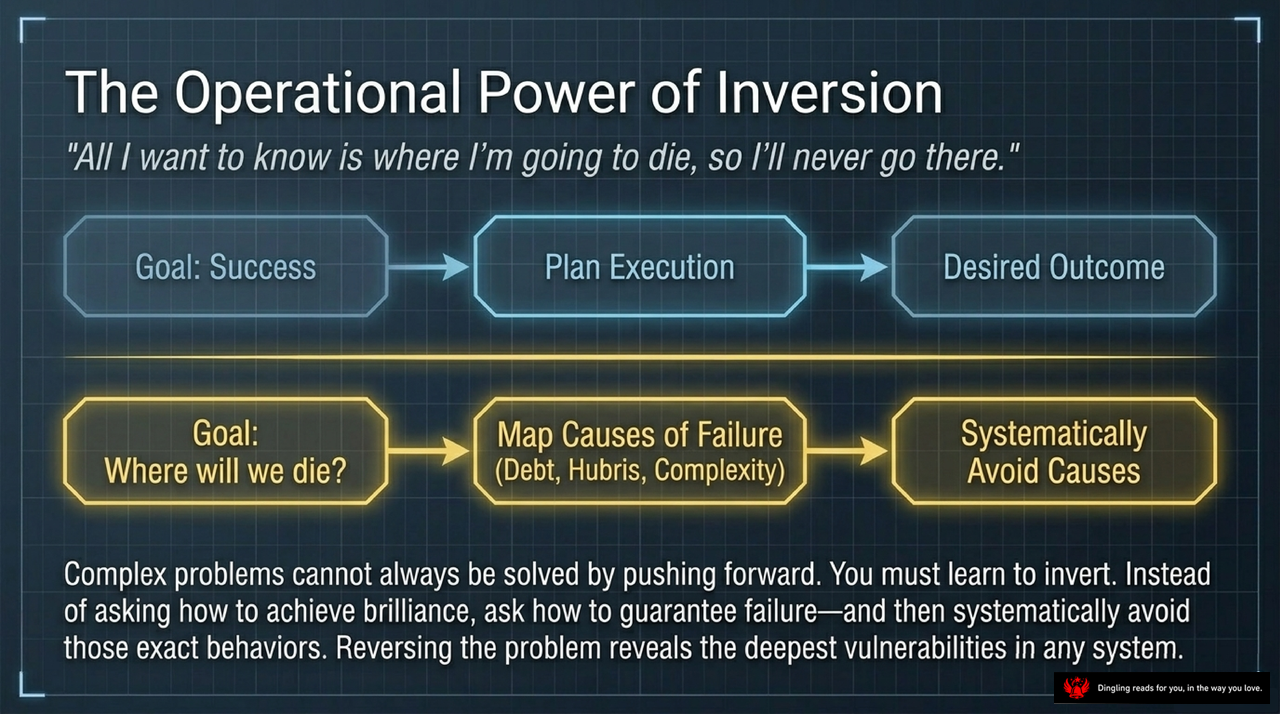
Welcome to the fourth slide. Today we're diving into one of the most powerful mental models in Charlie Munger's entire philosophy: The Operational Power of Inversion.
Look at that quote right up top: "All I want to know is where I'm going to die, so I'll never go there." It sounds a bit morbid, but it's actually a brilliant strategy for survival and success.
Most of us think about life like the top blue box shows: We start with a goal for success, make a plan, and hope for the desired outcome. We push forward, trying to build the perfect path to the finish line. But Munger suggests that's often the wrong way to play the game.
Instead, look at the yellow path below. It flips the script entirely. Instead of asking how to achieve brilliance, you ask: Where will we die? What are the causes of failure? The slide lists debt, hubris, and complexity as key culprits.
In the book, Munger emphasizes that the wisdom of life comes more from actively avoiding bad things than chasing great ones. He believes that a successful life doesn't require you to be the smartest or richest person; it just requires you to avoid the fatal traps like a bad marriage, drug addiction, or reckless driving.
He even calls this "reverse thinking." As the text notes, Munger prescribes four remedies to avoid pain. The fourth one is specifically about utilizing reverse thinking. He says, "Think backwards, always think backwards."
Think about how Darwin became a giant scientist despite mediocre grades. Why? Because he didn't just cling to his ideas. He actively looked for evidence to disprove them. He sought out the "death" of his own theories so he wouldn't be wrong.
So, when you look at this slide, notice how the yellow box says "Systematically Avoid Causes." That's the core of Munger's philosophy. Complex problems can't always be solved by pushing forward. You have to learn to invert. Instead of asking how to achieve brilliance, ask how to guarantee failure—and then systematically avoid those exact behaviors. Reversing the problem reveals the deepest vulnerabilities in any system.
It's about protecting yourself from the inevitable rather than trying to engineer a perfect future. Munger famously said that if you know where you are going to die, you'll never go there. It's a simple concept, but it changes everything.
So next time you face a tough decision, don't just ask how to win. Ask yourself where you're most likely to lose, and then make sure you don't go there. That's the operational power of inversion.
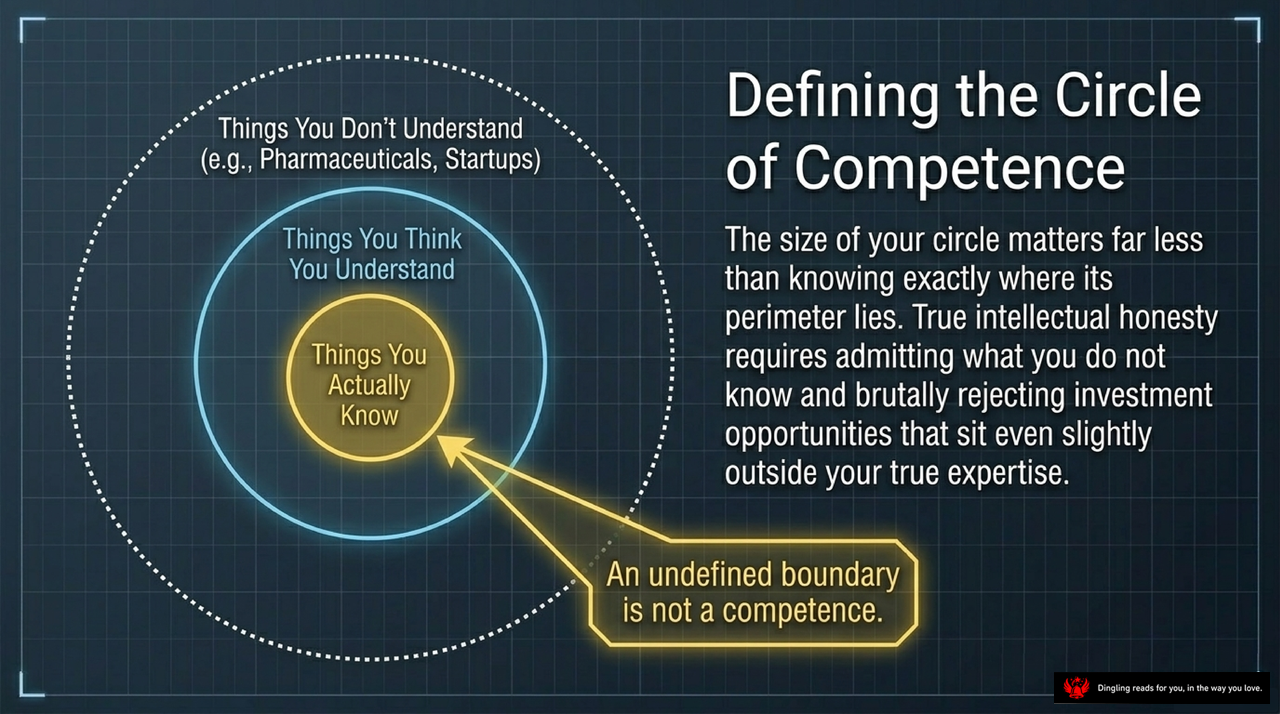
Let's take a look at this concept of the Circle of Competence. It's one of Charlie Munger's most critical tools for decision-making, and it's all about knowing your limits. Look at this diagram. It visualizes three distinct zones of knowledge. The innermost yellow circle represents 'Things You Actually Know.' This is your core expertise where you have real confidence. The middle blue ring is 'Things You Think You Understand.' This is the dangerous zone where overconfidence creeps in and mistakes become inevitable. And the outer dotted circle represents 'Things You Don't Understand,' like pharmaceuticals or startups, where you simply lack the necessary framework to make sound judgments.
Here is the crucial insight from Munger's philosophy: The size of your circle matters far less than knowing exactly where its perimeter lies. Many investors fail not because their circle is too small, but because they don't know the boundary. They mistake familiarity for mastery. True intellectual honesty requires admitting what you do not know. It's not about humility; it's about survival. You have to be willing to brutally reject investment opportunities that sit even slightly outside your true expertise.
Think about it this way. If you don't know the boundary, you're walking blindly into a minefield. Munger emphasizes that an undefined boundary is not a competence. You need to clearly define what you can do and, just as importantly, what you cannot do. This means staying out of high-tech trends or complex industries if you aren't genuinely equipped to analyze them. It's about protecting your capital by staying within the lines you can actually see.
Ultimately, this isn't just about investment; it's about life. Knowing your limits allows you to focus your energy where you can actually add value. It prevents you from making catastrophic mistakes in areas where you're merely guessing. So, the next time you face a decision, ask yourself: Do I truly know this, or do I just think I understand it? If the answer is the latter, it's time to walk away. This discipline is what separates the amateurs from the masters. Remember, defining your circle is the first step to expanding it responsibly.

Look at this grid here. It's called the 77-Square Batting Grid. And right in the center, we have what Charlie Munger calls the Fat Pitch. This is a powerful metaphor for how smart investors actually think about their capital.
In investing, there are no called strikes. You are not penalized for watching thousands of mediocre pitches sail by. This is the hardest part for most people because we feel social pressure to do something every day. We want action, but action without value is just noise. But the greatest advantage of the rational investor is the discipline to sit quietly on cash for years, waiting patiently until a once-in-a-decade opportunity lands exactly in the center of your sweet spot.
Think about the book's core philosophy. Munger and Buffett don't believe in constant trading. They believe in the sit and wait strategy. They focus on finding those rare opportunities where the odds are overwhelmingly in their favor. This isn't about being lazy; it's about being selective. They practice concentrated investment, putting all their chips on the table only when they have high confidence.
Why does this work? Because true wealth isn't built on frequent small wins. It's built on a few massive, correct decisions. The book highlights that if you miss the Fat Pitch, you just wait. But if you see it, you commit fully. This requires immense patience and the courage to do nothing when everything else is moving. It's about respecting the power of time and the value of certainty over activity.
Most investors fail because they try to catch every ball. They trade too much, pay too many fees, and lose their edge. But Munger teaches us that the market is often a waiting game. You need to be ready when the Fat Pitch arrives. When it does, swing heavily. Don't hesitate. This approach minimizes risk while maximizing the potential for life-changing returns. It's a simple concept, but it requires a complete shift in mindset from activity to patience. So, don't chase every ball. Wait for the one that matters.
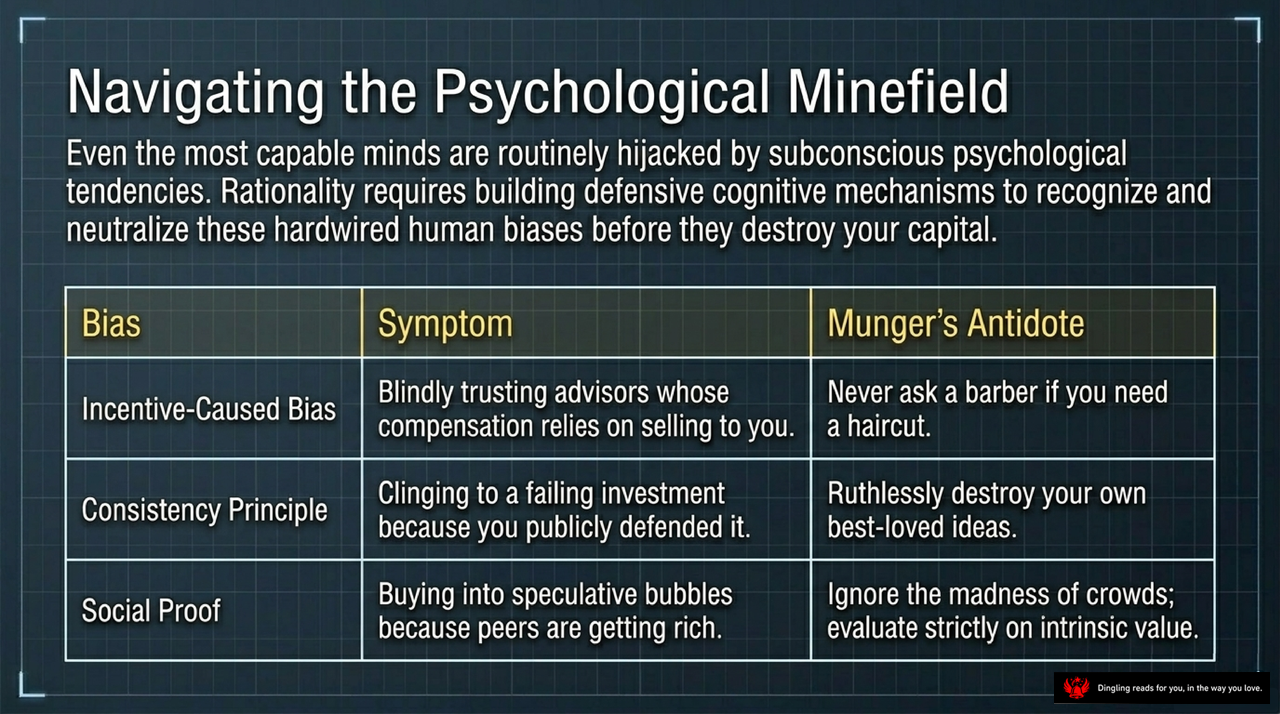
Navigating the Psychological Minefield is where we start today. Even the most capable minds are routinely hijacked by subconscious psychological tendencies. Rationality requires building defensive cognitive mechanisms to recognize and neutralize these hardwired human biases before they destroy your capital.
Why does this happen? Munger explains that our human brain's operation relies on simplified thinking programs, a legacy of natural evolution. These shortcuts help us process information quickly, but they often create hidden traps. He identified 25 specific tendencies that cover everything from instinctive reactions to social behaviors. These aren't just random errors; they are built-in defaults that can mislead even the smartest investors.
Let's look at the first row: Incentive-Caused Bias. We often blindly trust advisors whose compensation relies on selling to you. Munger gives a classic example: Never ask a barber if you need a haircut. This connects directly to the Reward and Punishment Super Reaction. If the advisor's pay comes from commissions, their incentive is to push products, not to find the best deal for you.
The second row is the Consistency Principle. We cling to a failing investment because we publicly defended it. This is the Avoid Inconsistency Tendency in action. We hate changing our minds once we've committed to a position, even when the data proves us wrong. The antidote is to ruthlessly destroy your own best-loved ideas. You must be willing to kill your own darlings to stay rational.
The third row is Social Proof. We buy into speculative bubbles because peers are getting rich. This is the Social Identity Tendency. We follow the crowd because it feels safe, but it often leads to disaster. The antidote is to ignore the madness of crowds and evaluate strictly on intrinsic value.
Sometimes, these biases don't act alone. Multiple tendencies combine to create what Munger calls the Lollapalooza effect, explaining extreme behaviors like cult mindsets or market crashes. Understanding these interactions helps us find solutions. Whether it's avoiding bad incentives, challenging our own ego, or ignoring the herd, the goal is simple: stay objective and disciplined. These psychological traps are real, but with the right mindset, we can navigate them successfully.
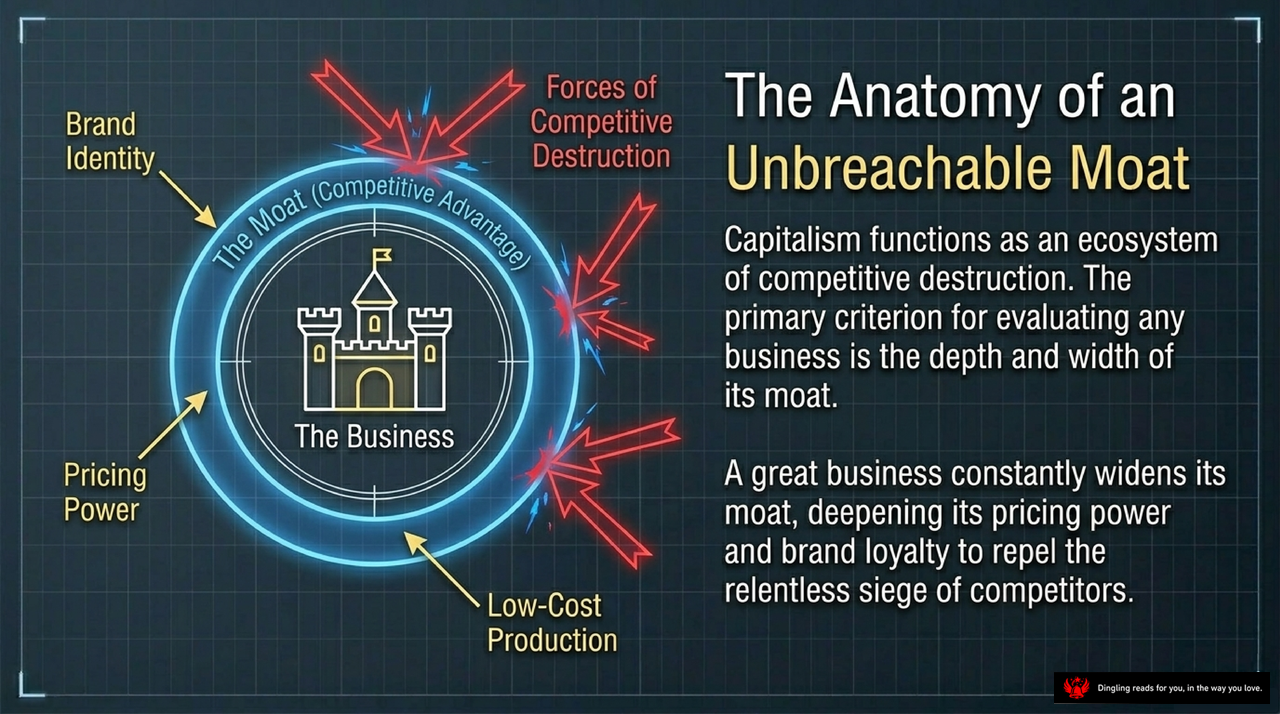
Let's talk about the harsh reality of business. We often imagine capitalism as a friendly marketplace, but Charlie Munger saw it for what it really is: an ecosystem of competitive destruction. Every company is under constant attack. Competitors are always looking for a weakness to exploit. In this environment, the primary criterion for evaluating any business isn't just its current revenue, but the depth and width of its moat.
Think of the business as the castle in the center of this diagram. Surrounding it is the moat, which represents your competitive advantage. But what actually fills that moat? Munger identifies three critical pillars that you see labeled here: Brand Identity, Pricing Power, and Low-Cost Production. These are the tools that build your fortress. A strong Brand Identity means customers choose you over anyone else, even if you charge more. Pricing Power means you can raise prices without losing your customer base. Low-Cost Production means you can operate cheaper than your rivals without sacrificing quality. This allows you to compete even when margins are thin.
Now, look at those red arrows attacking the circle. Those represent the relentless siege of competitors. They are constantly trying to cross that moat. If your moat is shallow, they will breach it. But here is the crucial insight: a great business doesn't just defend its moat; it constantly widens it. It actively deepens its pricing power and brand loyalty to repel this destruction. Munger reminds us that in this ecosystem, survival depends on making the cost of entry for new competitors prohibitively high.
Munger emphasizes that you must build a barrier that becomes harder and harder to cross over time. Competitors often try to copy the moat, but true moats are unique. This is why we look at companies with sustainable competitive advantages rather than those relying on fleeting trends. In the end, if you can't build an unbreachable moat, you're just a target in a game designed to eliminate you. So, when you analyze a company, ask yourself: How wide is their moat? And are they doing the work to make it wider every single year? That is the only way to survive the relentless siege.
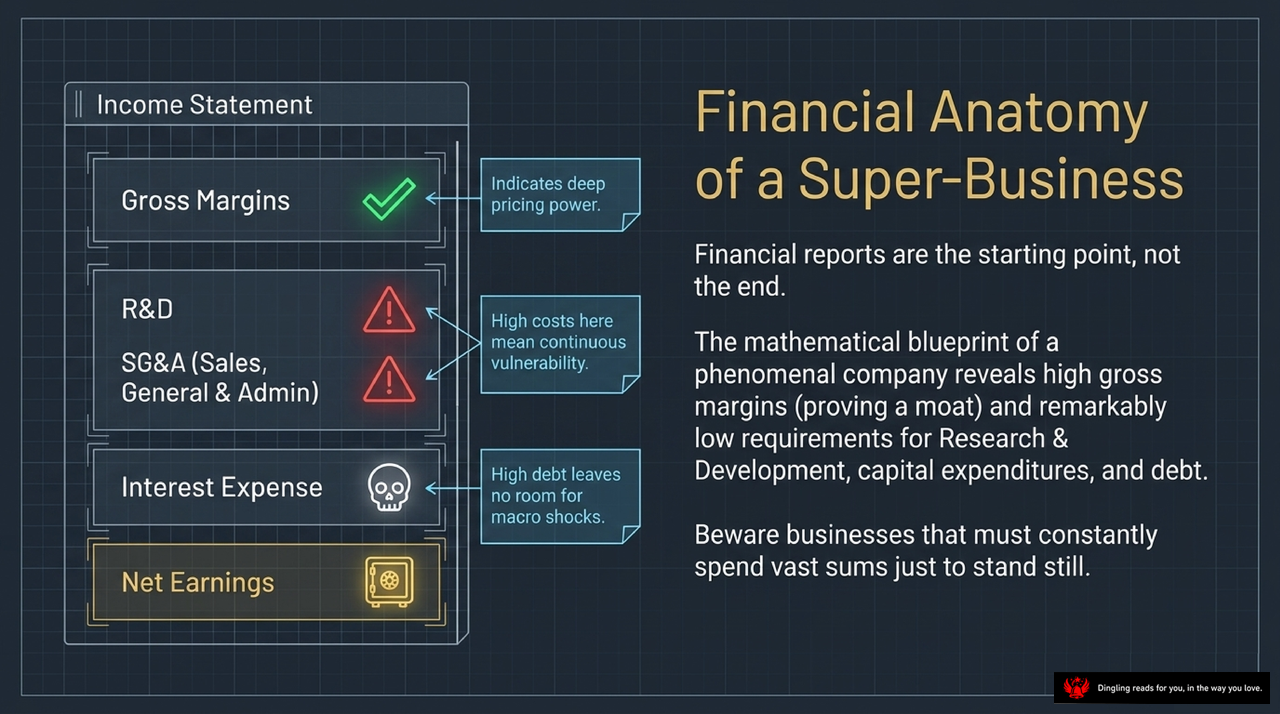
Let's break down the financial anatomy of a true super-business. Financial reports are just the starting point, not the end game. But if you know how to read them, they reveal the mathematical blueprint of a phenomenal company.
First, look at the top section: Gross Margins. In the book, we call this the signal of a deep moat. High gross margins prove pricing power. It means the company doesn't have to race to the bottom on prices to keep customers. The text suggests looking for companies where gross margin is consistently above 40%. This is the hallmark of a 'super-business.'
Now, look at the red warning signs: R&D and SG&A. The text warns us to beware businesses that must constantly spend vast sums just to stand still. High costs here mean continuous vulnerability. If a company needs to pour millions into research or sales just to maintain its current position, it's not an equity bond—it's a liability. We want companies that require remarkably low requirements for these expenditures. Ideally, SG&A should stay below 30% of your gross margin.
Next, the skull icon: Interest Expense. High debt leaves no room for macro shocks. In a downturn, debt kills. A super-business should have low debt requirements, allowing it to weather storms without selling assets or diluting shareholders. The text notes that interest expense should ideally be low, especially for consumer brands.
Finally, the gold safe: Net Earnings. This is the goal, but it's a byproduct of the structure above. As the text notes, we look for companies that act like 'equity bonds'—stable business models with predictable cash flows. We compare ten-year cumulative capital expenditures against net income. If that ratio is low, say under 50%, it means the company doesn't need to constantly reinvest to grow.
So, the logic is simple: High gross margins protect you. Low R&D and SG&A keep your capital requirements low. Low debt protects you from shocks. When you combine these, you get a business that generates Net Earnings without needing to constantly spend to survive. That is the financial anatomy of a winner. Beware the businesses that rely on burning cash to stay alive; they are not super-businesses, they are ticking time bombs. The math is clear: keep capital requirements low, and let the moat do the work.
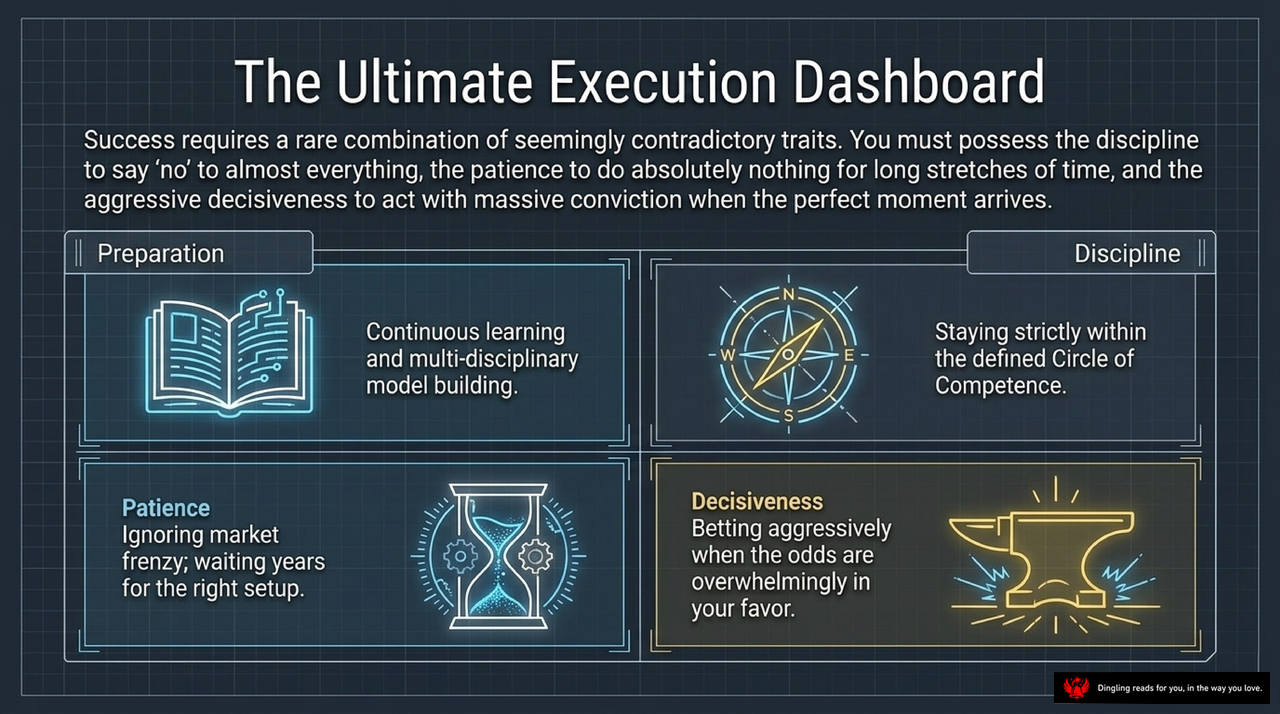
Welcome to the Ultimate Execution Dashboard. Let's face it: true success requires a rare combination of seemingly contradictory traits. You must possess the discipline to say no to almost everything, the patience to do absolutely nothing for long stretches of time, and the aggressive decisiveness to act with massive conviction when the perfect moment arrives. This balance is the difference between knowledge and execution.
First, Preparation. It starts with continuous learning and multi-disciplinary model building. You need to build a mental toolkit from various disciplines so you can decompose complex problems from different angles. Without this foundation, you're just guessing. Charlie Munger believed that the only winning move is to work hard and cultivate a lifelong learning habit.
Second, Discipline. This means staying strictly within the defined Circle of Competence. It's not about knowing everything; it's about knowing what you don't know. Munger would rather pass on a deal than risk crossing into a field he didn't understand. He simply avoided the third category entirely. This discipline protects you from the noise of the market.
Third, Patience. This is where most investors fail. It means ignoring market frenzy and waiting years for the right setup. You have to resist the urge to act when things are chaotic. If the odds aren't overwhelmingly in your favor, you sit on your hands. You don't interrupt the process. Patience isn't passive; it's an active choice to wait for quality.
Finally, Decisiveness. This is the flip side of patience. It means betting aggressively when the odds are overwhelmingly in your favor. It's not about frequent trading; it's about making a few key decisions with conviction. When you've done your homework, when you've waited, and when the setup is perfect, you act with force.
So, this dashboard isn't just a checklist. It's a reminder that execution is a mindset. You prepare, you stay disciplined, you wait, and then you strike. That's how you turn knowledge into results.
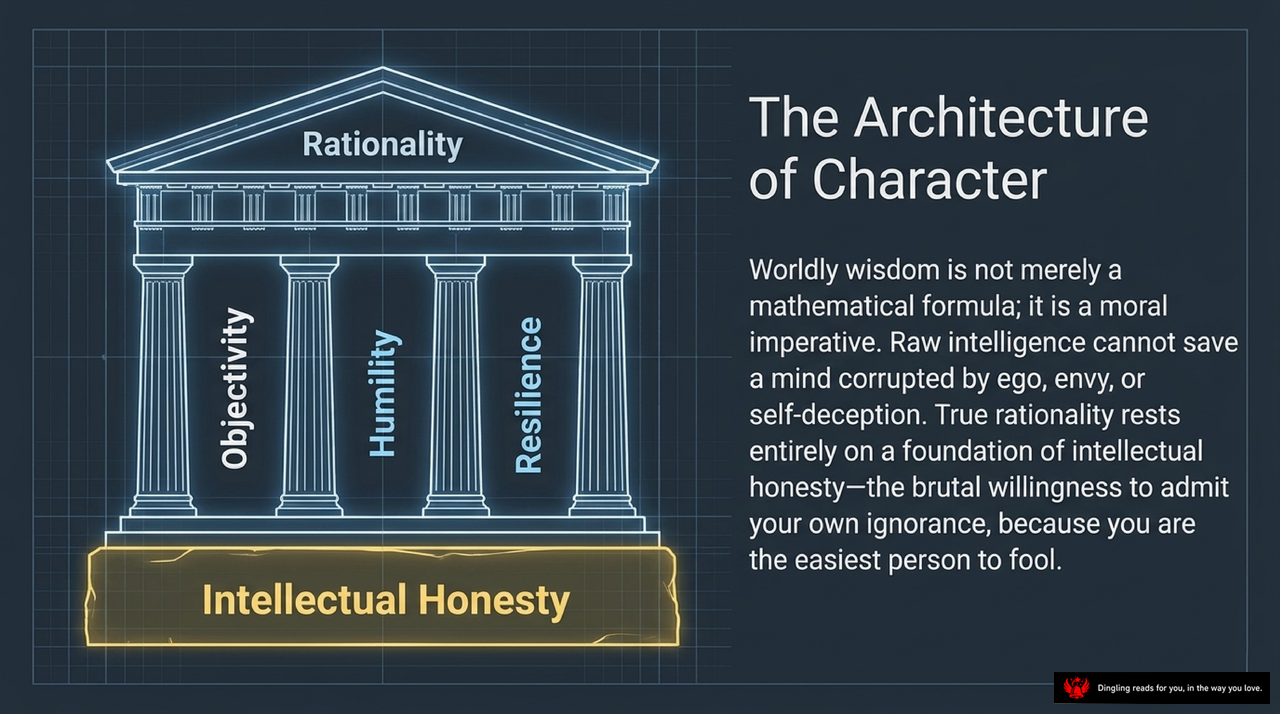
Welcome to this slide, which illustrates the "Architecture of Character." This diagram perfectly captures Charlie Munger's view on what makes a person truly successful in life and investing. Notice the base of this structure. It is labeled "Intellectual Honesty." Munger insists that this is the single most important element. As the text on the right reminds us, worldly wisdom is not merely a mathematical formula; it is a moral imperative. You can have high intelligence, but if you lack intellectual honesty, your mind is vulnerable to ego, envy, and self-deception.
Supporting this foundation are three key pillars: Objectivity, Humility, and Resilience. First, Objectivity. This means stripping away your biases to see the truth clearly. Without it, you are just fooling yourself. Second, Humility. Munger famously said, "You are the easiest person to fool." Admitting your ignorance is the start of wisdom. Third, Resilience. This is the ability to withstand pressure and keep your principles intact when things get tough.
All these elements support the roof, which represents "Rationality." But true rationality cannot exist without the foundation. He warns that raw intelligence cannot save a mind corrupted by ego, envy, or self-deception. Munger reminds us that if you refuse to admit your own ignorance, you are effectively imprisoning yourself. You might be smart, but if you aren't honest, your decisions will be flawed. So, remember this: Before you try to be rational, you must be honest. Build a character of integrity, and you will have the best chance at true success. This architecture is what separates the successful from the rest. Munger believed that true rationality rests entirely on a foundation of intellectual honesty—the brutal willingness to admit your own ignorance.
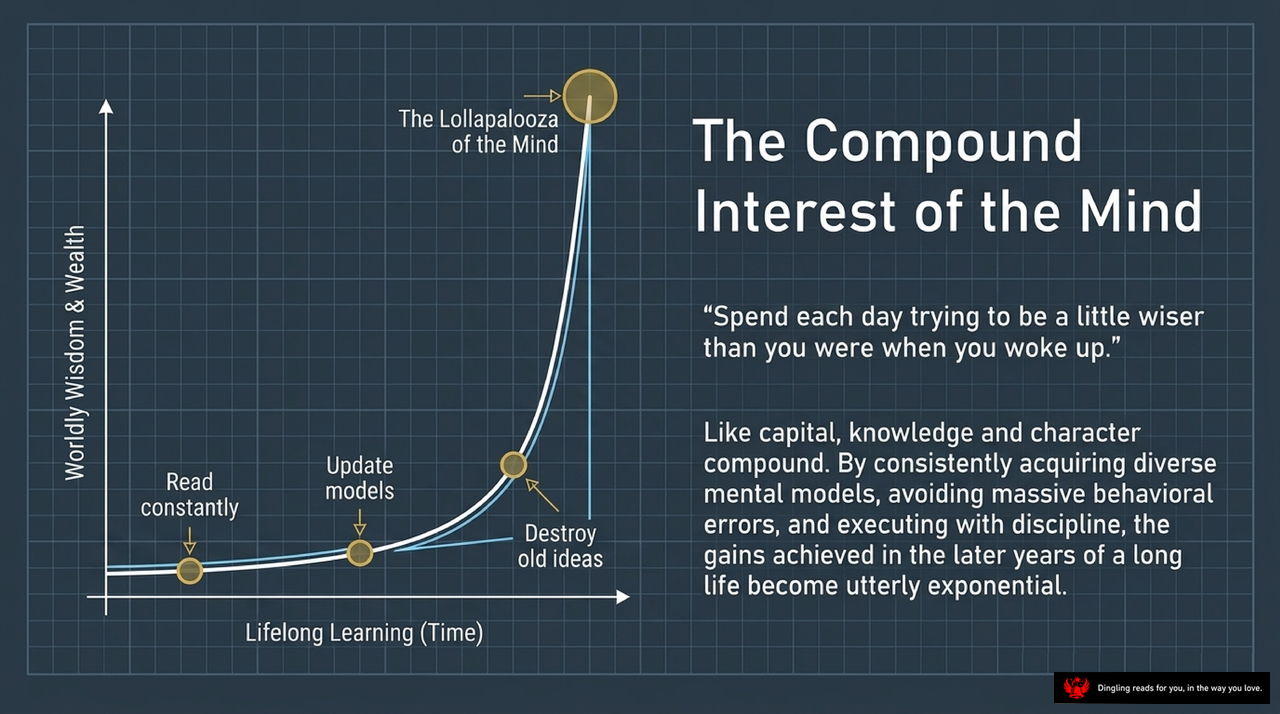
Imagine your mind as a bank account, but instead of dollars, you're depositing wisdom every single day. Charlie Munger calls this "The Compound Interest of the Mind." Look at this curve. It's not a straight line. It's an explosion. That top point? That's what he calls "The Lollapalooza of the Mind."
Munger's advice is simple but hard to execute: "Spend each day trying to be a little wiser than you were when you woke up." It sounds small, but consistency is key. It's about the daily grind of intellectual growth.
How do you actually do this? The graph breaks it down into three critical stages. First, "Read constantly." You have to feed your brain new information, not just skimming headlines, but diving into biographies and diverse fields. Reading connects the dots between unrelated ideas. Second, "Update models." You need to build a toolkit of mental models from different disciplines—history, psychology, math. Don't just use one hammer to fix every nail. Third, "Destroy old ideas." This is crucial. You have to be willing to kill your own ego and outdated beliefs when new evidence comes in. Munger hated being a "fossil," stuck in the past. Most people fail here because they can't admit they are wrong.
Why does this curve shoot up so steeply at the end? Because of compounding. Just like money, knowledge and character compound. By consistently acquiring diverse mental models, avoiding massive behavioral errors, and executing with discipline, the gains achieved in the later years of a long life become utterly exponential.
It's not about being a genius overnight. It's about the Lollapalooza effect, where all these mental models interact and reinforce each other. If you stick to this path of lifelong learning, you don't just get smarter; you become exponentially more capable. That's the secret to building worldly wisdom and wealth over a lifetime.

Let's be honest about how we usually approach life. We are constantly looking for shortcuts. We want quick formulas that give us instant answers. But true worldly wisdom isn't built that way. It is not achieved through isolated facts or quick tricks.
Charlie Munger, one of the smartest investors of our time, had a different take. He believed wisdom comes from painstakingly building a latticework of multi-disciplinary models. Think of it like this: instead of looking at the world through just one lens, you connect ideas from history, psychology, physics, and economics. You create a web of understanding. This latticework allows you to see the underlying forces at play, rather than just the surface symptoms. It helps you simplify complex problems and reveals the connections between things that others miss.
However, there is a major trap we all fall into. Munger called it the Iron Hammer tendency. If you only have one tool, you will look at every problem like it is a nail. You try to force a complex situation into a simple framework, and you end up making mistakes. You might be an expert in finance, but if you try to solve a human behavior problem using only financial models, you are going to fail.
So, how do you escape this? There are two critical things you need. First, you must maintain brutal intellectual honesty. This means admitting when you do not know something. It means challenging your own assumptions. You can't just ignore evidence that contradicts your view. You have to be willing to be wrong.
Second, you need the patience to wait for exponential opportunities. Great ideas are rare. The market is noisy. You cannot force action. You have to wait for the right conditions to align. This requires discipline.
So, I want you to ask yourself a hard question. Are you building a latticework of diverse mental models, or are you just walking through life as a man with a single hammer? The choice you make today defines your future. Do not let a single tool limit your potential. Build your framework. Stay honest. And wait for the big opportunities.