
Positioning in the 21st Century: Complete Chapter-by-Chapter Summary
Welcome to *Positioning in the 21st Century*, a strategic playbook co-authored by Al Ries, Laura Ries, and Zhang Yun. This isn't just about branding; it's about mastering the modern consumer mind by systematically dismantling outdated habits and leveraging the new rules of cognitive architecture. Think of this book as your essential guide to dominating the marketplace in an era where the brain is the ultimate battleground. We're going to explore how to stop fighting for attention and start owning the categories that matter, using timeless principles adapted for today's complex world.
Here is the spoken script for Slide 1, tailored for an American audience with a natural, engaging tone.
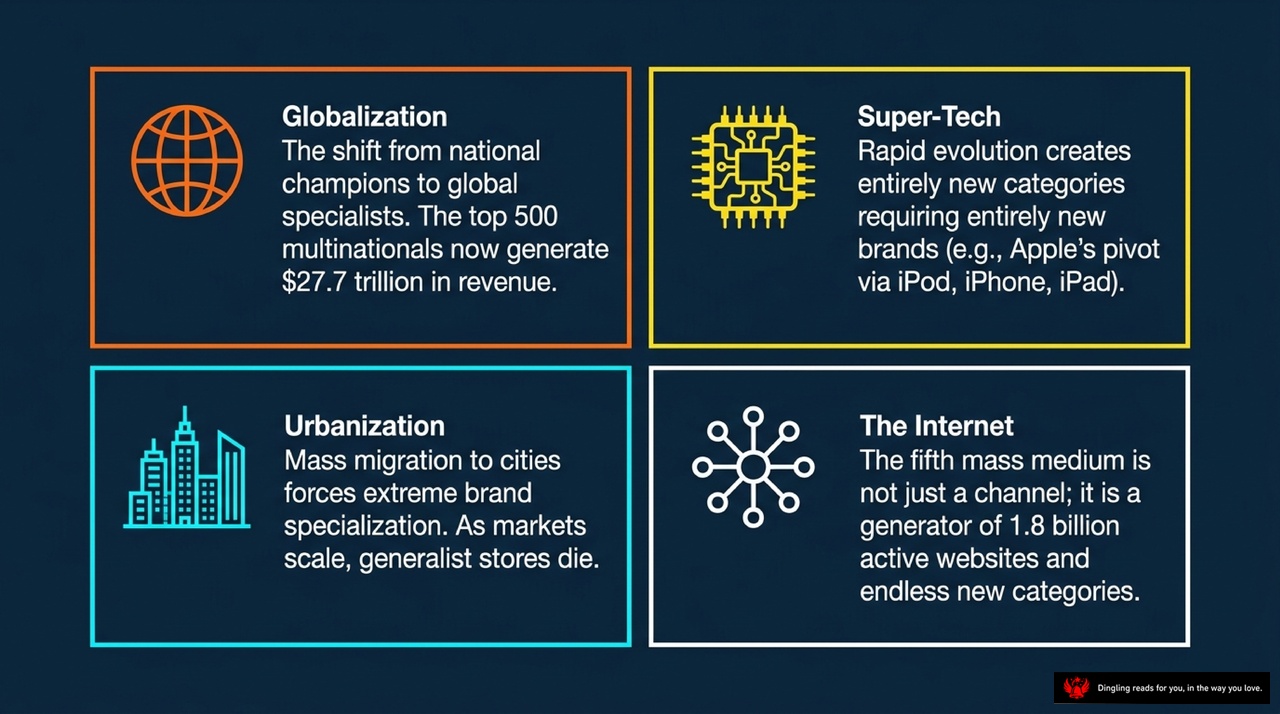
The future of business isn't about doing more; it's about doing the right things in the right markets. Look at these four massive forces reshaping our world. First, Globalization. We've moved from local champions to global specialists. The top 500 multinationals now generate a staggering $27.7 trillion in revenue. To survive, you can't just be a generalist anymore; you need to be a specialist in your field.
Second, Super-Tech. Rapid evolution creates entirely new categories that require entirely new brands. Think about Apple's pivot via the iPod, iPhone, and iPad. These weren't just updates; they were new brands for new categories. If you try to force an old brand into a new tech category, you'll likely fail.
Third, Urbanization. Mass migration to cities forces extreme brand specialization. As markets scale, generalist stores die. In a small town, one store might handle everything, but in a metropolis, you need a store that does one thing perfectly. The city rewards focus.
Finally, The Internet. This isn't just a new channel; it's the fifth mass medium. It's a generator of 1.8 billion active websites and endless new categories. It demands a completely different approach than the physical world.
The message is clear: to win in this era, you must embrace specialization, create new brands for new categories, and leverage the unique opportunities of the urban and digital world.

Look at this slide: "The 20th Century Illusion" versus "The 21st Century Reality." It highlights a massive shift in how we win in the marketplace. In the 20th century, the belief was that the best product wins through superior features, symbolized by factories and rising charts. But today, the reality is different: the first brand into the mind wins. Consumers inherently believe the market leader is the better product, even if it's not. This is illustrated by the glowing brain on the right, representing the power of perception over actual quality.
Consider the case of the 16-bit commercial PC. DEC actually invented it first, but they hesitated. IBM launched first, seized the mind, and dominated the entire category. This is the core lesson: in our hyper-competitive, fast-paced world, being first in the consumer's mind often matters more than being technically superior. If you wait to be the "best," someone else has already become the "standard." To succeed today, you don't just need a better product; you need to be the category itself before anyone else even thinks about it. Speed and mental dominance are the new currencies of success.
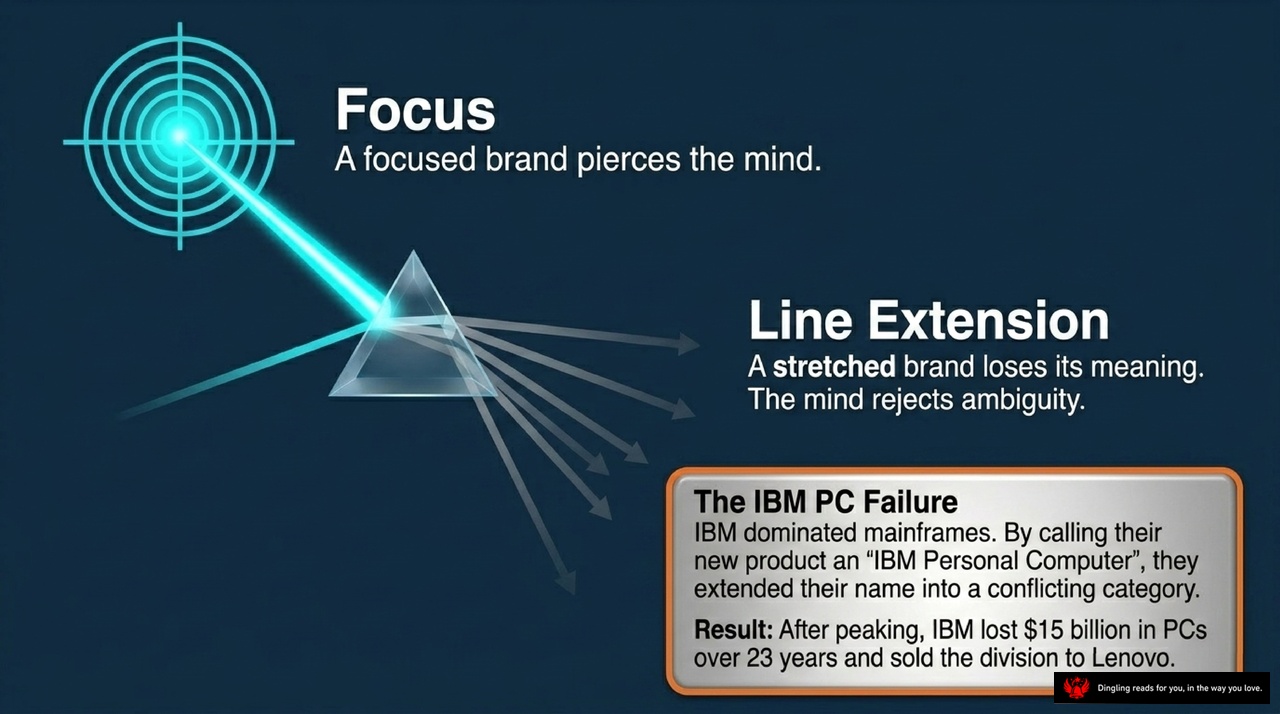
Today's slide tackles the most dangerous trap in branding: the difference between **Focus** and **Line Extension**. Look at the graphic—a laser beam hitting a prism. On the left, we have **Focus**. A focused brand pierces the mind. It's like that laser beam; it's intense, direct, and undeniable. When a brand stays narrow, it becomes the obvious choice for that specific need.
On the right, we see **Line Extension**. The text warns that a stretched brand loses its meaning. When you try to do too much, the consumer's mind rejects the ambiguity. They don't know what you stand for anymore.
The real-world example here is the **IBM PC Failure**. This is a classic case of line extension gone wrong. IBM dominated the massive mainframe market for decades. But when they tried to enter the personal computer space, they didn't create a new, distinct identity. Instead, they simply called it the "IBM Personal Computer." They stretched their prestigious mainframe name into a completely different, conflicting category.
The result was devastating. After peaking, IBM lost $15 billion in PCs over 23 years and eventually had to sell the entire division to Lenovo. They tried to be everything, and in doing so, they became nothing to the consumer. This slide proves a simple truth: in a crowded world, being the best at one thing is far more powerful than trying to be good at everything.
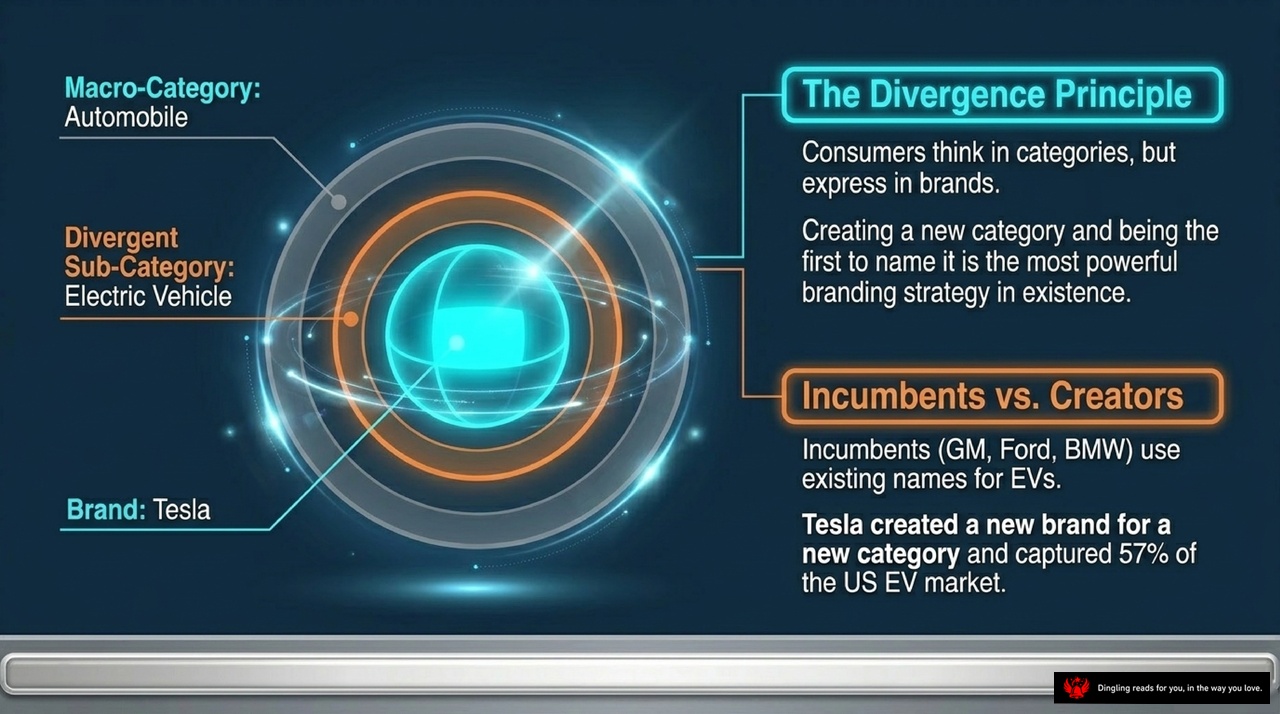
Let's talk about how you actually buy things. Think about it: when you crave a soda, do you think "I want a soda"? No, you think "I want a Coke." That's the core rule of branding: consumers think in categories, but they express themselves through brands. Your brand's entire value depends on owning a specific category in the customer's mind. If you lose that category connection, you lose your identity.
This slide illustrates exactly how this works using the "Divergence Principle." Look at the diagram: the macro category is the Automobile, but Tesla didn't just add electric cars to the existing mix. Instead, they created a completely new sub-category: the Electric Vehicle. By being the first to name it, they seized the most powerful branding strategy in existence.
Now, look at the battle between "Incumbents vs. Creators." The old guard—GM, Ford, BMW—tried to use their existing names for electric vehicles. They fought within the old rules. But Tesla created a new brand for a new category. The result? They captured 57% of the US EV market. The lesson is clear: don't try to be a better version of an old brand. Create a new category, name it, and dominate it. That's how you win.

Look at this slide. It reveals one of the most powerful truths in business: the Duality Principle. If you can't be the first, you must be the opposite. The human mind simply doesn't have room for a follower and a leader; it only accepts a leader and a contrarian.
On the left, we see the logic: "If you cannot be first, be the opposite." Don't try to be a slightly better follower. Instead, become the exact mirror image of the market leader.
On the right, the data proves it. Take Red Bull. As the Category Creator, it captured the mind first and now owns a massive 43% market share. It defined the energy drink category.
But look at what happened next. Monster didn't try to be "better" than Red Bull with a smaller can or a slightly sweeter taste. Instead, it became the Contrarian. It did the exact opposite: it launched a much larger 473ml can. By positioning itself as the bold, high-volume alternative to Red Bull's classic small can, Monster seized the second position and now owns 39% of the market.
This is the secret to becoming a number two brand. You don't compete on being better; you win by being different. You find the leader's weakness and become its perfect opposite. Whether it's size, price, or target audience, the moment you stop trying to be a follower and start being the strategic opposite, you unlock the second place in the consumer's mind. That is how you survive and thrive when you can't be first.
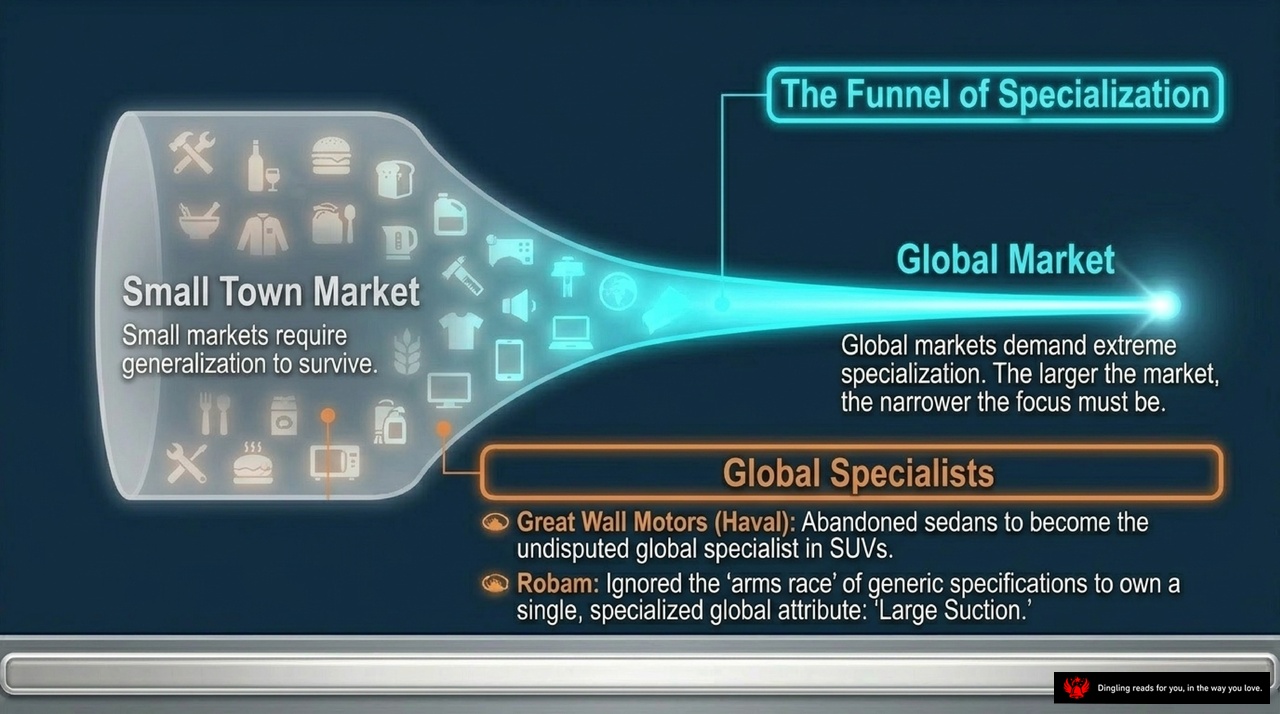
Imagine a world where the biggest cities demand the most specialized services. This is the core logic of the modern economy: as markets grow, they force businesses to narrow their focus to survive. Think about it—while a small town grocery store can sell everything from bread to beer, a massive global market or a bustling metropolis like New York only rewards extreme specialization.
The slide illustrates this perfectly with "The Funnel of Specialization." On the left, we see the "Small Town Market," where generalization is the key to survival. But as that market expands into the "Global Market" on the right, the funnel narrows drastically. Global markets don't want generalists; they demand extreme specialization. The larger the market, the narrower the focus must be.
Look at the examples listed at the bottom: Great Wall Motors (Haval) abandoned sedans entirely to become the undisputed global specialist in SUVs. Similarly, Robam ignored the endless arms race of generic kitchen specs to own a single, specialized attribute: "Large Suction." These aren't just companies; they are "Global Specialists." They realized that to dominate the world, they had to stop trying to be everything and instead become the absolute best at one specific thing.
This shift from generalization to specialization is the only way to win in the global arena. If you try to be a generalist in a global market, you will be crushed by competitors who are experts in a single niche. So, the lesson is clear: if you want to go global, you must narrow your focus, sharpen your expertise, and become the undisputed leader of that specific category.

In the battle for the consumer's mind, logic alone isn't enough. To truly own a category, you need a "Verbal Nail"—that specific word or positioning concept you want to drive home, like "Authentic Mexican Beer." But words sit in the left brain, which handles logic and takes time to process. To make that concept stick permanently, you need the "Visual Hammer." This is a visual element that bypasses logic and instantly triggers emotion in the right brain. Think of Christian Louboutin's signature red sole or Corona's iconic lime slice; these visuals create an immediate, powerful connection that words simply cannot achieve.
The magic happens when you combine them. The Visual Hammer provides the emotional force required to drive the Verbal Nail permanently into the consumer's memory. This is the core of "Cognitive Mechanics." While 90% of brands have a logo, only 1% possess a true Visual Hammer. The difference is that a hammer doesn't just sit there; it actively hammers the nail into place. Without this visual synergy, your brand remains just another option in the noise. To win, you must ensure your visual symbol perfectly matches your verbal promise, creating a unified brand experience that resonates instantly and stays unforgettable.

The human brain isn't a filing cabinet for words; it's a music player for sounds. If you want your message to stick, you have to speak to the right side of the brain—the one that handles images and emotion. That's where the "Visual Hammer" comes in. Think of it as the physical force that drives your brand's message home.
Look at this diagram. At the center is "Cognitive Retention," the goal of every marketer. Surrounding it are five acoustic mechanics—Rhyme, Alliteration, Repetition, Reversal, and Double Entendre—that make slogans memorable. But without a visual anchor, those words vanish instantly.
Consider the examples here. Folgers uses rhyme to make coffee feel like a comforting morning ritual. M&M's uses alliteration to highlight its unique texture. De Beers plays on a double entendre, linking diamonds forever to love. Secret uses reversal to flip the script on gender norms. And Geico relies on repetition to promise real savings.
But the most powerful tool is the visual element itself. The Coca-Cola contour bottle, the Marlboro cowboy, or the red sole of Christian Louboutin—these aren't just logos; they are emotional triggers that bypass logic and speak directly to desire. When you combine a sharp visual with a catchy acoustic hook, you don't just sell a product; you embed an idea in the customer's mind that is impossible to forget.
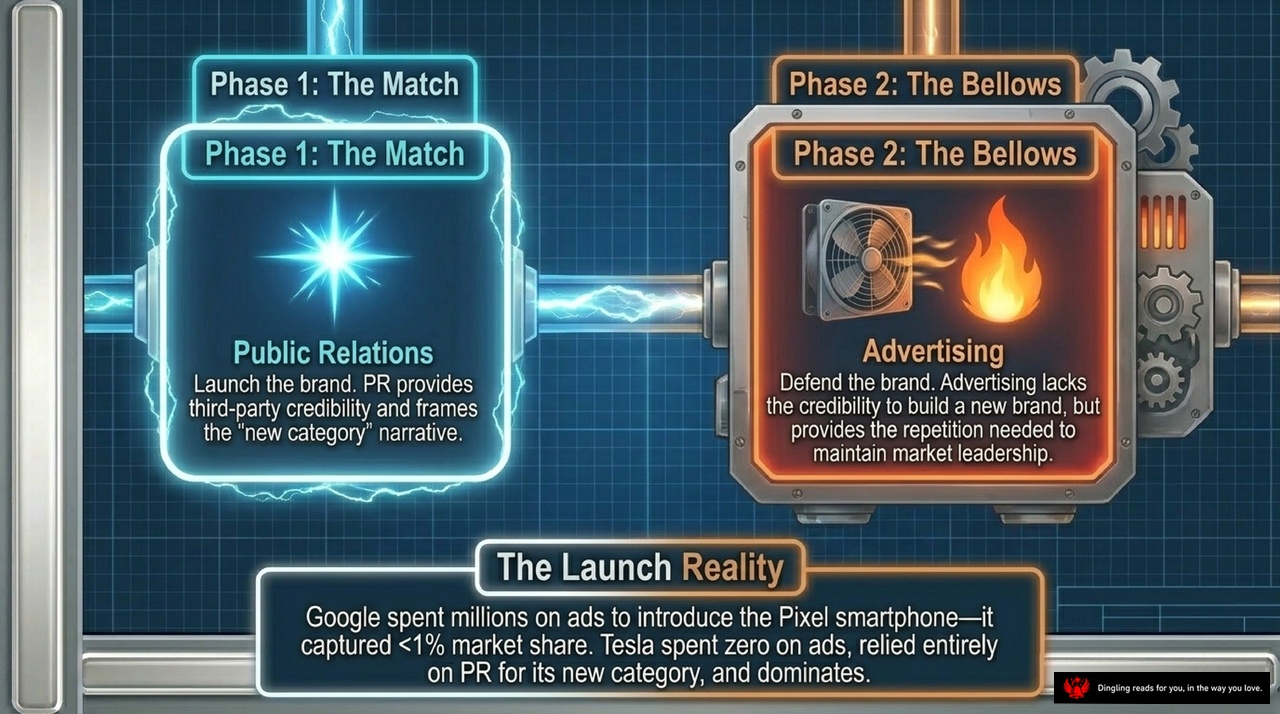
Let's talk about the reality of launching a new brand. The slide clearly breaks this down into two distinct phases: "The Match" and "The Bellows."
Think of "The Match" as your Public Relations strategy. In this initial phase, you don't buy ads; you ignite interest. You rely on third-party credibility to frame your brand as a revolutionary new category. It's about creating that spark of novelty that makes people stop and look.
Once that spark is lit, you move to "The Bellows." This is where Advertising comes in. But here's the catch: advertising lacks the inherent credibility to build a brand from scratch. Its real job is to defend the territory you've already claimed. It provides the repetition needed to keep the flame burning and maintain your market leadership.
The slide illustrates this with a powerful comparison. Look at the bottom section, "The Launch Reality." Google spent millions on ads to introduce the Pixel smartphone, yet it captured less than 1% of the market share. Why? Because they tried to force a new category with paid ads before establishing credibility.
Contrast that with Tesla. They spent zero on traditional advertising. Instead, they relied entirely on PR to define the entire electric car category. By letting the news and the innovation speak for itself, they dominated the market. The lesson is clear: start with the match of PR to define your category, then use the bellows of advertising to fan the flames and protect your position.
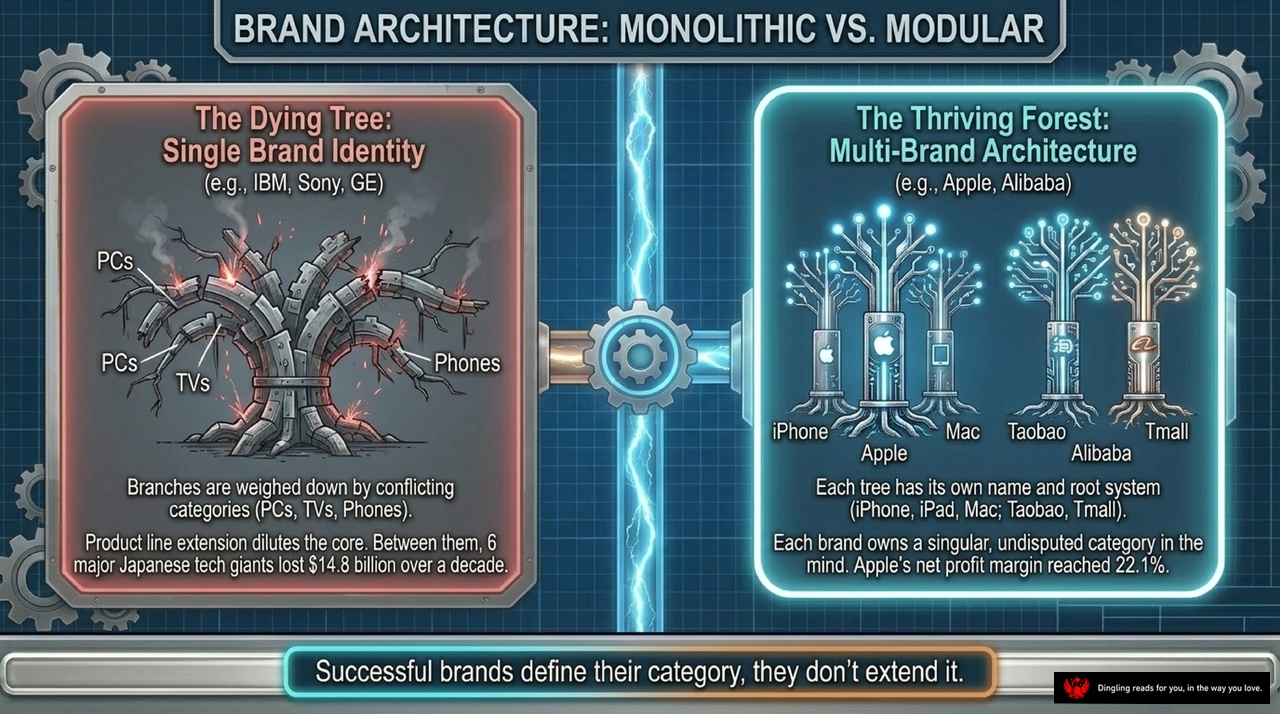
On this slide, we see the stark contrast between two brand architectures: the "Dying Tree" of a single identity versus the "Thriving Forest" of a multi-brand system. Look at the left side first. This represents the monolithic approach, where giants like IBM, Sony, and GE tried to do everything under one roof. The image shows a tree weighed down by conflicting branches—PCs, TVs, and phones all tangled together. The text warns us that product line extension dilutes the core. When you try to be everything, you become nothing. In fact, six major Japanese tech giants lost over $14.8 billion in a decade because their single brand identity couldn't support such diverse and competing categories.
Now, look at the right side: the thriving forest. This is the modular architecture used by winners like Apple and Alibaba. Notice how each tree stands alone with its own root system and name. Apple has distinct trees for iPhone, iPad, and Mac, while Alibaba has separate brands for Taobao and Tmall. The key insight here is that each brand owns a singular, undisputed category in the consumer's mind. Because they focus on one thing, they become the definition of that thing. That's why Apple's net profit margin reached 22.1%.
The bottom line, highlighted in the footer, is simple but powerful: successful brands don't extend their categories; they define them. Instead of trying to stretch one legacy brand across too many products, smart companies build a forest of specialized brands. They let each brand dominate its specific niche, ensuring clarity and strength. So, the choice is clear: be a dying tree weighed down by too many branches, or be a thriving forest where every tree stands tall and strong in its own right.

Look at this comparison table. It perfectly captures the seismic shift in how we build brands today. On the left, you see the 20th Century playbook: big, monolithic brands trying to be "National Champions" across the entire country. They relied on passive media like print and TV, stretched their names to cover everything, and used brute-force advertising to push a single product line.
But look at the right side. This is the 21st Century reality. We are no longer national champions; we are **Global Specialists**. The medium has shifted from passive TV to the Internet, which actively creates entirely new categories. Instead of stretching a brand name, we are now **Category-Led**, creating the box that defines the market. We've moved from verbal slogans to **Visual Hammers** that trigger emotion instantly. The launch mechanism has evolved from buying ad space to building **Public Relations** for credibility. And perhaps most importantly, the architecture has changed from a single, monolithic brand into a **Multi-Brand Ecosystem**.
The lesson here is clear: the old way of being "everything to everyone" is dead. To win globally, you must stop trying to be a generalist and start specializing. You need to build an ecosystem of focused brands, each dominating a specific niche, rather than one giant brand trying to do it all. This is how you scale from a local player to a global leader.
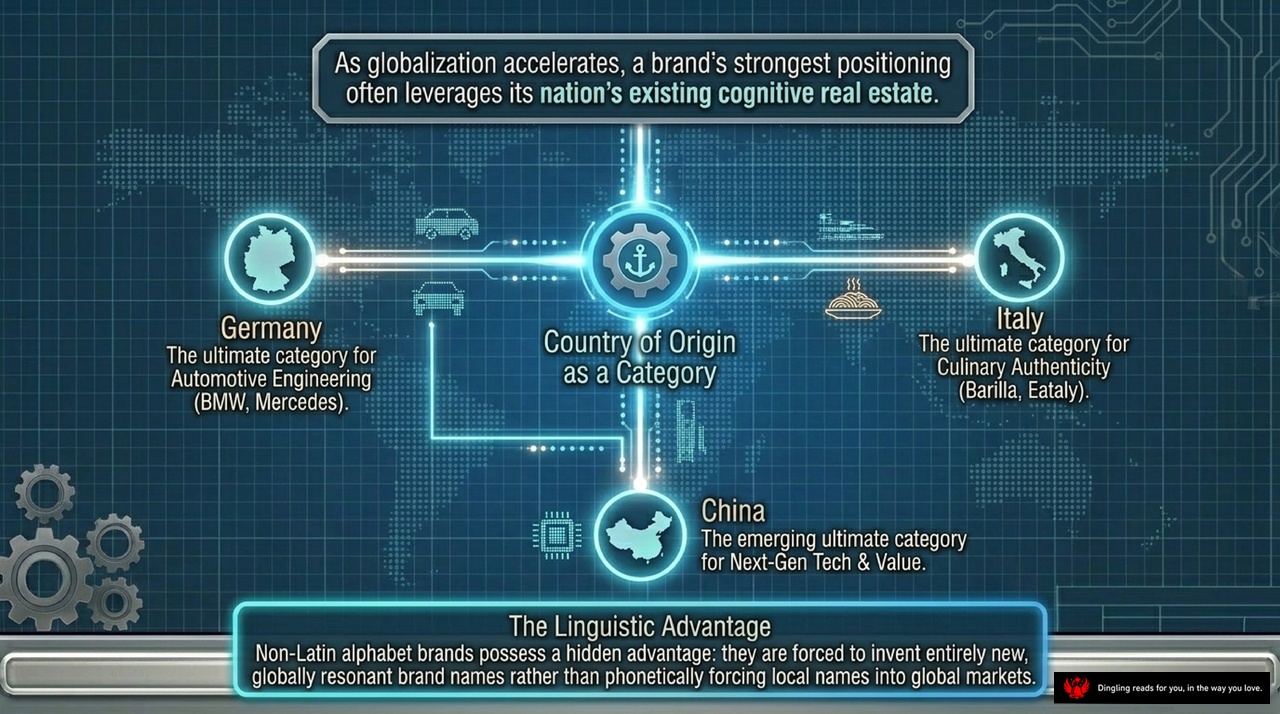
As globalization speeds up, the smartest move for any brand isn't to fight harder, but to leverage the "cognitive real estate" of its home country. Think of it as renting out the most valuable address in the global mind.
Look at the map. Germany owns the ultimate category of Automotive Engineering. When you see BMW or Mercedes, your brain instantly connects them to precision engineering because that is Germany's global identity. Similarly, Italy isn't just a country; it is the ultimate category for Culinary Authenticity. Brands like Barilla and Eataly succeed globally not just because of their food, but because they carry the weight of Italian heritage.
Now, look at the emerging giant at the bottom: China. It is rapidly becoming the ultimate category for Next-Gen Tech & Value. As a non-Latin alphabet nation, China has a hidden linguistic advantage. Instead of struggling to force a difficult phonetic translation into English markets, Chinese brands are forced to invent entirely new, globally resonant names. This allows them to bypass the baggage of their local language and build a fresh, powerful identity from scratch.
This is the power of "Country of Origin as a Category." By aligning your brand with a nation's strongest global association, you borrow its credibility instantly. Whether it's German engineering, Italian flavor, or Chinese innovation, the most effective positioning strategy is simply to stand where the world already expects greatness.

The ultimate battlefield has permanently shifted from physical market-share to cognitive mind-share. Victory belongs solely to those who build new categories, forge distinct visual hammers, and architect multi-brand ecosystems.
Will you continue to dilute your brand fighting over an overcrowded market, or will you create a new category and build an empire in the mind?