
Positioning: Complete Chapter-by-Chapter Summary

Welcome to the world of Positioning, the revolutionary framework by Al Ries and Jack Trout that changes everything about how we win in business. Think of marketing not as a product battle, but as a war for the human mind. In today's saturated world, where we are bombarded with hundreds of dollars worth of advertising every single year, your brain is a fortress that only accepts what it already knows. Trying to force new ideas into a full mind is like trying to pour water into a bucket that's already overflowing.
So, how do you break through? The answer is simple but powerful: be first. History is filled with names we remember because they were the first—the first person to fly solo across the Atlantic, the first to walk on the moon. In business, being the first to enter a customer's mind is the ultimate advantage. Once you occupy that spot, it's incredibly hard for anyone else to displace you. If you can't be first, trying to be second is often as good as being invisible. Positioning isn't about creating something new from scratch; it's about finding the empty space in the customer's mind and filling it with your brand. It's about understanding the battlefield before the fight even begins.
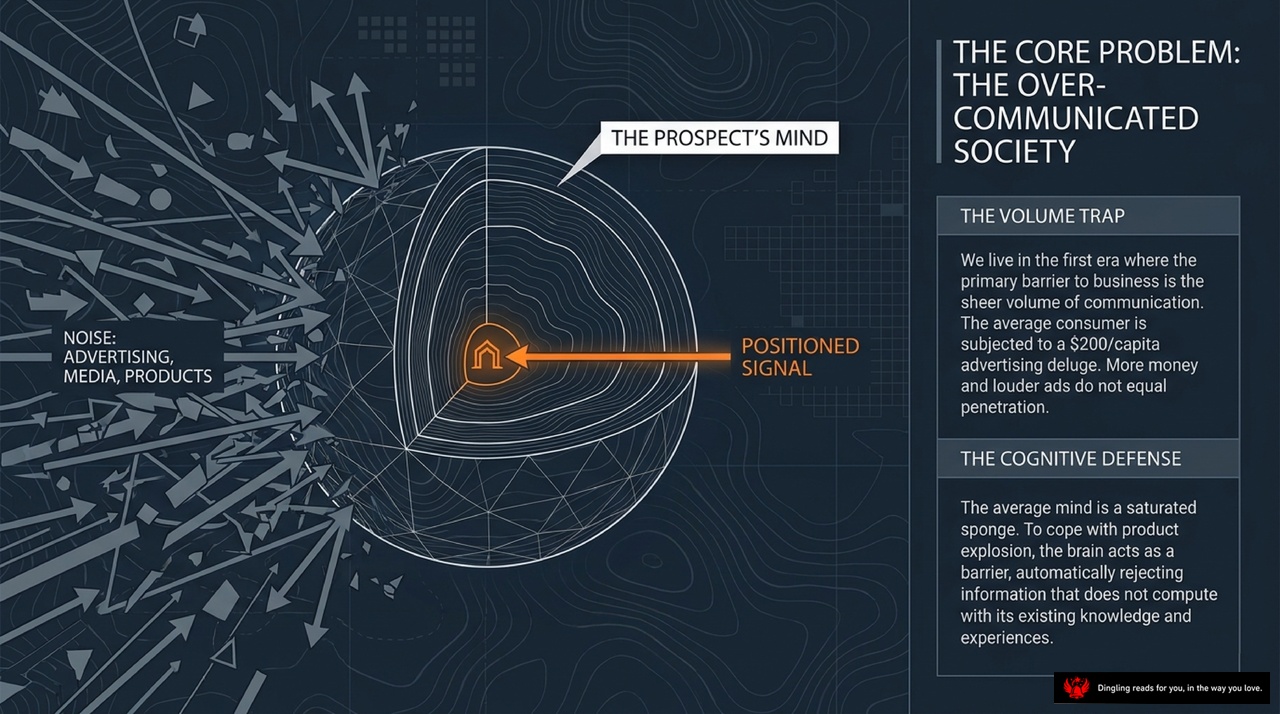
We are living in the first era where the primary barrier to business is simply the sheer volume of communication. The average consumer is subjected to a massive advertising deluge—roughly $200 per capita annually. Here's the hard truth: throwing more money at louder ads does not equal penetration. In fact, it creates a "volume trap" that stifles growth.
Think about your own mind. It acts as a saturated sponge, automatically rejecting information that doesn't compute with your existing knowledge and experiences. This is your brain's "cognitive defense." When you're bombarded with endless noise from advertising, media, and products, your mind tightens its filter, blocking out anything that isn't already familiar.
So, how do you actually get your message across? The answer lies in the diagram on the left. You see a chaotic storm of arrows labeled "Noise"—that's the advertising, media, and product clutter flooding in. But right in the center is "The Prospect's Mind." To reach them, you can't just shout louder; you must send a sharp, "Positioned Signal."
In an over-communicated society, the only way to cut through is to simplify. You must sharpen your message, remove all ambiguity, and repeat it until it drills into the mind. Don't look for solutions in your product or your own ideas; look inside the prospect's head. As John Lindsay famously said, "In politics, people's ideas are reality." This applies to business too. You have to accept the existing concepts in people's minds as reality, then reshape them to fit your advantage. If you ignore this and try to force a new idea on a saturated mind, you will fail. Precision beats volume every time.

Today's slide highlights a fundamental shift in how we think about marketing. On the left, you see "Traditional Marketing," an inside-out approach from the 1950s and 60s. It was about inventing a product, figuring out its features, and pushing it into the market. But as the graphic shows, this message often bounces off a "cognitive shield." Why? Because in our information-saturated world, people's brains are already full. They have existing perceptions and defenses against new ideas. Trying to force a product into a mind that isn't ready for it simply doesn't work.
Now look at the right side: "Positioning Strategy," an outside-in approach that defines the era from the 1970s to the present. This is where "Cognitive Cartography" comes in. Instead of looking at your product, you look inside the prospect's mind. You find an empty conceptual space and anchor your product to that exact spot. The result? Your message bypasses the defenses because it aligns with what the customer already knows or expects.
The bottom line, stated clearly on this slide, is that positioning is not what you do to a product; it is what you do to the mind of the prospect. If you want to succeed, stop trying to change how people think and start finding the empty space in their minds where your brand fits perfectly.

The Mental Ladder shows us exactly how the human brain organizes the world: not as a computer, but as a series of rungs where only the first brand gets to stand. As the slide highlights, the "Rule of Firsts" means that whoever occupies the top rung captures twice the market share of the second brand and three times the share of the third. It's a brutal reality: being first isn't just an advantage; it's the difference between dominance and obscurity.
But what if you can't be first? The slide's second concept, the "Anchor Effect," offers the solution. To introduce something new, you can't just shout into the void; you must hang your new ladder on an old one. Think of the automobile as a "horseless carriage"—it worked because it anchored a revolutionary invention to a familiar concept. If you fail to anchor, you fail to enter the mind.
This leads to our most critical strategic rule: if you are not first, you cannot simply yell that you are better. You have three choices. You must either climb an existing ladder, find an empty one, or knock someone off theirs. Trying to fight a giant head-on is a recipe for failure. Instead, look for the empty rungs in the consumer's mind—whether it's a price gap, a new usage occasion, or a demographic no one else is serving. The ladder is there; you just have to find the right spot to stand on it.
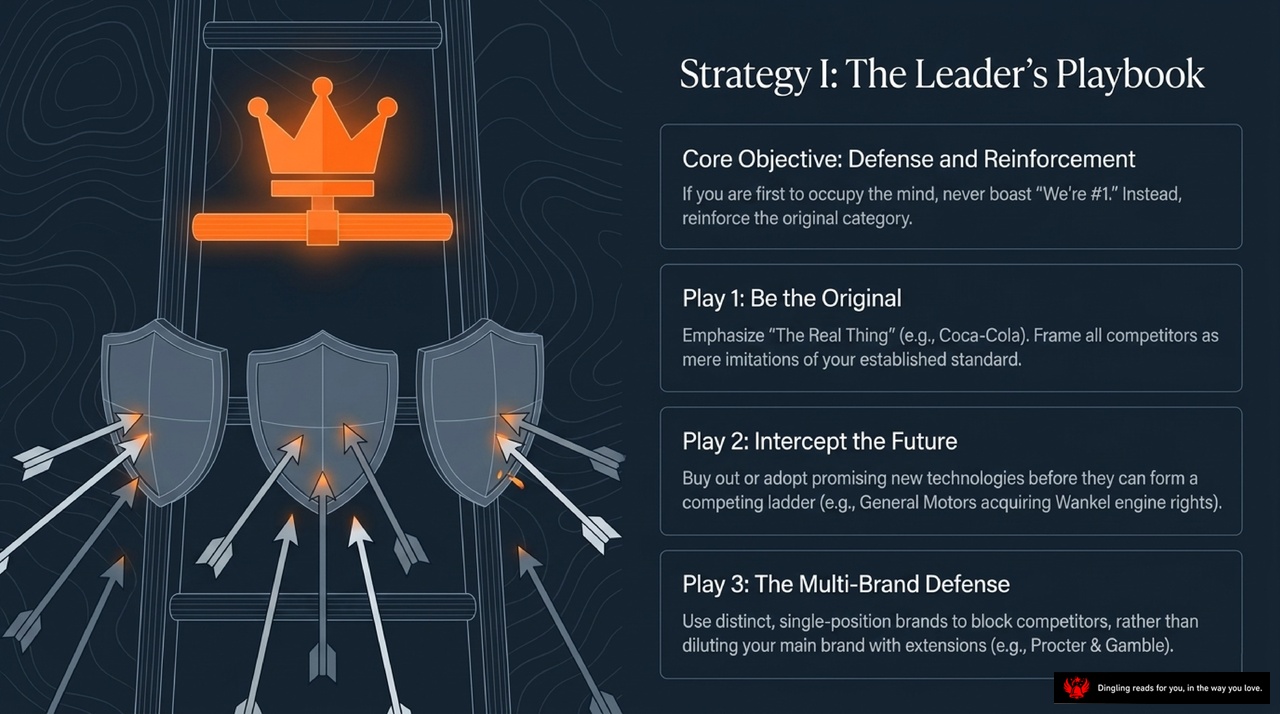
So, how does a market leader actually defend its throne? It's not about shouting "We're Number One." In fact, if you're already first, you should never boast about it. Instead, your job is to reinforce the category you invented. Think of yourself as the original, the "Real Thing." Every competitor is just an imitation of your standard. That's Play Number One.
But being the original isn't enough. You have to intercept the future. If a new technology looks promising, don't wait for it to form a competing ladder. Buy it out or adopt it early. Look at General Motors acquiring Wankel engine rights decades ago; that was a masterclass in pre-emptive defense. If you let a rival own the future, you lose the present.
Finally, you need a multi-brand defense. Instead of diluting your main brand with extensions, use distinct, single-position brands to block competitors at different angles. Procter & Gamble is the gold standard here. They don't call Tide "Super Tide" or "Tide Plus." They create new names for new positions. This keeps your core brand sharp while occupying every shelf space a competitor might want.
The result? Leaders don't just survive; they thrive. Look at the 1978 auto industry data: General Motors held 49% market share and nearly double the profit of its rivals. Why? Because once you occupy the mind, you own the category. The market naturally flows to the leader, making it nearly impossible for challengers to catch up. That is the true leader's playbook.

Imagine you're a brand trying to enter a crowded room where everyone is shouting. You can't just shout louder; you need to find the one quiet corner no one else is occupying. That is the essence of Strategy II: The Follower's Playbook. If you can't be first, you must find an unoccupied conceptual space in the prospect's mind and fill it. We call this "finding the creneau," or finding the hole.
Instead of fighting head-on, a smart follower looks for a specific gap. Think about size. Everyone assumes bigger is better, so Volkswagen Beetle flipped that script with "Think Small," carving out a niche for the compact car. Or look at price. Michelob established the ultra-premium beer spot, while Qwip grabbed the ultra-low end. Sometimes, it's about gender. Marlboro didn't just sell cigarettes; it invented the purely masculine cigarette, creating a demographic space that was previously neutral.
Timing is another powerful dimension. Nyquil didn't try to sell a general cold medicine; it owned the specific moment of consumption—the night when you're sick and need to sleep. By owning a specific moment, a follower can become the leader in that category. The goal isn't to be the biggest brand overall, but to be the only brand that fits a specific need. When you find that hole, you stop being a follower and start defining a new reality for the consumer.
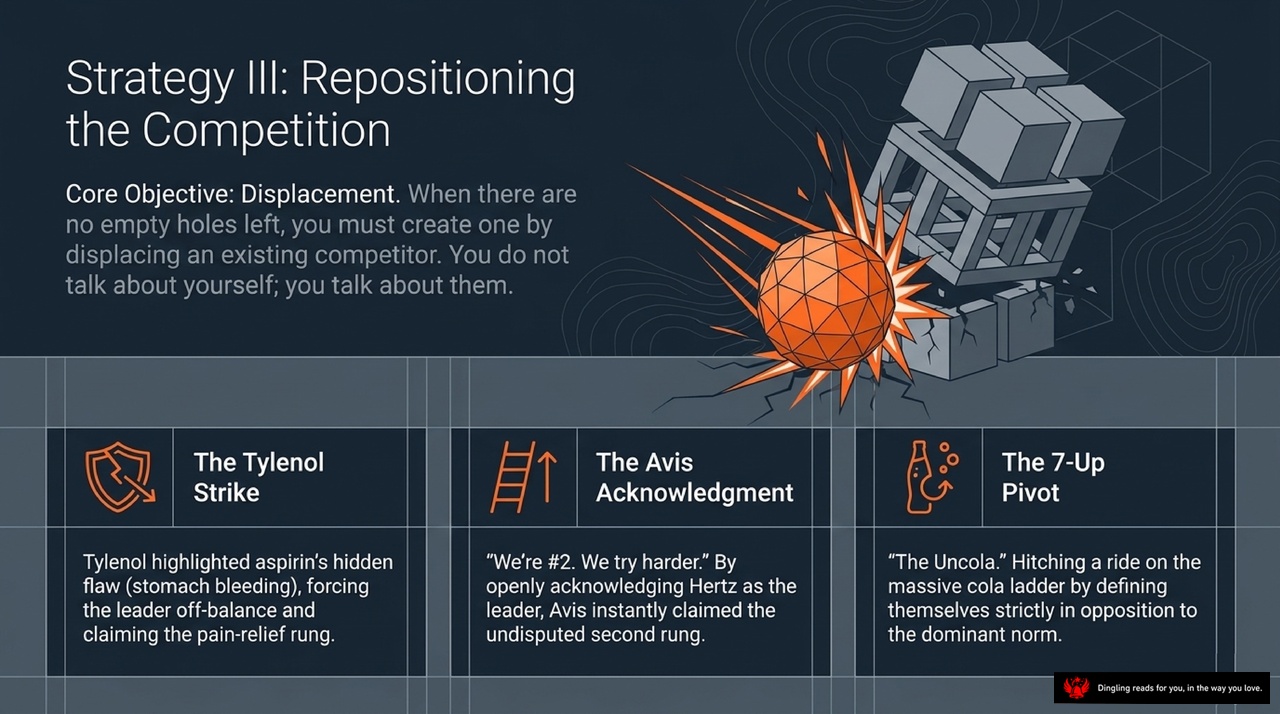
Imagine a stack of heavy blocks representing the market leaders, suddenly struck by a fast-moving, explosive orange sphere. This visual perfectly captures our third strategy: Repositioning the Competition. The core objective here is simple but powerful: Displacement. When the market is crowded and there are no empty spots left, you don't try to create a new hole; instead, you kick an existing competitor out of it. As the slide reminds us, "You do not talk about yourself; you talk about them."
Let's look at the three powerful ways to do this. First, we have The Tylenol Strike. Instead of boasting about their own safety, Tylenol highlighted a hidden flaw in the leader, aspirin—specifically, stomach bleeding. By forcing the industry leader off-balance, Tylenol successfully claimed the new "pain-relief rung" that nobody else owned.
Next, we see The Avis Acknowledgment. In the car rental business, Avis was clearly the number two player behind Hertz. Rather than pretending to be first, they openly admitted, "We're #2. We try harder." By honestly acknowledging the leader's dominance, Avis instantly claimed the undisputed second rung, turning a weakness into a badge of honor.
Finally, there is The 7-Up Pivot. When the cola market was dominated by Coke and Pepsi, 7-Up didn't try to fight them on their turf. Instead, they defined themselves strictly in opposition to the dominant norm, branding themselves as "The Uncola." They hitched a ride on the massive cola ladder by simply saying, "We are not cola."
This strategy works because it changes the user's perception of the competition, creating a new category where you become the leader.

The name is not just a label; it is the ultimate hook that secures your brand on the customer's mental ladder. As the slide illustrates, a strong name is descriptive and ownable, instantly explaining the benefit while remaining distinct—think Head & Shoulders or DieHard. These names do the heavy lifting for you. In contrast, weak names are engineered and meaningless, requiring millions in ad spend to educate the market, like Kodak or Xerox. And then there are dangerous acronyms that strip away all meaning, forcing the brain to work too hard.
Here is the hard truth: you hear what you expect to hear. If your name doesn't trigger an immediate understanding of what you do, you have already lost the battle for attention. Don't fall into the trap of using generic abbreviations or confusing extensions that dilute your core position. Instead, choose a name that acts as a cognitive shortcut, allowing the customer to grasp your value in a split second. In a world flooded with information, simplicity isn't just nice; it's the only way to survive.
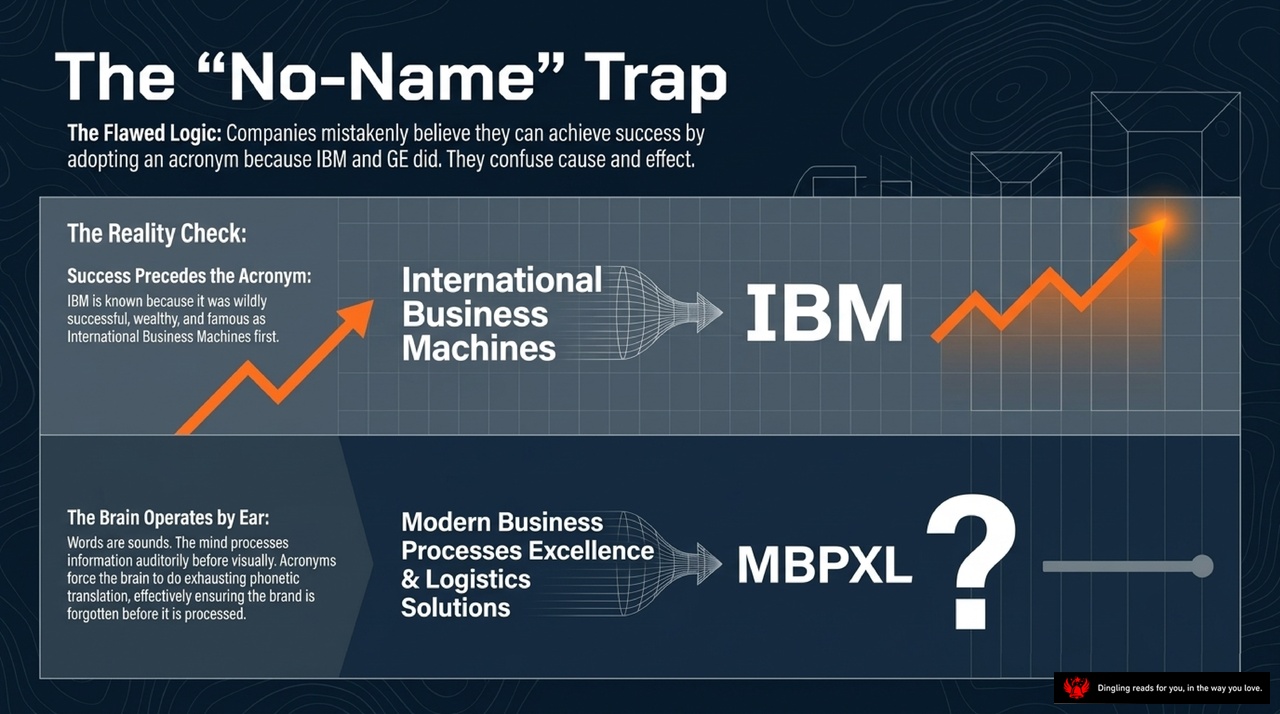
Let's talk about why your brand name might be costing you more than it's worth. Look at this slide: "The 'No-Name' Trap." It highlights a critical mistake many companies make. We often think adopting an acronym is a smart move, just because giants like IBM and GE did it. But here's the reality check: they confused cause and effect. Success didn't come from the acronym; success came first, and the acronym was just a byproduct. IBM was known as "International Business Machines" because it was wildly successful, wealthy, and famous *before* anyone shortened it to IBM.
Now, let's look at the bottom part of the slide. It shows "Modern Business Processes Excellence & Logistics Solutions" turning into "MBPXL," followed by a giant question mark. Why? Because our brains operate by ear, not just by eye. Words are sounds, and the mind processes information auditorily before visually. When you force your audience to decode a complex string of letters like MBPXL, you are making them do exhausting phonetic translation. You are effectively ensuring your brand is forgotten before it is even processed.
So, what's the lesson? Don't fall into the trap of thinking a clever acronym will build your brand. If you can't be the first, don't make it harder for people to remember you. Keep it simple, keep it pronounceable, and let your performance do the talking.

Imagine a seesaw in your mind, where the brand name Heinz sits on one side. For decades, it held a heavy, respected weight: "Heinz equals Pickles." It was a stable, trusted anchor. But then, the company decided to extend that name to a completely unrelated product: ketchup. Suddenly, the mental balance snaps. The heavy side of pickles drops, and the new side of ketchup flies up, but it's not stable. It creates an "Inside-Out Illusion"—the company thinks, "We have a great name; let's just use it to sell this new, unrelated product."
But the reality is "Outside-In." Your brain is stubborn. It cannot hold two distinct things under one name. When a brand tries to mean everything, the mental anchor breaks. The name becomes a burned-out, meaningless shell. As the slide warns, "Heinz owned pickles, then extended to ketchup. They won ketchup, but lost pickles to Vlasic."
This is the Line-Extension Trap. When a brand tries to mean everything, like Kraft, it ends up meaning nothing specific at all. In a crowded world, clarity is currency. If you want to climb a new ladder, you need a new name. Don't let your past success trap your future relevance.
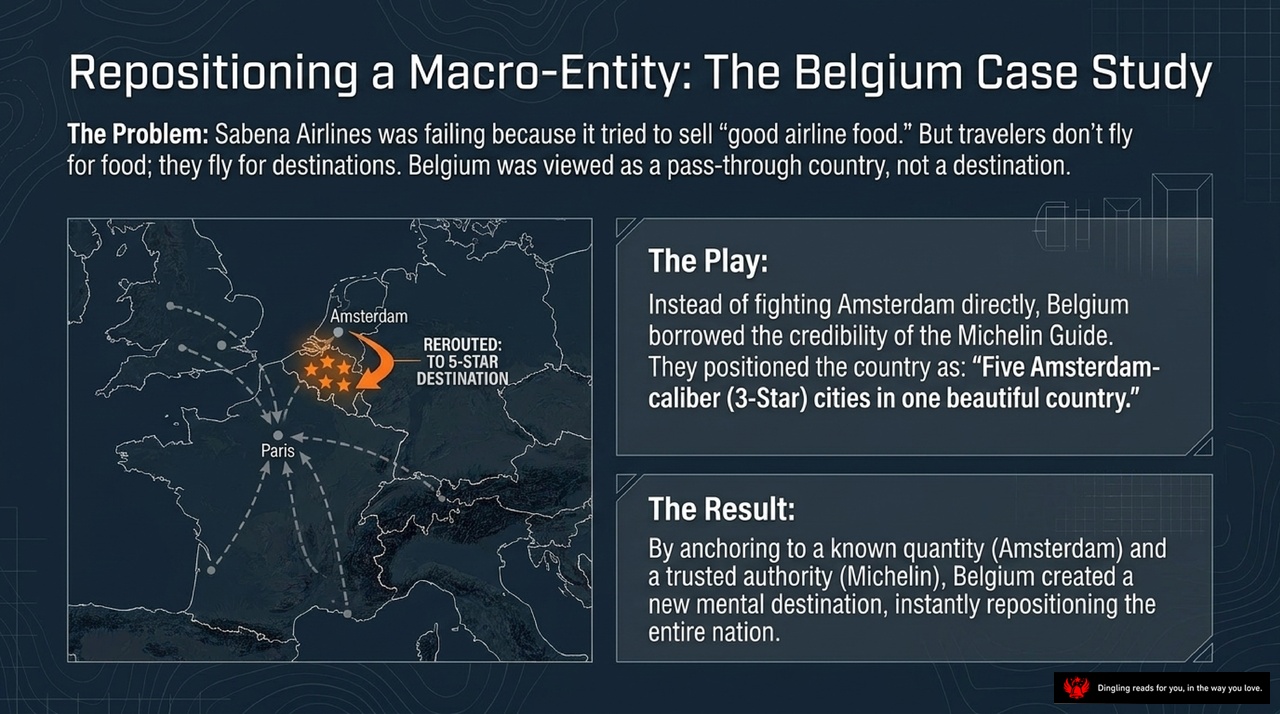
Repositioning a Macro-Entity: The Belgium Case Study
Look at this map. For decades, Belgium was just a boring stopover—a place where planes landed to refuel, not a place people wanted to visit. Sabena Airlines tried to fix this by selling "good airline food," but that's the wrong move. People don't fly for meals; they fly for destinations.
So, what was the play? Instead of fighting Amsterdam head-on, Belgium borrowed credibility. They leaned on the Michelin Guide, positioning the country as "five Amsterdam-caliber cities in one beautiful nation." By anchoring themselves to a known quantity and a trusted authority, they instantly repositioned the entire nation from a transit hub to a top-tier destination.
The result? They created a new mental map for travelers. But here's the hard lesson: this strategy failed because it wasn't sustained. When leadership changed, the clear, simple message got diluted. In an oversaturated world, confusion is the enemy. You need a simple, unshakeable idea that everyone agrees on, or you lose the battle for the mind.

Positioning Yourself: Finding a Horse to Ride.
Trying harder is rarely the path to success. In a world saturated with noise, working smarter means finding an external vehicle—a "horse"—to carry you up the ladder. The slide highlights six specific horses of career positioning.
First, ride **Your Company**. Is it in a high-growth, sunrise industry? If not, jump ship. Second, ride **Your Boss**. Are they going places? Success is often drafted when you align with a rising leader. Third, ride **A Friend**. Business connections drive the most significant breaks, so expand your network beyond your private circle. Fourth, ride **An Idea**. Be willing to go against the grain and ride a controversial concept before everyone else agrees with it. Fifth, ride **Faith**. Have confidence in others and their ideas when they are doubted. Finally, and perhaps most humbly, ride **Yourself**. But remember, this is the hardest, slowest, and least reliable horse to ride entirely alone.
The biggest mistake people make is thinking they can succeed by pulling their own weight. The reality is that winning isn't about being the strongest rider; it's about finding the best horse. Don't try to be the first one to fly the plane; find the airline that already owns the route. Identify which horse is available for you right now, commit to it, and let it do the heavy lifting for your career.

The slide highlights a critical shift in how we approach marketing: moving from the "Internal Trap" to becoming an "Objective Outsider."
Let's break down this visual logic. On the left, we see the "Internal Trap." The text warns that inside knowledge destroys objectivity. When companies drown in their own jargon, corporate politics, and product vanity, they end up with complex, ineffective messaging. It's like trying to see clearly while wearing thick, self-made glasses.
The solution, shown in the middle column, is "The Value of Ignorance." This is a counterintuitive but powerful idea. Why hire an agency or a consultant? Because there is one asset you cannot generate internally: ignorance. An outsider isn't ignorant of facts; they are ignorant of your internal biases. They don't know your history, your politics, or your jargon. This fresh perspective allows them to see the prospect's mind clearly, unburdened by how your factory actually works.
Finally, on the right, we see "The Execution." The objective outsider focuses entirely on a single, simple truth that can penetrate the market noise. Instead of getting lost in your own complexity, they strip it down to find the core message that the customer actually needs to hear.
In short, to communicate effectively, you must step out of your own story. You need that "ignorance" of your internal reality to find the clarity that your audience desperately needs.
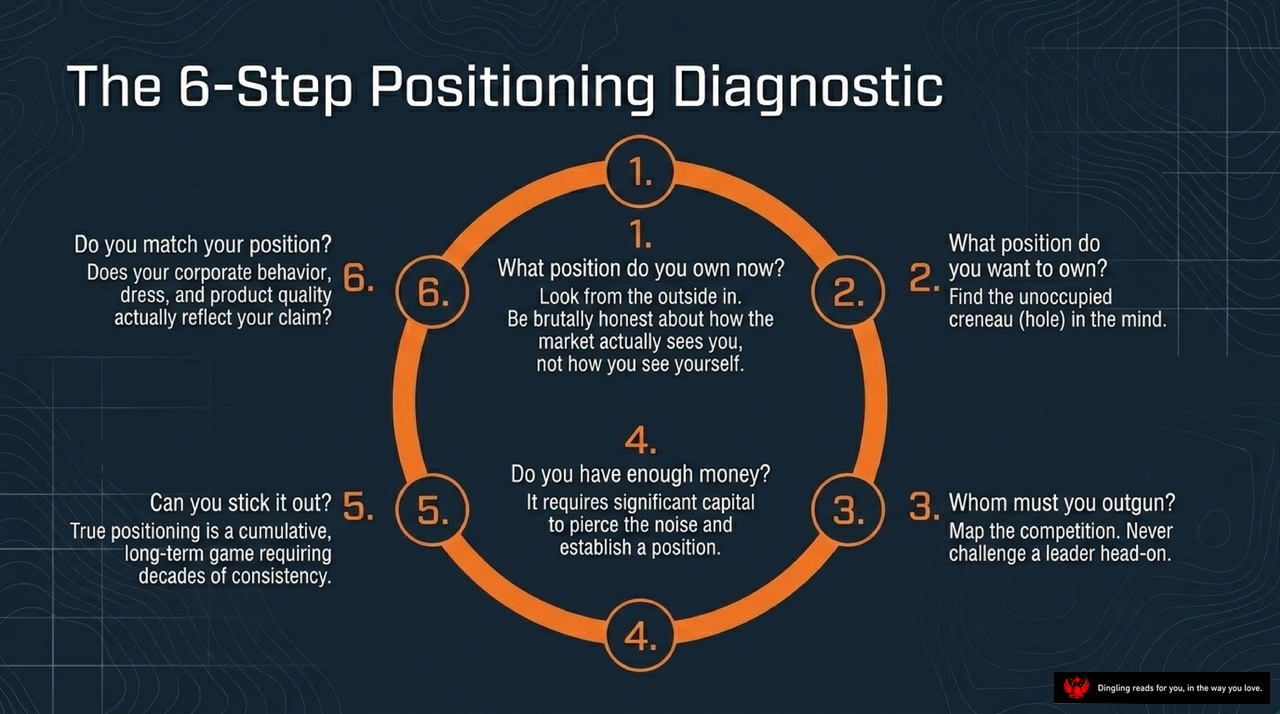
Let's talk about the reality check of building a brand. In today's oversaturated world, you can't just invent something new; you have to find the unoccupied space in the customer's mind. That's exactly what this "6-Step Positioning Diagnostic" is about.
First, look at Step 1: What position do you own now? Be brutally honest. How does the market actually see you, not how you see yourself? Next, Step 2: What position do you want to own? Find that empty hole in the mind that no one else is filling.
But before you can move forward, you need to answer the tough questions in the rest of the circle. Step 3 asks: Whom must you outgun? Map your competition and never challenge a leader head-on. Step 4 is about resources: Do you have enough money? True positioning requires significant capital to pierce the noise.
Then, Step 5: Can you stick it out? Real positioning is a long-term game requiring decades of consistency. Finally, Step 6: Do you match your position? Does your behavior, dress, and product quality actually reflect your claim? If there's a gap here, your strategy fails.
This diagnostic isn't just a checklist; it's a mirror to ensure your strategy is grounded in reality before you spend a dime.

In today's hyper-connected world, the biggest challenge isn't inventing something entirely new—it's cutting through the noise. Success relies on manipulating what is already present in the consumer's mind. To win, you must drastically simplify your message, find an unoccupied space, and ruthlessly defend it against the chaos.
Think of the modern marketplace as an over-communicated battlefield where the mind is the only territory that truly matters. In this crowded arena, your brand needs a singular word that it truly owns. If you can't be the first, you're essentially invisible. Being second is almost as good as being forgotten, as history shows us that the first name in a category often captures double or triple the market share of its challengers.
But what happens when the top spot is taken? You can't just force your way in; you need to find an unoccupied space. This means looking for gaps in the consumer's mind that haven't been filled yet. Whether it's a specific price point, a unique demographic, or a distinct usage time, you must identify that empty slot and move in immediately. If no gap exists, the only real strategy is to reposition the competition, fundamentally changing how they are perceived in the consumer's head.
Ultimately, the goal is simple: don't try to change the customer's mind; instead, fit your brand into the concepts they already hold. By owning one clear, simple idea and defending it relentlessly, you build a fortress in the consumer's mind that no amount of advertising spend from competitors can easily breach.