
Powerful: Complete Chapter-by-Chapter Summary

Welcome to today's session on *Powerful: Building a Culture of Freedom and Responsibility* by Patty McCord. This isn't just another book about corporate management; it's a radical blueprint for dismantling the outdated HR systems that have dominated the 20th century. For decades, companies relied on top-down control, rigid annual reviews, and complex incentives, operating on the flawed assumption that employees need constant supervision and external rewards to perform. But the world has changed. Today's business environment moves at breakneck speed, and those old, bureaucratic processes are actually suffocating innovation and autonomy.
McCord argues that the solution lies in a complete shift: treating employees not as children needing a "nanny" or a career manager, but as mature adults capable of making their own decisions. The book's core promise is a culture driven by freedom, extreme candor, and relentless innovation. It challenges the idea that you need perks like free food or ping-pong tables to attract top talent. Instead, it suggests that the ultimate benefit you can offer is the opportunity to work alongside other high-performers and solve meaningful problems. By removing restrictive policies and fostering an environment of absolute honesty, companies can unlock a level of responsibility and creativity that traditional management could never achieve. Let's dive into how this approach transforms the very fabric of high-performance teams.

Look at this split screen. On the left, we see a tangled mess of red ribbons, representing the old way of managing people: restrictive policies, HR coddling, and a lack of trust. On the right, we see white arrows shooting upward in unison, symbolizing the new paradigm: treating people like adults who need deep business context, strategic discipline, and the freedom to execute.
This slide captures the core paradigm shift at Netflix. The old management model assumed employees needed constant supervision and rigid rules to perform. But the reality is, adults do not need restrictive policies; they need the freedom to make decisions based on the company's best interests. When you abolish vacation policies and expense approvals, you aren't creating chaos—you are proving that high performers act responsibly when trusted.
The real goal of management isn't to manage happiness or retain talent through perks; it's to build a great team that does incredible work. Retention is just a byproduct of doing that work well. By giving employees the context they need to understand the business and the discipline to stay focused, we unlock their potential. They don't need a babysitter; they need a clear direction and the trust to take ownership. This shift from control to trust is what allows high-performing teams to move forward together, creating value that rigid processes could never achieve.

Look at this slide comparing 20th-century management with 21st-century agility. On the left, we see the old guard: a mindset built on command and control, relying on annual reviews and anonymous surveys for feedback, using perks to motivate, and betting on family loyalty to keep talent. It was designed for a stable world, but it's completely obsolete now.
On the right, that's where we are today. We've swapped control for context and agility. Instead of waiting for once-a-year evaluations, we prioritize real-time, face-to-face candor. We've replaced empty perks with a culture of freedom, responsibility, and actual business acumen. Most importantly, we've stopped trying to build a "family" and are now operating like a high-performance sports team.
Think about it: in the old model, managers acted like coaches who micromanaged every play. In the 21st century, we trust our players to make the right calls on the field because they understand the game. We don't need rigid rules or long retention promises; we need top-tier talent who are self-driven, accountable, and ready to win. This shift from managing people to empowering them is the single biggest difference between how we operated in the past and how we succeed today.

Today's slide makes a bold statement: Business Acumen Over Corporate Perks. It challenges the modern obsession with perks like free sushi or sleep pods, arguing that true workplace happiness comes from achieving great things with great colleagues.
Look at that pyramid. It illustrates the foundation of real engagement. At the base, we need a Deep Understanding of the P&L and the Business Model. Without this, employees are just flying blind. Moving up, we must focus on Solving Complex Customer Problems. If your team doesn't understand how their daily actions impact the company's profit, they can't be truly engaged.
The text on the right reinforces this: every employee, from engineering to customer service, must understand the business logic. If you want a highly engaged customer service team, teach them to read the P&L. This isn't just about numbers; it's about giving everyone a seat at the table. When employees understand the "why" behind the work, they stop being passive executors and become active problem solvers.
Finally, the top of the pyramid is True Employee Happiness. This isn't a reward for hitting targets; it's the natural result of working with smart people on meaningful challenges. As the slide suggests, if someone leaves because another company offers better snacks, they weren't a fit for us anyway. The real currency of our culture is business understanding, not free food.

In this slide, we dive into the core of how Netflix makes decisions: a culture driven by facts, not feelings or power trips. The big takeaway here is simple but powerful: humans can handle the truth, and radical candor kills office politics. Look at that cycle on the left—Start, Stop, Continue. This isn't just a diagram; it's the rhythm of our daily life. We are constantly asking each other: What should we start doing? What needs to stop immediately? And what are we doing right that we should keep going?
But here's the catch: feedback has to be face-to-face, fact-based, and continuous. We don't do anonymous surveys because they are toxic. They breed cynicism and protect bad behavior by hiding the truth. If you have an issue with a colleague, you don't whisper it to a manager; you go straight to them and say, "This is what's bothering me." Leaders also have to publicly admit their own mistakes. Why? To prove that speaking the truth to power is safe and expected. When leaders model this, it creates a psychological safety net where everyone feels comfortable challenging ideas and sharing hard data.
On the right, you see the rules of engagement. We prioritize facts over persuasion. We don't care who has the loudest voice; we care who has the best evidence. This means we debate openly, but we always tie our arguments back to customer needs and business reality. We separate the person from the behavior. Instead of saying, "You are difficult," we say, "This specific action created this specific problem, and here is how we can fix it." This approach eliminates the massive inefficiency of office politics, backstabbing, and hidden agendas. By committing to this cycle of honest, fact-driven feedback, we ensure that our decisions are based on reality, not ego, allowing us to move faster and build better products together.

Let's talk about how we actually make decisions at Netflix. We don't just follow the data blindly. In fact, we warn you: being "data-driven" can be a trap. Hard data tells us what happened, but it rarely explains why. That's where human judgment comes in. We combine that hard data with contextual intuition to form what we call a fact-based opinion.
Think about it like this: Data is a starting point for interrogation, not a shield to hide behind. We use it to question our assumptions, not to prove we're right. For example, when we decided to cancel the DVD queue feature, the data showed it was crucial for loyalty. But our A/B tests revealed that removing it didn't hurt retention. So, we trusted our intuition over the old data. Or take *Orange Is the New Black*; there was no data to predict its success because the script wasn't finished. We bet on the creator's vision instead.
But here's the real secret to our debates: they must always prioritize what is best for the customer, not personal ego. When we argue, we aren't trying to win or protect our own ideas. We're trying to find the single best answer for the user. We encourage open debate, even heated ones, as long as every point is backed by facts. It's about separating the business problem from the personal opinion. This way, we avoid the trap of letting the loudest voice win, and instead, we let the best evidence guide us forward.

Let's talk about the real cost of "family" culture in business. On the left, you see a traditional pyramid—CEO, C-Suite, Managers, down to Staff. That structure, with its layers of supervisors and rigid rules, is exactly what we need to dismantle. Think of it as a sports team that refuses to change its roster, sticking to sentimental loyalty instead of winning.
But look at the right side: that's the professional team mindset. Just like a coach who constantly reconfigures the lineup to win the championship, a company must treat itself as a professional sports team, not a family. Coaches don't keep players out of sentimental loyalty; they ruthlessly adjust the roster based on what's needed to win.
This is the core of the "Scotty Bowman Approach." The legendary hockey coach didn't wait for the end of an 80-game season to make changes; he reviewed and adjusted his players every 10 games. In business, this means leaders must actively scout talent and reconfigure teams entirely based on future business needs, not past relationships.
When we cling to the idea of a "family," we hold onto underperformers and block innovation. But when we embrace a professional team, we prioritize performance above all. It's not about being cruel; it's about being effective. We hire the best, we give them the tools, and if they can't perform, we let them go. This creates an environment where everyone knows the stakes, and everyone is fighting to be the star on the field. That is how you build a team that actually wins.

Let's talk about how we actually build a team that wins. Forget planning for today's battles; we need to build for the future. As the slide suggests, never construct your team based on current challenges. Instead, stand six months out in the future, visualize the specific achievements you need, and work backward from there.
Look at this timeline on the screen. We start at the "Current State," which for us was the Bandwidth Crisis. We realized that relying on our existing infrastructure would simply be too slow. We needed to be ready six months out for a massive Cloud Migration. That future reality demanded a completely different team composition than what we had today.
When Netflix realized we would consume one-third of US internet bandwidth in just nine months, we knew our current team couldn't handle it. We didn't try to stretch our existing skills; we immediately hired a new cloud infrastructure team with the exact expertise we needed for that future scenario.
So, the critical question for you is: Do we currently have the precise skills for our six-month reality? If the answer is no, don't wait. Start hiring today. Don't just fill seats; build the specific capabilities required to win the game that hasn't happened yet.

Let's talk about the "Talent Density Philosophy." As this slide illustrates, there is no such thing as a universal "A-Player." The idea that one person can be a superstar in every company is a myth. Perfect hiring isn't about finding the most talented individual; it's about perfect matching.
Look at that funnel in the center. We start with a pool of raw talent, but that talent doesn't automatically equal performance. It all depends on the "Context Filter." As the quote on the left reminds us, "A genius at a slow-moving bank can become a star VP in a hyper-agile tech environment—context is everything."
Think about it this way: a brilliant executive pushing for the wrong strategic priority must be let go, no matter how smart they are. Conversely, a great leader can be useless if placed in a team that doesn't need their specific skills or in a culture that stifles their approach. This is why high talent density requires every single seat to be filled by the absolute best fit for what needs to be done right now.
We keep the "Right Context" candidates and discard those in the "Wrong Context," even if they are individually brilliant. The goal is to build a team where everyone's strengths amplify each other, rather than hiring stars who cancel each other out because they don't fit the specific job we are trying to solve today.

Traditional compensation systems are fundamentally broken. Relying on market averages, annual 6% bumps, or simply looking at what someone earned last year is a relic of the past. It fails to account for the true value an individual brings to your organization today.
Look at this graph. It illustrates a critical reality: one elite top-performer can out-scale the combined value of three average performers. The difference between "Average Performance" and "Exponential Value" isn't just a small bump; it's a massive gap.
So, how do you close that gap? You have to stop paying for the past and start paying for the future value an employee brings to the organization.
The strategy is clear: identify the roles that drive the most growth, find the absolute best talent for those specific roles, and pay them the top of the market before your competitors do. This isn't about being generous; it's about recognizing that your best assets are your most expensive assets. If you want exponential value, you must be willing to pay top of the market to secure it.
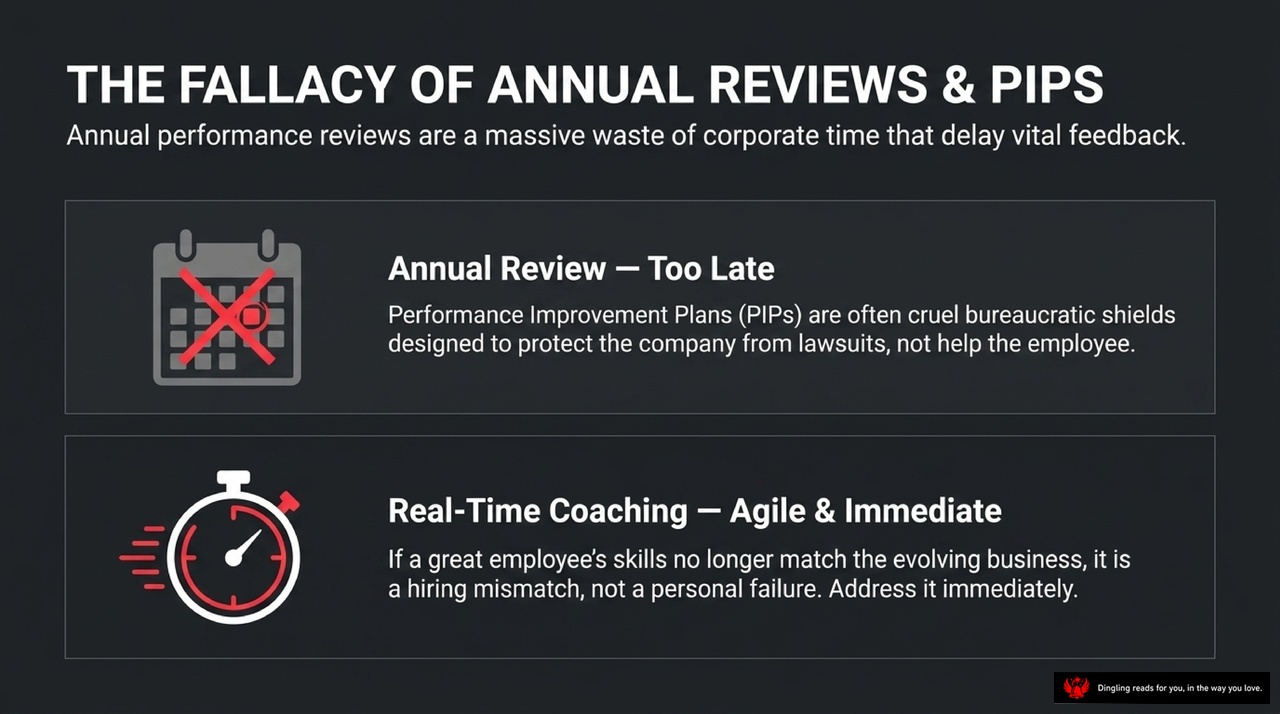
Let's talk about why the annual review is actually a trap. As the slide clearly states, waiting a full year to give feedback is simply too late. By the time an employee sits down for their yearly performance review, it's often too late to make a real impact. Performance Improvement Plans, or PIPs, are frequently nothing more than bureaucratic shields designed to protect the company from lawsuits, rather than genuine tools to help the employee grow.
The real issue is that if a great employee's skills no longer match the evolving business, that's a hiring mismatch, not a personal failure. Addressing this immediately is far more effective than waiting. Instead of relying on outdated annual cycles, we need to embrace real-time coaching that is agile and immediate. This approach allows us to catch issues early, pivot quickly, and ensure that every team member is always aligned with the company's current goals, turning potential failures into quick course corrections before they become problems.

Let's talk about the hardest, yet most essential, part of building a high-performance culture: the art of letting go. As this slide from Netflix's playbook reminds us, the real challenge isn't just hiring great people, but recognizing when their skills no longer fit the future.
Look at this Venn diagram. On the left, we have what the employee loves and does exceptionally well. On the right, we have what the company desperately needs right now. The sweet spot in the red center is where you "Keep & Reward." But what happens when those circles drift apart? That's when you must have the courage to say goodbye.
Netflix's approach is brutally honest: do not invent unnecessary roles just to keep people you like. If a former star can no longer contribute at the level the business demands, holding onto them out of sentimentality only dilutes the talent density for everyone else. Instead, be proactive. Be honest. Give them stellar references and help them find a new organization where they can be a star again.
This isn't about cruelty; it's about respect. When you let go with dignity and clarity, you protect the culture for those who remain and you give the departing employee a chance to thrive elsewhere. It's a win-win that keeps your team sharp, your culture authentic, and your business agile.

Synthesis: The Ecosystem of Freedom. You might think that freedom is just about removing rules, but at Netflix, we know the truth: freedom is actually the output of extreme operational discipline. Look at this diagram. It shows a finely-tuned ecosystem where Freedom and Responsibility sit at the center, driven by three critical gears: Extreme Talent Density, Radical Candor, and Deep Business Transparency.
If you simply remove policies without elite talent, you don't get freedom; you get chaos. That's why we prioritize extreme talent density. We hire only the most mature adults and pay them top market rates so they can focus entirely on the work. But high talent alone isn't enough. You need radical candor. We believe in a culture where no one talks behind backs; if you have an issue, you address it directly with the person involved. This transparency prevents office politics and allows us to solve problems fast.
Finally, this whole system relies on deep business transparency. We don't just tell employees what to do; we show them how the business works so they can make smart decisions independently. When you combine these three elements—top-tier talent, open communication, and clear business context—you create an environment where people don't need micromanagement. They take ownership because they understand the stakes and trust that their peers are equally capable. This isn't an HR checklist; it's a living ecosystem that drives our success.

Imagine this: You strip away every single rule, policy, and safety net in your organization today. Would your team rise to greatness, or would they simply fall apart? This isn't a hypothetical game; it's the core question driving Netflix's unique approach to high performance.
The slide highlights that true high performance isn't found in ping-pong tables, complex HR policies, or anonymous feedback forms. Instead, it's built on treating employees like adults. This means demanding radical honesty and obsessively aligning talent with future challenges. When you trust adults to make decisions, they don't abuse that freedom; they take ownership.
We saw this in action when Netflix canceled its vacation and reimbursement policies. The legal team warned it would be a disaster, but the result was the opposite. Employees used their time and company resources responsibly because they were trusted to do so. Similarly, we replaced rigid annual reviews with frequent, direct conversations. We stopped hiding behind anonymous surveys and started having face-to-face debates where everyone, from the CEO to the intern, felt safe challenging ideas.
But freedom without responsibility is chaos. That's why we focus on doing great work for the customer. Every decision, from product features to hiring, is tested against one question: Does this serve the customer? When teams are empowered to act quickly and honestly, they don't just follow orders; they innovate. So, ask yourself: Are you building a system that relies on control, or one that relies on the potential of the people you've hired?