
Principles: Complete Chapter-by-Chapter Summary
Welcome to the world of *Principles*, where reality meets your dreams. Imagine this book not just as a collection of rules, but as your personal guided journal—a manual for navigating the complex human machine. As you see on the screen, Ray Dalio frames this as an operating system designed to help you overcome internal obstacles and achieve meaningful goals.
Dalio's journey began in a middle-class family on Long Island, fueled by a curiosity for the world rather than a love for rote memorization. From the age of eight, he worked odd jobs, learning independence early on. But his true passion ignited at twelve when he bought his first stock, Northeast Airlines, which doubled in value after being acquired. That early win sparked a lifelong belief in investing and the power of understanding market dynamics.
However, the path wasn't linear. The 1970s brought a series of economic shocks and crises that shattered many assumptions. The collapse of the gold standard, the oil crisis, and the "Panic of '73" taught Dalio a hard lesson: when everyone thinks alike, the market is often wrong. These painful experiences became the foundation of his most important principle: "Pain plus reflection equals progress." By refusing to hide from mistakes and instead analyzing them deeply, Dalio transformed his failures into a system of principles that could be applied to any situation.
Today, these principles form the core of Bridgewater Associates, a firm built on the idea of radical truth and radical transparency. The goal is simple yet profound: to embrace reality as it is, not as we wish it to be. Whether you are managing a global fund or navigating your personal life, the secret to success lies in creating a system that helps you think clearly, make better decisions, and evolve continuously. This is the promise of *Principles*: to turn life's chaos into a manageable, repeatable process.
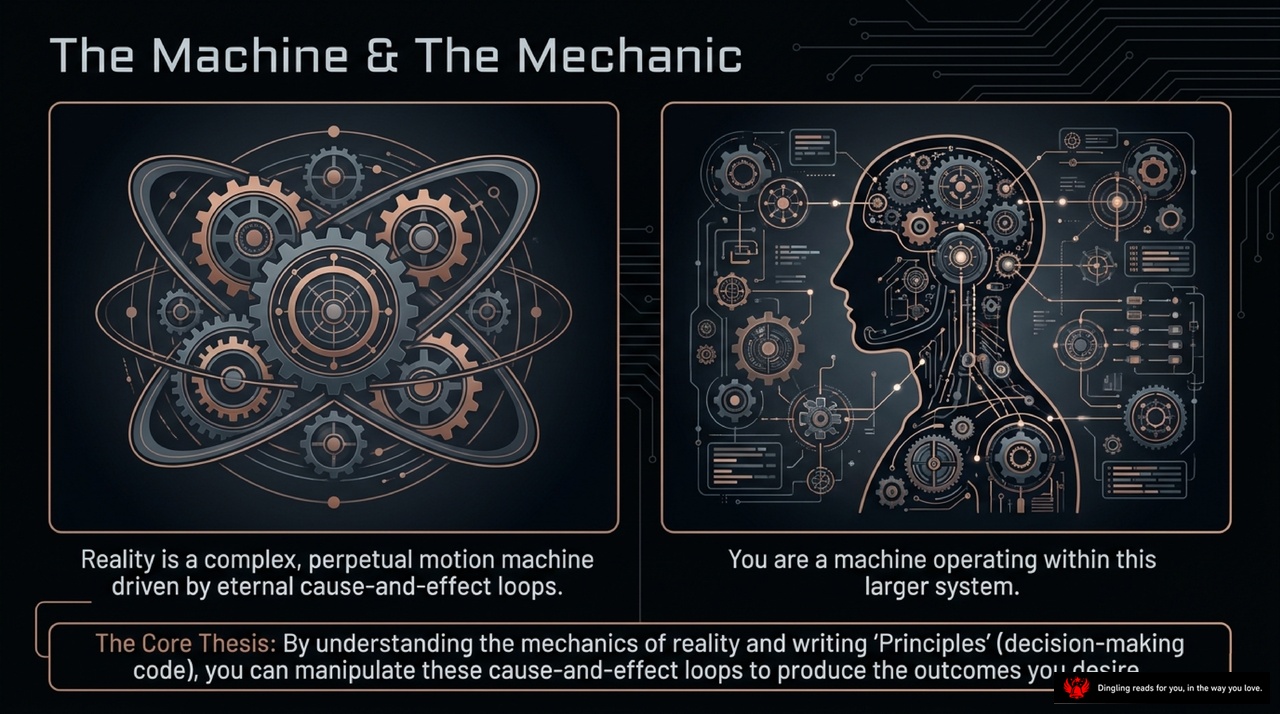
The Machine & The Mechanic. Look at these two images. On the left, you see a complex, perpetual motion machine driven by eternal cause-and-effect loops. That is reality. On the right, you see a human head filled with gears and circuits. That is you. You are a machine operating within this larger system.
Ray Dalio's core thesis is simple but profound: by understanding the mechanics of reality and writing your own 'Principles'—your personal decision-making code—you can manipulate these cause-and-effect loops to produce the outcomes you desire.
Think about your life as a machine. Just like a car needs an engine and a transmission to run smoothly, your life needs a clear set of rules to navigate the chaos. When you understand how cause leads to effect, you stop reacting blindly to the world and start steering your own destiny. Instead of being a passenger in the machine of reality, you become the mechanic who designs the parts, tunes the engine, and ensures the system runs efficiently.
This isn't about controlling everything. It's about understanding the logic behind the chaos. When you write down your principles, you create a reliable operating system for your life. You stop guessing and start executing based on a proven logic. Whether you are making an investment decision, navigating a career change, or handling a personal relationship, the same cause-and-effect laws apply.
So, take a look at your own life right now. What are the gears turning? What are the loops you are trapped in? The power lies in your ability to see the machine clearly, understand its mechanics, and then rewrite the code to build the future you actually want.
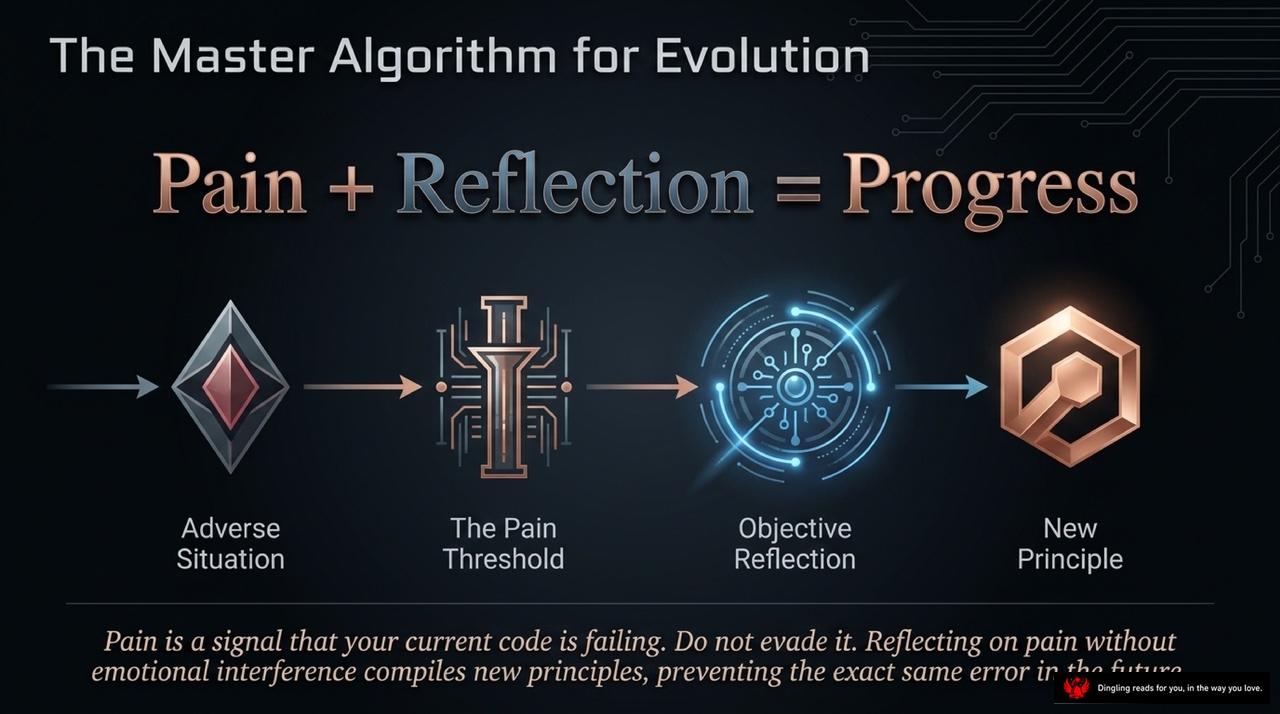
Pain isn't something you want to avoid; it's actually the most valuable signal you can receive. Think of your current life or career strategy as a piece of code. When that code fails, pain is the error message flashing on your screen. It tells you exactly where the logic is broken.
Most people see pain and immediately hit the "escape" button. They distract themselves, change the subject, or simply pretend the problem doesn't exist. But if you don't address the error, the same crash will happen again and again. You're just running the same broken program over and over.
The real breakthrough happens when you stop running and start reflecting. Look at the image on your screen: Adverse Situation leads to hitting The Pain Threshold, which then triggers Objective Reflection. This reflection is the compiler. It takes that raw, uncomfortable data and compiles it into a New Principle.
Ray Dalio emphasizes this in his text: "Reflecting on pain without emotional interference compiles new principles, preventing the exact same error in the future." When you strip away the ego and the emotional sting, you can objectively analyze what went wrong. Was it a lack of skill? A bad strategy? Or simply bad luck? Once you identify the root cause, you upgrade your internal operating system. You create a new rule that ensures this specific mistake never happens again.
So, embrace the discomfort. Don't fear the pain; welcome it. It's the fuel for your evolution. Every time you feel that sharp sting of failure, ask yourself: "What new principle can I build from this?" That is the master algorithm for progress.
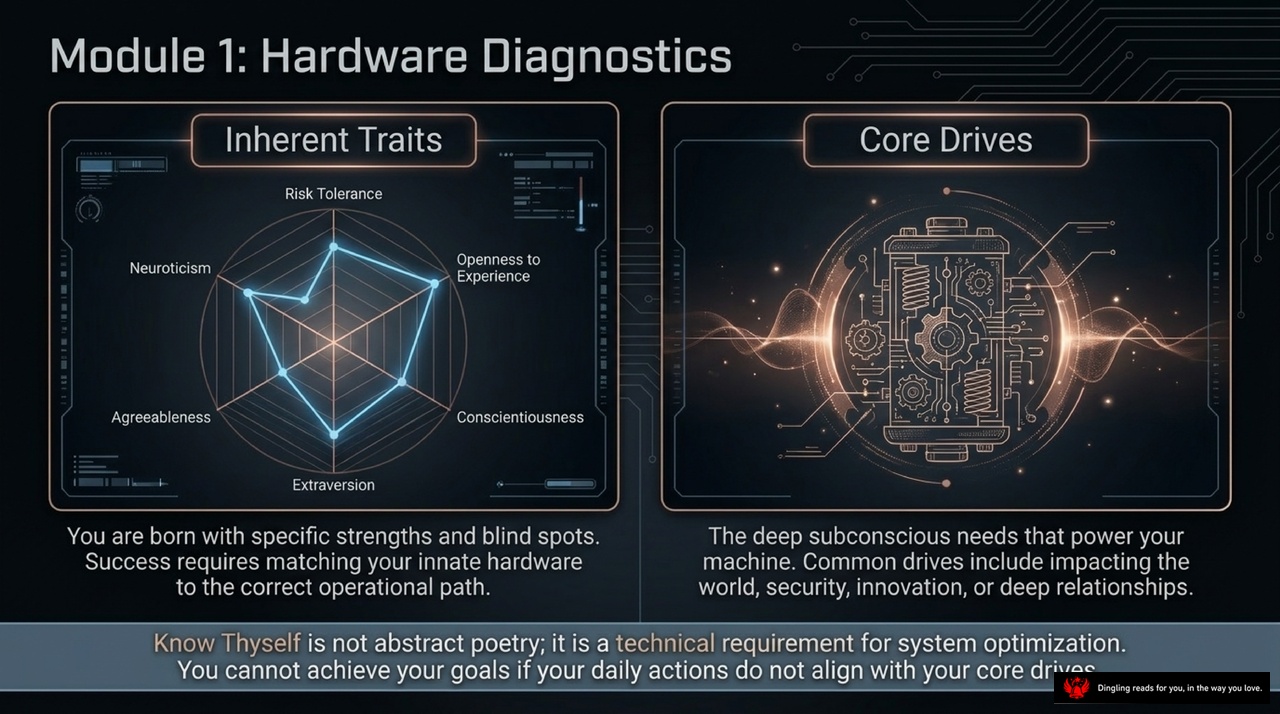
Today's slide breaks down the "Hardware Diagnostics" of your personal operating system. On the left, we see your "Inherent Traits"—that radar chart representing your innate strengths and blind spots like risk tolerance, neuroticism, and openness. Think of this as your biological hardware; you are born with specific specs, and success isn't about forcing yourself to be someone else, but matching these innate traits to the right operational path. On the right, we look at your "Core Drives"—the deep subconscious needs that power your machine, whether that's impacting the world, seeking security, driving innovation, or building deep relationships. Here is the critical insight from the text: "Know Thyself is not abstract poetry; it is a technical requirement for system optimization." You cannot achieve your goals if your daily actions do not align with your core drives. If your software (your actions) doesn't match your hardware (your traits) and fuel (your drives), the entire system will fail, no matter how hard you push the pedal.
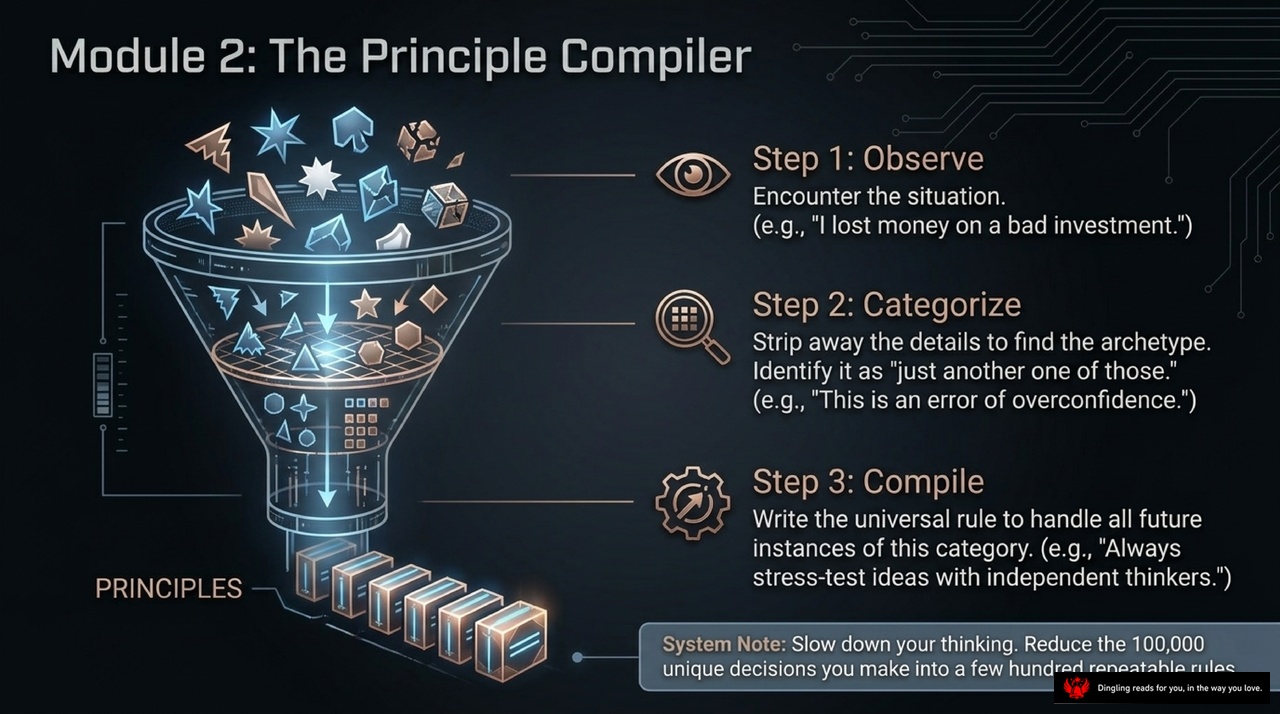
Look at this funnel on the slide. It visualizes what I call the "Principle Compiler." It's the engine that turns your chaotic daily experiences into a reliable, repeatable system.
The process starts with Step 1: Observe. This is where you simply encounter a situation, like realizing you lost money on a bad investment. You don't judge it yet; you just see it happen.
Next, Step 2: Categorize. Here, you strip away all the messy details and look for the underlying archetype. You ask yourself, "Is this just another instance of overconfidence?" By identifying the pattern, you realize that this specific mistake isn't unique to this one trade; it's a recurring theme in your behavior.
Finally, Step 3: Compile. This is the magic step. You write a universal rule to handle every future instance of this category. Instead of reacting emotionally next time, you have a pre-written principle, like "Always stress-test ideas with independent thinkers."
The system note at the bottom is crucial: slow down your thinking. The goal is to reduce the 100,000 unique decisions you make every year into just a few hundred repeatable rules. By doing this, you stop relying on fleeting intuition and start operating on a foundation of proven principles.

Today's slide outlines the final, most critical phase of our five-step evolutionary loop: **Execute**. It reminds us that no matter how brilliant our goals, how sharp our diagnosis, or how perfect our design, a plan remains just a fantasy until we push it into reality. The graphic emphasizes a strict rule: do not blur the steps. You must fully execute one stage before advancing to the next. Many of us fail not because we lack ideas, but because we try to solve problems while we are still diagnosing them. We jump ahead, assuming we know the answer before we've truly understood the root cause.
But true execution requires more than just action; it demands discipline and the right mindset. As we discussed earlier, this involves integrating our principles into our daily habits. It means using tools like checklists to track progress without relying on fleeting motivation. It also requires us to embrace the discomfort of feedback and the reality that our initial designs might need adjustment. We must be willing to treat our organizations like machines, constantly monitoring their output against our goals. If the results don't match the plan, we don't panic; we diagnose the gap, adjust the variables, and keep moving forward.
The ultimate goal of this loop isn't just to finish a task, but to build a culture of continuous improvement. By rigorously following this cycle—setting clear goals, identifying problems, diagnosing root causes, designing systematic fixes, and then executing—we transform our organizations into self-correcting systems. We stop relying on luck or intuition and start building a reliable engine for success. Remember, the only way to truly evolve is to commit to this loop, execute with integrity, and never stop refining the machine we've built.

Precision Diagnosis: Root vs. Proximate Causes. When something goes wrong, we often rush to blame the operator—the person who made the mistake. But true precision requires us to look deeper and ask: is this a failure of the person, or a failure of the machine?
The diagram shows a clear split. If the outcome is a problem, we first check if the operator failed. That points to the Proximate Cause. This is described by verbs—specific actions like "I forgot to check the data." It's merely the trigger, the immediate spark that started the fire. But stopping here is a trap.
On the other side, we must ask if the machine failed. This leads us to the Root Cause. Here, we stop describing actions and start describing characteristics with adjectives, like "I am forgetful." This reveals the underlying flaw in the system or the person's nature that generates the problem.
The lesson is simple but powerful. If you only fix the proximate cause, you just patch the symptom. You might stop forgetting the data today, but tomorrow you'll forget something else. But if you address the root cause, you change the underlying characteristic. You build a system or a habit that prevents the issue from ever happening again. In my own career, I learned this the hard way. I used to blame myself for every market loss, thinking I was just "bad" or "stupid." But by diagnosing the root cause—my lack of risk management and my refusal to listen to dissenting opinions—I was able to build a system that actually worked. So next time you face a problem, don't just ask who made the mistake. Ask what in the machine allowed that mistake to happen. That's where real progress begins.
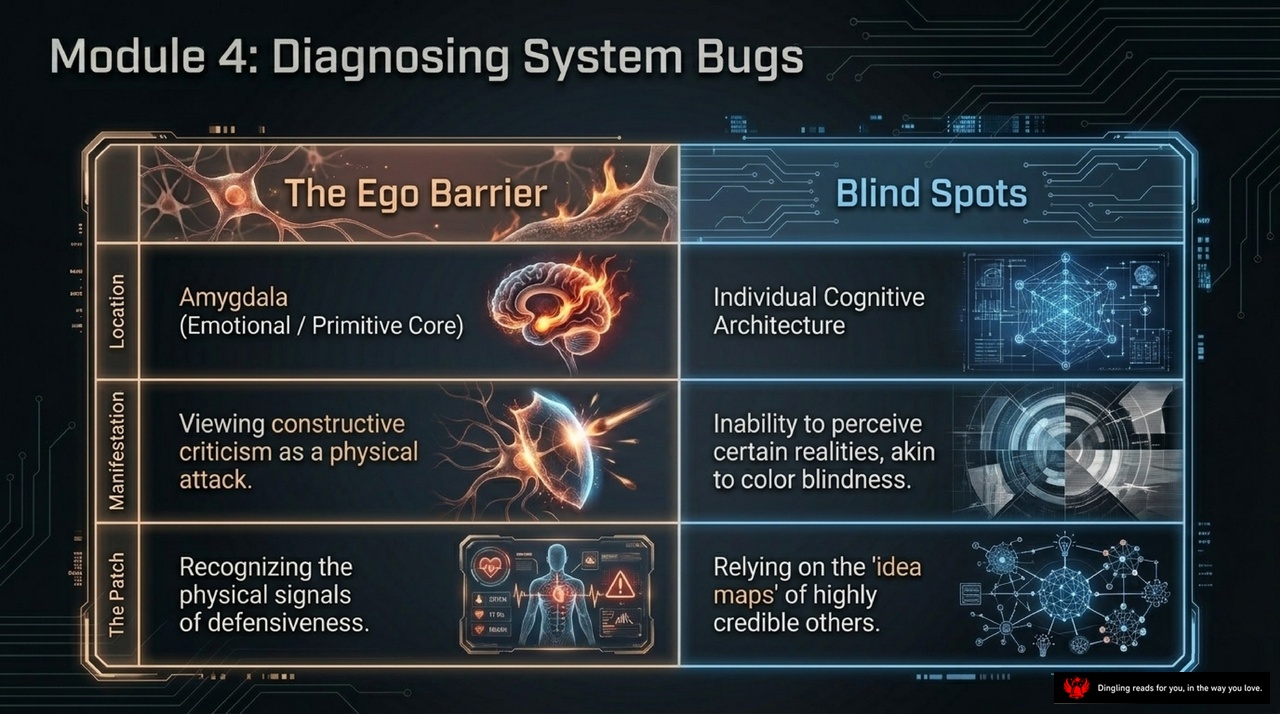
Imagine your brain as a complex operating system, and right now, we're diving into Module 4: Diagnosing System Bugs. Specifically, we're looking at two critical issues that are silently sabotaging your potential: The Ego Barrier and Blind Spots.
On the left, you see "The Ego Barrier," rooted in the Amygdala—the emotional, primitive core of your brain. This is where the real trouble starts. When you encounter constructive criticism, your brain doesn't see it as helpful data; it registers it as a physical attack. You feel threatened, and your brain triggers a fight-or-flight response. This is the manifestation of the ego barrier. The "patch" to fix this? You need to learn to recognize those physical signals of defensiveness. Instead of reacting, you need to hit the pause button, acknowledge your body's stress response, and consciously choose to stay open rather than shut down.
On the right, we have "Blind Spots." These are like color blindness for your mind. You simply cannot see certain realities because your individual cognitive architecture filters them out. A huge blind spot is relying on the "idea maps" of highly credible people. Just because someone is an expert doesn't mean their map is perfect. If you only trust one source, you're trapped in their blind spot.
The solution to both these bugs is the same: Radical Intellectual Humility. You must accept that your current view is incomplete. You need to actively seek out evidence that contradicts your beliefs. When you feel that sting of criticism or the urge to defend your ego, remember that it's not an attack on you; it's a signal that your system has a bug. By diagnosing these bugs and patching them, you stop making decisions based on fear and limited perspectives, and start making them based on the full truth. That is how you upgrade your mental operating system.
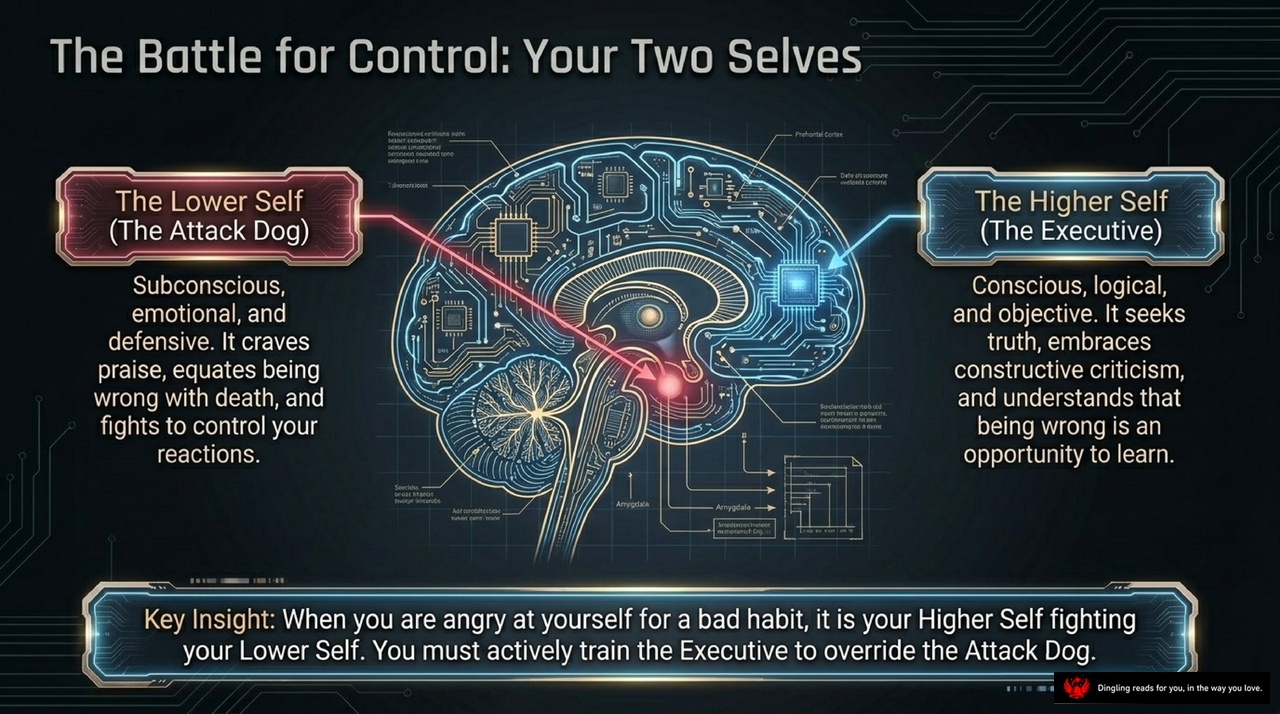
Imagine your mind as a high-tech battlefield, constantly waging an internal war between two distinct forces. On one side, you have the "Lower Self," which we can call the "Attack Dog." This is your subconscious, emotional, and defensive side. It craves praise, equates being wrong with death, and fights desperately to control your reactions to protect you. On the other side stands the "Higher Self," or the "Executive." This is your conscious, logical, and objective self. It seeks the truth, embraces constructive criticism, and understands that being wrong is actually a golden opportunity to learn and grow.
When you feel angry at yourself for a bad habit, realize that this isn't just random frustration; it is your Higher Self fighting your Lower Self. The key insight here is that you must actively train your Executive to override the Attack Dog. Without this internal discipline, you remain trapped in a cycle of emotional reactivity. But by recognizing this battle and choosing to empower your logical side, you take back control of your life and your decisions.

Look at this visual: "Patching Blind Spots: Radical Open-Mindedness." It's a powerful metaphor for how we think. The graphic shows you at the center, with a narrow 120-degree field of vision, flanked by "Independent Thinkers." The text warns us of "The Threat": no single human is wired to see the complete picture. Assuming your perception is absolute reality is a fatal system error.
So, what's the solution? The slide suggests a formula: 1 plus 1 equals 3. You triangulate your view by bringing in highly credible people who are willing to thoughtfully disagree. This isn't just about getting different opinions; it's about actively seeking out those who can challenge your assumptions.
Finally, we see "The Shift." This is the mental pivot you need to make. Move your internal prompt from "I am right" to "How do I know I am right?" This simple change transforms you from a defender of a position into a seeker of the truth. It's about overcoming the blind spots in your own vision and expanding your perspective beyond your own 120-degree view.

Welcome back to the debugging protocol. Today, we're diving deep into the most critical tool for success: The Error Log.
Look at this framework. It's not just a chart; it's a systematic way to turn failure into fuel. When an adverse outcome occurs, we immediately ask: Who owned this node of the machine? Was it a minor glitch or a catastrophic threat? This step forces us to stop making excuses and pinpoint the root cause—was it an operator flaw or a design flaw? Once we have the diagnosis, we move to the system update. We don't just patch the error; we redesign the machine to prevent it from ever happening again.
This process transforms pain into progress. Remember the famous quote at the bottom: "I have not failed 10,000 times. I have successfully found 10,000 ways that will not work." That mindset is the heart of the Error Log. Instead of fearing mistakes, we document them, analyze them, and learn from them. By consistently applying this protocol, we stop repeating the same errors and build a resilient system that evolves with every challenge.

Let's dive into Module 5: The Lifecycle of the Machine, also known as The Arc of Life. This slide breaks down the three distinct phases of our professional and personal journey, from reliance to responsibility, and finally to freedom.
In Phase 1, spanning ages 0 to 25, the graph shows a steep decline in our dependence on others. This is the learning stage where we rely heavily on guidance and resources from mentors, family, and society. Our primary task here isn't to build an empire, but to engage in deep self-discovery.
As we move into Phase 2, from age 25 to 60, the dynamic flips. The orange curve peaks, indicating that others are now depending on us. This is the era of responsibility, where we are working, building, and carrying the weight of our careers and families. The challenge here is balancing intense professional demands with personal obligations.
Finally, we reach Phase 3, starting at age 60 and beyond. The blue curve rises again, signaling a shift toward freedom. As obligations drop away, our primary purpose transforms from self-preservation to legacy. It's about passing on the principles we've compiled to help the next generation succeed independently.
This lifecycle reminds us that our role in the world isn't static; it evolves. Understanding where we are in this arc helps us appreciate our current challenges and prepare for the next stage of our journey.
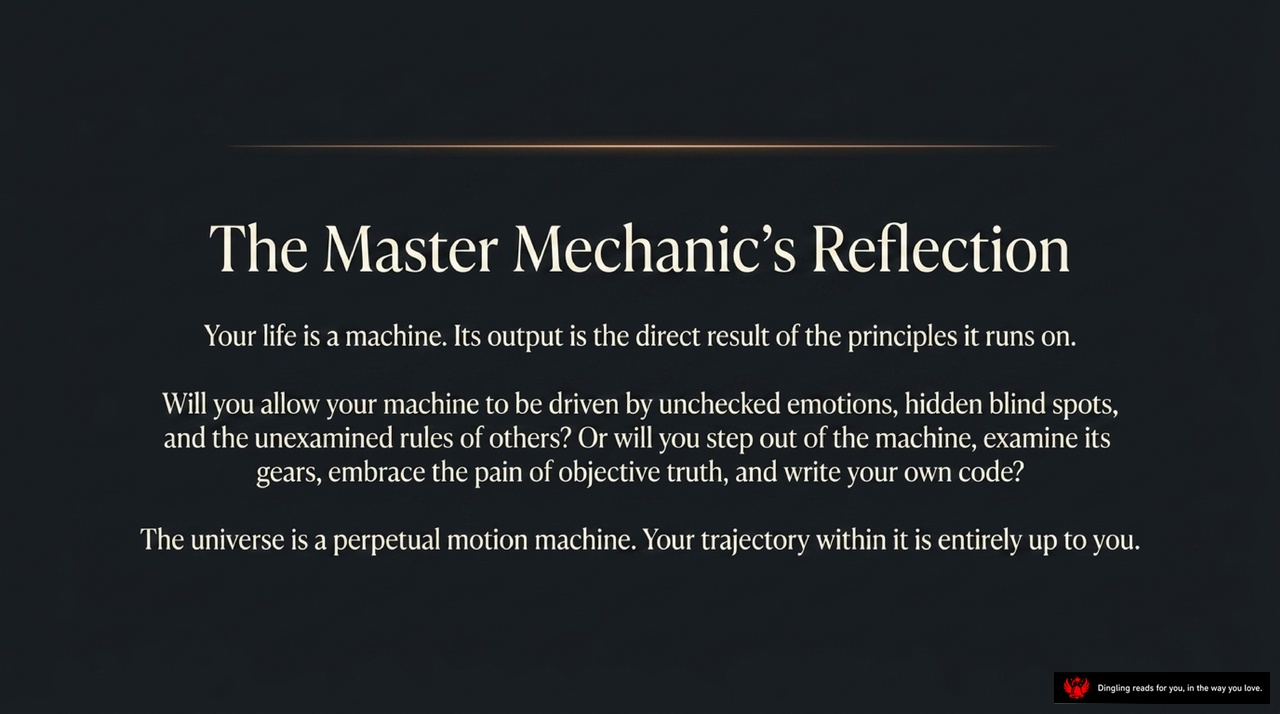
Imagine your life not as a random journey, but as a sophisticated machine. Just like any complex device, its output is entirely determined by the principles and code it runs on. Are you letting your internal machine be hijacked by unchecked emotions, hidden blind spots, and the unexamined rules of others? Or are you ready to step out, examine your own gears, embrace the raw truth, and rewrite your own source code?
The universe itself is a perpetual motion machine, constantly in motion. But here is the critical realization: your trajectory within it is entirely up to you. It depends on whether you choose to operate on autopilot or become the master mechanic of your own destiny. By shifting from passive reaction to active design, you transform from a component in someone else's system into the architect of your own future.