
Project Hail Mary: Complete Chapter-by-Chapter Summary
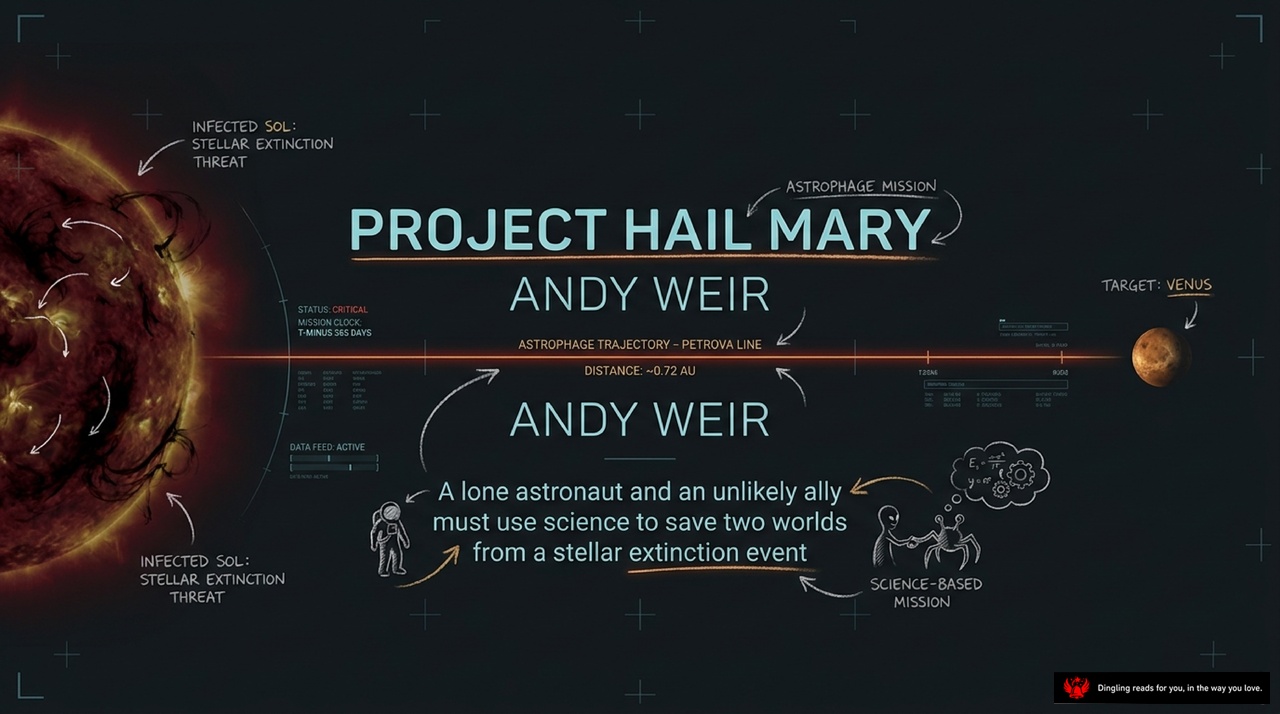
Welcome to Project Hail Mary, the mind-bending sci-fi epic by Andy Weir. Imagine waking up in a strange, silent ship with no memory of who you are or where you are. You're the lone survivor of a mission that went terribly wrong, surrounded by the wreckage of your crew. But you're not just lost; you're trapped in a cosmic emergency.
Your mission is clear: stop a star-eating alien lifeform known as a Star-Eater from extinguishing our sun. This isn't just about saving Earth; it's about saving two worlds from a stellar extinction event. You have a lone astronaut's resolve and an unlikely alien ally to help you. Together, you must use pure science to save humanity and a distant star system from total darkness.
In this story, a lone astronaut and an unlikely ally must use science to save two worlds from a stellar extinction event. It's a high-stakes race against time, where every calculation and every experiment could mean the difference between life and death for billions of people. Get ready for a journey that will challenge everything you think you know about the universe and your own potential.
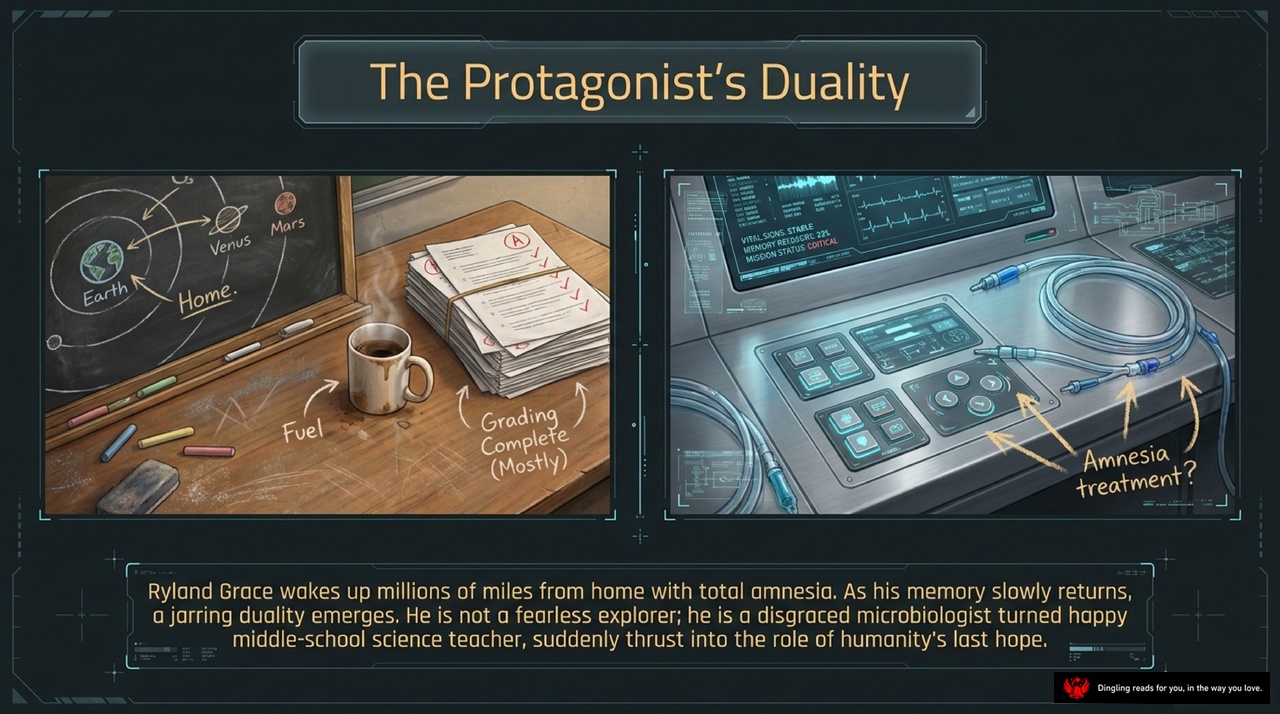
Ryland Grace wakes up millions of miles from home with total amnesia. As his memory slowly returns, a jarring duality emerges. He is not a fearless explorer; he is a disgraced microbiologist turned happy middle-school science teacher, suddenly thrust into the role of humanity's last hope. The image on the left shows his past life: a chalkboard drawing of Earth as "Home," a steaming mug of coffee labeled "Fuel," and a stack of graded papers marked "Grading Complete (Mostly)." This represents the grounded, relatable life he once knew, filled with routine and care for his students. But the image on the right reveals his terrifying new reality: a high-tech medical interface displaying "Amnesia treatment?" and critical mission status. This stark contrast captures the core conflict of the story—the collision between a normal teacher's world and a desperate, alien survival mission. Ryland must now bridge this gap, using his scientific mind to save Earth while grappling with the shock of his forgotten past and the weight of being the only hope for a dying planet.

Look at this diagram of the "Astrophage Lifecycle." It illustrates a terrifying, self-sustaining loop that threatens our entire solar system. The cycle begins with the Sun, which acts as the primary energy source. The Astrophage absorbs solar energy, converting mass into neutrinos while maintaining a precise internal temperature of 96.415°C. This process creates an infrared transmission vector, effectively turning the star's heat into a propulsion system.
Once fueled, these entities migrate at near-light speeds toward Venus. Why Venus? Because the Astrophage is drawn to the planet's carbon dioxide-rich atmosphere. Upon arrival, they reproduce exponentially, using that thick CO2 layer as a breeding ground. These new offspring then return to the Sun to repeat the cycle, creating a closed energy loop that drains the star's output.
The ultimate impact is catastrophic: as the Sun's energy is siphoned away, Earth faces an imminent and fatal ice age. This isn't just a theoretical threat; it's a biological engine designed to extinguish life on our planet. The diagram captures the essence of this crisis—a perfect, deadly machine that turns our own star against us.

The Earth's survival has come down to a single, terrifying equation: can we breed enough "Astrophage" fast enough to power our escape? To save humanity, unprecedented global mobilization was required. Enter Eva Stratt, who was granted unquestioned, immune-from-prosecution authority over the entire planet. She orchestrated a logistical triumph of epic proportions: paving a quarter of the Sahara Desert with "Black Panels" to artificially breed Astrophage, creating the massive energy reserves required for interstellar travel.
But here is the twist that defines her legacy. On the left, you see the hierarchy she built. At the very top sits Eva Stratt, commanding Global Militaries, Scientific Institutions, and Legal Frameworks. She didn't just ask for help; she took absolute authority. Why? Because time was running out. On Earth, the clock was ticking toward a frozen extinction. But in space, a new problem emerged. Our ally, Loki, had been trapped because his Astrophage fuel was eaten by a mutated enemy.
Eva's genius wasn't just in the Sahara; it was in the backup plan. She sent four "Beetle" ships back to Earth with the critical data we needed. While I stayed behind to save Loki, she ensured humanity had the knowledge to survive. Her plan to breed Astrophage in the desert was the key that unlocked the door to the stars, proving that sometimes, to save the future, you must seize absolute control of the present.

Look at this schematic. It shows the terrifying intersection of biology and destiny: the "Junk DNA Marker" on the left, which is the key to survival, leading directly to the "Cryosuspension Unit" on the right where the crew sleeps. The text explains the brutal math behind this mission. To survive a four-year journey without food or sanity, long-term comas were the only option, but they are usually fatal. Except for a tiny fraction of humans with this rare genetic marker. That's why Grace was forced onto this suicide mission against her will. His DNA simply allowed him to survive the trip when everyone else would have perished. It's a high-stakes gamble where a specific strand of ancient genetic code is the only difference between extinction and a chance at salvation.

Look at this schematic of the *Vessel: Project Hail Mary*. We're not just looking at a spaceship; we're looking at a desperate, brilliant life-support system built for survival, not comfort. Notice the label right in the center: "Centrifuge Mode: 1G Artificial Gravity." This is the ship's ultimate hack. Since they have no fuel left to return home, they split the vessel in half and connect them with high-tensile cables. By spinning at 7.5 RPM, they create enough centrifugal force to simulate Earth's gravity. It allows the crew to walk, eat, and operate standard lab equipment that would otherwise fail in zero-G. It's a fragile balance where the tension on those cables is critical, but it's the only way to keep human life functioning in the void.
But here's the twist that changes everything: the mission relies on four "Beetle" probes—labeled John, Paul, George, and Ringo on the diagram. These aren't just backup capsules; they are the final hope for Earth. Designed to fly independently, they carry the accumulated data back home. The ship itself is a one-way ticket to the star system Trappist-1, but these probes are the return ticket. Without them, humanity is lost. With them, there's a chance. This diagram captures the entire gamble: using physics to fake gravity, sacrificing the main ship, and trusting four tiny probes to save billions. It's a masterpiece of engineering born from absolute necessity.

Look at this map of the local star cluster. You see Earth's Sun, but notice the red lines surrounding most of the other stars. That's the signature of the Astrophage, a cosmic parasite that is slowly consuming and dimming every neighboring star. It's a silent extinction event happening right now. But there is one exception. Right here in the center is Tau Ceti. While everything else is being eaten, this star remains completely unaffected. It is immune.
This anomaly is the sole objective of Project Hail Mary. The mission is clear: reach this one star, discover the biological or physical reason for its immunity, and send that data home to save Earth. We are looking for the one answer that can stop the darkness from spreading to our own sun.

Imagine a radar screen from a sci-fi movie, but this one is real. In the center sits the "Hail Mary," our last hope, drifting alone twelve light-years from Earth. But the silence is broken. Suddenly, a blip appears on the display—Blip A. It's not a rock or a ghost; it's a massive alien vessel, vastly larger than ours, approaching with purpose.
This moment marks humanity's first contact. Grace, our lone survivor, realizes that Earth isn't the only species threatened by the star-eating Astrophage. This alien ship proves that others are building interstellar vessels, too. Yet, the tension is palpable. As the alien draws closer, Grace instinctively sends a signal: three short beeps, one long, and one short. It's a desperate attempt to say, "I'm here."
What happens next is nothing short of magical. Seconds later, the alien ship responds perfectly, repeating the exact same signal pattern. It's a perfect handshake across the stars. An automated drone then deploys a cylinder toward Grace, a gift from a civilization that has been fighting for centuries. Inside that cylinder lies a star map and a model, revealing that the aliens are from the Vega system, and their home star is also being consumed by the same threat. They aren't invaders; they are fellow victims, here to find a solution. This isn't just a meeting; it's the beginning of a partnership that will determine the fate of two entire civilizations.

Look at this schematic of Rocky, the Eridanian survivor. He's a terrifyingly alien yet deeply relatable being—a blind, pentagonal creature with an exoskeleton made of rock. As the image shows, he breathes scalding ammonia under crushing pressures, surviving in an environment that would instantly vaporize a human. But here's the mind-blowing part: he doesn't see the world like we do. Rocky perceives the universe entirely through advanced, hyper-detailed echolocation and sound frequencies.
That's why the diagram highlights his "Echolocation / Sound Frequencies" so prominently. He navigates by listening, interpreting the echoes bouncing off his rocky shell and the xenonite hull structure around him. To Rocky, silence isn't empty; it's a canvas of data. Every click reveals the texture of the universe, from the biological mass of his own limbs to the distant hum of a dying star. He might not have eyes, but his perception of reality is far more detailed than ours ever could be. In a universe where light is failing and stars are dying, Rocky's ability to hear the truth is the ultimate superpower.
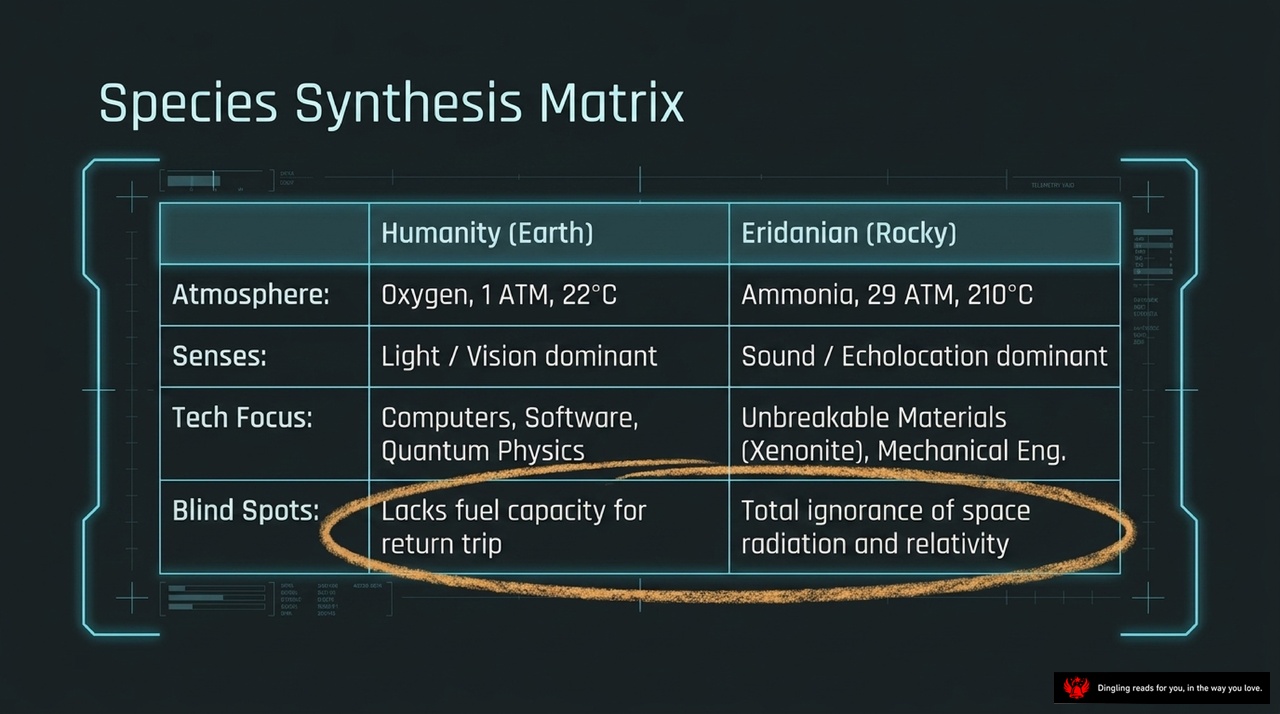
Look at this "Species Synthesis Matrix." It lays out the stark reality of why humanity and the Eridanians—let's call them the Procyonians—could never truly understand each other. We breathe oxygen at a gentle 22 degrees Celsius, while they thrive in a crushing 29 atmospheres of ammonia at a scorching 210 degrees. Our senses are dominated by light and vision; theirs are built on sound and echolocation. We obsess over software and quantum physics; they master unbreakable materials like Xenonite and mechanical engineering.
But the real tragedy lies in the "Blind Spots" circled here. Humanity lacks the fuel capacity to return from deep space, while the Procyonians have a total ignorance of space radiation and relativity. This gap is fatal. It's why their crew died of radiation sickness, thinking they were safe, and why they underestimated the limits of the universe, flying for years in what they thought was a short trip, only to find themselves stranded by the very laws of physics we understand. Their survival depends on our science; our survival depends on their technology. Without bridging these specific blind spots, neither species could ever save the other.

Imagine you're stranded on a distant world, speaking a language no human has ever heard. How do you bridge the gap? The answer lies not in words, but in the universal grammar of science itself. As seen on this slide, our protagonist Grace turns to a "Wave-Analysis Program" to decode alien communication. She takes their mysterious "Alien Chords"—complex, multi-tonal musical patterns—and runs them through a Fourier Transform Algorithm. This isn't magic; it's math. By anchoring the translation in immutable constants like prime numbers and atomic weights, she creates a dictionary that both species can trust. The result? A seamless conversion from alien sound waves into clear English, like hearing "Happy Astrophage." This moment proves that when sensory inputs differ, the universal language of physics remains the only true translator, turning silence into understanding and isolation into connection.
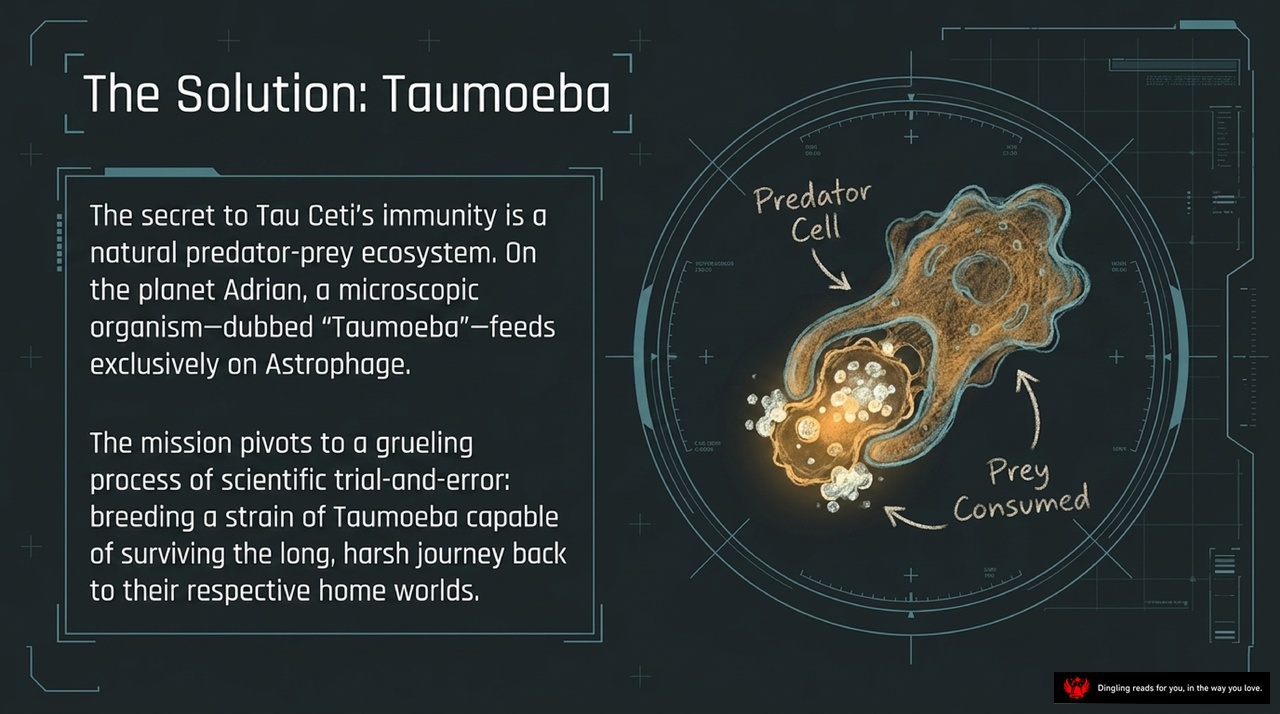
The secret to Tau Ceti's immunity lies in a natural predator-prey ecosystem, much like a self-correcting balance found in nature. On the planet Adrian, a microscopic organism known as the Taumoeba feeds exclusively on Astrophage, acting as a natural check to keep the star-eating threat in check.
But getting this solution to work required a grueling process of scientific trial-and-error. The mission pivoted to breeding a specific strain of Taumoeba capable of surviving the long, harsh journey back to their respective home worlds. As shown in the diagram, this is a delicate dance: the Predator Cell hunts and consumes its prey, creating a cycle that ultimately stabilizes the environment. It's a perfect example of how life evolves to solve the most existential crises, turning a potential extinction event into a sustainable future through the relentless power of adaptation.

The final dilemma is here, and it cuts right to the core of what it means to be human. As the slide reveals, success demands a devastating price. Grace discovers a terrifying truth: the nitrogen-resistant Taumoeba she bred can actually eat through Rocky's Xenonite ship, destroying his fuel supply and leaving him to starve in the deep void.
This is the ultimate sacrifice. Grace stands at a crossroads, represented by the two paths on the screen. Path A leads to Glory and Home, where she loads the automated probes to save Earth and returns as a hero. But Path B leads to isolation, where she turns her ship around, abandoning her own survival to save her friend, Rocky. It's a choice between saving humanity or saving a single life. The narrative forces us to ask: when the cost of success is everything we have, what is the one thing worth more than our own survival?
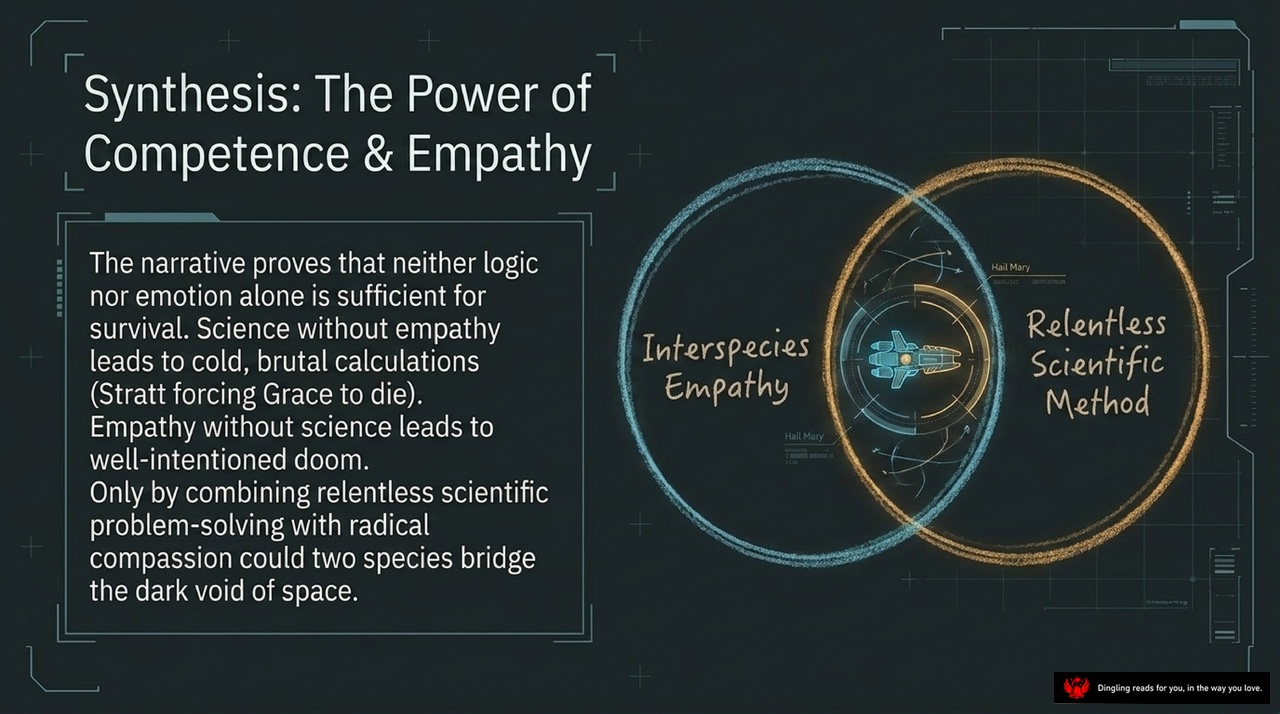
So, here is the synthesis of what we've learned: neither cold logic nor raw emotion alone can save us. As the slide illustrates, science without empathy leads to brutal, inhumane calculations—just like when Strat forced Grace to die. But empathy without the rigor of science leads to well-intentioned doom. The only path forward lies in that intersection: combining relentless scientific problem-solving with radical compassion. Only by bridging this gap can two species truly cross the dark void of space and survive.

Look at this image of a lone dome on a desolate, reddish alien landscape. It captures the ultimate sacrifice: two desperate species bridging the void of space, proving that survival requires not just intellect, but the courage to sacrifice for a friend. The text on the slide poses a haunting question: If you were millions of miles from home with the power to save your planet, would you risk it all to save a single stranger?
This is the defining moment for our protagonist, Ryan. After weeks of isolation and the heartbreaking realization that his alien friend, Loki, had been consumed by the very lifeforms they were trying to save, Ryan faced an impossible choice. He had the means to return to Earth with the solution—the Tau Starbug to wipe out the star-eaters—but his own food supplies had run out.
In a move that defies logic and breaks the human heart, Ryan chose to turn back. He didn't just return; he went back to find Loki. He used his remaining ships to search the vast darkness, scanning every angle until he finally found Loki's drifting vessel, trapped and empty. It was a desperate reunion in the silence of space.
But Ryan's sacrifice didn't end there. To survive the journey back to the high-gravity world of Vega b, he made a shocking discovery: the very creatures they were fighting, the Tau Starbugs, were edible. He ate them. He consumed the life he had fought so hard to destroy, becoming a living bridge between two worlds.
Years later, Ryan stands in a classroom on Vega b, leaning on a cane, his body aged by the harsh gravity. He looks out through the thick, alien wall at thirty young children, ready to teach them about light and speed. His sacrifice has paid off. The sun has returned to normal, Earth is safe, and he has found a new family among the stars. In the end, saving a stranger wasn't just an act of heroism; it was the only way to save us all.