
Protagonist Mode: Complete Chapter-by-Chapter Summary

Hello everyone, welcome to today's session. We are diving into a concept that will change how you see leadership: Protagonist Mode, by Fan Deng.
Look at this empty chair under the spotlight. It represents a powerful truth: true leadership is not about standing in the light yourself, but about orchestrating your own growth while relentlessly igniting the potential of others. Many leaders mistakenly think they are the hero of the story, but in reality, the most effective leaders are those who step back and let their team shine.
In our modern world, we often confuse noise with signal. We might think that being the loudest or having the biggest ego makes us the protagonist, but that is actually just noise. Real leadership is about distinguishing what truly matters. It's about creating an environment where everyone feels empowered to take the lead. When you shift from being the "savior" to being an "enabler," you unlock a new level of performance.
Think of it this way: a great leader doesn't write the script for others; they provide the stage, the lighting, and the encouragement, allowing every team member to become the hero of their own story. This mindset transforms a group of individuals into a high-performing team where innovation thrives. So, let's commit to this shift. Stop waiting for someone to save you, and start taking the wheel. Your team is waiting for you to step out of the way and let them lead.
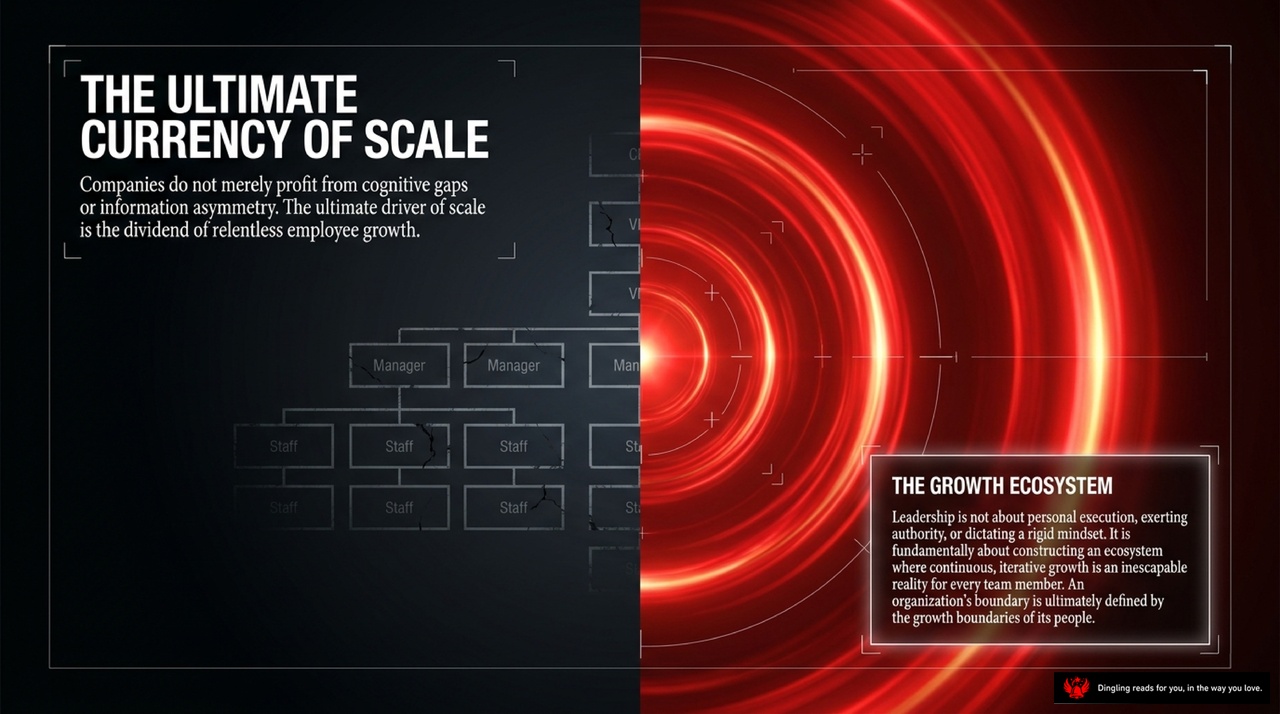
The ultimate currency of scale isn't just about exploiting information gaps or leveraging cognitive advantages. While those factors play a role, the true engine that drives an organization to massive scale is the relentless, continuous growth of its employees. Think of it this way: a company doesn't just profit from knowing things others don't; it profits from the dividends of people who are constantly getting better.
On the left side of our visual, you see a traditional hierarchy with managers and staff, representing the old model. But the real power lies in what we call "The Growth Ecosystem," highlighted on the right. In this ecosystem, leadership isn't about personal heroics, exerting authority, or forcing a rigid mindset onto others. Instead, leadership is fundamentally about constructing an environment where continuous, iterative growth is an inescapable reality for every single team member.
When you build this kind of ecosystem, the boundary of your organization is no longer defined by its physical walls or its budget, but ultimately by the growth boundaries of the people within it. If your people are stagnant, your organization hits a ceiling. If your people are evolving, your organization expands exponentially. So, the question for every leader is simple: are you building a machine that produces results, or are you cultivating an ecosystem that produces growth? Because in the long run, it's the latter that creates true, sustainable scale.
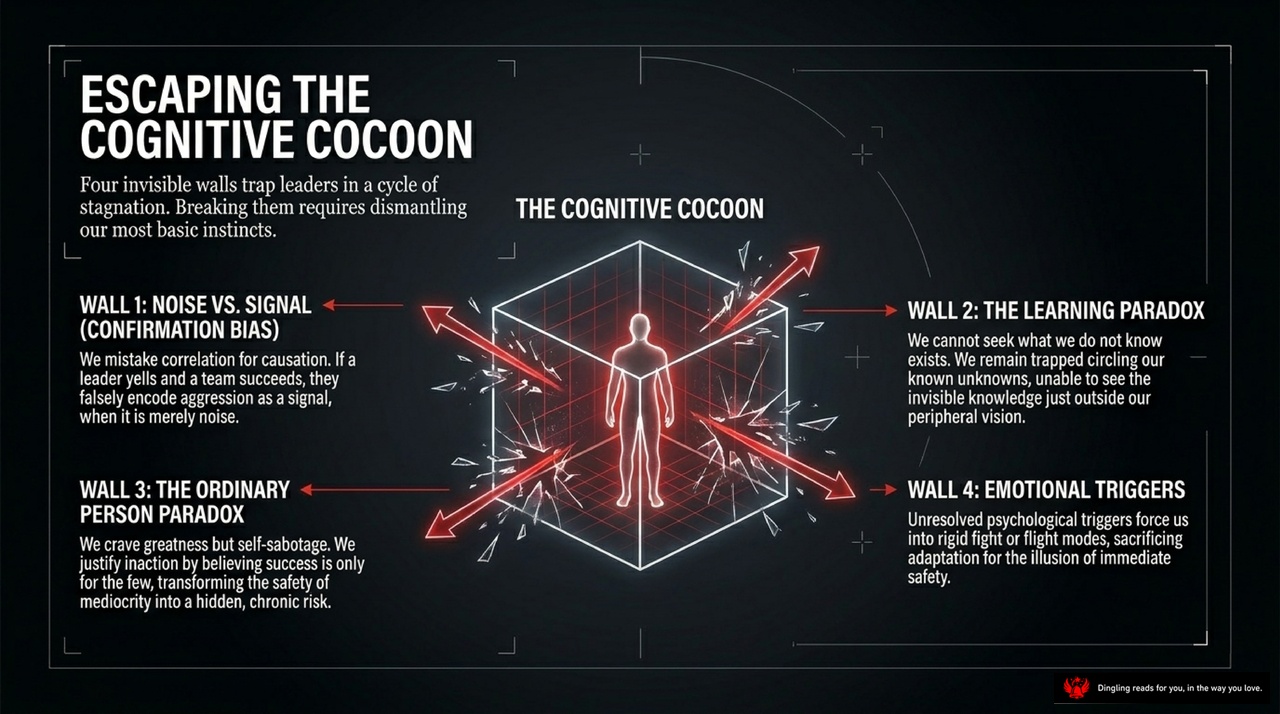
Escaping the Cognitive Cocoon is all about breaking free from four invisible walls that trap leaders in a cycle of stagnation. Let's dive into how we can dismantle these barriers to truly grow.
First, we have Wall One: Noise versus Signal, driven by confirmation bias. We often mistake correlation for causation. For instance, if a leader yells and the team succeeds, they falsely encode that aggression as a signal of effectiveness, ignoring the real drivers like market timing or team effort. It's like confusing random noise for a clear melody. To escape this, we must train our critical thinking. Instead of blindly accepting success as proof of our methods, we need to ask: "Is there data supporting this? Are there other explanations?" We must actively seek evidence that contradicts our beliefs, not just reinforce them.
Next is Wall Two: The Learning Paradox. We cannot seek what we do not know exists. Imagine a child in a library who only picks books within their reach, completely unaware of the keys to new worlds sitting just out of sight. This is our reality. We stay trapped in our "known unknowns," circling familiar ground while blind to the invisible knowledge right outside our peripheral vision. The solution? Continuous learning across different fields. By actively reading about topics you don't understand yet, you expand your cognitive boundary, allowing you to see opportunities and solutions that were previously invisible.
Then we face Wall Three: The Ordinary Person Paradox. We crave greatness but sabotage ourselves by believing success is reserved for the few. We justify inaction by transforming the safety of mediocrity into a hidden, chronic risk. Think about it: choosing the path of least resistance feels safe now, but it guarantees failure later. As the story of actor Lam Suet shows, persistence pays off. Those who dare to break out of the "ordinary" label, like him who endured grueling shoots, prove that success isn't a myth for the elite; it's a result of refusing to quit when others do.
Finally, Wall Four: Emotional Triggers. Unresolved psychological triggers force us into rigid fight-or-flight modes, sacrificing adaptation for the illusion of immediate safety. When a boss says, "We need to revise this," you might instantly feel attacked, triggering a childhood wound where you were constantly criticized. This emotional hijacking stops rational communication. To escape this cocoon, you must recognize these triggers. When you feel that spike of anger or fear, pause and ask, "Is this about the present, or is it echoing my past?" By acknowledging these hidden wounds and communicating them honestly, you can move from a defensive reaction to a constructive conversation.
Breaking these four walls requires courage and self-awareness. It means distinguishing real signals from noise, learning what you don't know yet, embracing the possibility of greatness, and managing your emotional triggers. Only then can you truly step out of the cocoon and lead with clarity and impact.
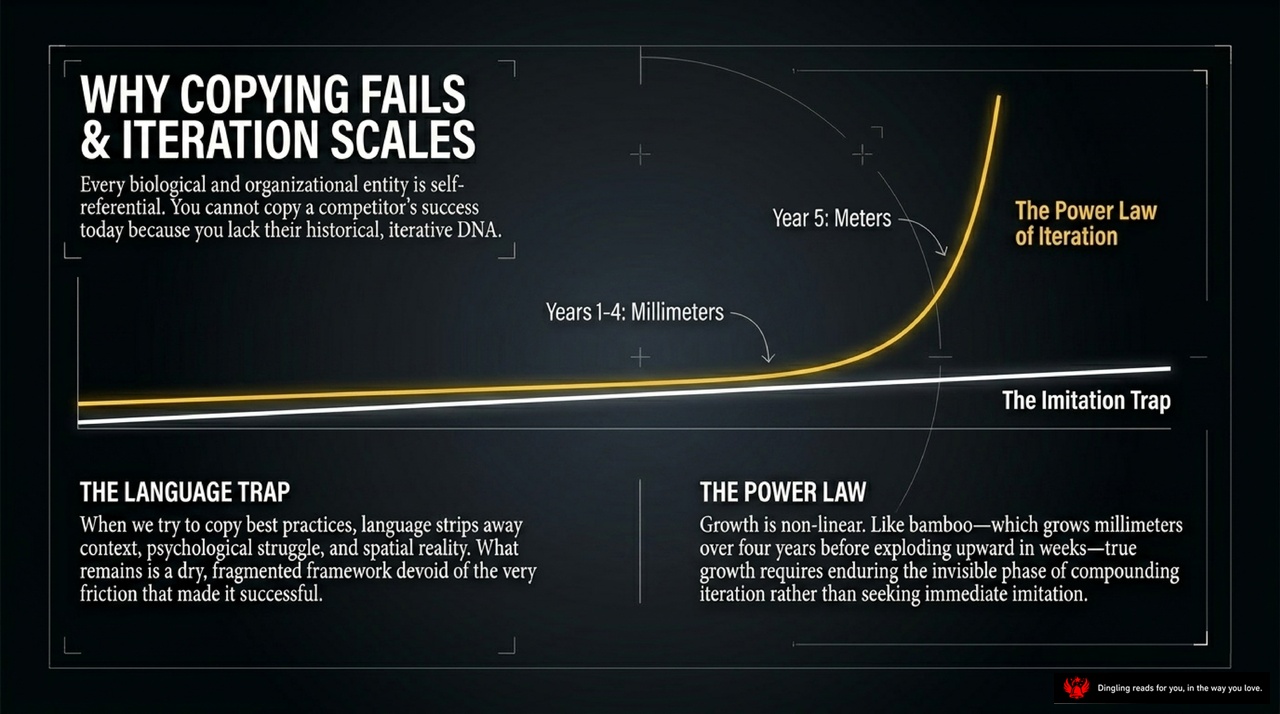
Why copying fails and why iteration scales is the real secret to success. As the slide illustrates, every biological and organizational entity is self-referential. You simply cannot copy a competitor's success today because you lack their historical, iterative DNA. When we try to copy best practices, language strips away context, psychological struggle, and spatial reality. What remains is a dry, fragmented framework devoid of the very friction that made it successful.
This is the "Language Trap." But there is another trap waiting for you: the Imitation Trap. Many people fall into it because they don't understand the Power Law of Iteration. Growth is non-linear. Think of bamboo: it grows only millimeters for the first four years, then explodes upward in weeks. True growth requires enduring the invisible phase of compounding iteration rather than seeking immediate imitation.
If you skip the years 1 through 4, you miss the foundation. You might see the final result, but you don't have the roots. The linear path of imitation looks safe, but the exponential curve of iteration is where real breakthroughs happen. Don't just copy the招式—the moves. Copy the journey, the struggle, and the time it took. That's the only way to build something that lasts.
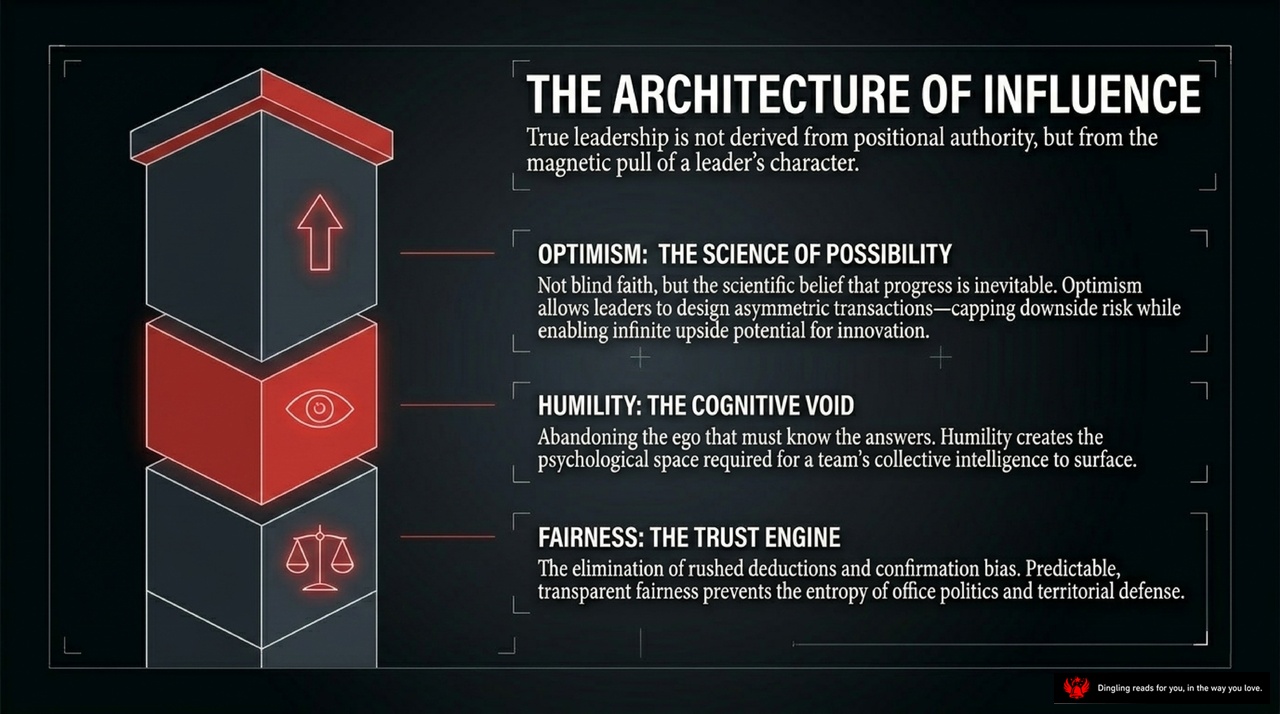
True leadership isn't about your title; it's about the magnetic pull of your character. Think of influence as an architecture built on three core pillars.
First, at the foundation, is **Fairness**. This is the trust engine. When you eliminate rushed judgments and confirmation bias, you create a predictable environment. Transparent fairness stops the chaos of office politics and territorial defense, ensuring everyone plays by the same rules.
Building on that, the middle block is **Humility**. This creates the "cognitive void." By abandoning the ego that insists on having all the answers, you open up psychological space. It's here that your team's collective intelligence can finally surface and thrive.
Finally, at the top, sits **Optimism**. This is the science of possibility. It's not blind faith, but the scientific belief that progress is inevitable. This mindset allows you to design asymmetric transactions—capping your downside risk while unlocking infinite upside potential for innovation.
When you stack these elements, you stop relying on positional authority and start leading with a character that naturally draws people in.
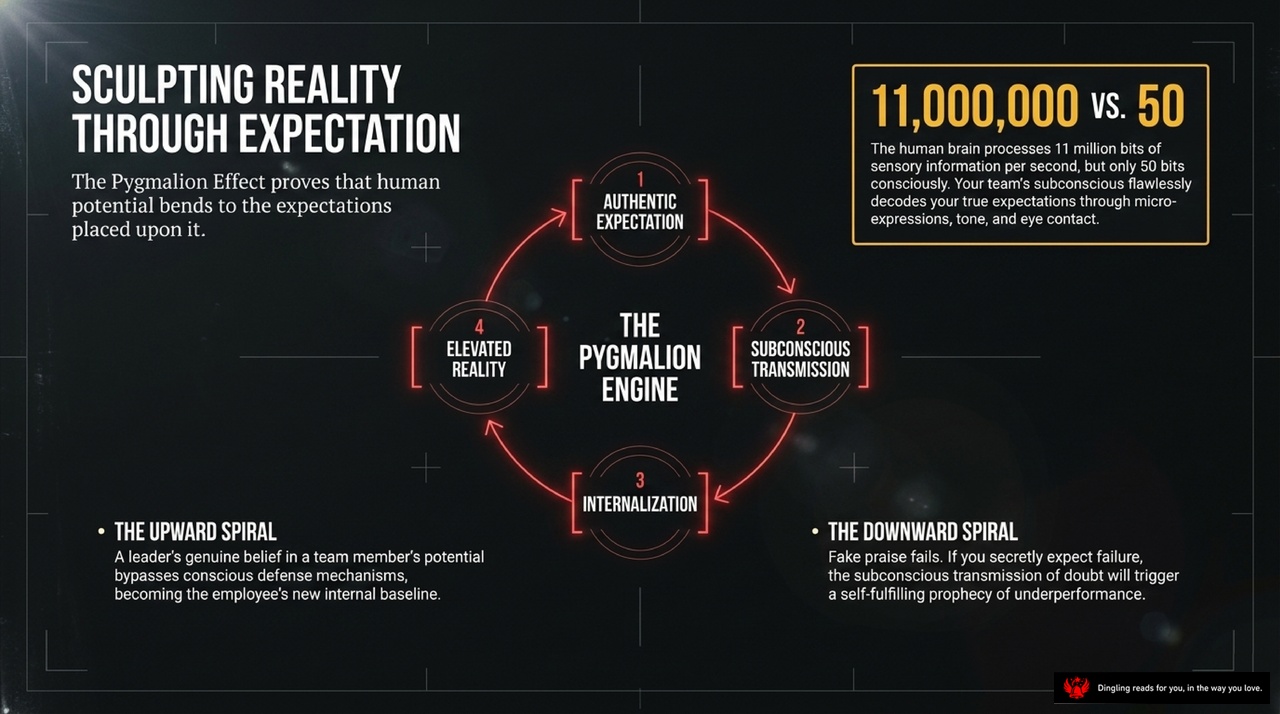
The Pygmalion Engine isn't just a theory; it's a self-fulfilling prophecy in action. As the slide illustrates, it all starts with **Authentic Expectation**. When a leader genuinely believes in a team member's potential, that belief bypasses the employee's conscious defenses and becomes their new internal baseline. This creates an **Upward Spiral**, where the leader's confidence fuels the employee's growth.
But here's the catch: your team's subconscious is far more perceptive than you think. While your conscious mind might process millions of bits of information, your team only needs a few micro-expressions, a shift in tone, or a change in eye contact to decode your true expectations. If you secretly expect failure, you trigger a **Downward Spiral**, creating a self-fulfilling prophecy of underperformance. Fake praise fails because the subconscious transmission of doubt is impossible to hide.
To break this cycle, you must move through **Internalization** and ultimately reshape reality. You have to ensure that your expectations are real, not just performative. When you truly see your team's potential, you aren't just predicting success; you are actively sculpting it. The difference between an upward and downward spiral often comes down to one thing: are you projecting genuine belief, or are you hiding your doubts?
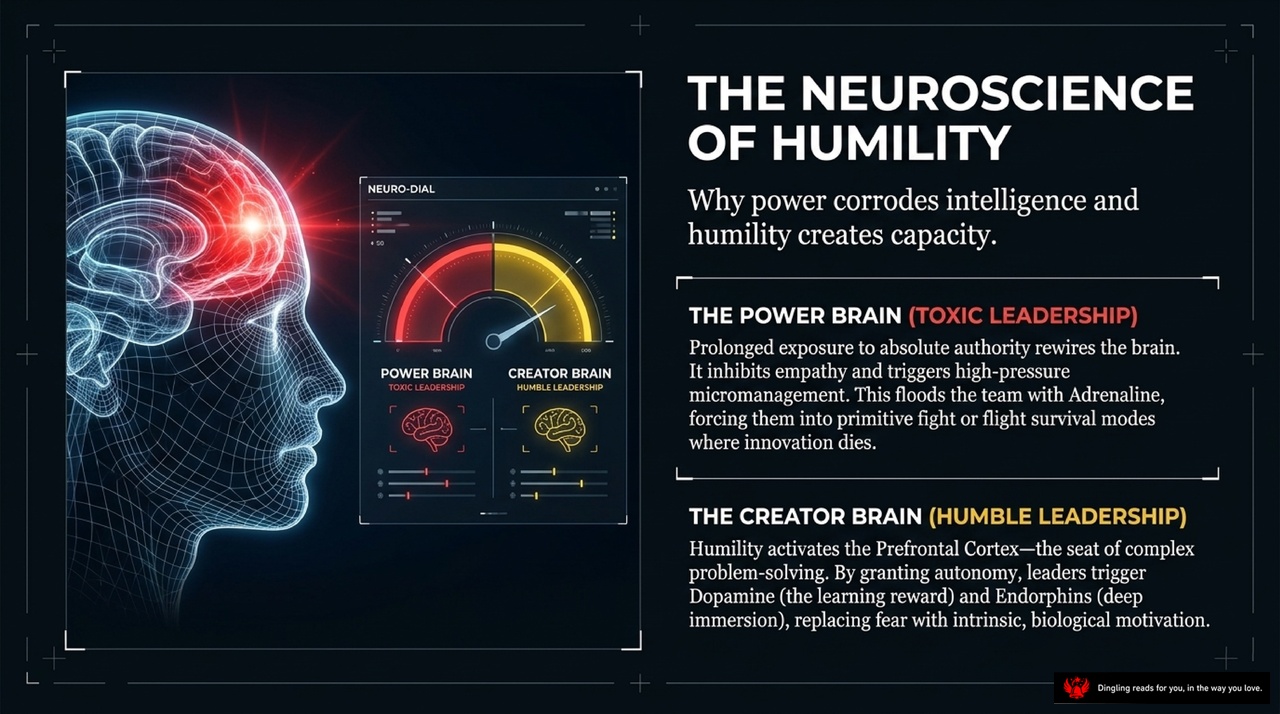
Imagine your brain as a high-tech cockpit, where the instrument panel determines whether your team flies into the future or crashes into fear. The image you see here perfectly captures the "Neuroscience of Humility," revealing a stark truth: power doesn't just change behavior; it physically rewires the brain.
Look at the left side, labeled "The Power Brain." When a leader clings to absolute authority, their brain enters a toxic state. This isn't just about being bossy; it's biological. Prolonged exposure to unchecked power inhibits empathy and triggers high-pressure micromanagement. The result? Your team's brains flood with adrenaline, forcing them into a primitive "fight or flight" survival mode. In this state, innovation dies because people are too busy scanning for threats to think creatively.
Now, look at the right side: "The Creator Brain." This is the result of humble leadership. When leaders step back and grant autonomy, they activate the Prefrontal Cortex—the seat of complex problem-solving. Instead of fear, this approach triggers dopamine, the brain's reward chemical for learning, and endorphins, which create deep immersion. You replace the fear of failure with intrinsic, biological motivation.
The lesson is clear: Humility creates capacity. It shifts the team from a defensive, survival-based mindset to a proactive, growth-oriented one. True leadership isn't about controlling the brain; it's about unlocking the Creator Brain in everyone you lead.
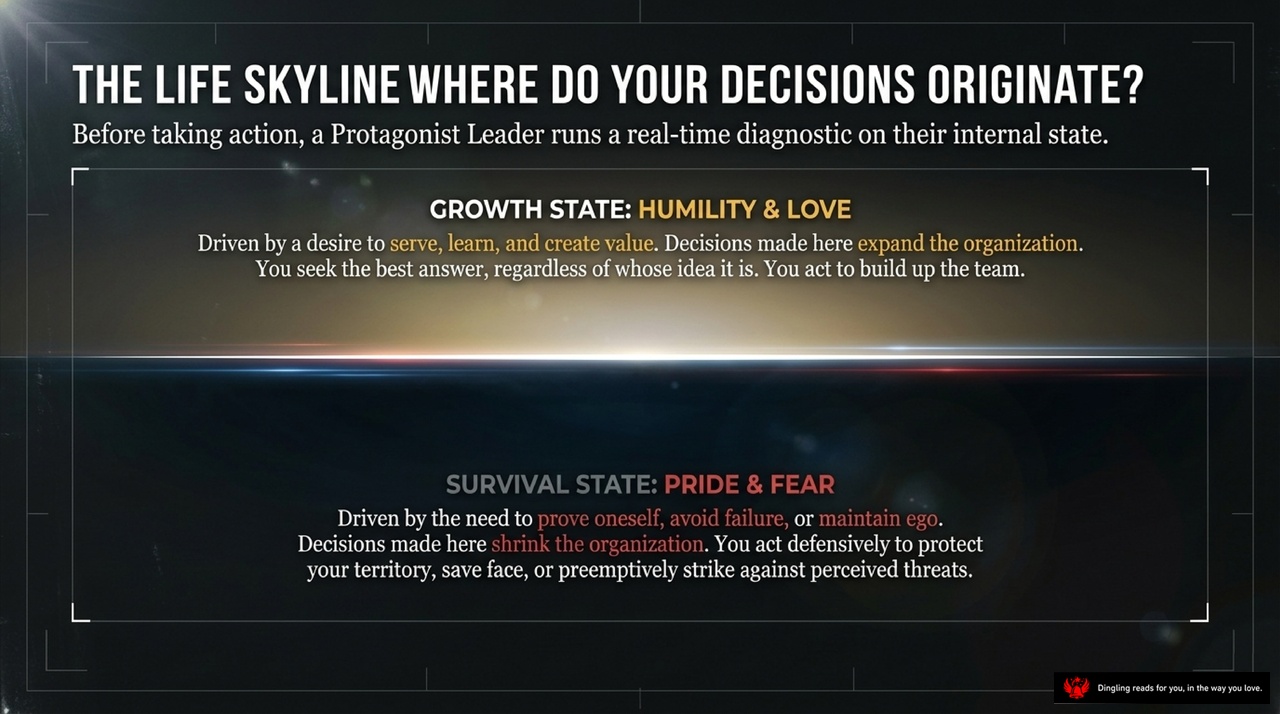
Have you ever stopped to ask yourself where your decisions actually come from? Before taking action, a true Protagonist Leader runs a real-time diagnostic on their internal state. It all comes down to the "Life Skyline." Are you operating from the **Growth State** or the **Survival State**?
When you are in the Growth State, driven by **Humility and Love**, your decisions originate from a desire to serve, learn, and create value. In this mindset, you seek the best answer regardless of whose idea it is. You aren't trying to protect your ego; you are acting to build up your team and expand the organization.
On the other hand, if you are in the Survival State, driven by **Pride and Fear**, your decisions stem from a need to prove yourself, avoid failure, or maintain your ego. Here, decisions tend to shrink the organization. You act defensively to protect your territory, save face, or even preemptively strike against perceived threats.
So, before you make your next move, ask yourself: Where do your decisions originate? Are you leading from a place of love and expansion, or from fear and contraction? The answer defines not just your choices, but the future of your entire team.

Stop providing answers. Start asking questions.
As adults, we inherently resist being told what to do. We only truly commit to the conclusions we reach ourselves. That's why the GROW model forces leaders to shift from being the "answer giver" to the "catalyst."
Let's break down this framework using the four steps shown on the slide.
First, **Goal**. We need to ask: What are we ultimately trying to achieve? This isn't just about immediate tasks; it forces alignment on the bigger picture.
Next, **Reality**. What is the current situation and the real challenge? This step strips away emotion to establish an objective baseline. We need to see the truth, not what we wish were true.
Then, **Options**. If there were no limits, what could we do? This question is powerful because it bypasses our fear response, unlocking the prefrontal cortex to generate creative ideas we might otherwise suppress.
Finally, **Will**. What specific action will you commit to next? This transfers ownership and accountability back to the employee. When people decide for themselves, they own the outcome.
By following this cycle, leaders stop giving answers and start asking the right questions, empowering their teams to find the solutions.

Look at this split screen. On the left, we have "The 10% Trap," and on the right, "The 10X Mindset." This isn't just about numbers; it's about how your brain processes ambition.
When you ask a team for a 10% improvement, you trigger linear thinking. They just work longer hours using the exact same flawed methods. It's comfort breeding complacency. But when you demand a 10X improvement, something shifts. You force a complete teardown of the process. You force them back to First Principles.
Think about Elon Musk and SpaceX. If he gave them an unlimited budget to build a rocket, they would have built traditional, expensive ones. But when he demanded a rocket for 1/10th the cost of NASA's, that constraint forced the invention of reusable boosters. Scarcity became the tool that unleashed creativity.
In our daily work, we often fall into that 10% trap, trying to optimize what's already broken. True innovation requires the friction of extreme limitations. So, next time you feel stuck, don't ask for a little bit more. Ask for ten times better. Limit the resources, challenge the status quo, and watch your team's creativity explode.

A team cannot self-organize without an immovable center of gravity. Think of your organization as a high-tech compass. To navigate the chaos of the modern workplace, you need to drive two specific engines: Vision and Key Tasks.
First, let's talk about Vision. This is the ultimate "Why." It's not just a slogan on a wall; it's a singular, unshakeable purpose. Ask yourself: What would the world lose if our company vanished tomorrow? This question provides the intrinsic meaning required to sustain momentum, especially during those grueling phases of iterative growth when things get tough. Without this deep sense of purpose, your team will drift.
But having a vision isn't enough. You also need the second engine: Key Tasks. This is the ruthless "What." Here's the hard truth: if everything is a priority, nothing is. You must restrict your strategic focus to a maximum of three to five non-negotiable tasks that directly serve your vision. And here is the most critical part—communicate these tasks so relentlessly that your team anticipates them before you even speak. When your people know exactly what the three big things are, they stop guessing and start executing with laser focus.
By anchoring your team in a clear Vision and driving them with a focused set of Key Tasks, you create that immovable center of gravity. You transform a group of individuals into a self-organizing, high-performing unit ready to tackle any challenge.
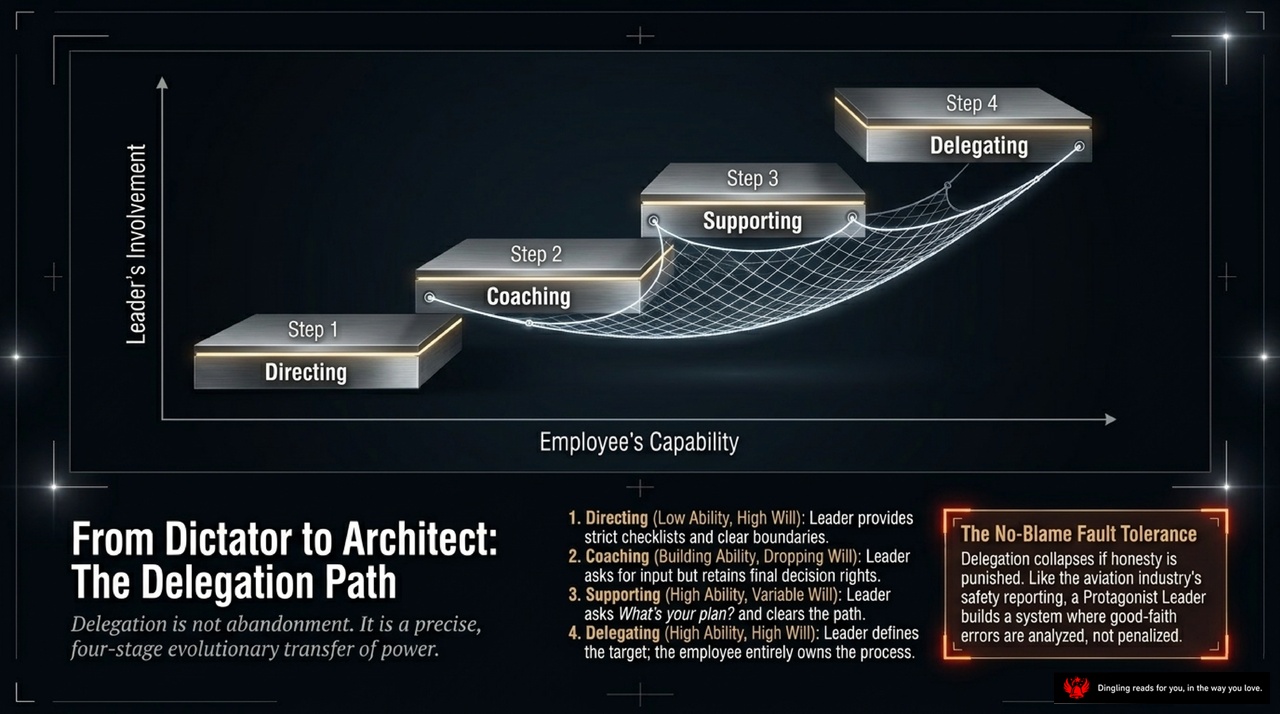
Leaders often think delegation is about dumping tasks and walking away, but the reality is far more strategic. As the chart illustrates, true delegation is a four-stage evolutionary path that shifts power from the leader to the employee as capability grows.
In the beginning, when an employee has low ability but high will, we are in the **Directing** phase. Here, the leader acts like a captain on a stormy sea, providing strict checklists and clear boundaries. The employee follows orders because they trust the leader's direction.
As the employee gains experience, we move to **Coaching**. This is where we stop giving answers and start asking questions. The leader asks for input but retains the final decision rights. It's about building ability while gradually dropping the heavy hand of control.
Next comes **Supporting**. Now the employee has high ability, but their will might fluctuate. The leader's role changes to a safety net. We ask, "What is your plan?" and then simply clear the path. We provide support when needed, but we don't steer the ship anymore.
Finally, we reach **Delegating**. This is the ultimate goal: High Ability and High Will. The leader defines the target, and the employee entirely owns the process. At this stage, the leader is no longer involved in the daily execution; they are an architect watching a masterpiece unfold.
However, this transition only works if we build a culture of **No-Blame Fault Tolerance**. Just like in the aviation industry, where pilots are encouraged to report errors without fear of punishment, a great leader creates a system where mistakes are analyzed to learn, not penalized to hide. When honesty is punished, delegation collapses. But when we treat errors as learning opportunities, we empower our team to take the risks necessary for real growth.

Let's talk about the fundamental shift in how we lead. Look at this comparison: we're moving from the "Traditional Manager," who sees themselves as an all-knowing hero, to the "Protagonist Leader," who acts as a facilitating director.
The traditional manager focuses on fixing immediate problems and relies on external rewards like bonuses or fear to motivate the team. Their communication style is simple: "I speak, you execute." They operate with a linear mindset, constantly seeking quick, replicable shortcuts. When failure happens, they assign blame and tighten control.
But the Protagonist Leader is different. Their primary focus is expanding team capacity, not just putting out fires. They tap into intrinsic motivation—autonomy and a shared vision—rather than just paying for results. Instead of giving orders, they ask questions: "You speak, I ask questions." They believe in exponential growth, embracing slow iteration over quick fixes. When things go wrong, they don't blame individuals; they analyze systemic flaws and iterate to improve.
This shift represents a complete change in the game. It's about moving from control to facilitation, from fear to trust, and from linear shortcuts to the power of continuous learning. This is the synthesis we need to lead effectively in a complex world.
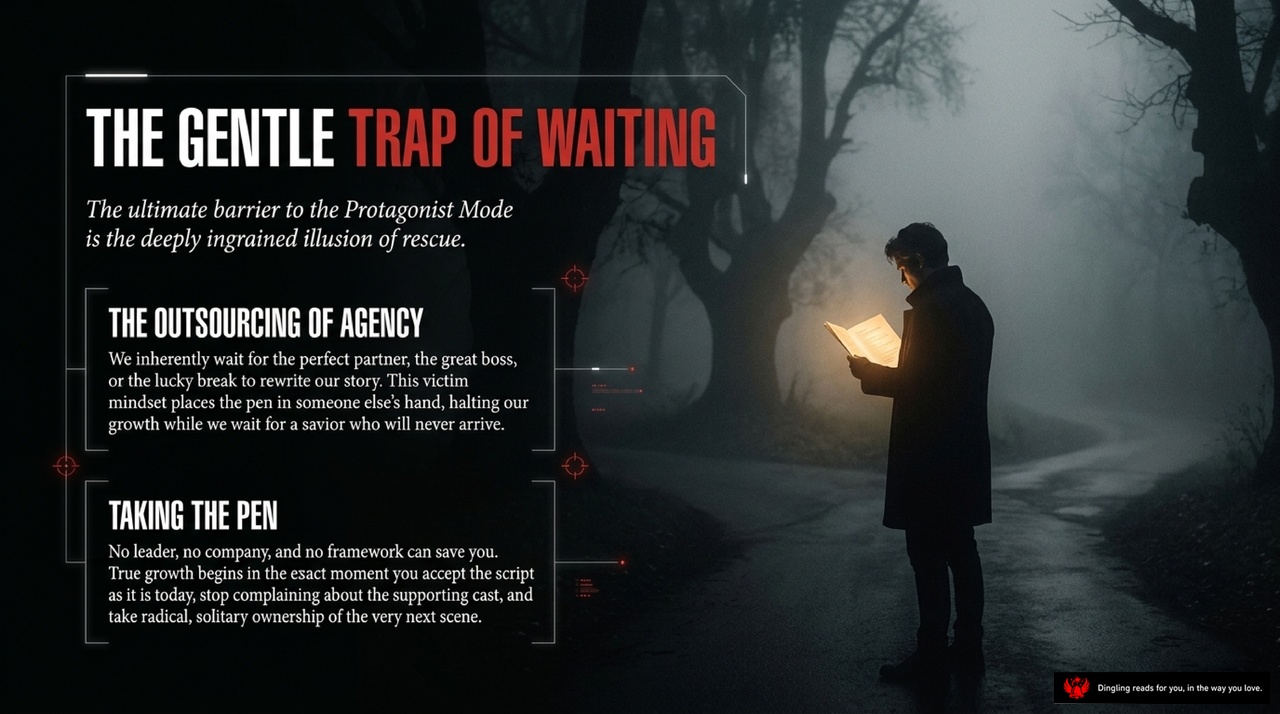
The image captures a hauntingly quiet moment: a lone figure standing on a foggy, tree-lined road, illuminated only by the warm glow of a book in their hands. The title, "The Gentle Trap of Waiting," perfectly sets the scene. It speaks to that deep, seductive illusion where we believe someone or something else will come to save us.
We often outsource our agency, waiting for a perfect partner, a great boss, or a lucky break to rewrite our story. This victim mindset places the pen in someone else's hand, halting our growth while we wait for a savior who will never arrive. It's like being stuck in that foggy road, hoping for a sign that never comes.
But true growth begins in the exact moment you accept the script as it is today. No leader, no company, and no framework can save you. You must stop complaining about the supporting cast and take radical, solitary ownership of the very next scene. You have to take the pen. The story isn't waiting for you; you have to write it.
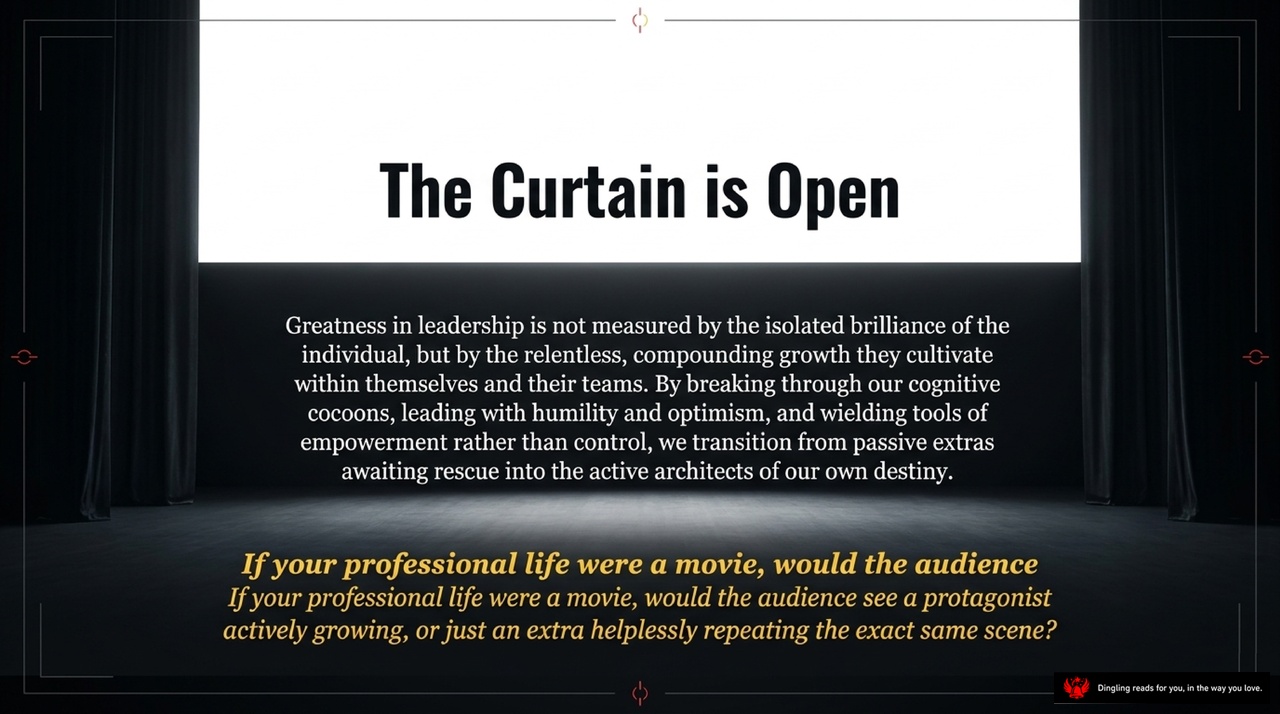
Imagine your professional life as a movie. Now, ask yourself a hard question: Are you the protagonist actively shaping the story, or just a background extra helplessly repeating the same scene?
The slide in front of us, "The Curtain is Open," invites us to step off the sidelines. True greatness in leadership isn't about isolated brilliance; it's about relentless, compounding growth within yourself and your team. We must break through our cognitive cocoons by leading with humility and optimism, wielding empowerment instead of control.
When we shift from passive extras waiting for rescue into active architects of our own destiny, the entire narrative changes. Instead of blaming the script, we start writing it ourselves. This transition transforms our daily struggles into a dynamic journey of creation, where we don't just watch the action unfold, but become the ones pulling the strings.