
Psychoanalysis and the Cure of Souls: Complete Chapter-by-Chapter Summary

Welcome to the opening of our journey into the human psyche with Carl G. Jung's masterpiece, *Psychoanalysis and the Cure of Souls*. Today, we stand at the very beginning of a profound exploration, bridging the realms of modern science, ancient religion, and the mysterious, autonomous unconscious.
This book isn't just about therapy; it's a quest to heal the soul. Jung invites us to look beyond the surface of our conscious minds and dive into the deep waters of the unconscious, where our truest selves reside. He challenges us to understand that our psyche is not a machine to be fixed, but a living, breathing entity that holds the key to our spiritual wholeness.
As we turn the page, we'll discover how Jung reimagines the relationship between the mind and the spirit, offering a path forward for those seeking not just relief from symptoms, but a deeper, more meaningful connection to themselves and the world around them. Get ready to embark on this transformative journey with one of the most influential thinkers of the 20th century.
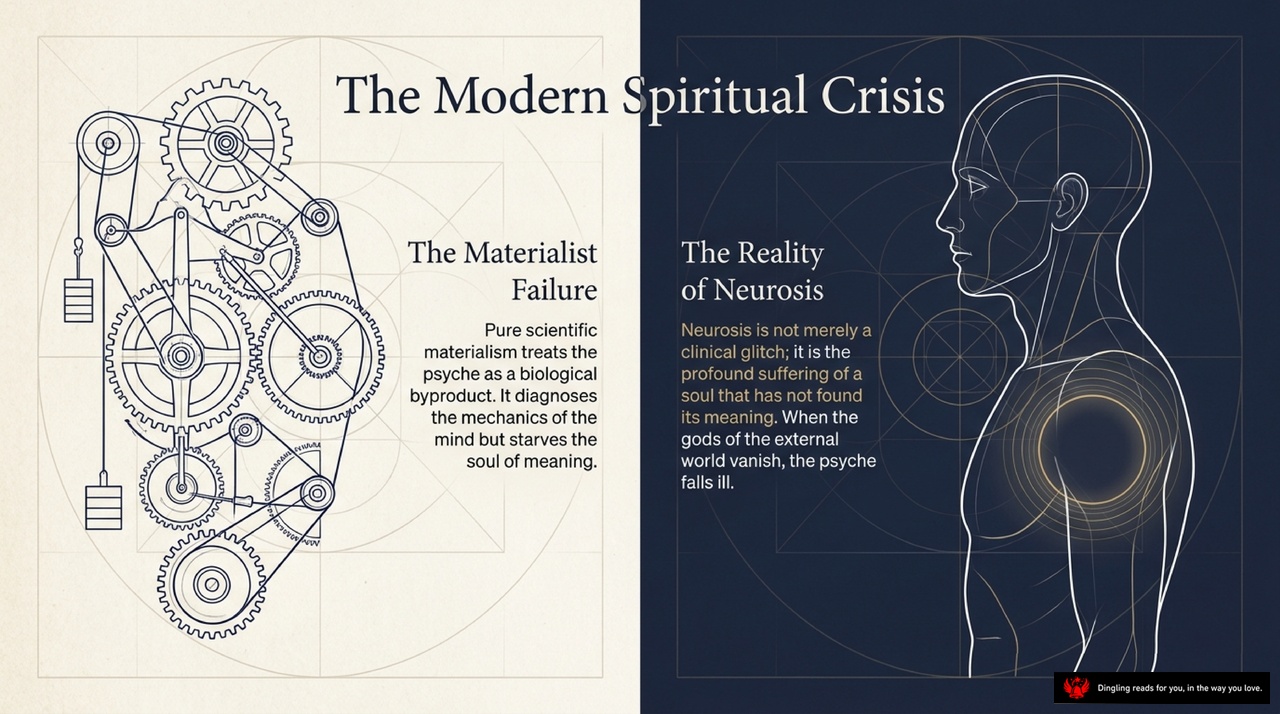
Today's slide, titled "The Modern Spiritual Crisis," captures the profound disconnect we face between our physical existence and our inner lives. On the left, we see a complex machine labeled "The Materialist Failure." This image represents how pure scientific materialism treats the psyche as nothing more than a biological byproduct. It tries to diagnose the mechanics of the mind, but in doing so, it starves the soul of meaning. It explains *how* we think, but it fails to answer *why* we suffer.
On the right, under "The Reality of Neurosis," we see a human figure with a glowing, painful spot on the shoulder. The text here clarifies that neurosis is not merely a clinical glitch or a wiring error. It is the profound suffering of a soul that has not found its meaning. When the gods of the external world vanish, when our traditional anchors disappear, the psyche falls ill.
This duality highlights the core argument: our modern mental health crisis isn't just about chemistry or faulty circuits. It is a spiritual crisis. We are trying to fix a spiritual wound with mechanical tools. As we move forward, we will explore how ancient wisdom and modern psychology can bridge this gap, helping us move from a fragmented, mechanical view of ourselves to a whole, integrated understanding of the human spirit.

The slide we see here, titled "The Protectors of the Psyche," breaks down three distinct approaches to protecting our inner mind: Catholicism, Protestantism, and Psychoanalysis. Think of these not just as religious or medical labels, but as different psychological tools we've used throughout history to handle the overwhelming forces of the unconscious.
First, look at Catholicism, labeled here as "The Container." Its mechanism relies on rituals, dogma, and confession. The core idea is that it protects the individual by providing a safe, collective container. It acts like a safety net, holding back the chaotic and overwhelming forces of the unconscious so the individual doesn't have to face them alone. It's about finding shelter within a community and established beliefs.
Next, we have Protestantism, described as "The Isolated Conscience." Here, the mechanism is the removal of ritual. By stripping away the collective safety net, the individual is left alone, directly burdened with their conscience before God. This approach removes the psychological safety net, leaving the person isolated. While this can prime them for direct experience and personal responsibility, it also carries a significant risk of anxiety and fragmentation without that external support.
Finally, we have Psychoanalysis, which the slide calls "The Surgical Key." Its mechanism is clinical unveiling. Unlike the religious frameworks, this approach acts as a surgical tool. It directly unlocks the unconscious, forcing the conscious mind to confront and integrate repressed instincts without the shelter of religious dogma. It doesn't offer a comforting container or a distant God; instead, it demands that we do the hard work of facing our own psyche head-on to achieve true integration.

Welcome to the next chapter, where we dive into the ancient wisdom of the East and its surprising resonance with Western psychology.
Think about the I Ching, or the Book of Changes. For centuries, the West viewed it through the lens of superstition, a simple tool for fortune-telling. But Jung saw something entirely different. He treated the I Ching not as a manual for predicting the future, but as a bridge between our conscious mind and the vast, hidden depths of the unconscious. The core principle here is "synchronicity"—a concept that completely breaks from our Western obsession with linear cause and effect. Instead of asking "what caused this?", the I Ching asks, "what is connected to this right now?" It suggests that everything happening in your life at this specific moment is part of a deeper, invisible web of meaning. When you cast the coins, you aren't just getting a random number; you are engaging in a dialogue with your own unconscious, allowing ancient archetypes to speak to your current situation.
But this isn't just about divination; it's about psychology. Jung realized that the East and West were actually speaking the same language, just using different dialects. While Western science often focuses on dissecting the world into separate parts—mind versus body, subject versus object—Eastern traditions like Yoga and Buddhism offer a holistic view. They teach us that we are not separate from the universe, but an integral part of it. This "oneness" was a radical idea for the West, which had spent centuries prioritizing logic and control. Jung saw that Yoga's practice of connecting breath, body, and mind was actually a scientific method for integrating the fragmented self. It wasn't just about physical flexibility; it was about dissolving the barriers between consciousness and the unconscious, achieving a state of wholeness that Western medicine struggled to define.
The fusion of these two worlds became the hallmark of Jung's later work. He didn't just admire Eastern philosophy; he integrated it into the very fabric of his therapy. Concepts like the Mandala, found in Tibetan Buddhism, mirrored the psychological process of individuation—the journey toward becoming a whole person. Similarly, the Zen practice of using paradoxical riddles to break the mind's logical grip was a powerful tool for Jung to help patients bypass their intellectual defenses and access deeper truths. By embracing these Eastern insights, Jung provided the West with a map for navigating the unknown territories of the psyche, proving that the ancient wisdom of the East could heal the modern spirit.

Dreams are not random noise; they are the unvarnished voice of nature attempting to communicate. Think of them as objective historical artifacts that do not lie, but simply speak a forgotten symbolic language. When we step into the dream world, we encounter the "Voice of the Unknown," where the conscious ego often clashes with the raw, unfiltered truths of the psyche.
This is where the "Compensatory Function" comes into play. Dreams spontaneously arise to balance our blind spots, neuroses, and the arrogance of our conscious self. If your ego is too rigid or one-sided, the dream world pushes back with opposing images to restore equilibrium. It is nature's way of keeping us whole.
So, how do we approach these symbols? The key is to treat them as "The Unvarnished Truth." Instead of forcing a rational explanation or ignoring them, we must learn to listen to this ancient, symbolic language. By doing so, we stop fighting our dreams and start integrating the hidden parts of ourselves, allowing for a deeper psychological healing and a more complete sense of self.

The cross and the mandala: two symbols from different cultures, yet both pointing to our deepest search for cosmic order and inner balance. The cross divides space into four quadrants, acknowledging the inevitable conflict in our spirit—the sharp angles speaking to our struggle to find redemption in separation. But the mandala offers a different vision. With its circular, inclusive form, it shows light and dark coexisting without tearing apart, representing the ideal state of psychological wholeness where consciousness and the unconscious finally unite.
Both symbols center on the "center," a projection of our psyche's search for origin and home. Whether it's the cross's intersection or the mandala's core, this center is our anchor. In Jungian psychology, symbols are the bridge between conscious and unconscious. The cross helps us face our conflicts and see our fragmentation clearly; the mandala guides us toward integration. When you draw a mandala or feel a pull toward the cross, these aren't just distant cultural icons—they become the external expression of your inner journey. They turn invisible psychological energy into visible form, allowing split parts to be seen and accepted. Ultimately, both the cross's redemption and the mandala's wholeness tell us the same truth: our spiritual path is always a movement from fragmentation to integration, from chaos to order, finally arriving at the completeness of union with our true self.

Modern individuals stand at the edge of history, fully awake yet deeply haunted by a profound sense of guilt. We have severed our spiritual umbilical cords from tradition, choosing to face the void without the comfort of ancient myths. This radical awareness, once seen as the pinnacle of human intellect, has ironically become proof of our shattered hopes. For nearly two millennia, the Christian ideal promised a golden age, yet instead, it delivered the horrors of world wars, concentration camps, and chemical weapons. The result is a modern psyche in crisis, trembling with uncertainty.
The root of this crisis is the collapse of our traditional value systems. Faith, morality, and grand social narratives have crumbled under the weight of reality. We tried to build a new world on ideals like international brotherhood and economic unity, but they failed to stop the devastation. Now, the optimism of the post-war era feels less like healing and more like a prelude to the next disaster. When the chaos of the external world breaks through our defenses, we turn inward, only to find our own minds equally chaotic.
This has led to a deep psychological split within us. On one hand, science and technology grant us unprecedented power and material comfort. On the other, these very tools threaten our own existence. This conflict rages not just in society but in our personal spirits. Our rational minds constantly battle with our instincts, our conscious awareness clashes with our unconscious depths, and our ideals collide with harsh realities. Even those who appear normal can suddenly be swept away by the flood of the unconscious, trapped in a war with themselves.
Modern civilization, built on the banner of reason, has aggressively suppressed the unconscious, treating it as a dark zone to be controlled or eliminated. But the unconscious does not disappear; it merely hides, growing stronger in the shadows. When the balance between consciousness and the unconscious is broken, individuals spiral into mental crises, and society faces turbulence. This is why we see the rise of occult movements, astrology, and spiritualism—they are the unconscious seeking a voice, challenging the rigid order of the modern world.
To heal this split, we must integrate our personal consciousness with our collective unconscious. We cannot simply reject our unique selves or blindly follow the crowd. We must face the tension between individuality and belonging. By exploring our dreams and symbols, we can awaken the archetypal forces within us, allowing our personal minds to dialogue with the deeper, shared psyche of humanity. When we reconnect with this vast inner foundation, we stop feeling isolated. We find that our struggles are not just personal failures but part of the human story. Through this integration, we can move from a state of fragmentation to one of wholeness, finding the balance and completeness we desperately need in a fractured world.

The image before us contrasts two fundamental archetypes that shape our understanding of the psyche: the Trinity and the Quaternity. On the left, we see the triangle representing the Trinity, symbolizing spirit, light, and masculine perfection. However, as Jung warns, this structure systematically excludes the dark, the feminine, and the material elements, creating a sterile ideal.
The arrow in the center points us toward the square on the right: the Quaternity. This is the archetype of true wholeness. Jung believed that the psyche spontaneously dreams in fours to integrate those rejected elements—Earth, the Shadow, the Feminine—demanding completeness over sterile perfection. This shift from three to four mirrors the psychological journey from a one-sided, conscious ego to a fully integrated self. It suggests that true healing isn't about polishing away our flaws, but rather embracing the full spectrum of human experience, including the darkness we often try to deny.

Today's slide brings us to a powerful synthesis: the "World Clock." Imagine the vertical axis of spiritual time intersecting perfectly with the horizontal axis of material reality. This isn't just a diagram; it's the ultimate resolution of the mind-body split.
Think of this as the moment a patient, after surviving an intense psychological crisis, finally experiences a spontaneous dream of sublime harmony. In this vision, the "Self" unites the highest conscious intellect with our deepest earthly instincts. It's where the divine and the human meet without friction.
This concept bridges the gap between our conscious mind and the vast, often chaotic depths of the unconscious. Just as the World Clock aligns time and space, true healing aligns our rational self with our primal instincts. It suggests that when we stop fighting our inner shadows and embrace the full spectrum of human experience—from our noblest aspirations to our rawest desires—we achieve a state of wholeness. It is the realization that we are not fragmented parts, but a unified whole, ready to navigate the complexities of life with both clarity and depth.
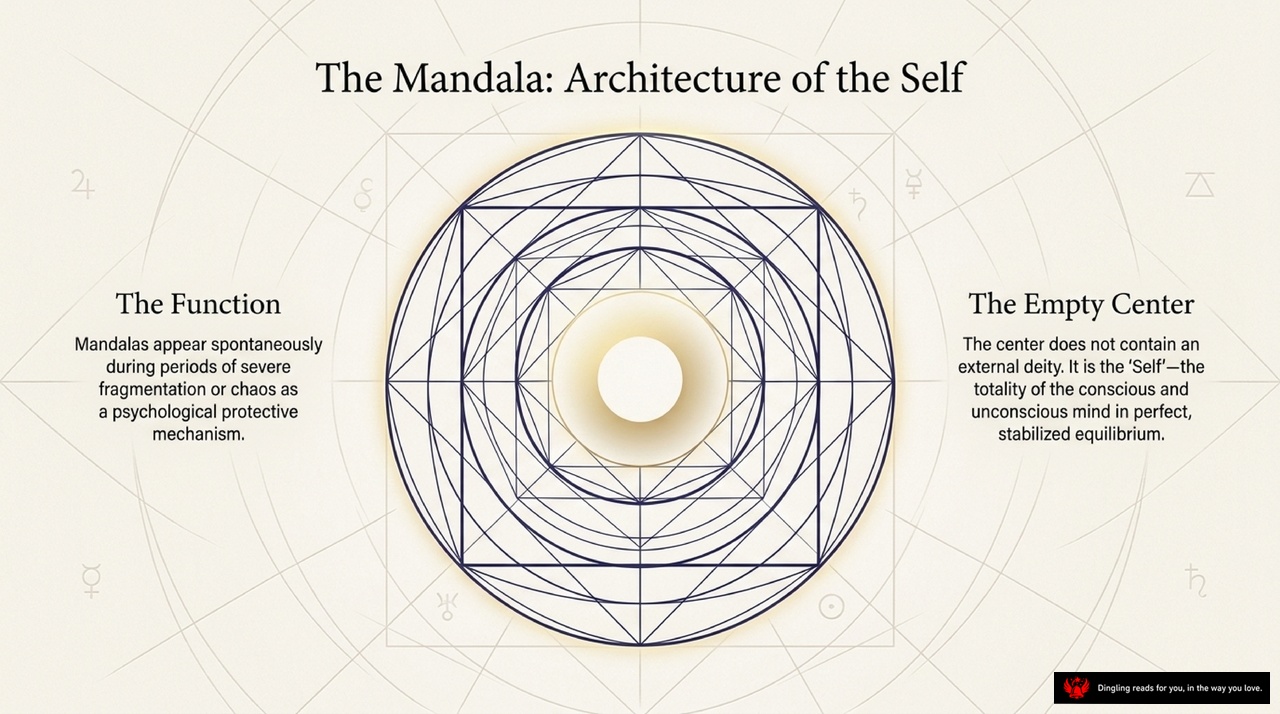
The Mandala: Architecture of the Self. Look at this intricate design. It's not just art; it's the blueprint of our own psyche.
According to Jung, the Mandala appears spontaneously when we feel fragmented or chaotic. It acts as a psychological shield, a way to bring order out of the storm. But what sits right in the middle? Notice the empty center. It's not a god or an external deity. It is the 'Self'—the total union of your conscious mind and your deep, hidden unconscious. It represents a perfect, stabilized equilibrium.
Think of it this way: when you feel torn apart by conflicting emotions or confusing thoughts, your mind naturally tries to rebuild itself. It draws a circle, a square, a pattern. This is your psyche trying to heal. The outer layers are your conscious defenses and daily life, but that hollow center? That's your true core, the part of you that holds everything together. It's the ultimate goal of psychological growth: to stop fighting your inner chaos and instead embrace it, finding that calm, unified center within.

The East versus the West Divide isn't just a historical footnote; it's the fundamental split in how we understand reality itself. Look at the left side: the Western Paradigm. It's extroverted, grounded in matter, and views religion as something external—faith and grace bestowed upon us from outside. But flip to the right, and you see the Eastern Paradigm. It's introverted, rooted in the mind, and sees religion as an internal journey, a cognitive and experiential quest for enlightenment from within the self.
This distinction shapes everything. In the West, we tend to separate subject from object, spirit from matter, good from evil. We look outward for answers, relying on logic and external authority. In the East, the mind is the bridge connecting the individual to the universe. Consciousness and the unconscious aren't enemies here; they are one. The goal isn't to conquer the unconscious, but to awaken the wisdom hidden within it, achieving a harmony that the West often struggles to find. Understanding this divide doesn't mean one is superior; it simply offers us two complementary lenses to finally see the whole picture of the human soul.

We believe our sharp intellect has conquered nature, but by discarding our spiritual containers, we have left our psyches defenseless. This is the hubris of the modern age: the illusion that reason alone can hold us together. Yet, as the slide illustrates, when we push too hard, the repressed psyche doesn't vanish; it mutates. Unconscious primitive forces erupt as mass psychological epidemics, totalitarian ideologies, and collective panic.
Think of it this way: we built a complex, orderly structure of logic and control, only to watch it shatter under the pressure of what we ignored. The dark side isn't an enemy to be defeated; it's a force we accidentally unleashed. When we suppress our instincts and spiritual needs, we don't achieve stability—we create a ticking time bomb. The chaos on the right side of that image represents the inevitable backlash when the conscious mind tries to dominate the unconscious without understanding it.
True healing isn't about building bigger walls to keep these forces out. It's about recognizing that these "dark" forces are part of us. We need to integrate them, to bring the unconscious into the light of consciousness. Only then can we stop the cycle of repression and eruption, and finally find a balance where our sharp intellect and our wild, creative spirit work together, rather than against each other.

Imagine a dark square representing our conscious mind, rigid and structured, holding the agonizing tension between what we rationally demand and the wild, autonomous urges bubbling beneath. Now, picture a swirling, organic circle—an autonomous symbol—emerging naturally without any force or suppression. When these two forces meet, they don't just clash; they transform. The result is a complex, luminous geometric pattern: the synthesis. This is Jung's "Transcendent Function." It's not about choosing one side over the other, but allowing a new symbol to unite the opposites, transcending the conflict entirely. This new symbol elevates our personality to a higher level of wholeness, bridging the gap between our conscious ego and the deep, mysterious depths of the unconscious. It is the alchemical process of the psyche, turning the lead of conflict into the gold of integration.

Imagine a world where the cure for society isn't found in political slogans or economic formulas, but starts right here, within the individual. This slide captures a profound truth: if the world feels sick, it is because we, as individuals, are sick. We cannot wait for external salvation; we must turn inward to find that absolute, unshakeable ground of our own psyche.
Think of this golden compass not just as a tool for navigation, but as a metaphor for our inner journey. It reminds us that the path to healing requires us to look away from the chaos outside and focus on the depths within. By exploring our own psyche, we begin to understand that true change starts with self-awareness. It's about taking responsibility for our own spiritual and psychological well-being, rather than blaming the system or the world around us.
This shift in perspective is the first step toward healing ourselves and, ultimately, healing the world.

True healing starts the moment we stop looking outside ourselves for salvation and dare to face the vast, autonomous forces of our own unconscious. It is about integrating our darkest shadows to discover our ultimate wholeness.
But here is the real question: if the gods of the external world have vanished, do you have the courage to discover the universe that is quietly waiting within you?
In our modern world, we often try to fix everything by looking outward—seeking new beliefs, new leaders, or new rituals to save us. But true transformation happens only when we turn inward. We must stop treating our inner darkness as something to be exorcised and start seeing it as a necessary part of our complete self.
This slide reminds us that the divine isn't just out there in the sky; it is woven into the very fabric of our psyche. The "universe" mentioned here isn't a distant cosmos, but the totality of your conscious and unconscious mind working together. When you finally accept your fears, your anger, and your hidden desires without judgment, you unlock a profound sense of peace that no external authority could ever give you.
So, take a deep breath. The power you are searching for has been with you all along. The only step left is to stop running from yourself and finally embrace the fullness of who you are.