
Psychology of Anxiety: Complete Chapter-by-Chapter Summary
Welcome to our reading session on "The Psychology of Anxiety" by Li Sha. Imagine a stormy sea under a dark, heavy sky, with a single, brilliant beam of lightning cutting through the clouds to illuminate the water below. This image perfectly captures the core message of today's book: that even in the deepest darkness of fear and stress, clarity and peace are always just a moment away.
This comprehensive guide is designed to help you understand your deepest fears, untangle the complex web of modern stress, and ultimately reclaim your inner peace. We will explore how anxiety often stems from unnecessary worries that drain our mental energy, trapping us in a cycle of depression and frustration. But the book also reminds us that anxiety isn't always an enemy; moderate levels can actually boost our performance. The real challenge lies in identifying the four main roots of chronic anxiety: the uncertainty of our environment, the gap between our desires and our actions, the pressure of debt from overspending, and the physical toll of health issues.
Whether you are struggling with social fears, the paralyzing dread of failure, or the constant worry about not having enough money, this book offers practical tools to break free. From deep-rooted past traumas to the simple act of accepting imperfection, we will learn how to shift our perspective. As the lightning strikes the water, creating a path of light, we will discover that by facing our fears with courage and making conscious choices to change our mindset, we can transform chaos into calm. Let's dive in and start our journey toward a more peaceful life.
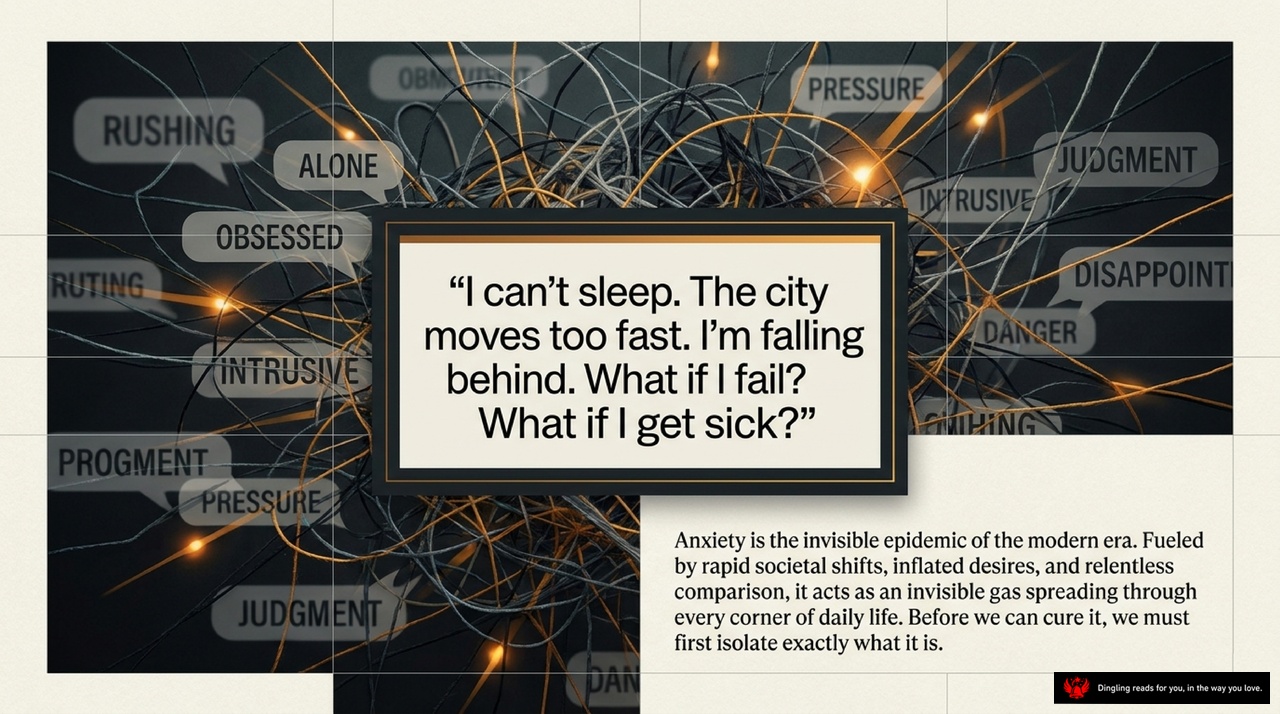
Imagine a tangled web of thoughts pulling you in every direction. Words like "Rushing," "Pressure," "Alone," and "Obsessed" float in the background, creating a chaotic atmosphere that mirrors the modern experience. At the center of this storm lies a very real, very human cry: "I can't sleep. The city moves too fast. I'm falling behind. What if I fail? What if I get sick?"
This isn't just a random thought; it's the voice of the invisible epidemic we all face today. Anxiety has become the defining condition of our era, fueled by rapid societal shifts, inflated desires, and the relentless comparison with others. It acts like an invisible gas, seeping into every corner of our daily lives, making it hard to find peace.
But before we can even think about curing it, we must first isolate exactly what it is. It's that nagging feeling that the world is moving faster than you, that you are constantly falling behind, and that a catastrophic failure is just around the corner. We worry about things that might never happen, consuming our mental energy with fears that aren't even real. This is the trap of the modern mind: trying to control the uncontrollable and fearing the unknown, all while the simple act of sleeping escapes us.

On this slide, we're distinguishing between two very different types of anxiety: Realistic Anxiety, which is just "the spark," and Destructive Anxiety, which has turned into a "wildfire."
Think of Realistic Anxiety as that small, useful flame. It's temporary and perfectly matched to what's actually happening in your life. Maybe you have a deadline tomorrow, or you're worried about a difficult conversation. This kind of anxiety triggers active problem-solving; it pushes you to prepare, sharpen your reflexes, and tackle immediate challenges head-on. It's your brain's helpful alarm system.
But on the other side, look at Destructive Anxiety. This is the wildfire. It's chronic and completely out of proportion to reality. Unlike the spark, it doesn't help you solve problems; instead, it paralyzes your decision-making and shuts down your rational thought. It persists even when there are no real threats, flooding your body with severe symptoms like insomnia, racing heart, and uncontrollable tremors.
The key takeaway here is the balance. We need the spark to navigate life's obstacles, but we must recognize when that spark has ignited a wildfire that is burning down our peace of mind.

Have you ever felt that your worries are heavier than reality? The slide you see here captures a profound truth: 80% of what you worry about will never happen. Only 20% are real threats. The rest? They are "Phantoms"—ghosts created by your own imagination.
Anxiety is essentially a self-inflicted tax paid on a future that doesn't exist. We suffer infinitely more in our minds than we ever do in reality. Think about it: do you actually have a heart attack, or just imagine one? Do you really lose your job tomorrow, or are you just rehearsing the disaster in your head?
This is the core trap of anxiety. It thrives on uncertainty and the stories we tell ourselves. While a little worry can keep us alert, letting these phantom fears take over drains our energy, paralyzes us, and steals our happiness. The good news is that you have the power to break free. By recognizing that most of your fears are just phantoms, you stop paying the tax on a fake future. You reclaim your peace, because the only thing that truly matters is living your life, not the terrifying movies playing in your mind.
Welcome to Chapter 4, where we tackle the anxiety that grips us every time we check our bank accounts: the fear that money is never enough.
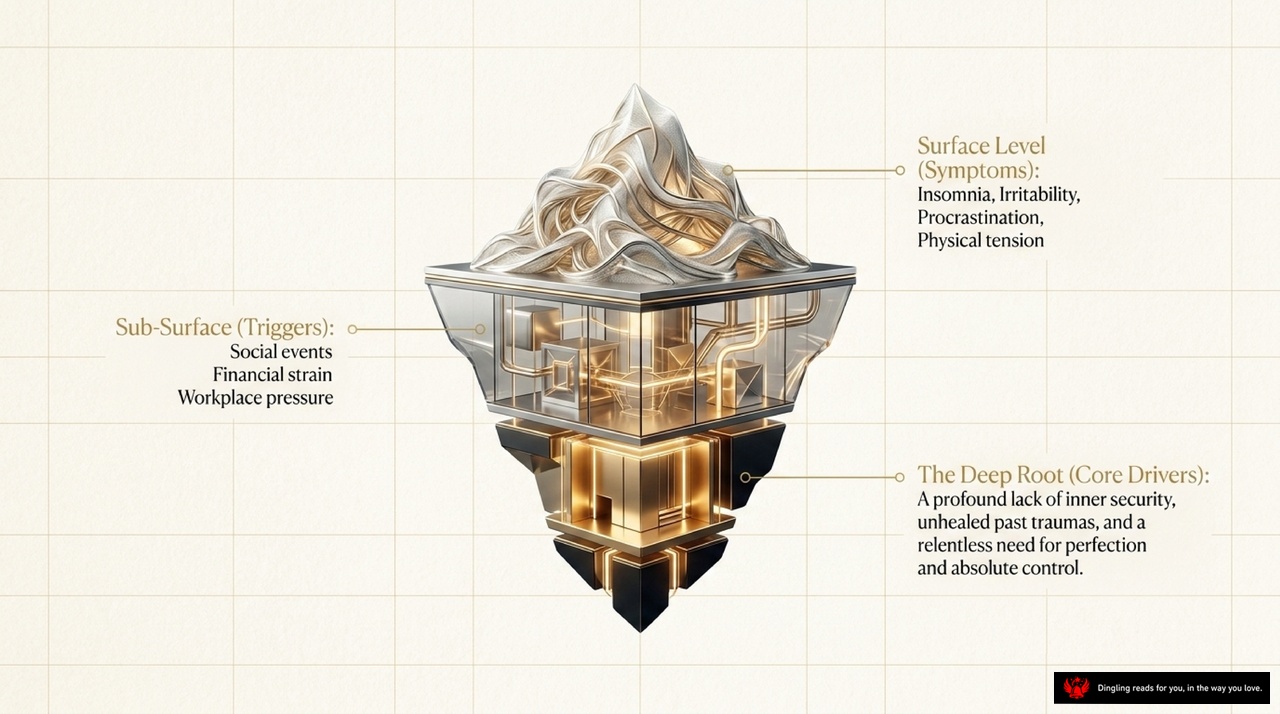
The image you see right now perfectly illustrates this trap. At the very top, we have the **Surface Level Symptoms**. This is where the panic lives—insomnia, irritability, procrastination, and that constant physical tension you feel in your shoulders. It's the immediate, overwhelming feeling of being overwhelmed.
But look deeper into the **Sub-Surface Triggers**. These are the daily events that set it off: social events where you feel out of place, financial strain that keeps you up at night, and the crushing pressure of the workplace. These aren't just annoyances; they are the fuel for the fire.
However, the real problem lies at the bottom, in **The Deep Root**. This is the core driver of your financial anxiety: a profound lack of inner security. We are terrified of the future, haunted by past failures, and driven by a relentless need for perfection and absolute control. We believe that if we just had more money, we would finally be safe.
The text reveals a harsh truth: many of us are living as "cubicle poor." We earn a steady income, yet we spend it all on the latest trends and name brands, believing that spending is the only way to prove our worth. We live paycheck to paycheck, constantly reaching out to parents or friends for cash, and our savings account remains empty. This isn't just about being broke; it's about a broken mindset.
We often mistake material accumulation for happiness. There's a story about a woman who traded her youth and love for luxury, only to become a "parasite" in her own life. On the other hand, consider an ordinary man named Lao Zhang. He earns less than his colleagues, yet he finds true joy in simple moments: a family dinner, warm conversation, and being together. He realized that happiness has nothing to do with the number in your bank account.
So, how do we break free? First, we must practice forced savings. Even if you have no habit, start by saving a portion of your salary immediately upon receiving it. Second, practice rational consumption. Before buying anything, ask yourself: Is this truly necessary? Will I use it often? If the answer is no, put it back. Finally, manage your credit cards strictly. They are designed to trigger impulse buying.
True confidence doesn't come from a flashy car or a big house. It comes from inner calm and the ability to live within your means. When you stop trying to "fake it till you make it" through debt, you stop the cycle of anxiety. By setting a realistic budget and embracing a life of modest but meaningful choices, you reclaim your power. You stop being a slave to money and start being the master of your life.
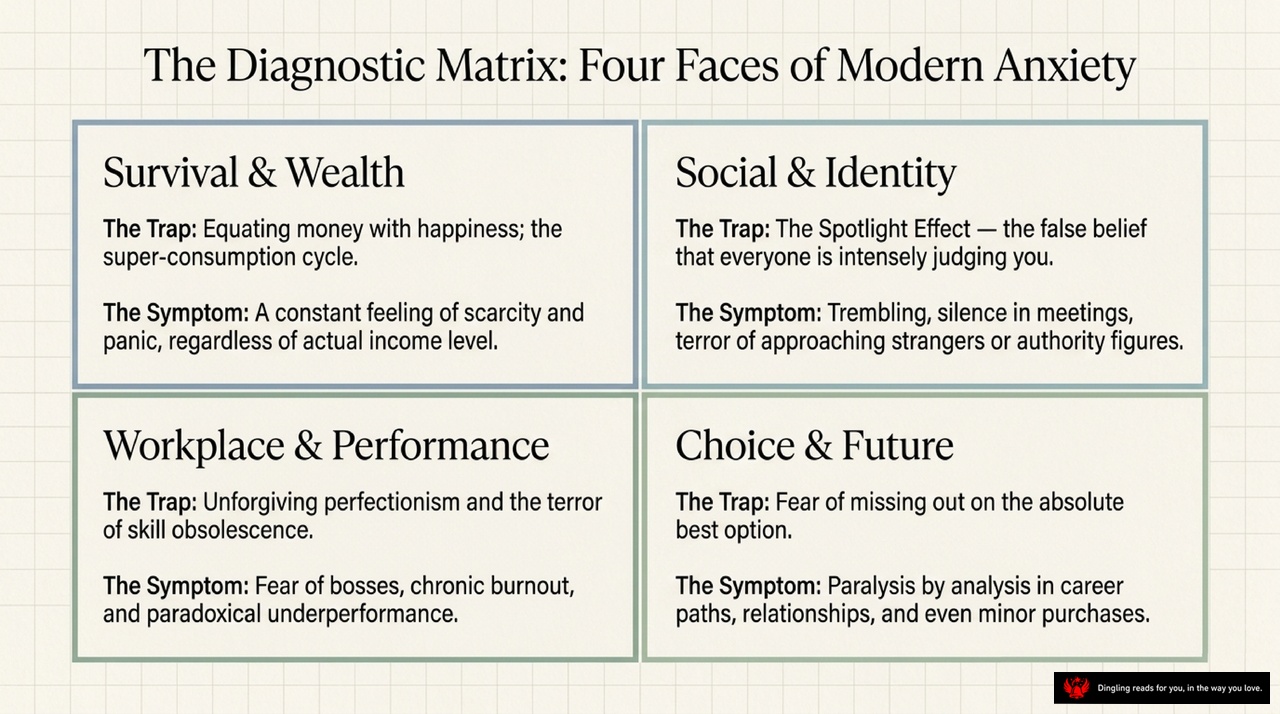
Welcome back. Today, we're diving deep into the hidden traps of our modern lives. Look at this diagnostic matrix: it breaks down the four faces of anxiety that are silently draining your energy.
First, let's talk about Survival and Wealth. The trap here is equating money with happiness, getting stuck in a cycle of super-consumption. The symptom? A constant feeling of scarcity and panic, even when your income is actually fine. You feel poor, not because you are, but because you believe that more money equals more safety.
Next is Social and Identity. The trap is the Spotlight Effect—the false belief that everyone is intensely judging you. The result? You're trembling, staying silent in meetings, or terrified to approach strangers. You're building a wall of insecurity where there is none.
Then, we have Workplace and Performance. The trap is unforgiving perfectionism and the fear that your skills will become obsolete tomorrow. The symptom is chronic burnout, a fear of your boss, and the paradoxical result of underperforming because you're too afraid to try.
Finally, Choice and Future. The trap is the fear of missing out on the absolute best option. The symptom is paralysis by analysis. You can't choose a career path, a relationship, or even what to buy for dinner because you're terrified of making the wrong choice.
The book tells us that these anxieties often stem from trying to control the uncontrollable. Whether it's the fear of financial ruin, social rejection, or professional failure, the root cause is often a lack of trust in our ability to handle whatever comes next. We are trying to predict the future perfectly, but the future is inherently uncertain.
So, how do we break free? The text suggests that we must stop fighting the uncertainty and start embracing it. Instead of waiting for the "perfect" moment or the "perfect" outcome, we need to take action with what we have right now. The book shares stories of people who, instead of hiding from their fears, faced them head-on. One woman, paralyzed by the fear of starting a business, took a leap of faith and transformed her life. Another overcame social anxiety not by waiting for confidence to magically appear, but by simply speaking up, one awkward sentence at a time.
Remember this: anxiety is not a stop sign; it's a compass. It tells you that you care about something important. But let it guide you, not paralyze you. As the matrix shows, the solution isn't to eliminate these feelings, but to understand them. By identifying which trap you're in—whether it's wealth, social, performance, or choice—you can start to dismantle the illusion that you are powerless.
True freedom comes from realizing that you can handle the unknown. You don't need to have all the answers today. You just need to take the next step, imperfectly and bravely. When you stop trying to control everything and start trusting your ability to adapt, the weight of these four faces of anxiety begins to lift. You reclaim your life, one brave choice at a time.

Today's slide introduces a fascinating psychological phenomenon called the "Target Tremor Paradox." Have you ever tried threading a needle? If you do it casually, your hand is perfectly steady. But if you're told your life depends on doing it in five seconds, your hand starts shaking uncontrollably. This graph illustrates exactly that: as your focus and pressure increase, performance quality actually drops.
The core insight here is that the more desperately you fixate on a goal, the more your anxiety sabotages your execution. This is why perfectionism is often our enemy. The cure, as our slide suggests, is to lower the stakes and let go of the need for perfection. By reducing the pressure, you allow yourself to enter that "Optimal Zone" where your natural abilities shine. So, instead of trembling from fear of failure, try to relax and trust the process.

Imagine a man trekking up a steep mountain, his back weighed down by a massive pack of jagged rocks. Those rocks aren't just heavy; they represent the past—old traumas, lost opportunities, and regrets we refuse to let go. As the image suggests, carrying this "immutable weight" into the present is exactly why we suffer. We insist on dragging yesterday's baggage up today's mountain, and anxiety thrives on that refusal to accept what has already been lost.
But here is the profound wisdom we need to remember: forgetting is a form of liberation. True acceptance doesn't mean surrendering to the past; it means dropping those heavy rocks. When you finally set them down, you free up the energy you need to climb the mountain in front of you. Instead of being paralyzed by what went wrong, you gain the strength to focus on the path ahead. So, ask yourself: are you climbing, or are you just carrying the weight of a mountain you left behind?

Let's dive into the antidote for anxiety, starting right with our mind. The first step is to embrace the flaw. It's crucial to accept that you cannot control everything. Lowering those unrealistic expectations of yourself and the world is the key to freeing up your mental energy.
Next, we need to shift our focus from "What If" to "What Is." Instead of getting lost in catastrophic, fictional future scenarios, ground your mental energy in the present, objective reality. Stop feeding your anxiety with imaginary disasters.
Finally, remember to acknowledge, don't fight. Resistance actually feeds anxiety. When you feel nervous, actively allow yourself to feel it. Paradoxically, accepting the anxiety often makes it instantly dissipate. By stopping the internal battle and simply observing your feelings, you can regain control and find peace.

Welcome back to the Antidote Framework. Today, we are shifting our focus from the mind to the body. As we've seen, anxiety isn't just a thought; it's a physical experience. So, how do we physically hack our way out of it?
First, let's talk about Rhythmic Breathing. It's a powerful tool to control your breath and manually shift your nervous system from that terrifying fight-or-flight mode back to a calm, rest-and-digest state. You don't just breathe to live; you breathe to regulate.
Next, try Progressive Muscle Relaxation. This is about systematically tensing and releasing muscle groups from your toes all the way up to your head. It forces a physical release of that built-up cortisol that's been weighing you down for days. Think of it as giving your body a signal that it's safe to let go.
Finally, we have Sensory Redirection. When your mind is stuck in a loop of internal worry, shift your focus entirely outward. Intensely observe the details of a flower, the texture of an object, or just listen to the ambient sounds around you. By grounding yourself in the present moment through your senses, you break those internal psychological loops and find your center again.
Your body holds the key to your calm. Use these three tools to take control.
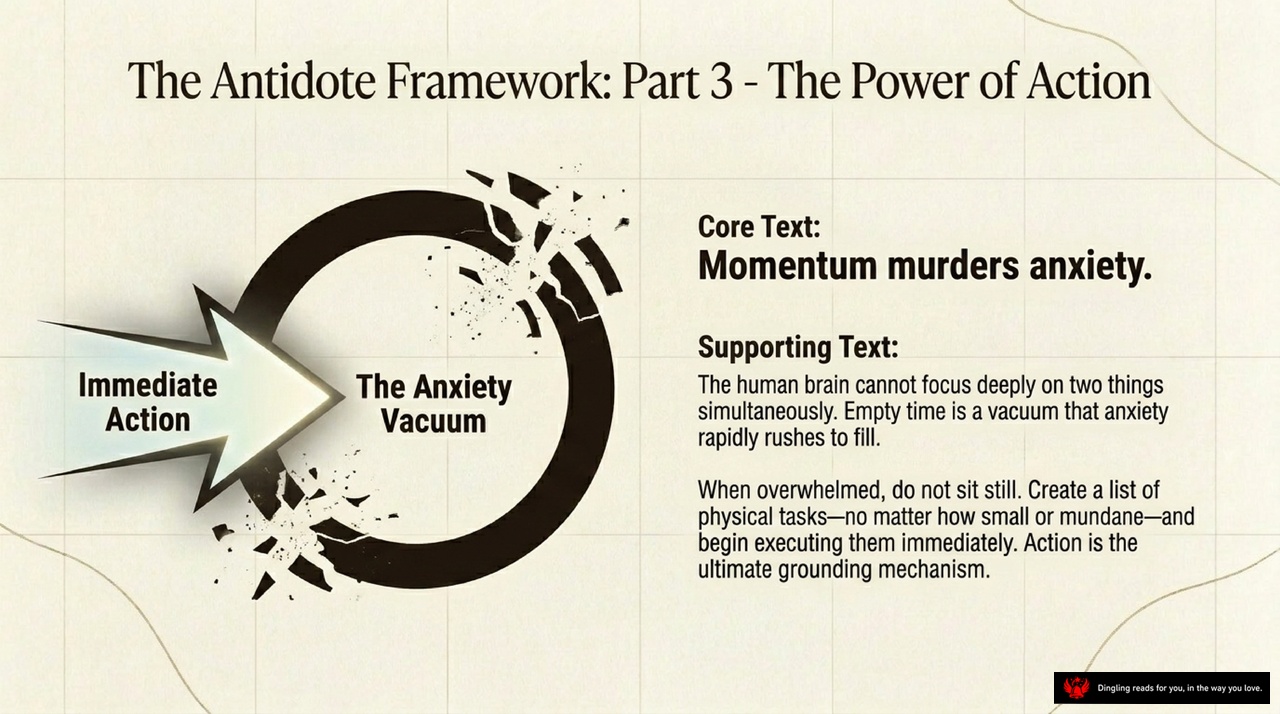
Welcome back to the Antidote Framework. We are now at Part 3, where we unlock the ultimate cure for anxiety: The Power of Action.
Look at this visual. It illustrates a powerful psychological truth: "Momentum murders anxiety." The graphic shows an arrow labeled "Immediate Action" striking directly into "The Anxiety Vacuum." Why is this so effective? Because the human brain simply cannot focus deeply on two things at once. When we sit still and wait for the perfect moment, we create a vacuum. And as the supporting text reminds us, anxiety rushes to fill that empty space with its worst-case scenarios.
So, what is the antidote? When you feel overwhelmed, do not sit still. Do not try to solve the problem in your head. Instead, create a list of physical tasks—no matter how small or mundane—and begin executing them immediately. Whether it's folding a load of laundry, organizing your desk, or taking a ten-minute walk, action is the ultimate grounding mechanism. It breaks the loop of worry by forcing your brain to focus on the "now" rather than the "what if." Remember, you don't have to see the whole staircase; you just have to take the first step.

Have you ever felt like everyone is staring at your every flaw, judging you mercilessly? We often walk through life convinced that others are analyzing our mistakes, that the spotlight is fixed right on us. But here's the liberating truth: in reality, everyone is too busy worrying about themselves.
This slide breaks it down perfectly. On the left, we have "Your Perception"—that intense fear that people are dissecting your flaws. But on the right lies "Their Reality." The moment you realize that everyone else is trapped in their own anxieties, worrying about their own insecurities, the pressure instantly evaporates. True confidence isn't about arrogance; it's simply shifting the spotlight off of yourself. Stop asking, "How do I look?" and start asking, "How can I make the other person comfortable?" When you realize everyone is fighting their own internal battles, social fear loses its power. You aren't the only one struggling. Embrace this shift, and watch how the world suddenly feels a lot less intimidating.
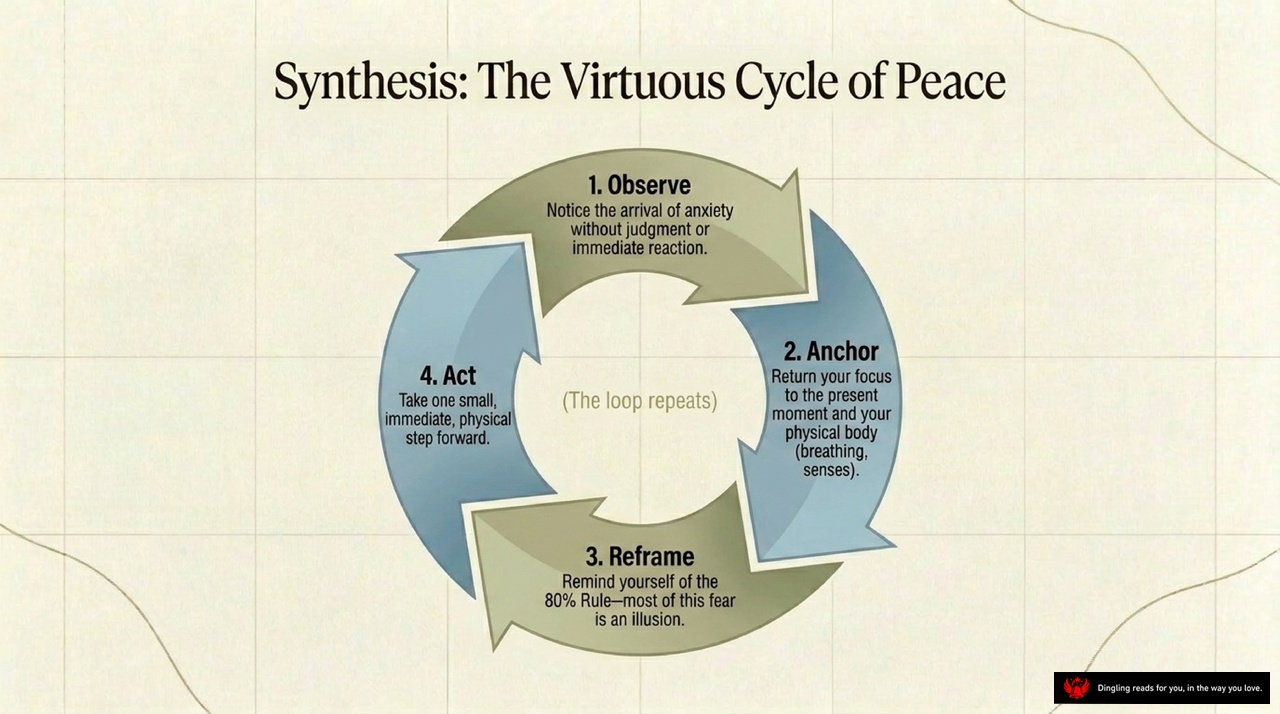
So, we've reached the final synthesis of our journey through the anxiety cycle. Imagine this: peace isn't a destination you reach once and forget; it's a virtuous cycle you actively build, day after day. As we've explored, anxiety often tricks us into seeing imaginary threats as real monsters. But the solution lies in a simple, four-step loop that you can practice right now.
First, **Observe**. When that knot of anxiety tightens in your chest, pause. Notice its arrival without judging yourself or reacting immediately. Don't fight the feeling; just watch it like a cloud passing in the sky.
Next, **Anchor**. Pull your focus back to the present moment. Feel your feet on the floor, listen to your breath, or notice the texture of the chair beneath you. Ground yourself in your physical senses to break the spiral of worrying about the future.
Then, **Reframe**. This is where the magic happens. Remind yourself of the "80% Rule": most of the fear you're feeling is an illusion. The danger you're panicking about has an 80% chance of never happening. By acknowledging that much of your anxiety is just your brain playing tricks on you, you shrink its power.
Finally, **Act**. Take one small, immediate, physical step forward. It could be sending that email you've been avoiding, making that call, or simply standing up and stretching. Action is the antidote to paralysis.
Once you've done this, the loop repeats. You observe, anchor, reframe, and act again. It's not about eliminating anxiety forever, but about changing your relationship with it. By mastering this cycle, you stop being a victim of your thoughts and become the captain of your own calm.
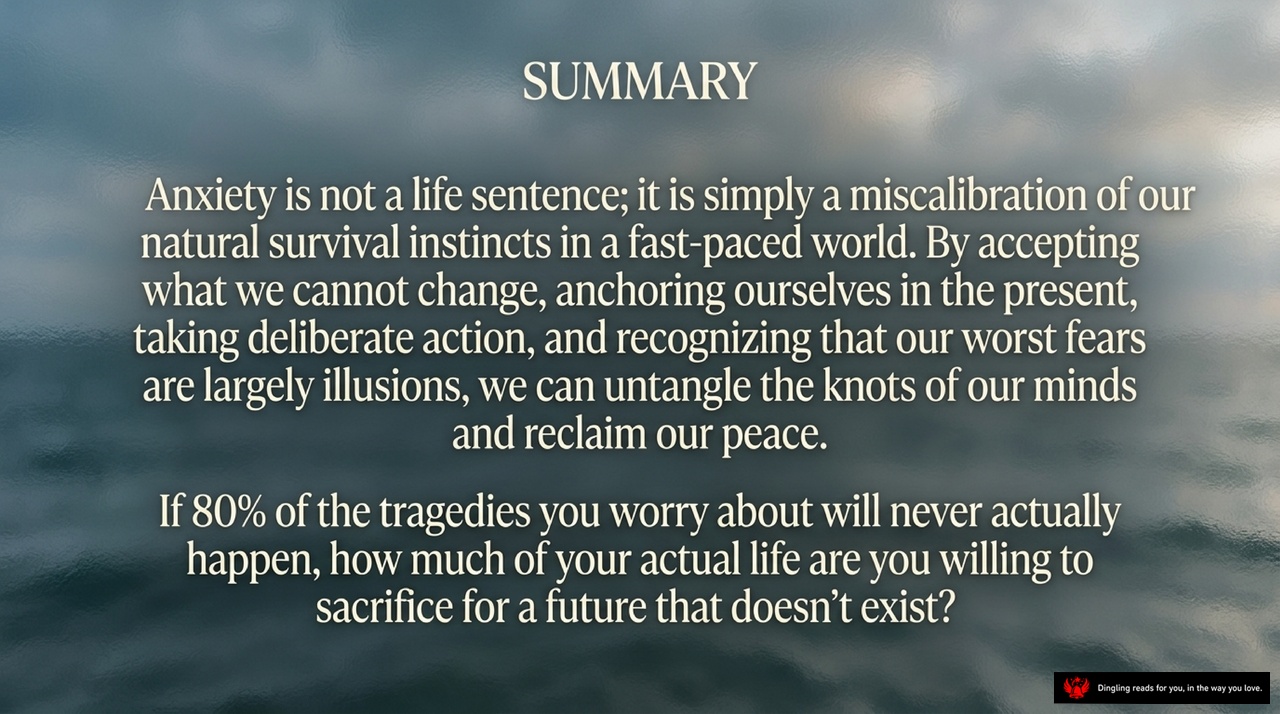
Welcome back to our deep dive into managing anxiety. Today, we're landing on a powerful summary that ties everything we've discussed together.
As you can see on this slide, the core message is clear: Anxiety is not a life sentence. It's simply a miscalibration of our natural survival instincts in a fast-paced world. We've spent the last chapters exploring how this happens—whether it's through social fears, career pressures, or the paralyzing fear of losing out. But the solution lies right here in this text.
The path to reclaiming peace starts with acceptance. We need to accept what we cannot change, anchor ourselves in the present, and take deliberate action. We must also recognize a hard truth: our worst fears are largely illusions. By untangling these knots in our minds, we can finally breathe again.
The slide ends with a provocative question that challenges us all: If 80% of the tragedies you worry about will never actually happen, how much of your actual life are you willing to sacrifice for a future that doesn't exist?
Think about that. We often spend our energy preparing for disasters that statistically won't occur. Instead of sacrificing our present for a phantom future, let's choose to live fully right now. Thank you.