
Public Opinion: Complete Chapter-by-Chapter Summary
Welcome to our deep dive into Walter Lippmann's timeless masterpiece, *Public Opinion*. This slide sets the stage for everything we're about to explore: the fascinating—and often unsettling—truth that our minds don't just see the world as it is, but construct a version of it that we cannot actually see.
Lippmann argues that our reality is shaped by invisible mechanisms: the media, stereotypes, and symbols. Think about it: we rely on mental images to navigate a complex world, but these images are often simplified, incomplete, and sometimes entirely fictional. Just like the people on a remote island in 1914 who were still celebrating peace while the world had already turned to war, we often live in a "virtual environment" that has long since diverged from the real one.
This gap between what we imagine and what is actually happening is the root of so much misunderstanding, from political polarization to international conflict. Today, we'll unpack how this happens, why our social circles and pre-existing biases limit our vision, and why traditional democracy struggles when faced with a world we can't fully grasp. We're going to challenge the idea that we can simply "know" the truth, and instead discover how we actually construct our reality.
Have you ever stopped to ask why we react the way we do? Are we responding to reality, or to a story we've written in our own minds?
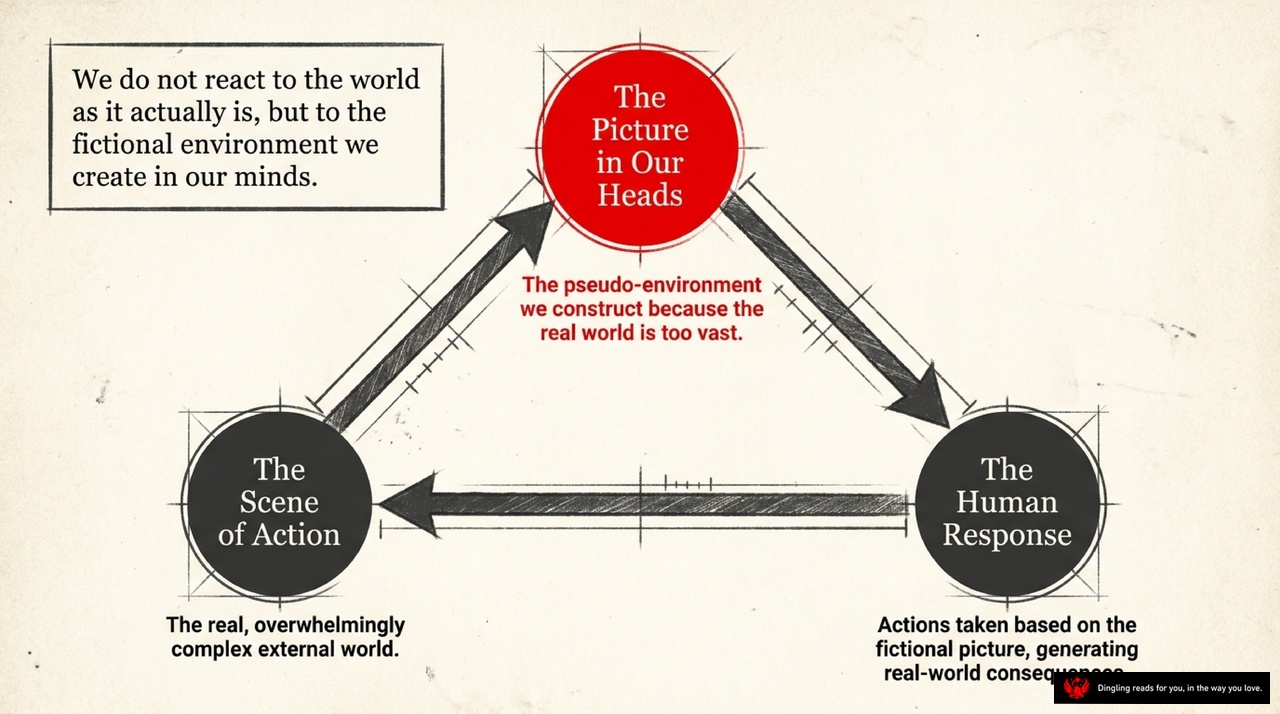
Look at this diagram. It illustrates a powerful cycle that Walter Lippmann called the "pseudo-environment." We don't react to the world as it actually is, but to the fictional environment we create in our heads. Why? Because the real world is just too vast and complex for us to process on our own.
So, we build a simplified picture in our minds—what the slide calls "The Picture in Our Heads." This is a mental shortcut. From this internal image, we generate "The Human Response." We act based on our imagination, not reality. And those actions then land us back in "The Scene of Action"—the real, overwhelming, and often chaotic external world.
But here's the trap: our actions are based on a fiction, yet the consequences happen in reality. When our internal picture doesn't match the external scene, we get confused, angry, or wrong. We are constantly fighting battles in a world that no longer exists, because we are living in a time lag, reacting to yesterday's news as if it were today's reality.
This cycle is why public opinion is so often filled with bias and misunderstanding. We are trapped in a loop where our simplified mental models clash with the messy complexity of the actual world, and the result is often a disconnect between what we think is happening and what is actually happening.

Imagine you're trying to see the world as it truly is. You look out, but what you actually see is a simplified, distorted version—a "pseudo-environment" we all construct because the real world is too complex and overwhelming to process directly.
Look at this diagram. On the left, we have "Reality"—the messy, chaotic, and incredibly complicated external world. But between that reality and our perception, there are five major filters that distort the truth.
First, we have **Censorship & Secrecy**. This is the artificial withholding of facts by authorities or privacy norms. Governments and institutions actively hide information, creating a barrier between what actually happens and what we know.
Second, **Social Contact**. Our physical and social circles are severely limited. We only interact with a tiny fraction of humanity, which means our view of the world is shaped entirely by our immediate, narrow bubble, ignoring the vastness of the rest of the globe.
Third, **Time & Attention**. We simply don't have enough leisure time to dedicate to understanding public affairs. The scarcity of our daily attention forces us to skim the surface, missing the depth of global events.
Fourth, **Language Limitations**. When we try to describe complex events using simple words, we lose nuance. News gets compressed into telegraphic headlines, stripping away context and detail until the original story is unrecognizable.
Finally, **Emotional Defense**. This is the psychological fear of facts that threaten our established ways of life. We subconsciously reject information that makes us uncomfortable, protecting our existing beliefs rather than seeking the truth.
These five filters take the raw data of reality and reshape it into a fictional environment on the right. This is the "Pseudo-Environment"—the comfortable, simplified, and often false version of reality we live in every single day. We don't just observe the world; we construct a story about it, and that story is rarely the truth.
Have you ever stood in a train station, staring at a crowd, and suddenly convinced you recognized a friend in a stranger's hat? That split-second certainty is the power of our "stereotypes"—mental shortcuts that help us navigate a chaotic world, but often blind us to reality.
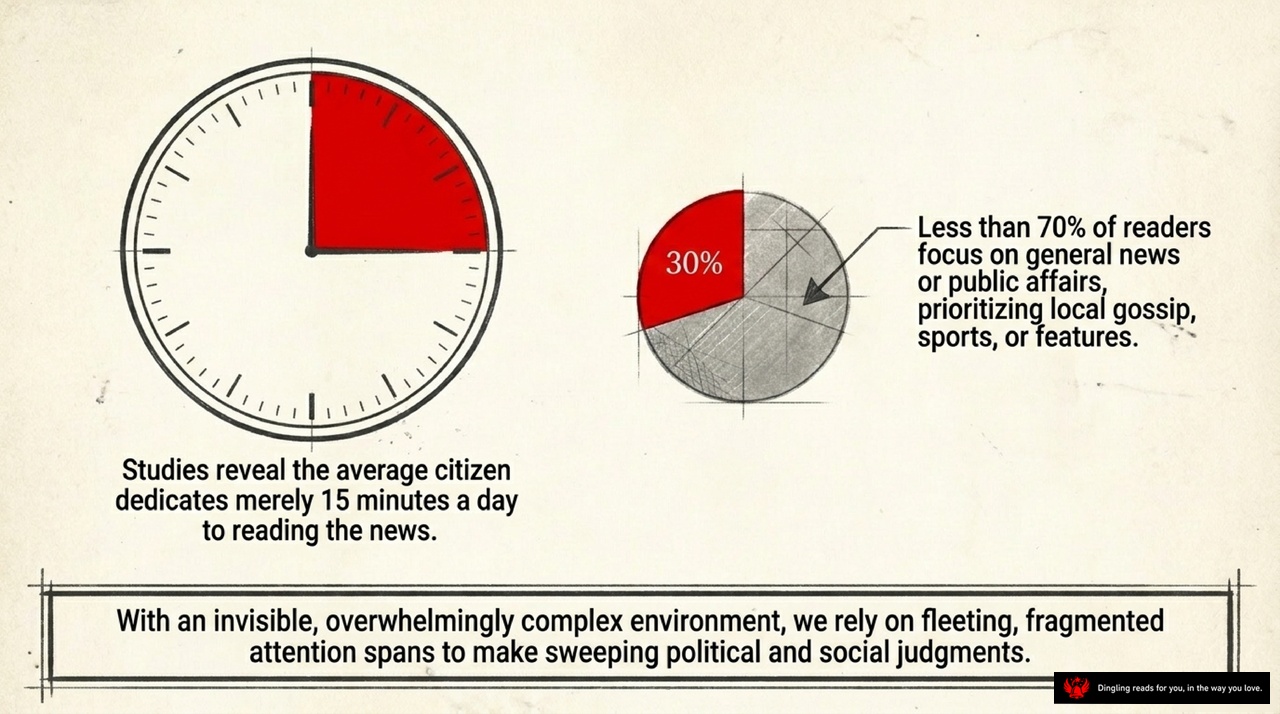
As we see here, our daily engagement with the news is surprisingly shallow. Studies reveal the average citizen dedicates merely 15 minutes a day to reading the news. And here's the kicker: less than 70% of readers actually focus on general news or public affairs. Instead, we prioritize local gossip, sports, or features.
Why does this matter? Because we rely on these fleeting, fragmented attention spans to make sweeping political and social judgments about an invisible, overwhelmingly complex environment. We aren't seeing the world as it is; we are seeing a simplified version filtered through our biases. When we only consume 15 minutes of news a day, we miss the nuance. We don't see the full picture; we just see what fits our existing narratives. This is why public opinion often feels so polarized and why we struggle to find common ground. We are all living in different, self-constructed realities, and without deeper, more comprehensive information, we can't bridge the gap.

Have you ever met someone who looks exactly like your best friend, only to realize they are a stranger? That moment of confusion isn't just a bad date; it's a glimpse into how our minds actually construct reality. As we've discussed, we rarely see the world as it is. Instead, we define it first through our existing expectations and then force what we see to fit that definition.
Look at this slide. On the left, we have "The Reality"—a chaotic, messy, and unpredictable jumble of facts. On the right, we have "The Expectation"—a neat, red box representing the mental framework we've built. The arrow between them shows a crucial transformation: we take that chaotic reality and try to force it into our pre-existing box. If the reality doesn't fit, we don't change the box; we break the reality to make it fit.
This is the mechanism of public opinion. When we are plunged into a confusing, buzzing world of unseen events, we don't stop to investigate the details. Instead, we pick out the traits that feel familiar and fill in the rest with images already stored in our heads. We are essentially editing the world to match our story. This is why politics, war, and social conflicts often feel so irrational to outsiders; they are fighting over different versions of the same reality, each version carefully constructed to confirm their own beliefs.
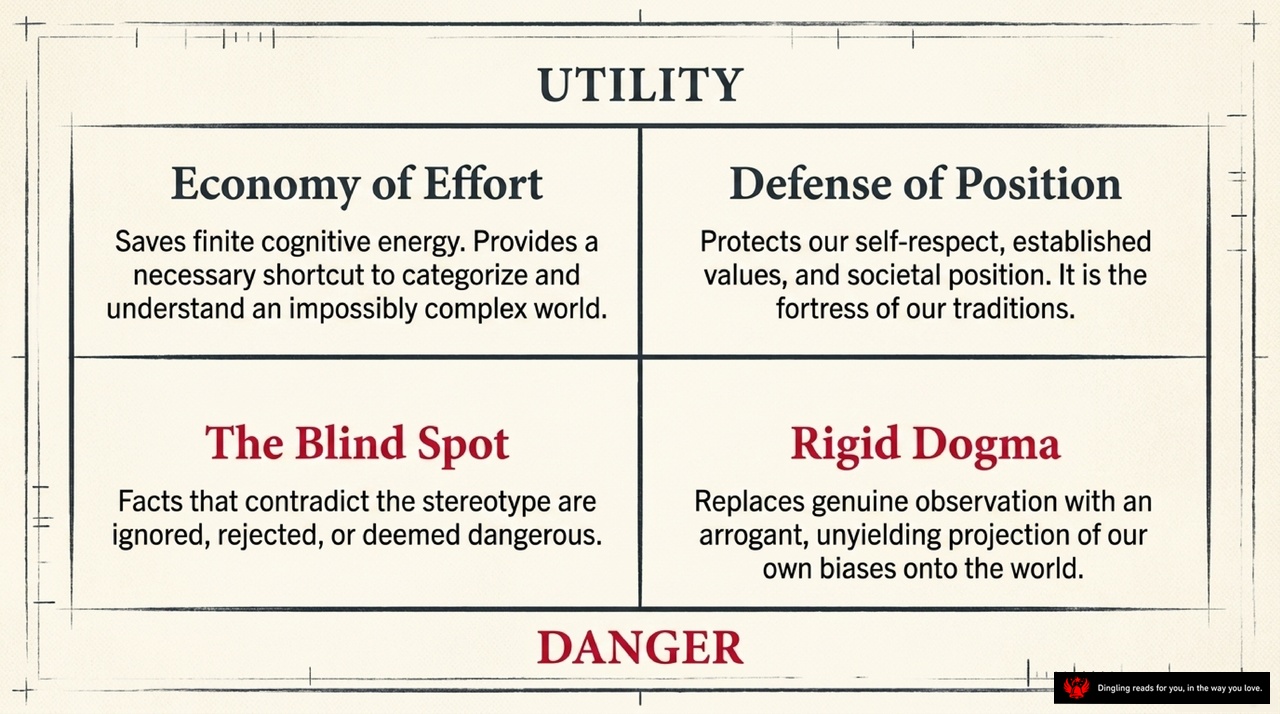
Utility isn't just about being useful; it's about the invisible architecture of our minds. Today, we're diving into the dangerous side of that architecture. Look at this four-quadrant grid. On the top left, we have the "Economy of Effort." We crave it because the world is impossibly complex. We need shortcuts to categorize reality and save our finite cognitive energy. But on the top right, this same need creates a "Defense of Position." We cling to these mental categories to protect our self-respect and our societal standing. It's the fortress of our traditions.
But here is where it gets dangerous. When we defend our position, we inevitably develop a "Blind Spot." We start ignoring, rejecting, or even deeming facts as dangerous if they contradict our stereotypes. We stop seeing the world as it is and only see what we expect to see. This leads us directly to the bottom right: "Rigid Dogma." In this state, we stop making genuine observations. Instead, we arrogantly project our own biases onto the world, replacing reality with a fantasy that feels safe but is completely wrong.
Lippman argues that this isn't a bug in our system; it's a feature we built to survive. But when we mistake our internal map for the actual territory, we stop learning. We become trapped in a loop where our beliefs protect us from the truth, and the truth becomes too threatening to face. That is the true danger of relying solely on utility without questioning our underlying assumptions.

Have you ever noticed how the same factory can look like a triumph of progress to one person, but a scene of human destruction to another? This slide perfectly captures that divide. View A, the Capitalist or Economist, looks through a lens of efficiency and wealth accumulation, seeing the industrial trust as the triumph of systemic order. But View B, the Laborer or Reformer, looks at the exact same reality and sees nothing but monopoly, harsh conditions, and the stifling of human dignity.
Both factions are staring at the exact same reality, yet they selectively perceive only the facts that validate their existing moral and economic stereotypes. This isn't just about politics; it's about how our brains work. We don't see the world as it is; we see the world as we imagine it to be. Our opinions are often just different projections of the same facts. To move forward, we have to stop hiding behind these selective lenses and recognize that our truth is often just a story we've told ourselves.

Imagine a funnel where chaos gets distilled into a single, powerful arrow. On the left, we have "The Concept": the engineered illusion of a Common Will. Leaders don't just ask for agreement; they create the *feeling* that everyone thinks the same thing. How do they do it? Through "The Tactic." As the slide notes, they use vague, universally positive symbols—think "American Rights," "Humanity," or "The Common Good." These words are empty of specific detail, which is actually their superpower. Because they are so broad, they act as blank canvases. People project their own hopes, fears, and contradictions onto them, creating a unified emotion without ever having a unified intellect. This is "The Symbol." It's a magical trick that makes us feel connected to strangers we've never met, united by a feeling rather than a shared reality. But what's the outcome? "The Result." When the symbol is this empty, we stop thinking critically. We stop asking *what* we are actually defending. Instead, we just feel a surge of patriotism or moral righteousness. We end up with a powerful, unified emotion, but a dangerously fragmented understanding of the world. We fight for the same symbol, but often for completely different reasons. That is the trap of the engineered common will.

Look at this slide. It draws a sharp line between "The News" and "The Truth." On the left, we see what news actually does: its function is simply to signal an event. It focuses on what's overt, dramatic, and breaking. It relies on public records, disruptions, and actions that have already happened. It's reactive.
But on the right, we see the standard we should be aiming for: The Truth. Its function isn't just to signal; it's to bring hidden facts to light. It doesn't just show us isolated events; it establishes relationships and paints a complete picture of reality. To get there, it requires systemic investigation and continuous tracking, not just waiting for something to explode.
The bottom line here is crucial. News is not a mirror of social conditions. It doesn't show us the whole world. It is merely a report of an aspect that has obtruded itself into public view. It tells us about the parts of reality that are loud enough to be seen, but it leaves the complex, hidden connections in the dark. This is why relying solely on the news often gives us a fragmented view of the world, rather than the truth.

Look at this graph. It illustrates a harsh truth about how we consume information: news doesn't cover the slow burn; it only captures the explosion.
The image breaks this down into three distinct phases. First, we have "The Invisible Phase." This is the gradual process where a person, like John Smith, struggles quietly for ten years. He works hard, but he's facing hardship. Yet, there is no public record. The press ignores him. This is the long, silent period where reality is building up, but no one is watching.
Then, on the 11th year, comes "The News Trigger." Suddenly, he files for bankruptcy. The clerk makes an official record. At that exact moment, the line hits "Public Disruption." The red spike on the chart shows how quickly the situation shifts from invisible to unavoidable.
The result, as the slide clearly states, is that news only occurs when a situation takes a definitive shape. Whether it's a strike, a bankruptcy, or a vote, the underlying realities remain completely unreported until they explode. We are conditioned to wait for the dramatic event to validate the struggle, but the real story often lies in those invisible years before the trigger pulls.
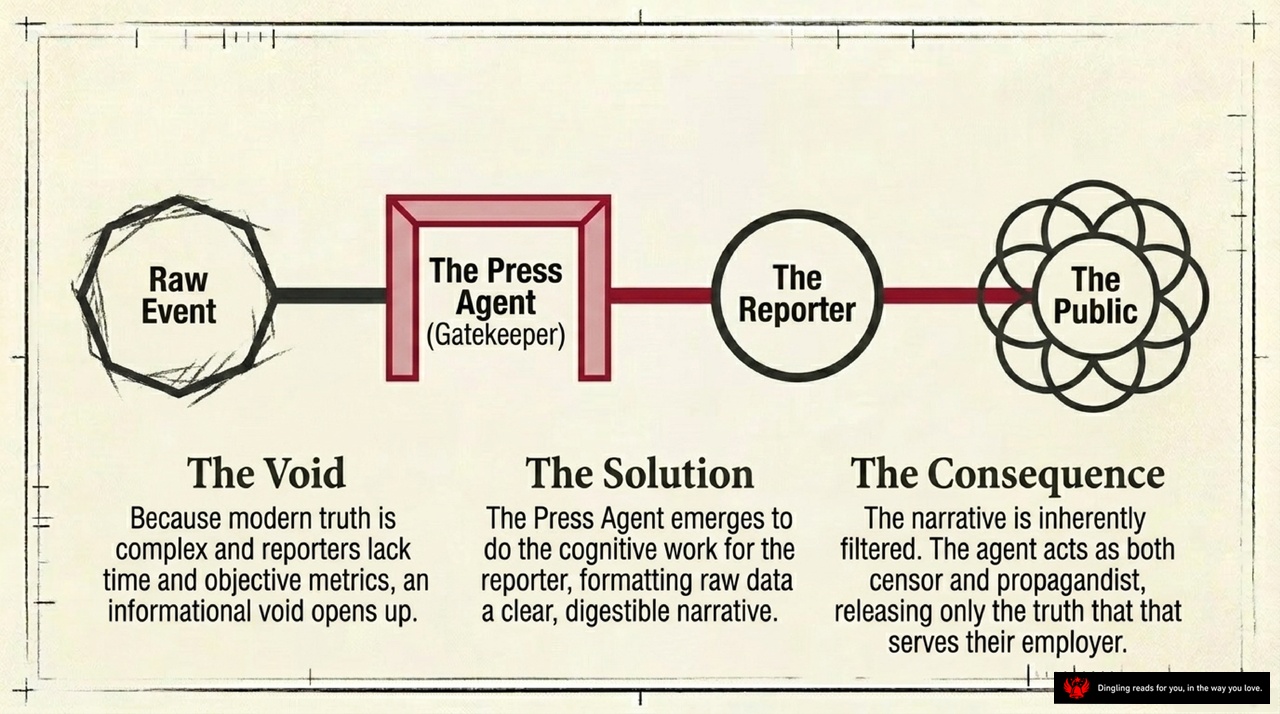
Look at this flow: from a raw event, through the press agent acting as a gatekeeper, to the reporter, and finally reaching the public. This diagram perfectly captures Walter Lippmann's core argument: the narrative we consume is inherently filtered. Because modern truth is too complex and reporters lack the time to process it all, an informational void opens up. To fill it, the press agent emerges to do the cognitive work for the reporter, formatting raw data into a clear, digestible story. But here lies the danger. The agent acts as both censor and propagandist, releasing only the version of truth that serves their employer. The result? A narrative that is shaped not by reality, but by who controls the gate.
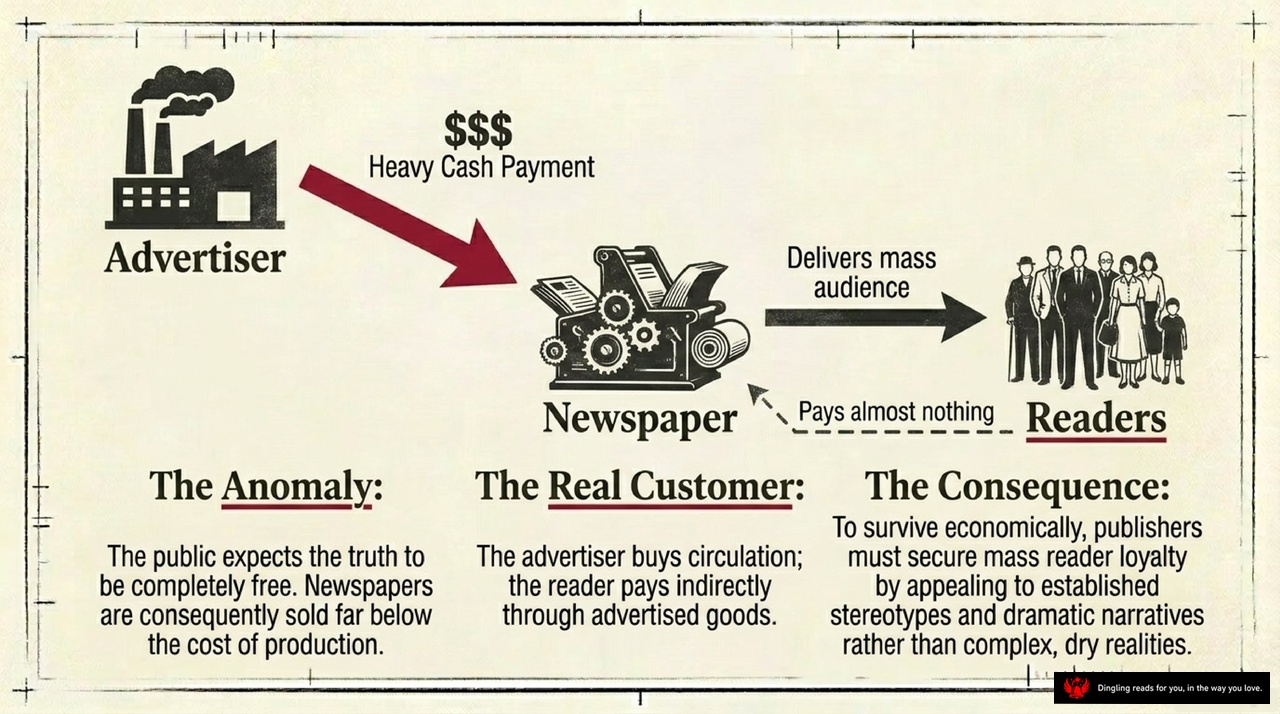
Look at this diagram. It reveals the hidden engine driving our entire media landscape. On the left, you see the **Advertiser** pouring in **heavy cash payments**. This money flows directly to the **Newspaper**, which acts as the middleman. The newspaper then delivers this mass audience to the **Readers** on the right. But notice the arrow pointing back from the readers to the newspaper—it says they **pay almost nothing**.
This creates a massive **anomaly**. We expect news to be free, so papers sell below cost. But the **real customer** isn't you; it's the advertiser who buys circulation. Because the newspaper relies on ad revenue to survive, it must prioritize keeping readers happy and loyal. This leads to the dangerous **consequence**: to maintain that loyalty, publishers start appealing to established stereotypes and dramatic narratives rather than complex, dry realities. They feed you what you want to hear, not what is true, because the business model demands it. This is why sensationalism thrives while deep truth often fades away.

Look at this scale. On one side, we have the "Omnipotent Citizen"—the classic idea that every person naturally possesses the time, knowledge, and capability to understand and direct all public affairs. But on the other side? The Vast, Complex World. As the image clearly shows, that side is already tipping the scales down. Why? Because we are all outsiders to almost everything. The environment is too vast, our time is too limited, and our perceptions are filtered by stereotypes.
This isn't just a philosophical point; it's the fatal error in how representative government often works. The slide warns us: relying entirely on the uninformed, spontaneous opinions of the masses to solve complex, invisible problems is a recipe for failure. When leaders try to govern based on what the public *thinks* they know, rather than what is actually true, the system collapses under the weight of its own ignorance. We live in a world that is far too intricate for any single individual to master, yet we constantly pretend we do. This gap between our simplified mental models and the messy reality is where democracy struggles the most.

Imagine a world where the chaos of reality is finally tamed by a new, smarter design. This slide outlines a "Redesigned Architecture of Information" that solves the age-old problem of how we actually make sense of the world.
On the far left, we have "Reality"—a tangled mess of complex facts. Currently, trying to untangle this knot is the job of the average citizen, which is exhausting and prone to error. The proposed solution? Move that burden.
The middle box introduces the "Independent Expert Bureaus." These are dedicated institutions of statisticians, accountants, and scientists, protected from political pressure. Their sole job is to take that chaotic reality and translate it into clear, unambiguous data. This is the crucial "shift in burden." Instead of asking the busy public to understand raw facts, we hand the complexity to responsible administrators guided by these experts.
On the right, the roles change completely. "Decision Makers" and "Executives" receive this clear data and make the hard choices. But here is the most important part: "The Public." Their role is no longer to manage the intricate mechanics of policy. Instead, they are free to judge the procedure and the results. You don't need to know how the engine works to decide if the car is driving the right way. By separating the analysis of facts from the judgment of values, we finally create a system where democracy can actually function based on truth, not just opinion.

Public opinion isn't a mirror of reality; it's a reaction to a fake environment built by limited media, engineered symbols, and our own deep-seated stereotypes. Think about it: are you actually seeing the world as it is, or are you just defending the pictures you've constructed in your head?
We live in a constant state of cognitive dissonance. Our minds can't handle the sheer complexity of the real world, so we simplify it into stereotypes and clichés. When a story breaks, we don't analyze the facts; we instantly match them to our pre-existing mental templates. If a story fits our narrative, we believe it without question. If it challenges our worldview, we dismiss it as fake news. This is why we often see the same event through completely different lenses depending on which side of the political aisle we sit.
The media plays a massive role in this, not necessarily by lying, but by curating what we see and how we feel. They package complex issues into dramatic, black-and-white images that trigger our emotions rather than our reason. We crave these simple narratives because they feel safe and familiar, even when they are dangerously wrong. The result is a public discourse that is more about protecting our identities than discovering the truth. To move forward, we have to be willing to dismantle these mental structures and confront the uncomfortable reality that our "truth" is often just a convenient fiction.