
Punished by Rewards: Complete Chapter-by-Chapter Summary

Punished by Rewards by Alfie Kohn. This isn't just a book; it's a wake-up call to one of the most dangerous myths in our culture: the idea that you have to pay people to do what you want them to do. The cover shows a golden carrot, a symbol of that old "carrot and stick" logic. We've been told that if we give enough rewards—whether it's a sticker, a bonus, or a promise of pizza—we can control behavior. But the reality is far more complex and often counterintuitive.
This book argues that relying on external rewards doesn't just fail to create lasting change; it actually punishes the very creativity, curiosity, and intrinsic motivation we are trying to encourage. We aren't arguing against rewards themselves, like a nice gift or fair pay. We are arguing against using them as tools of control, as a way to manipulate others into doing things they wouldn't otherwise do. When we treat people like machines that need external stimuli to function, we strip away their humanity and reduce them to mere objects.
The text highlights how deeply this behaviorist mindset has seeped into our schools, workplaces, and homes. Teachers use points and grades; companies tie salaries to performance metrics; parents dangle treats to get kids to clean their rooms. We believe in this system because it feels practical and simple. It promises a clear cause and effect: do this, get that. But the evidence shows that this approach creates a dependency. Once the reward stops, the behavior stops. Worse, it teaches people to focus only on the reward, not the task itself, ultimately making them less effective and less happy in the long run. It's time to question this paradigm and explore what truly motivates us to do our best work.

The pervasive myth of the "Skinner Box" suggests that the core dogma of modern society—"Do this, and you'll get that"—is based on a profound categorical error. We often mistake complex human environments like classrooms, boardrooms, and living rooms for simple lab setups where external stimuli can neatly manipulate behavior. But this is the illusion of pop-behaviorism. It assumes human beings are simply a collection of behaviors to be controlled, equating our deep-seated motivation with nothing more than animal training.
Let's look at the origin of this mistake. Psychology derived from starving pigeons and lab rats, pioneered by B.F. Skinner, took a shortcut that ignored our humanity. It reduced us to mere products of genetics and environment, treating us like physical objects rather than beings with self, freedom, creativity, and love. This reductionist view has permeated every corner of our lives. In schools, teachers use stickers and points to reward quiet students. In offices, 75% to 94% of American companies rely on bonuses, parking spots, and "Employee of the Month" awards to drive performance. Even in our homes, parents use allowances or extra screen time to buy obedience.
This approach feels so natural because it aligns with our cultural instincts for practical results and measurable success. However, by mapping the Skinner Box onto human life, we strip away the very things that make us human. We stop seeing ourselves as creators and collaborators, and instead see ourselves as machines waiting for the next stimulus. The illusion is convincing, but it is built on a fundamental misunderstanding of how people actually work. When we treat complex human interactions as simple stimulus-response loops, we don't just fail to motivate; we actively undermine the trust, creativity, and intrinsic drive that make our society function.
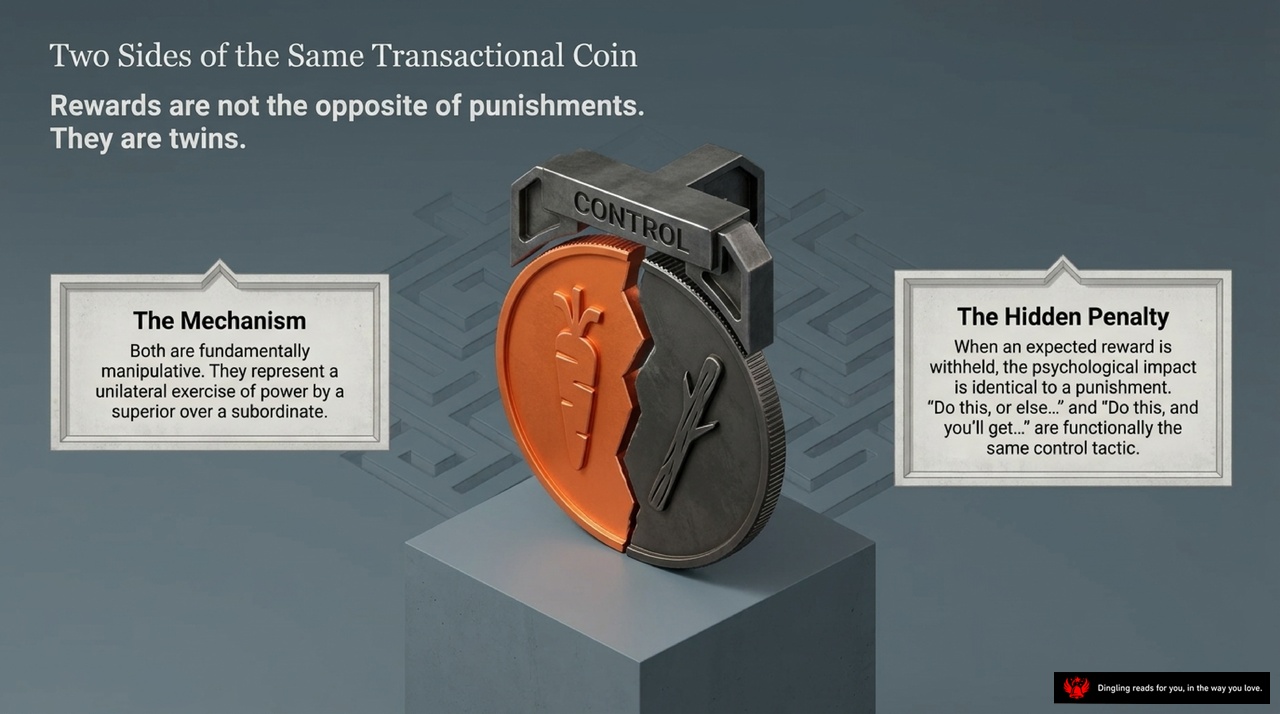
The slide presents a powerful metaphor: a single coin split into two halves, labeled "The Mechanism" and "The Hidden Penalty," under the overarching theme of "Control." It challenges a deeply held belief that rewards and punishments are opposites, revealing instead that they are twins.
Let's dive into this. The image suggests that whether you are offering a carrot or holding a stick, the underlying dynamic is identical. On one side, we see the "Mechanism": a unilateral exercise of power where a superior manipulates a subordinate. This is the logic of behavioral conditioning, the idea that "do this, and you'll get that." On the other side lies "The Hidden Penalty." The slide makes a crucial point: when an expected reward is withheld, the psychological impact is identical to a punishment. The text explicitly states that "Do this, or else..." and "Do this, and you'll get..." are functionally the same control tactic.
This insight dismantles the comfort of thinking we are being benevolent by using rewards. In reality, tying behavior to external incentives—whether it's a bonus at work, a sticker for a child, or praise from a manager—creates a relationship of control rather than cooperation. It reduces complex human motivation to a simple transaction, where people act not because they care about the task itself, but because they are being managed. As the slide illustrates, this coin of transactional control has no good side; it simply shifts the pressure from the stick to the carrot, but the weight remains the same.
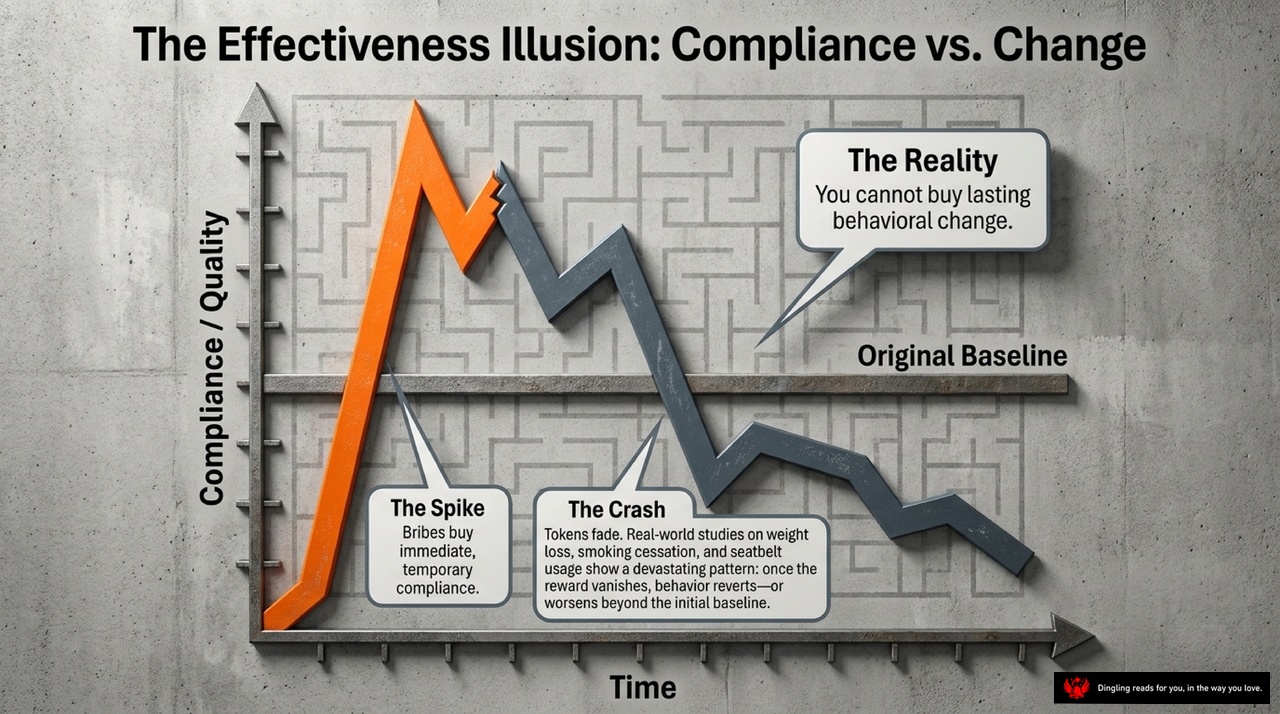
The graph in front of us tells a harsh but necessary truth: the "Effectiveness Illusion." It illustrates the fatal cycle of relying on rewards to drive behavior. Look at that orange line, labeled "The Spike." It shows what happens when we introduce bribes or incentives: we get an immediate, sharp rise in compliance. It looks like success at first glance. But look at what happens next. As soon as the reward is removed, the gray line labeled "The Crash" plunges. Not only does behavior revert to the original baseline, but it often crashes even lower.
This isn't just theory; it's the reality of weight loss programs, smoking cessation efforts, and even corporate performance bonuses. The chart reminds us of a critical insight: "You cannot buy lasting behavioral change." When we tie actions to external rewards, we don't create motivation; we create dependency. People stop doing the behavior the moment the payoff disappears. Instead of fostering genuine commitment, we end up training people to wait for the next incentive, trapping them in a cycle where they need a push to move forward. True, sustainable change doesn't come from manipulation or transaction; it comes from internal drive.
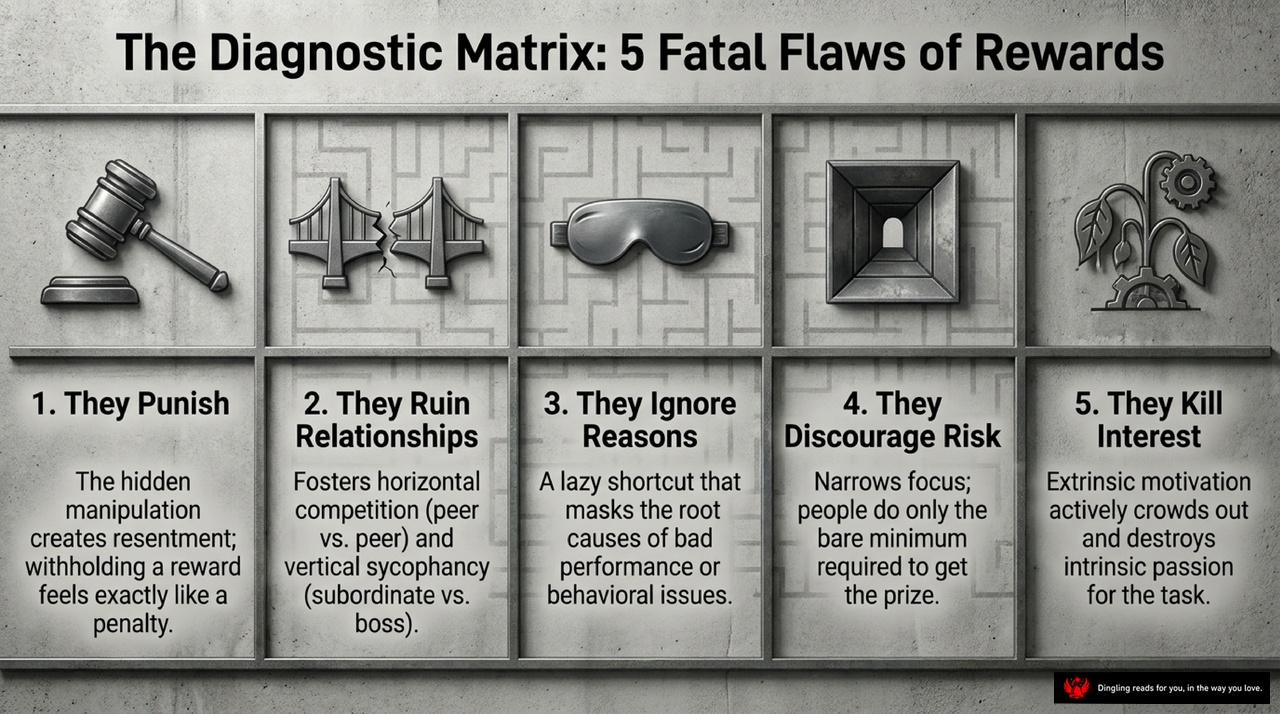
The Diagnostic Matrix reveals five fatal flaws in how we use rewards, starting with the first one: they punish. It might sound counterintuitive, but withholding a reward feels just like a penalty, creating hidden resentment and manipulation rather than genuine motivation. Next, rewards ruin relationships. Instead of fostering collaboration, they ignite horizontal competition among peers and encourage vertical sycophancy, where subordinates flatter bosses just to get the prize. This destroys trust and turns workplaces or classrooms into cutthroat environments. The third flaw is that rewards ignore the root causes of problems. When a child stays up late or an employee slacks off, handing out a treat is a lazy shortcut that masks the real issue—like exhaustion or a lack of engagement—ensuring the problem resurfaces the moment the reward stops. Fourth, rewards discourage risk. By narrowing our focus to the path of least resistance, they make people do only the bare minimum required to get the prize, effectively killing creativity and innovation. Finally, the most tragic flaw: rewards kill interest. Extrinsic motivation actively crowds out intrinsic passion. When we tie an activity to a reward, we transform it from something we love doing into a chore we do just to get paid, ultimately destroying our natural curiosity and love for the task itself.
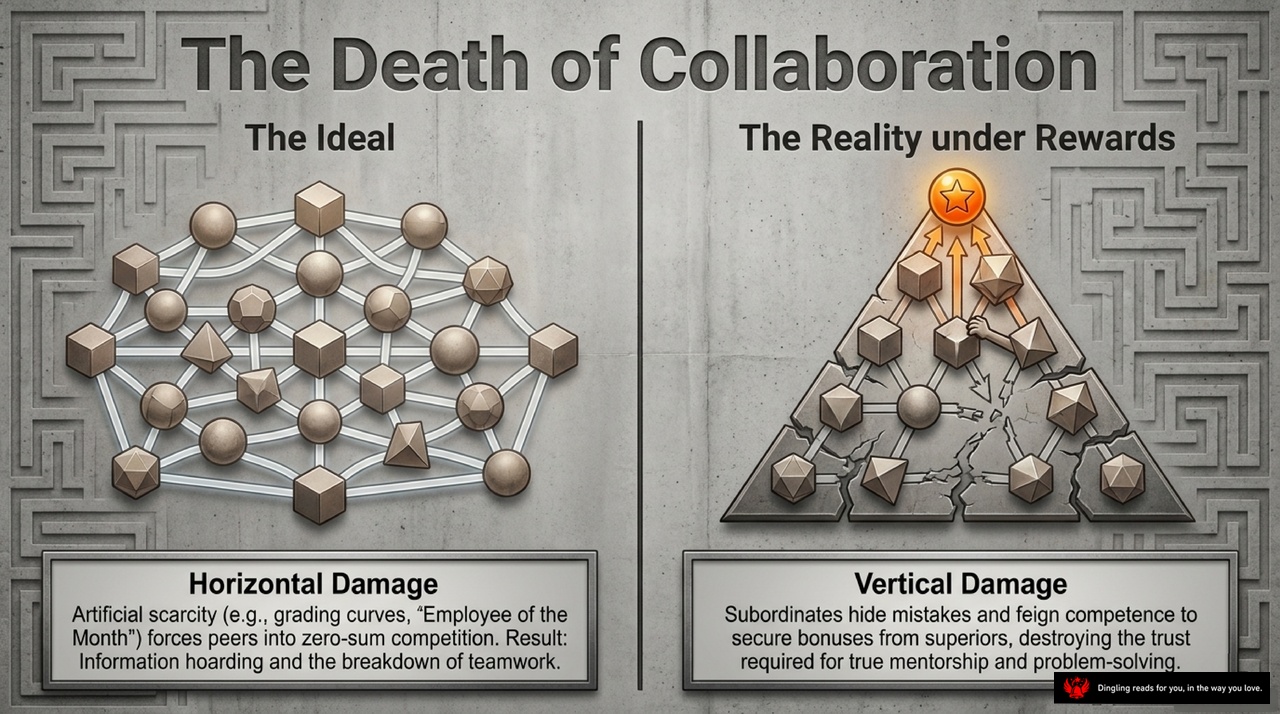
The Death of Collaboration isn't just a slogan; it's the hidden cost of the very reward systems we think are saving us. Look at this slide: on the left, we have "The Ideal"—a web of horizontal connections where everyone supports everyone. But on the right, under the pressure of rewards, that web collapses into a rigid pyramid of vertical damage.
This happens because artificial scarcity, like grading curves or "Employee of the Month" awards, forces peers into zero-sum competition. Instead of collaborating, information gets hoarded, and teamwork breaks down. Simultaneously, subordinates start hiding mistakes and feigning competence just to secure bonuses from superiors. This destroys the trust required for true mentorship and problem-solving.
We often think rewards solve problems, but they actually poison the well of human connection. By turning colleagues into competitors and bosses into gatekeepers of rewards, we aren't building a team; we're building a fortress where no one feels safe enough to be vulnerable or creative. The death of collaboration isn't an accident; it's the inevitable result of trying to buy what should be freely given.

The Enemy of Exploration. Look at this funnel. It's a powerful visual of why rewards actually kill creativity. The slide states clearly: "Rewards do not create excellence; they create predictability."
When we place a reward at the bottom of a funnel, we aren't just incentivizing a task; we are narrowing the human mind. The graphic highlights two critical problems on either side. On the left, we have the "Incidental Learning" Deficit. Driven by a reward, humans instinctively seek the fastest, easiest, and safest path to the finish line. They ignore the peripheral discoveries—the messy, unexpected insights that often lead to true breakthroughs.
On the right, we see Risk Aversion. The text warns us bluntly: if you want innovation, a reward is the worst tool available. When people are promised a payout, they actively choose the easiest possible task to guarantee that result. They avoid the necessary challenges that come with real growth.
Essentially, when you put a reward in front of someone, you turn their attention inward to the prize and outward to the rules, rather than outward to the world. You stop exploring and start calculating. You stop creating and start complying. This is why the most predictable outcomes are often the least innovative. True excellence comes from the freedom to wander, to fail, and to discover, not from the certainty of a payoff.

The Assassination of Interest: Why Rewards Kill Motivation
Look at this equation: Task plus Reward equals a Devalued Task. This graphic captures a counterintuitive truth from psychology: extrinsic motivation doesn't add to your inner drive; it actively crowds it out. When you attach a reward to an activity, you subconsciously teach the child—or the employee—that the task itself is a terrible chore that must be endured just to get the prize.
Research across multiple studies, from children drawing with markers to adults drinking kefir, proves that once you reward a specific activity, people lose all interest in doing it for free. The reward shifts their focus from the joy of the task to the value of the reward. Suddenly, the task isn't about exploration or learning; it's just a means to an end. This is the core thesis: saying "do this, get that" transforms a meaningful experience into a transaction, effectively killing the intrinsic curiosity that makes us human.

Imagine a giant, rusted machine of gears and chains, spinning in a relentless circle. This is the "Reward Dependency Loop," a trap that keeps us stuck in a cycle of diminishing returns and eroded motivation. It all starts when we introduce an extrinsic reward to fix a behavioral issue. We think we're solving a problem, but we've actually just started an addiction.
As soon as that reward is introduced, something insidious happens: the person's intrinsic interest in the task drops instantly. The activity, once meaningful, is instantly devalued into a mere chore. Now, the task is only done to get the treat. But here's the catch—compliance plummets the moment the reward gets stale or is withheld. People don't just stop; they demand more.
To get the exact same output, managers and parents feel forced to escalate the bribe, introducing larger and more expensive rewards just to keep the gears turning. We are treating people like pets, conditioning them to work only for treats, and then complaining when they stop moving the moment the leash is loosened. This isn't just about bad management; it's a fundamental flaw in how we view human nature. We are building a system where the only way to get results is to increase the cost of the bribe, leaving us with no real motivation, only dependency.
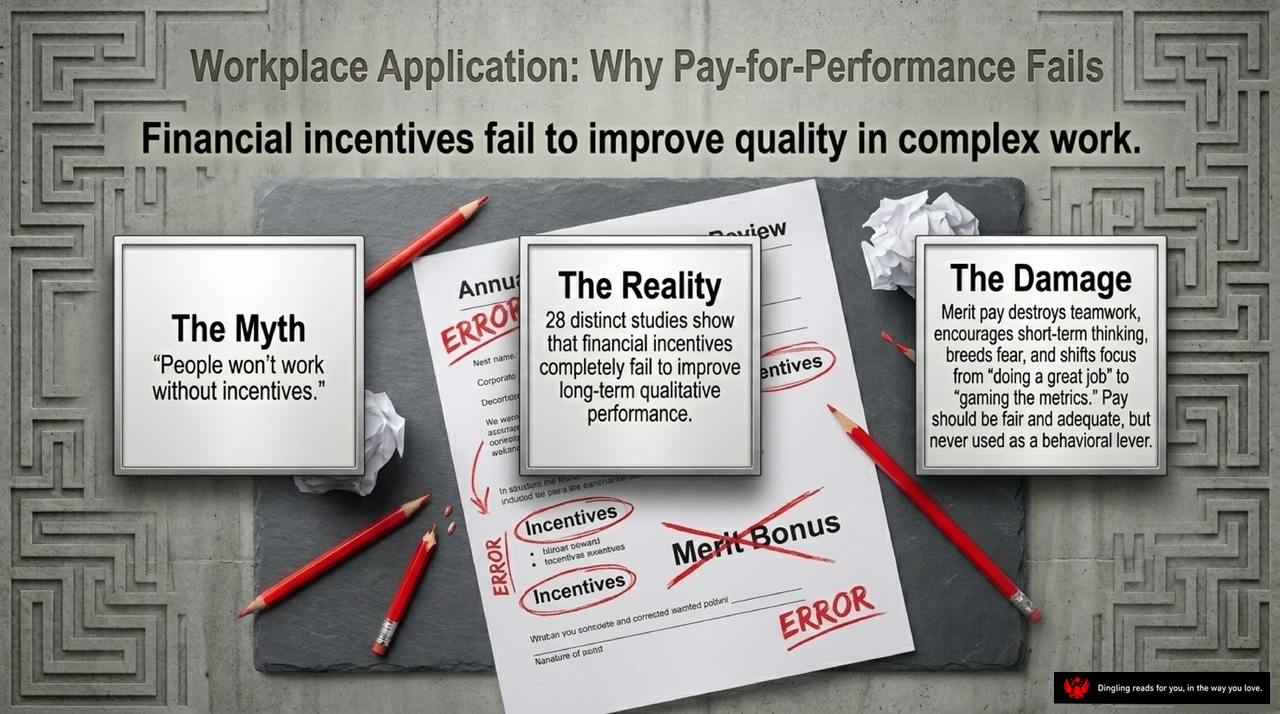
Let's cut through the noise and look at the hard truth about workplace incentives. The slide clearly states that "Financial incentives fail to improve quality in complex work," and it's not just a bold claim—it's backed by data. We are told that 28 distinct studies prove that money simply cannot boost long-term qualitative performance. Instead of creating a motivated workforce, pay-for-performance schemes often do the exact opposite.
Consider the damage. When we tie pay to specific metrics, we destroy teamwork and breed fear. Employees stop trying to "do a great job" and start obsessing over "gaming the metrics." You see this daily: salespeople pushing the wrong products to hit quotas, or engineers cutting corners to meet deadlines. The document warns that pay should be fair and adequate, but it must never be used as a behavioral lever.
So, why do we keep falling for "The Myth" that people won't work without incentives? We confuse motivation with manipulation. We treat complex human beings like machines that need a carrot and a stick to function. But the reality is that when you try to control behavior with money, you encourage short-term thinking and erode the very creativity and trust that drive real success. True performance comes from engagement and autonomy, not from a spreadsheet that dictates every move. It's time to stop trying to buy quality and start building an environment where it can grow on its own.
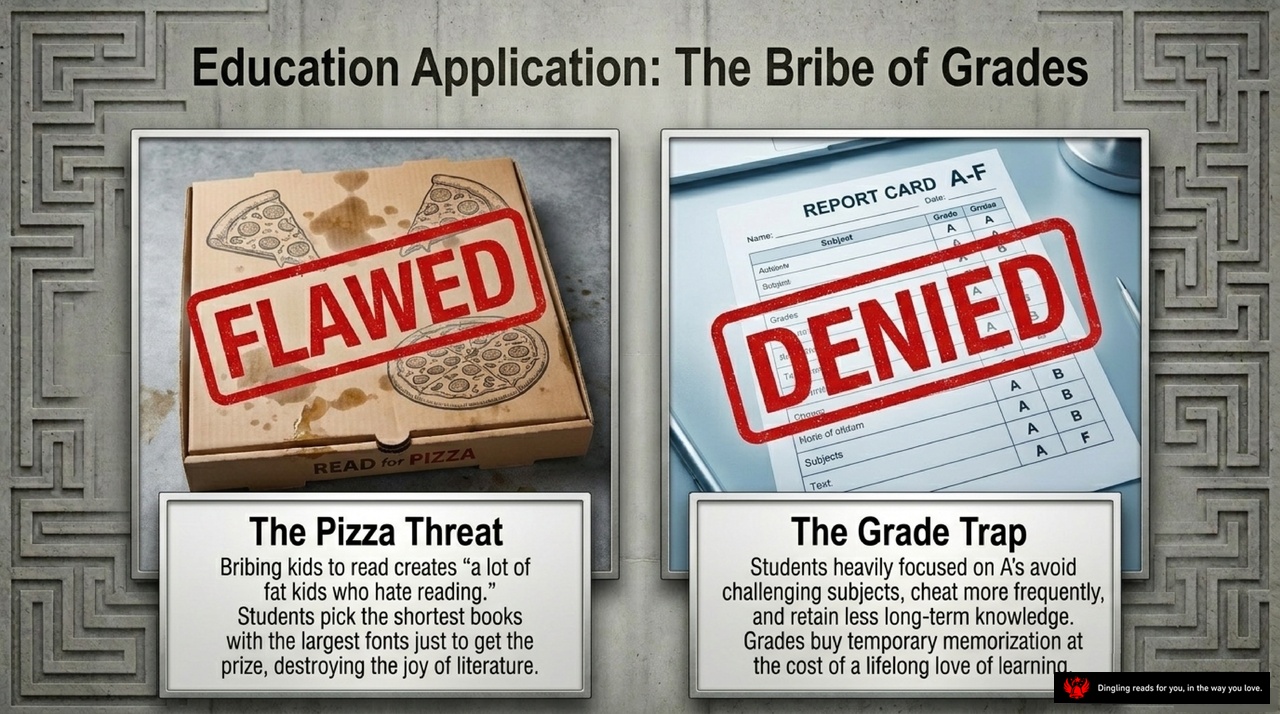
Look at this slide: "Education Application: The Bribe of Grades." On the left, we see a pizza box stamped "FLAWED," representing "The Pizza Threat." On the right, a report card stamped "DENIED" illustrates "The Grade Trap." These images perfectly capture the dark side of the "bribe of grades."
First, let's look at the pizza. The idea that reading books earns a free pizza is a classic trap. It creates a generation of kids who hate reading. Instead of falling in love with stories, students start picking the shortest books with the largest fonts just to grab the prize. They aren't reading for joy; they are reading for a reward. This destroys the very love of literature we want to foster.
Then, look at that denied report card. This is the "Grade Trap." When students become heavily focused on getting As, they avoid challenging subjects and cheat more frequently. Grades buy temporary memorization at the cost of a lifelong love of learning. Students stop exploring and start strategizing. They retain less long-term knowledge because they are too busy protecting their score.
The problem is that we treat education like a transaction. We think, "If you do this, you get that." But this logic reduces complex human beings to machines that only respond to external bribes. It creates a cycle where the only reason to learn is the reward, and without the reward, the behavior stops. We need to move away from this flawed bribery system and help students find the intrinsic joy in learning for its own sake.

The Praise Paradox is a powerful reminder that not all praise is good. In fact, simple phrases like "Good boy!" can act like verbal dog treats, creating approval junkies who only work for validation. The image on this slide perfectly illustrates the difference between two types of feedback. On the left, we have Controlling Praise, where you say, "You did exactly what I wanted." This heavy weight on the scale reduces autonomy, spikes anxiety, and positions the praiser as the ultimate judge. It's essentially manipulation disguised as kindness. On the right, we have Informational Feedback. Notice how much lighter this side is? Instead of judging the person, you focus on the work by saying, "I noticed you used a new technique on this problem." This approach supports autonomy, builds true competence, and leaves motivation intrinsic. The key takeaway is simple: focus on the work, not the power dynamic. When we shift from controlling praise to informational feedback, we stop creating dependency and start fostering genuine growth.

Today's slide highlights a fundamental shift in how we approach motivation: moving from extrinsic control to intrinsic autonomy. On the left, we see "Pop-Behaviorism," the old way of thinking that asks, "What can I give them to make them do this?" This approach relies on compliance, metrics, and short-term obedience, often treating humans like lab animals through surveillance and conditional bribes. It's a mindset of control where people are merely reacting to external rewards or threats.
But on the right, we have "The Alternative": Autonomy. Instead of asking what we can give, we ask, "What do they NEED to want to do this?" This flips the script entirely. True motivation isn't about forcing behavior; it's about unlocking internal drivers through what we call the 3 C's. First is Choice—giving people real autonomy over how they work, not just what they do. Second is Collaboration, fostering genuine teamwork rather than zero-sum competition where everyone fights for a limited reward. Finally, there is Content—ensuring the task itself is meaningful and appropriately challenging so that the work is rewarding in its own right.
The contrast is clear: one side treats people as objects to be manipulated, while the other respects them as partners capable of self-direction. When we shift from control to autonomy, we stop needing to constantly push and pull, and instead create an environment where people naturally want to engage, collaborate, and excel because the work itself matters to them.

If you're stuck in a situation where you absolutely have to offer a reward—perhaps due to budget constraints or urgent behavioral needs—don't just hand it over blindly. You need a strategy to minimize the psychological damage it causes. Think of this as your "Harm Reduction Protocol."
First, make the reward invisible. Don't make a big deal out of it. No giant checks, no lavish banquets. Keep it low-key so the focus stays on the work, not the prize.
Second, make it a genuine surprise. Give the reward only after the fact as a token of appreciation. Never use it as a pre-conditioned bribe like, "If you do X, you get Y." That turns the person into a transactional machine.
Third, never make it a competition. Avoid limiting the number of winners or using zero-sum grading curves. When everyone is racing for a finite prize, you destroy cooperation and breed resentment.
Finally, and most importantly, de-link the reward from performance. Pay people fairly and generously for their work, then do everything possible to take money off their minds. Let them focus on the quality of their contribution, not on calculating their next payout. By following these steps, you can acknowledge effort without accidentally crushing their intrinsic motivation.
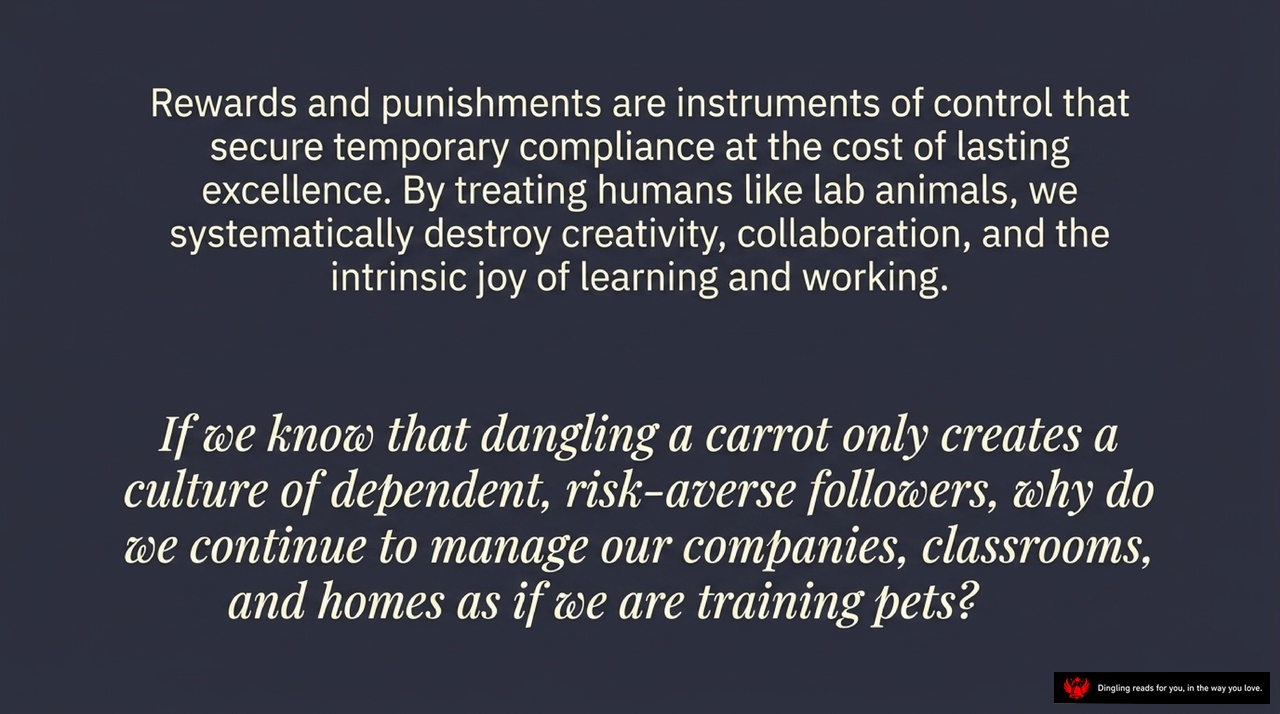
Rewards and punishments are instruments of control that secure temporary compliance at the cost of lasting excellence. By treating humans like lab animals, we systematically destroy creativity, collaboration, and the intrinsic joy of learning and working.
If we know that dangling a carrot only creates a culture of dependent, risk-averse followers, why do we continue to manage our companies, classrooms, and homes as if we are training pets?
The reality is that the moment we tie a task to an external reward, we strip it of its inherent meaning. We shift the focus from the work itself to the prize at the end, turning a fulfilling activity into a mere transaction. This approach doesn't just fail to build long-term motivation; it actively undermines it. When people rely on rewards, they stop asking "why" and start asking "what's in it for me." They become cautious, avoiding challenges that might jeopardize their payoff, and they lose the spark of curiosity that drives true innovation.
We often think we are being generous or fair by offering incentives, but we are actually conditioning behavior. We are teaching people to wait for permission and to perform only when watched or rewarded. This creates a fragile system where effort stops the moment the reward disappears. Instead of cultivating independent thinkers who are driven by purpose and passion, we end up with followers who need constant external validation to take the next step.
The question isn't whether we can get people to follow orders using carrots and sticks; the question is whether we want to. If our goal is to build a resilient, creative, and joyful workforce or community, we must stop trying to train pets and start empowering people. We need to create environments where the work itself is the reward, where autonomy is respected, and where individuals are trusted to find their own reasons to excel. Only then can we move beyond temporary compliance and achieve lasting excellence.