
Quit: Complete Chapter-by-Chapter Summary
Hello everyone. Today, we're exploring a concept that often feels uncomfortable: quitting. The book we're discussing is *Quit: The Power of Knowing When to Walk Away* by Annie Duke.
Take a look at the text on this slide. It challenges a common belief we hold dear. It says, "Quitting is not the opposite of success, but the essential strategic tool for navigating an uncertain world."
Think about that for a moment. We are often praised for persistence, yet in an unpredictable world, persistence without direction can be dangerous. Knowing when to walk away isn't about giving up; it's about making a strategic choice to protect your time and energy. It allows you to pivot toward better opportunities instead of digging a deeper hole.
So, how do we apply this wisdom in our lives and careers? Let's start with a story from the mountains that changed the way we think about success.

We all know the story of Mount Everest. It is usually about the summit. But today, I want to talk about the people who didn't reach the top, and why they might be the smartest climbers of all.
Look at the blue path on the screen. This is the Illusion of Grit. In 1996, climbers Rob Hall and Doug Hansen ignored the 1:00 PM turnaround time. They pushed for the summit because they believed that was the only thing that mattered. They perished on the descent. Their story became legendary because society idolizes perseverance, even when it is fatal. We want heroes who die trying. We confuse grit with stubbornness. We think that if you don't finish, you didn't try hard enough.
Now, look at the orange path. This is The Strategic Quit. You have Hutchison, Taske, and Kasischke. At 11:30 AM, just three hours from the summit, they looked at the clock. They knew the danger of coming down was eight times greater than going up. They turned around just to honor the safety deadline. They survived. But here is the hard truth: they are entirely forgotten. A rational quit makes for a boring movie. We don't celebrate the people who walked away safely; we only remember the ones who died trying.
The lesson here is clear: The ultimate goal of climbing Everest is not reaching the summit. It is returning safely to the base.
This mindset applies to everything we do. We are often trapped by the pressure to persist. We think quitting is a failure. But persistence without a plan to quit is just a slow way to fail. The 1:00 PM deadline wasn't about stopping you from climbing; it was about protecting your life.
So, when you face a difficult choice, ask yourself: Is this persistence, or is this just stubbornness? The smartest people know that the best way to win is sometimes to walk away before you lose everything. Be the survivor who makes it home.
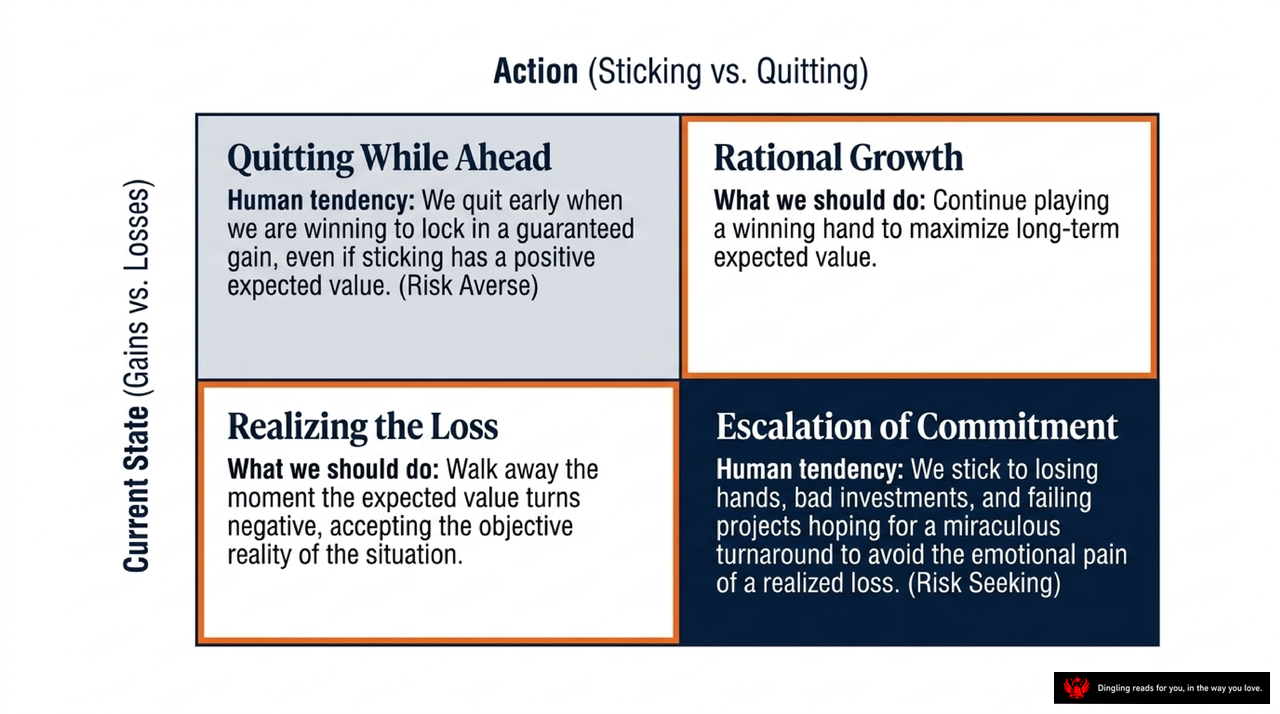
Welcome to this segment on Action. Specifically, we are looking at the critical decision between sticking and quitting. The chart in front of us maps out our choices based on our current state: are we currently gaining or losing?
Look at the top half, where we are in a state of gains. Human nature tells us to quit while we are ahead. We tend to be risk-averse. We lock in a guaranteed gain, even if sticking around has a better expected value. It feels safe to take the win. Think about the classic experiment where people choose a sure 100 dollars over a coin toss for 200. We prefer certainty. However, the rational approach, labeled as Rational Growth, is the opposite. We should continue playing a winning hand. If the expected value is still positive, we maximize long-term value by not stopping too early.
Now, flip to the bottom half, where we are realizing a loss. Here, the human tendency is the most dangerous. This is the escalation of commitment. We become risk-seeking. We stick to losing hands, bad investments, and failing projects. We hold on hoping for a miraculous turnaround just to avoid the emotional pain of a realized loss. We are afraid of the loss, so we gamble more. This is exactly why taxi drivers often drive until their shift ends even when they have already earned enough, just to avoid the feeling of "wasting time." But what should we actually do? The rational choice is Realizing the Loss. We need to walk away the moment the expected value turns negative. We must accept the objective reality of the situation and cut our losses. This means walking away from bad investments or failing projects the moment the math stops working in your favor. Think about investors who hold onto losing stocks hoping they will bounce back, only to lose even more.
The core lesson here is simple but hard to master. We often quit too early when winning, fearing risk. And we stick too long when losing, fearing the pain of failure. This mismatch between human tendency and rational action is where we lose the most. Understanding this matrix helps us make smarter decisions about when to let go and when to fight.
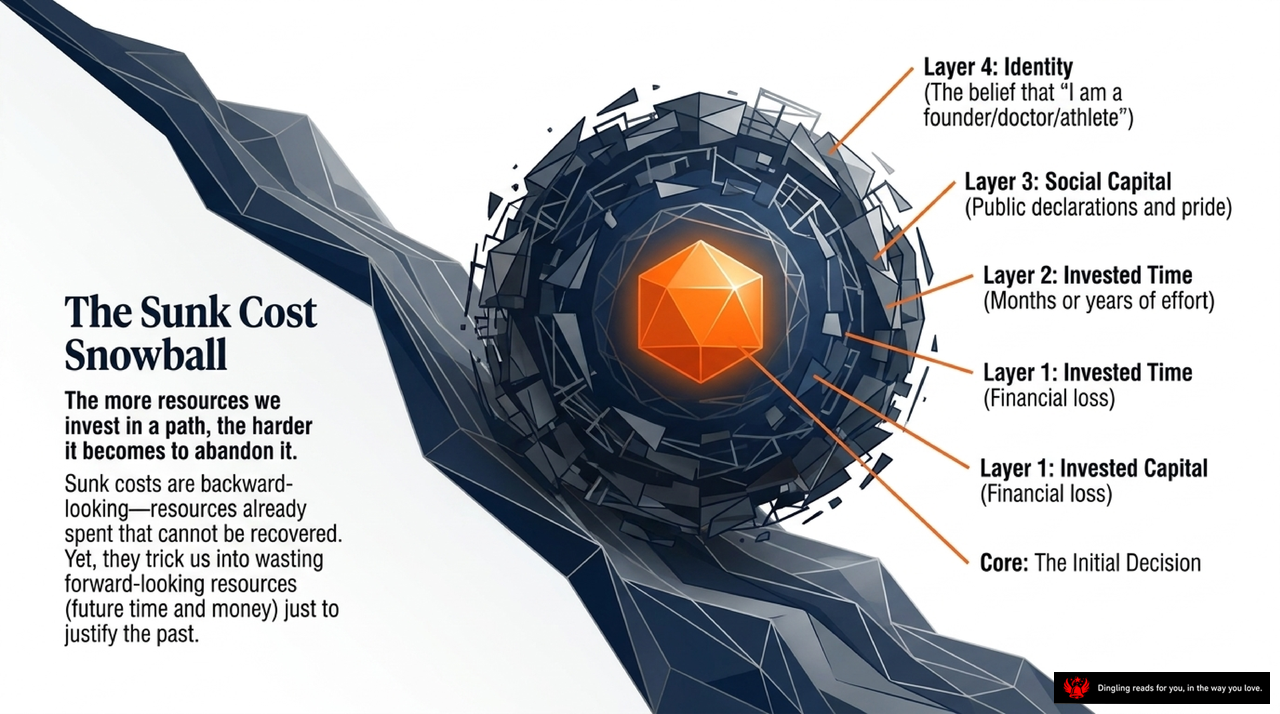
Look at this diagram. It represents the "Sunk Cost Snowball" effect. The text on the left explains it clearly: the more resources we pour into a path, the harder it becomes to turn around. Sunk costs are backward-looking. They are resources already spent that can't be recovered. But here's the trap: they trick us into wasting forward-looking resources—like our future time and money—just to justify the past. We often convince ourselves that quitting means wasting everything, but actually, staying often costs us more in the long run.
Now, look at the layers on the right. It starts with the Core: The Initial Decision. That's where it begins. But as we move outward, the snowball gets heavier. Layer 1 is Invested Capital. We lose money. Layer 1 is also Invested Time. We lose hours. Then Layer 2 is Months or Years of Effort. It's not just about cash anymore; it's about the sweat we've put in.
But it gets deeper. Layer 3 is Social Capital. This is public declarations and pride. We tell everyone we're building this. We become the face of the project. Finally, Layer 4 is Identity. This is the belief that "I am a founder, a doctor, or an athlete." When the project fails, it feels like *we* fail. This is where the real trap lies. As the text describes, we end up wasting future resources to justify the past. We tell ourselves, "If I quit now, all that money and time is wasted." But that's a lie. The money is gone regardless. The real cost is what we lose by staying. Think about fixing an old car that keeps breaking down, or sticking with a major you hate just because you've studied for years. We stay because we don't want to close the account on a losing investment.
This snowball effect reinforces itself. The more we add to it, the heavier it gets. It's like a game where you keep adding blocks to a tower just to make it taller, even if the foundation is shaky. Psychologists call this commitment escalation. Once we take responsibility for a decision, we keep pouring resources into it even when the results are bad. Eventually, the weight of our identity and social reputation becomes heavier than the actual value of the project. We stop looking at the future and start defending the past. The key takeaway is this: The core is just a decision. The layers are the weight we carry. To move forward, we have to be willing to shed the snowball, even if it means admitting the initial decision wasn't right. Remember that stopping is not a failure; it's a strategic move to save what matters most.

Look at this chart. The Y-axis shows Growth and Impact, while the X-axis tracks Time. It illustrates the journey from failure to massive success. On the left, Glitch represents the Sunk Cost Trap. Stuart Butterfield spent years and $17.5 million building this multiplayer game. Even with a highly engaged audience, the unit economics pointed to a dead end. Continuing would have been a financial disaster.
On the right, Slack represents The Acceleration. By killing Glitch, Butterfield pivoted to an internal communication tool the team had built for themselves. That tool became Slack, eventually acquired by Salesforce for $27.7 billion.
The Pivot section highlights that Butterfield returned the remaining investor capital and killed the game, freeing his team's talent and resources from a negative expected value trap.
This story teaches us that success isn't always about persistence. Sometimes, the smartest move is to stop. Killing a failing project isn't failure; it's the courage to reallocate your assets to a winning direction. Knowing when to walk away is often the key to finding the real opportunity.
This slide reminds us that success often comes from knowing when to walk away, turning a potential loss into a massive gain.
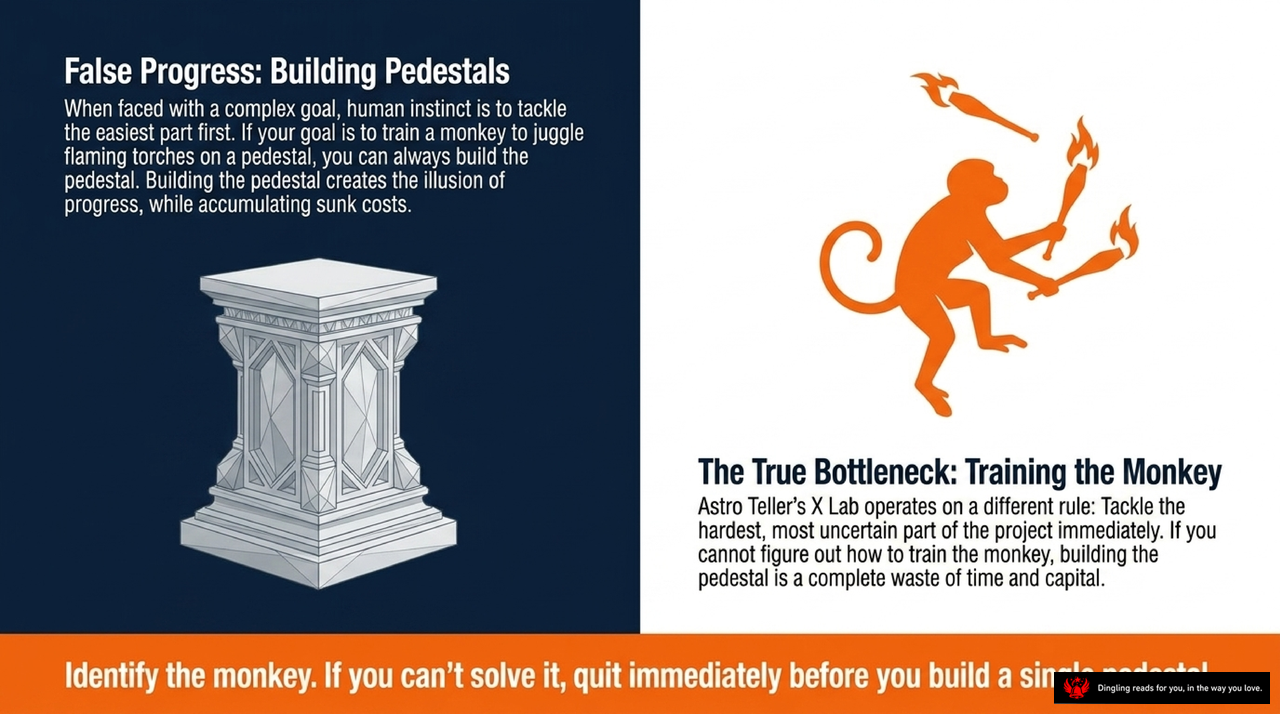
Hello everyone. Today we're diving into a critical concept that often trips us up: False Progress. Have you ever felt like you're working incredibly hard, yet you're not actually getting closer to your goal? This happens when we confuse activity with progress. Look at the slide. It breaks this down into two parts: Building Pedestals versus Training the Monkey.
When faced with a complex goal, our human instinct is to tackle the easiest part first. If your goal is to train a monkey to juggle flaming torches on a pedestal, you can always build the pedestal. It's easy, quick, and tangible. But here's the trap: building the pedestal creates an illusion of progress. You feel productive, but you are just accumulating sunk costs. Meanwhile, the real bottleneck remains unsolved. You've built a stage for a show that can never happen.
This is where Astro Teller's X Lab operates on a different rule. They don't start with the pedestal. They tackle the hardest, most uncertain part of the project immediately. That's the monkey. If you cannot figure out how to train the monkey, building the pedestal is a complete waste of time and capital. It's better to fail fast on the hard part than to invest heavily in the easy part that leads nowhere.
So, how do we apply this? The slide gives us a clear instruction at the bottom: Identify the monkey. If you can't solve it, quit immediately before you build a single pedestal. This sounds harsh, but it's liberating. It stops us from wasting resources on things that won't work. It forces us to focus on the core value. Instead of pretending we are moving forward by building infrastructure, we ask: is the core capability actually possible?
In your own projects, whether it's a business idea or a personal goal, ask yourself: what is the monkey? Is it the technology? Is it the market? Is it the team? If you can't solve that core challenge, stop. Don't build the pedestal. Don't let the sunk costs trap you. True progress comes from solving the hard problems, not hiding behind the easy ones. Remember, the pedestal is just a monument to failure if the monkey isn't trained. This mindset shift is crucial for innovation. Thank you.
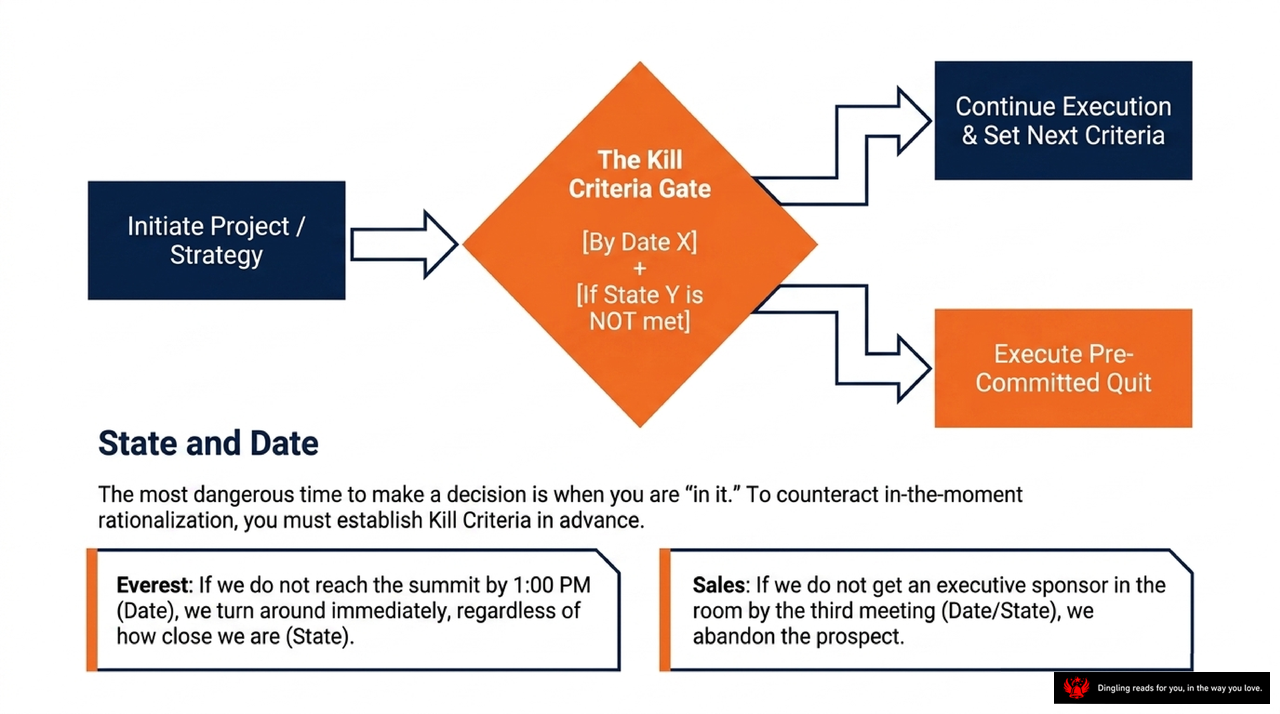
Let's look at this flowchart. It shows the "Kill Criteria Gate." The core idea is simple: before you initiate a project or strategy, you must decide in advance exactly when to stop. Why? Because the most dangerous time to make a decision is when you are already "in it." Once you are invested, emotions take over, and we tend to rationalize continuing even when we should quit.
To counteract this, you need to establish two specific criteria: a Date and a State. Think of it as a pre-written rule that you agree to follow. For example, in the 1996 Everest expedition, the team set a hard deadline: "If we do not reach the summit by 1:00 PM, we turn around immediately." It doesn't matter how close they are to the peak; the date is the rule.
Or consider a sales scenario: "If we do not get an executive sponsor in the room by the third meeting, we abandon the prospect." This combines a measurable state with a time limit. By setting these rules beforehand, you remove the guesswork. You aren't deciding based on how you feel right now; you're following a plan you made when you were calm. This allows you to execute a pre-committed quit without guilt or hesitation, saving you from wasting resources on things that simply aren't working. If you meet the criteria, you continue execution and set next criteria; if not, you execute a pre-committed quit. It's about knowing when to walk away, rather than being dragged down by past investments. This discipline is crucial for long-term success.
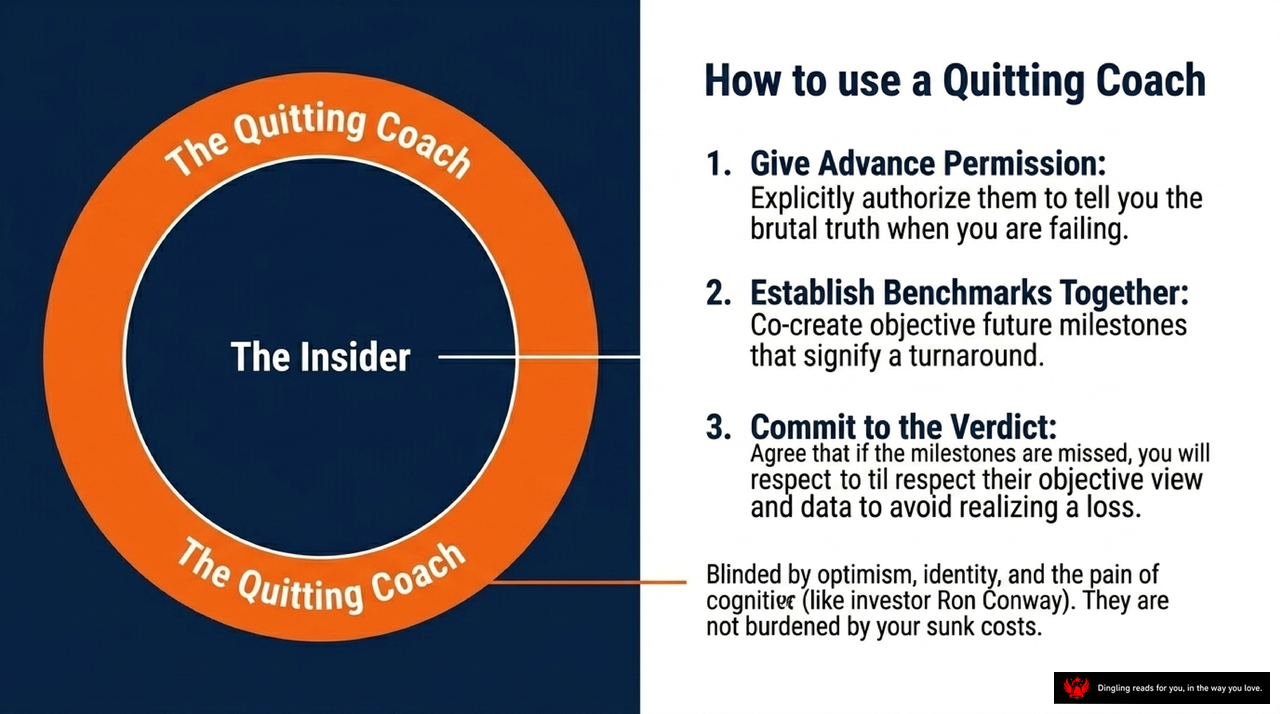
Welcome back. Let's look at this slide, which introduces a game-changer for decision-making: How to use a Quitting Coach.
Picture the diagram on the left. You are "The Insider" in the center—the person doing the work, the one feeling the pressure. Surrounding you is "The Quitting Coach." This isn't just a supportive friend who offers comfort. This is a strategic partner designed to protect your future by telling you the hard truth.
So, how do you actually make this framework work? The book outlines three critical steps you need to follow.
First, Give Advance Permission. You have to explicitly authorize them to tell you the brutal truth when you are failing. Without this permission, they might sugarcoat things to protect your feelings, which ultimately hurts your decision-making. You need to know that their job isn't to make you feel good, but to make you successful.
Second, Establish Benchmarks Together. You need to co-create objective future milestones. These aren't vague hopes; they are concrete signs that signify a turnaround. If you hit them, great. If not, it's a signal that something is wrong.
Third, Commit to the Verdict. This is the hardest part. You agree that if those milestones are missed, you will respect their objective view and data. You avoid realizing a loss by sticking to the plan, not by hoping it changes. You have to be willing to walk away.
Why do we need this? Because, as the text notes, we often get blinded by optimism, identity, and the pain of cognitive dissonance. We tend to hold onto things because of what we've already invested, known as sunk costs. Like investor Ron Conway, a Quitting Coach isn't burdened by your sunk costs. They see the numbers clearly and aren't emotionally attached to the past.
The text also reminds us that we often stick to things because of our identity. If a project fails, we feel like we failed. A coach helps you separate your worth from your work. So, don't just rely on your own gut. Get an outside perspective that's willing to say "stop" before you burn out. That's the power of a Quitting Coach. It's about making the tough call before the situation becomes irreversible. Remember, it's better to quit early than to quit late.
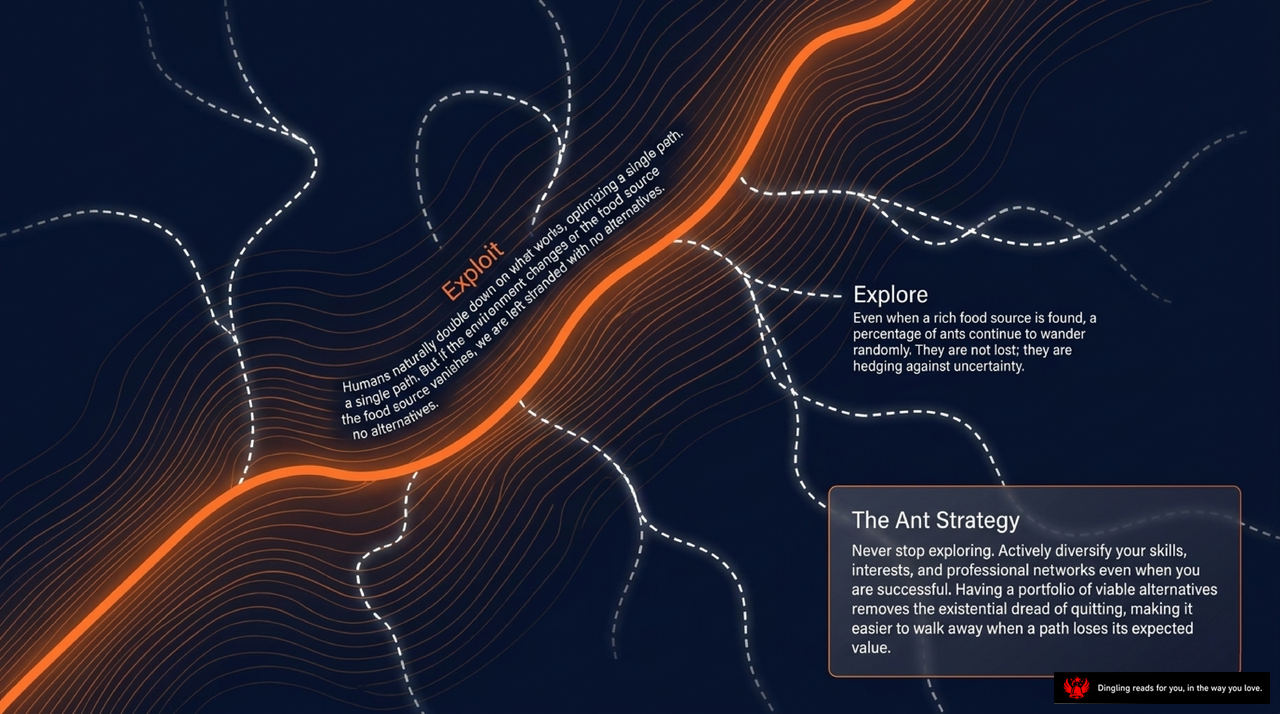
Look at the visualization on this slide. We are looking at a fundamental tension in decision-making: Exploit versus Explore. The solid orange line represents Exploit. This is the path we humans naturally take. We double down on what works, optimizing a single path. It feels efficient, right? We want to maximize our output on the current track. But the text warns us: if the environment changes or the food source vanishes, we are left stranded with no alternatives. We become trapped by our own optimization. We think we are building a skyscraper, but if the foundation shifts, we fall.
Contrast that with the dashed white lines on the right. That represents Explore. The book explains that even when a rich food source is found, a percentage of ants continue to wander randomly. They are not lost; they are hedging against uncertainty. This wandering is not a mistake; it is a survival strategy. It keeps the colony alive when the current food runs out.
This brings us to The Ant Strategy. The core message is simple but powerful: Never stop exploring. Think about your career or your life. Actively diversify your skills, interests, and professional networks, even when you are successful. Most people think they should just stick to the orange line and keep digging deeper. But that creates a single point of failure.
Having a portfolio of viable alternatives removes the existential dread of quitting. When you have multiple paths, it becomes much easier to walk away when a path loses its expected value. You are not forced to stay in a sinking ship. The fear of quitting often comes from the belief that you have nowhere else to go. But if you have built a portfolio of options, quitting becomes a choice, not a desperate act. You gain the power to leave.
So, how do we apply this? We need to balance our focus. Do not just be the ants that follow the pheromone trail blindly. Keep some of your energy wandering into the unknown. Explore new industries, learn new skills, or network with different groups. This way, when the market shifts, you are not stranded. You have options. The goal is not just to find the best path right now, but to ensure you have other paths available if the best one disappears. That is the wisdom of the ant colony, and it is the key to long-term resilience in a changing world. By keeping one foot on the orange line and one on the white paths, you ensure that no matter what happens, you always have a way forward. This mindset shifts the goal from just winning today to surviving and thriving tomorrow. It reminds us that exploration is just as important as execution.
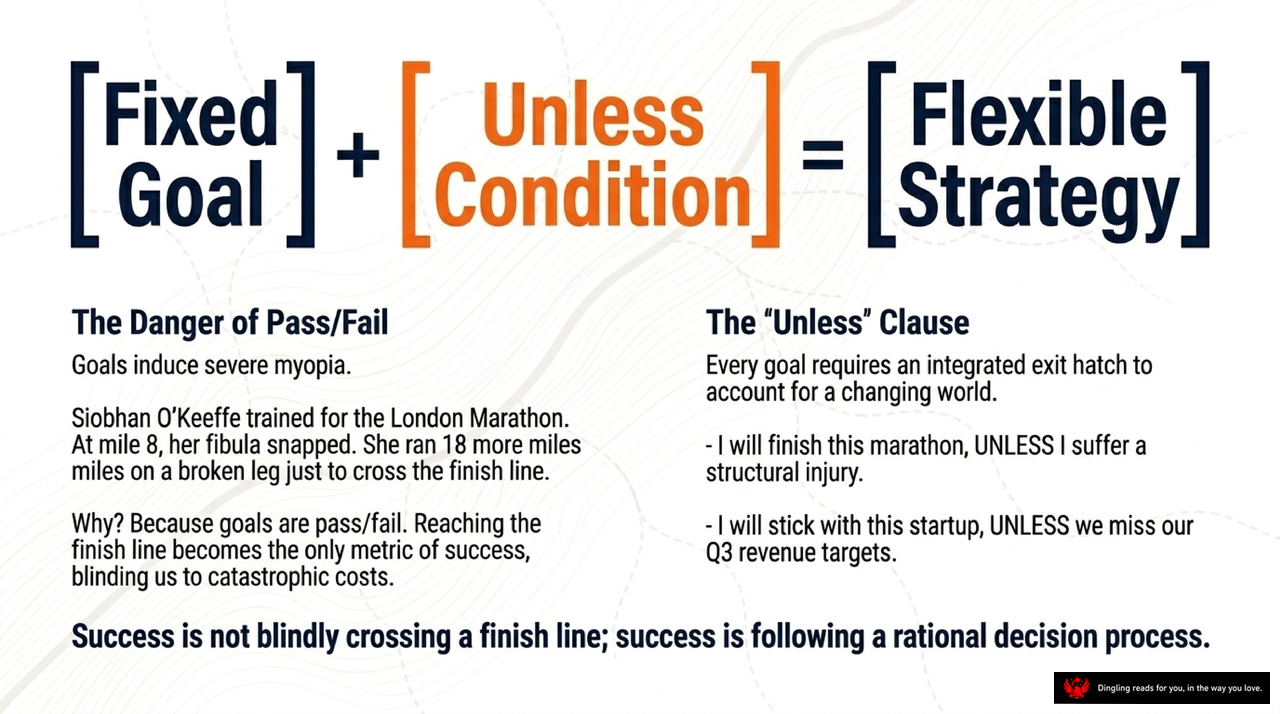
Let's look at this equation on the screen. It says: Fixed Goal plus Unless Condition equals Flexible Strategy. This is a powerful framework for how we should actually approach our goals in life and business.
We are often conditioned to believe that a goal is a destination we must reach at all costs. We treat goals as pass-or-fail tests. If you reach the finish line, you succeed. If you don't, you fail. But this binary thinking creates a dangerous trap. It induces severe myopia. We become so focused on the outcome that we ignore the cost of getting there.
Consider the story of Siobhan O'Keeffe. She trained hard for the London Marathon. At mile eight, her fibula snapped. The medical advice was clear: stop immediately. But she didn't. Driven by the fixed goal of finishing, she ran eighteen more miles on a broken leg just to cross the finish line. Why? Because reaching the finish line had become the only metric of success. It blinded her to the catastrophic cost of running on a broken bone.
This is the danger of the pass/fail mindset. It makes us stubborn.
So, how do we fix this? We need to introduce the Unless clause. Every goal requires an integrated exit hatch to account for a changing world. You don't have to be rigid. You can say, I will finish this marathon, UNLESS I suffer a structural injury. Or in business, I will stick with this startup, UNLESS we miss our Q3 revenue targets.
This transforms your goal from a rigid command into a flexible strategy. It acknowledges that the world changes and that sometimes, the smartest thing you can do is stop. Success is not blindly crossing a finish line; success is following a rational decision process. By adding that unless condition, you protect yourself from unnecessary pain and keep your energy for opportunities that actually work.
So, next time you set a goal, ask yourself: What is my exit strategy? What is the condition where I stop? That's the difference between a trap and a strategy. Don't just set a target. Set a target and a condition for stopping. That's how you turn a rigid goal into a flexible strategy.
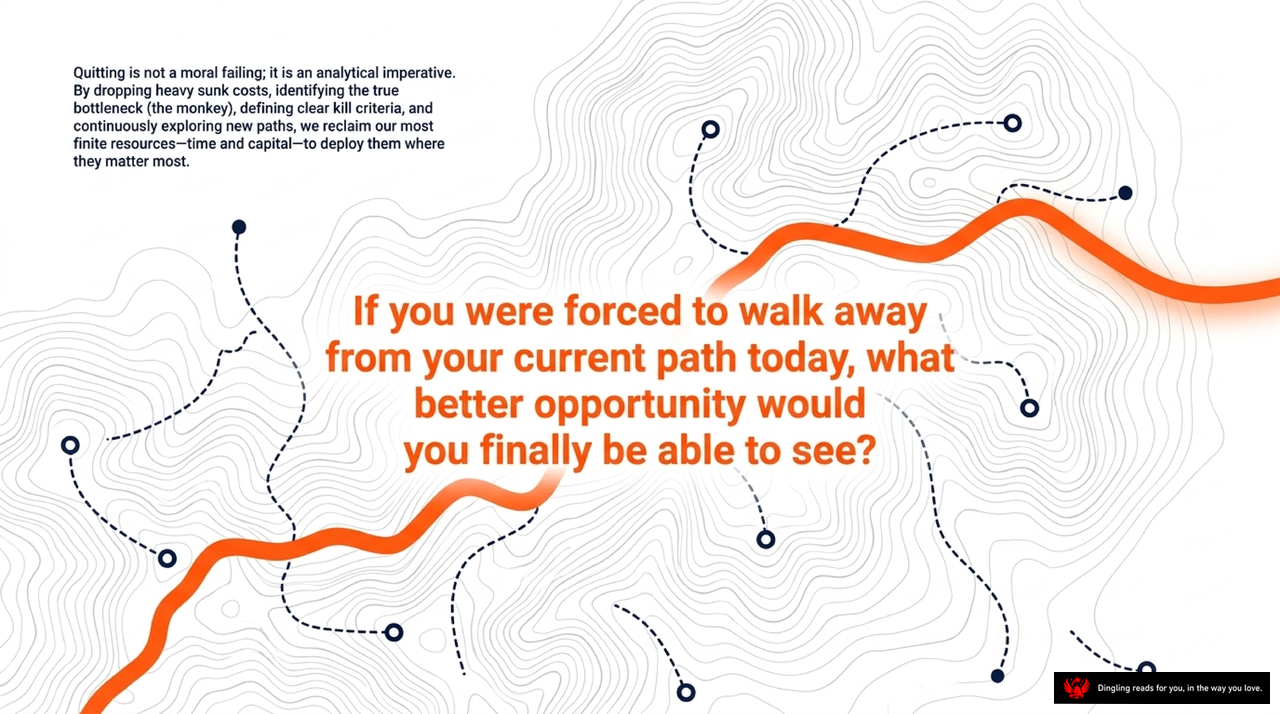
Look at this map. We often see the orange line as the only way forward, but what if the dashed paths were actually better opportunities? The slide asks a tough question: If you were forced to walk away from your current path today, what better opportunity would you finally be able to see?
Here's the mindset shift: Quitting isn't a moral failing; it's an analytical imperative. Think about it. When we keep going despite the signs, we're often trapped by heavy sunk costs. We're holding onto the past instead of investing in the future.
To break free, we need a clear strategy. First, drop the sunk costs. Second, identify the true bottleneck—what the book calls the 'monkey'—and stop wasting energy on it. Third, define clear kill criteria. Know exactly when to stop. And finally, keep exploring new paths.
By doing this, we reclaim our most finite resources—time and capital. We deploy them where they matter most, not where we just happened to be. So, don't just follow the map. Ask yourself: If I walked away right now, where could I be? That's where the real growth happens. Remember, quitting allows you to redirect your energy toward things that truly align with your goals, rather than just clinging to a plan that no longer works for you.