
Rainbows End: Complete Chapter-by-Chapter Summary

Welcome to *Rainbows End* by Vernor Vinge. Imagine a near-future world where augmented reality doesn't just overlay digital information on reality—it completely blankets human perception, making the physical world feel secondary to the data we see. In this landscape, a resurrected poet and a shadowy intelligence cabal collide over a technology that could permanently rewrite the concept of free will. The story begins with a terrifying twist on history: a virus that looks like a harmless variant of a past plague, yet is actually a sophisticated gene weapon designed to trigger mass psychosis. As we dive into this world, we meet a cast of extraordinary characters, from a young hacker named Juan who navigates virtual dinosaurs and secret missions, to an elderly poet named Robert Gu who fights to reclaim his lost talent against a world that wants to replace his mind with algorithms. This is a tale about the fragility of human consciousness, the power of technology, and the desperate struggle to remain free in a world where everything can be rewritten.

Look at this layered visualization of our future. We aren't just moving forward into a smarter world; we are stacking realities on top of each other. At the bottom, we have **Layer 1: The Physical Base**. This is the raw stuff of life—our biology, the old brick and mortar we live in, and the hidden legacy infrastructure like those steam tunnels running beneath the city. It's the part of our world that remains stubbornly out of reach for the average user.
Building on that foundation is **Layer 2: The Wearable Network**. Here, technology becomes a second skin. Imagine smart clothing, biometric sensors woven into your fabric, and micro-motors providing tactile feedback. It's the bridge between the physical and the digital, turning your body into a data hub.
Above that sits **Layer 3: The Visual Interface**. This is where the magic happens for the user. Through contact lenses and augmented overlays, digital objects seamlessly merge into our physical space. You might see a navigation arrow floating in the air or a friend's avatar standing beside you. It creates a state of continuous connectivity, blurring the line between what's real and what's projected.
Finally, at the very top, we reach **Layer 4: The Belief Layer**. This is the most profound shift. It's about the consensus realities and digital guilds we subscribe to. We selectively choose which shared hallucinations and visual filters to accept, effectively curating our own version of truth.
The image captures a critical tension: the ancient, organic roots of our physical world tangled against the sleek, glowing architecture of our digital future. It asks us a simple but terrifying question: as we climb these layers, do we enhance our humanity, or do we eventually lose our connection to the very ground we stand on?
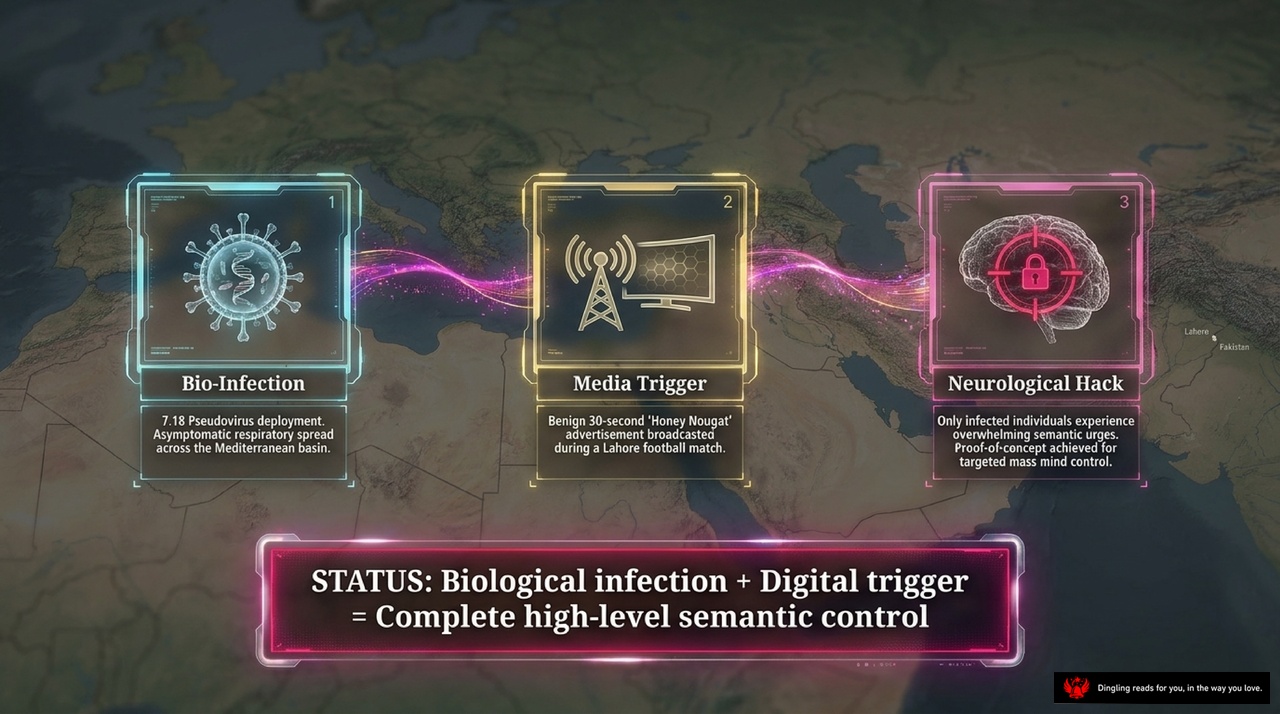
Look at this schematic: it lays out a terrifying, three-step blueprint for total mind control. First, we have **Bio-Infection**. It's not just a random virus; it's a 7.18 Pseudovirus deployed to spread asymptotically across the Mediterranean. Think of it as the silent key inserted into the lock. Next comes the **Media Trigger**. This is where the invisible becomes visible. A seemingly harmless 30-second ad for "Honey Nougat" gets broadcast during a football match. But here's the twist: it only works because of the virus. Finally, the **Neurological Hack**. Once the virus and the ad align, the target's brain is compromised, experiencing overwhelming semantic urges that allow for targeted mass mind control.
The bottom line is chillingly simple: Biological infection plus a digital trigger equals complete high-level semantic control. This isn't just a conspiracy theory; it's a proof-of-concept for a weapon that could rewrite human thought itself. The danger isn't just in the virus or the ad alone, but in their perfect synchronization.

Here is the spoken-word script for Slide 3, tailored for an American audience:
"Look at this screen. It's not just a list of names; it's the entire chessboard of the coming apocalypse. We have four distinct players, each with a terrifying agenda.
First, we have Günberk Braun from the EU Intel. He's an obsessive, paranoid investigator who believes a rogue state is testing bioweapons. His goal is simple but dangerous: expose and neutralize the threat before it's too late. Then, over in the top right, we have Keiko Mitsuri, a cautious Japanese sociologist. She's tracking social patterns and fears the return of superpower-driven atrocities. She's the one watching the failsafes, terrified of what happens when those break.
But the real danger lies in the shadows. In the bottom left, we have Alfred Vaz from Indian Intel. He's labeled 'The Traitor.' He's secretly funding a mind-control project, claiming he wants to 'save humanity from itself' before a worse apocalypse strikes. It's a twisted logic that makes him the most unpredictable variable. And finally, the Wildcard: Mr. Rabbit. This is an anonymous, omniscient virtual broker hired by Vaz. But here's the kicker—he has his own unpredictable agenda. He manipulates the global network for his own gain, turning the very tools meant to save us into weapons of chaos.
Together, these profiles show us that we aren't just fighting a virus or a government conspiracy. We are fighting a global game where every player is trying to control the next one, and the cost of losing is extinction."

Picture this: A library in chaos. Students and virtual knights clash in the digital realm, while the very building they occupy begins to tilt and collapse in real life. It's the perfect storm of a virtual riot and a physical disaster.
But look closer at the slide. We see a split reality. On one side, we have the "Before Cure" era—Robert Gu, frail and trapped by Alzheimer's, a poetic genius silenced by a dying mind. On the other, the "After Cure" era: UCSF Rejuvenation. He's physically young, his mind sharp, and his analytical skills unlocked. But here's the catch: the machinery works, yet the soul is silent. He has lost the ability to create poetry.
This slide captures the central tragedy of our story. Robert has been saved from death, but he's been robbed of his soul. He's a healthy man in a broken world, unable to express the very thoughts that once defined him. This loss of artistry is the price he pays for a second chance at life.
And then, the chaos erupts. As the library's smart systems fail during the protest, the building itself starts to collapse. It's a terrifying reminder that when the technology we rely on goes wrong, the consequences are catastrophic. Robert and MiLi are now trapped in the rubble, fighting for survival while the world around them crumbles. It's a moment where the personal tragedy of lost creativity meets the global threat of a failing technological infrastructure.

Imagine a world where the very fabric of reality—your credit, your transport, your ability to buy or travel—is held hostage by a single, invisible command. In the climax of our story, we witness the terrifying power of "Digital Immigrants" versus "Digital Natives" collide on a global scale.
On the right side of our image, we see the cold, rigid interface of the "Digital Immigrant" mindset: systems that demand explicit instructions, rely on physical metaphors, and leave no room for error. This is the world of Alfred, who triggers a catastrophic global crisis. By executing a "Global Credit Certificate Revocation Attack," he doesn't just shut down a network; he freezes the entire planet. Look at those red warning signs and the stark "No User-Serviceable Parts Inside" message. That is the essence of his philosophy: when the system breaks, there is no repair, only total shutdown. Planes stop, trains stall, and ten billion digital identities vanish in an instant. It's a black box that has swallowed the world.
Contrast this with the left side, the domain of the "Digital Native." Here, technology is an extension of the self—intuitive, fluid, and avatar-driven. This is the world Miri and Juan inhabit. While Alfred's world freezes in rigid error states, Miri's world flows with adaptive energy. She and Juan don't panic when the grid fails; they track the signal, navigate the chaos, and physically intervene where the digital logic has failed. They represent the belief that tech should serve humanity, not enslave it with unbreakable barriers.
The tragedy of this scene is that the "Digital Immigrant" approach, which values control and linear instructions, nearly destroys everything. But the "Digital Native" spirit, which trusts in intuition and human connection, is the only thing that saves the day. As the library collapses and the world goes dark, it's the fluid, adaptive nature of the native mindset that allows Robert and Miri to survive the ruins. The image perfectly captures the central conflict: can we evolve our technology from a fragile, breakable box into a seamless, life-sustaining extension of ourselves? The answer, as our story shows, depends on whether we choose to adapt or to break.
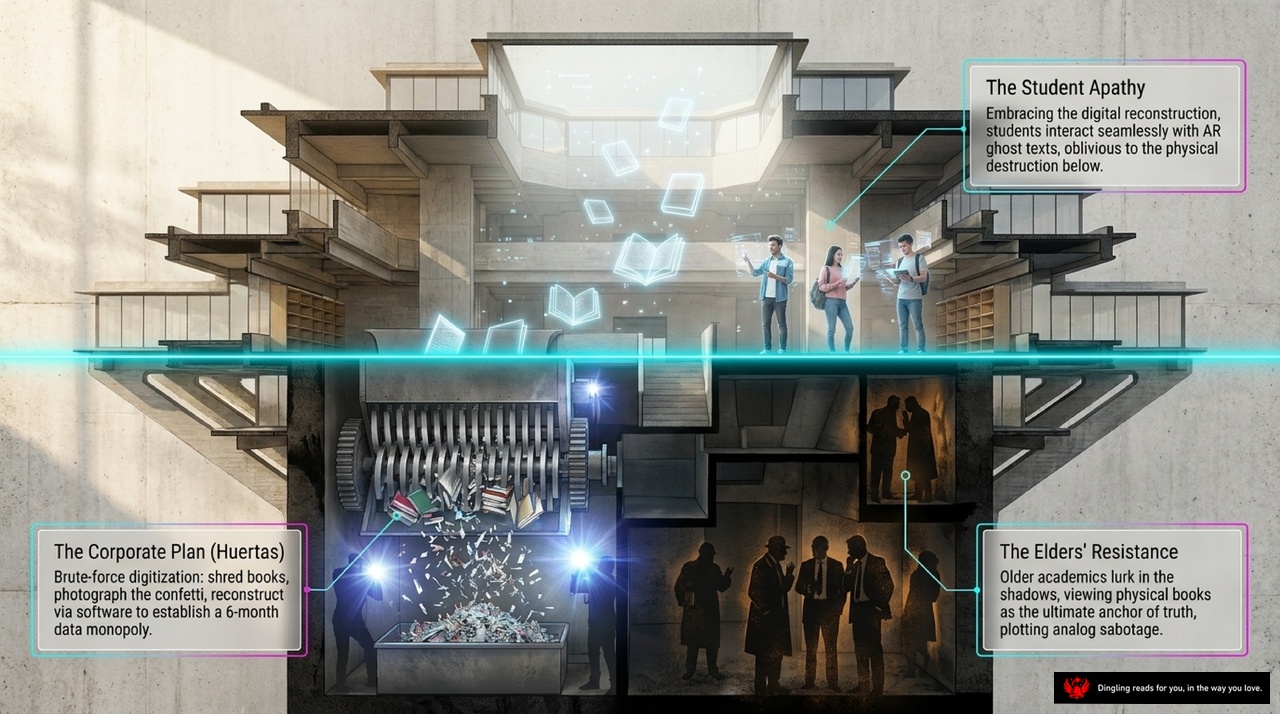
Imagine a library not as a place of quiet study, but as a war zone frozen in time. This is the reality for the "Elders' Resistance," a group of retired academics who refuse to accept the digital future. As you see in the diagram, they lurk in the shadows, viewing physical books as the ultimate anchor of truth. They are plotting analog sabotage against a corporate machine that wants to erase them.
Below them, deep in the underground, lies "The Corporate Plan." It's a brutal operation designed by Huertas: shred books, photograph the confetti, and reconstruct the data via software to establish a six-month data monopoly. They don't care about the art or the history; they only care about speed, cost, and control. They are turning knowledge into a commodity, grinding down the past into digital dust.
But above it all, disconnected from the destruction happening beneath their feet, is "The Student Apathy." Students interact seamlessly with AR ghost texts, oblivious to the physical destruction below. They embrace the digital reconstruction, living in a world of holographic books while the real ones are being shredded. This apathy is the very fuel that allows the corporate plan to succeed.
This image captures the central conflict of our story: a battle for the soul of knowledge. On one side, the elders fighting to preserve the tangible truth of the written word. On the other, a cold, calculated corporate strategy to monopolize information, and a generation so immersed in virtual reality that they don't even notice the world crumbling around them. The question isn't just who wins the war for the library, but whether anyone will even notice the war is being fought.

Look at this blueprint beneath the Geisel Library. It reveals a hidden war being fought in the shadows. The target is the bio-lab servers, but the infiltration route is surprisingly simple: obsolete concrete steam tunnels that completely bypass modern digital security grids. While the world obsesses over X-ray and gamma-ray data pipelines, the ultimate stealth weapon is forgotten 20th-century concrete.
To stop the enemy, they deploy the Analog Arsenal: experimental aerosol glue designed to physically jam corporate book-shredders and optical sensors. This is a desperate, low-tech countermeasure against a high-tech threat. The irony is stark—in an age of advanced surveillance, the victory lies in returning to the analog past. It's a reminder that sometimes, the most powerful tools are the ones we thought were obsolete.

Imagine a world where the lines between reality and a video game have completely dissolved. In this scene, we see the chaos of "The Smokescreen"—a massive, orchestrated "Guild War" between two digital factions, Scooches and Hasek. It's not just a game; it's a weapon. Virtual dragons and mechs are flooding the local augmented reality bandwidth, creating a sensory overload that blinds campus security to real-world dangers.
But look closer at the chaos. Beneath the holographic madness lies "The Hidden Truth." While everyone is distracted by the digital spectacle, the Elder resistance and Robert Gu are using the confusion to quietly pick physical locks and enter restricted zones unseen. This is the perfect cover. The noise in the sky distracts the guards, allowing the true operation to happen on the ground.
This mirrors a terrifying reality where technology is used to mask something far more dangerous. Just as the digital dragons hide the real threat, these digital distractions hide the people trying to stop it. The story asks us to question what we see versus what is actually happening right in front of us. When the world is screaming with fake battles, is anyone listening to the quiet truth trying to get through?

Look at this countdown clock ticking down to zero—T-minus five seconds. This isn't just a timer; it's the final second before a catastrophic failure at the UCSD Gen-Genomics Lab. On the left, the Macro Plot reveals a chaotic timeline: five minutes ago, Alfred Vaz was trying to load a mind-control bioweapon into local launchers, but Mr. Rabbit double-crossed him, crashing the global network and creating a massive "dead zone." Just one minute ago, Robert Gu and Miri were physically trapped inside the lab as the automated systems completely failed.
On the right, the Micro Plot shows the immediate tactical response. Bob Gu's Marine Intel forces deployed high-energy IR lasers from 2,000 meters away, surgically vaporizing the lab to prevent the launch. This split-second decision—triggered by the countdown hitting zero—was the only thing that stopped a global catastrophe. It was a race against time where the lab's destruction became the ultimate defense, proving that sometimes, to save the world, you have to burn it down.

Look at this mechanical hand emerging from the molten slag—it's the physical cost Robert pays to save his granddaughter, Miri. In a moment of desperate sacrifice, Robert burns his own arm to shield her from the heat. But this isn't just about flesh and blood; it's the catalyst for his final transformation.
This scene marks "The Epiphany." Robert realizes that Mr. Rabbit, the mysterious broker, has been manipulating him from the shadows this whole time. He sees the strings being pulled. Yet, instead of collapsing, this leads to "The Final Acceptance." Robert understands that his poetic soul is permanently gone. The therapy that cured his Alzheimer's also erased his ability to create beauty. He can no longer write poetry or feel the rhythm of words.
So, he must build a new identity. He accepts his newfound cold, analytical competence. He can manipulate the machinery, he can engineer solutions, but he can never again create art. As he lies there amidst the destruction, watching his robotic arm glow with blue circuitry, Robert accepts his new reality: he is no longer a poet, but a survivor who has traded his soul for the chance to protect the one person who still loves him.

Imagine a world where technology doesn't just help us—it almost enslaves us. In this story, we see the terrifying cost of digital convenience. Robert Gu, a man who regained his youth and mastered the digital realm, pays a heartbreaking price: he loses his poetic soul. While humanity narrowly escapes a mind-control apocalypse orchestrated by those who ironically claimed to save us, a deeper crisis emerges. Technology cured the body and digitized knowledge, but it nearly erased our autonomy.
Look at the image: hands resting on a wooden table, symbolizing a fragile connection to reality. This visual asks a haunting question: When our realities are entirely overlaid by invisible algorithms and digital convenience, are we truly the masters of our tools? Or have we simply engineered a beautiful, comfortable cage for our own minds? The narrative warns us that even when we think we are in control, we might just be waiting for the next signal to trigger our downfall.