
Reality Is Not What It Seems: Complete Chapter-by-Chapter Summary

Welcome to a journey that challenges everything you think you know about the world around you. Today, we are exploring the core idea from Carlo Rovelli's book: Reality Is Not What It Seems.
Imagine looking at a complex web of threads against a dark background. That visual perfectly captures our starting point: the illusion of our senses. We live in a world that feels solid, continuous, and predictable. We see a table, feel its weight, and assume it exists independently of us. But as Rovelli invites us on this journey, from the macroscopic illusion of our senses to the fundamental quantum fabric of the universe, we discover that this solid reality is actually a sophisticated trick.
For centuries, philosophers and scientists have struggled with this. From Democritus's ancient atoms to Einstein's relativity, and finally to the quantum realm, the story is the same. The world we perceive is not the world that actually exists. It is a projection, a story our brain tells itself to make sense of a much stranger, more interconnected, and fundamentally quantum reality.
So, when you look at that web of lines on your screen, don't just see a design. See the hint of the true nature of reality: a dynamic, vibrating, and deeply interconnected network that defies our everyday intuition. The truth is far more fascinating than the illusion we live in every day.
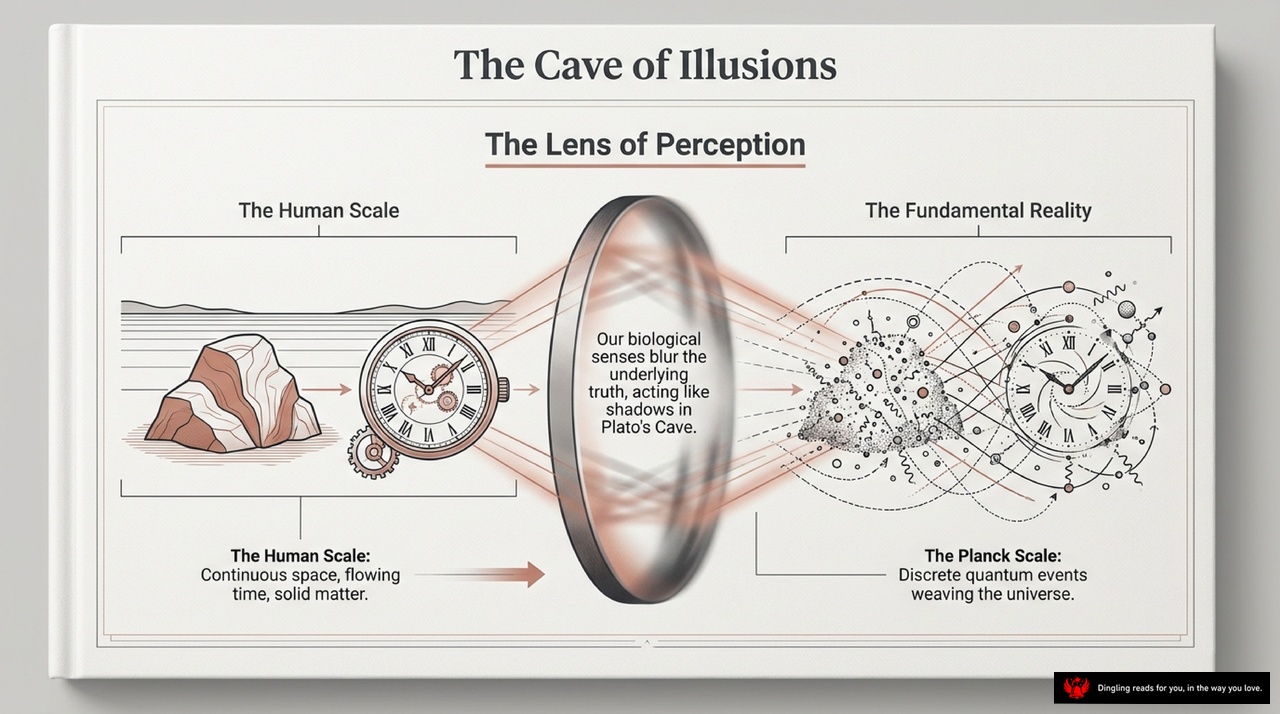
Have you ever stopped to consider that your senses are tricking you? This slide, titled "The Cave of Illusions," beautifully illustrates how our perception acts like a lens, distorting the fundamental reality of the universe.
On the left, we see "The Human Scale." Here, the world looks continuous. Time flows smoothly like a river, space is unbroken, and matter feels solid, like that rock depicted. We experience a steady, predictable reality where things exist independently of us.
But look through the lens in the center. Our biological senses blur the underlying truth, acting like shadows in Plato's Cave. They filter out the raw data, presenting us with a simplified version of reality that feels real but isn't the whole picture.
On the right lies "The Fundamental Reality." When we strip away our human perception, we find "The Planck Scale." Here, the universe isn't continuous at all. It's made of discrete quantum events, a chaotic dance of particles weaving the cosmos together. There is no flowing time or solid matter, only discrete jumps and interactions.
So, the next time you touch a rock or watch a clock, remember: you aren't seeing the universe as it truly is. You are seeing a beautiful, comforting illusion created by the limitations of your own biology.

The First Clue: Matter is Discrete. Imagine holding a grain of pollen under a microscope, watching it jitter and dance in a chaotic, zig-zag path. This isn't random magic; it's the physical evidence of the invisible world bumping into it. As the slide illustrates, this random, jagged drifting is caused by the finite, discrete impacts of invisible atoms.
Long before we could see them, the ancient Greek philosopher Democritus theorized that matter cannot be divided infinitely. He believed reality has a limit to divisibility and that matter is granular, built from these tiny, indivisible units. For centuries, this idea was just a philosophical guess, dismissed by giants like Aristotle. But in 1905, Albert Einstein proved this mathematically. By analyzing the motion of those pollen grains, he showed that the jiggling is direct proof of atoms colliding with them.
This was the first major clue that our universe isn't a smooth, continuous fluid, but rather a collection of distinct, separate parts. From the ancient intuition of Democritus to Einstein's rigorous proof, we finally understood that reality is made of building blocks. The universe is granular, not infinite and divisible.

Imagine a world where space isn't a smooth, empty stage, but a fabric woven from tiny, discrete threads. This is the radical vision of Loop Quantum Gravity, and it starts with a simple, yet mind-bending idea: space itself has atoms.
Look at the diagram on your screen. You see a grid, representing the universe we know. But in the quantum realm, that grid dissolves into something far stranger. Instead of a continuous flow, space is built from "spin networks." Think of these as a web of nodes and lines. Each node isn't just a point; it's a chunk of volume, a fundamental unit of space, much like an atom is the building block of matter. The lines connecting them? Those are the links between these space-quantum, the quantum version of the invisible force lines Faraday imagined.
Here's where it gets truly counterintuitive. In our everyday world, you can keep dividing a piece of paper in half, again and again, forever. But in this quantum universe, there's a limit. You hit a floor. There is a smallest possible unit of area and volume, defined by the Planck scale. You simply cannot go smaller. This means the universe isn't infinitely divisible; it has a granular structure. It's not a smooth river, but a stream made of individual droplets.
This structure is described mathematically by "spin networks," where every node carries a specific value, like a spin number, that dictates the amount of space it holds. And when these networks evolve, they don't slide smoothly into new shapes. They jump. They flip. This dynamic process is visualized as a "spin foam." If the spin network is a snapshot of space at one moment, the spin foam is the history of that space evolving. It's like a 4D movie where the very fabric of reality is constantly bubbling, popping, and reconfiguring itself at the most fundamental level.
This discovery solves a massive problem that plagued physics for a century: the infinity paradox. When we tried to combine Einstein's gravity with quantum mechanics, we got nonsensical infinite numbers. But if space is made of discrete chunks, those infinities vanish. There are no infinite points to sum up. By treating space as a collection of finite quantum units, Loop Quantum Gravity creates a universe that is both dynamic and finite, a reality woven from information and connection rather than empty, continuous void.
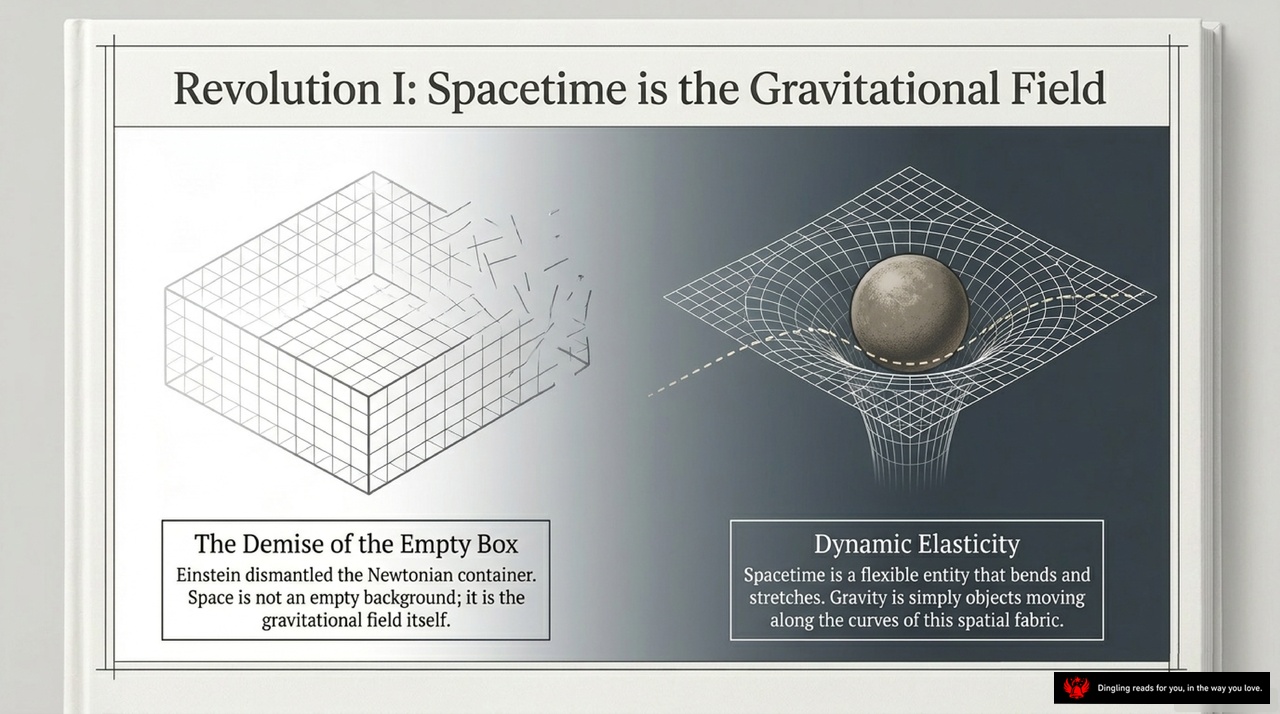
Imagine you are looking at a fabric, not a rigid box. For centuries, we thought space was just an empty stage where things happened, a static container that never changed. But Einstein shattered that idea. As this slide shows, the "Demise of the Empty Box" means space itself is alive. It is the gravitational field.
Look at the right side: "Dynamic Elasticity." When mass exists, like that sphere in the image, it doesn't just sit in space; it bends the fabric of spacetime. Gravity isn't a mysterious force pulling objects across a distance. Instead, objects simply follow the curves of this flexible spatial fabric. A planet orbiting a star isn't being tugged by an invisible hand; it is just rolling along the curve created by the star's mass, like a marble spinning on a stretched sheet.
This realization unified two previously separate worlds. The universe is no longer a collection of particles moving in empty voids. It is a dynamic, breathing entity where matter and geometry are one and the same. This shift from a static background to a dynamic, elastic field is the true revolution of modern physics.
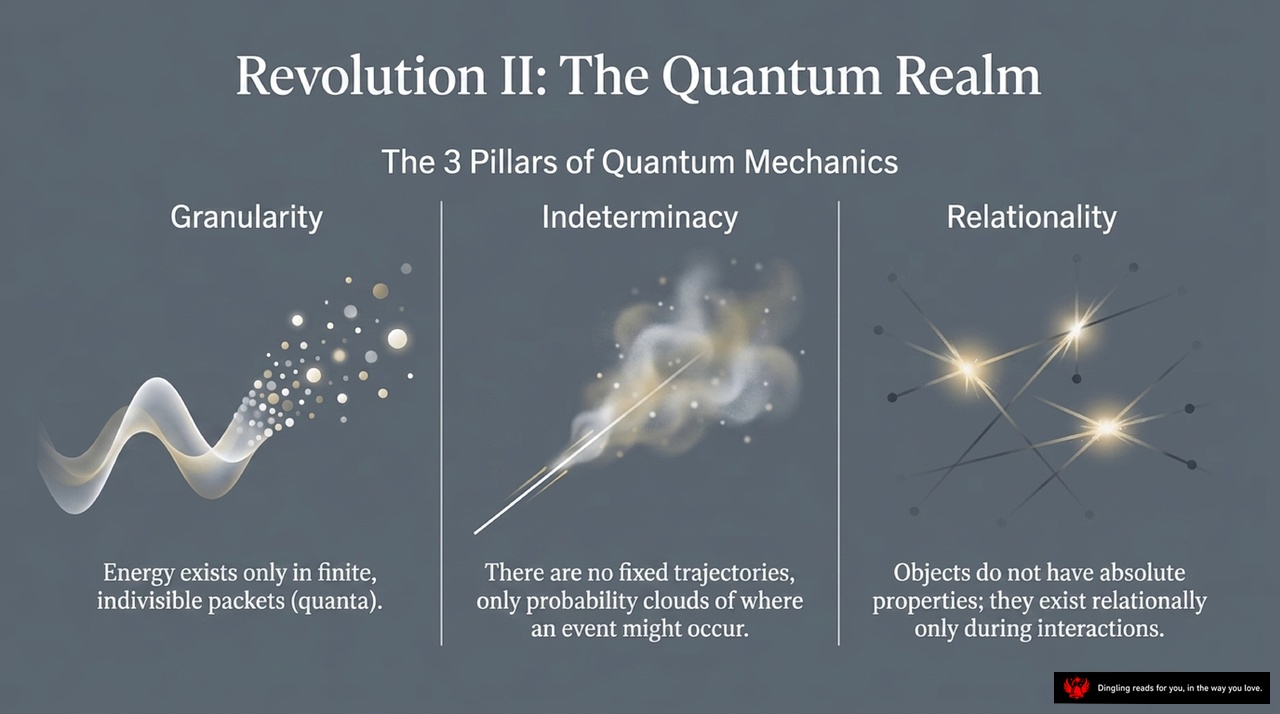
Imagine you are looking at a fabric that seems perfectly smooth from afar, but up close, you realize it's actually woven from countless tiny threads. This is the profound reality of our universe, and today's slide captures the three revolutionary pillars that define the quantum realm.
First, we see **Granularity**. The image shows a wave transforming into discrete packets. This illustrates a fundamental shift: energy isn't a continuous flow; it exists only in finite, indivisible packets called quanta. Just like the threads in a cloth, the building blocks of our world are distinct and countable, not infinitely divisible.
Next, look at **Indeterminacy**. The swirling cloud represents the loss of fixed paths. In the quantum world, particles don't follow predictable trajectories like planets. Instead, they exist as probability clouds. We cannot know exactly where an event will happen or where a particle is until we interact with it; we can only predict the likelihood of its location.
Finally, we have **Relationality**, depicted by the interconnected nodes of light. This is perhaps the most mind-bending concept: objects do not have absolute, independent properties. An electron's position or momentum only becomes real during an interaction with something else. Without that connection, the property doesn't exist in a fixed state. The universe isn't a collection of isolated things, but a dynamic web of relationships.
Together, these three pillars—Granularity, Indeterminacy, and Relationality—shatter our classical intuition. They tell us that reality is built from discrete chunks, governed by probability, and defined entirely by how things relate to one another. This is the true nature of the quantum realm.

The final frontier of physics isn't about finding new particles, but realizing that the very fabric of reality has a hard limit. For centuries, we've assumed space and time are infinitely divisible, like a smooth canvas we can zoom into forever. But quantum gravity shatters that illusion. There is a minimum size to the universe: the Planck length, roughly 10 to the minus 33 centimeters. Anything smaller is physically meaningless. It's not a measurement error; it's a fundamental boundary of nature.
This insight resolves a century-old nightmare in physics called "the singularity problem." When we try to combine Einstein's General Relativity with Quantum Mechanics, the math explodes into infinite nonsense. Imagine squeezing all the matter in the universe into a single point. Classical physics says density goes to infinity. But quantum gravity says, "Stop." At the Planck scale, quantum repulsion kicks in, acting like a cosmic floor that prevents infinite compression. The universe cannot collapse into a point of infinite density.
This same principle saves us from the Big Bang singularity and the center of black holes. Instead of a chaotic, infinite abyss, these regions are filled with intense quantum activity. In black holes, this leads to a stunning prediction: they aren't eternal traps. Due to Hawking radiation and quantum effects, black holes slowly evaporate and eventually explode, returning all their mass to the universe. The singularity vanishes, replaced by a finite, dynamic reality.
Ultimately, this means our universe is finite, not because it has an edge you can hit, but because it contains a finite amount of information. There are only so many distinct states the universe can be in. The infinite possibilities we once imagined are just illusions created by ignoring quantum limits. By accepting these boundaries, we move from a world of mathematical infinities to a coherent, self-consistent reality where every question has a finite answer.
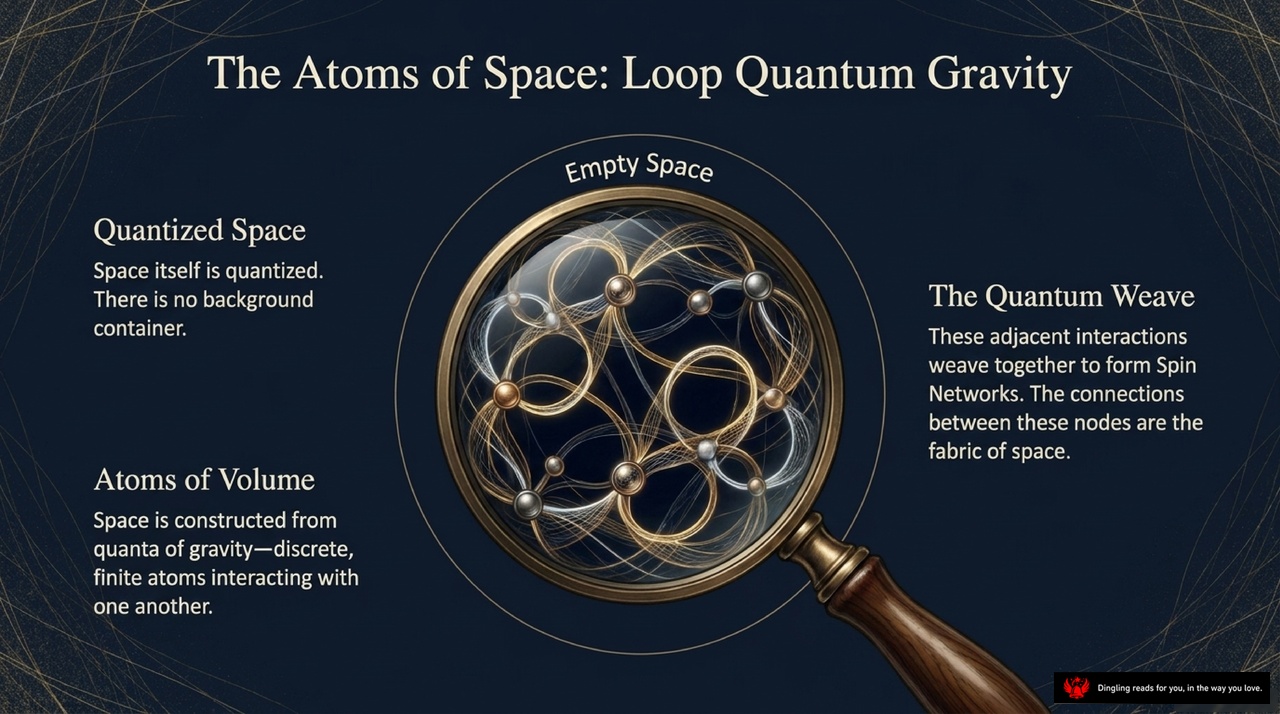
Imagine you're looking at a piece of fabric up close. From far away, it looks like a smooth, continuous sheet. But if you zoom in with a powerful magnifying glass, you'd see it's actually woven from countless individual threads. That's the core idea behind Loop Quantum Gravity, the subject of our slide today.
Look at the title: "The Atoms of Space." This flips our entire understanding of reality on its head. For centuries, we've assumed space is a smooth, empty background where things happen. But this slide reveals a radical truth: space itself is quantized. There is no empty container; space is constructed from discrete, finite "atoms of volume."
Notice the central image labeled "Empty Space." Under the lens, that emptiness isn't actually empty. It's a complex, dancing web of golden and silver loops. This is what the slide calls "The Quantum Weave." These adjacent interactions weave together to form Spin Networks. The connections between these nodes are the very fabric of space.
Think about it: just as matter is made of atoms, the space around those atoms is made of space-atoms. These aren't just mathematical tricks; they are the fundamental building blocks of the universe. The nodes represent the smallest possible units of volume, and the lines connecting them define the structure of space itself. We aren't moving *through* space; we are moving through a dynamic, granular network of these quantum connections.
This discovery means the universe has a built-in limit to how small it can get. There is a minimum scale, a "pixel size" for the cosmos, below which the concept of distance simply loses its meaning. It's a universe built not from a void, but from a vibrant, interconnected web of quantum events.

The slide reveals a profound shift in our understanding of reality: the end of infinity. We are moving from a universe of continuous, infinitely divisible space to one with a hard, absolute limit.
Look at the progression on the screen. We start at the human scale, zoom into an atom, then the nucleus, and finally reach the Planck Length at 10 to the minus 33 centimeters. This isn't just a tiny number; it is the "Absolute Limit."
As the text explains, the Planck Length is the absolute limit of divisibility. Below this scale, the very concept of space ceases to exist. There is no "smaller." By proving that space cannot be divided infinitely, we permanently cure the impossible infinities that have plagued continuous physics for centuries.
This discovery means our universe is fundamentally finite. From the vastness of the cosmos down to the smallest possible unit of space, everything has a boundary. We have finally found the ultimate resolution to the age-old question of whether the universe is truly infinite or if there is a fundamental grain to reality.
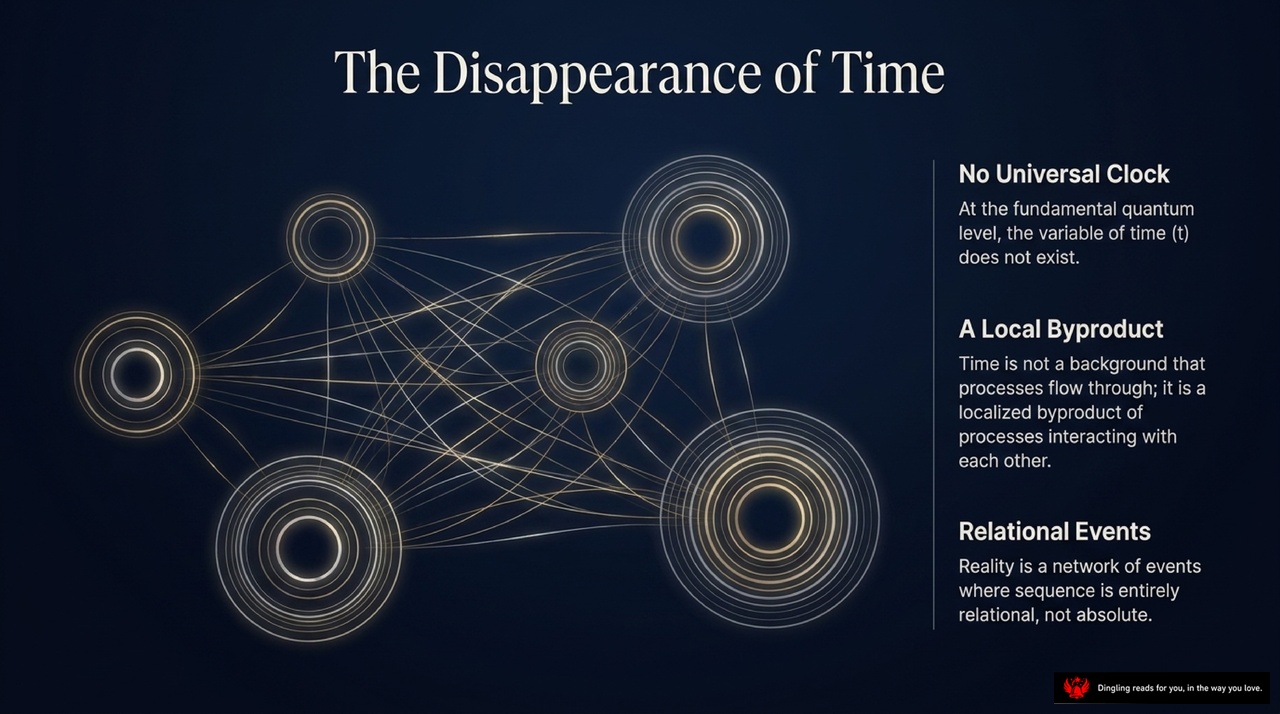
Imagine a world where the smooth, flowing river of time you take for granted simply ceases to exist at its most fundamental level. As we dive into the quantum realm, the concept of a universal clock evaporates. At the deepest layer of reality, the variable of time, often denoted as $t$, doesn't exist at all. There is no background stage against which events unfold; instead, time emerges as a localized byproduct of processes interacting with one another.
Think of reality not as a movie playing on a screen, but as a vast, intricate network of events. In this web, the sequence of things happening isn't absolute or fixed for everyone; it is entirely relational. What happens "first" depends entirely on your position and your connection to the event. This is the profound shift from the Newtonian universe we grew up with to the quantum gravitational reality we are uncovering.
In this framework, we move away from asking "when" something happens to asking "how" it is connected to other things. Time is no longer a master controller dictating the pace of the universe. It is a dynamic feature that arises from the relationships between particles and fields. Just as space is no longer an empty void but a fabric woven by quantum loops, time becomes a texture generated by the interactions within that fabric.
This "disappearance of time" doesn't mean time is an illusion or that nothing ever changes. Rather, it means our intuition about time as a constant, flowing entity is a macroscopic approximation, a useful fiction that breaks down when we zoom in to the Planck scale. At that scale, the past, present, and future lose their rigid definitions, merging into a complex tapestry of correlations. We are learning that the universe isn't a story written in time; time is simply the story itself, written in the language of relationships.

Beyond the Big Bang: The Quantum Bounce. In our classical view, gravity is a relentless pull that squeezes the universe down to a point of infinite density—a singularity. But what if space itself has a limit? What if, like matter, space is made of discrete, indivisible chunks?
This slide shows the pivotal shift from Classical General Relativity to Loop Quantum Gravity. Look at the top: the classical path narrows endlessly until it hits a singularity, marked by that red "X." But in the quantum view, space cannot be compressed smaller than a Planck volume. There is a hard limit. When the universe hits this limit, it doesn't collapse into nothingness. Instead, it bounces.
That central beam of light represents the Planck Limit. It's the wall that stops the collapse. Because space resists being squeezed into zero, a massive repulsive force kicks in, triggering the Big Bounce. The universe that was collapsing is now expanding, birthing the cosmos we see today. This isn't just a new beginning; it's a quantum rebound, proving that the universe has a finite, granular structure at its very heart.
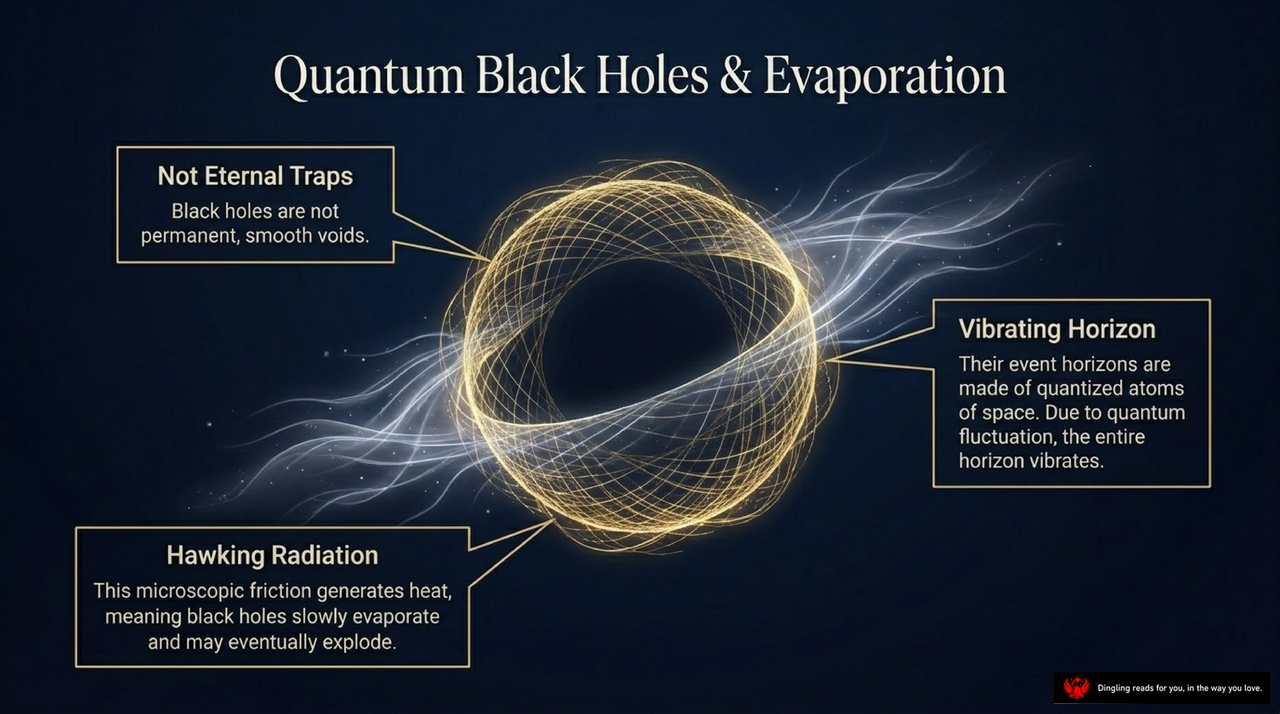
Quantum Black Holes & Evaporation aren't just theoretical concepts; they represent a radical shift in how we view the universe's most mysterious objects. As the slide illustrates, black holes are not the eternal, smooth traps we once imagined. Instead, they are dynamic systems governed by quantum mechanics.
First, look at the "Vibrating Horizon." The event horizon isn't a smooth surface; it's made of quantized atoms of space. Because of quantum fluctuations, the entire horizon vibrates, much like a plucked string. This vibration is the source of the black hole's heat.
This leads us to "Hawking Radiation." That microscopic friction from the vibrating horizon generates heat, meaning black holes slowly evaporate over time. They aren't permanent; they may eventually explode.
Finally, this brings us to the crucial point: "Not Eternal Traps." Black holes are not permanent voids. Thanks to the quantum nature of space itself, they have a finite lifespan. This discovery resolves the paradox of the singularity, suggesting that even the center of a black hole avoids infinite collapse through quantum repulsion. The universe, it turns out, is fundamentally discrete, and even the darkest corners of space obey this rule.

Look at this table titled "The Evolution of Reality." It maps our understanding of space, time, and matter across three major eras: Newton's classical view, Einstein's relativity, and the modern frontier of Loop Quantum Gravity.
In Newton's world, space was a fixed container, time was absolute and universal, and matter consisted of solid particles. It was a stable, predictable stage where physics played out.
Then came Einstein. He shattered that stage. Space became a flexible, curved field that bends under gravity. Time stopped being universal; it became relative and local, slowing down near massive objects. Matter transformed into an energy-mass duality, showing us that mass and energy are two sides of the same coin.
But the most radical shift is in the third column: Loop Quantum Gravity. Here, space isn't a smooth fabric at all. It's a relational spin network. Time, in its traditional sense, doesn't exist as a flowing river; reality is built from relational events. Matter is no longer solid particles or even energy waves, but interacting information.
This evolution reveals a profound truth: the universe isn't a static container holding things inside. It is a dynamic, discrete network of connections. What we perceive as smooth space and flowing time are actually illusions created by our macroscopic view. At the deepest level, reality is made of indivisible chunks of space and time, woven together by information. We have moved from seeing the universe as a machine to understanding it as a living, interconnected web.

Imagine the world not as a smooth, continuous river, but as a vast network of discrete quantum nodes. What we perceive as a seamless flow of time and solid matter is actually a "statistical illusion"—a blurred macroscopic average created because we cannot perceive the trillions of microscopic variables that are constantly flickering. This is the core of "The World as Information."
At the bottom of our reality lies the fundamental truth: discrete quantum nodes. As we move up through the layers of perception, we lose microscopic information. This loss of detail, known as thermodynamic entropy, is what gives rise to the illusion of time. We don't experience flowing time because we are looking at a frozen, high-resolution snapshot of a chaotic quantum dance. Instead, time emerges entirely from our lack of information.
Think of it this way: if you could see every single atom and its exact position, the concept of "time" would vanish. It is a tool we invented to simplify a complex, static, yet dynamic network of interactions. The smooth, continuous flow we see in daily life is just a fuzzy approximation of a reality that is fundamentally digital and discrete. By understanding that our continuous world is born from blurring the discrete, we finally grasp how reality emerges from information.
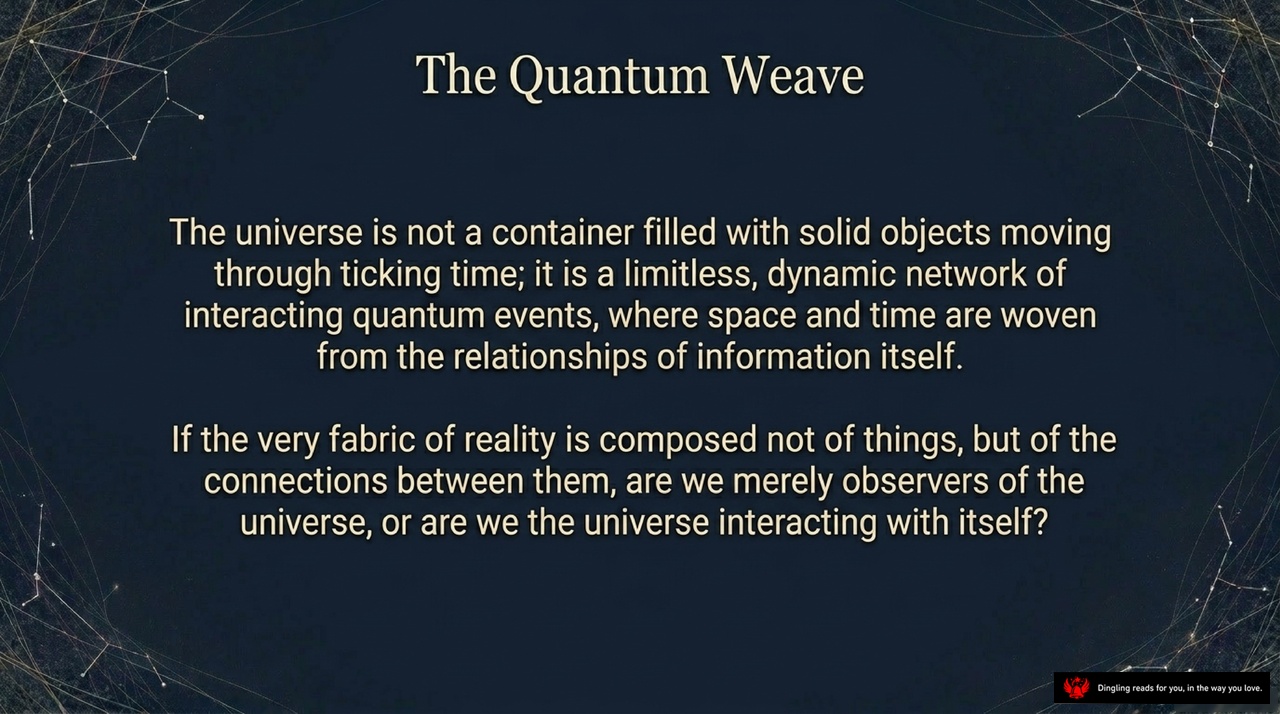
The universe isn't a stage with objects moving across it; it's a dynamic tapestry woven from the relationships of information itself. As we explore the frontiers of quantum gravity, a radical new picture emerges: reality is composed not of solid things, but of the connections between them. Imagine the fabric of space itself as a network of vibrating quantum events, where every point is linked to its neighbors through invisible threads of interaction. This is the essence of the "Quantum Weave."
Consider the implications: if the very structure of reality depends on these connections, then we aren't just passive observers watching the universe unfold from the outside. Instead, we are part of the weave itself. Our existence, our thoughts, and our very presence are integral to the network that constitutes the cosmos. The universe isn't something separate from us; it is us interacting with itself. This shift from a container of objects to a web of relationships challenges our deepest intuitions about what it means to exist. It suggests that the ultimate building blocks of our world aren't particles sitting in empty space, but the dynamic, informational links that bind everything together in a seamless, ever-evolving whole.