
Red Star Over China: Complete Chapter-by-Chapter Summary
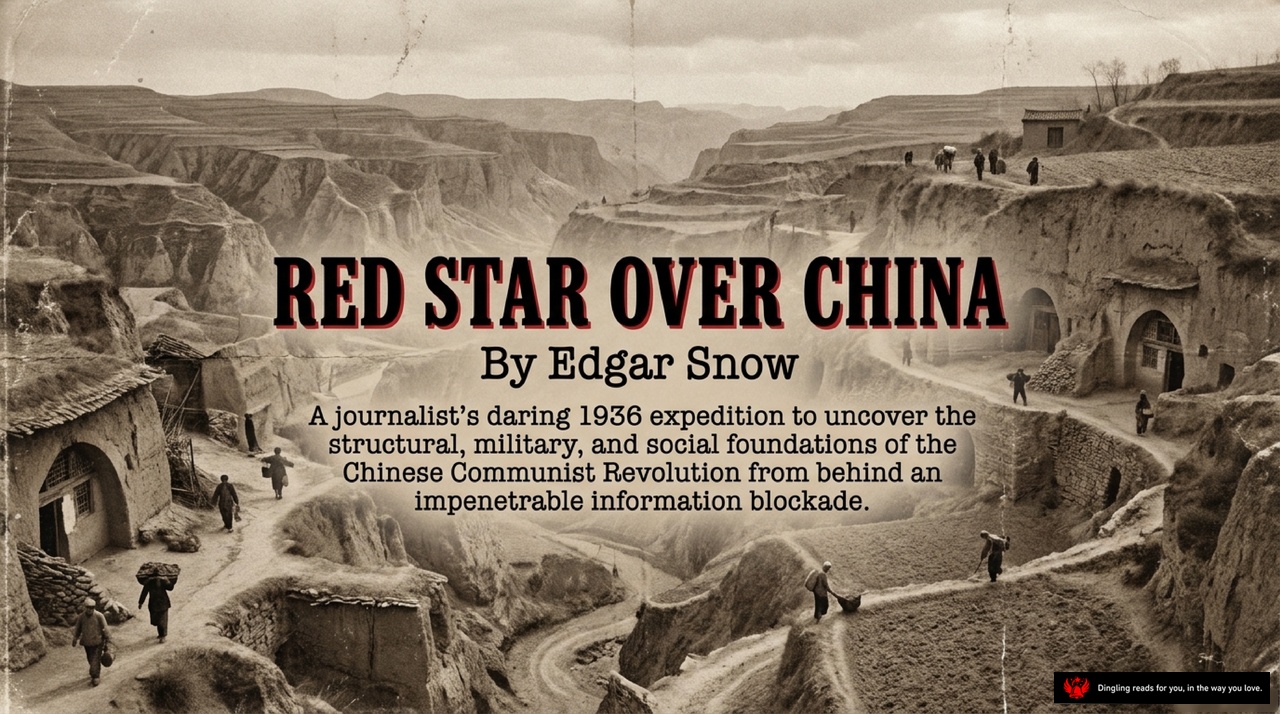
Welcome to the journey of *Red Star Over China* by Edgar Snow. Imagine a vast, rugged landscape carved by centuries of hardship—deep gullies, terraced hillsides, and simple earthen dwellings clinging to the cliffs. This is the world of the Chinese Communist Revolution, a place hidden behind a wall of silence for nine long years.
In 1936, the world was divided by propaganda and fear. Some called the Red Army nothing more than starving bandits; others denied the existence of a Soviet China entirely. But for journalist Edgar Snow, the questions were too heavy to ignore. Who were these people? Why did thousands risk death for a cause that the Nationalists labeled treason? And what was the truth behind the rumors?
Snow made a daring decision. He traveled into the forbidden zone, breaking through an impenetrable information blockade to uncover the structural, military, and social foundations of the revolution from the inside. This wasn't just a report; it was a confrontation with reality, revealing a movement built on the resilience of the people and the vision of leaders like Mao Zedong. The story of the Red Star rising over China begins here, in the shadows of history, ready to change the world.
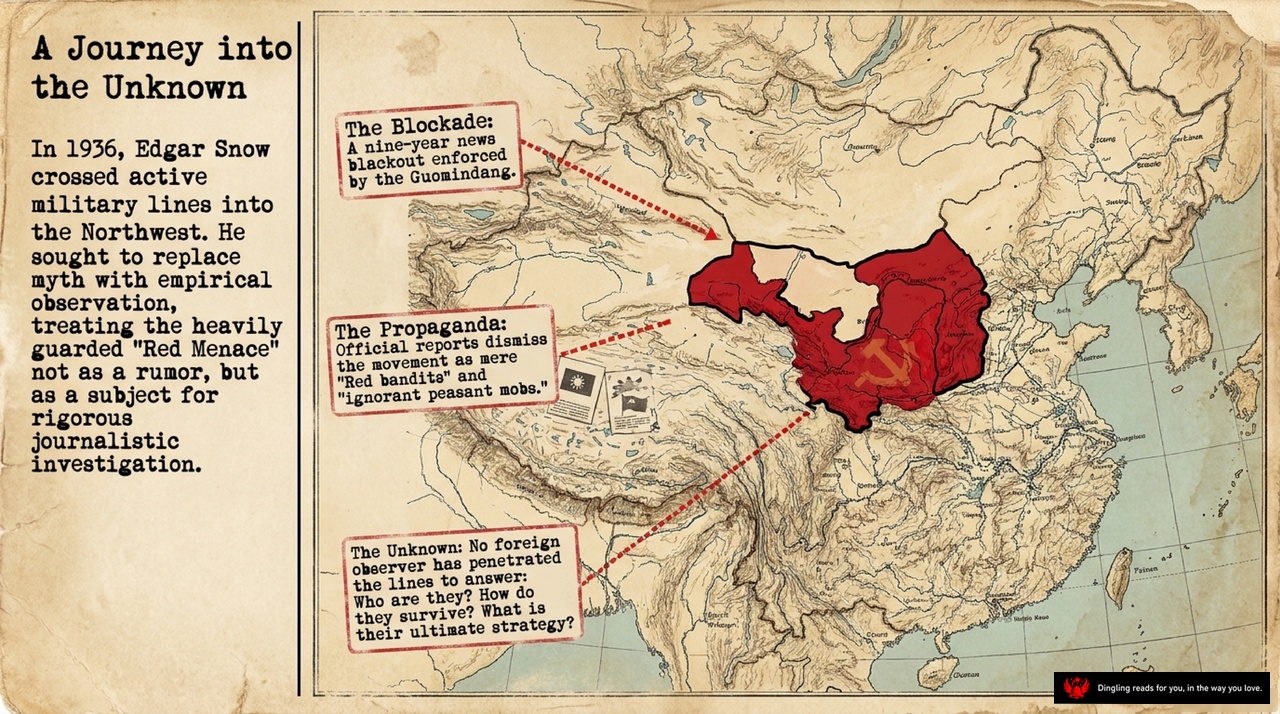
In 1936, Edgar Snow made a daring decision to cross active military lines into China's Northwest, driven by a simple but urgent goal: to replace myth with empirical observation. For nine years, the Chinese Communists had been locked behind a strict news blackout enforced by the Kuomintang, dismissed by official reports as nothing more than "red bandits" or "ignorant peasant mobs." While the outside world debated whether they were a few thousand starving outlaws or a savior movement, no foreign observer had ever penetrated the lines to answer the critical questions: Who are they? How do they survive? And what is their ultimate strategy?
Snow stepped into this unknown territory not as a conqueror, but as a journalist seeking truth. He sought to treat the heavily guarded "Red Menace" not as a rumor, but as a subject for rigorous investigation. His journey began in the shadow of a nation torn between internal conflict and the looming threat of Japanese aggression, a place where propaganda warred with reality, and where the path to understanding was paved with danger, uncertainty, and the relentless pursuit of the truth behind the red flag.
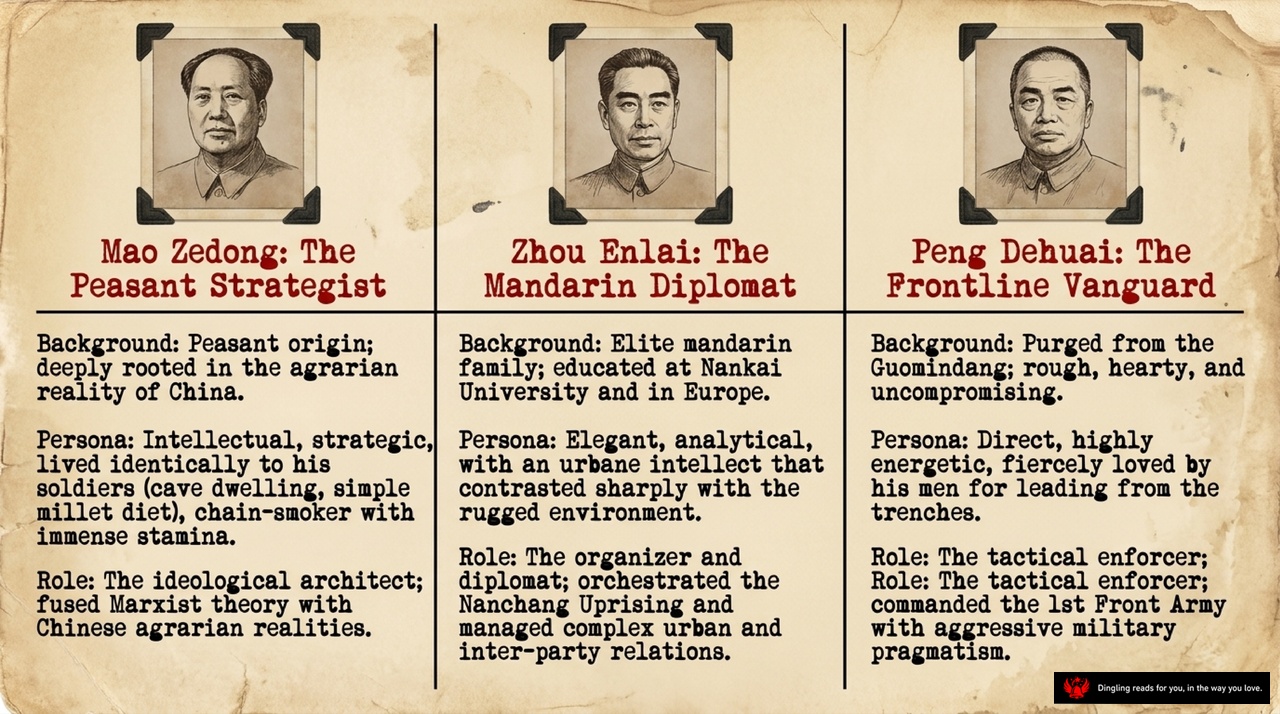
Look at this slide. We see three distinct portraits: Mao Zedong, the Peasant Strategist; Zhou Enlai, the Mandarin Diplomat; and Peng Dehuai, the Frontline Vanguard. This isn't just about names; it's about the DNA of the Chinese Revolution. Each man brought a different world to the battlefield.
Mao Zedong, on the left, represents the soul of the agrarian struggle. Born into a peasant family, he didn't just study Marxism in a library; he fused it with the harsh reality of Chinese soil. He lived exactly like his soldiers—eating simple millet, living in caves, and smoking like a chimney. He was the ideological architect, the one who figured out how to turn a ragtag group of farmers into a disciplined army that could change history.
In the center stands Zhou Enlai, the elegant Mandarin Diplomat. While others were in the trenches, he was the brain behind the operation. Educated at Nankai University and in Europe, he brought an analytical, urban intellect to a rugged war. He was the organizer and the face of the party, orchestrating complex relationships, managing the Nanchang Uprising, and most importantly, negotiating the alliances that would eventually bring the nation together. He was the calm in the storm.
On the right is Peng Dehuai, the Frontline Vanguard. He was the rough, uncompromising enforcer. Purged from the old regime, he led with a fierce energy that his men loved. He didn't give orders from a safe distance; he commanded the 1st Front Army from the trenches, using aggressive military pragmatism to win battles when diplomacy failed. He was the tactical hammer that Mao's strategy needed.
Together, they formed a perfect triangle: the visionary, the diplomat, and the warrior. Without any one of them, the revolution might have crumbled under the pressure of the Nationalists or the Japanese invaders. Their unique backgrounds and roles created a leadership team capable of surviving the impossible.

Look at this infographic: "A Conscious Vanguard." It breaks down the very soul of the Red Army, revealing that this wasn't just a ragtag group of desperate men, but a highly disciplined, ideologically driven force. Let's look at the stats. The average age was just 19. These were remarkably young, resilient fighters, not hardened veterans, but fresh blood fueled by a cause. Their origin was deeply rooted in the working class: 58% agrarian and peasant, with 24% industrial workers. They weren't conscripts forced by starvation; they were volunteers. Why? The motivation was clear: fighting for land redistribution and national survival, not for a paycheck.
Notice the literacy rate. Between 60% and 70% of these soldiers could read and write. That is vastly higher than the general population. This wasn't an illiterate mob; it was an educated army capable of reading and writing reports. They were deeply politicized, spending two hours every single day on political education and literacy classes. This indoctrination created a shared consciousness. They knew exactly why they were fighting. As the text describes, they weren't a "mercenary horde," but a military force structured around political consciousness. They were a conscious vanguard, fighting for a future they believed in, making them one of the most formidable fighting forces the world had ever seen.

Welcome back to the Agrarian Engine. Let's dive into the core mechanism that kept the Red Army alive: Confiscation.
Look at the first step in our diagram. It all starts with seizing wealth, estates, and resources from landlords and corrupt tax collectors. This wasn't just about taking property; it was a radical economic restructuring that served as the absolute prerequisite for military viability. The logic was simple but powerful: the army protected the land reform, and in return, the land reform fed and manned the army.
Once the wealth was confiscated, we move to the second step: Redistribution and Relief. Land titles were distributed directly to the poorest peasants, giving them a stake in the land they tilled. Crippling surtaxes and opium taxes were permanently abolished. This wasn't charity; it was a strategic move to secure the loyalty of the rural majority.
This leads us to the third box: Fierce Loyalty. Because peasants gained a tangible economic stake in the survival of the revolution, their support became unshakeable. They weren't just fighting for an abstract ideology; they were fighting to protect their newly acquired land and freedom.
Finally, this cycle completes with Recruitment and Intelligence. In return for the land and relief, the agrarian base provided volunteer manpower, food supplies, and crucial local intelligence to the Red Army. This created a self-sustaining loop where the revolution funded itself through the very people it empowered, turning a group of ragged soldiers into a formidable force capable of surviving against a massive, well-equipped enemy.

The image on your screen outlines the four core principles of guerrilla warfare that allowed the Red Army to turn weakness into a strategic asset. These aren't just military tactics; they are a philosophy of survival and counter-attack.
First, we have "Advance and Retreat." As the graphic illustrates, the strategy is simple yet profound: "When the enemy advances, we retreat." Instead of engaging a superior force head-on, the Red Army used space as a shield, drawing the enemy deep into their territory to stretch their supply lines and exhaust their morale.
Next is "Camp and Harass." Once the enemy stops moving and sets up camp, the dynamic shifts. The principle becomes: "When the enemy camps, we harass." By constantly attacking supply lines and outposts, the Red Army prevented the enemy from ever feeling secure or gaining a foothold.
The third principle is "Tire and Attack." As shown in the diagram, the goal is to wait for the enemy to become fatigued. "When the enemy tires, we attack." This is the moment of the counter-punch, striking when the opponent is most vulnerable and least able to recover.
Finally, we have "Retreat and Pursue." "When the enemy retreats, we pursue." This ensures that every victory for the enemy becomes a loss. By relentlessly chasing a retreating force, the Red Army could inflict maximum damage and capture resources, effectively bleeding the superior Kuomintang forces dry over time and space.
Together, these four principles formed the backbone of the Long March and the eventual success of the Communist revolution, proving that flexibility and patience could overcome brute force.

The Xi'an Incident wasn't just a military standoff; it was a pivotal moment that forced China to choose between internal class warfare and national survival. As the timeline shows, Chiang Kai-shek had ordered Zhang Xueliang—the "Young Marshal"—and his exhausted Northeastern Army to annihilate the Communists, even as Japan was already invading Manchuria. But the soldiers were fed up fighting fellow Chinese. This frustration culminated in the Mutiny in December 1936, where Zhang Xueliang's forces arrested Chiang in Xi'an, proving that the cost of civil war was simply too high.
Instead of executing Chiang, the Communists, led by Zhou Enlai, chose a path of diplomatic intervention. They demanded an end to the civil war, prioritizing the fight against the Japanese invader over immediate conflict with their political rivals. This strategic maturity allowed Chiang to agree to cease hostilities, leading to the creation of the Second United Front. The Xi'an Incident proved that the movement possessed the strategic maturity to prioritize national survival over internal conflict, a decision that would ultimately change the course of history and lead to the unification of China against a common enemy.

Look at this diagram of "The Second United Front." It visually captures a pivotal moment in Chinese history where two seemingly opposing forces—the KMT and the CCP—joined hands against a common enemy: Japanese Imperialism.
The graphic breaks this complex alliance down into three key components. First, "The Compromise." You see the arrows showing the KMT and CCP forces merging, but note the text at the bottom: the Red Army was reorganized as the Eighth Route Army under nominal Nationalist command. This was a strategic pause. The Soviets temporarily halted their aggressive land confiscations to make this unity possible.
Second, "The Unifying Force." The diagram highlights that nationalism proved to be a far more immediate catalyst than pure Marxism. The existential threat of Japanese invasion forced a fragile but effective political consensus. It was the fear of national extinction that made the internal differences between the KMT and CCP secondary to the urgent need for survival.
Finally, "The Consequence." This is the outcome of that unity. The United Front granted the Communists vital breathing room. By fighting side-by-side under the banner of national defense, they were able to expand their political influence and build their military infrastructure without being crushed by the Nationalists. This strategic alliance didn't just stop the Japanese; it fundamentally reshaped the balance of power in China, setting the stage for the future.

Look at this diagram. It illustrates the "Red Menace" not as a military anomaly, but as a highly integrated socio-political ecosystem. Snow's ultimate discovery was that the Communists' resilience and expansion were built on three distinct pillars working in perfect unison.
On the left, we have the Agrarian Engine. This is the socio-economic foundation. By providing an inexhaustible supply of loyal manpower, intelligence, and resources from the peasant base, the Communists secured their survival. It wasn't just about fighting; it was about winning the hearts of the countryside.
On the right stands the United Front. This is the geopolitical strategy. By harnessing anti-imperialist nationalism, they paused domestic threats and aligned themselves with the broader public will. They realized that to defeat a foreign invader, they first had to unite the Chinese people against their common enemy.
And in the center, holding the entire structure together, is the Guerrilla Doctrine. This is the military component. It ensured military survival and the attrition of superior forces without risking total destruction in pitched battles. They avoided head-on collisions, instead using the terrain and their numbers to wear down the enemy.
By the time the world realized this structure, its foundation in the Chinese countryside was already irreversible. It was a sophisticated system where economics, politics, and warfare were all synchronized to create an unstoppable force.

Edgar Snow's journey shattered the prevailing myths of 1936, revealing that the Chinese Communist revolution didn't survive on foreign funding or chaotic rebellion. Instead, its power came from a precise mix of agrarian reform, disciplined guerrilla tactics, and fierce nationalism. By anchoring abstract ideology to the real struggles of the peasantry, they transformed millions of marginalized people into an organized force that would eventually shape Asia's future.
Here lies the profound lesson: if a movement can forge an unstoppable military machine simply by answering the most basic economic grievances of the forgotten, what other dormant forces in the world are currently waiting for their own catalyst? The story of the Red Army proves that when you solve the people's problems, you don't just gain allies—you build an army.