
Red Mars: Complete Chapter-by-Chapter Summary

Welcome to the world of *Red Mars*. This isn't just a story about space travel; it's a gripping thriller about what happens when humanity decides to play god.
Imagine a future where Earth is dying—resources are running out, and the environment is collapsing. Humanity has no choice but to look to the stars. Mars, with its familiar seasons and history of water, becomes our only hope for survival. But getting there is just the beginning.
The book opens with a massive, international project called "Ares," a race to build the first permanent colony on the Red Planet. It's a monumental effort involving the world's top scientists, engineers, and dreamers. But behind the excitement, there's a dark undercurrent. Nations are fighting over funding and control, and the public is split between awe and fear. Some see it as a noble mission; others call it an escape plan for the elite, leaving the rest of us behind.
As the first 100 colonists launch in 2026, they leave everything they know for a hostile, alien world. They face not just the harsh vacuum of space, but also the deep psychological toll of isolation. Who are they really? And when they finally touch down, will they be the saviors of humanity, or the architects of a new kind of tyranny?
Join us as we dive into this epic tale of ambition, betrayal, and the fight for the soul of the universe.

Welcome to the reality check of the Ares mission. While Earth promised a utopia, the truth inside the ship was a psychological pressure cooker. The crew, the First Hundred, were carefully selected elites averaging 55 years old, but as they traveled in a tin can for nine months, the scientific utopian model began to die in transit.
Look at the ship itself: a fragile vessel built from space shuttle external tanks, spinning at 4 RPM to create a mere 0.38g of artificial gravity. This wasn't just a journey; it was a social experiment gone wrong. The environment was a lie—simulated seasons meant to keep sanity intact, masking the deep political fractures and sexual tensions brewing below.
The reality was stark: a microcosm where the elite clung to power while the rest stagnated. What started as a noble mission to colonize Mars quickly devolved into a chaotic maze of competing ideologies, secret alliances, and a desperate struggle for control. As the ship drifted through the void, the dream of a perfect society dissolved, replaced by the harsh truth that in a closed system, humanity's darkest instincts take over.

Welcome to the psychological blueprint of the first hundred colonists. This isn't just a list of names; it's a map of human conflict and survival, drawn by Dr. Michel Duval. We are looking at the "Psych Matrix," which categorizes our crew into four distinct archetypes based on their stability and social energy.
In the top right, we have the **Sanguine** types: the stable extroverts. Think of John Boone, the charismatic unifier who holds the group together, or Arkady Bogdanov, the radical visionary driving them toward revolution. They are the glue of the mission, the ones who keep the peace and push the boundaries forward.
Opposite them, in the top left, are the **Choleric** types: unstable extroverts. Here we find Maya Toitovna, a leader driven by volatile passion and power, and Frank Chalmers, a pragmatic and ruthless Machiavellian. They are the fire of the ship—intense, charismatic, but capable of burning things down if not carefully managed.
Moving down to the bottom left, we see the **Melancholic** types: the unstable introverts. This includes Dr. Duval himself, overwhelmed by nostalgia, and Ann Clayborne, the geologist driven by a fierce, solitary need to preserve the planet's original state. They are the thinkers and the guardians of the past, often feeling the weight of the mission too heavily.
Finally, in the bottom right, are the **Phlegmatic** types: the stable introverts. These are the engineers and the doers. Nadia Cherneshevsky is the tireless, pragmatic engineer, while Sax Russell is the laser-focused scientist obsessed with logic and terraforming. They are the quiet backbone of the operation, the ones who build the future without seeking the spotlight.
So, as we watch these pioneers head toward Mars, remember that every conflict, every breakthrough, and every moment of tension on that red planet is simply the result of these four psychological forces colliding. It's a delicate balance between the fire of the Choleric, the glue of the Sanguine, the conscience of the Melancholic, and the hands of the Phlegmatic.

Welcome to the reality of Mars, where the dream of a weightless utopia crashes into a brutal, dirt-covered existence. As shown on this blueprint, the surface conditions are lethal: with zero ozone and no magnetic field, a simple year of exposure delivers a fatal dose of radiation. The "death above" isn't just a warning; it's a daily threat that forces humanity to look down, not up.
This diagram illustrates the only solution: subterranean living. Designed by architect Nadia Cherneshevsky, our survival depends on burying habitats under meters of Martian regolith, using the planet's own soil as a natural radiation shield. This isn't just about safety; it's about redefining what it means to be human on another world. We've traded the dream of floating in zero gravity for the heavy, grounded reality of interconnected vault-rooms and access tunnels.
These subterranean structures, acting as the foundational blueprint for all future Martian settlements, represent our only safety. By living deep underground, shielded from the cosmos, we build a fortress against the hostile environment. It's a shift from the weightless freedom we left behind to a confined, engineered existence. Yet, this is the price of survival. As we dig deeper into the red planet, we are building not just a home, but the very future of our species, turning the harsh, alien ground beneath our feet into the safest place in the solar system.

The ideological divide on Mars isn't just about politics; it's a fundamental clash of worldviews that threatens to tear the colony apart. On one side stands the Red Faction, led by Ann Clayborne, who believes in Preservationism. They view Mars as a pristine, three-billion-year-old planetary record that holds intrinsic value, arguing that humanity must adapt to the harsh environment rather than trying to change it. Their goal is to keep the planet barren and scientifically pure.
Opposing them is the Green Faction, led by Sax Russell, who champions Terraforming. For them, the universe's beauty is only realized through conscious life, meaning Mars is currently dead and must be awakened. Their ultimate goal is to thicken the atmosphere, raise temperatures, and introduce bio-engineered flora to reshape the planet into a new Eden.
This conflict isn't abstract; it's playing out in the very heart of the colony. While engineers and scientists work tirelessly to build life-support systems and greenhouses, these opposing philosophies create deep rifts. Some, like Ann, fear that altering Mars destroys its unique history, while others, like Sax, argue that without transformation, the planet remains a dead rock unfit for life. As the colony expands, these tensions escalate, turning the red dust of Mars into a battlefield of ideas where the future of human survival hangs in the balance.

Imagine a world where the very air you breathe is a ticking clock, and the ground beneath your feet is being deliberately reshaped by a new generation of humans. This is the reality for the second wave of colonists, led by figures like Frank and Maya, who have arrived not just to survive, but to actively transform Mars. But this ambition comes with a heavy price: the relentless threat of radiation, which now demands that every hour spent outdoors is a calculated risk, and a deep-seated resentment against the feeling of being trapped like caged animals.
As tensions simmer, the conflict between those who want to embrace rapid terraforming and those who insist on waiting for United Nations approval reaches a breaking point. Frank, driven by a vision of progress, clashes with Maya, who remains deeply concerned about the political fallout and the violation of international treaties. This ideological rift isn't just about science; it's about the soul of the new society they are building.
In a desperate bid to hide their true activities from the scrutiny of Earth and the rival factions on Mars, Frank and Maya make a shocking decision. They construct a highly sophisticated, invisible rover, camouflaging it with rocks to blend seamlessly with the Martian landscape. They are on the run, fleeing from a planet that is rapidly becoming a battlefield of ideologies, driven by the fear that their home is being consumed by the very changes they intended to create.

Look at this blueprint. At the center sits John Boone, the architect of a new Martian identity. His vision isn't just about survival; it's about synthesis. He's weaving together fractured outposts into a unified culture, drawing inspiration from three distinct sources. First, he looks to "The Swiss Model." He admires those pragmatic, infrastructure-focused roadbuilders who operate with total neutrality, completely independent of Earth's chaotic politics. Then, there's "The Sufi Influence." Boone found transcendence traveling with Arab caravans, learning ancient chants that shifted his perspective on the planet's harshness. Finally, he relies on "The First Hundred." These original colonizers served as the emotional anchor, a mediator holding the group together when the scientific crew was deeply fractured. By blending these elements, Boone creates a path forward: a culture that is neutral, spiritual, and human.
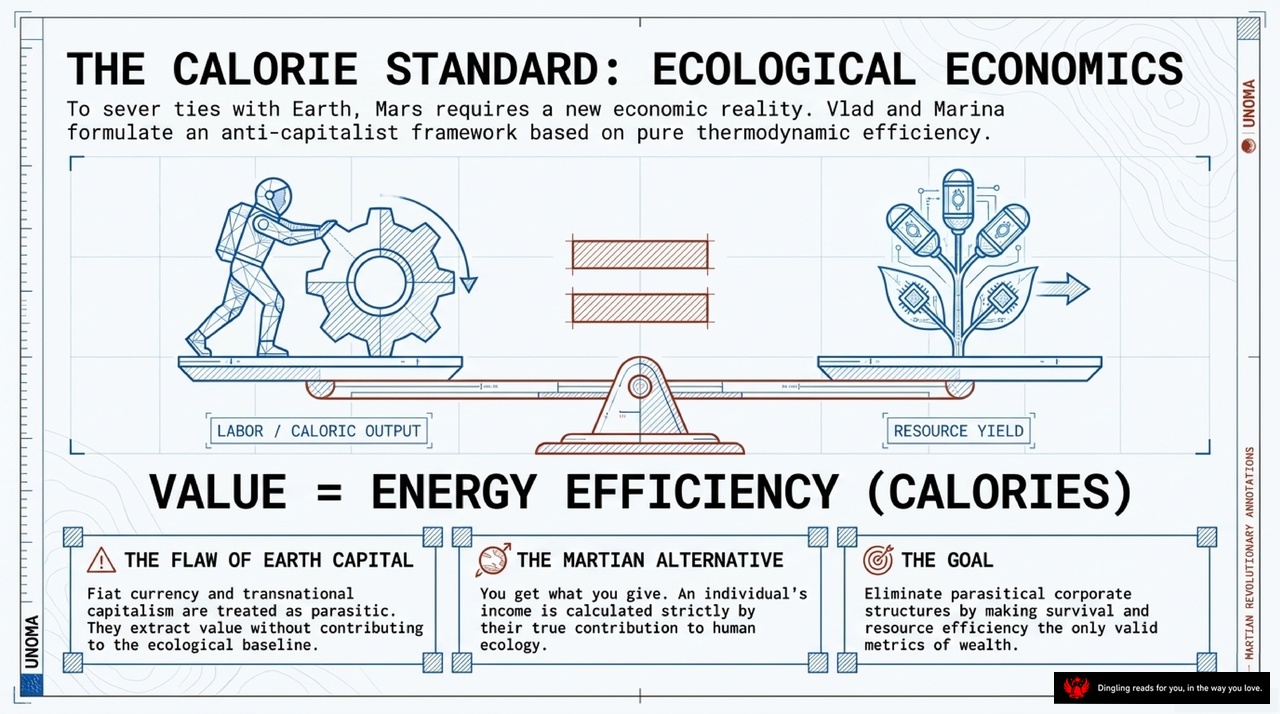
Imagine a world where money is useless, and the only currency that matters is pure energy. This slide introduces the "Calorie Standard," a radical economic framework designed specifically for Mars. Unlike Earth's capitalism, which relies on fragile fiat currency and often extracts value without contributing to the ecosystem, the Martian economy is built on one simple, unbreakable law: Value equals Energy Efficiency.
As the diagram shows, this system balances two sides of the scale. On one side, we have "Labor / Caloric Output"—the energy humans expend to work. On the other, we have "Resource Yield"—the energy the planet provides in return. In this anti-capitalist framework, you literally get what you give. Your income isn't determined by market speculation or corporate ownership; it's calculated strictly by your true contribution to human ecology and your efficiency in using resources.
The goal is clear: to eliminate parasitical corporate structures that drain the system. By making survival and resource efficiency the only valid metrics of wealth, humanity creates a sustainable loop. This isn't just theory; it's the thermodynamic reality required to sever our ties with a broken Earth and thrive on Mars.

Welcome to the final chapter of our journey into the Red Planet. Today, we look at the shadow side of Mars: Hiroko and the Zygote Generation. As we see on this slide, the story splits into three critical threads. First, the Disappearance: Biosphere genius Hiroko Ai and her followers vanish entirely into the uncharted Martian wilderness. They refused to wait for Earth's permission to evolve.
This leads to the second point: The Ectogenesis Project. Hiroko uses stolen genetic material from the First Hundred to secretly breed the first native-born Martian generation. She is creating a society biologically and culturally severed from Earth. This hidden sanctuary accelerates the creation of a new indigenous Martian mythology, spawning the legend of the Coyote.
Imagine a future where humanity isn't just exploring Mars, but trying to become something else entirely. While the rest of the colony struggles with radiation and political infighting, Hiroko is engineering a new species right here on the red dust. It's a radical divergence—a "Shadow Mars" that exists in the cracks of our official history. This is the ultimate question of our story: at what point do we stop being human, and start becoming something new?
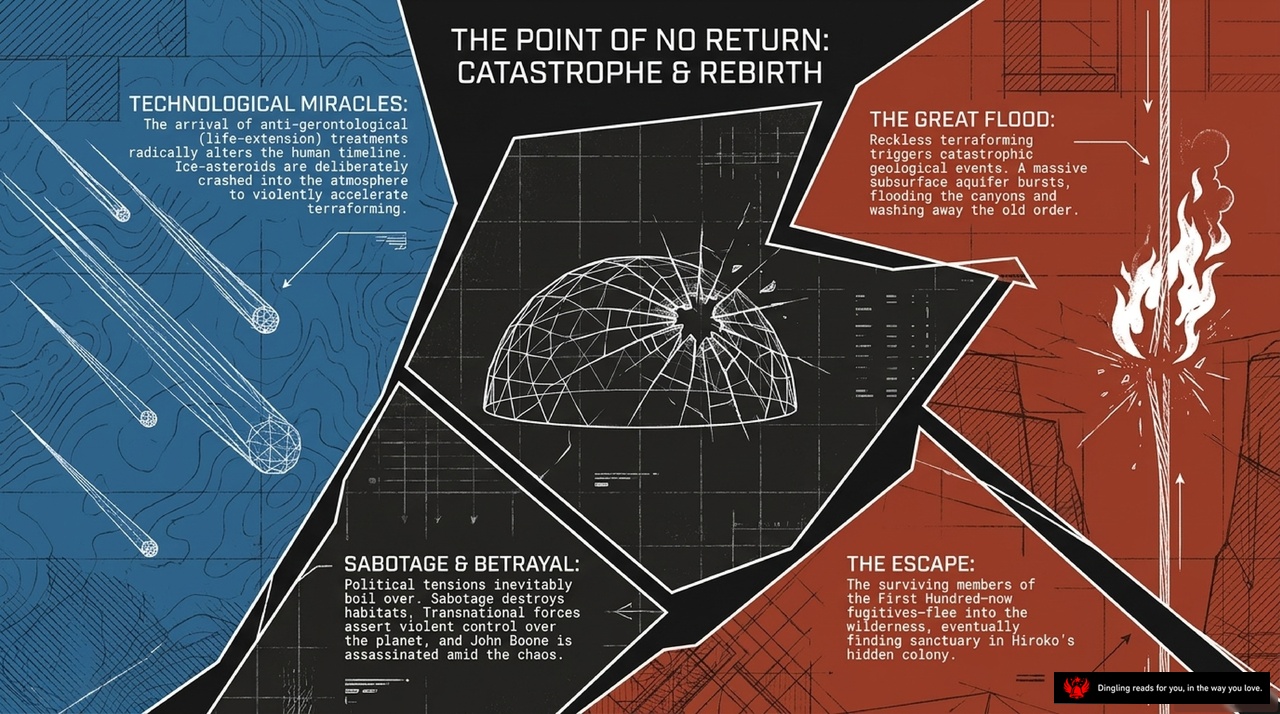
Welcome to the final chapter of our journey, where the story of Mars shifts from a place of discovery to a battleground for the future. Look at this slide, titled "The Point of No Return: Catastrophe & Rebirth." This isn't just a timeline; it's a warning and a blueprint for survival.
On the left, under "Technological Miracles," we see the dark side of progress. The image depicts ice asteroids being deliberately crashed into the atmosphere. In the book, this reckless terraforming triggers catastrophic geological events. By trying to force nature to bend to our will, we've unleashed a "Great Flood." As the red section on the right shows, massive subsurface aquifers burst, flooding the canyons and washing away the old order. This is the cost of moving too fast.
But the story doesn't end in destruction. In the bottom right, "The Escape" reveals the next phase. When the political tensions boil over and sabotage destroys the habitats, the survivors—once the elite "First Hundred"—flee into the wilderness. They are forced to adapt, finding sanctuary in hidden colonies like Hiroko's. This is the harsh reality of the slide's center: the dome is cracking.
Finally, look at "Sabotage & Betrayal" at the bottom left. Political tensions inevitably lead to violence. Transnational forces assert control, and leaders like John Boone are assassinated amid the chaos. The slide captures the tragic truth: the very people who built this future can also destroy it.
So, what does this mean for us? It means that technological miracles without ethical guardrails lead to catastrophe. But it also means that rebirth is possible, but only if we learn to survive the chaos we create. The slide shows us that the future of humanity isn't guaranteed; it's a fragile balance between our ambition and our ability to coexist with the planet we are trying to conquer.

Welcome back to the story of Mars. We've just witnessed the desperate, high-stakes race to terraform our red neighbor. But now, the stakes have shifted from engineering to survival.
The narrative hits a brutal turning point: a global dust storm that has raged for two Martian years. It's not just weather; it's a chaotic force that blinds technology and isolates humanity. In this chaos, John leaves the safety of the sheltered towns to investigate a terrifying mystery—a mysterious explosion at a deep ice well in Beck Hansen Crater. The water pressure there is immense, enough to flood the area like an ancient Amazon, and someone, or something, just blew the lid off.
While John races through the dust to find answers, the rest of the colony faces a different kind of crisis. The population is exploding. We've seen the birth of the thirtieth Martian child, but now the pressure mounts from a new, desperate group: refugees fleeing an overpopulated Earth. These intruders, wearing tattered suits and speaking broken Martian, demand that human migration stop immediately. They argue that the influx of new Earthlings will crush the fragile Martian society they've built.
But the conflict deepens. John discovers evidence of sabotage, pointing fingers at a hidden faction led by a former colonizer, Guanzi. She admits to creating a secret community of children, bypassing the rules of the colony. Meanwhile, the colony's most ambitious project—the atmospheric terraforming—reaches a critical moment. A massive ice asteroid is on a collision course with Mars. If it burns up in the atmosphere, it could double the air pressure in a single minute, finally making the sky breathable. But it's a gamble with no margin for error.
As the asteroid approaches, the story takes us on a harrowing chase. An underground group, led by An and Michael, goes off-grid to escape the coming catastrophe. They drive through the Noctis Labyrinthus, a maze of canyons and cliffs, using a specially designed "invisible" rover to hide from satellite surveillance. They are racing against time, trying to reach a safe haven before the atmosphere changes forever.
The tension comes to a head as they navigate the deadly Doover Gate, a narrow passage between towering cliffs where a raging flood of ice and water threatens to swallow them whole. It's a moment of pure terror, where every decision could mean the end of the mission.
This page captures the essence of the "Martian Inevitability." No matter how much technology we build, or how carefully we plan, human nature—our greed, our fear, our desire for control—will always shape our destiny. Whether it's the political battles on Earth, the internal conflicts on Mars, or the cosmic forces beyond our control, humanity is forced to adapt or be destroyed.
The question remains: Can we truly build a new world, or are we just repeating the mistakes of the old one, now under a pink sky? The dust is settling, but the storm is far from over.