
Refining Professionalism: Complete Chapter-by-Chapter Summary
Welcome everyone. Today we're diving into "Striving Towards Professionalism" by Meng Zhiqiang. Many of us think being professional is just about dressing up or knowing the right etiquette. But that's a common myth. The real goal is becoming someone others can trust completely. This is the definitive guide on transforming from a merely good person into a highly reliable, indispensable professional. It's about the shift from amateur to expert. It's about becoming the person your company can't live without. In a competitive market, being "good" isn't enough. You need to be essential. You need to be the one who delivers results when it matters most. Whether you are navigating a corporate career or leading a team, mastering this mindset is the key to unlocking your true potential. Let's get started.

Look at this slide. It presents a fascinating contrast between two worlds. On the left, we have "The Good Person," representing Life Culture. On the right, we have "The Professional," representing Commercial Culture. At first glance, they might seem similar, but understanding the core difference is what separates a well-meaning amateur from a successful professional.
Let's break down the left side. In Life Culture, the core driver is Emotion and Empathy. Your goal is Harmony and keeping everyone happy. Your behavior is flexible; you bend the rules to help others, prioritizing kindness over strict procedure. This is how we live our personal lives. We value relationships and mutual understanding.
Now, look at the right side. This is the blueprint for Commercial Culture. Here, the core driver shifts to Contract and Principle. Why? Because business is built on trust and predictability. The goal changes to Mutual commercial gain and reliability. You aren't trying to make everyone happy at all costs; you are trying to deliver value consistently.
This brings us to the most critical part: Behavior. A good person might be flexible with rules to help a friend. But a professional strictly honors prior commitments and respects boundaries, ensuring predictable value delivery. Think about this: if you treat your business relationships exactly like your personal friendships, you risk failure.
For example, imagine a professional service provider. If they are too flexible with boundaries because they want to be "nice," they might over-promise and under-deliver. In the business world, being too flexible with rules can actually destroy your reputation. A true professional knows that respecting boundaries is a form of respect. They understand that their reliability is their currency.
The book text highlights that many people fail because they bring self-centeredness from life into work. They think, "I'm doing this for my own happiness." But a professional operates with a business mindset. They realize that to achieve mutual gain, they must be reliable. They don't make excuses when things go wrong; they honor the agreement they made.
So, here is the takeaway. You can be a "Good Person" in your personal life, driven by empathy. But in your professional life, you must embrace the "Professional" culture. Don't confuse kindness with compliance. Kindness is great, but integrity and contract adherence are what build a sustainable career.
In the end, you want to be a professional who delivers on their word. That is the foundation of trust, and without trust, there is no business.
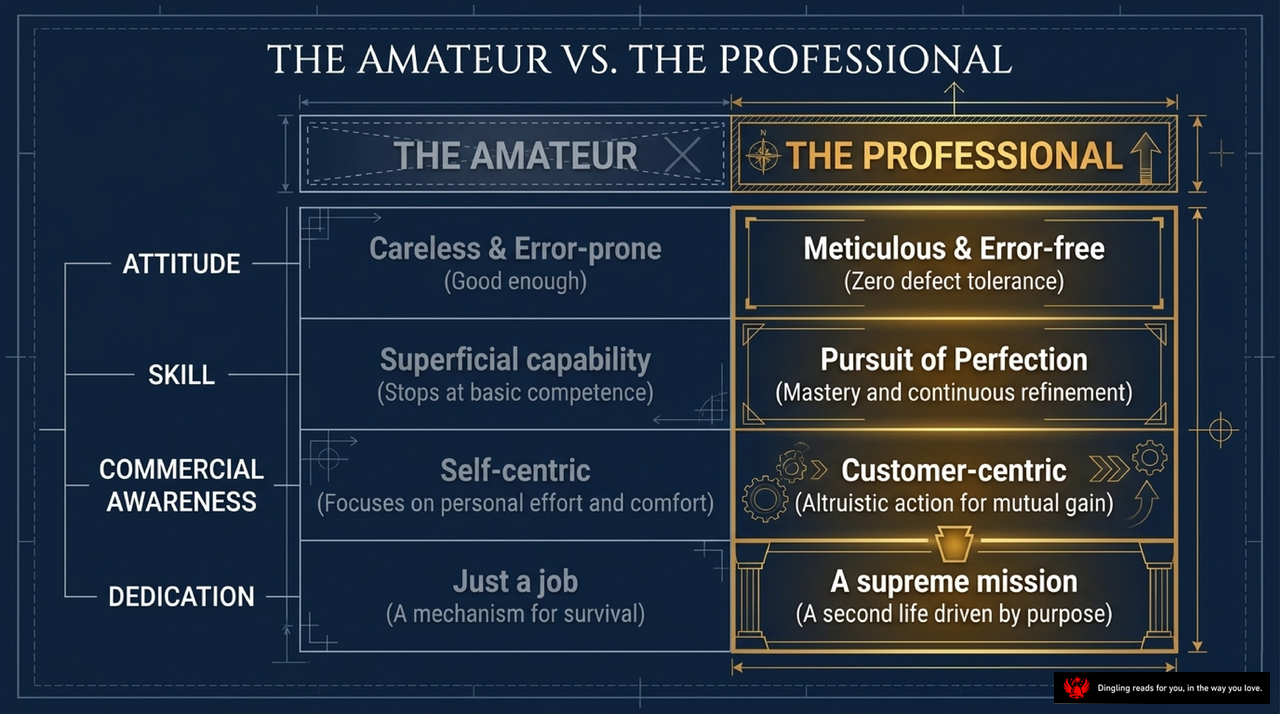
Let's look closely at the core gap between an amateur and a true professional. This slide breaks it down into four critical dimensions that define your career trajectory.
First, consider **Attitude**. An amateur often operates with a "good enough" mindset, being careless and error-prone. A professional, however, embraces meticulousness with zero defect tolerance. We've seen real-world examples where a lack of attention to detail, like verifying elevator specifications, led to millions in losses. A professional simply doesn't cut corners. They treat every task as if it matters because they know their reputation is on the line.
Second, look at **Skill**. Amateurs often stop at basic competence, satisfied with superficial capability. They think "almost there" is enough. But a professional is in a relentless pursuit of perfection. It's about mastery and continuous refinement. Think of the dedication required to master a craft, whether it's refining a specific sound in animation or optimizing a manufacturing process. The professional knows that excellence is a habit, not an event. They keep pushing the boundaries of what's possible, constantly asking how they can do it better.
Third, we have **Commercial Awareness**. This is often the biggest differentiator. Amateurs tend to be self-centric, focusing on their own effort, comfort, or ego. They work for themselves. Professionals are customer-centric. Their focus is on altruistic action for mutual gain. It's not about what you want; it's about what the client needs. Whether it's a service provider or an internal team member, a professional always prioritizes the other party's success. They understand that serving others is the best way to serve themselves. A true professional puts the customer's experience above their own convenience.
Finally, **Dedication**. For an amateur, work is just a mechanism for survival, a paycheck to get by. For a professional, it's a supreme mission—a second life driven by purpose. This is the difference between doing a job and living a vocation. When you view your work as a mission, like a dedicated athlete or a visionary leader, the results follow naturally. You aren't just clocking hours; you are investing in a legacy.
So, the question isn't just what you do, but how you do it. Moving from amateur to professional means shifting your mindset in all four areas. It's about reliability, mastery, empathy, and purpose. This transformation is what separates the good from the great. It's the path from just being an employee to becoming a leader.
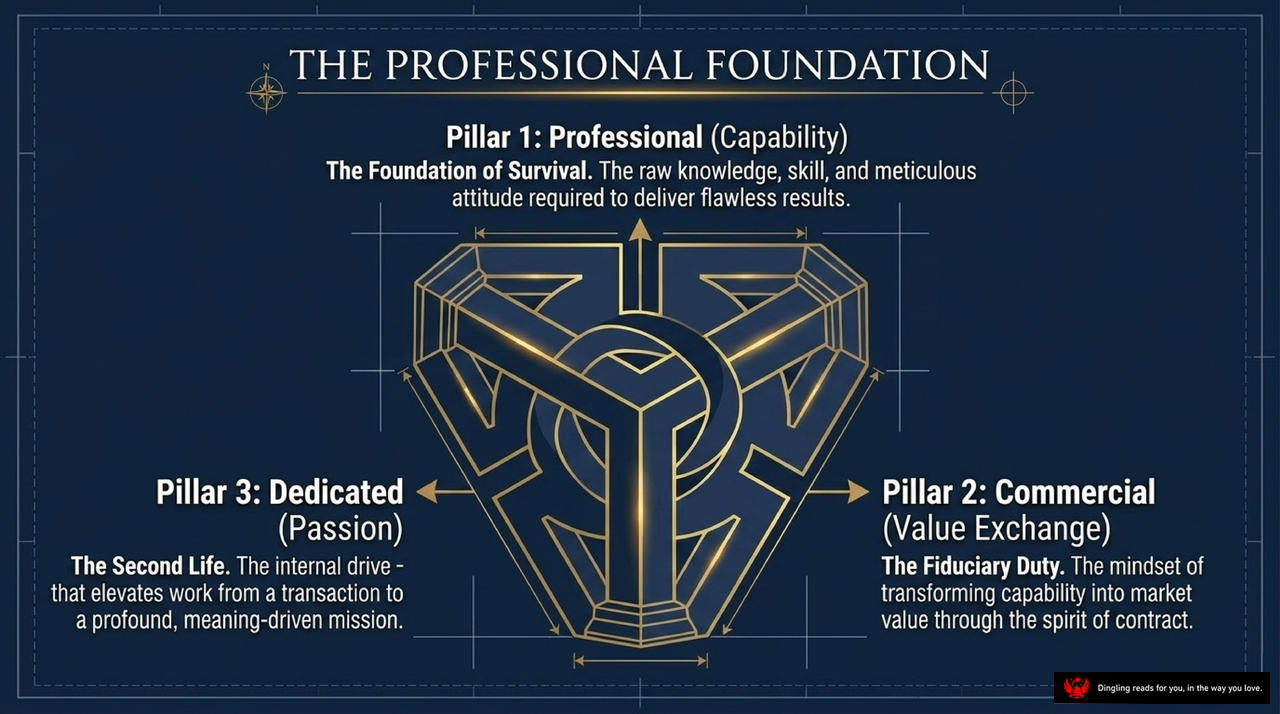
Let's break down what it really means to be a professional. Look at this diagram. This is the Professional Foundation. It's not just a job title; it's a structure built on three core pillars that you need to master to stand out in today's competitive market.
First, we have Capability. This is your Professional pillar. Think of this as your foundation for survival. It's not just about having a degree or a resume; it's about possessing the raw knowledge, the hard skills, and the meticulous attitude required to deliver flawless results. In the real world, if you can't do the work, you don't have a job. This is the baseline. Without this, you're just an amateur. Amateurs often cut corners or are careless. Professionals are serious, reliable, and give clear results. They understand that their skills are their only real asset.
Next, look at the Commercial pillar. This is about Value Exchange. Being professional isn't just about being good at your job; it's about understanding the market. You are a provider of value. You have a fiduciary duty to transform your capability into something that the market values. It's about honoring the spirit of the contract. If you promise something, you deliver it. That trust is what creates your career capital. It's the difference between just working and creating business value. You need to shift from a self-centered mindset to a customer-centric one. Remember, in business, trust is the currency.
Finally, we have the Dedicated pillar. This is about Passion. This is often where most people fall short. It's not just about doing the work; it's about elevating it from a simple transaction to a profound, meaning-driven mission. This is your "second life." It's the internal drive that keeps you going when the work gets tough. It's the difference between someone who works for a paycheck and someone who works for a purpose. Think of it like this: capability gets you hired. Commercial thinking gets you paid well. But Dedication gets you respected.
This is the journey from being an amateur to being a true professional. Most people stop at the first pillar. But to be truly professional, you need all three. You need the skill to do the work, the business mind to create value, and the passion to care about the outcome. This is how you move from an employee to a leader. These three standards are progressive, just like the path of a great athlete like Yao Ming, who mastered skill, then value, then mission.
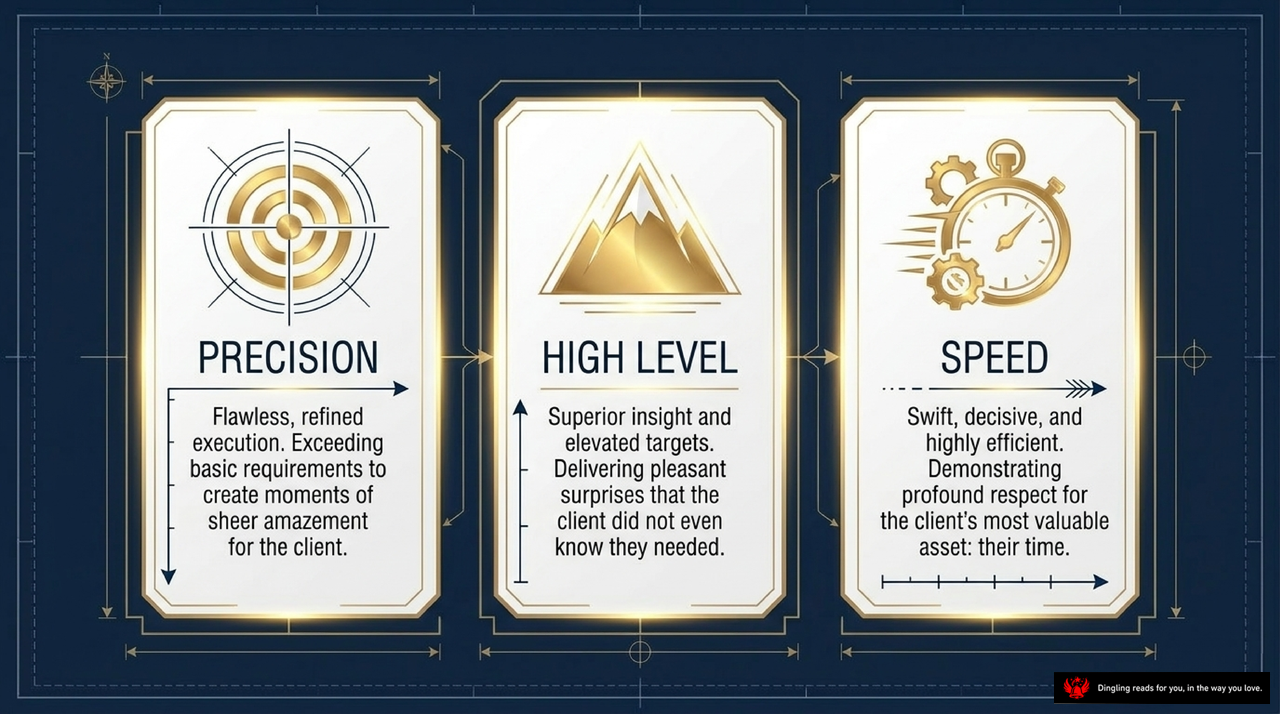
Let's talk about the core gap between an amateur and a professional. It's not just about your skills; it's about how you deliver them. We define true professionalism through three core standards: Precision, High Level, and Speed.
First, Precision. Think about the Hong Kong-Zhuhai-Macao Bridge. Engineers managed to dock thousands of tons of underwater pipes with millimeter-level accuracy. That's Precision. It creates a moment of sheer amazement for your client. It's about flawless execution that exceeds basic requirements.
Second, High Level. It's about superior insight and elevated targets. The bridge project didn't just build a road; it saved costs, protected the ecosystem, and ensured safety. That's High Level. It delivers value the client didn't even know they needed. It's about aiming for excellence, not just competence.
Third, Speed. It's about being swift and efficient. The bridge team installed two pipe sections in half a month. That's Speed. It shows respect for the client's most valuable asset: their time.
These standards apply to your daily work too. Whether it's installing an air conditioner perfectly, designing a software interface, or ensuring a car door gap is millimeter-perfect, professionals don't just get the job done; they get it done right. They have a find the flaw in the egg mentality, refusing to overlook any detail. Amateurs are satisfied with good enough, while professionals pursue perfection. Amateurs bring their personal ego to work, while professionals focus on the client's needs. This mindset shift is crucial for long-term success.
Think about how consumer expectations have shifted. In the past, people bought products for basic function. Today, they buy experiences. They want organic quality, premium feel, and customization. They are literally buying time. That's why express delivery is more popular than standard shipping, even if it costs more.
But becoming a professional takes time. Malcolm Gladwell's 10,000 Hour Rule suggests that true expertise comes from focused repetition. It's not about working harder; it's about doing the right thing over and over again until it becomes second nature.
Also, remember that management is a higher-level professional skill. It's not just about doing your own job well; it's about coordinating a team to achieve results. You need to align your personal skills with organizational goals.
So, to be a true professional, you need to aim for Precision to impress, High Level to delight, and Speed to respect. This is the gap between an amateur and a professional. It's not just about doing the work; it's about elevating the work to a standard that wins trust and commands premium value.
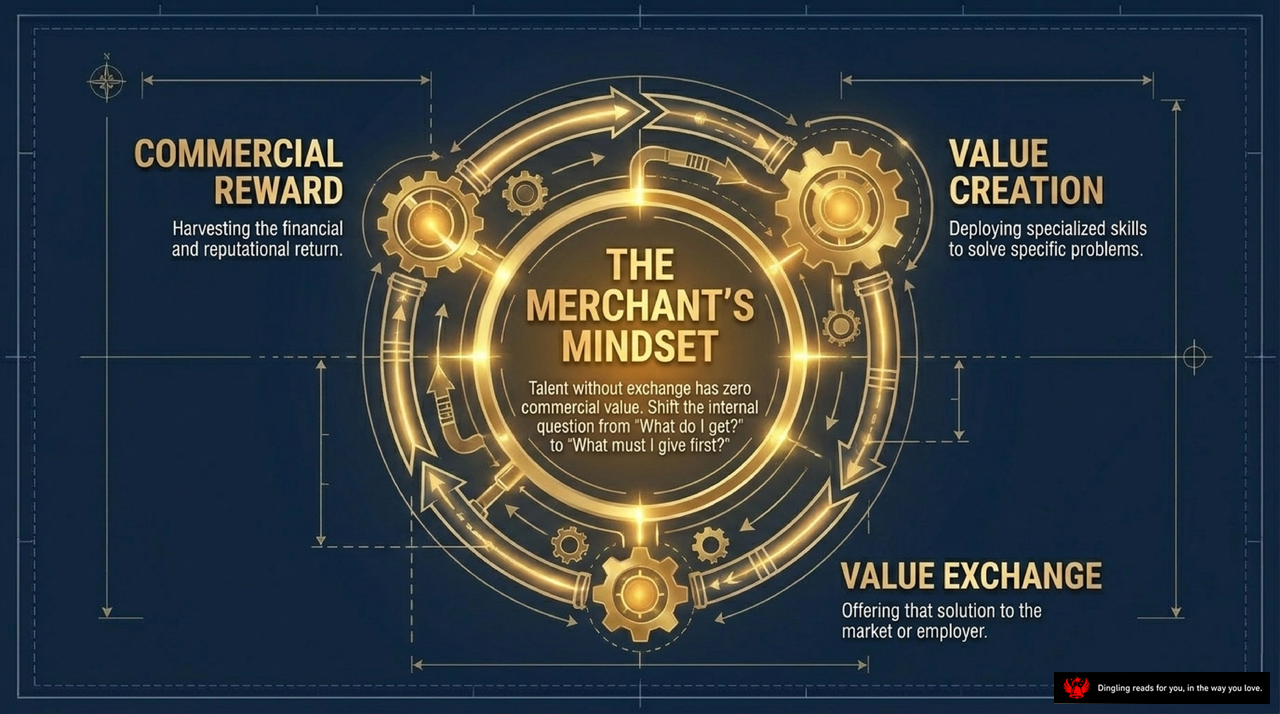
Let's dive into this central concept: The Merchant's Mindset. This isn't just about selling things; it's about the fundamental logic of how professional value works in the modern economy. The diagram breaks it down into a cycle of three critical steps that every professional needs to master.
First, we have Value Creation. Look at the text on the right. It says, Deploying specialized skills to solve specific problems. In the workplace, simply having a degree or a skill set isn't enough. You have to actively use those skills to solve a problem for someone else. That is what creates value. Without this step, you are just sitting on potential.
Second is Value Exchange. This is the core of the merchant mindset. The text in the center warns us that talent without exchange has zero commercial value. Many people fall into the trap of asking, What do I get out of this? A true professional flips the script. They ask, What must I give first? You take that solution you created and offer it to the market or your employer. This exchange is the bridge between your effort and your income. It's about trust and commitment.
Finally, this cycle leads to Commercial Reward. This is the harvesting the financial and reputational return part. When you consistently deliver value and exchange it properly, the rewards come naturally. It's not a bonus you beg for; it's the result of the work you've done.
Think about the difference between an amateur and a professional. Amateurs often bring a self-centered attitude to their work, focusing on their own comfort or status. But professionals focus on the client and the employer. They understand that to benefit themselves, they must first benefit others. As the book notes, only by benefiting others can you achieve self-benefit. This is the essence of the commercial philosophy.
So, the path to becoming a true professional is to adopt this merchant mindset. Stop waiting for opportunities. Instead, look for problems to solve. Create value, exchange it honestly, and let the rewards follow. This mindset shift is what separates those who are just employees from those who are truly valued leaders in their industry. It transforms you from a consumer of resources into a creator of value. Remember, if you don't create value or exchange it, you are just a product, not a commodity. Embrace this cycle, and you will build a career that is sustainable and rewarding.
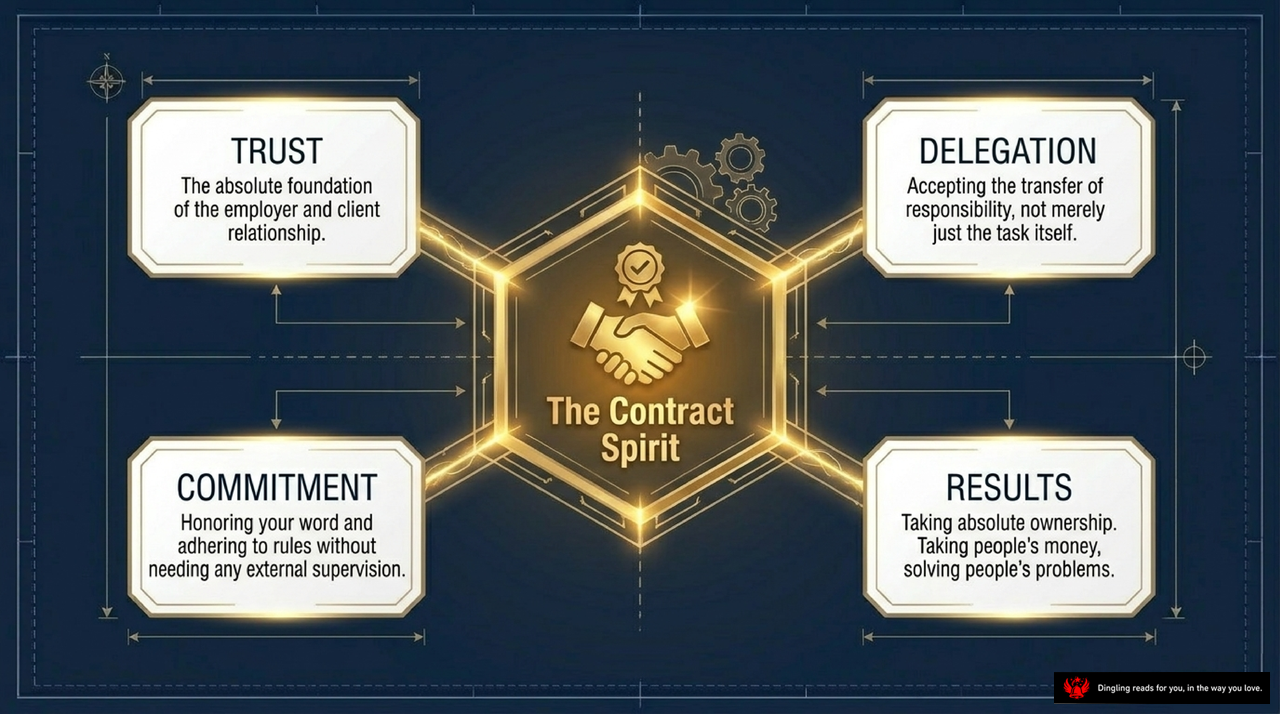
Look at that handshake in the center. It represents 'The Contract Spirit,' which is the absolute foundation of how we operate in the professional world. You can't have a successful business or a productive team without it. It's not just about signing a paper; it's about the unwritten agreement of value and integrity.
Let's break down the four pillars shown here. First is Trust. In any relationship, whether you're an employer and employee or a doctor and patient, trust is the currency. It covers both external contracts with clients and internal contracts with company rules. If you can't trust someone, you can't give them responsibility. Without trust, delegation becomes impossible.
Second is Delegation. Notice the definition here: 'Accepting the transfer of responsibility, not merely just the task itself.' True delegation means you're handing over ownership of the outcome, not just a to-do list. It requires confidence in the other person's ability to handle the load, but it also requires you to accept that responsibility when things go wrong.
Third is Commitment. This is about honoring your word without needing external supervision. It's the difference between doing the right thing because you were told to, versus doing it because you promised to. It's the internal discipline that separates amateurs from professionals. It's about adhering to rules not because you are being watched, but because you respect the agreement.
And finally, Results. 'Taking absolute ownership. Taking people's money, solving people's problems.' This is the most critical part. You are paid to solve problems, not just to show up. If you take resources but don't deliver value, you aren't fulfilling the contract. As the text says, you must operate like a merchant who invests first and gets paid later. You give your time and resources, and in return, you get value.
So, how do you apply this? Treat every interaction as a business deal. Trust is your starting point. Delegation is your method of scaling. Commitment is your integrity. And Results are your proof of value. When you align these four, you stop working for a paycheck and start working for a legacy. That is the true essence of professional success.
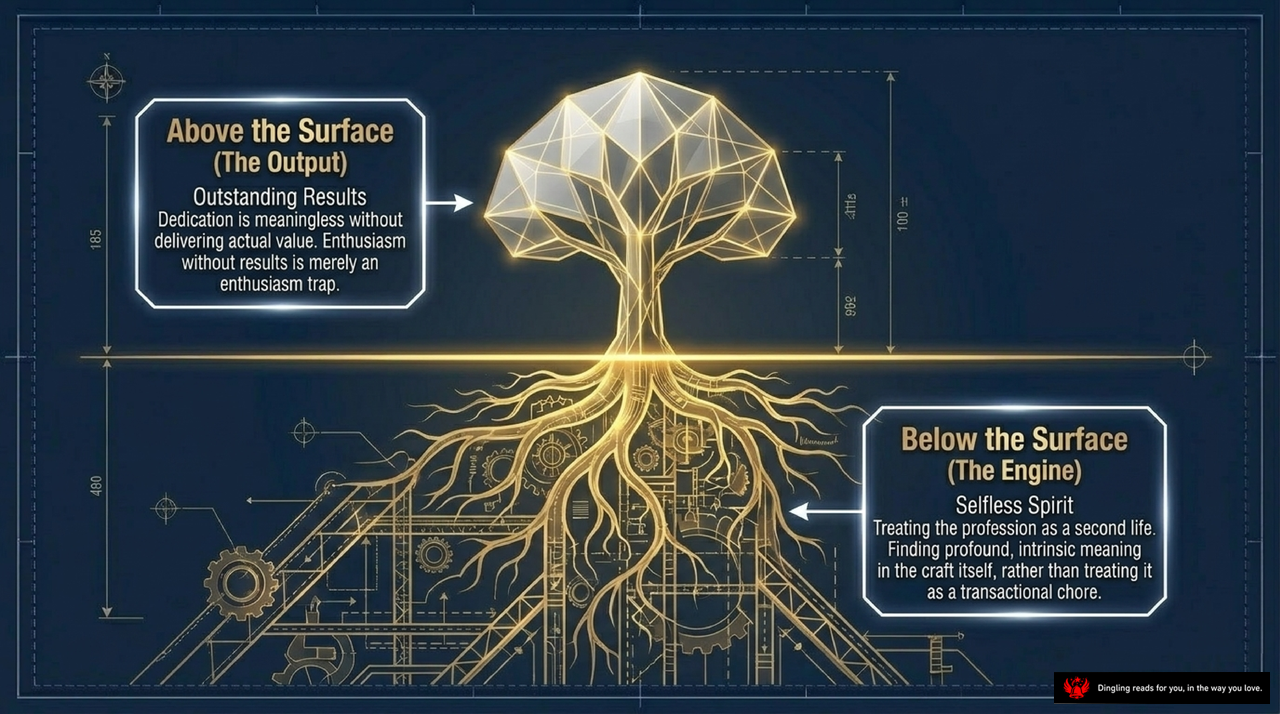
Look at this tree. It's a powerful visual for what true professionalism actually looks like in the real world. We see the canopy, the leaves, the fruits. That represents the 'Above the Surface' section. The PPT labels this as 'The Output'. We see 'Outstanding Results' here, and that's exactly what clients, bosses, and the market are looking for. But there's a crucial warning right there. It says, 'Dedication is meaningless without delivering actual value.' You can be incredibly hardworking, you can show up early, and you can be full of energy, but if you aren't producing tangible value, you aren't moving the needle. Enthusiasm without results is merely an enthusiasm trap. It looks good on paper, but it doesn't grow the business. You can't just be busy; you have to be effective.
Then, look down. That's where the real work happens. That is 'Below the Surface'. This is 'The Engine'. What powers the tree? It's not just the leaves; it's the roots. The text calls this 'Selfless Spirit'. It's about 'Treating the profession as a second life.' Think about it. When you just do a job for a paycheck, you're treating it as a transactional chore. You check the box and move on. But true professionals find something deeper. They are 'Finding profound, intrinsic meaning in the craft itself.' They love the work. They care about the quality. That internal drive is what builds the roots that can support the massive canopy above. If you only focus on the top, the roots will rot, and the tree will fall.
So, the lesson here is simple but hard to execute. You can't just focus on the output. You have to build the engine below. If you want to succeed, you need to stop treating your career like a transaction and start treating it like a mission. When you find that intrinsic meaning, the results take care of themselves. That's the difference between an amateur and a true professional. That's the foundation of a sustainable career. It's about aligning your internal spirit with your external output. When you do that, you don't just survive the market; you thrive in it. Remember, the roots determine the height. So, what are you doing today to strengthen your roots?
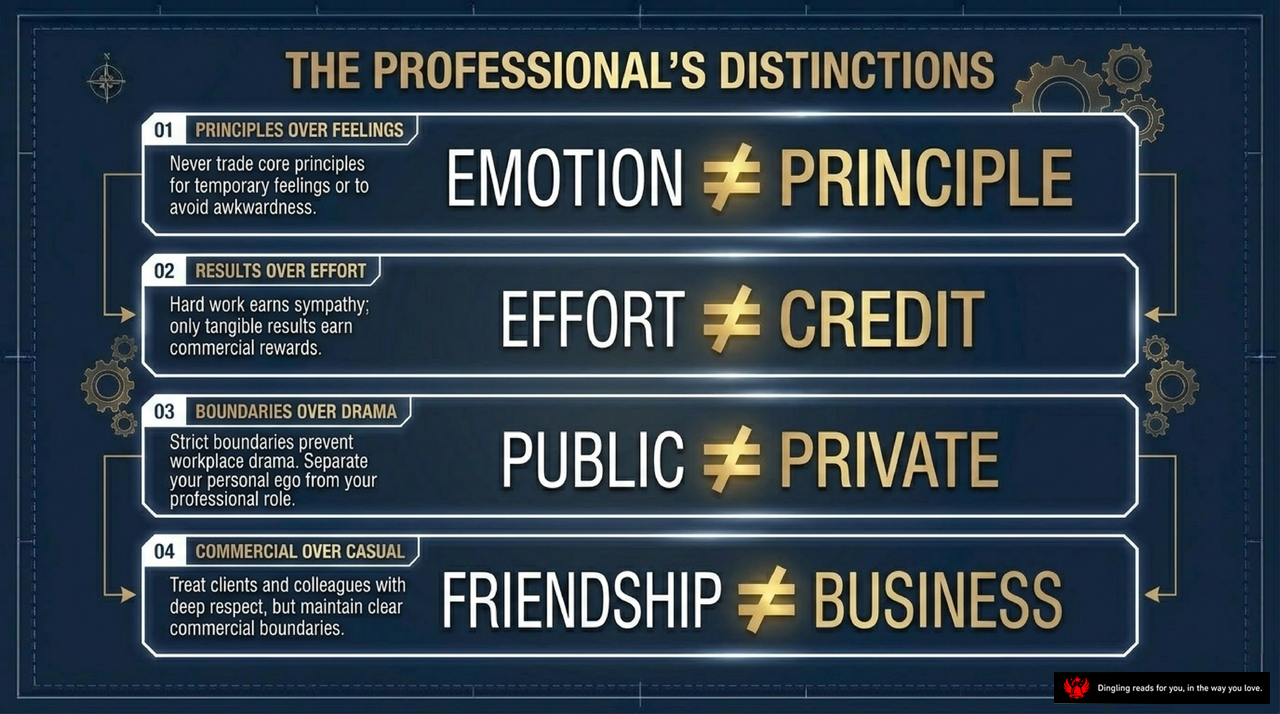
Welcome back. So, what actually separates a true professional from an amateur? It's not just about your skills or your title. It's about how you handle the tough, gray areas of work. Look at this slide. It outlines four critical distinctions every professional needs to master to succeed in today's competitive market.
First, Principles Over Feelings. The slide clearly states Emotion does not equal Principle. We often compromise our core values just to avoid awkwardness or because we're feeling emotional. But a true professional never trades principles for temporary feelings. Your values must remain steady, regardless of the mood in the room or the pressure you're under. Integrity is your currency.
Second, Results Over Effort. Notice it says Effort does not equal Credit. This is a hard truth in the modern workplace. Hard work might earn you sympathy from your boss, but only tangible results earn commercial rewards. Don't confuse being busy with being productive. If you don't deliver value, your effort is invisible. Think about it: the market pays for outcomes, not hours logged. As the text notes, hard work gets sympathy, but results get paid.
Third, Boundaries Over Drama. Here, Public does not equal Private. Strict boundaries prevent workplace drama. You need to separate your personal ego from your professional role. Keep your private life out of the office to maintain focus and respect. Mixing the two often leads to conflicts that distract from your actual goals. Professionalism means keeping your personal life separate from your work responsibilities.
Finally, Commercial Over Casual. This means Friendship does not equal Business. Treat clients and colleagues with deep respect, but maintain clear commercial boundaries. Don't let personal friendships interfere with business decisions. For example, treating a supplier as a friend doesn't mean you ignore price hikes or payment terms. Clear agreements build trust, while blurring lines leads to conflict.
These four distinctions are the foundation of a successful career. Master them, and you move from amateur to professional.

Welcome to the Zero-Tolerance Zone. Let's debunk a dangerous myth right now: the idea that 'muddy waters breed good fish.' That is a lie. In the modern commercial world, corruption doesn't build a business; it destroys the commercial contract. Look at the shield in the center. Law is the baseline. This means compliance isn't optional; it's the floor. Ethics are your armor. And true professionals? They don't hide in the shadows. They thrive in transparent, rule-based environments.
Now, look at the red warning signs surrounding us. These are the non-negotiables. First, leaking commercial secrets. We've seen companies lose millions because employees took core technology to new competitors. Second, accepting kickbacks. This is bribery in disguise, a cancer in the supply chain. Third, embezzlement or misappropriation. This is stealing from the company's own assets.
Why does this matter? Because trust is the only currency that matters. If you think 'clear water breeds no fish,' you are actually raising termites for your own company. As the text notes, internal corruption is the biggest risk to any enterprise. It's not just about avoiding jail; it's about preserving value. When you compromise on law and ethics, you break the contract with your clients and your investors.
So, how do we build this? It starts at the top. Leaders must set the tone. You can't expect compliance from your team if you are willing to cut corners yourself. We need to establish a legal risk prevention system. We need to educate everyone that law is the bottom line of morality. And we need to enforce consequences. When we eliminate these red zones, we create a culture where integrity is the default. That is the only way to build a business that lasts. True professionalism isn't about how hard you work; it's about how clean you play. Remember, a professional knows that their reputation is their most valuable asset, and once it's lost, it's gone forever. So let's commit to a clear, transparent future.
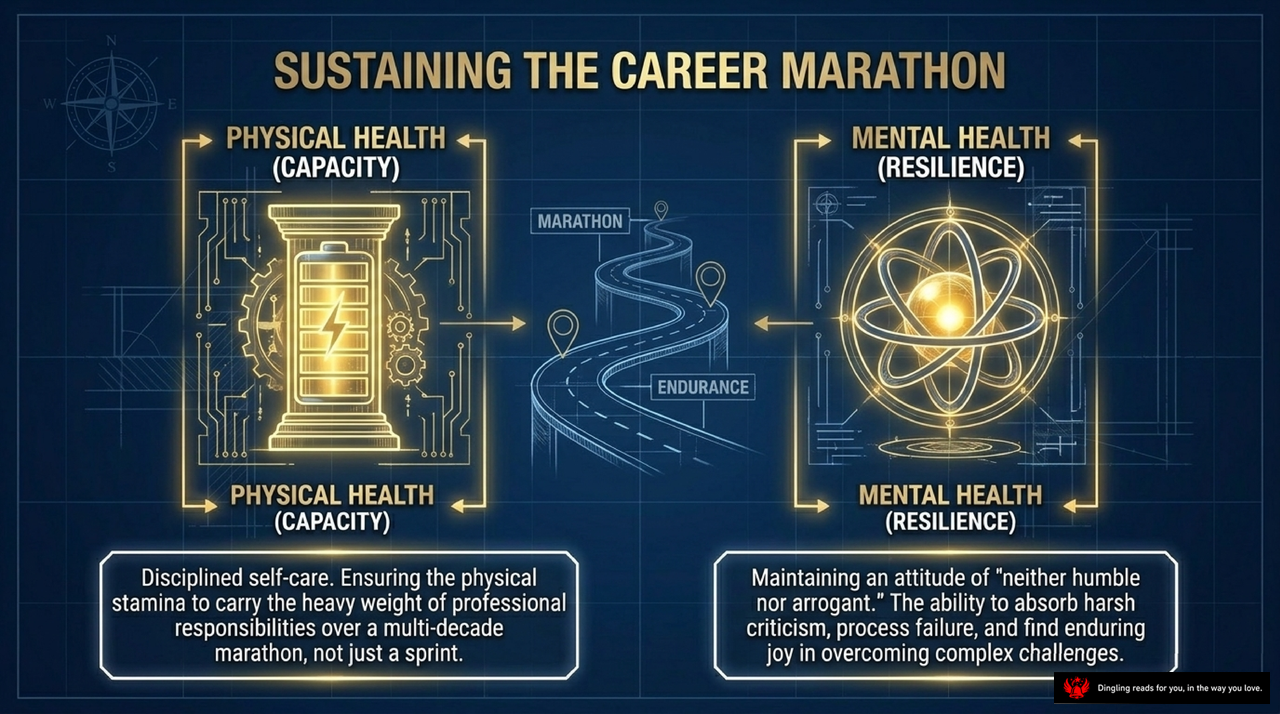
Welcome back. Today we're diving into the most critical question for any long-term career: How do we sustain it? Think about your career not as a sprint, but as a marathon. A marathon requires endurance, and endurance relies on two specific fuel tanks: Physical Health and Mental Health.
First, let's look at the left side: Physical Health, which we define as Capacity. The text emphasizes that physical health is the foundation of mental health. You simply cannot have a strong mind if your body is running on empty. The slide mentions 'disciplined self-care.' This isn't just about vanity; it's about survival. You need the physical stamina to carry the heavy weight of professional responsibilities over a multi-decade marathon. There's a warning here: many of us try to earn with our lives before age 50, only to spend the next 30 years trying to buy our lives back. That is a tragedy. Real professional endurance comes from protecting your physical health so you have the energy to keep going for the long haul. Successful leaders know that health is a prerequisite for leadership.
Now, shift your focus to the right side: Mental Health, defined as Resilience. This is about how you handle the inevitable pressure. The text notes that performance pressure is the biggest challenge everyone faces. A mature professional doesn't break under stress; they convert pressure into power. The slide suggests maintaining an attitude of 'neither humble nor arrogant.' This is a specific mindset. It means you can absorb harsh criticism and process failure without letting it destroy your confidence. It's about finding enduring joy in overcoming complex challenges, rather than just surviving the grind. You need to be strong enough to stand firm, but not arrogant enough to ignore feedback. As the text says, you should be rational and calm, not emotional.
Finally, look at the center of the image. That winding road represents the 'Marathon' and 'Endurance.' Notice how the arrows connect the two sides. Physical and mental health aren't separate silos; they feed into each other. If your body is weak, your mind falters. If your mind is fragile, your body suffers. To build a career that lasts, you must train both. You need the discipline to stay fit, and the resilience to stay calm when things get tough. It's about shifting from a 'sprint' mentality to a 'marathon' mindset. Only by investing in both your capacity and your resilience can you truly endure the long road ahead and achieve lasting success.
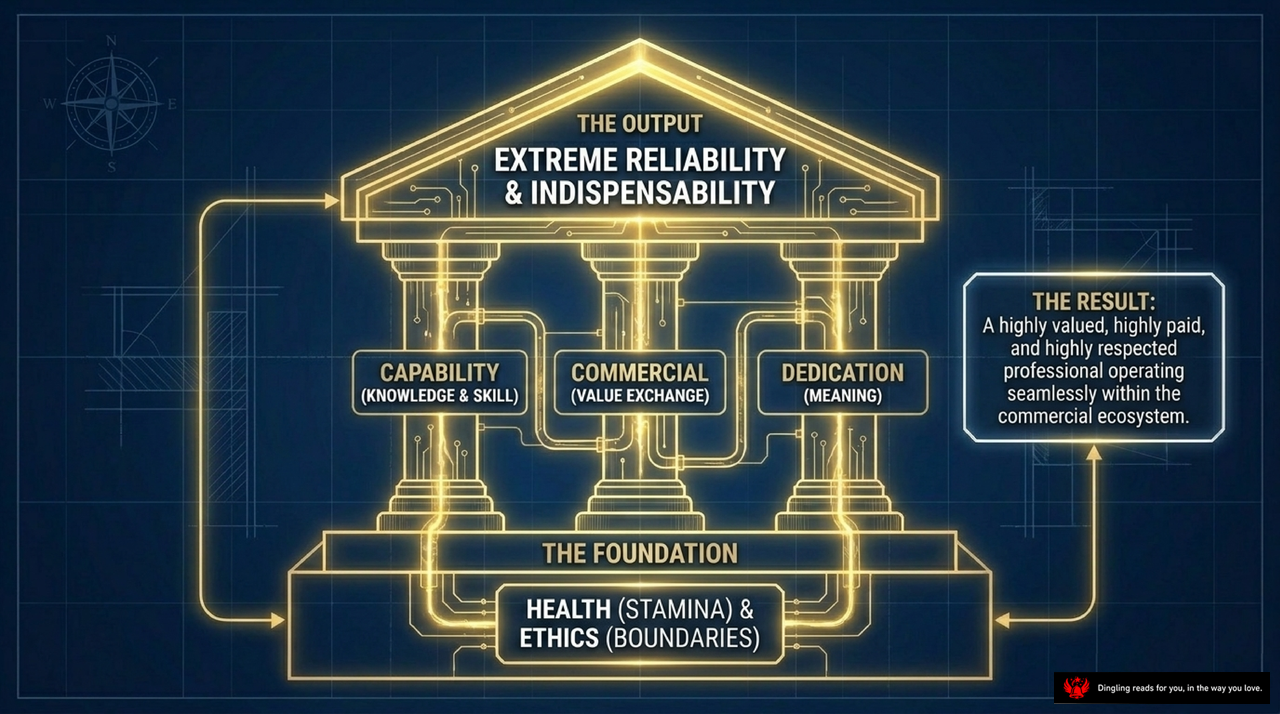
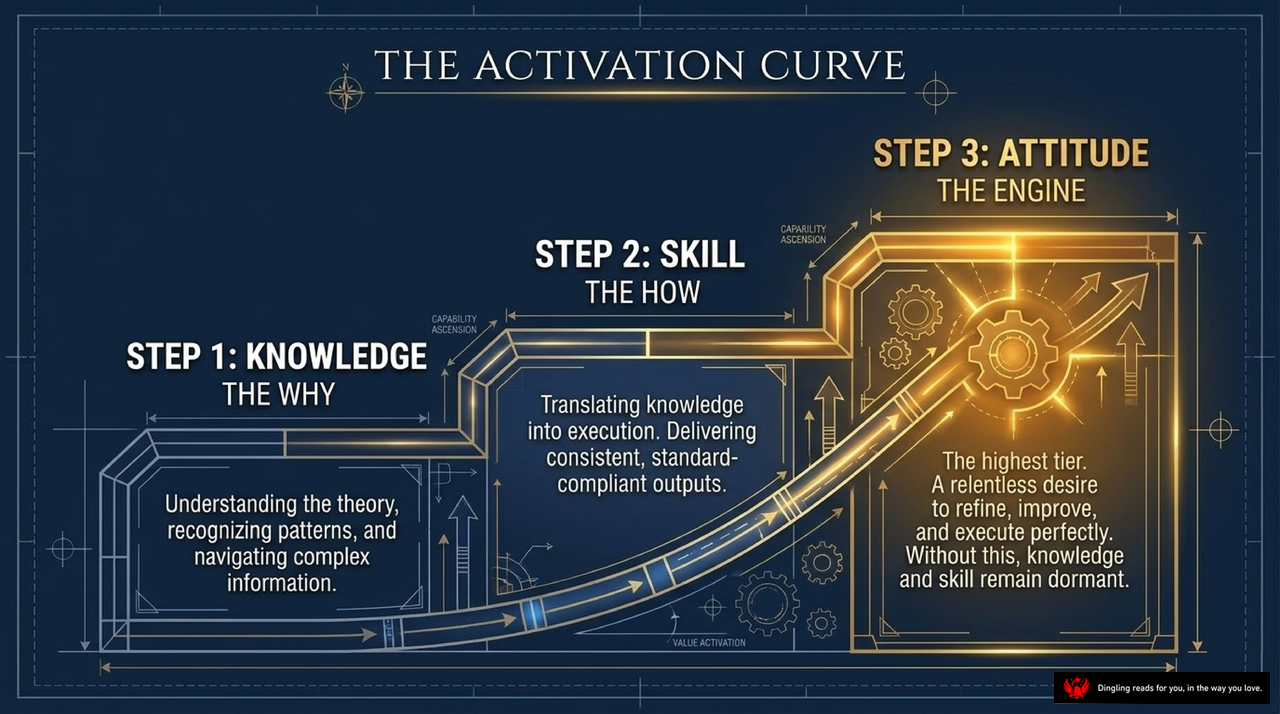
So, what actually separates a true professional from an amateur? It's not just about having a job title. It's about building a specific structure of value that makes you indispensable.
Look at the top of this model: **Extreme Reliability and Indispensability**. In the modern workplace, being replaceable is a career killer. You want to be the person who is trusted implicitly and cannot be swapped out.
How do you build that? It rests on three core pillars.
First is **Capability**. This combines your Knowledge and Skill. It's not enough to just know the theory; you need the practical ability to execute. You need to be the expert who solves problems when others can't.
Second is **Commercial**. This is your Value Exchange. You need to understand the business. You aren't just doing tasks; you are creating value for the client and the company. You operate with a business mindset, understanding that trust is the currency of commerce.
Third is **Dedication**. This is the Meaning. It's about treating your work as your second life. It's the difference between doing a job and having a career. It's about passion and commitment. It's about enjoying the process, not just the paycheck.
But these three pillars don't float in the air. They need a solid **Foundation**.
This foundation is made of **Health and Ethics**.
**Health** is your stamina. You need physical and mental resilience to handle the pressure of high performance. You can't be a professional if you're constantly burning out. You need to protect your energy, both physically and mentally.
**Ethics** are your boundaries. You need integrity and professional conduct. Without trust and clear boundaries, your skills don't matter. Ethics prevent you from crossing the line into unprofessional behavior.
When you stack these elements—Capability, Commercial Mindset, Dedication, all supported by Health and Ethics—you achieve a specific result.
As the slide shows, the result is a professional who is highly valued, highly paid, and highly respected. You operate seamlessly within the commercial ecosystem.
This framework moves you from being an amateur to a true professional. It's about more than just skills; it's about building a sustainable career where you are the asset, not just the cost. It's about shifting from a "get by" mindset to a "give value" mindset. When you master this, you stop competing on price and start competing on value.
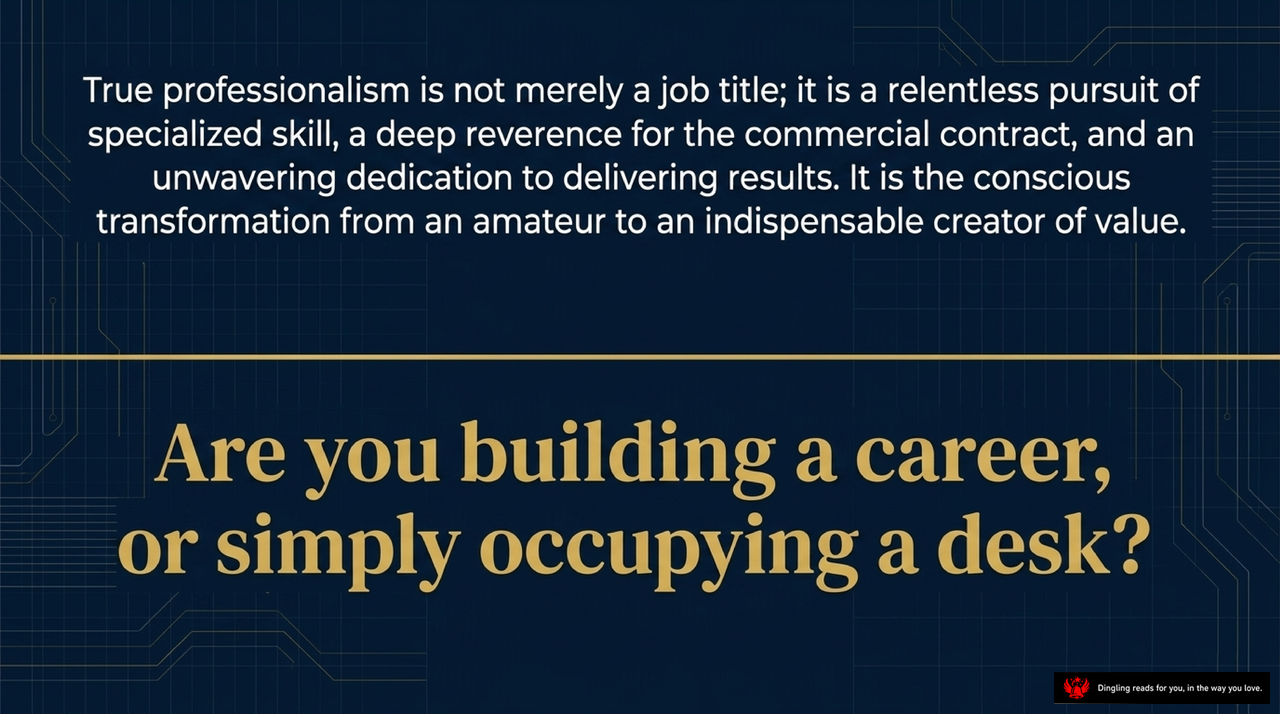
Let's be honest with ourselves for a second. Look at that question at the bottom. Are you building a career, or simply occupying a desk? It's a tough question, but it defines everything about your path. Too many of us confuse having a job with having a career. We think being a professional just means wearing a suit or having a fancy title. But the text above reminds us that true professionalism is not merely a job title; it is a relentless pursuit of specialized skill, a deep reverence for the commercial contract, and an unwavering dedication to delivering results. It is the conscious transformation from an amateur to an indispensable creator of value.
Think about the difference between an amateur and a pro. An amateur might show up, but they leave gaps. They might make excuses, like that HR manager who forgot to print materials and wasted the whole team's time. Or that construction worker who kept working when injured, thinking it was 'tough,' but actually, that was unprofessional because it compromised safety and quality. A professional, on the other hand, is an indispensable creator of value. They don't just wait for instructions; they anticipate needs and solve problems.
So, what's the core gap? It's the attitude. Amateurs work hard but often work on the wrong things or do things poorly. They treat their job as a place to occupy time. Professionals treat it as a platform to create value. They care about the details, they respect the rules, and they understand that their reputation is built on reliability, not just presence. They have business thinking; they know that to get paid, they must solve problems for others.
Ultimately, this is about transformation. It's a conscious choice to stop being an amateur who waits for permission and start being a creator who drives the outcome. If you want to move from just filling a seat to building a legacy, you have to ask yourself: Am I creating value, or am I just showing up? Because in the end, that's the only thing that truly separates a career from a desk. Don't just occupy space. Create value. Remember, your career is built on the trust you build every single day. When you stop being an amateur and start acting like a professional, you stop being replaceable and start becoming indispensable.