
Reminiscences of a Stock Operator: Complete Chapter-by-Chapter Summary
Welcome to a journey into the mind of one of history's greatest traders. Today, we are opening the cover of *Reminiscences of a Stock Operator* by Edwin Lefèvre. This isn't just a biography; it is the timeless playbook of Jesse Livermore, distilled from a century of market mechanics, human psychology, and the unbreakable rules of speculation.
Think of this book as the ultimate guide for anyone who wants to understand not just how to trade, but how the market truly thinks. It strips away the noise to reveal the core truths about market behavior, the repetitive patterns of history, and the dangerous traps that even the smartest investors fall into. Whether you are looking for a strategy or simply seeking to understand the human element behind the numbers, this book offers a masterclass that remains just as relevant today as it was when it was first written. Let's dive in and see how the legend of Livermore began.
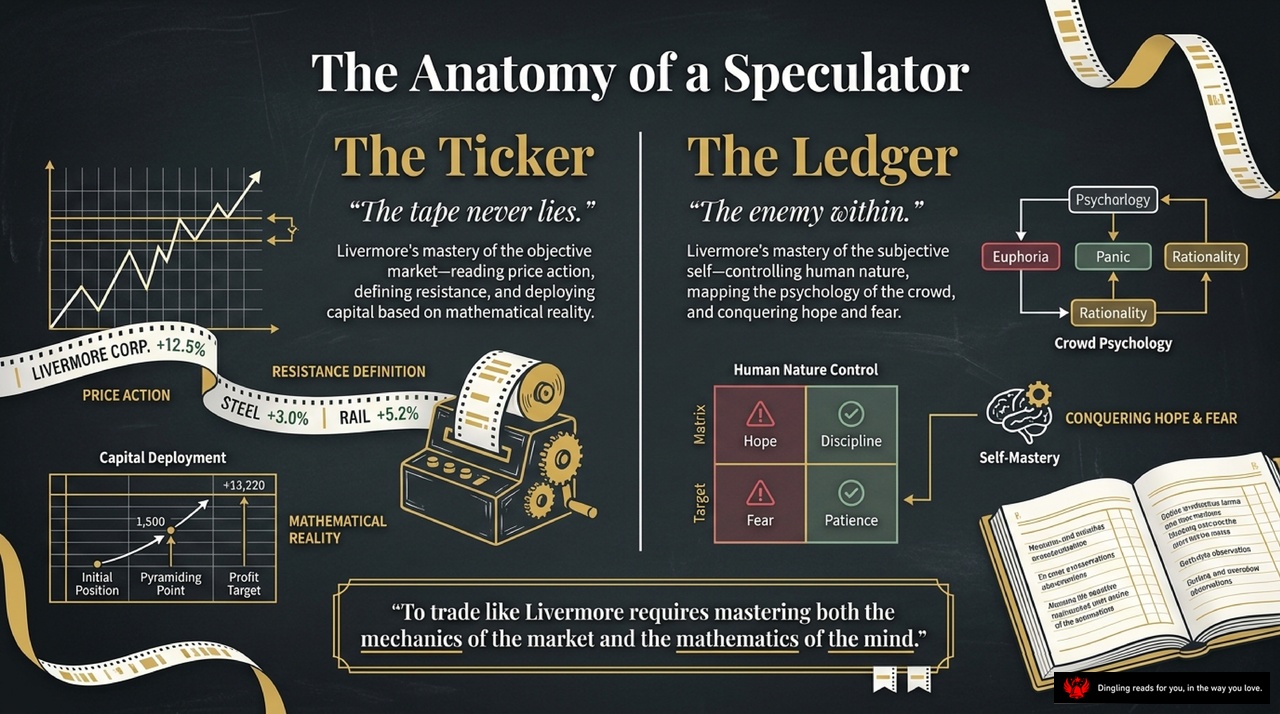
The Anatomy of a Speculator breaks down into two distinct, yet equally critical, pillars: The Ticker and The Ledger. On the left, we see The Ticker, representing the objective market. As the graphic illustrates with "The tape never lies," this is about mastering price action, defining resistance like the steel and rail examples shown, and deploying capital based on mathematical reality. It's the art of reading the chart, spotting the pyramiding point, and hitting your profit target without emotion.
On the right lies The Ledger, which represents the subjective self—the "enemy within." This is where the real battle happens. The diagram highlights Crowd Psychology, mapping how Euphoria and Panic often override Rationality. True mastery comes from Self-Mastery, specifically the ability to conquer Hope and Fear. The matrix clearly shows that Discipline is the antidote to Hope, and Patience is the cure for Fear. To trade like Livermore, you must master both the mechanics of the market and the mathematics of the mind. You cannot let the crowd's panic dictate your moves; you must rely on your own rationality and patience to stay the course.
Welcome back to our deep dive into the life of a legendary trader. Today, we are unpacking a pivotal moment in history: the 1907 Panic.
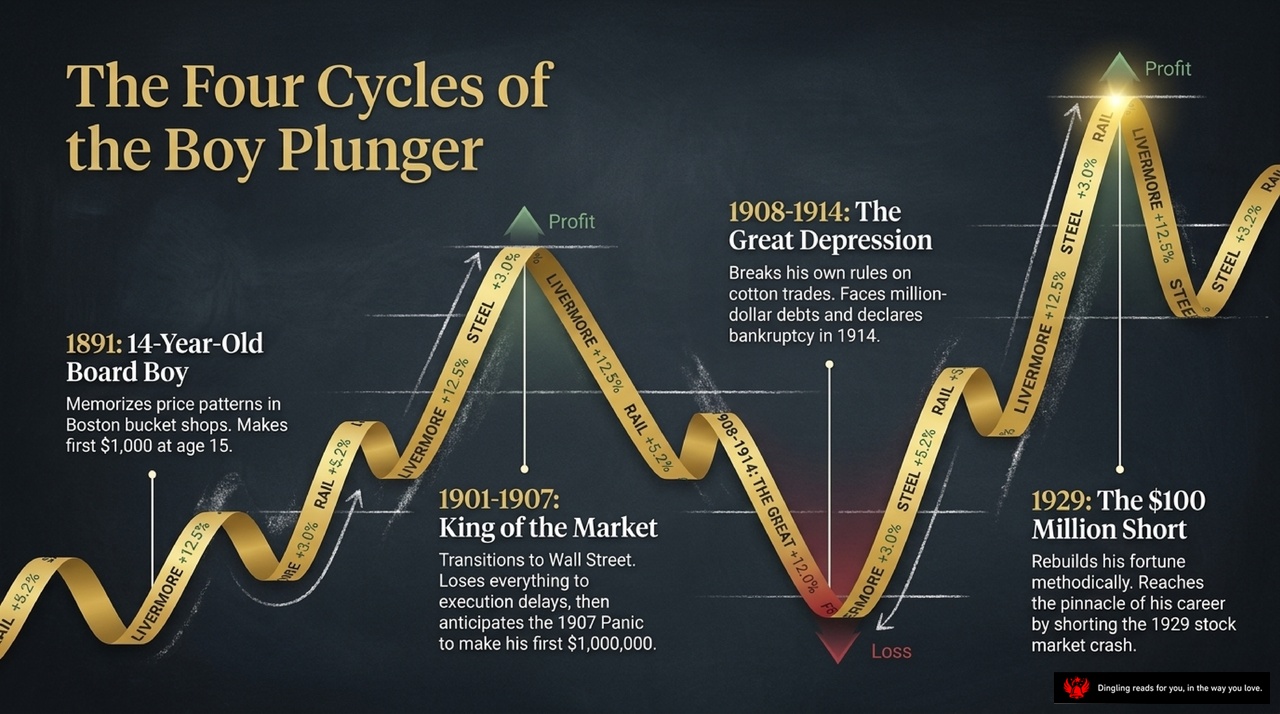
The slide highlights this specific period as the turning point where the protagonist transitions from a gambler to a true market master. You can see the graph dip sharply into "Loss" around 1907, marking the Great Depression and the subsequent bankruptcy of many, including our hero. The text explains that on October 24th, 1907, the market faced a catastrophic collapse as liquidity dried up completely. Borrowers were desperate, and the entire financial system teetered on the brink of ruin.
However, look closely at the narrative associated with this crash. While the world was panicking, the protagonist made a bold, counter-intuitive decision. Instead of continuing to short the market for profit, he realized that further selling would cause irreversible damage to the economy. He immediately covered his short positions and switched to buying heavily, purchasing 100,000 shares. This decisive move not only saved the market but also cemented his status as the "King of the Market." By the end of that year, his net worth finally surpassed one million dollars.
This moment wasn't just about luck; it was about mastering the core principle of trading: understanding the bigger picture over immediate profit. He learned that the true essence of speculation lies in anticipating major trends rather than betting on small price fluctuations. This single day in 1907 transformed him from a reckless gambler into a disciplined professional, proving that sometimes, the greatest profit comes from knowing when to stop fighting the tide and instead, help steer the ship.

In this slide, we're looking at the "Evolution of a Speculator," specifically focusing on Step 3: Trading the Macro Trend. This is where the journey truly transforms from gambling into a disciplined art.
As the graphic illustrates, the final breakthrough comes from the ultimate realization inspired by a veteran trader known as "Old Partridge." The key insight here is simple yet profound: "It's a bull market, you know." This phrase encapsulates the shift in focus. The big money is not found in individual fluctuations or trying to outsmart the market with every minor swing, as we saw in the earlier steps. Instead, true success lies in the main sweep of the market.
Look at the trajectory on the right side of the chart. In Step 1, the speculator was betting on micro-fluctuations, asking only, "What is the price doing right now?" In Step 2, they tried to anticipate every move, but the result was often buying right and selling too early. But in Step 3, the strategy changes completely. The focus shifts to the big picture. You stop chasing the noise and start riding the trend.
This mindset allows you to ignore the short-term volatility that usually traps amateur traders. Instead, you align your position with the dominant force of the market. Whether it's a massive bull run or a deep bear market, the goal is to stay in the game as long as the trend holds. By trading the macro trend, you stop fighting the market and start working with it, turning speculative risk into calculated opportunity.

The day the market turned from chaos to clarity. October 24, 1907. The date that made me a king.
Look at this quote from J.P. Morgan's emissary to Livermore: "We hope he will not sell any more stock today. The market cannot stand much more pressure." This was the calm before the storm, or rather, the desperate plea to stop the bleeding.
But here is where the story gets fascinating. The slide breaks down the drama into three acts: The Setup, The Climax, and The Reversal.
In **The Setup**, Livermore had anticipated a severe liquidity crisis. He saw the writing on the wall. So, he heavily shorted the market, betting that prices would crash. He was right about the trend, but wrong about the timing.
Then came **The Climax**. By the afternoon, there was absolutely no money left to buy stocks. Wall Street was virtually bankrupt. Panic was total. Everyone was selling, and no one could buy. This is the moment of maximum fear.
But here is the genius move in **The Reversal**. Realizing that further panic would destroy the entire economy, Livermore made the most difficult decision a trader can make. He covered his shorts and bought 100,000 shares. He bought when everyone else was running for the exit. He turned the tide and secured his first million dollars.
This wasn't just about luck; it was about understanding that when the market is at its absolute lowest, the reversal is often just one step away. Livermore stopped being a gambler and became a master of the situation. That is the day he became king.

The Illusion of the "Bargain"
Look at this chart. It shows a stock dropping from $150 to $130. On the surface, it looks like a golden opportunity. This is what we call "The Amateur View." The amateur thinks, "It was $150, now it's $130. It's a bargain. It must bounce back." They see a discount and immediately buy, chasing the drop.
But look at the other side. This is "The Livermore View." When the price dropped 20 points, the trend was broken. The line of least resistance is down. Selling pressure is overriding buying pressure. The smart money knows that a big decline is rarely a buying signal; it's a warning sign that the downtrend is still intact.
This is the core trap of every trader. We are wired to buy low and sell high, but the market often forces us to do the opposite. We buy because it looks cheap, and we sell because it feels expensive. But the real rule, as written right here at the bottom, is simple yet hard to follow: Never buy a stock just because it has had a big decline from its previous high. And never sell a stock just because it seems high-priced.
True profitability comes from following the trend, not from guessing the bottom or the top. If the trend is down, a "bargain" is actually a liability. If the trend is up, a "high price" is just momentum. Stop looking for deals that look too good to be true, and start respecting the direction of the market.

The Line of Least Resistance isn't just a chart pattern; it's the fundamental heartbeat of the market. As the slide illustrates, prices don't move in straight lines; they dance within a range, oscillating between support and resistance until a decisive moment arrives. Look at that jagged white line—it represents the struggle. But once momentum breaks through that $1.20 threshold, the path of least resistance shifts upward, and the game changes.
This concept is the core of our trading philosophy. We aren't here to predict the future or guess where prices will go next. Our job is simply to wait. We wait for the market to declare its direction through a clear breakout. As the text reminds us, "Don't argue with the tape." When the line of least resistance is established, you follow it without hesitation.
Think back to the wheat example. Instead of buying at 1.14 because it felt "cheap," we waited patiently for the price to breach the 1.20 level. Why? Because only then did we have confirmation that upward force had finally overcome the selling pressure. That crossing point proved the trend was real, not just a temporary fluctuation. This is the difference between gambling and professional trading: we don't fight the market; we align ourselves with its momentum. Once the breakout happens, we deploy our capital with confidence, knowing we are riding the wave rather than trying to swim against the current.
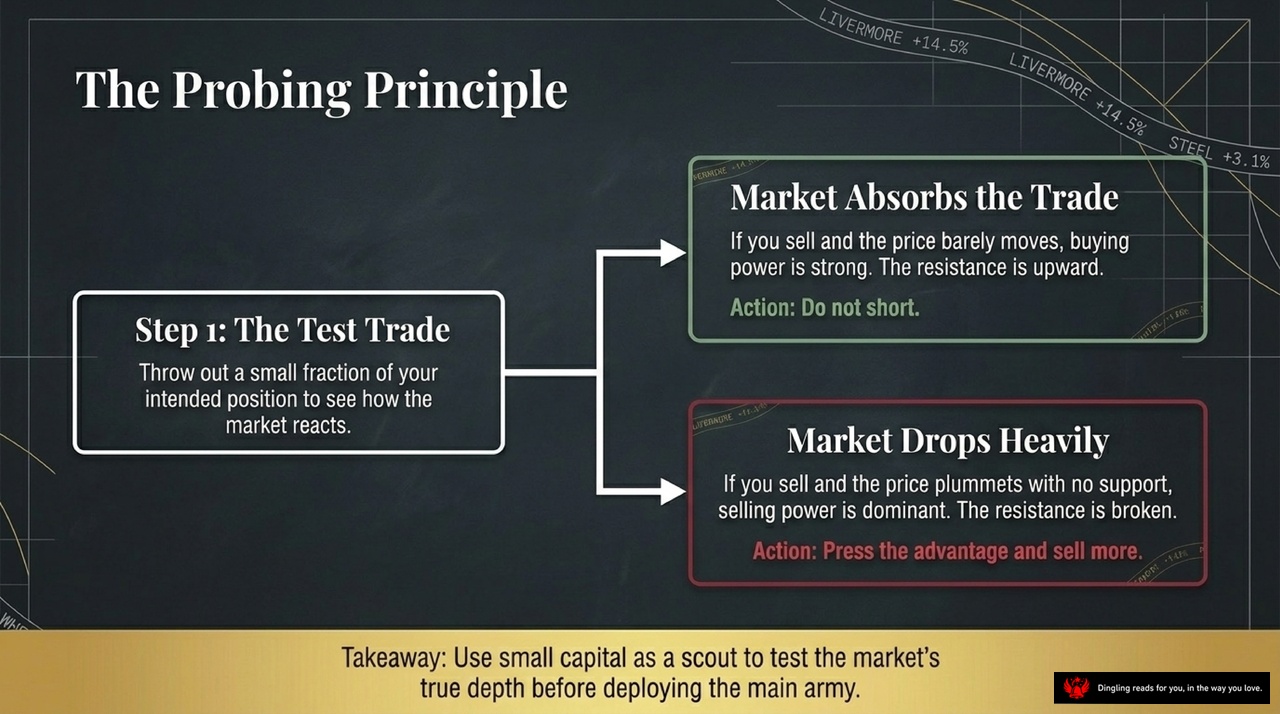
Have you ever wondered why some stocks skyrocket while others crash, even when the news looks the same? The answer often lies in who is actually pulling the strings. Today, we're diving into a crucial lesson from *Reminiscences of a Stock Operator*: the hidden game of internal manipulation and the traps it sets for the average investor.
The slide highlights a terrifying reality: when a stock suddenly surges without a logical reason, it's often not a sign of strength, but a signal that insiders are dumping their holdings. Look at the case of the New Haven Railroad. It was once the most prized stock in New England, soaring to $255. But behind the scenes, insiders knew the company was heading for bankruptcy due to poor management. Instead of telling the public the truth, they quietly sold their shares. When the price finally collapsed, they blamed it on "short sellers" trying to crush the market, convincing everyone to hold on while they made their final exit. That's a lie that cost thousands of investors their life savings.
Another example is the Interver Petroleum Company. Manipulators pumped the price to $50, then started selling off. When the public panicked and asked what was happening, the operators claimed it was a short squeeze and promised to clean up the shorts. In reality, they were just offloading more shares. They even threatened to punish anyone who tried to short them, ensuring the public stayed trapped at the top.
The core problem here is human nature. We love tips and anonymous "insiders." Brokers often encourage us to buy stocks that insiders are trying to sell because it earns them commissions. They might promise that a "prominent insider" is buying, but these stories are often fabricated to lure you in. The law punishes those who spread bearish rumors, but it rarely stops insiders from lying with bullish ones. This creates a dangerous imbalance where the public loses far more money than they ever would from bad news.
So, what's the takeaway? Never trust an explanation for a price drop. If a stock is falling, it's likely because the smart money is leaving. If it's rising without a clear reason, be careful—someone might be pushing the price up to sell to you. As the book teaches us, the stock market has no need for explanations. If the trend is up, follow it. But if it turns down, don't wait for an excuse. The insiders will never tell you the truth. Protect your capital by relying on the actual price action, not on stories. Because in the end, the only thing that matters is the market's true direction, not the lies we tell ourselves.

The enemy within is always boring from within.
Trading isn't about beating the market; it's about defeating yourself. Look at that tangled mess in the head—it represents the constant internal conflict every speculator faces. We are wired to chase what feels safe, but in trading, safety is often the most dangerous trap. What feels dangerous is usually where the real money lies.
The market never defeats you; you defeat yourself. You can have mathematical genius and sharp observation, but without emotional control, you will fail utterly. The real battle isn't against external forces or other traders; it's against your own natural impulses.
The conflict is this: trading requires acting in direct opposition to human nature. We crave certainty, but the market is defined by uncertainty. We want to hold onto winners too long and cut our losers too early, driven by fear and greed rather than logic.
The argument is clear: your greatest enemies are the boring ones inside your own head. If you cannot master your emotions and stick to your principles, no amount of market knowledge will save you. The path to success starts with conquering the chaos within.

Look at this "Diagnostic Matrix: Hope vs. Fear." It perfectly captures the psychological divide between how amateurs and professionals trade. Notice the stark contrast: when you're in a loss, the amateur instinct is to *hope* the market bounces back, refusing to cut the loss. That small loss eventually becomes devastating. But the professional instinct is to *fear* that small loss growing into a fatal one, so they cut the trade immediately to preserve capital.
Flip it to when you're in a profit. The amateur *fears* profits evaporating, so they cash out too early, missing the macro trend. The professional, however, *hopes* the profit will multiply into a massive trend and sits tight to capture the big money.
This matrix isn't just theory; it's the difference between gambling and investing. Hope keeps you trapped in bad trades, while fear forces you to protect your gains and stay alive for the next big opportunity. Mastering this switch from hope to fear is the single most important lesson in trading.
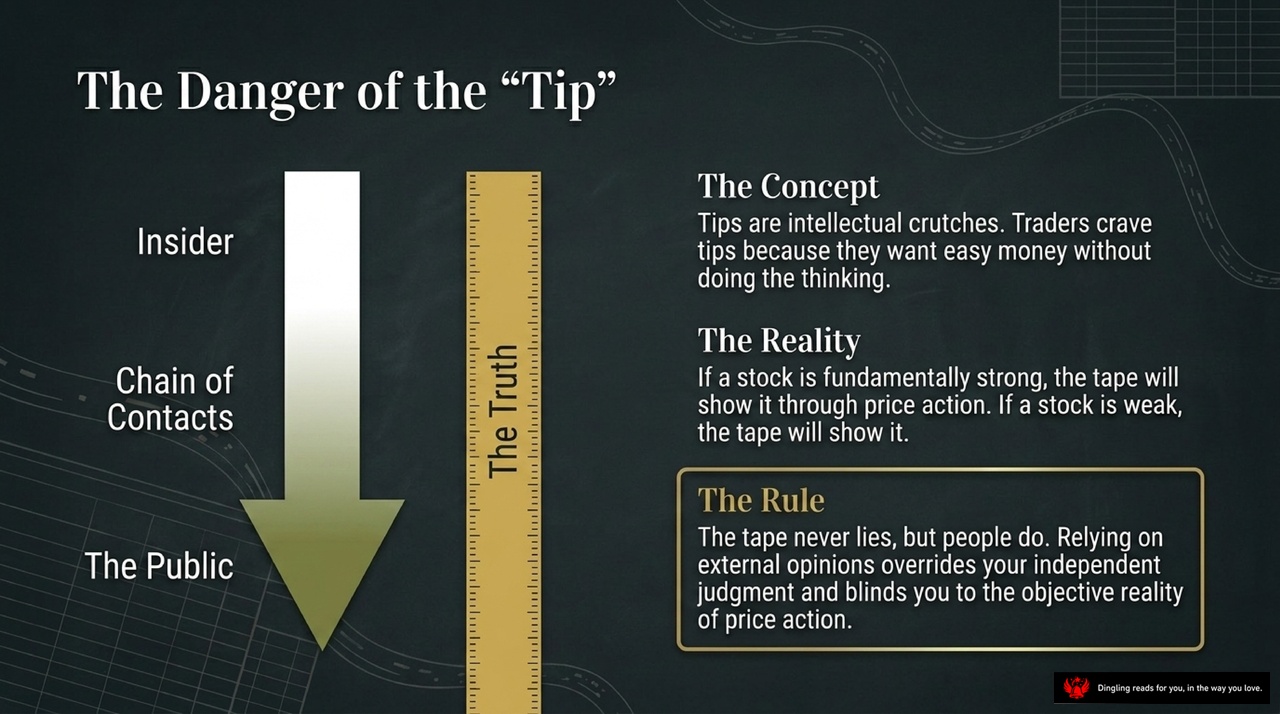
The tape never lies, but people do. This is the most dangerous truth a trader can face. Look at this chart: it shows how the "tip" acts as an intellectual crutch. Traders crave tips because they want easy money without doing the thinking. They rely on insiders, chains of contacts, or just the general public, hoping someone else will make the call for them. But here is the reality: if a stock is fundamentally strong, the tape will show it through price action. If a stock is weak, the tape will show that too. Relying on external opinions overrides your independent judgment and blinds you to the objective reality of price action. True success comes from trusting the data right in front of you, not the noise coming from strangers.

Let's talk about how smart money actually deploys capital. Forget the idea of throwing everything in at once. The golden rule here is simple: never buy your entire position all at once, and absolutely never average down on a losing trade.
Look at this step-by-step approach. It all starts with Step 1: buy just 20% of your intended position right at the breakout. This is your test. Then, you move to Step 2 and 3: wait. If the stock falls, the timing was wrong. Take that small loss immediately. But if the stock rises, the tape confirms your thesis, and that's when you buy the next 20%.
Finally, we get to Step 4. You continue scaling in ONLY as the price confirms your judgment, until the full position is built. This disciplined method protects you from getting trapped in bad trades while letting you ride the wave of a real breakout.
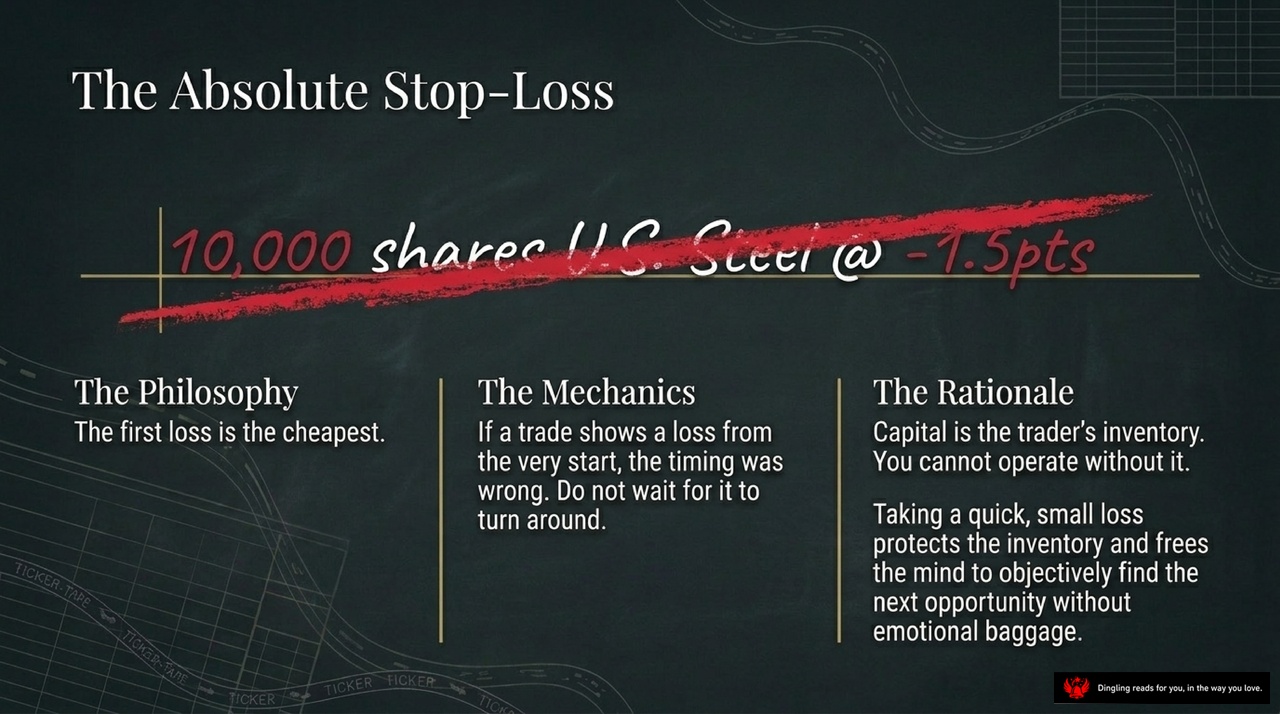
The first loss is the cheapest. This isn't just a catchy phrase; it's the absolute bedrock of professional trading. Look at that crossed-out order for 10,000 shares of U.S. Steel. That red line represents a critical moment: the decision to cut the loss immediately rather than waiting for a miracle turnaround.
The mechanics are simple but powerful. If a trade shows a loss from the very start, the timing was simply wrong. Do not wait. Do not hope. The moment you realize the direction is against you, you exit. This quick, small loss protects your capital—the trader's actual inventory—and frees your mind from emotional baggage. It allows you to remain objective and hunt for the next real opportunity.
The philosophy behind this is clear: capital is your most valuable asset. You cannot operate without it. By taking a quick exit, you preserve your inventory and your peace of mind. In the high-stakes world of speculation, the ability to stop a loss instantly is often the single most important skill a trader can master.

Inaction is often mistaken for weakness, but in the world of trading, it is actually one of the most powerful strategies of all. As the slide illustrates, the real secret to making big money isn't constant action—it's the courage to sit still.
Most traders suffer from the opposite problem: they feel compelled to act every single day. They over-trade, jumping in and out of minor fluctuations, losing their core position before the real move happens. They mistake noise for signal. But the solution is simple yet difficult to execute. Once a position is established along the line of least resistance, you do nothing. You ignore the daily noise and have the courage to sit tight until the tape proves the trend has fundamentally reversed.
Remember the wisdom of the old hand: "It was never my thinking that made the big money for me. It always was my sitting." True profit comes not from how often you trade, but from how well you hold your conviction when the market is moving in your favor. Patience is the ultimate edge.

Wall Street has never changed. As the image suggests, there is nothing truly new here because speculation is as old as the hills. Look at this infinite loop: Boom, Greed, Panic, Fear. It repeats endlessly. The mechanics of trading have evolved from bucket shops to algorithmic servers, and the names of the companies have changed, but the players and the price patterns remain exactly the same. Why? Because markets are driven by human nature. Our emotions—hope, fear, and greed—never change.
I learned this the hard way. Years ago, I was convinced I could beat the market by predicting every small fluctuation, just like a gambler. I would buy low and sell high based on gut feelings or tips from strangers. But the market didn't care about my ego or my clever tricks. When I finally stopped trying to control the market and started following the trend instead, everything changed. I stopped chasing every little move and learned to hold my positions when the big picture looked right. That shift from gambling to disciplined trading is what allowed me to survive the crashes and thrive in the booms. The lesson is simple: respect the market, understand your own psychology, and let the trends do the work for you.

So, what are the non-negotiable rules that turned a gambling addict into a market master? Let's break down the four pillars of Livermore's Master Rules.
First, Trade the Trend. This is the golden rule: never fight the market. Only trade when the overall direction is crystal clear. If the market is a bull, you buy; if it's a bear, you sell. Trying to outsmart the trend is the fastest way to lose your shirt.
Second, Buy Strength, Sell Weakness. This means you only buy stocks that are making new highs and sell those making new lows. Don't try to catch a falling knife or buy the dip before it's confirmed. Let the price tell you the story.
Third, Trust the Tape. This is about discipline. Ignore opinions, tips, and even fundamental logic if the price action disagrees. If the chart says go, you go. If the chart says stop, you stop. Your own analysis is useless if the market is telling you a different story.
Finally, Rest the Mind. Never trade every single day. There are times when cash is the only position you should hold. Taking breaks isn't laziness; it's essential for preserving your capital and your sanity.
Master these four rules, and you stop gambling and start trading like a professional.

Look at this torn piece of paper on the screen. It's titled "The Ultimate Price," and it captures the tragic end of Jesse Livermore, one of the greatest speculators in history. In 1940, despite his unmatched mastery of market mechanics and the vast fortunes he won, Livermore took his own life, leaving a note stating his life was a failure.
Why did a man who could predict the market so accurately end in despair? The final lesson here is stark: speculation is a grueling, all-consuming profession. Mastering the market is entirely possible, but surviving the psychological burden requires a balanced life outside the ledger. The market can give you millions, but it cannot give you peace.
This image reminds us that no amount of financial success can replace inner stability. For traders, the ultimate price isn't just the money you lose or gain; it's the cost of letting the market dictate your entire existence. True mastery means knowing when to step away, to live a full life, and to understand that while the charts can teach you about money, only you can teach yourself about peace.