
Rendezvous with Rama: Complete Chapter-by-Chapter Summary
Welcome to *Rendezvous with Rama*, a novel by Arthur C. Clarke. Imagine a classified United Planets telemetry dossier detailing humanity's first encounter with an indifferent cosmic leviathan. This story begins not with a bang, but with a terrifying realization: Earth is not a safe island. From the Tunguska explosion in 1908 to the devastating asteroid strike in 2077, we learned that the universe is full of threats we cannot ignore. In response, we launched the "Space Guard" program to track potential dangers. But fate has a way of turning our defenses into something far more extraordinary. Fifty years later, that defensive system detects an object so massive and alien that it shatters every assumption we have about the cosmos. It is a cylinder, fifty kilometers long, drifting silently through our solar system. This is Rama, a visitor from the stars that will change everything we know about life, technology, and our place in the universe.

On the left, we see a timeline tracing humanity's terrifying awakening to cosmic threats. It starts with the Tunguska and Vladivostok explosions in 1908 and 1947, then jumps to a catastrophic 2077 impact in Italy that wiped out 600,000 lives. In response, Project SPACEGUARD launches in 2078, building a planetary defense radar network. By 2130, that system detects something unprecedented beyond Jupiter: Anomaly 31/439, designated RAMA.
On the right, the radar display reveals what makes RAMA so dangerous. It's not a normal asteroid orbiting the sun. The trajectory shows it moving too fast for solar capture—a solitary interstellar vagabond hurtling through our system at impossible speeds. This isn't just a passing rock; it's an object from another star system, arriving with a velocity that defies our current understanding of local space. The concentric rings represent the radar's sweep, locking onto a target that humanity has never seen before. This is the moment our planet's luck runs out, and the first true contact with the unknown begins.

Imagine a world where the laws of physics you know are nothing more than a suggestion. Picture a hollow cylinder, fifty kilometers long and twenty kilometers wide, spinning so fast that it creates artificial gravity. On the inside equator, that rotation generates a centrifugal force exactly equal to 1G—just like standing on Earth. But here's the terrifying catch: if you try to land anywhere except the absolute center of the poles, the extreme rotation will fling you into space at lethal speeds.
This is the reality of "Rama," a massive, man-made artifact drifting through our solar system. It's not a natural asteroid; it's a hollow shell with a mass of ten trillion tons, confirmed by gravitational readings. Its surface is a monotone gray, punctuated by a single, mysterious one-kilometer-wide mark around its middle. When humanity finally landed on its north pole, the silence was deafening. No radio signals, no vibrations, just the faint tremor of solar heat.
But the true magic of Rama lies in its interior. As explorers stepped out onto the "North Hemisphere," they found a landscape that defied imagination. Instead of a flat floor, they stood on the inner wall of a giant bowl. The "ground" they walked on was actually the curved ceiling, with the axis of rotation above their heads. The centrifugal force pulled them outward, making the curved wall feel like solid ground. Beyond the central plains, three massive spiral ramps stretched hundreds of kilometers into the sky, leading to platforms and eventually to the vast "Cylindrical Sea"—a ring of ice and water encircling the world.
As the sun warmed Rama, the ice began to melt, revealing a strange, rapid evolution of primitive life forms in the water. But the mystery deepened when a storm brewed. The rising heat created super-fast winds, tearing across the interior like a hurricane. It was a closed ecosystem, a self-contained machine designed for interstellar travel, where every detail—from the geometric cities named after Earth's metropolises to the silent, waiting machinery—suggested a civilization far beyond our own. Rama wasn't just a ship; it was a testament to engineering that could make the impossible, perfectly ordinary.
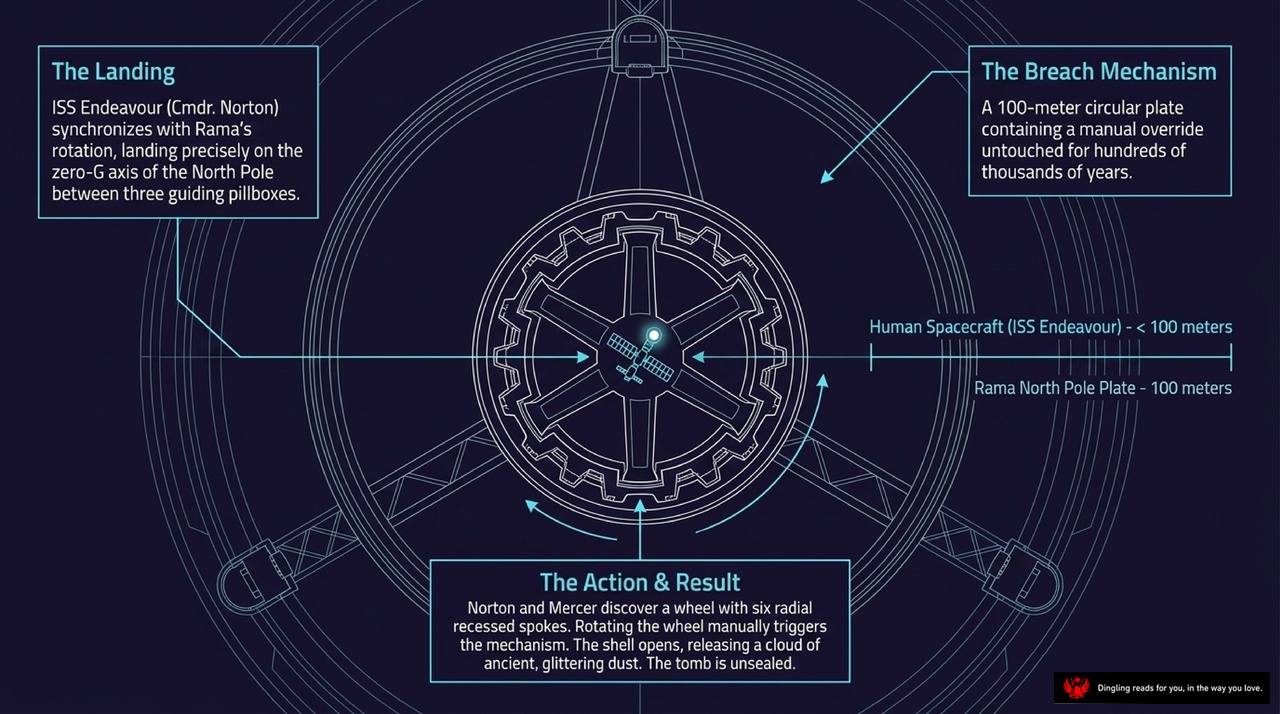
When the storm finally broke, the silence inside Rama was replaced by something far more unsettling. Commander Norton and his crew returned to find a world that had completely transformed. The blinding blue light of the artificial suns had softened into a gentle, foggy daylight, and the air itself had changed. The oxygen levels had surged past fifty percent, and humidity climbed to eighty percent, creating a humid, living atmosphere that required no masks.
But the most shocking discovery wasn't the air—it was the sound. As they descended the ladders, they heard a roar that defied logic: a massive waterfall cascading across the dome, bending away from gravity in a perfect arc. It was the most vivid proof of the Coriolis effect imaginable. And when they finally reached the equatorial sea, the color had shifted from deep blue to a vibrant pea green. Within just forty-eight hours, the water had teemed with primitive, single-celled organisms. Evolution, accelerated to a pace unimaginable on Earth, was happening right before their eyes.
They launched the "Resolute," a makeshift raft named after Captain Cook, to explore the "New York" island. What they found there shattered any hope that this was a city for humans. There were no doors, no windows, and no signs of daily life. Instead, they discovered a vast, intricate machine cluster built from perfect geometric shapes. Roads formed a maze of concentric circles and radial lines, a labyrinth designed for function, not comfort. Every surface was sealed tight, accessible only by explosives or lasers. It looked less like a home and more like a sleeping factory, waiting for a command that hadn't come.
The mystery deepened when they explored the interior of the structures. Inside the walls, they found crystalline columns containing holographic images of tools, instruments, and even a uniform designed for a creature with three arms. These were three-dimensional templates, a library of blueprints suggesting that Rama's inhabitants could assemble anything from these stored designs. It was a glimpse into a civilization that mastered matter itself, leaving humanity to wonder: who built this, and what were they waiting for?

The diagram on your screen reveals the terrifyingly beautiful geography inside Rama. We see the North Bowl, acting as our zero-G entry axis, and the massive stairways descending into the Northern Plain where we've designated cities like Paris and London. But look at the center: the Cylindrical Sea, a ten-kilometer-wide band of solid ice wrapping the core. And at the far end, the South Pole, guarded by six menacing, spire-like horns.
This layout explains everything we've discovered so far. The ice band isn't just decoration; it's the boundary between our habitable world and the unknown. When we first entered, that ice was frozen solid, but as the sun's heat penetrated, it began to melt. That melting triggered the catastrophic storms we faced, turning the ice into a toxic, boiling ocean that nearly destroyed us.
But the most chilling part of this map is what lies beyond the South Pole. While we explored the North and the central sea, our brave pilot, Jim Park, flew toward those six horns. He found no cities, no life, only a smooth, glass-like structure humming with energy. He discovered that these spires generate a powerful electromagnetic field, capable of frying any electronics that gets too close. It's a warning sign, a defensive perimeter that suggests Rama isn't just a ship—it's a fortress.
As we prepared to leave, the entire structure began to shift. Those spires weren't static; they were part of a propulsion system that allowed Rama to accelerate faster than physics should allow, diving straight into the sun to refuel before vanishing into the Magellanic Cloud. The map shows us where we stood, but it also shows us how small we are in the face of a civilization that has mastered the very fabric of space itself. We came looking for answers, but Rama left us with only questions and a reminder that the universe is far stranger than we ever imagined.
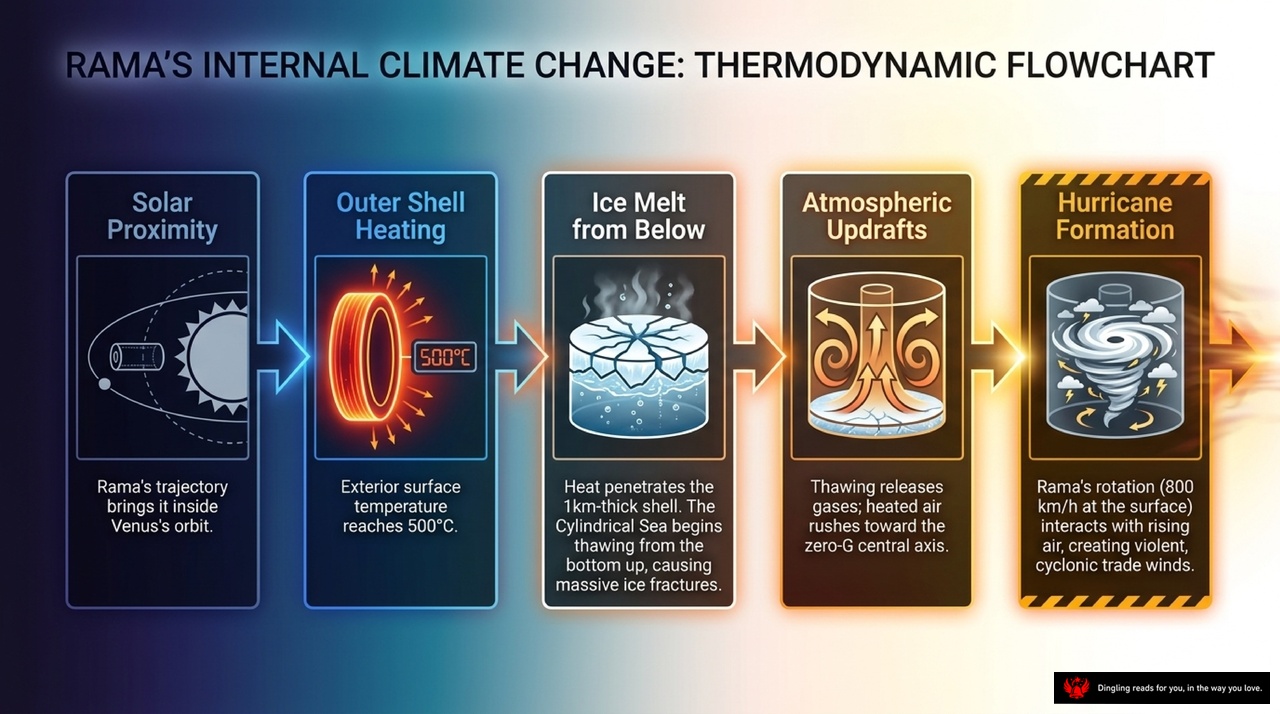
Picture Title: RAMA'S INTERNAL CLIMATE CHANGE: THERMODYNAMIC FLOWCHART
**Spoken Script:**
Welcome to the critical moment where Rama's dormant state shatters. As we move through this thermodynamic flowchart, we see a chain reaction triggered by solar proximity. Because Rama's trajectory brings it inside Venus's orbit, the exterior surface temperature spikes to a scorching 500°C. This intense heat penetrates the 1km-thick shell, causing the Cylindrical Sea to thaw from the bottom up, leading to massive ice fractures.
This melting releases gases that rush toward the zero-G central axis, creating powerful atmospheric updrafts. Here is where the physics gets intense: Rama's rotation spins at 800 km/h at the surface. As the heated air rises, it interacts with this rapid rotation, generating violent cyclonic trade winds. The result is the formation of a full-blown hurricane.
This isn't just a weather event; it's a survival crisis. The rising air and the hurricane force the crew to evacuate immediately. As the storm intensifies, the internal environment transforms from a frozen world into a chaotic, wind-swept arena, proving that even in a sealed cylinder, nature's laws still hold absolute power.

Six trench-like valleys across the interior plain ignite simultaneously, acting as linear suns that bathe the 50km interior in harsh, arc-lamp blue light. For the first time, the crew sees the far side of the cylinder arching 16 kilometers directly above their heads, curving into an impossible sky. Rama is not a dead tomb; it is an active, self-regulating ecosystem.

Welcome to the final piece of our deep dive into *The Three-Body Problem*. Today, we're decoding the "Rule of Three," a design principle that runs through the entire alien civilization of Rama.
Look at this diagram. It breaks down the evidence into three distinct categories, all pointing to one central concept: Raman engineering completely eschews bilateral symmetry in favor of trilateral perfection.
First, let's look at the **Botanical Evidence**. The text mentions an anomalous flower discovered on the southern continent. It features exactly three tube-like petals. This isn't a random mutation; it's a signature of the builders.
Next, we have the **Architectural Evidence**. Think about the layout of the ship. There are three primary airlock systems. Furthermore, there are three mega-stairways—Alpha, Beta, and Gamma—descending from the pole. Even the structure itself is built on a three-sided logic.
Finally, the **Biological Evidence**. The native biological robots, or "Biots," possess three legs, three eyes, or three manipulators. This trilateral design allows for 360-degree vision and omnidirectional movement, giving them a tactical advantage that two-legged creatures simply don't have.
Every single element on this ship, from the plants to the robots to the architecture, follows this rule of three. It suggests a culture that views the number three as the ultimate form of perfection, a stark contrast to our own human-centric, bilateral world.

Welcome to the final revelation of Rama's true purpose. Look closely at this schematic: we are peeling back the layers of this mysterious cylinder to understand how it actually functions.
First, notice the discovery on the right. The island we thought was a living city is actually devoid of homes or human-scale infrastructure. It is nothing more than a massive, automated chemical and manufacturing plant. Inside the glass temple, the crew found forests of crystal pillars. These aren't just decorative; they are the core mechanism. By shining light into these pillars, Rama projects 3D holographic templates of tools, components, and even bizarre biological forms.
This leads to our most critical insight: this is a 1:1 scale catalog. Rama creates its inhabitants on demand, synthesizing them from the organic soup of the Cylindrical Sea based on these crystalline blueprints. There are no traditional people here, only a factory that builds life whenever the system requires it. This changes everything we thought we knew about the visitors we met.
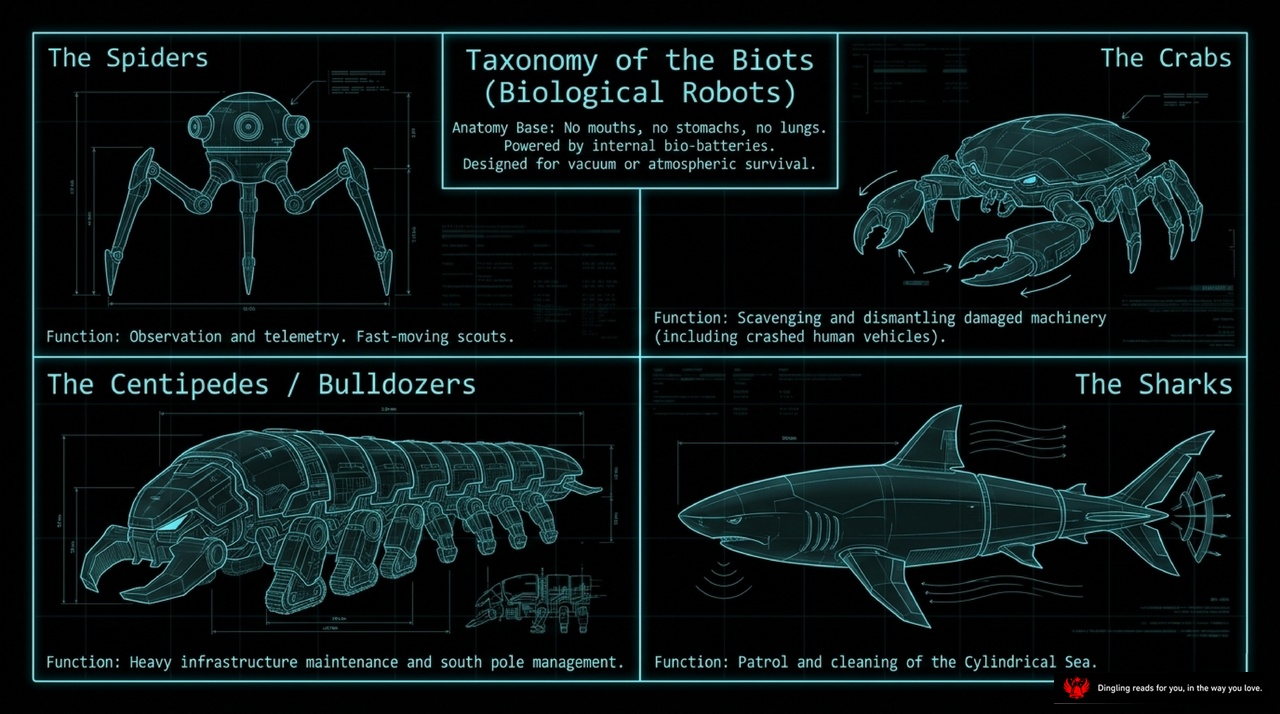
Look at this schematic. We are looking at the "Taxonomy of the Biots"—the biological robots that inhabit this alien world. Notice how they are designed not for comfort, but for pure function.
First, we have **The Spiders**. These are fast-moving scouts built for observation and telemetry. Their job is to gather data from the shadows. Then, over here, **The Crabs**. These aren't just for show; they are scavengers and dismantlers, specifically designed to tear apart damaged machinery, including crashed human vehicles.
Down below, we see **The Centipedes**, also known as Bulldozers. These are heavy-duty machines built for massive infrastructure maintenance and managing the harsh conditions of the South Pole. Finally, we have **The Sharks**. These patrol and clean the Cylindrical Sea, keeping the ecosystem in check.
The central text explains their base anatomy: no mouths, no stomachs, no lungs. They are powered entirely by internal bio-batteries, allowing them to survive in vacuum or atmosphere. This isn't nature; this is engineering. These are not animals; they are a fleet of specialized, self-repairing drones that have been here for millennia, waiting for us to arrive.
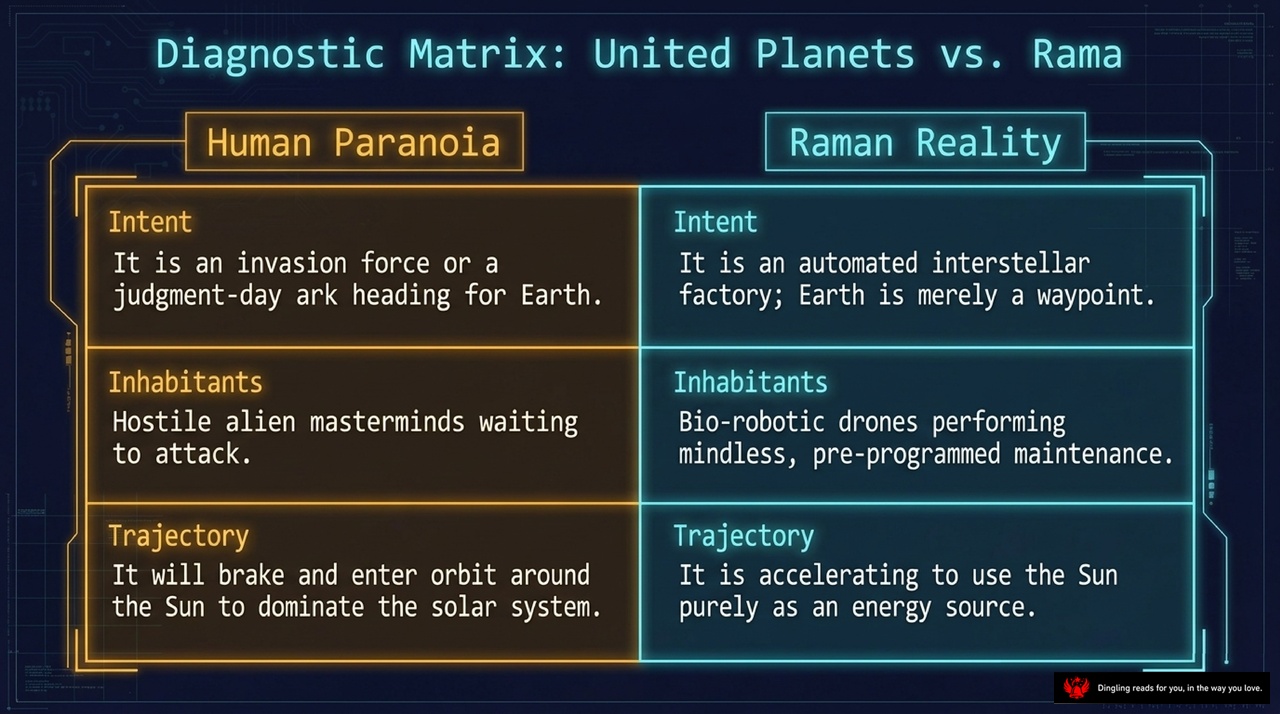
Look at this diagnostic matrix comparing human paranoia against the Raman reality. For decades, we've been terrified that this massive cylinder is an invasion force or a judgment-day ark heading for Earth. We imagined hostile alien masterminds waiting to attack us. But the truth, as revealed by the data, is far stranger. It's not an army; it's an automated interstellar factory where Earth is merely a convenient waypoint. The inhabitants aren't evil conquerors, but bio-robotic drones performing mindless, pre-programmed maintenance. And instead of slowing down to dominate our solar system, this structure is actually accelerating, diving into the Sun purely to harvest it as an energy source. We thought we were the center of the universe, but we were just the fuel.
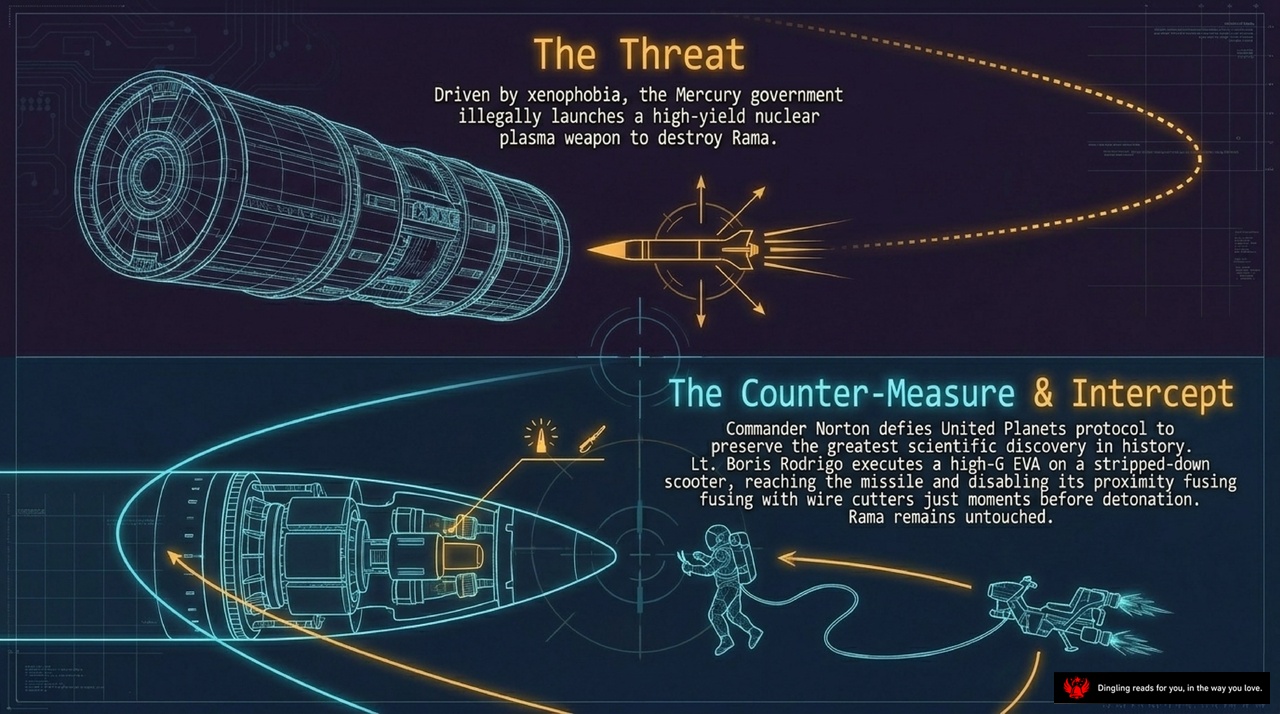
Look at this schematic. It depicts a high-stakes moment of survival. Above, we see the threat: the Mercury government, driven by xenophobia, illegally launches a high-yield nuclear plasma weapon designed to destroy Rama. But below, the counter-measure unfolds. Commander Norton defies United Planets protocol to preserve humanity's greatest scientific discovery. In a breathtaking act of bravery, Lt. Boris Rodrigo executes a high-G EVA on a stripped-down scooter. He reaches the missile just moments before detonation, disabling its proximity fusing with wire cutters. Thanks to this split-second intervention, Rama remains untouched. This page captures the precise intersection of a calculated threat and a heroic, improvisational rescue that saves an entire alien civilization.
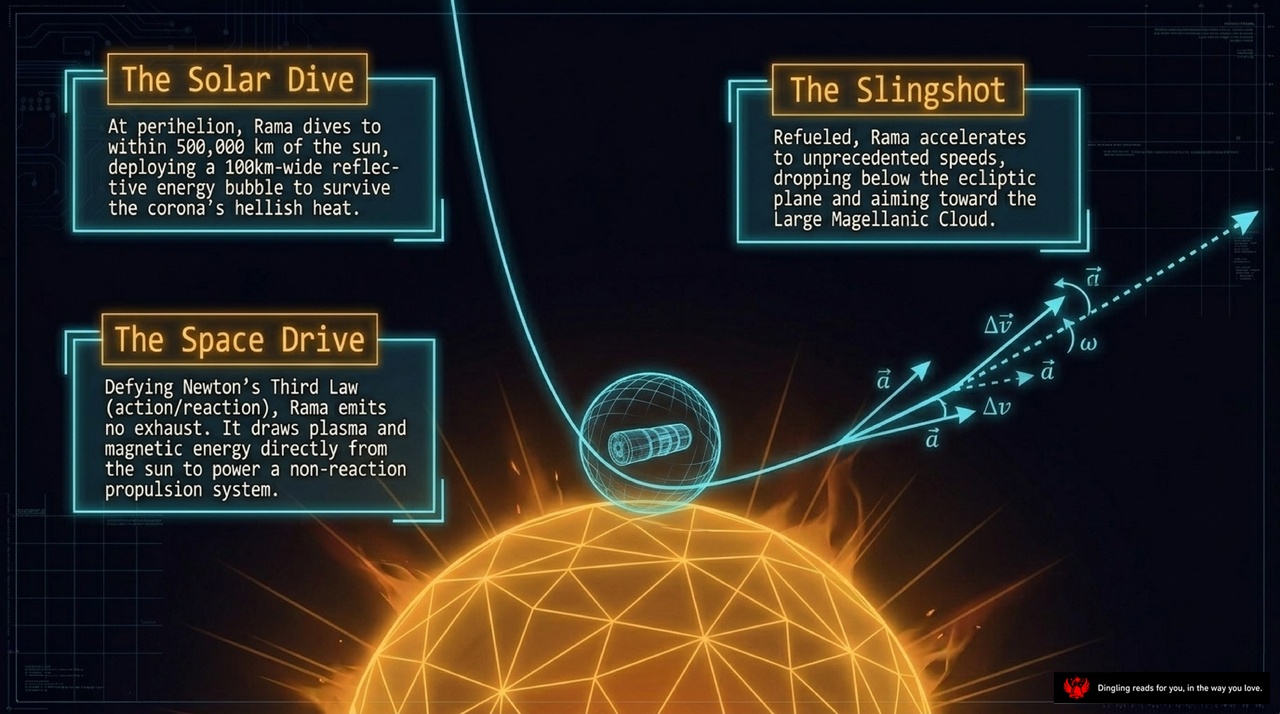
Look at this incredible visualization of Rama's final journey. The image breaks down three critical phases: The Solar Dive, The Space Drive, and The Slingshot.
First, we see **The Solar Dive**. As Rama approaches perihelion, it dives incredibly close to the Sun, within just 500,000 kilometers. To survive the hellish heat of the corona, it deploys a massive 100-kilometer-wide reflective energy bubble, acting as a perfect shield against the intense radiation.
Next, notice **The Space Drive**. This is where physics takes a wild turn. Rama defies Newton's Third Law, meaning there is no exhaust or reaction mass. Instead, it draws plasma and magnetic energy directly from the Sun itself to power a non-reaction propulsion system. It's essentially surfing on the Sun's energy to achieve speeds no other object in our solar system could ever match.
Finally, we see the result: **The Slingshot**. Refueled by the Sun, Rama accelerates to unprecedented speeds. It drops below the ecliptic plane, aiming straight for the Large Magellanic Cloud. In a single pass, it has traveled further than any human-made object in history, leaving our solar system behind forever. This isn't just a flyby; it's a masterclass in interstellar navigation, turning the Sun into a cosmic fueling station.

Look at that streak fading into the void. That's the moment humanity's first real contact ends, but it leaves a scar that never heals. As the ISS *Endeavour* watches *Rama* shrink away into the cosmic darkness, the mission is technically over. No lives were lost, and we all made it home. But the psychological impact? That is permanent.
Here's the hard truth we had to face: we showed up ready for war, diplomacy, and a grand first contact. We prepared for everything except the one thing that actually happened. To the Ramans, we didn't exist. They didn't even know we were here.
To them, Earth was nothing more than a convenient cosmic refueling station. We were irrelevant. The universe is vastly older and more advanced than we ever comprehended. We thought we were the main characters of the cosmos, but we were just a brief, unnoticed stopover. That indifference is the most terrifying discovery of all.
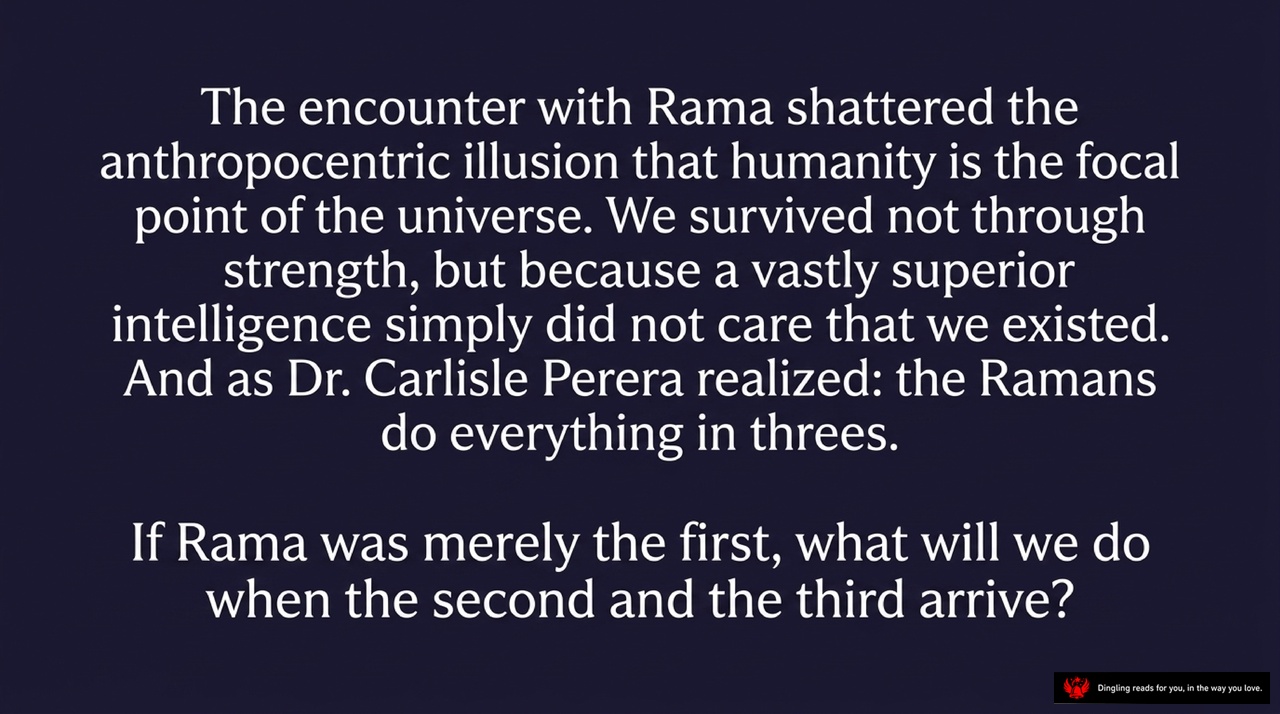
The encounter with Rama shattered the anthropocentric illusion that humanity is the focal point of the universe. We survived not through strength, but because a vastly superior intelligence simply did not care that we existed. And as Dr. Carlisle Perera realized: the Ramans do everything in threes.
If Rama was merely the first, what will we do when the second and the third arrive?