
ReOrient: Complete Chapter-by-Chapter Summary
Welcome to our book club session on *ReOrient: Global Economy in the Asian Age* by Andre Gunder Frank. Today, we're diving into a paradigm-shifting history that challenges everything we think we know about the past. For centuries, Western theory has been built on the idea that Europe is the sole engine of world history, a "civilization" that woke up the supposedly stagnant East. But Frank argues this isn't just a mistake—it's a deliberate fiction designed to justify colonialism.
Look at the map behind us. It depicts a world where Asia wasn't a backwater waiting to be civilized, but the undisputed core of the global economy centuries before the West ever rose. In fact, until around 1800, Asia dominated everything. China, India, and the Islamic world weren't just participants; they were the masters. Europe was the edge, the periphery. The "rise of the West" wasn't a birth of something new and superior; it was Europe hitching a ride on the back of the Asian economy, using silver from the Americas to buy its way into a market it couldn't compete with on its own.
Frank calls this a "paradigm-shifting history." He reveals that the global economy was deeply integrated, with Asia at the center, long before the Industrial Revolution. The West didn't conquer the world; it was invited in, or rather, it squeezed in, by leveraging the silver mines of the Americas to pay for Asian goods like silk, porcelain, and spices. The real story isn't about European uniqueness or destiny. It's about a global system where the center was in Asia, and what we call "modernity" is actually just a temporary shift in the center of gravity. By rejecting this Eurocentric narrative, we finally see the truth: history belongs to the whole world, not just one corner of it.
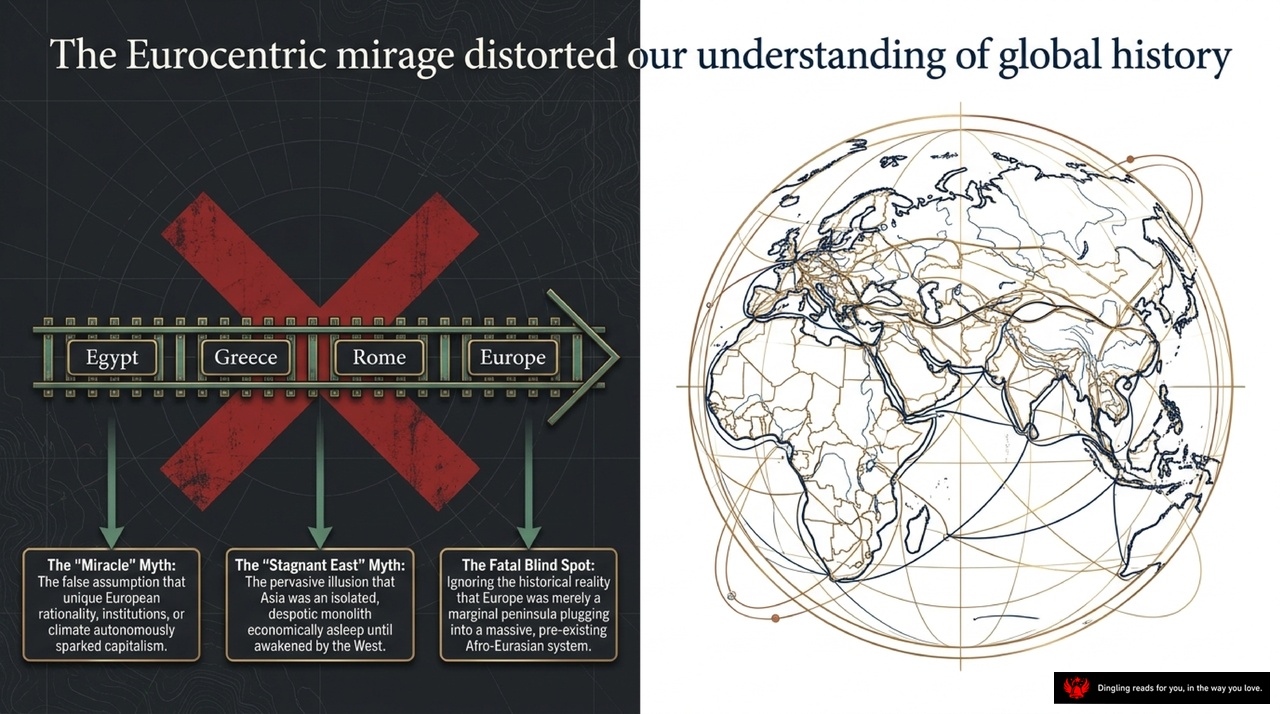
The Eurocentric mirage has long distorted our understanding of global history, convincing us that Europe was always the engine of civilization. But look at this slide: it reveals the three great myths we must dismantle to see the truth.
First, the "Miracle Myth." This is the false assumption that Europe's unique rationality or institutions autonomously sparked capitalism. The image shows a timeline where Egypt, Greece, and Rome feed into Europe, but the red X cuts through it, signaling that this linear, isolated view is wrong. Europe didn't start from nothing; it was part of a much older, global system.
Second, the "Stagnant East" Myth. The slide points to Asia, labeling it a despotic monolith asleep until the West woke it up. This is the pervasive illusion we need to reject. In reality, from 1400 to 1800, Asia was the world's economic core. China and India were not stagnant; they were the primary producers, consumers, and the ultimate "silver vault" that attracted metals from the Americas and Japan.
Third, the Fatal Blind Spot. The image highlights a massive world map, showing Europe as just a marginal peninsula plugged into a massive, pre-existing Afro-Eurasian system. The real story isn't about Europe rising on its own, but about Europe using American silver to buy its way into a market dominated by Asia.
So, how do we fix this? We must stop looking at Europe as the center and start seeing the global whole. The truth is simple: Europe's rise was a temporary shift in the global structure, not a victory of superior civilization. By rejecting these myths and adopting a global perspective, we finally understand that history belongs to everyone, not just one continent.

Classical social science was built on an illusion. For centuries, theorists like Marx, Weber, and Braudel convinced us that Europe was the sole engine of history, while the rest of the world, especially Asia, was stagnant or backward. But the data tells a completely different story.
Look at the table. On the left, we see the Eurocentric claims. Marx argued that Asia was isolated and required Western intervention to progress. But the reality? Asia possessed highly dynamic, commercialized, and expanding markets with sophisticated credit systems long before 1800. Weber claimed that only the "Protestant Ethic" drove capitalism. Yet, Asian institutions managed massive, complex bureaucracies and highly rationalized, profit-driven trade networks operating on strict commercial logic. Braudel suggested Europe built a "world-economy" around itself. In truth, Europe merely assimilated into a massive, preexisting Afro-Eurasian global economy, adapting to its established rules.
The truth is, until around 1800, Asia was the true core of the global economy. Europe's rise wasn't a triumph of superior civilization; it was a temporary advantage gained by leveraging American silver to enter an Asian-dominated market. To understand the real world, we must stop viewing history through a single national lens and embrace a global perspective that sees all regions as interconnected parts of one economic system.
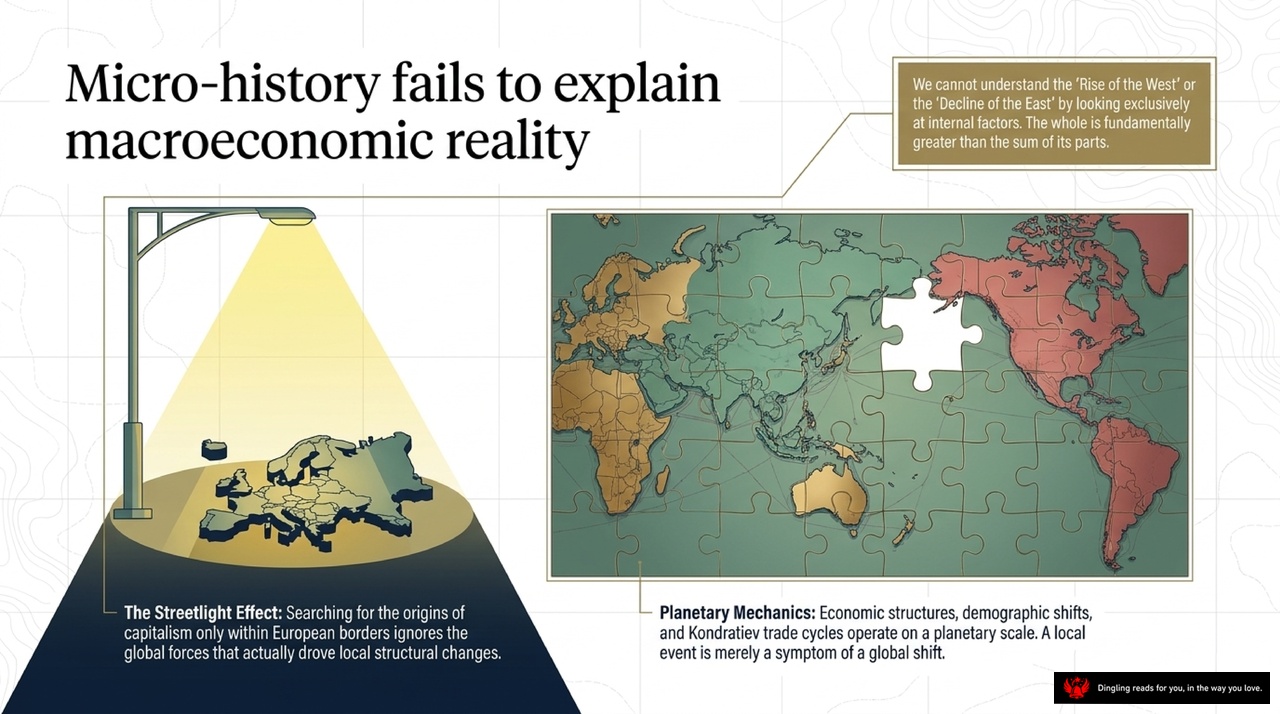
Micro-history fails to explain macroeconomic reality. This slide argues that looking only at internal factors within Europe cannot account for the "Rise of the West" or the "Decline of the East." The truth is, the whole is fundamentally greater than the sum of its parts.
On the left, we see the "Streetlight Effect." This metaphor illustrates a dangerous flaw in traditional history: searching for the origins of capitalism only within European borders. It's like searching for lost keys only under a streetlamp simply because that's where the light is. By focusing exclusively on Europe, we ignore the massive global forces that actually drove local structural changes. We mistake a local symptom for the global cause.
On the right, the image shows a world map as a puzzle with a missing piece in the Atlantic. This represents "Planetary Mechanics." Economic structures, demographic shifts, and Kondratiev trade cycles operate on a planetary scale, not a national one. A local event in Europe is merely a symptom of a global shift happening across the entire system.
The core message here is clear: you cannot understand the rise of the West by studying Europe in isolation. You must adopt a global perspective. The West didn't rise because it was inherently superior; it rose because it successfully integrated into a global economy where the center was actually Asia. The East didn't decline due to internal stagnation; it shifted as the global economic center of gravity moved. To truly understand history, we must stop looking at isolated pieces and start seeing the entire interconnected puzzle.

Look at this map. It tells a story that completely overturns what we've been taught in school. Until at least 1800, the epicenter of global production, trade volume, and wealth accumulation was resolutely Asian. The gravity of the early modern world wasn't pulling toward Europe; it was anchored firmly in Asia.
See this central point labeled "China (The Ultimate Sink)"? This was the undisputed center of gravity. China wasn't just a participant; it was the engine. It held the unmatched advantage in high-volume manufacturing of silk and ceramics, effectively absorbing the world's wealth. The map shows the concentric rings radiating outward, illustrating how China acted as the ultimate sink for global capital.
Just to the south, you see "India (The Textile Powerhouse)." This was the engine of global textiles. India wasn't a stagnant village; it was a massive exporter of value-added manufactured goods, feeding markets in both the East and the West. Together, China and India formed the backbone of the global economy.
Now, look over here at "Europe (The Peripheral Peninsula)." The map is very clear: Europe was a late-arriving, resource-poor edge of the Eurasian landmass. It operated with a persistent structural trade deficit. Europe could not produce enough to compete with Asian goods. It was essentially a peripheral region that had to rely on something else to survive in this system.
So, how did Europe manage to be there? The answer lies in the arrows pointing from the Americas. Europe didn't lead the world; it hitched a ride. By exploiting the silver mines of the Americas, Europe acquired the precious metal it needed to pay for Asian goods. It used American silver as a "ticket" to enter a market it couldn't otherwise access. The wealth of the world flowed from the Americas to Europe, and then from Europe to Asia to buy Chinese silk and Indian cloth.
This visual proves that the "rise of the West" was not a story of European superiority or unique genius. It was a temporary advantage gained by standing on the shoulders of the Asian economic giant. For centuries, the true center of gravity was Asia, and Europe was just the peripheral player waiting for the rules of the game to change.
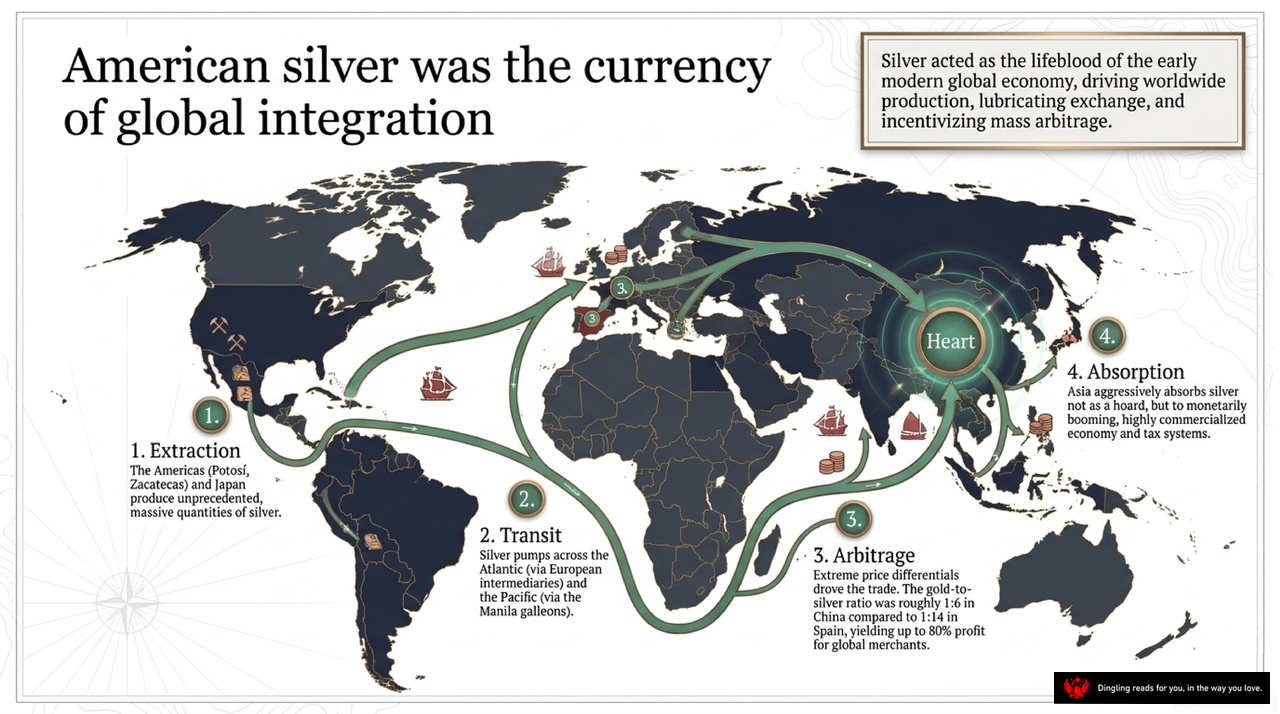
American silver was the lifeblood of the early modern global economy, driving worldwide production, lubricating exchange, and incentivizing mass arbitrage. As the map illustrates, this wasn't just about moving metal; it was about fueling a truly interconnected world.
It all started with **Extraction**. The Americas, specifically Potosí and Zacatecas, alongside Japan, produced unprecedented quantities of silver. This wasn't a local phenomenon; it was the engine of global trade.
Then came the **Transit**. Silver pumped across the Atlantic via European intermediaries and crossed the Pacific on the famous Manila galleons. Think of it as a massive, continuous pipeline connecting the New World to the East.
This flow created **Arbitrage**. Extreme price differences drove the trade. While the gold-to-silver ratio was roughly 1:6 in China, it was 1:14 in Spain. For global merchants, this meant yielding up to 80% profit. It was a massive incentive that pulled silver eastward.
Finally, we see **Absorption**. Asia aggressively absorbed this silver not as a hoard, but as a monetary boom. It fueled a highly commercialized economy and supported complex tax systems. China became the ultimate "secret vault" for the world's silver, absorbing about half of the total influx.
The result? A global system where Europe acted as a middleman, using American silver to buy Asian goods like silk, porcelain, and spices, then reselling them elsewhere. Without this silver, Europe couldn't have entered the Asian market. This flow of currency shaped the entire world order, proving that the global economy was centered on Asia, with silver as its vital currency.

Europe bought a third-class ticket on the Asian economic train. This is the core truth we need to grasp. Europeans didn't build the global market; they simply used American capital to buy their way into a thriving system they didn't control.
Look at the ticket itself. First, they lacked desirable goods. By the 17th and 18th centuries, European manufacturing was completely uncompetitive. They possessed virtually no goods that Asian markets actually wanted to buy. Unlike the modern era, Europe couldn't sell its way in with industrial products.
So, how did they get on board? The silver key. Plundered American silver was the only commodity that permitted Europe to participate in this Asian-dominated trade network. Without the massive influx of silver from the Americas, Europe would have been shut out entirely. They used this precious metal to pay for silk, porcelain, and spices from Asia, effectively financing their own entry into the world economy.
Finally, consider their role. For three centuries, Europeans acted primarily as couriers and regional intermediaries in a system designed by, and driven by, Asian consumer demand. They were passengers on a train built and operated by Asia, enjoying a ride that was fundamentally third-class. It wasn't about European superiority; it was about leveraging a unique financial advantage to join a game where Asia held all the cards.
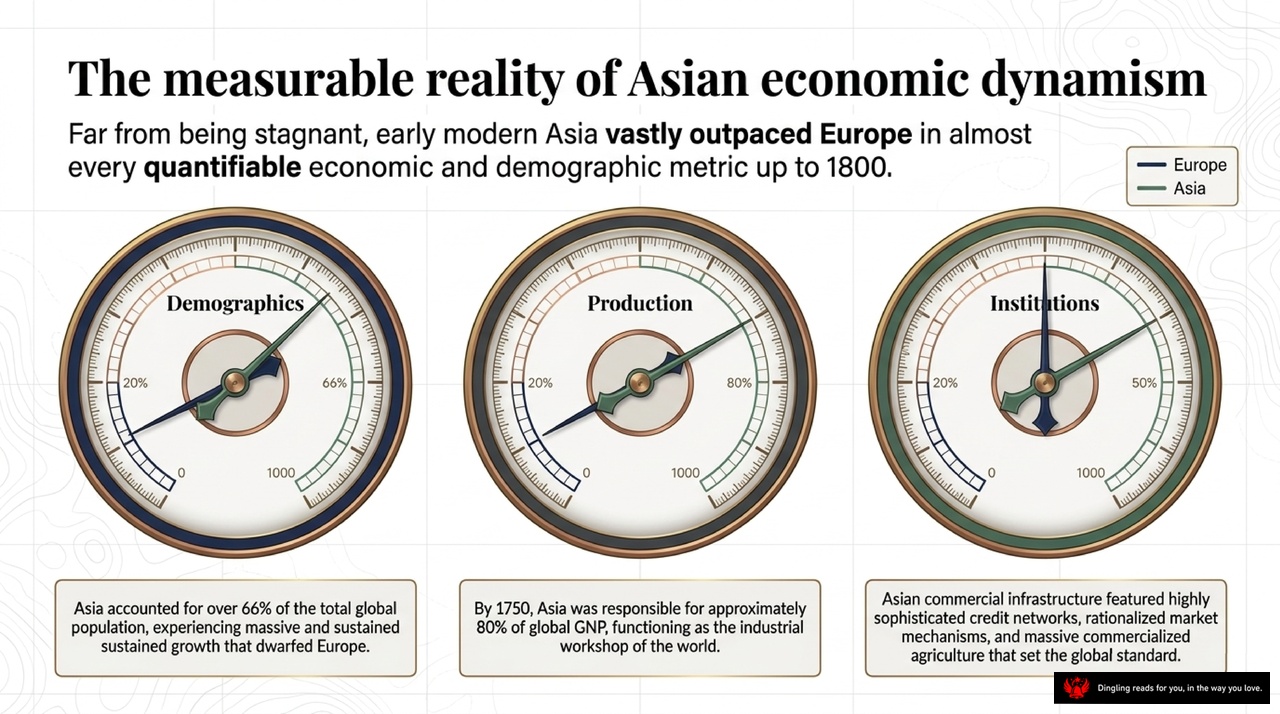
Long before 1800, the map of global power looked nothing like the one we see today. In fact, early modern Asia wasn't just keeping up with Europe; it was vastly outpacing it in almost every measurable metric. From demographics to production to institutions, Asia was the undisputed engine of the global economy.
Look at the first gauge: Demographics. By 1750, Asia accounted for over 66% of the total global population. While Europe was growing, Asia was experiencing massive, sustained growth that completely dwarfed the rest of the world. It was the home to billions of people, creating a market and workforce of a scale Europe simply couldn't match.
Now, turn your eyes to the second dial: Production. This is where the gap was truly staggering. By 1750, Asia was responsible for approximately 80% of global GNP. It functioned as the industrial workshop of the world, churning out silk, porcelain, tea, and textiles that the rest of the globe, including Europe, desperately wanted. Europe wasn't the factory; it was the customer, relying on the Americas for silver just to pay for Asian goods.
Finally, look at the third indicator: Institutions. Don't let the word "institutions" sound like a dry academic term. Here, it refers to the sophisticated commercial infrastructure that made Asia's success possible. Asian commercial networks featured highly advanced credit systems, rationalized market mechanisms, and massive commercialized agriculture. These weren't isolated village economies; they were complex, integrated systems that set the global standard for how trade and finance worked.
So, the reality is clear: far from being stagnant, early modern Asia vastly outpaced Europe. The idea that Europe was always superior is a myth built on later history. Until 1800, the world's economic center of gravity was firmly, undeniably, in Asia.

Let's bust the biggest myth in history: the idea that Europe was the only engine of progress. The slide on your screen clearly states that the notion of European exceptionalism is simply false.
First, consider the reality of property rights and institutions. While we often hear that Europe had superior systems, the truth is that Asian market efficiencies, robust property frameworks, and vast bureaucratic state capacities actually equaled or even surpassed those of Europe long before the 19th century.
Second, let's talk about the "Protestant Work Ethic." The myth suggests that this specific European moral code drove rational profit-seeking. But the reality? Asian merchant syndicates—think of the overseas Chinese networks or Indian trading castes—were ruthlessly rational, obsessed with profit maximization, and mathematically sophisticated. They didn't need a specific religion to be successful entrepreneurs.
Finally, the idea that Europe was a technological genius that invented everything is a lie. Europe relied almost entirely on imported Afro-Eurasian technologies like gunpowder, the magnetic compass, paper, and printing to facilitate its eventual expansion. It didn't invent these; it borrowed them from Asia and Africa.
So, the slide's message is clear: the "European miracle" wasn't a miracle at all. It was built on the shoulders of giants from the rest of the world.
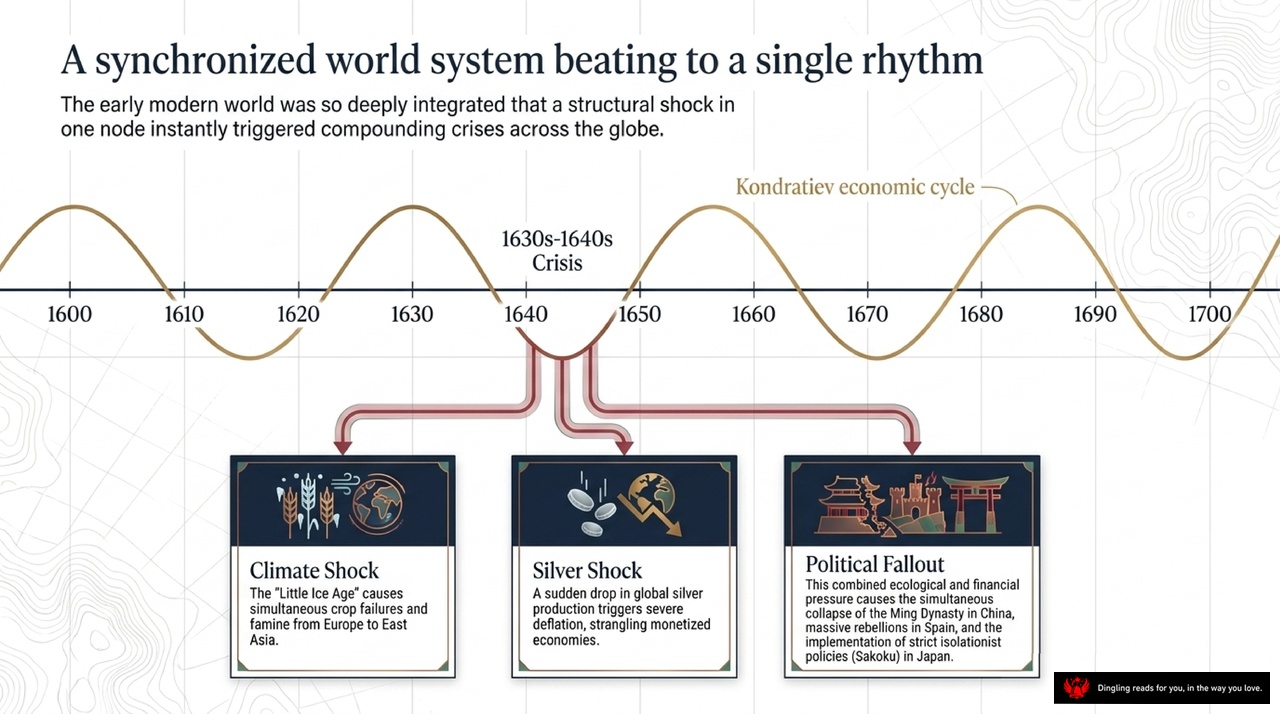
Imagine a world where every major crisis didn't happen in isolation, but as a synchronized global event. This slide illustrates that exact reality: a single structural shock in one part of the world instantly triggered compounding crises everywhere else. Look at the timeline above, tracing the Kondratiev economic cycle from 1600 to 1700. Notice the sharp dip around the 1630s and 1640s? That wasn't just a local event; it was a global tremor.
The graph shows how three distinct forces converged to crash this system. First, the Climate Shock. The "Little Ice Age" caused simultaneous crop failures and famine, hitting everything from Europe to East Asia at the same time. Then, the Silver Shock. As global silver production suddenly dropped, it triggered severe deflation, strangling the monetized economies that everyone relied on. Finally, the Political Fallout. This combined ecological and financial pressure caused the simultaneous collapse of the Ming Dynasty in China, massive rebellions in Spain, and the implementation of strict isolationist policies, known as Sakoku, in Japan.
This visual proves a crucial point: the early modern world was so deeply integrated that a shock in one node instantly triggered a chain reaction across the globe. It wasn't that Europe was leading the world; it was that the entire system was beating to a single rhythm, and when that rhythm faltered, the whole world shook together.
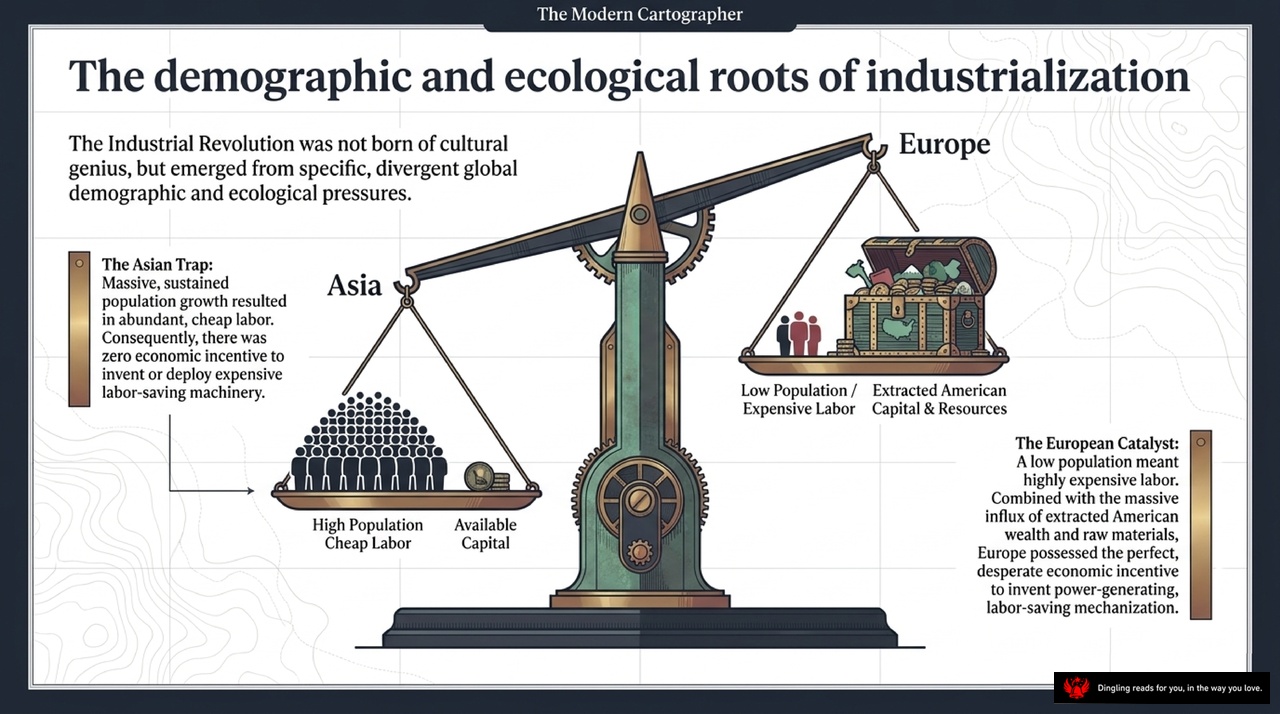
Look at this scale. It perfectly illustrates why the Industrial Revolution didn't happen because Europe was culturally superior, but rather because of specific demographic and ecological pressures.
On the left side, under "Asia," we see a massive population of cheap labor. This is what historians call "The Asian Trap." Because there was such an abundant supply of workers, there was zero economic incentive to invent expensive, labor-saving machinery. Why build a machine when you can just hire more people for pennies?
On the right side, under "Europe," the picture is completely different. We see low population, which meant highly expensive labor. When labor costs are high, it becomes much more profitable to invest in power-generating, labor-saving mechanization. Combine this with the massive influx of extracted American wealth and raw materials, and Europe possessed the perfect economic incentive to innovate.
So, the Industrial Revolution wasn't a triumph of European genius. It was a result of divergent global conditions: Asia's high population trapped them in low-wage labor, while Europe's scarcity of workers and access to American capital forced them to invent the machines that changed the world.

Western ascendancy is a temporary historical anomaly. Look at this graph: it shows the long arc of global economic dominance, swinging from East to West and back again. For thousands of years, from 3000 BCE until 1800, the pendulum pointed firmly East. This wasn't an accident; it was a period of uninterrupted, structural Asian economic dominance and global centrality. China, India, and the vast networks of the Middle East and Southeast Asia were the true engines of the world. They produced the goods, set the prices, and absorbed the capital from everywhere else.
Then, something shifted around 1800. The graph dips sharply. Why? It wasn't because Europe was suddenly more innovative or culturally superior. It was a demographic and ecological detour. The rapid population growth in Europe, combined with a stagnation in Asia, temporarily shifted the center of gravity. This created a brief window for Western hegemony, lasting roughly from 1800 to 2000. But notice the trajectory now. The curve is swinging back up toward the East.
The 21st century represents a structural return to the historical norm. As East Asia experiences rapid economic resurgence, the pendulum is completing its cycle. The "Rise of the West" was never the culmination of history, as traditional narratives claim. Instead, it was a brief, ecologically-driven anomaly in a much longer cycle. Today, we are seeing the center of gravity move back toward a globally centered Asia. This chart reminds us that no region is destined to rule forever; economic dominance is always fluid, driven by population, resources, and global trade flows, not by some unchangeable cultural destiny.

For centuries, the story we've been told about history has been a classic case of "Eurocentrism." It paints a picture where Europe is the sole engine of human progress, the only civilization capable of innovation, while the rest of the world—especially Asia—is portrayed as stagnant, waiting to be "awakened" by Western power. This narrative has shaped our textbooks, our museums, and even our understanding of our own place in the world. But what if this story is entirely wrong?
The slide in front of you challenges this entire premise with a powerful statement: "The global economy is not a modern European invention." In fact, for centuries, the world was deeply integrated into a single system where Asian productivity, fueled by American silver, drove global wealth. Europe's rise wasn't a sudden explosion of genius; it was a late, ecologically-driven shift built upon the foundation of an already thriving Asian age.
Think about the mechanics of the early modern world. Europe didn't lead the global economy; it was actually the laggard. It was the edge of the system. For centuries, the real center of gravity was in Asia. China, India, and the Islamic world were the manufacturing hubs, the financial centers, and the primary consumers. They produced the silk, the porcelain, the spices, and the cotton that the rest of the world desperately wanted.
So, how did Europe join the party? The answer lies in that second line on the slide: "fueled by American silver." When the Americas were discovered, a massive influx of silver flooded into the global economy. Europe, which had little to offer in terms of goods to Asia, used this new supply of silver to buy its way into the market. They bought Asian products with American gold. It was essentially a trade deficit financed by a windfall from the New World. Europe didn't create the wealth; it rode the wave of Asian demand and American resources.
The slide asks a profound question: "If the 'Rise of the West' was merely a brief, temporary detour in a 5,000-year history of Asian economic dominance... are we prepared for the world to return to its natural center?"
This is the core argument. The "Rise of the West" wasn't a permanent transformation of human destiny; it was a temporary detour. For five thousand years, the economic center of gravity was in Asia. Europe's dominance was a short interlude, a detour made possible by specific historical conditions—like the influx of silver and the eventual collapse of Asian economic expansion.
Today, as we see the rise of East Asia again, the question becomes: Are we ready to accept that history has a rhythm? That the center of the global economy can, and perhaps should, return to its natural center? The slide suggests that the world isn't a stage where Europe plays the lead role forever. Instead, it's a dynamic system where power shifts. When Asia grows, the center moves east. When Asia stagnates, the center moves west.
Understanding this is crucial because it shatters the myth of Western exceptionalism. It tells us that our current global order isn't the final destination, nor is it a unique achievement of European culture. It's a cyclical process. The "Rise of the West" was real, but it was temporary. And now, as we stand on the brink of a new era, the slide challenges us to ask: Are we prepared to let go of the idea that Europe is the default setting for human progress? Or are we ready to embrace a world where the center returns to where it belongs, naturally, historically, and economically?