
Review: Complete Chapter-by-Chapter Summary
Welcome to today's session on "Fupan+: Turning Experience Into Ability" by Qiu Zhaoliang. This isn't just another book about management; it's a definitive playbook for institutionalizing rapid learning, continuous improvement, and the mechanics of a true learning organization.
Think of "Fupan," or "review," not as a simple post-mortem, but as a powerful mechanism to transform your past experiences into actionable skills. While many confuse it with standard work summaries, the core difference is clear: summaries often focus on reporting results or assigning blame, whereas Fupan is a structured, structured learning process. It forces you to look back at your goals, compare them against reality, analyze the root causes of the gaps, and most importantly, extract lessons that prevent you from repeating mistakes.
The real magic happens when you shift from merely recalling events to deeply analyzing them. This approach helps organizations stop falling into the same traps and instead evolve rapidly. Whether you are leading a team or managing a strategy, mastering this method means you stop relying on luck and start building a system where every challenge becomes a stepping stone for future success. Let's dive into how to make this happen.
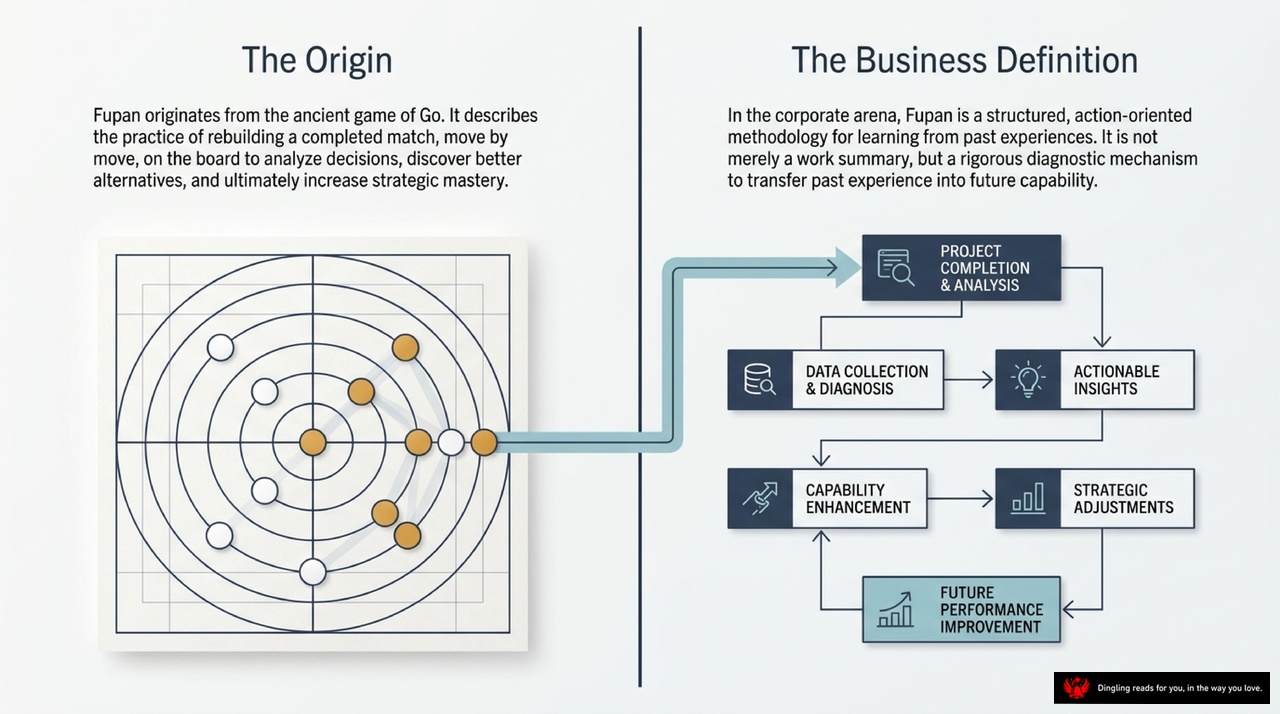
Welcome to the beginning of our journey into "Fupan," or "Post-Mortem Analysis." Think of it as a superpower for your team and your company.
On the left, we see the roots of this concept. It starts with an ancient game: Go. In Go, players don't just play to win; after the match ends, they rebuild the game on a fresh board, move by move. They analyze every decision to find better alternatives. That is the origin.
Now, look at the right side of the screen. That's where this ancient wisdom transforms into modern business strategy. In the corporate world, Fupan is a structured, action-oriented methodology. It's not just about writing a summary of what happened; it's a rigorous diagnostic mechanism. Its goal is simple but powerful: to transfer past experience into future capability.
Notice the flow on the right? It starts with **Project Completion & Analysis**. From there, we move to **Data Collection & Diagnosis** to uncover **Actionable Insights**. These insights drive **Capability Enhancement**, which leads directly to **Strategic Adjustments**. Finally, these adjustments fuel **Future Performance Improvement**, creating a cycle that keeps your organization getting smarter every single day.
So, whether you are a chess player or a CEO, the lesson is the same: don't just play the game. After the game, go back, analyze it, and learn how to play better next time.
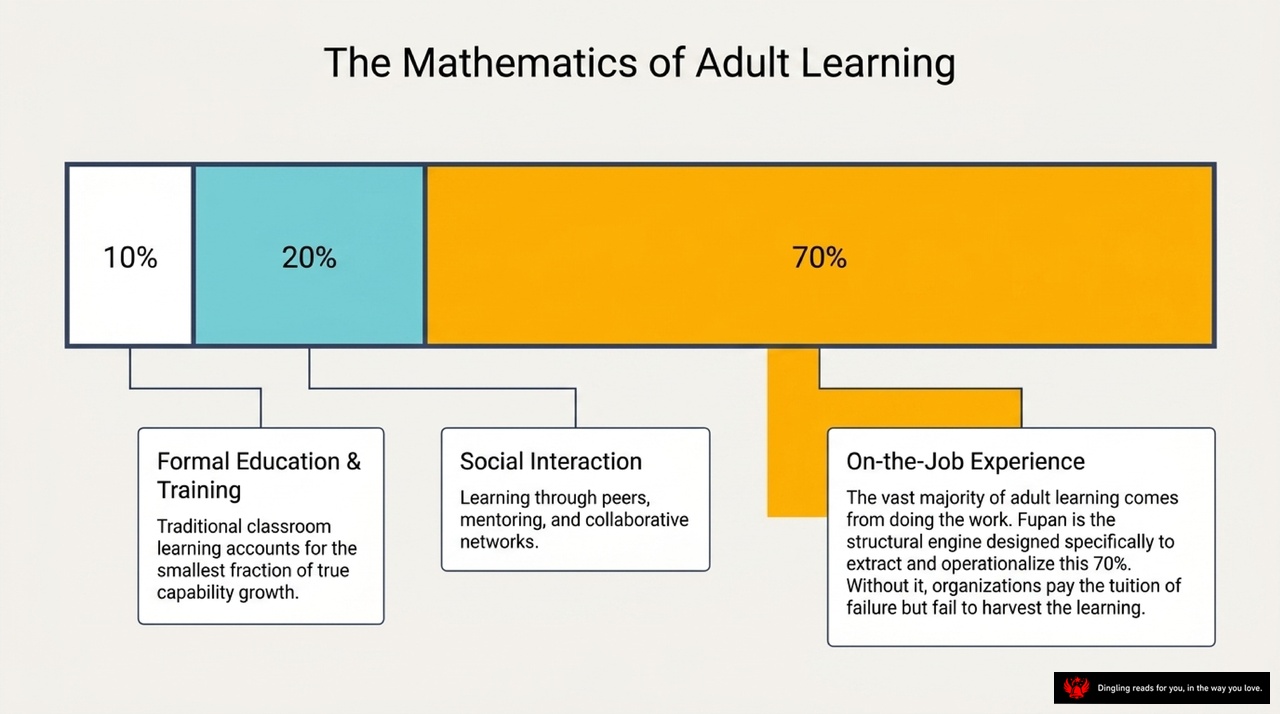
So, here's the hard truth about how adults actually learn. We tend to think learning happens in classrooms or through formal training, but the data tells a completely different story.
Look at this breakdown. Only **10%** of our real capability growth comes from traditional classroom learning. That's the smallest fraction. Then, **20%** comes from social interaction—learning from peers, mentors, and collaborative networks. It's valuable, sure, but it's not the main driver.
The massive **70%**? That comes from **On-the-Job Experience**. This is the structural engine designed specifically to extract and operationalize what we learn while doing the actual work.
Think about it: the vast majority of adult learning comes from doing the work itself. Without a system to capture that, organizations might pay the tuition of failure but fail to harvest the learning. That's why tools and processes that help us analyze our daily actions are so critical. If we ignore that 70%, we're leaving the bulk of our potential on the table.

Let's talk about how we actually learn from our mistakes. Most of us are stuck in a trap called "Meaningless Failure"—we miss the target, we get frustrated, and then we just move on without learning anything. That's pure operational waste.
But there is a better way. Look at this quadrant here. The real gold mine for growth is the yellow zone: **Meaningful Failure**. This happens when you miss the target, yes, but you have the clarity to understand exactly why. You've mapped out the root causes and the operational flaws. That specific kind of failure is the highest value zone for capability growth.
Contrast that with the top left: **Meaningless Success**. You hit the target, you feel great, but you don't know why. It's just blind luck, unrepeatable and fragile. Without clarity, you can't scale it.
The lesson here is simple: success without understanding is just a lucky break, but failure with deep insight is your most powerful teacher. Don't fear missing the mark; fear missing the lesson.
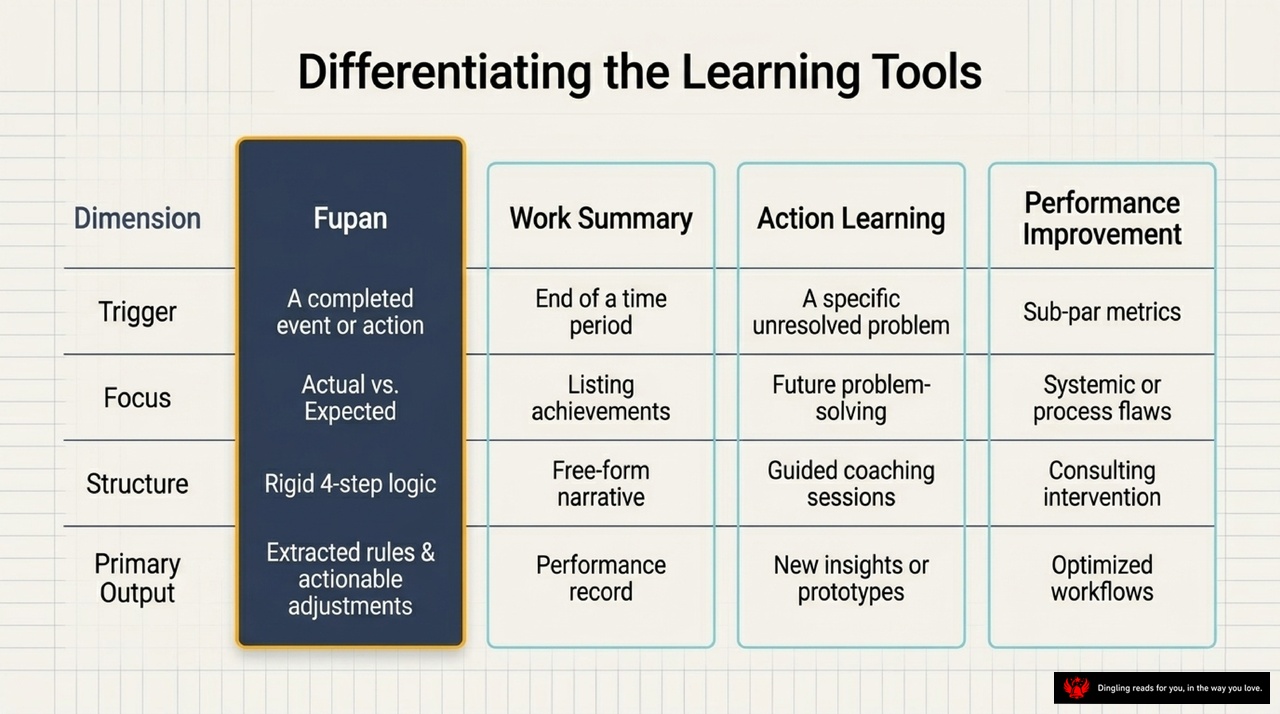
Differentiating the Learning Tools isn't just about picking a fancy name; it's about matching the right tool to the specific job at hand. Look at this chart: we're comparing Fupan against three common approaches—Work Summary, Action Learning, and Performance Improvement.
Think of Fupan as your personal growth engine. It kicks off when an event is done, not when the clock strikes a deadline. While a Work Summary is just a list of achievements you write at the end of a month, Fupan digs deeper. It compares what actually happened against what you planned, using a rigid four-step logic to extract real rules and actionable adjustments. It's not about bragging; it's about learning from the gap between expectation and reality.
Then there's Action Learning. If Fupan looks backward to learn from the past, Action Learning looks forward to solve a specific, unresolved problem right now. It's a guided coaching session where you build new insights or prototypes while you work. It's "learning by doing" for immediate challenges, whereas Fupan is "learning by reflecting" on past experiences to prepare for the future.
Finally, Performance Improvement is the consultant's approach. It starts when your metrics drop below par. Instead of reflecting on your own experience, it treats your workflow as a system to be fixed. It's an external intervention to optimize your processes, whereas Fupan is an internal practice to upgrade your personal and team capabilities.
So, which one do you need? If you want to avoid repeating mistakes and build long-term capability, choose Fupan. If you need to solve a crisis today, choose Action Learning. If your numbers are crashing and you need a quick fix, choose Performance Improvement. Understanding these boundaries is the first step to mastering your learning toolkit.

Today's slide breaks down the "Iteration Engine," a powerful framework combining PDCA and Double-Loop Learning. Think of this diagram not just as a chart, but as a self-driving engine for your organization. The outer ring represents the classic PDCA cycle: Plan, Do, Check, and Act. It's the engine that keeps you moving forward. Step one is Plan, where you review your original intent. Step two is Check, where you evaluate what actually happened against that intent. Step three is Act, where you analyze the causes behind any gaps. And finally, Step four kicks off a new cycle, summarizing your experience to establish new rules for the future.
But here is where it gets really interesting. Look at that yellow arrow labeled "Double Loop." This is the critical differentiator. Most organizations only run a "Single Loop," which is just fixing immediate actions or errors. True Fupan, or deep reflection, forces a re-evaluation of the underlying assumptions, beliefs, and policies that created the initial plan in the first place. It asks, "Are our goals even the right ones?" By integrating this double-loop thinking into your PDCA cycle, you stop just reacting to problems and start fundamentally improving your strategy. This is how you turn a simple feedback loop into a true engine for continuous evolution.
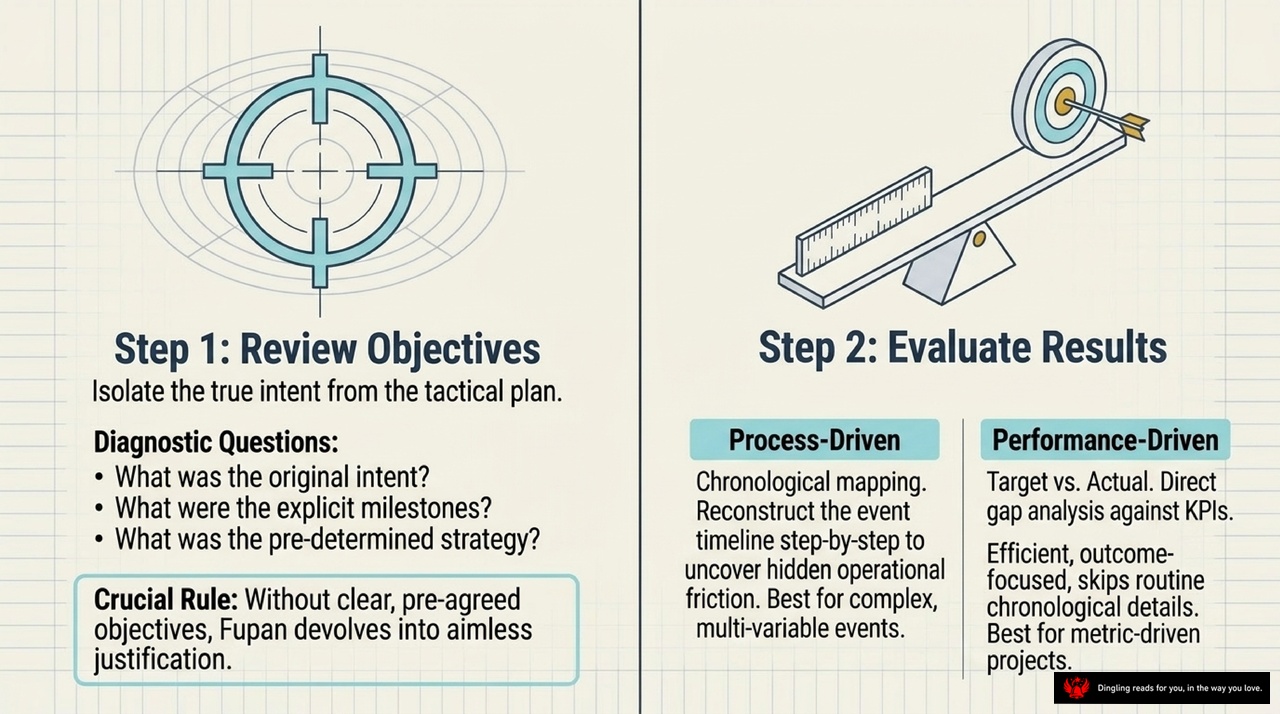
Step 1: Review Objectives. Before we dive into the data or the final outcome, we have to go back to the beginning. What was the original intent? What were the explicit milestones we set before we even started? And crucially, what was the pre-determined strategy? As the slide emphasizes, without clear, pre-agreed objectives, our entire effort devolves into aimless justification. We need to isolate the true intent from the tactical plan. If we don't know where we were aiming, how can we possibly know if we hit the target?
Step 2: Evaluate Results. Now, let's look at where we actually ended up. The slide presents two powerful approaches here. On the left, we have the "Process-Driven" method. This is about chronological mapping. It's for when things get complex and multi-variable. You reconstruct the event timeline step-by-step to uncover hidden operational friction. Think of it as a detective story, piecing together the narrative to understand exactly what happened. On the right, we have the "Performance-Driven" approach. This is for metric-driven projects where efficiency is key. It's a direct gap analysis against your KPIs. You compare Target vs. Actual. It's efficient and outcome-focused, skipping routine chronological details to get straight to the point.
So, the choice isn't black and white. If you are navigating a complex, messy situation, use the timeline to understand the story. If you are hitting a specific number and need speed, focus on the gap between where you wanted to be and where you are. The goal of both is the same: to understand the difference between what we planned and what we delivered, so we can learn from it and move forward.
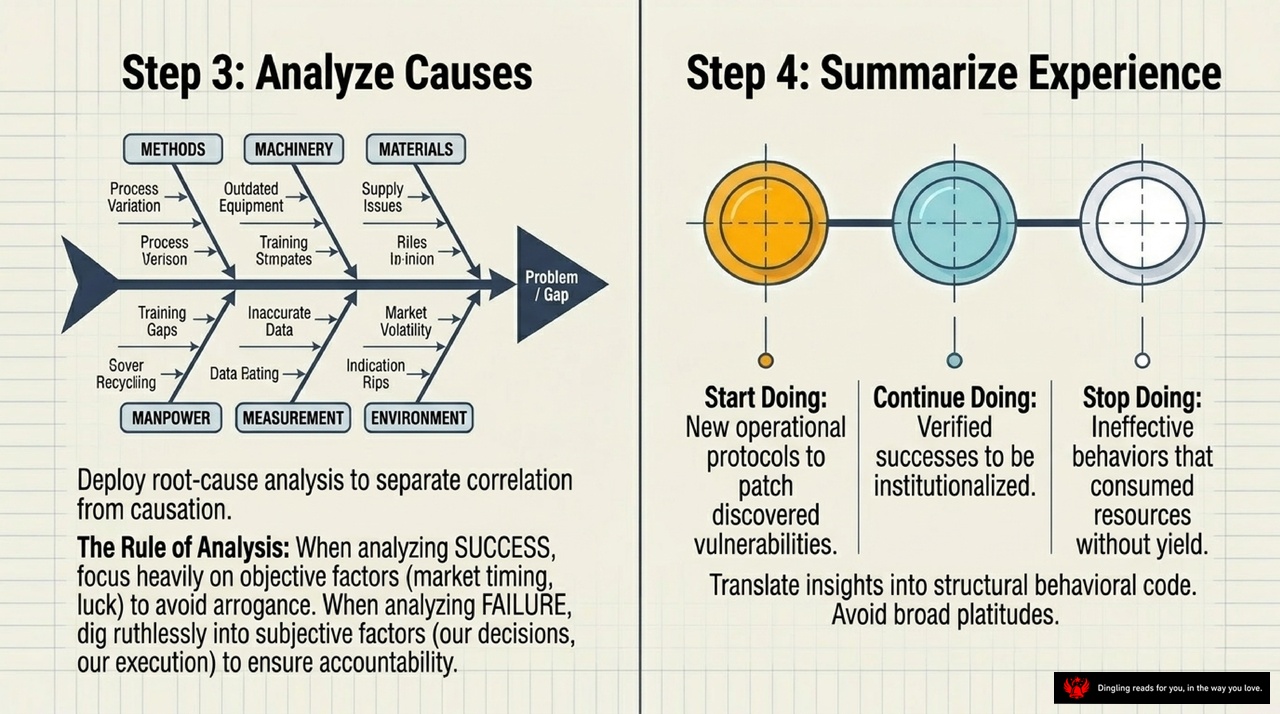
So, we've walked through the "what" and "why" of复盘. Now, let's talk about the "how." The magic isn't in the concept; it's in the specific steps we take to turn past chaos into future clarity.
Look at the left side of this slide. This is Step 3: Analyze Causes. This is where we separate correlation from causation. We don't just look at the surface; we dig deep using root-cause analysis. Think of it like a fishbone diagram, breaking down a problem into methods, machinery, materials, manpower, measurement, and environment. But here is the golden rule you need to remember: When analyzing success, focus on objective factors like market timing or luck to stay humble. But when analyzing failure? Dig ruthlessly into subjective factors—our own decisions and execution. That is how we ensure accountability and stop making the same mistakes twice.
Now, look at the right side. This is Step 4: Summarize Experience. This is where we translate our insights into a structural behavioral code. We categorize our learnings into three simple actions: Start Doing, Continue Doing, and Stop Doing. "Start Doing" covers new protocols to patch our vulnerabilities. "Continue Doing" locks in our verified successes so they become institutionalized. And "Stop Doing" eliminates those behaviors that simply consume resources without yielding results.
The goal here is simple but powerful: avoid broad platitudes and commit to specific actions. By following this structured flow from analyzing causes to summarizing experience, we stop just reviewing the past and start building a smarter future.
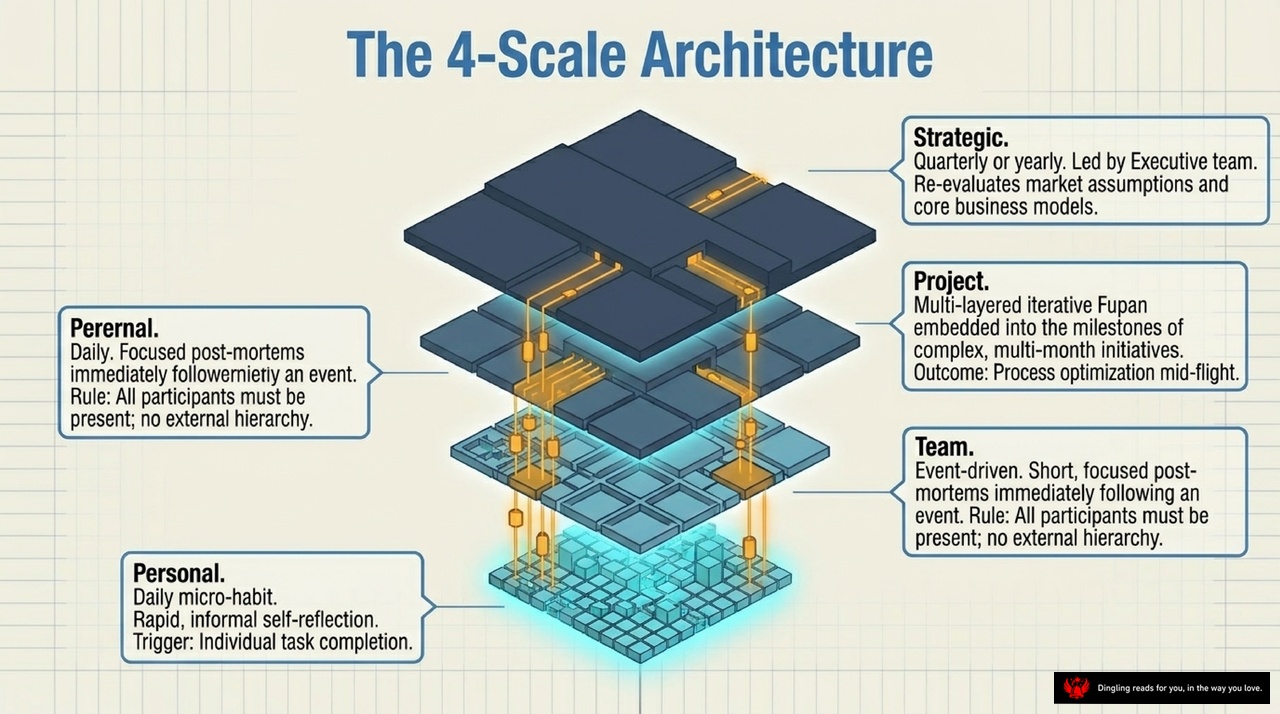
Look at this "4-Scale Architecture." It's not just a diagram; it's a blueprint for how a truly learning organization operates at every single level.
At the very top, we have the **Strategic** layer. This is where the Executive team looks quarterly or yearly. They aren't just checking boxes; they are re-evaluating market assumptions and the core business model itself. It's about asking, "Is our entire direction still right?"
Moving down to the **Project** layer, things get iterative. This is where multi-layered "Fupan" practices get embedded into the milestones of complex, multi-month initiatives. The goal here isn't just to finish the project, but to optimize the process while we are still mid-flight. We learn by doing, and we adjust as we go.
Below that, we have the **Team** and **Perernal** layers. These are event-driven. Whenever something happens—a meeting, a launch, a failure—everyone gathers immediately. There are no external hierarchies here; everyone must be present to share the truth. We do short, focused post-mortems right after the event to catch insights while they are fresh.
And finally, at the foundation, is the **Personal** layer. This is where the real magic happens for individuals. It's about daily micro-habits. After you complete a task, you take a rapid, informal moment to reflect on yourself. No pressure, no formal reports—just honest self-reflection to build your personal capability.
The beauty of this architecture is that it connects everything. Your daily personal reflection feeds into team insights, which shape project optimizations, which eventually inform the big strategic decisions at the top. It ensures that learning doesn't get stuck in one person's head; it flows up and down, making the whole organization smarter, faster, and more resilient.
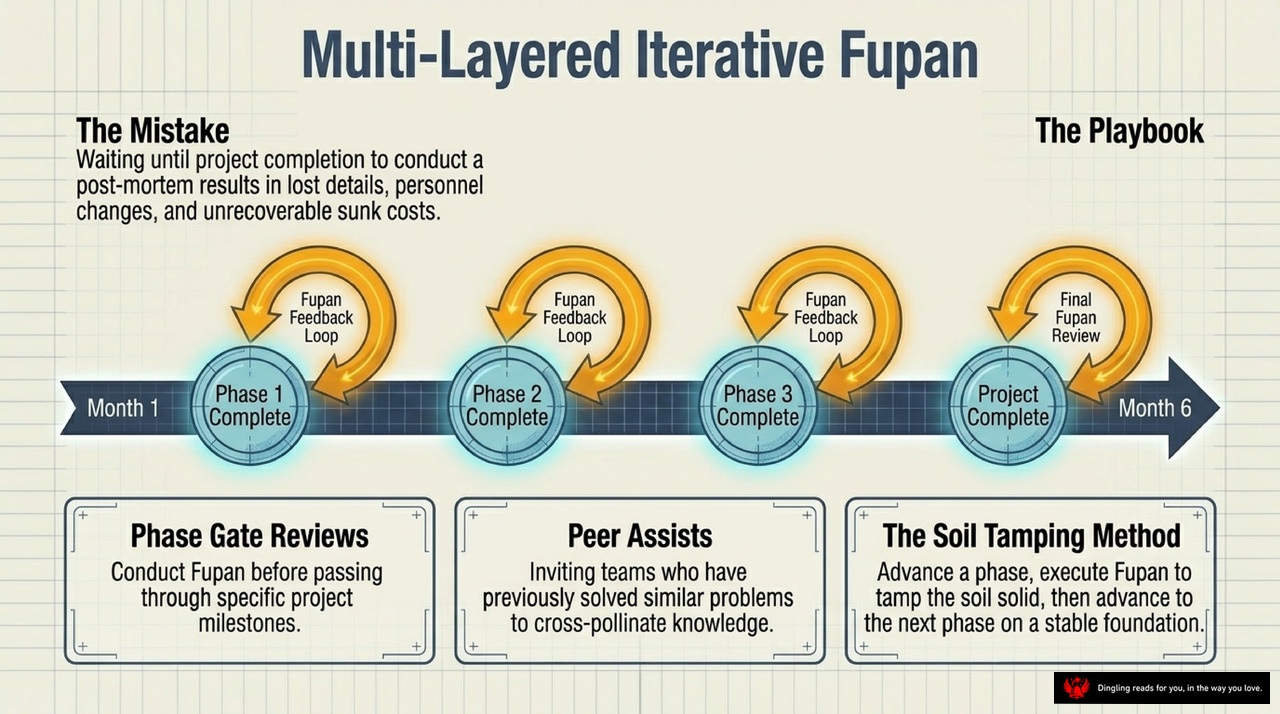
Most companies make a fatal mistake: they wait until a project is completely finished to do a post-mortem. By then, details are lost, key people have moved on, and the cost of failure is already sunk. You can't learn from what you can't remember.
The solution is a Multi-Layered Iterative Fupan. Instead of waiting for the end, we build feedback loops into every phase. As you can see on the slide, we don't just wait for "Project Complete" at Month 6. We stop at every milestone—Phase 1, Phase 2, and Phase 3—to run a Fupan Feedback Loop. This ensures we catch issues early, when they are still cheap and easy to fix.
To make this work, we rely on three key strategies. First, Phase Gate Reviews. We conduct Fupan before passing through specific milestones, ensuring no one moves forward with unresolved problems. Second, Peer Assists. We invite teams that have solved similar problems before to cross-pollinate knowledge, so you don't reinvent the wheel. Finally, The Soil Tamping Method. Think of it like construction: you advance a phase, execute Fupan to tamp the soil solid, and only then advance to the next phase on a stable foundation.
By shifting from a single final review to continuous, layered learning, we turn every project phase into an opportunity for growth, ensuring we build on a rock-solid foundation rather than hoping for the best at the very end.

When we talk about running a post-mortem, it's easy to accidentally turn it into a blame game or a debate about who was right. But if we look at the pitfalls on this slide, we see exactly where things go wrong. Instead of trying to prove ourselves right or blaming external circumstances, we often turn our sessions into criticism rallies. We treat symptoms instead of the root disease, and worst of all, we end up with all talk and no action. These are the defensive routines that kill learning.
So, how do we fix this? The answer lies in the seven success factors right here. It starts with an open mindset where we suspend our assumptions. We need candid expression, putting company interests first so there are no hidden agendas. We must rely on objective truth and data over narratives, and pool our collective intelligence through real brainstorming. Leaders have to engage in self-reflection, dissecting their own subjective failures. We need to dig deep for root causes, not just surface issues, and most importantly, we must drive immediately to behavioral change.
This shift from defensive routines to these seven success factors is what transforms a simple meeting into a powerful engine for organizational growth. It's about moving from proving ourselves to actually learning and evolving together.

Have you ever noticed a strange divide in team meetings? On one side, we have "Process"—how we talk, how we keep things safe, and how we ensure everyone gets a fair shot. On the other side, we have "Content"—what we actually talk about, the ideas and solutions we are discussing.
This slide highlights a critical failure point known as "The Facilitator's Divide." The most common reason teams flop isn't because the ideas are bad, but because the facilitator tries to drive the content instead of the process. Think of it like this: if you are leading a discussion, your job isn't to give the answers or push your own agenda. Your job is to manage the conversation itself.
Look at the "Process" side. It's about maintaining psychological safety so people feel safe to speak up. It's about curbing the "loudmouth" effect so quiet voices are heard. It's about keeping the sequence strict so we don't jump straight to solutions before we've done the hard work of thinking.
Now, look at the "Content" side. Here, your role is different. You must maintain neutrality and suspend judgment. Don't evaluate the ideas on the spot. Instead, provide the structural tools—like frameworks or questions—but let the team do the heavy lifting. Let them generate the answers themselves.
The lesson is simple but powerful: a great facilitator doesn't lead the team to the destination; they build the vehicle and the map, letting the team drive. When you focus on the process, the content naturally improves.

Let's talk about how to actually run a meeting that sticks. This slide outlines the complete 9-Step Facilitation Flow, broken down into three distinct stages that take you from planning to real results.
First, we have Stage 1: Meticulous Preparation. You can't skip this. It starts with defining your scope and participants, then setting the exact time and venue. But it doesn't stop there—you must gather all your data and documentation beforehand. This preparation is the foundation; if you don't do this right, the rest of the meeting will struggle.
Next, we move to Stage 2: Execution, which is the actual meeting. This is where the magic happens. You need to set the stage by establishing clear rules and safety guidelines so everyone feels comfortable. Then, you guide the team through the core 4-Step Logic to explore the topic deeply. Finally, you close the session by ensuring everyone has made real commitments. Without this structure, the meeting is just a conversation, not a facilitation.
Lastly, Stage 3: Implementation. This is often where teams fail, but it's crucial for success. You must consolidate and share the knowledge gained, ensuring it's not lost. Then, you follow up on the action plans everyone committed to. And finally, you evaluate the improvement to see if things actually got better.
By following this flow, you turn a random gathering into a powerful learning engine. It's not just about talking; it's about preparing, guiding, and ensuring that what we learn today drives action tomorrow.

Imagine you are leading a high-stakes meeting where voices are raised, opinions clash, and the real work gets lost in the noise. How do you keep the conversation focused and productive? The answer lies in a facilitator's toolkit designed specifically for this chaos.
First, let's look at managing the flow of conversation. You have "The Talking Stick," a simple physical tool for Step 2: Evaluate Results. Here's the genius part: the person holding the stick has the exclusive right to speak. No cross-talk, no defensive interruptions. It forces everyone to listen and ensures that the holder can state their perspective on the facts without fear of being cut off immediately.
Next, when you need to dig into complex causes in Step 3, try the "World Cafe." Instead of one big, intimidating meeting, you create structured, rotating small-group dialogues. This allows teams to safely surface cross-functional friction points without triggering hierarchy intimidation. People feel safe to speak up when they aren't staring down at the whole room.
For digging even deeper into the root causes, we move to visual frameworks like "Fishbone & 5 Whys." This is your tool for forcing teams past superficial symptoms. Instead of accepting the first excuse, you push down to structural, systemic root causes. It's about asking "why" repeatedly until you find the real problem, not just the symptom.
Finally, to ensure your actions actually work long-term, use "Causal Loop Diagrams" for Step 4: Summarize Experience. These systems-thinking maps help you visualize how your proposed actions might create unintended negative feedback loops elsewhere in the organization. You aren't just fixing one thing; you are ensuring your solution doesn't break something else.
This toolkit transforms a chaotic discussion into a structured learning journey, turning friction into fuel for your team's growth.
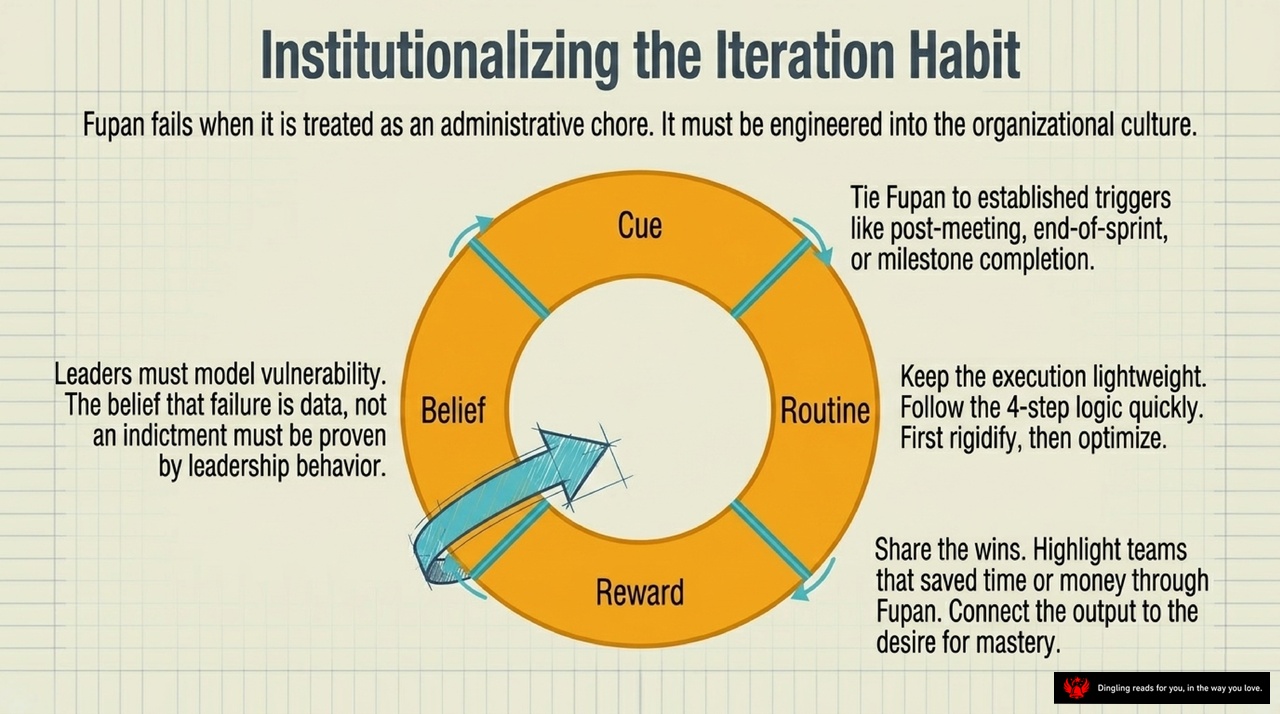
Institutionalizing the Iteration Habit means moving Fupan beyond a mere administrative checklist and engineering it directly into your organizational culture. As the slide illustrates, this transformation relies on a powerful, four-part loop: Cue, Routine, Belief, and Reward.
First, we need to set the right **Cues**. Fupan fails when it's optional; it succeeds when it's automatic. Tie it to established triggers like post-meeting debriefs, the end of a sprint, or the completion of a major milestone. When these moments happen, Fupan automatically kicks in.
Next, keep the **Routine** lightweight. Don't overcomplicate it. Follow the standard four-step logic quickly: rigidify the process first, then optimize. Keep the execution simple so teams can focus on learning rather than paperwork.
But habits need a foundation, which is **Belief**. Leaders must model vulnerability. You have to prove that failure is just data, not an indictment of character. If leadership treats mistakes as learning opportunities, the team will follow suit.
Finally, close the loop with **Reward**. Share the wins. Highlight teams that saved time or money through Fupan. Connect the output to the deep desire for mastery. When people see the tangible benefits of their reflection, the habit sticks.
In short, Fupan isn't about looking back to dwell on the past; it's about engineering a system that turns every experience into a stepping stone for the future.

Look at this "Organizational Learning Matrix." It visually maps out the four essential ways an organization learns, breaking them down by where the learning comes from—Internal or External—and when it happens—Past or Future.
First, let's look at the bottom-left quadrant, highlighted in blue: **Fupan**. This stands for Internal + Past. It's about extracting capability from our own operational history. Think of it as mining your own past for hidden gold. Instead of just looking at what went wrong, you systematically analyze your own history to build a stronger foundation. As the slide notes, Fupan is the foundation, but not the entire story of a learning organization.
Now, move up to the top-left: **U-Theory**. This is Internal + Future. Here, the goal is to let go of past assumptions and sense emerging possibilities from within. It's about looking inward to prepare for what's next, actualizing future potential before it fully arrives.
On the right side, we have the external drivers. The bottom-right quadrant is **Benchmarking**: External + Past. This is about systematically studying the proven best practices of competitors and industry leaders. You're looking outward at history to see what others have already solved.
Finally, the top-right corner: **Open Innovation**. This is External + Future. It involves crowdsourcing R&D and integrating with external ecosystems to preempt market shifts. Instead of waiting for the future to happen, you're actively pulling in outside ideas to shape it.
The key takeaway here is that a true learning organization doesn't rely on just one of these. You need the stability of your own history (Fupan and Benchmarking) to ground you, while simultaneously using U-Theory and Open Innovation to stay agile and future-ready. It's about balancing what we know with what we don't, and what's inside us with what's out there.

Think about the most critical project your team just wrapped up this month. Did you merely survive the experience, or did you actually extract the code required to master the next one? That's the real question we need to be asking ourselves.
Many of us treat our post-project reviews like post-mortems—just looking back to see what went wrong without really learning from it. But that's not how it works. True review is a mechanism for capability transfer. By rigorously mapping our intended objectives against actual results and ruthlessly diagnosing the subjective root causes of our failures, we convert operational waste into systemic intelligence.
Here is the hard truth: If your organization's rate of learning is not greater than the external rate of change, failure is inevitable. The world is moving fast, and if we aren't learning faster than the market is shifting, we're already behind.
So, let's stop just surviving our projects. Let's start extracting the code. Let's turn every single experience into a lesson that makes us smarter, more capable, and ready for whatever comes next. That is how we build a truly adaptive organization.