
Rewalking: Complete Chapter-by-Chapter Summary

Welcome to "Rewalking: In Search of the Southwest Associated University," a journey that spans 1,600 kilometers and eighty years. This isn't just a story about a university; it's about how a nation's darkest hour forged its brightest minds.
Imagine two worlds colliding in one image: on the left, a rugged, sepia-toned path where students walked barefoot through mud and mountains eighty years ago; on the right, a smooth, modern highway cutting through misty peaks. This contrast captures the essence of the book. In 1938, nearly 300 students and 11 professors left their homes in Changsha, choosing to walk 1,600 kilometers on foot rather than flee. They weren't just escaping war; they were actively rebuilding their connection to the land and the people.
Today, we often learn about China through screens and fragmented news. But this journey invites us to break that barrier. By retracing these ancient footprints, we touch the real texture of history—the old post roads, the stories in the villages, and the resilience of a people who refused to break. It reminds us that history isn't a distant past; it's a living thread woven into our present. This book is an invitation to step out of the classroom, look at the world with fresh eyes, and find the courage to keep walking forward.

Look at this split-screen comparison. On the left, we see a map of Peking in 1937, fractured by war. This was the External War. The Sino-Japanese conflict forced the intellectual elite from universities like Peking, Tsinghua, and Nankai to flee south. It was a moment of existential annihilation where survival meant marching into the unknown.
Now, look at the right side. This is 2018. It represents The Internal Crisis. Imagine a 36-year-old writer, completely overwhelmed by a frictionless, digitized modern world. He faces a severe existential crisis because he is disconnected from physical reality. In that moment, survival requires logging off and walking into the dirt.
The connection here is powerful. Just as the nation needed to march south to survive in 1937, the individual needs to step away from the screen to survive today. The Xiang-Qian-Dian trek wasn't just a physical journey; it was a spiritual awakening that reshaped the character of an entire generation. Today, we retrace those steps not to copy the past, but to break our own cognitive barriers. By leaving the comfort of our screens and touching the real earth, we reconnect with history and find our own path forward.

Look at this map. It tells a story of incredible grit. On the left, we see 1,600 kilometers of rugged, mountainous terrain. On the right, the Vanguard: the Hunan-Guizhou-Yunnan Travel Group, comprised of 300 male students and just 11 professors. And in the middle, the cost of their choice: 68 days of relentless, grueling marching.
While most evacuated via boat and train to Hong Kong and Vietnam, this vanguard consciously chose to walk the grueling interior—to witness the true state of their nation.
This wasn't just a relocation; it was a deliberate act of defiance against comfort. In a time when the country was crumbling, these intellectuals refused to stay in their ivory towers. They stepped out, barefoot and in mud, to reconnect with the land and the people they were sworn to serve. By walking 1,600 kilometers through some of the most difficult terrain in China, they didn't just move schools; they forged a spirit of resilience that would define the Southwest Associated University for the next eight years. It was a powerful reminder that true education happens not just in classrooms, but in the struggle to survive and understand the world around you.
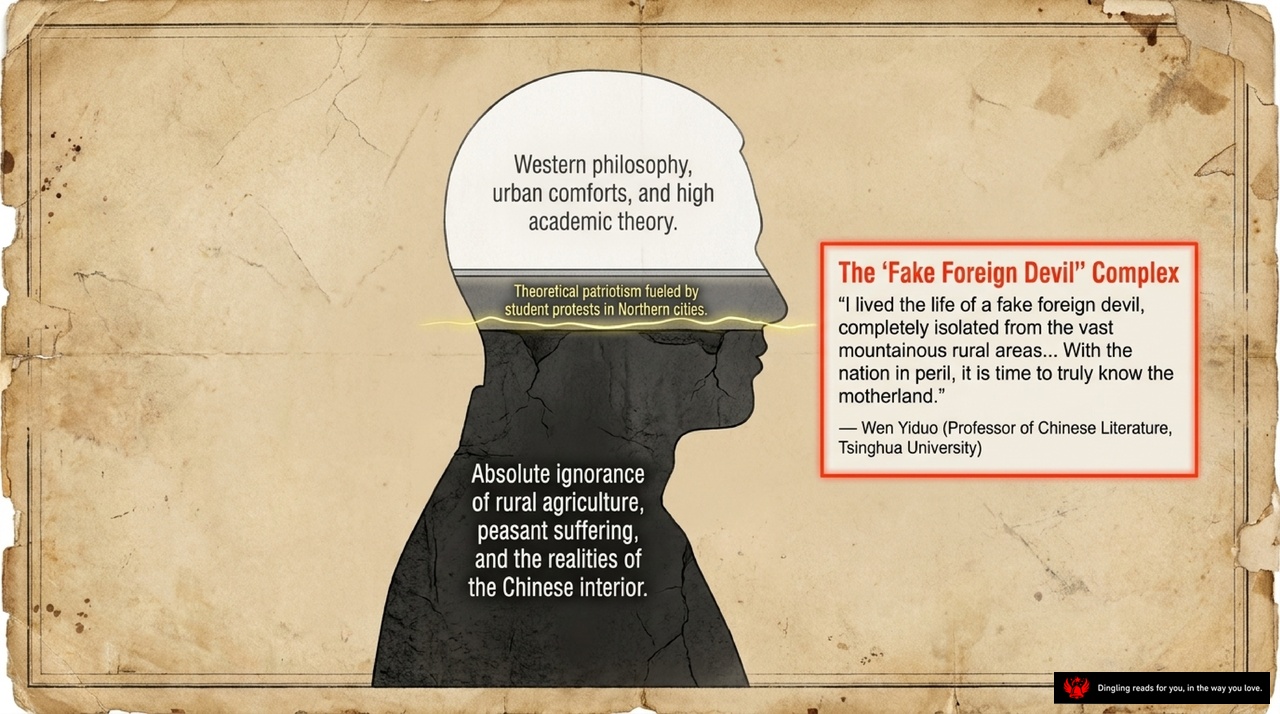
The image you see here captures a profound paradox that defines a specific historical mindset: the "Fake Foreign Devil" Complex. It illustrates a deep divide within the intellectual class of that era. On the surface, the upper part of the figure represents a head filled with Western philosophy, urban comforts, and high academic theory. This was the world they knew best, a realm of abstract ideas and intellectual prestige.
However, beneath that polished exterior lies a stark reality. The middle section shows a fracture caused by theoretical patriotism fueled by student protests in northern cities. While they spoke loudly about saving the nation, their connection to the actual land was severed. The lower, dark portion of the figure reveals an absolute ignorance of rural agriculture, peasant suffering, and the harsh realities of the Chinese interior.
This disconnect is perfectly summarized by the quote from Wen Yiduo, a professor at Tsinghua University. He described himself as a "fake foreign devil," completely isolated from the vast mountainous rural areas. He realized that while the nation was in peril, the intellectuals were living in a bubble, detached from the very people and land they claimed to defend. It was a moment of painful awakening, where the gap between their academic theories and the suffering reality of the countryside became impossible to ignore.

Look at this timeline. It captures the profound transformation of the Chinese intellectual spirit during the war. We start on the left with "The Shock of Poverty." This isn't just a statistic; it's the raw reality of starving families, the desperation of a society on the brink. The image shows emaciated figures and a collapsed world. This is where the journey begins—not with a flag-waving parade, but with the heavy, crushing weight of survival.
But the path doesn't stop there. As we move right, we encounter "The Opium Scourge." This is the silent killer that was rotting the land from the inside. It wasn't just a crop; it was a slow poison that stripped away the dignity and vitality of the people, turning a once-vibrant nation into a shadow of its former self. It represents the depth of the crisis, the moral and physical decay that the country had to confront head-on.
Then, look at the final stage: "The Animalistic Vitality." This is the turning point. After witnessing the depths of human suffering and the destructive power of addiction, the spirit didn't break; it mutated. It hardened. The students and teachers, facing these horrors, didn't retreat into ivory towers. They dug deep into the earth, finding a raw, untamed energy. They became like the land itself—resilient, enduring, and fiercely alive. This is the birth of a new kind of patriotism.
Notice the red arrow connecting these stages. It moves from "Theoretical Patriotism" to "Grounded Empathy." Before, patriotism was something you read about in books or recited in speeches. It was abstract and distant. But after walking through poverty and witnessing the scourge of opium, that theory dissolved. It was replaced by something real and visceral. They didn't love the country because they were told to; they loved it because they finally understood its pain. They saw the suffering in the faces of the people they walked beside.
The text at the bottom says it perfectly: "The rugged interior systematically dismantled their urban facades. To save the country, they first had to meet it." You cannot save a nation you do not know. You cannot heal a land you have never touched. This journey forced them to strip away their illusions and embrace the harsh, unfiltered truth of their homeland. That is how they found the strength to rebuild. That is how abstract ideals became a concrete force for change.

The image captures a haunting contrast between the past and the present. On one side, we see the "Abandoned History," where ancient waypoints and post stations have been erased, replaced by empty, identical concrete facades. This speaks to the loss of local culture and memory. On the other, there is the "Demographic Void," where villages have been hollowed out as the working-age population migrates to coastal factories, leaving only the elderly and children behind. Meanwhile, a "Propaganda Veil" of red banners claiming "Poverty Alleviation" and "Modernization" masks this erasure.
This scene reflects a profound melancholy. As the text at the bottom notes, while the 1938 students encountered a raw, dangerous vitality during their journey, the 2018 traveler discovers the ghostly remnants of rapid modernization. Just as the students walked through a land that was changing yet alive, we walk through a landscape that has been reshaped by speed and efficiency, often at the cost of its soul. The road stretches straight ahead, a symbol of progress that has left the villages it passed by behind. It forces us to ask: in our rush to modernize, what part of our history and our people have we left on the side of the road?
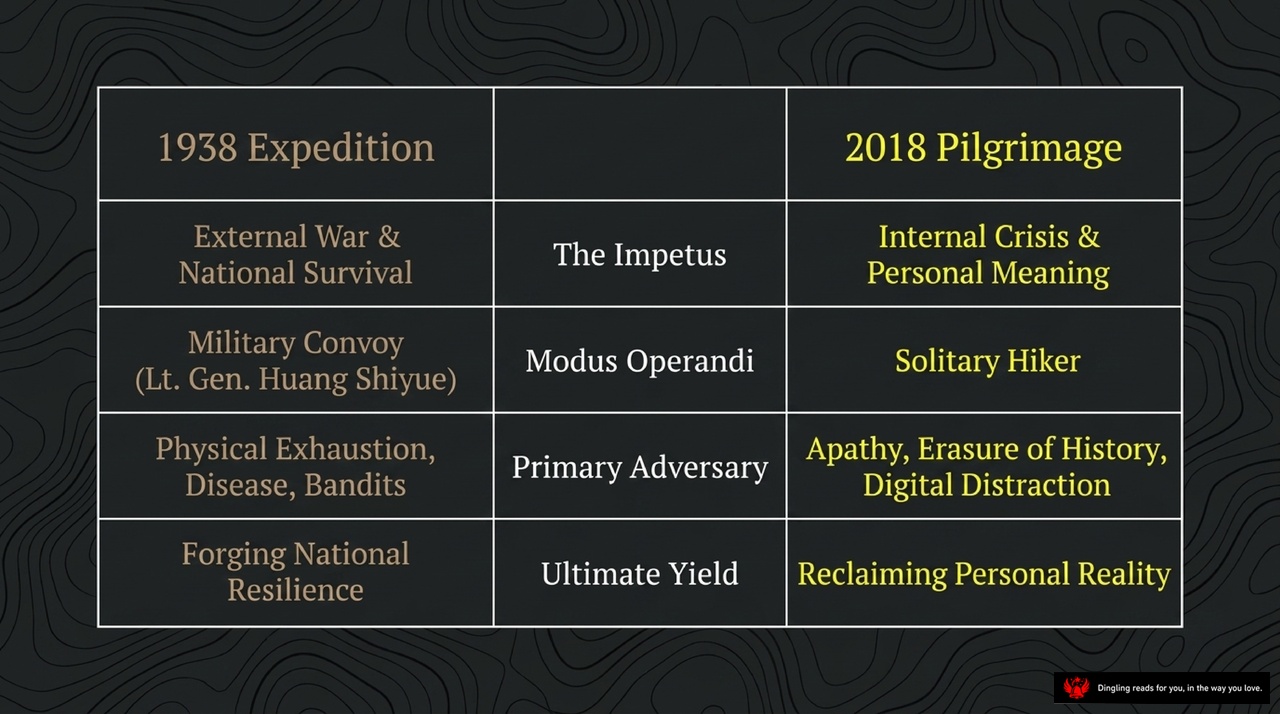
Today's slide draws a powerful parallel between two journeys: the 1938 Expedition and the 2018 Pilgrimage. Let's look at the core differences that define each. The 1938 Expedition was driven by external war and the urgent need for national survival, whereas the 2018 Pilgrimage stems from an internal crisis and a search for personal meaning. Their methods, or modus operandi, couldn't be more different. The original group moved as a military convoy under the command of Lt. Gen. Huang Shiyue, while we traveled as solitary hikers.
The challenges they faced were also distinct. Back then, the primary adversaries were physical exhaustion, disease, and bandits. Today, our enemies are intangible: apathy, the erasure of history, and digital distractions. Yet, the ultimate yield remains strikingly similar. For the 1938 group, the journey forged national resilience. For us, reclaiming personal reality is the goal. This comparison highlights that while the context changes, the act of walking through difficult terrain remains a profound way to reconnect with our past and redefine our present.
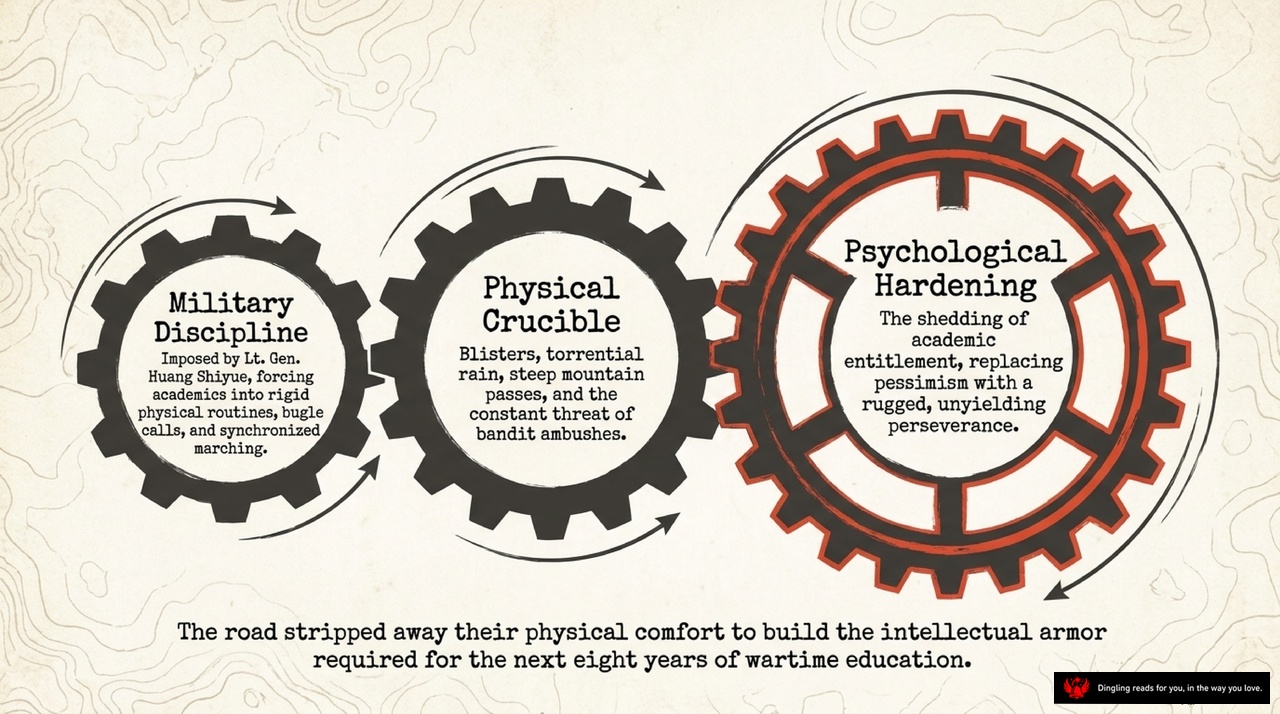
This slide visualizes the transformative journey of the Xiang-Qian-Dian Trek, breaking it down into three critical gears that meshed together to forge the spirit of the Southwest Associated University.
First, we see **Military Discipline**. This wasn't just about rules; it was a deliberate strategy imposed by Lt. Gen. Huang Shiyue. He forced these academics, used to the comfort of bookshelves, into rigid physical routines, bugle calls, and synchronized marching. It was a shock to their system, stripping away their old identities.
Next, the **Physical Crucible**. This gear represents the sheer hardship they endured. Think blisters, torrential rain, steep mountain passes, and the constant, terrifying threat of bandit ambushes. They didn't just walk; they survived. Every step was a battle against the elements and the unknown.
Finally, and most importantly, the result: **Psychological Hardening**. This is the output of the first two gears. It was the shedding of academic entitlement and the replacement of pessimism with a rugged, unyielding perseverance. The road stripped away their physical comfort specifically to build the intellectual armor required for the next eight years of wartime education.
As the bottom text reminds us, this journey wasn't just a migration; it was a forging process. They walked through hell to become the unbreakable force needed to save their country and preserve their culture.

The graph you see here is titled "The Intellectual Awakening Curve," and it maps a profound transformation that happened as the students traveled west. The vertical axis tracks their "Connection to Reality," while the horizontal axis follows their journey from Changsha, through Hunan and Guizhou, all the way to Kunming.
It starts in Changsha, built on theoretical ideals. As they moved into Hunan and the border with Guizhou, the curve plunges into a deep dip. This was the moment of shock, disgust, and despair upon witnessing extreme poverty and opium addiction. It was a brutal collision with reality that shattered their illusions.
But then comes the sharp rise in deep Guizhou. Here, that initial disgust turned into a profound respect for the survival instincts and resilience of the rural masses. They realized that these people were not just victims; they were fighters. Finally, the line stabilizes at a high point in Kunming. This is where the mature, grounded Lianda Spirit was born. By walking through the mud, they didn't just escape the war; they rebuilt their understanding of the nation, transforming from abstract scholars into true citizens of the land.
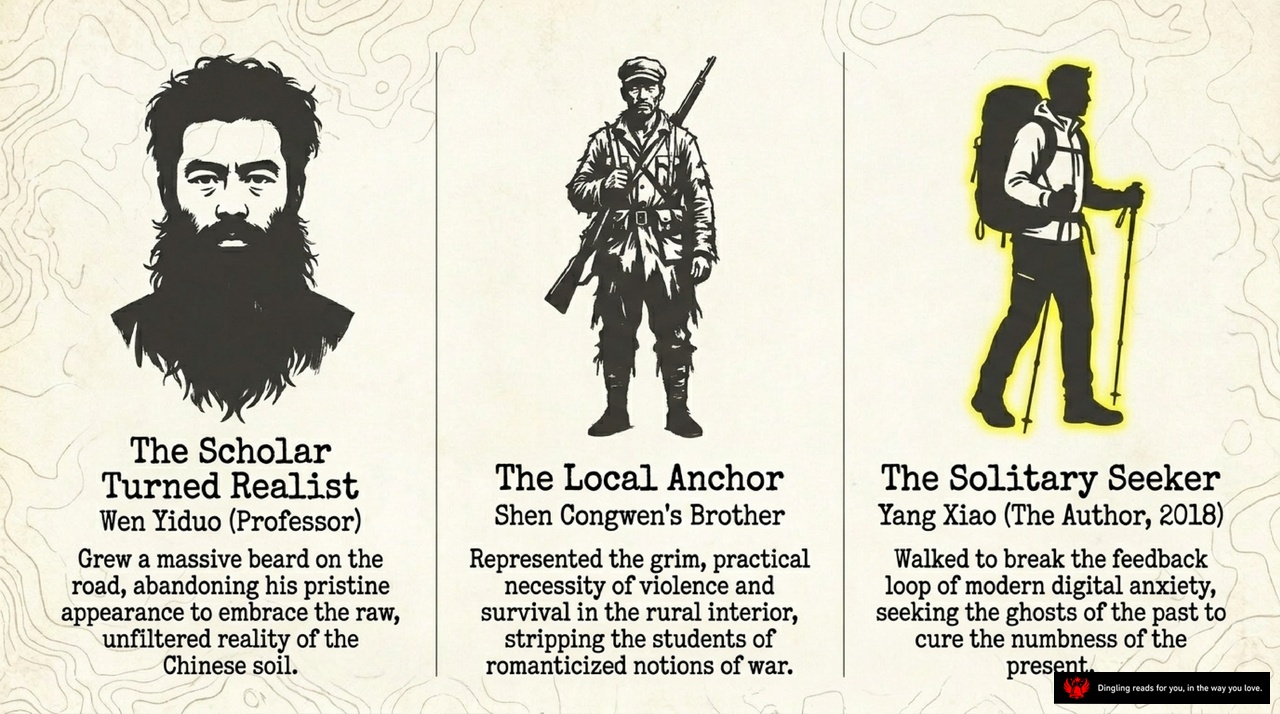
This slide breaks down the three distinct archetypes of the Xiang-Qian-Dian travelers, each representing a unique response to the chaos of their time. On the left, we see **The Scholar Turned Realist**, Wen Yiduo. As a professor, he didn't just observe the world; he physically entered it. By growing a massive beard on the road and abandoning his pristine academic appearance, he embraced the raw, unfiltered reality of the Chinese soil. He traded the comfort of the ivory tower for the grit of the battlefield and the village.
In the center stands **The Local Anchor**, Shen Congwen's brother. His role wasn't about romanticizing the past or fighting with grand gestures. Instead, he represented the grim, practical necessity of violence and survival in the rural interior. He stripped away the students' romanticized notions of war, forcing them to confront the harsh truth that in the countryside, survival often required a toughness they had never known before. He was the bridge between the educated elite and the rugged, often unforgiving, local reality.
Finally, on the right, is **The Solitary Seeker**, Yang Xiao, the author of this very journey. His motivation was different yet deeply connected. He walked not just to honor history, but to break the feedback loop of modern digital anxiety. In a world where we live behind screens, he sought the ghosts of the past to cure the numbness of the present. By retracing these steps, he found that the answers to our modern confusion lie in the tangible, messy, and resilient history of the land itself. These three figures together show us that true understanding comes from stepping out, getting dirty, and facing the world directly.

On April 28, 1938, in the heart of Kunming, a new chapter of Chinese intellectual history began. This wasn't just a date on a calendar; it was the moment the Southwest Associated University found its spiritual home. While the physical journey of the Xiang-Qian-Dian trek had finally ended, something far more profound was taking root here.
Look at the core of this image: "The Foundation." For the teachers and students who arrived, this was where their true education began. They had walked through mud, crossed dangerous rivers, and faced bandits, but in Kunming, they built something enduring. This is what the image calls "The Ethos"—a spirit forged in the dirt. It was a university defined not by luxury, but by fierce academic freedom, democratic ideals, and the sheer courage to stand up for truth.
And then, we see "The Output." Over the next eight years, this crucible produced giants. We are talking about Nobel laureates, pioneering scientists, and the literary icons who would shape modern China. From this humble beginning in Kunming, a legacy was born that would outlast the war itself. This spot on the map, this moment in time, became the engine that drove an entire generation forward.

The 1938 Walk wasn't just a physical journey; it was a defining moment that split a generation into three distinct paths, each carrying the weight of that historic trek. As the diagram shows, the trail diverged into three directions: The Builders, The Exiles, and The Martyrs.
The Builders chose to stay behind in the newly established Republic, dedicating themselves to building infrastructure and academic institutions despite the political turbulence swirling around them. They became the backbone of the nation's recovery, turning chaos into opportunity.
Others became The Exiles. They moved abroad to escape persecution, yet they never lost their identity. Carrying that rigid moral compass forged on the road, they went on to shape global academia, proving that one can leave their homeland but never leave their principles behind.
Then there were The Martyrs. They returned to the political fire, facing immense hardship. Think of poet Mu Dan translating works amidst danger, or Wen Yiduo, who eventually paid the ultimate price with his life for his democratic ideals. Their sacrifice was the cost of conscience.
Ultimately, those 1,600 kilometers became more than just a distance. They transformed into a permanent moral compass, guiding an entire generation through the chaotic remainder of the 20th century. It reminds us that where we walk determines who we become.

Look at this diagram. It illustrates "The Modern Apathy Loop," a cycle where we sink into digital pessimism, seek pre-packaged meaning, and feel disconnected. But there's a way out: Physical Action, or "The Walk."
The text explains that philosopher Feng Youlan taught us that pessimism stems from searching for an external "meaning of life." We try to find answers in books or online, but that often leads to emptiness. The real antidote is the physical act of living, moving, and enduring the journey itself.
Just like the students of the Southwest Associated University who walked thousands of miles during wartime, they didn't find meaning by theorizing. They found it by walking through mud, crossing rivers, and connecting with the land. The journey *was* the meaning. So, instead of staying stuck in a loop of anxiety and disconnection, break through with your feet. Step outside, move your body, and let the act of walking rebuild your sense of purpose.
In an age where our lives are defined by frictionless digital existence, we often forget what it truly means to be awake. The 1938 expedition proved that true education demands grounding our highest ideals in the dirt of reality. Eighty years later, the 2018 pilgrimage revealed a hard truth: meaning is forged through physical endurance, not digital consumption.
So, in our era of seamless screens and instant information, where is the rugged road that will force us to finally wake up? It is the path that challenges our comfort, the journey that strips away the noise of the modern world, and the only route that can reconnect us with the raw, unfiltered reality of our history and our land.