
Rich Dad Poor Dad: Complete Chapter-by-Chapter Summary
Welcome everyone. Today we're exploring a classic in personal finance: Rich Dad Poor Dad by Robert T. Kiyosaki. As the screen shows, this book is a financial blueprint to escape the rat race by making money work for you. Most of us work hard for money, but the real game is flipping that script. Let money become your employee instead of your boss. We'll explore how to break free from the cycle of fear and debt, and build assets that generate wealth while you sleep. It's about shifting from being a slave to your paycheck to becoming the master of your financial destiny. Whether you're just starting out or stuck in the middle, this book offers the mindset shift needed to take control. Let's dive into how to build true freedom.
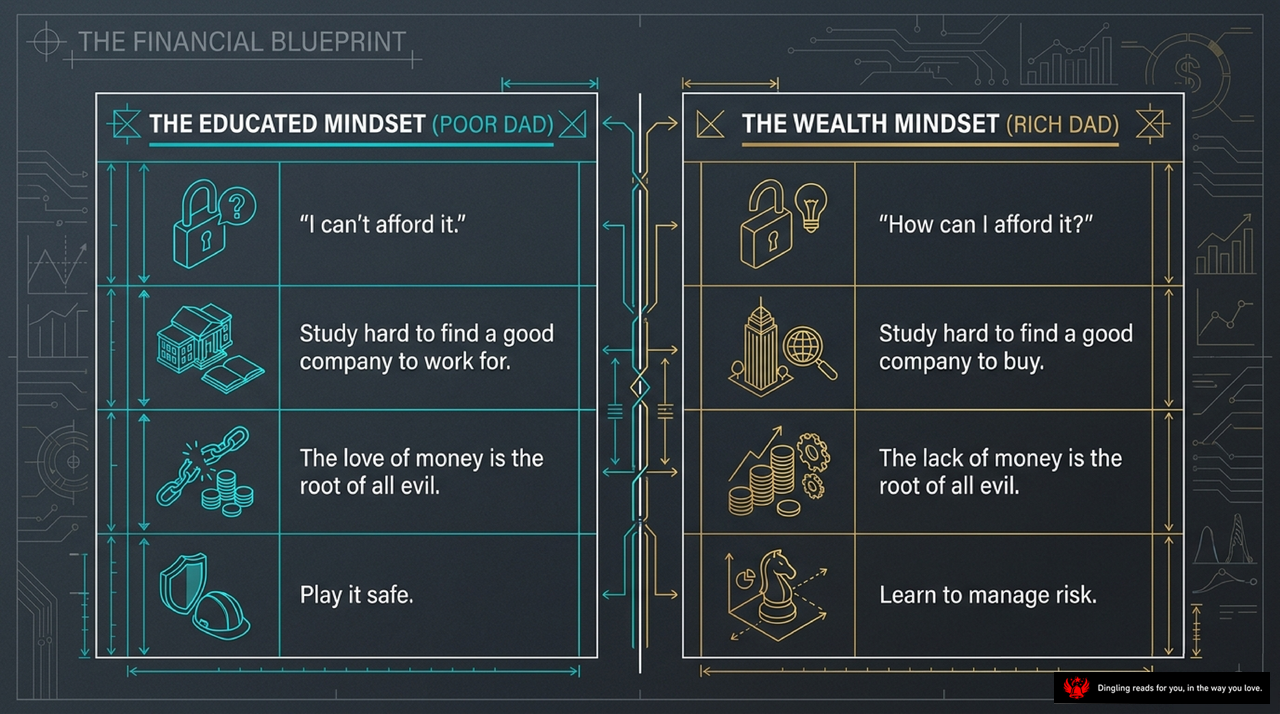
Welcome to the Financial Blueprint. Today, we're diving into the core difference between the mindset of the educated and the mindset of the wealthy. On the left, we see the Educated Mindset, often associated with the Poor Dad. On the right, the Wealth Mindset, championed by the Rich Dad. This comparison isn't just about income; it's about how you think about money and your future.
Let's break down the four key contrasts. First, look at the reaction to cost. The Educated Mindset says, "I can't afford it." It's a statement of limitation driven by fear. The Wealth Mindset asks, "How can I afford it?" This shifts the focus from a lack of resources to finding a solution. It's about creativity and opportunity. As Rich Dad taught, most people work for money, especially when they feel fear, but true wealth comes from making money work for you.
Second, consider your career path. The Educated Mindset tells us to study hard to find a good company to work for. It assumes that working for someone else is the only path to success. The Wealth Mindset flips this. It says, study hard to find a good company to buy. This isn't just about employment; it's about ownership. It's about building systems that generate cash flow without your constant labor, like the assets Rich Dad encouraged us to seek. In contrast, the educated often buy liabilities like a house thinking it's an asset, but it actually drains cash flow.
Third, look at the relationship with money. The Educated Mindset believes "The love of money is the root of all evil." This creates a psychological barrier where you avoid money out of guilt. The Wealth Mindset counters with, "The lack of money is the root of all evil." This acknowledges that financial scarcity is what causes the real problems in life, not the pursuit of wealth itself. Money is just a tool.
Finally, look at risk. The Educated Mindset says, "Play it safe." Safety is often a comfort zone that prevents growth. The Wealth Mindset says, "Learn to manage risk." True wealth is built by understanding risk, not avoiding it. Most people get trapped in the rat race because they fear losing what they have.
Ultimately, the gap between these two mindsets is the difference between financial freedom and the rat race. One waits for safety, the other builds assets. One fears money, the other masters it. By shifting from the left side to the right side, you fundamentally change your life.
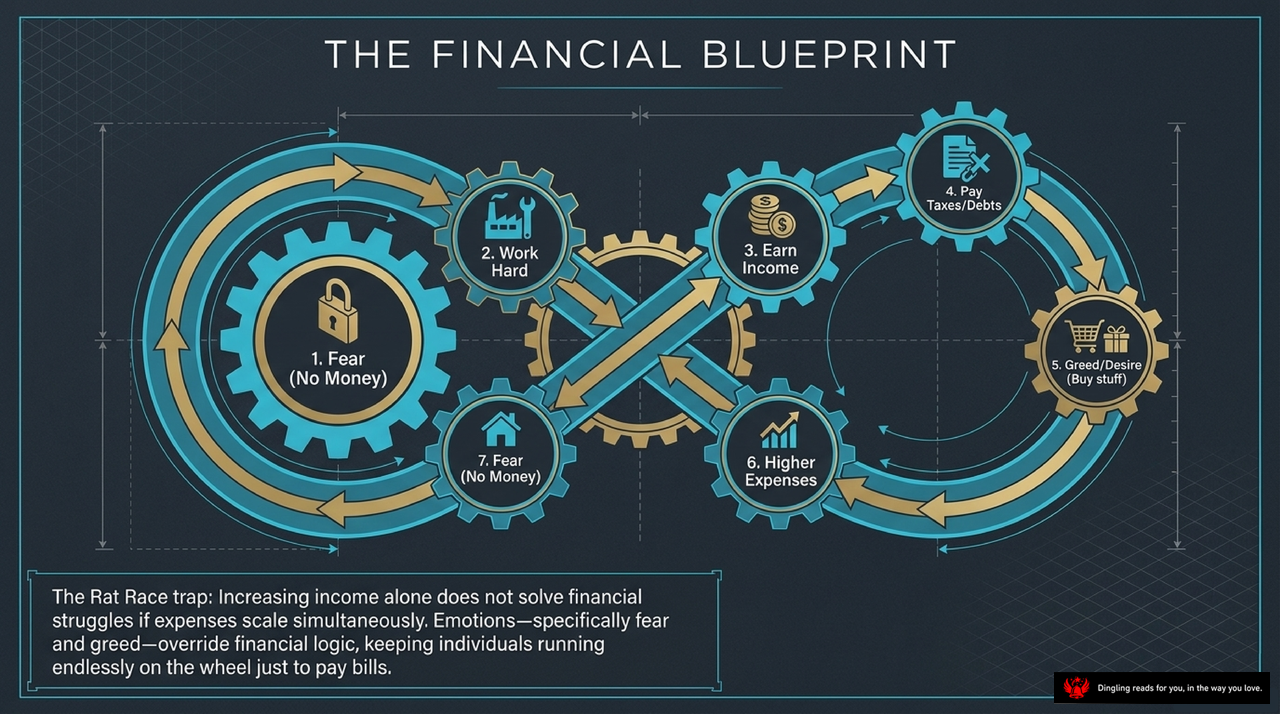
Welcome to the Financial Blueprint. Rich Dad Poor Dad teaches us that this diagram shows exactly why most people stay stuck in poverty, even when they work hard. It's a cycle we call the Rat Race.
Look at the gears. It starts with Fear—specifically, the fear of having no money. That fear pushes you to Work Hard. You Earn Income, sure. But the moment you get paid, you Pay Taxes and Debts. Then, Greed kicks in. You want more, so you Buy Stuff. Your Expenses go Higher. And suddenly, you're back at the start, with Fear again. No money.
The text at the bottom explains the trap perfectly. Increasing your income alone does not solve financial struggles if expenses scale simultaneously. It's a vicious loop. You earn more, but you spend more on the same things, plus new things. Emotions—specifically fear and greed—override financial logic. You end up running endlessly on the wheel just to pay bills. We often think money is about math, but it's actually about psychology. If you don't control your emotions, the wheel keeps spinning.
This is the reality for the middle class. They work for money, trapped by fear, and they never stop to think about making money work for them. They think working harder will fix it, but the system is designed to keep you spinning. You buy a bigger house or a nicer car, which just increases your expenses and taxes. You end up working harder just to pay for the lifestyle you created.
To break this blueprint, you have to stop the cycle before it starts. You have to change the logic from fear-based to asset-based. Instead of letting fear drive your actions, you need to use your head to control your emotions. Instead of buying stuff to satisfy greed, you need to buy assets that generate cash flow.
This slide isn't just about the problem; it's about waking up to the trap. Once you see the wheel, you can choose to step off it. That's the first step toward true financial freedom. Don't let the blueprint trap you. Change the game.
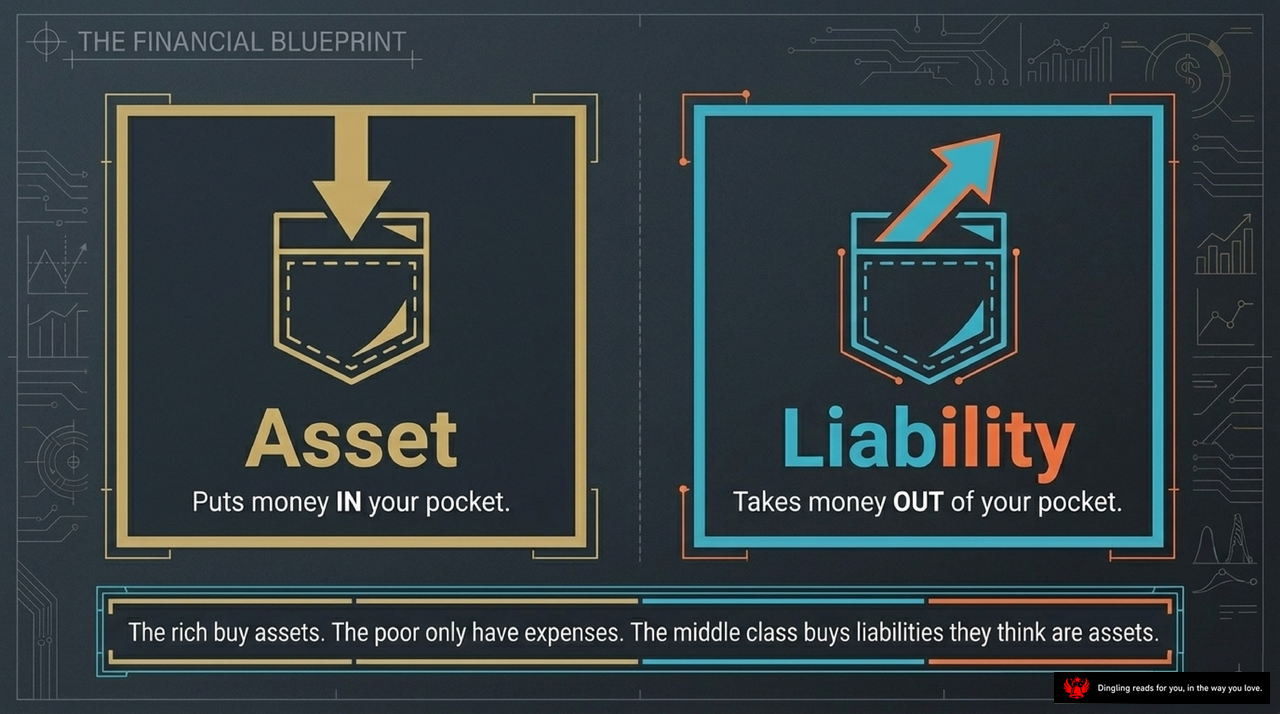
Welcome back to the session. Look at this slide. It is the single most important concept you need to grasp if you want to change your financial life. We are talking about the fundamental difference between an Asset and a Liability.
Notice the arrows. On the left, the Asset arrow points down into your pocket. On the right, the Liability arrow points up, taking money out. That simple visual tells the whole story. Rich Dad taught us that the definition of an asset isn't what you own. It is what puts money in your pocket. Your home, your car, your clothes—they might look like assets on paper, but if they take money out of your pocket every month through mortgage payments, insurance, and maintenance, they are liabilities.
Think about your own home. Many people feel safe because they own a house. But ask yourself: does it put money in your pocket? If you have to pay a mortgage, property taxes, and maintenance every month, the answer is no. It is a liability. Most people buy liabilities because they fear losing their job or can't afford to save. They think a house is safety, but it is actually a financial burden.
The middle class often falls into this trap. They buy liabilities they think are assets. They put their life savings into a house, thinking they are building wealth. But in reality, they are funding their lifestyle with debt. Every paycheck goes to the bank, not to them. They believe they are rich because of their net worth, but they are actually poor because of their cash flow.
The rich, however, buy assets. They focus on things that generate cash flow for them. Stocks, bonds, rental properties, businesses. These are the things that work for you while you sleep. They are the loyal employees that pay you twenty-four hours a day.
The poor and the middle class often only have expenses. They work for money, but they never make money work for them. They get paid, they spend, they get paid again, and the cycle continues. This is what we call the Rat Race.
So, the real question isn't about how hard you work. It is about what you buy with your money. Do you buy things that pay you, or things that pay for themselves?
Let's look at the text at the bottom. It says the rich buy assets. The poor only have expenses. The middle class buys liabilities they think are assets. This is the exact distinction.
This shift in mindset is the first step toward financial freedom. Once you stop confusing expenses with assets, you can start building a portfolio that generates wealth, rather than just funding your lifestyle. You need to stop working for money and start making money work for you. That is the essence of the game.
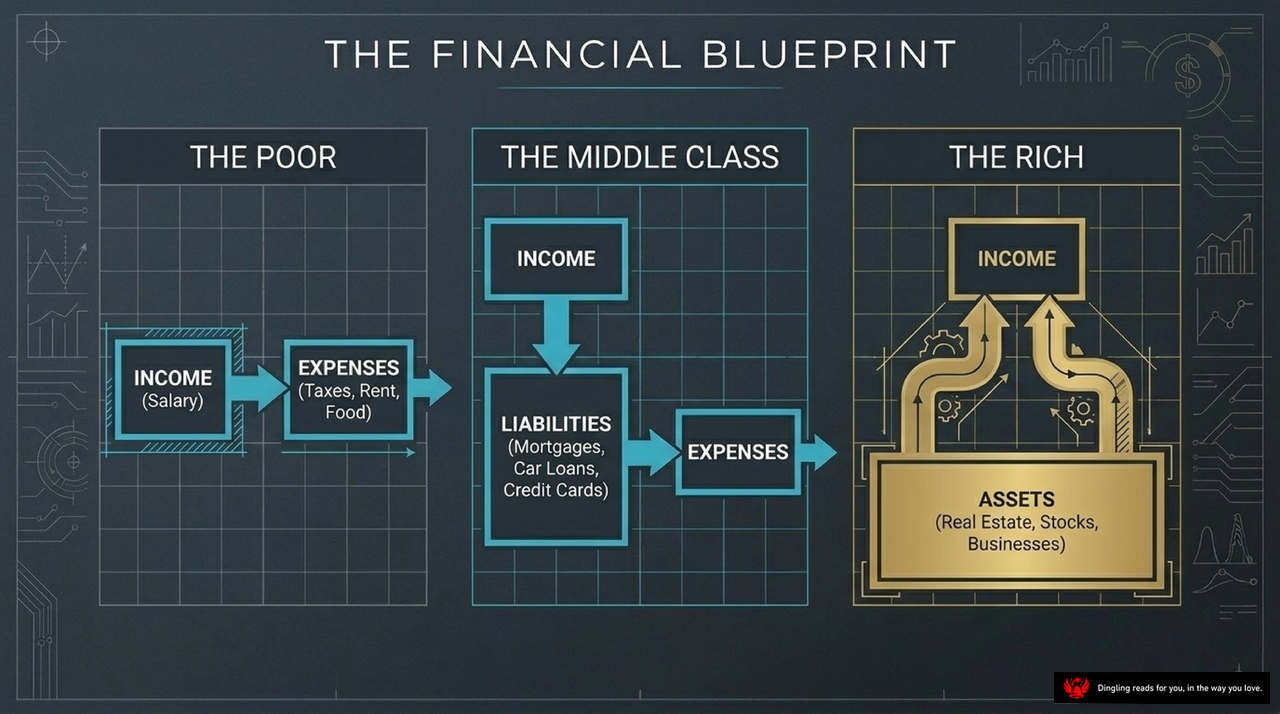
The Financial Blueprint. This diagram lays out the fundamental difference in how money moves through the lives of the poor, the middle class, and the rich. It’s not just about how much you earn, but where that money goes next.
Look at the first column, The Poor. Their path is simple and linear: Income flows directly into Expenses. Whether it’s salary, taxes, rent, or food, the money leaves their pocket immediately. There is no accumulation, no growth. It’s a cycle of survival where they work to pay for the things they need to live.
Now, look at the middle column, The Middle Class. Here, the flow changes slightly but remains trapped. Income goes into Liabilities first—mortgages, car loans, credit cards—before reaching Expenses. The middle class often mistakes these liabilities for assets. They buy a house or a car thinking they are investing, but in reality, these are things that take money out of their pocket every month. They work to pay for these liabilities, which then pay for their expenses. They are still working for money, just with more debt on their back.
Finally, look at the third column, The Rich. This is the golden flow. Income goes into Assets—real estate, stocks, businesses. And crucially, the arrows curve back up. These assets generate their own Income. The rich don’t work for money; they make money work for them. Their assets act like loyal employees, creating cash flow 24 hours a day, even when they aren’t there.
Rich Dad taught us that the rich acquire assets, while the poor and middle class acquire liabilities, even though they think those liabilities are assets. The core of financial knowledge is understanding that assets put money in your pocket, while liabilities take money out.
Most people stay in the middle class trap because they fear losing their job or their paycheck. So they focus on stability and high salaries, which leads to higher expenses and more debt. But the wealthy focus on building a system where their assets generate cash flow that covers their expenses. They don’t need to trade time for money.
To break the cycle, you have to shift your focus from liabilities to assets. Stop buying things that drain your cash, like depreciating cars or expensive houses that cost you more to maintain than they are worth. Instead, start buying things that generate income. This is the blueprint. It’s not about being smarter or working harder; it’s about changing the direction of your money so it works for you, rather than you working for it.
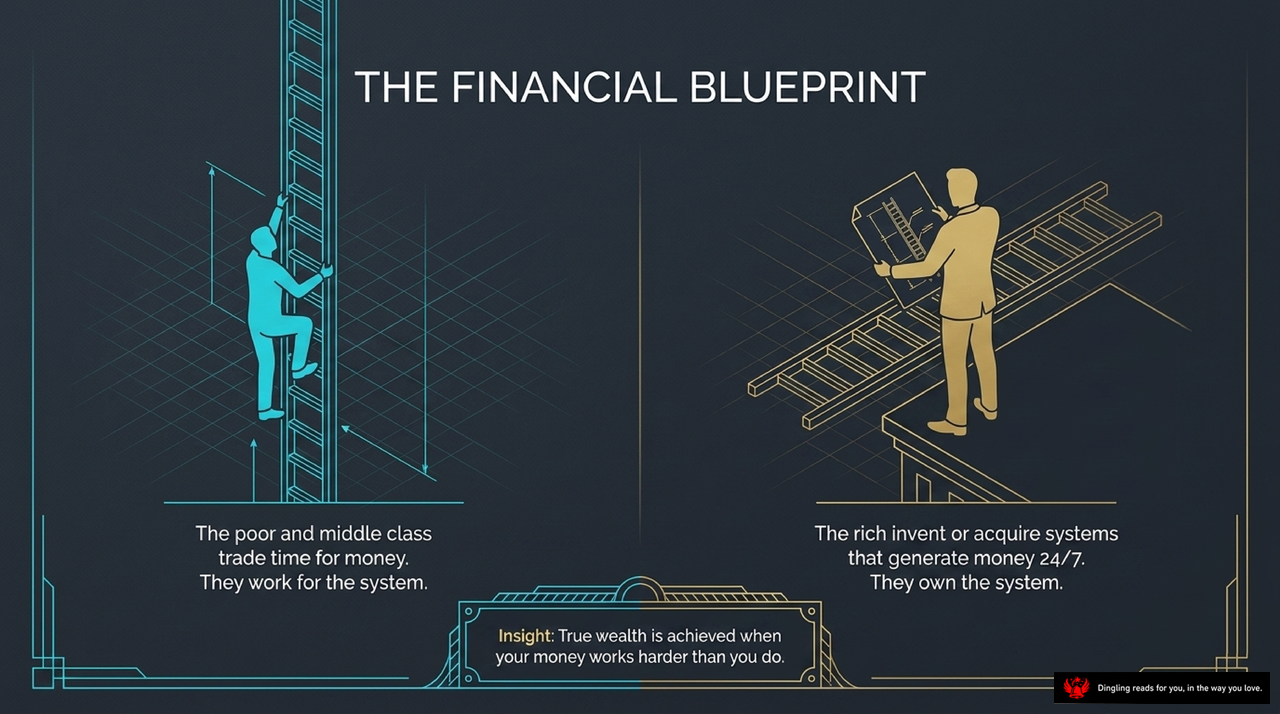
Check out this visual. It's called "The Financial Blueprint," and it shows us exactly where the gap lies between the average person and the wealthy. Look at the left side. The poor and middle class are climbing a ladder. They trade time for money. They work for the system. It feels like progress, right? But the reality is, you're just climbing. If the ladder stops moving up, or if the company pulls the rungs, you're stuck. You're trading your life for a paycheck.
Now look at the right side. The rich aren't climbing. They're standing on a platform, designing the ladder. They invent or acquire systems that generate money 24/7. They own the system.
This is the core lesson from Rich Dad Poor Dad. Most people work for money, especially when they are afraid of money. Fear drives them to work, and then greed drives them to spend, creating a cycle where they're always running but never getting ahead. This is what we call the "Rat Race." They think they need more money to be safe, so they work harder, but that just increases their expenses. It's a trap. They believe that if they work harder, they will be safe, but they just end up working harder for the same paycheck.
But the rich don't work for money. Their money works for them. Their assets act like loyal employees, running 24 hours a day, 7 days a week, creating wealth even when they are sleeping.
The insight at the bottom says, "True wealth is achieved when your money works harder than you do." Think about that. If you have to work to earn a dollar, you are a slave to time. But if you have a business or investments that earn a dollar while you sleep, you are the master of time.
So, how do you move from the left side to the right? You stop trading time for money and start building assets. You stop fearing the loss of a paycheck and start building systems that generate cash flow. It's not about working harder; it's about working smarter. It's about shifting from being an employee of the system to becoming the owner of the system. That's the blueprint for real freedom.

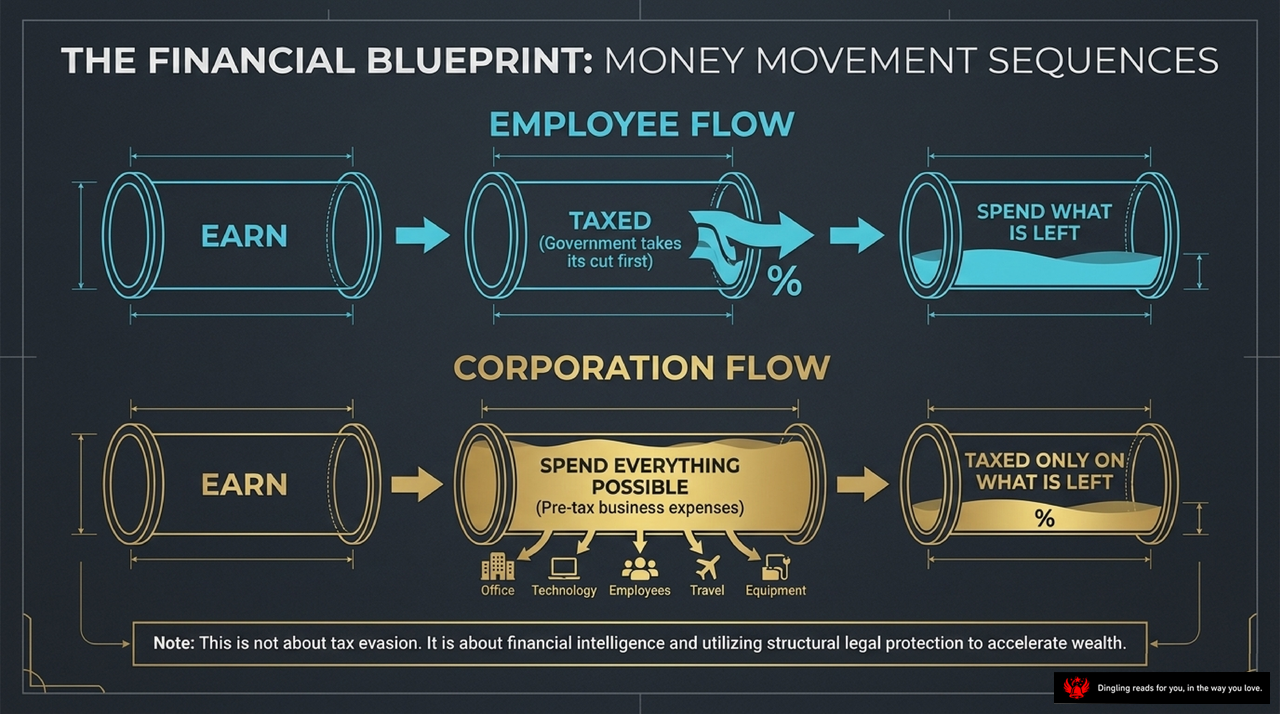
Welcome to the Financial Blueprint. Today, we're looking at the money movement sequences that define your financial future. Look at the top section, Employee Flow. This is the path most of us follow without realizing it. You earn your income, but the government takes its cut first. That percentage is deducted immediately. Then, you spend what is left. You are essentially working for the tax man before you ever see the money. This creates a cycle where your hard work is diminished before it even reaches your pocket.
Now, look at the bottom section, Corporation Flow. This is the strategy used by the financially intelligent. You earn, but instead of paying tax on the full amount upfront, you spend everything possible first. These are pre-tax business expenses. Think about it: office, technology, employees, travel, and equipment. You deduct these costs before calculating your tax liability. You only get taxed on what is left. This means you keep more of your earnings to reinvest and grow your wealth. The icons below represent the levers you pull. These aren't just costs; they are deductions that lower your taxable income.
See the structural difference? In the employee flow, you pay tax on income before you spend. In the corporation flow, you spend on expenses before you pay tax. It's not about avoiding taxes illegally; it's about utilizing structural legal protection to accelerate wealth. As the note at the bottom reminds us, this is financial intelligence, not tax evasion. It is about understanding the rules of the game and playing them to your advantage.
Why does this distinction matter so much? Because the average person spends their entire life trapped in the Employee Flow. They work hard, get a paycheck, and watch the government take a significant chunk before they can enjoy the fruits of their labor. They end up working for the government, for the banks, and for their bosses, but rarely for themselves.
However, when you shift to the Corporation Flow, you change the game. You turn your business into a legal vehicle that shelters your income and reduces your tax burden legally. You keep more capital to reinvest in assets. You stop working for money and start making money work for you.
So, don't just focus on the tax rate. Focus on the structure. Are you earning as an individual or as a business entity? The blueprint is clear. The structure determines your outcome. Choose wisely, and let your financial blueprint work for you.
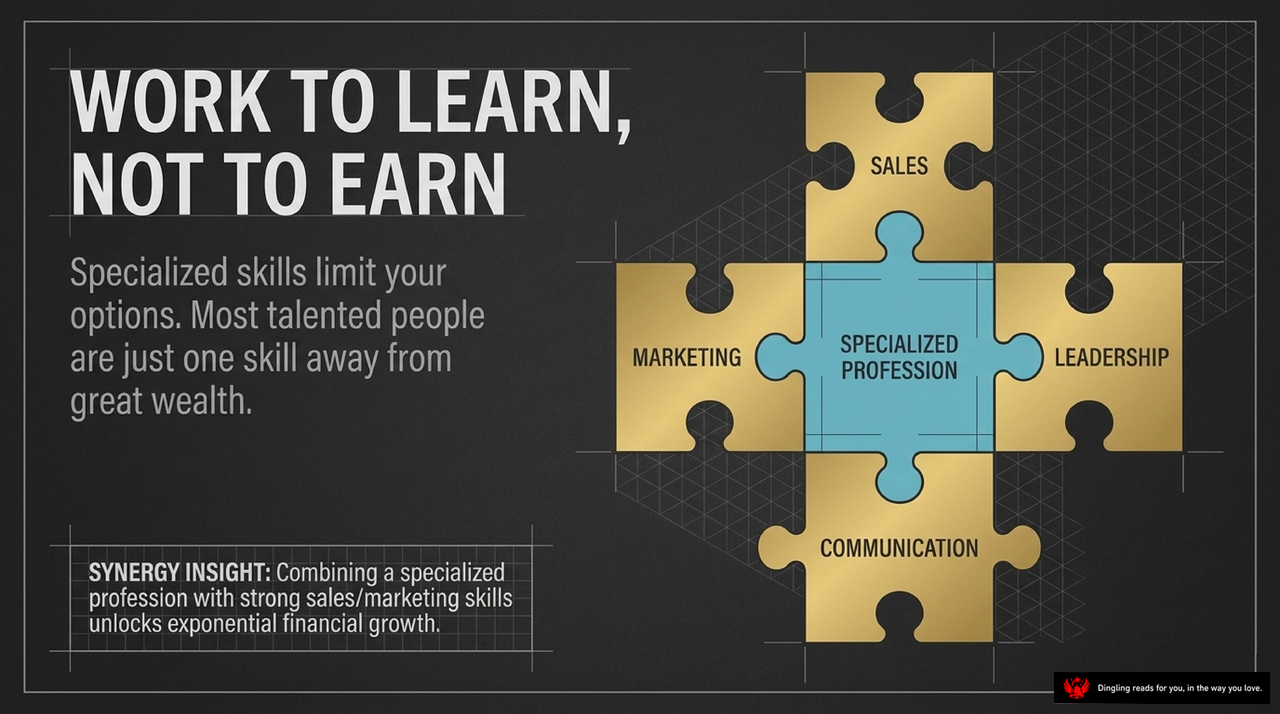
Look at that puzzle. The center piece represents your specialized profession. That's what most people focus on. But the text on the left says something powerful: "Work to learn, not to earn." Why? Because specialized skills actually limit your options. Most talented people are just one skill away from great wealth.
Think about the surrounding pieces: Sales, Marketing, Leadership, Communication. These aren't just add-ons; they are the keys. In the book, the Rich Dad and Poor Dad had very different views on this. The Poor Dad believed that if you focused on one specialized skill and became an expert, you'd have a stable life. That's why he told the narrator to study harder and get a high-paying job. But the Rich Dad saw it differently. He never suggested focusing on just one department. Instead, he wanted the narrator to learn the whole enterprise system.
He believed that success requires managing three things: cash flow, systems, and people. But the most critical specialized skill? Sales and marketing. These are the keys to opening the wealth door. If you can combine your professional expertise with strong sales and marketing skills, you unlock exponential financial growth. That's the synergy insight right there.
Many talented people get stuck because they only sell their time. They trade hours for dollars. But if you learn to sell your value, your product, or your vision, you stop working for money. You start working to learn how to make money work for you. So, don't just perfect your craft. Add the business skills around it. That's how you move from being an employee to being an entrepreneur.
Remember, the goal isn't just to be good at what you do. It's to understand how to monetize that ability. The Rich Dad taught that the fear of money drives most people to work, but true financial freedom comes from making money work for you. So, stop hiding behind your specialization. Step out, learn to sell, learn to lead, and watch your wealth grow. The puzzle is complete when you connect your expertise with the ability to sell it. This is how you break the cycle of working for a paycheck and start building assets that generate income for you. By combining your specialized profession with sales and marketing, you create a system where your skills multiply, not just your hours.

So, we've talked about the difference between assets and liabilities. But here's the hard truth: even with the knowledge, most people still get stuck. Why? Because of five specific roadblocks to financial freedom.
First up is Fear. It's the most common one. Playing it entirely safe, terrified of losing money. But remember, avoiding risk is the real risk. Rich Dad said that if you hate losing money, you'll never make it. You have to learn to lose small amounts to win big ones. Success means not being afraid of failure.
Second is Cynicism. Think of the 'Chicken Little' mindset. You hear every negative rumor and stop yourself from acting. Like that friend who missed a great real estate deal because neighbors told him it was a bad investment. He listened to the noise instead of analyzing the numbers. They let external noise dictate their internal choices.
Third is Laziness. It often hides behind being 'too busy.' You work hard but avoid facing your finances. You use busyness as an excuse not to make money. Instead, you should use your desire for a better life to fuel your action.
Fourth is Bad Habits. Specifically, the order in which you spend. Most people pay everyone else first—bills, taxes, bills—before paying themselves. That lack of discipline keeps you in the 'rat race.' You need to pay yourself first, even if it's a small amount.
Finally, Arrogance. Using your ego to hide financial ignorance. Thinking you know it all when you actually don't. Rich Dad warned us: 'My knowledge gives me money, but what I don't know makes me lose money.' True wealth comes from admitting what you don't know and learning from experts.
So, the path to freedom isn't just about knowing the rules. It's about overcoming these internal barriers. Stop fearing, stop listening to noise, stop being lazy, fix your spending habits, and stay humble enough to learn. That's how you break the cycle and take control of your financial future.

Let's take a closer look at the two mindsets displayed here. On the left, we have the Texas Mindset, and on the right, the Analyst Mindset. These aren't just concepts; they are the deciding factor between wealth and poverty.
Start with the Texas Mindset. It's about your relationship with failure. Winners are inspired by failure; losers are defeated by it. When you lose money, do you see it as a stop sign, or a stepping stone? Many people fail because they are too afraid to lose. They treat every setback as the end. But look at the text: even the rich lose money. The difference is they don't stop. They learn. As the book puts it, failure is just part of success. If you avoid failure, you avoid success. You need to treat losses like stepping stones, not obstacles. Remember, fear of loss is the biggest obstacle.
Now, shift your focus to the Analyst Mindset. This is about how you respond to problems. Cynics criticize. They complain about the work. Imagine someone saying, 'I don't want to fix toilets.' That's a cynical attitude. It shuts down opportunity. But winners analyze. They ask, 'How do I solve this?' Instead of complaining about the labor, they analyze how to hire property managers and scale wealth. They turn a chore into a business model.
Consider Richard's story. He saw a great deal on a house, but his neighbors told him it was a bad idea. So he backed out. Two years later, the market boomed, and that house doubled in value. Richard was a cynic who listened to fear. A winner would have analyzed the numbers and bought it.
Rockefeller said, 'I always try to turn every disaster into an opportunity.' That's the Texas Mindset in action. And as the Analyst Mindset suggests, cynics never win. Success comes from analyzing reality, not just fearing it.
So, I want you to ask yourself: When things go wrong, do you stop and complain, or do you analyze and act? Do you treat failure as a lesson or a life sentence? If you want to escape the 'rat race,' you need to stop fearing loss and start analyzing solutions. Choose the mindset that builds wealth, not the one that limits it.

So, what is the ultimate habit that separates the wealthy from everyone else? It's simple, but incredibly hard to stick to: Pay Yourself First. Look at this diagram. You see money flowing in. The Rich Dad philosophy dictates that you must funnel that money into your Asset Column before you even think about the Expense Column.
Most of us do the exact opposite. We get paid, we pay the bills, we put gas in the car, and then, if there's anything left, we save a little bit. That's the trap. That's why so many people stay broke. They treat their income like a leaky bucket. They live paycheck to paycheck, and the moment they get a raise, they just buy a bigger car or a bigger house. They increase their liabilities instead of their assets.
But here's the shift you need to make. When you prioritize your assets first, you build a fortress. You're not just saving cash; you're building wealth that works for you. Now, I know what you're thinking. "But what if I'm short on cash? What if my bills are piling up?"
This is where the strategy gets powerful. When you're short on cash, do not raid your asset column to pay your liabilities. That destroys your future. Instead, let the pressure of those creditors motivate your financial genius to create more income. Think of those bills not as a burden, but as a signal that you need to earn more.
There's a mindset shift here. Poor Dad habit pays others first, then considers himself. Rich Dad insists "Pay Yourself First"... even when tight on cash, put money into assets first, then pay taxes and bills. That simple order changes everything. It stops you from making excuses and starts you looking for solutions.
This pressure acts like weightlifting for your money muscles. Every time you face a financial crunch because you prioritized assets, you are forced to innovate, to find new income streams, to work smarter. You aren't just surviving; you're evolving.
Think about the difference between a paycheck and an asset. A paycheck stops when you stop working. An asset keeps paying you even when you sleep. If you want to escape the rat race, you have to stop buying liabilities that cost you money every month.
So, stop waiting for the "perfect time" to invest. Build your asset fortress first. Let the pressure of your obligations drive your ambition, not your panic. When you master this habit, you stop working for money and start making money work for you. That is the key to true financial freedom.
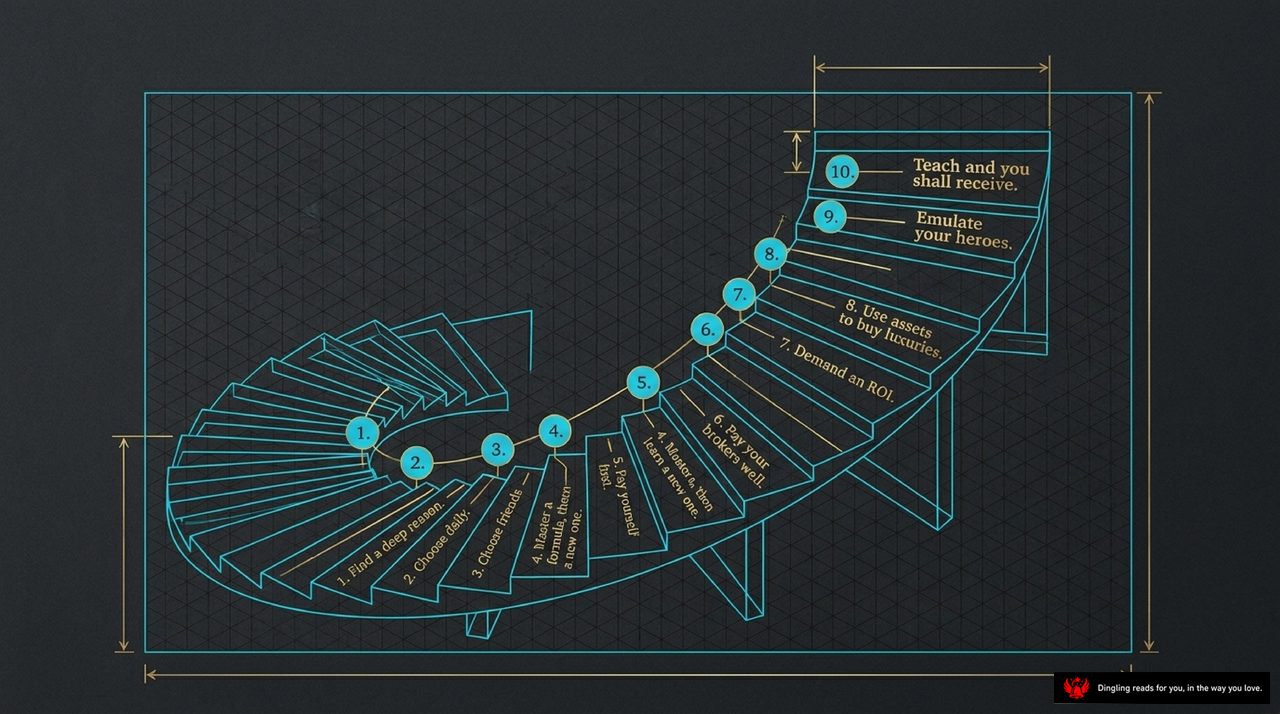
Look at this spiral staircase. This isn't just a cool graphic; it's the exact roadmap to financial freedom that we've been talking about. It breaks down into ten specific steps that you need to climb, one by one, to escape the rat race.
It all starts at the bottom with Step One: Find a deep reason. You need a spiritual motivation, a 'why' that's strong enough to push you through the tough times. Without that, you'll quit when things get hard. Then, Step Two: Choose daily. Every single dollar you earn is a choice. Do you spend it on consumption or invest it in your future? You have to make that choice every day, consciously.
Moving up, Step Three says Choose friends. You can't learn in isolation. You need to surround yourself with people who are already wealthy, not just to borrow money, but to learn their mindset. Avoid the 'chicken' talk of fear. Step Four is about Mastering a formula. Learn the patterns of money, then find a new one. Keep evolving.
Now we hit the financial discipline zone. Step Five is the golden rule: Pay yourself first. Before you pay the bills, put money into your assets. It creates the pressure you need to grow. Step Six tells you to Pay your brokers well. Don't be stingy with information. A good broker saves you time and makes you money. Step Seven is to Demand an ROI. Never accept a deal that doesn't give you a return.
As you climb higher, Step Eight says Use assets to buy luxuries. Let your wealth fund your lifestyle, not debt. Step Nine is to Emulate your heroes. Study the best, like Buffett or Trump, and copy their decisions. And finally, Step Ten: Teach and you shall receive. Give back to the world. The more you give, the more you get.
This staircase shows us that financial freedom isn't magic. It's a habit. It's a choice you make every day to move up one step. So, where are you on this staircase today? Are you stuck at the bottom, or are you ready to climb?
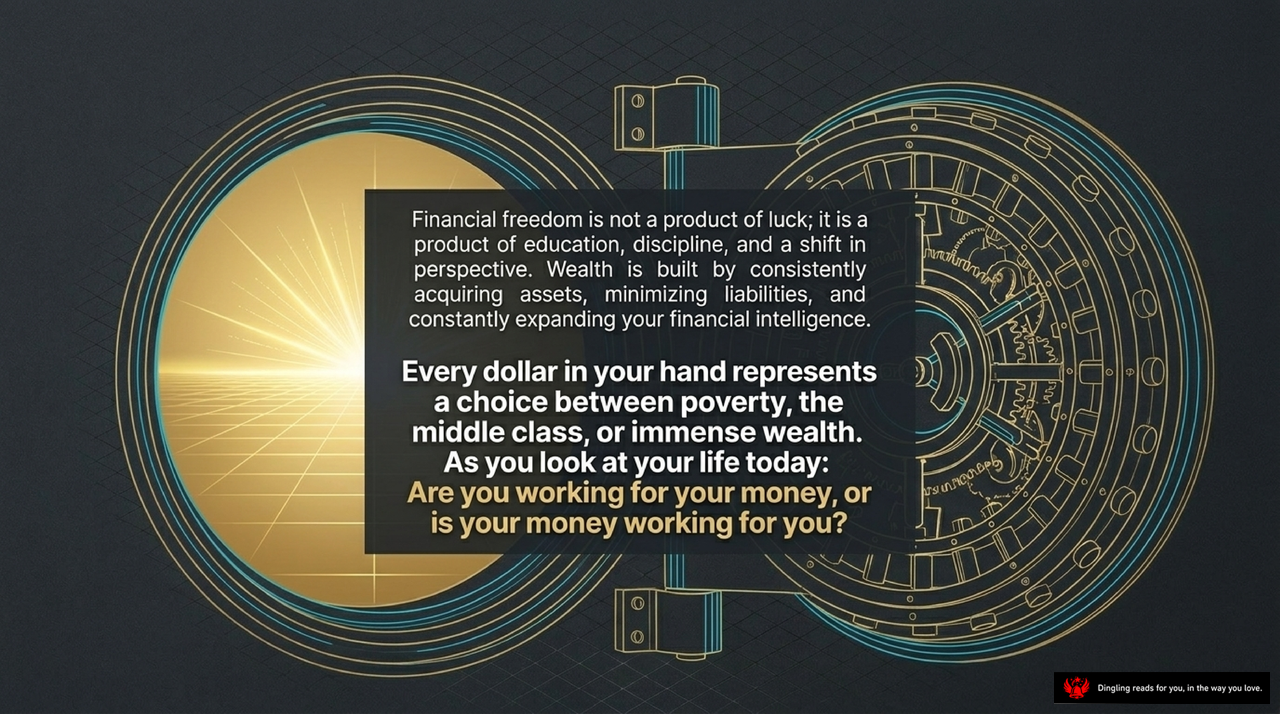
Look at this image. On the left, we have the promise of wealth, and on the right, the machinery behind it. But here's the hard truth: Financial freedom isn't a lottery win. It's not luck. It's the result of education, discipline, and a complete shift in how you see money.
Wealth isn't just about having cash in the bank. It's built by consistently acquiring assets, minimizing liabilities, and expanding your financial intelligence. Think about the definition of an asset. An asset is something that puts money into your pocket. A liability is something that takes money out of your pocket. Most of us, especially in the middle class, confuse the two. We think a house is an asset because it has value. But if you're living in it and paying a mortgage every month, it's actually a liability. It's taking money out of your pocket.
Every single dollar you hold represents a choice. You can use it to buy something that drains your cash flow, or you can use it to buy something that generates it. This choice determines whether you stay in poverty, remain in the middle class, or build immense wealth. The book teaches us that the real education doesn't happen in the classroom. It happens in life. Most people are driven by fear. They fear losing their job, so they cling to stability. But true wealth comes from courage. It comes from taking the risk to buy assets instead of liabilities.
So, as you look at your life today, I want you to ask yourself the most important question in finance: Are you working for your money, or is your money working for you?
Most people work for money. They wake up, go to a job, earn a paycheck, and then use that paycheck to pay bills and buy things they don't really need. They stay trapped in the rat race. But the wealthy understand a different rule. They make their money work for them. Their money acts like a loyal employee, working 24 hours a day, creating more wealth for them even while they sleep.
This isn't about being greedy. It's about understanding the flow of cash. It's about taking control. When you stop working for money and start making money work for you, you unlock the freedom to design your life, not just survive it. So, look at your assets. Look at your liabilities. And decide today: Who is really working for whom?