
Richer, Wiser, Happier: Complete Chapter-by-Chapter Summary
Welcome to *Richer, Wiser, Happier* by William Green. Think of this book not just as a guide for markets, but as a comprehensive playbook that distills the philosophies of the world's greatest investors into actionable frameworks for both your financial life and your daily existence. We're here to explore how top performers don't reinvent the wheel; instead, they stand on the shoulders of giants, turning proven wisdom into their own unique edge.

The world's greatest investors aren't just financial analysts; they are seekers of "worldly wisdom." As we see on this slide, top investors operate on a distinct wavelength, rejecting the hyperactive Wall Street casino in favor of disciplines drawn from stoicism, biology, history, and mathematics.
Think about this: the market is essentially a laboratory. Instead of trying to predict the future with crystal balls, these masters use the market as a testing ground to observe human behavior, rationality, and discipline. They understand that true alpha doesn't come from complex models, but from understanding the timeless principles of how people react to fear and greed.
Consider the story of Monish Pabrai, who didn't try to reinvent the wheel. Instead of chasing the latest trend, he reverse-engineered the wisdom of legends like Buffett and Munger. He realized that the most powerful strategies are often the simplest ones—principles that have survived decades of market cycles. By focusing on the intrinsic value of a business and maintaining a stoic patience, he proved that you can beat the market not by being smarter, but by being more disciplined and less emotional.
So, when you look at the maze on the left, don't see it as a complex puzzle. See it as a map of the mind. The top performers aren't lost in the chaos; they are navigating with a compass built from biology, history, and math. They stop playing the casino game and start playing the game of life, where the rewards are far greater and far more sustainable.

Imagine a scale balancing two worlds: on one side, "Chance," driven by emotion and guesswork, represented by a spinning roulette wheel; on the other, "Edge," grounded in mathematical probability, symbolized by an abacus and a calculator. This slide captures the essence of transforming luck into a winning advantage, a lesson perfectly illustrated by Ed Thorp, who conquered both blackjack and the stock market by refusing to play games without a mathematical edge.
The key takeaway here is simple yet profound: avoid games with poor odds. True broad rationality isn't about having all the answers; it's about analyzing the facts and remaining unswayed by emotion. When you feel angry or panicked, the smartest move is to step back and ask yourself, "What do you actually know?" By shifting your focus from the chaos of chance to the stability of mathematical probability, you stop gambling and start investing with an edge.

Welcome to Section I: The Mechanics of Wealth. Think of wealth not as a lottery ticket, but as a complex machine with precise gears and rules. Before you can build your own fortune, you must first understand the tactical rules of the game.
Many top investors, like Monish Pabrai, didn't try to reinvent the wheel. Instead, they mastered the art of imitation. They studied the giants—Buffett and Munger—and reverse-engineered their decisions. It wasn't about lacking originality; it was about efficiency. Why spend years stumbling in the dark when you can stand on the shoulders of those who have already navigated the storms?
But imitation isn't just copying; it's about understanding the core principles. Pabrai focused on three timeless ideas: buying a business, not just stock; treating the market as a voting machine, not a weighing machine; and always buying with a margin of safety. He learned the power of patience, waiting for the market to panic before others, and the discipline of saying "no" to 99% of opportunities to catch that one perfect moment.
This section is about defining the mechanics. It's about realizing that true wealth comes from simple, proven principles applied with extreme discipline, rather than chasing the next hot trend. Let's dive into how these mechanics actually work.

Imagine a curve that starts with just $4,800 and, over the course of 60 years, explodes into $21 million. This isn't magic; it's the mathematical reality of compounding at a 15% annual rate, effectively doubling your wealth every five years. This is the "Cloning Advantage" in action.
In the world of wealth building, we often overrate originality. But look at Mohnish Pabrai. He didn't invent a new system; he unapologetically "cloned" Warren Buffett's rules, turning a small fund into a billion-dollar empire. His story teaches us that harnessing the power of simple ideas, taken seriously, is far more potent than chasing complex, unproven theories.
When you understand that time is the ultimate ally, you stop worrying about short-term noise and start focusing on the long-term trajectory. Whether you are investing or building a business, the secret isn't to be the first to arrive, but to be the one who stays and lets the compound interest of time do the heavy lifting.
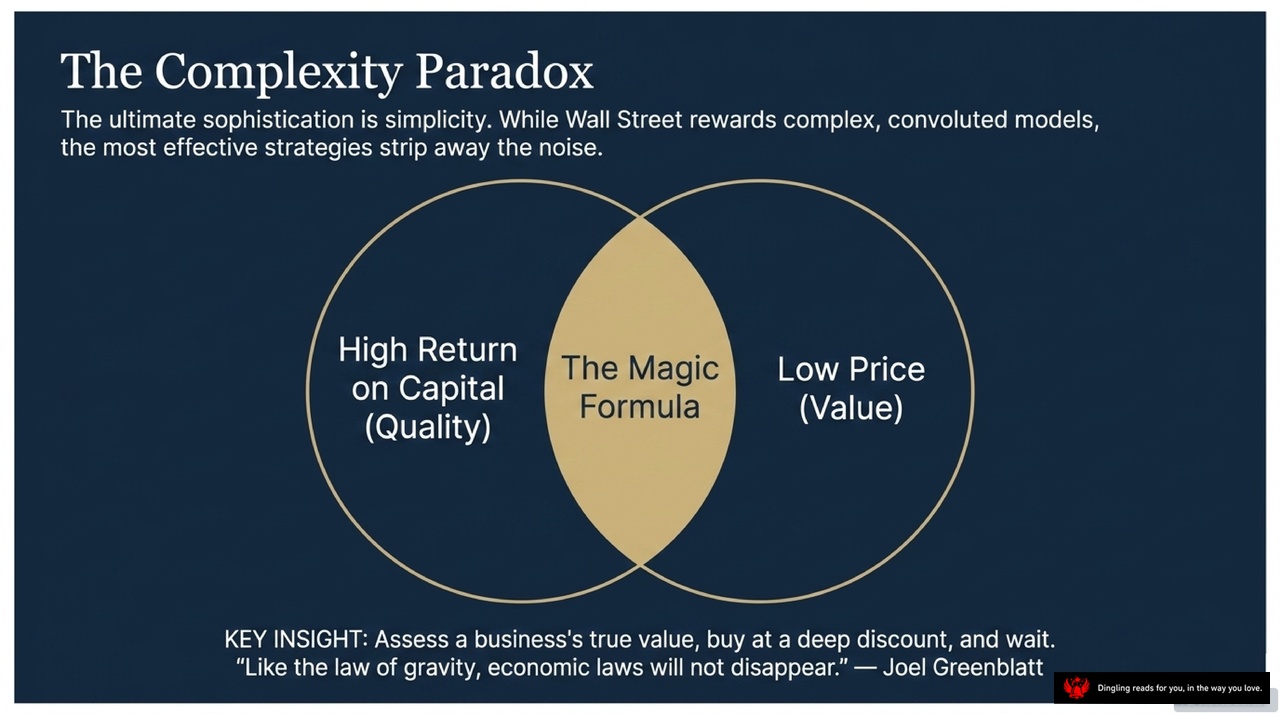
The ultimate sophistication is simplicity. While Wall Street rewards complex, convoluted models, the most effective strategies strip away the noise to reveal what truly matters. Look at this Venn diagram: on one side, you have High Return on Capital, which we call Quality. On the other, you have Low Price, which represents Value. The magic happens right in the intersection. This is what we call "The Magic Formula."
It's a powerful reminder that the best investment strategy isn't about finding the next big thing or using a complicated algorithm. It's about combining a business that generates incredible returns with one that you can buy at a bargain. As Joel Greenblatt famously said, "Like the law of gravity, economic laws will not disappear." If you assess a business's true value and buy it at a deep discount, you create an inevitable edge. The key insight here is simple: assess the true value, buy at a discount, and wait. By focusing on this intersection of quality and value, you stop fighting the market and start letting the laws of economics work for you.
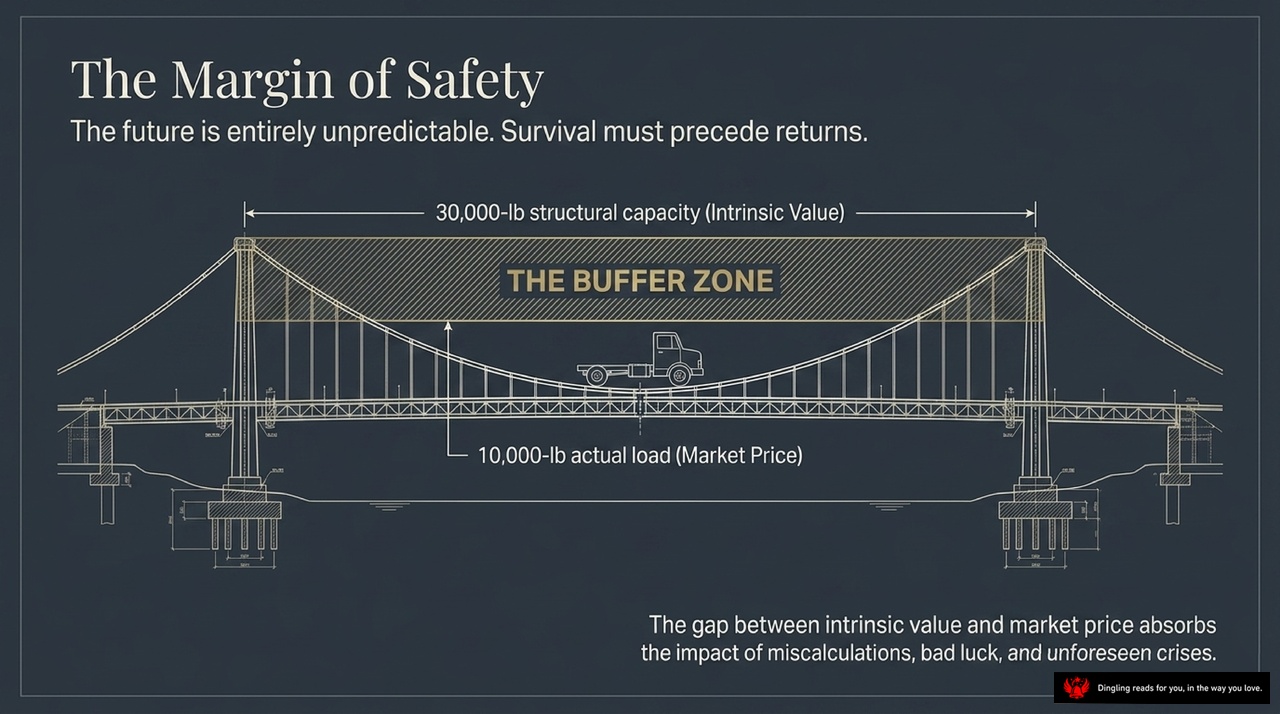
Imagine a bridge designed to hold 30,000 pounds, yet you only drive a 10,000-pound truck across it. That extra space isn't wasted capacity; it's your "Margin of Safety." As the slide reminds us, the future is entirely unpredictable, so survival must always precede returns. This gap between intrinsic value and market price acts as a powerful buffer zone. It absorbs the inevitable impact of miscalculations, bad luck, and unforeseen crises that no one can predict. In investing, you don't need to guess the exact weight of the truck; you just need to ensure the bridge is strong enough to handle the worst-case scenario. By buying when the price is significantly lower than the true value, you build this protective layer, giving yourself room to breathe when the market turns volatile. It's the difference between walking on a tightrope and walking on a wide, sturdy bridge.

Welcome back to Section II: The Psychology of Mastery. This isn't just about mastering the market; it's about conquering your internal landscape to navigate the external chaos.
Think about the most successful investors you know. Do they reinvent the wheel every time? No. They are masters of imitation. They stand on the shoulders of giants, taking proven wisdom from legends like Buffett and Munger, and making it their own. It's not about lacking originality; it's about efficiency. Why struggle in the dark when a map already exists?
Take Munish Pabrai, for instance. Instead of trying to build a brand-new system from scratch, he reverse-engineered Buffett's decisions. He broke down the logic, the mindset, and the patience, turning abstract genius into actionable steps. He proved that true power often lies in simple, repeated principles rather than flashy new theories.
But imitation is just the starting point. To truly master yourself, you have to avoid the traps that derail everyone else. This is where Charlie Munger's "Inversion" comes in. Instead of asking how to succeed, ask how to fail. What are the stupid things you must never do? By identifying your own weaknesses—like emotional panic, overconfidence, or chasing trends—you build a shield against disaster.
It's also about your habits. Are you willing to do the boring work? While others are distracted by noise or socializing, the masters are reading, learning, and thinking deeply. They prioritize long-term value over short-term gratification. They say "no" to 99% of opportunities so they can say "yes" to the one that truly matters.
Ultimately, mastery is a discipline. It's about controlling your emotions, staying humble, and building a life where your decisions align with your values, not the market's noise. When you get your internal world right, the external world starts to make sense.
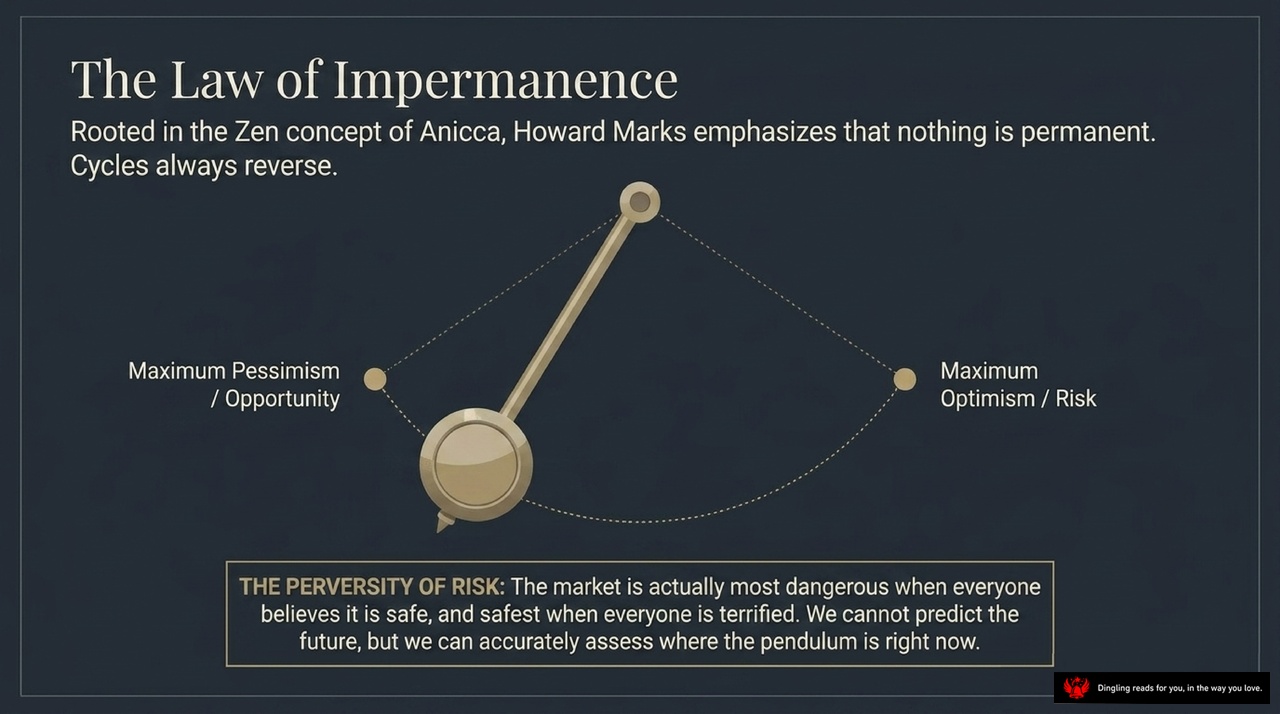
The Law of Impermanence isn't just a philosophical concept; it's the heartbeat of the market. Rooted in the Zen idea of Anicca, Howard Marks reminds us that nothing is permanent. Cycles always reverse. Think of the market like a pendulum swinging between two extremes: on one side, Maximum Pessimism, which is actually your greatest Opportunity; on the other, Maximum Optimism, which hides the biggest Risk.
Here's the perversity of risk: the market is most dangerous when everyone believes it's safe, and surprisingly, safest when everyone is terrified. We can't predict the future, but we can accurately assess where the pendulum is right now. When fear is at its peak, that's often the time to buy. When greed takes over, that's when you should prepare to sell. Understanding this rhythm helps you stay calm when others panic and act decisively when others are blinded by hype.

Look at this slide: "The Wall Street Novice vs. The Practical Philosopher." This isn't just a comparison; it's a blueprint for why most investors fail while the few who succeed stay ahead.
On the left, we have the Novice. He's defined by hyperactive trading and constant portfolio turnover. He gets lost in complex, fragile models with 50 variables, trying to guess next quarter's earnings. He craves the psychological safety of the crowd, seeking validation from everyone else.
On the right stands the Philosopher. His action is extreme, dormant patience, waiting for the perfect pitch. His analysis is simple, focusing strictly on just 3 or 4 unassailable key variables. He isn't afraid of sentiment; in fact, he willingly stands in complete isolation, rejecting the noise. His focus isn't on short-term noise but on evaluating 10-year structural business advantages.
Think about this: the Novice chases complexity and crowd approval, while the Philosopher embraces simplicity and solitude. As we've seen with investors like Munish Patbhai and John Templeton, true alpha doesn't come from doing more or being smarter at math. It comes from the discipline to say "no" to 99% of opportunities, to sit still when everyone else is panicking, and to trust a simple, long-term logic over a fragile, complex one. The market rewards those who can be boring, patient, and alone when it matters most.

The Courage of the Contrarian isn't just a catchy title; it's a survival strategy for the smartest money managers in the world. Look at that graph. It shows "Crowd Sentiment" crashing into a deep red valley, labeled "The Point of Maximum Pessimism." This is where the rest of the world is paralyzed by fear, selling everything they own. But that's exactly where Sir John Templeton stepped in.
He didn't follow the crowd; he acted decisively when everyone else was frozen. Templeton understood a hard truth: if you buy the same assets as everyone else, you'll get the exact same mediocre results. To achieve superior performance, you must do something different from the crowd.
This slide captures the essence of being a contrarian. It's about having the courage to strike when the philosopher strikes—when pessimism is at its absolute peak. History has proven that buying at the point of maximum fear often leads to the greatest rewards when the market inevitably turns around. So, the next time you feel the urge to sell in a panic, ask yourself: is this the moment the crowd is wrong, and the opportunity is finally right?

Imagine investing not as a race for quick wins, but as a metaphysical journey where quality triumphs over speed. This is the core philosophy behind the work of Nick Sleep and Qais Zakaria, who famously rejected the temptation of instant gratification. Instead, they focused entirely on the "shelf-life" of their insights.
Think of the market as a giant, multi-layered filter. The top layer catches short-term noise like daily earnings beats and breaking news. The second layer filters out cyclical trends, macroeconomic shifts, and temporary market moods. Only the most valuable assets survive these sieves to reach the bottom: long-shelf-life insights. These are the permanent behavioral truths and the power of scale economics that compound over decades.
The slide reminds us to ignore ephemeral data. True wealth comes from investing heavily in these permanent truths. While the market chases the latest trend, the wise investor looks past the noise to find businesses built on durable advantages that can thrive for generations.

Welcome back to Section III: The Architecture of Habit. Think of your daily routine not as a random collection of tasks, but as the intricate inner workings of a precision clock. Just as the gears in the background of our slide must turn in perfect synchronization to tell time, your habits are the mechanical engine driving relentless compounding in your life.
In this section, we move beyond the theory of investing and dive into the daily mechanics that make it real. It's about understanding that extraordinary results rarely come from grand, one-time leaps, but from the consistent, often invisible, turning of small gears every single day.
Consider the story of Tom Gaina, a successful investor whose secret weapon wasn't a complex formula, but a simple, disciplined habit: losing just 0.45 kilograms a year. By making tiny, sustainable adjustments—like reducing his donut intake from 200 to 20 per year and building a consistent running routine—he mastered the art of gradual improvement. His life and his portfolio both thrived because he understood that massive victories are just the accumulation of small, daily wins.
Similarly, Paul Lazaris treated learning as a non-negotiable habit. He didn't just read books; he lived them, reading four to seven hours a day and re-reading classics like Benjamin Graham's *The Intelligent Investor* dozens of time. He even listened to investment wisdom while riding his bike or falling asleep at night. This relentless, repetitive input built a mental framework that allowed him to spot opportunities others missed.
The architecture of habit also requires avoiding the "stupid" choices that derail progress. Charlie Munge, the legendary investor, spent a lifetime collecting stories of "stupidity"—mistakes made by himself and others. By actively studying what *not* to do, he built an emotional and cognitive firewall. He realized that managing your emotions and avoiding cognitive biases is often more important than trying to be clever. When you stop doing the wrong things, the right things naturally happen.
So, what does this mean for you? It means that your future isn't determined by a single lucky break, but by the quality of your daily habits. Are you building the gears that lead to compounding growth, or are you letting friction and inconsistency grind your progress to a halt? The architecture is yours to design. Start by identifying one small habit you can refine today, and watch how that single gear begins to turn the entire machine of your life.

The aggregation of marginal gains is the secret to unstoppable momentum. As the slide illustrates, extreme, sudden moves often lead to disaster, while gentle, persistent habits create the compounding force we all crave. This is the core of The Gayner System, a four-step cycle designed to build wealth through consistency rather than luck.
First, you must identify high-return, low-leverage businesses. Think of these as the engines of your portfolio—companies that generate cash with minimal effort. Second, ensure the management team has unassailable integrity. You are buying a business, not just a stock, so trust in the people running it is non-negotiable. Third, verify massive reinvestment potential. The best companies have a built-in flywheel; they take profits and automatically invest them back into growth, creating a self-sustaining cycle of expansion. Finally, buy at a fair, reasonable price. This is your safety margin, the buffer that protects you when the market turns volatile.
Notice how these steps form a continuous loop. You don't start with a massive win; you start with a small, disciplined decision and repeat it. Over time, these tiny advantages stack up, generating the massive returns that feel like magic but are actually just the result of smart, repeated choices.
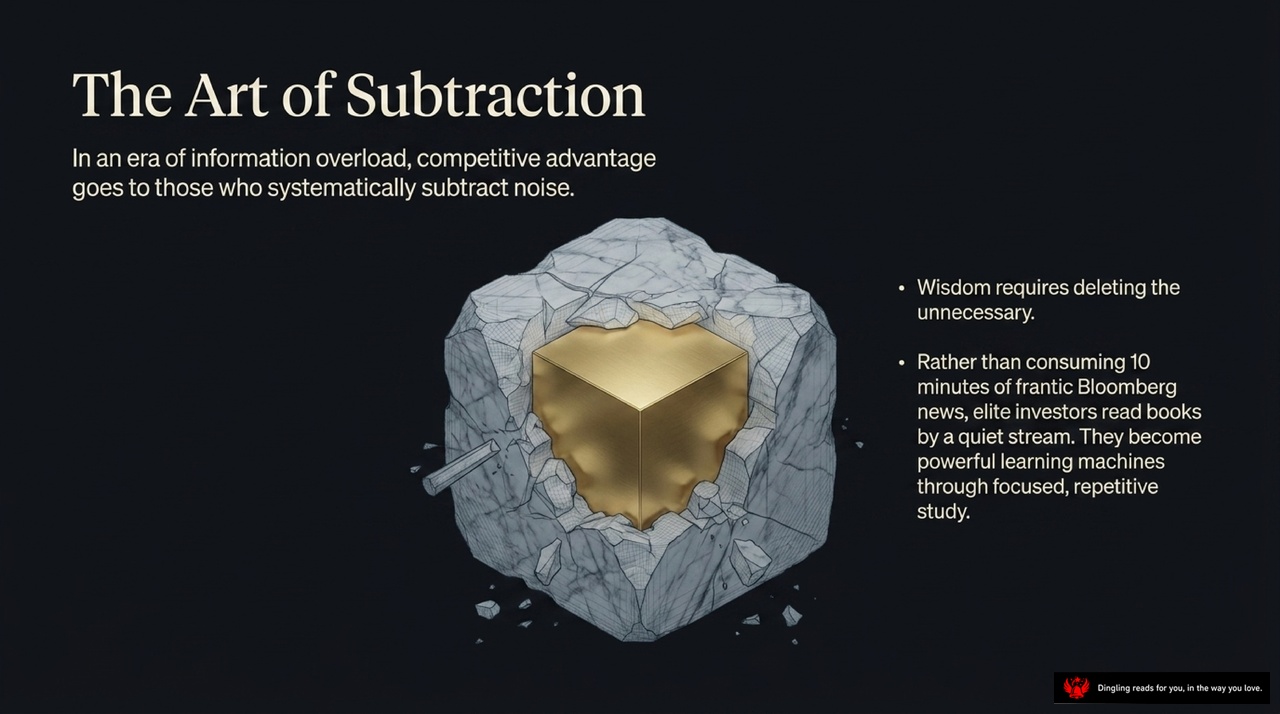
The Art of Subtraction isn't just about cutting things out; it's about creating space for what truly matters. In a world drowning in noise, the real competitive advantage belongs to those who systematically strip away the unnecessary. Look at that golden cube emerging from the rock—it represents the core truth: wisdom is found not by adding more data, but by deleting the clutter.
Think about your morning routine. Instead of spending ten minutes frantically scrolling through frantic news feeds like Bloomberg, why not read a few pages of a book by a quiet stream? Elite investors don't chase every headline; they become powerful learning machines through focused, repetitive study. They know that while the market is screaming for your attention, the greatest opportunities are often hidden in silence.
The lesson is simple yet profound: to find the gold, you must first break away from the noise. Whether it's limiting your news intake, avoiding pointless meetings, or saying "no" to 99% of opportunities, subtraction is the ultimate act of discipline. When you remove the distractions, you don't just save time—you unlock clarity, making room for the most important decisions in your life and career.

The Inversion Checklist isn't just a catchy title; it's a survival manual for smart investing. As Charlie Munger famously said, the real secret to long-term advantage isn't trying to be brilliant. It's about consistently avoiding stupidity.
Look at the right side of this slide. Instead of asking "What should I do?", Munger flips the script and asks, "What should I absolutely NOT do?" This is the power of the Inversion Checklist.
First, never act on misaligned incentives. If your rewards don't match your goals, you're doomed to fail. Second, stay out of any game where the odds are stacked against you. Third, resist the urge to follow the crowd into irrational exuberance. When everyone is cheering, that's usually the time to be cautious. And finally, stop chasing brilliance. You don't need to be a genius; you just need to avoid obvious errors.
By focusing on what *not* to do, you automatically eliminate the biggest risks in your life. It's a simple, powerful strategy that turns your brain into a filter for success.

Welcome to Section IV: The Ultimate Dividend. Look at the compass behind us; it points beyond the numbers on a balance sheet and toward a life that is truly well-lived.
In this section, we shift our focus from mere financial returns to the deeper dividends that wealth can buy: autonomy, purpose, and the freedom to live on your own terms. We explore how the ultimate return isn't just a number in an account, but the ability to help others, to avoid foolish mistakes, and to build a legacy that outlasts your net worth.
We'll see how top investors like Munish Patil and Arnold Vandenberg discovered that true wealth is about independence, not accumulation. They realized that the greatest leverage comes from using capital to solve problems—whether that's funding education for underprivileged students or simply having the quiet confidence to say no to a luxury car.
More importantly, we'll look at the "dividend" of avoiding stupidity. By studying the habits of the greats, from Charlie Munger's list of things to avoid to the power of deep work, we learn that protecting yourself from ruin is often more valuable than chasing the next big gain.
So, let's move past the balance sheet. Let's talk about how to use your resources to build a life of meaning, resilience, and genuine impact. This is where the real investing begins.

Imagine you're standing on a scale. On the left, you have the "External Scorecard"—a trophy, a dollar sign, and the question: Would you rather be the best lover in the world but known publicly as the worst, or the worst lover known as the best? This is the Buffett Test, forcing us to choose between reputation and reality.
Now, look at the right side. This is the "Internal Scorecard." As Van Den Berg reminds us, a vast net worth means nothing without self-mastery. True wealth isn't about what you own; it's an internal state defined by health, deep relationships, and peace of mind.
The balance isn't just about money; it's about where your true worth lies. Can you build a life that feels rich from the inside out, regardless of what the outside world sees? That is the only scorecard that truly matters.

Look at this Venn diagram: The Architecture of a Master. It visualizes the ultimate goal of investing: a life where money serves meaning, probability serves peace, and compounding serves character.
To achieve this, we need to integrate three distinct circles. First, Financial Independence. This isn't just about having cash; it's built on the principles of probability, maintaining a margin of safety, and harnessing the magic of compounding. Second, Intellectual Honesty. This requires the courage to use inversion and impermanence, constantly removing the noise that distracts us from the truth. Third, Spiritual Fulfillment. This is achieved through an inner scorecard, giving back to others, and mastering the art of delayed gratification.
When these three areas overlap, they create what the slide calls "The Ultimate Dividend." This is the state where your financial freedom supports your purpose, your understanding of risk brings you calm, and your commitment to long-term value shapes your character. As we've seen from the stories of masters like Munish Parekh, Tom Gayner, and Arnold Vanderberg, true mastery isn't about chasing quick wins. It's about aligning your financial strategy with your intellectual integrity and your spiritual values. When you do that, you stop being a victim of the market and start becoming the architect of your own life.

So, we've reached the final equation. Think about it: the world's greatest investors don't get rich by trying to outsmart the market. Instead, they treat the market like a crucible for character. They achieve extraordinary wealth not by being smarter than everyone else, but by mastering their own psychology, respecting probability, keeping their systems simple, and playing a game that extends far beyond just money.
Now, here's the real question for you: You might know how to build a portfolio for the next decade, but have you actually built an Inner Scorecard for the rest of your life? It's about shifting your focus from what others think to what you believe is right. It's about making decisions based on your own values, regardless of the noise around you. That's the true foundation of lasting success.