
The Sailor Who Fell from Grace with the Sea: Complete Chapter-by-Chapter Summary

Welcome to our book club. Today, we're diving into Yukio Mishima's *The Sailor Who Fell from Grace with the Sea*.
This isn't just a story about a boy named Toru and his mother, Fumi. It's a visual essay on the fatal collision between the absolute ideals of youth and the inevitable compromises of adulthood.
Imagine a thirteen-year-old boy who believes the world is made of simple signs and decisions, where death is a natural part of life and society is a fiction. He sees his father's death not as a tragedy, but as a victory. But then, he discovers a secret peephole in his mother's room. Through it, he watches her make love to a sailor, a man named Ryuji. In that moment, Toru feels he has found the pure, unadulterated truth of existence—a sacred ring connecting everything. He decides he must protect this truth at any cost, even if it means doing something terrible.
But as the story unfolds, we see the other side of that same collision. Ryuji, the sailor, is a man who hates the land but is forced to live there. He dreams of glory and the sea, yet he finds himself falling in love with a woman on land. When he finally returns to her home, he becomes a father figure, a husband, and a man of the house. To Toru, this transformation is a betrayal. The hero he worshipped has become ordinary, a man of the land, and the pure reality Toru saw in that peephole is gone.
This book challenges us to ask: What happens when the ideals of youth crash into the messy reality of adulthood? And at what point do we lose our innocence? Let's turn the page and explore the beginning of this summer.

The Fatal Triad. Three lives bound by a shared illusion of perfection.
Let's dive into the characters that drive this story. First, we have Noboru, our thirteen-year-old nihilist. He sees the world as an empty void governed by cruel, objective laws. To him, adulthood is nothing but a disease, and he demands absolute perfection.
Then there is Fusako, representing The Reality. At thirty-three, she is a widowed boutique owner. She embodies the heavy, immutable gravity of domesticity, commerce, and human connection. She is the anchor in this storm.
Finally, we have Ryuji, The Catalyst. Also thirty-three, he is a sailor who believes he is destined for a special, luminous "Glory" at sea. Yet, secretly, he is exhausted by the ocean's isolation.
These three—The Nihilist, The Reality, and The Catalyst—are locked in a delicate, dangerous balance. Their lives intersect not by chance, but by a fragile, shared delusion.

On this slide, we're breaking down the "Architecture of Perfection"—the specific mental trap Noboru falls into while spying on his mother and Ryuji. It's a fascinating psychological breakdown of how a child constructs a god-like narrative out of a simple, messy moment.
First, look at **The Frame**. The peephole acts as a lens, literally and metaphorically. It strips away all the "messy human context." In reality, Ryuji is just a tired sailor, and Noboru's mother is just a woman in a humid room. But through that tiny hole, they become abstract, perfect shapes. They are no longer people with flaws; they are symbols of pure existence.
Then, we have **The Catalyst**. This is the moment everything clicks. When the ship's horn sounds in the distance, it connects the raw flesh of the embrace to the vast, dark ocean. That sound bridges the gap between the bedroom and the sea, turning a private act into something epic. It tells Noboru that this isn't just sex; it's a cosmic event.
Finally, **The Illusion**. Noboru believes he is witnessing an "unavoidable circle of existence"—a moment of pure, objective glory untouched by society. He thinks he's discovered a secret truth about the universe. But here's the tragedy: he's not seeing reality. He's seeing a projection of his own genius. He convinces himself that if he destroys this "perfect" moment, the world will end. That's why he feels so justified in wanting to kill the sailor later. He thinks he's protecting a masterpiece, not realizing he's just destroying his own mother and a man he doesn't know. It's a beautiful, terrifying example of how innocence can twist into something monstrous.

The image on your screen perfectly captures the internal conflict of Ryuji, the second mate, by contrasting two worlds: the fluid, heroic ideal of the sea versus the stagnant, heavy reality of the land.
On the left, we have "The Sea," representing his ideal. It's fluid, abstract, and unpredictable, promising him a unique, luminous glory and a heroic death. The sound here is the deep, tragic wail of a ship's horn, a call to adventure. However, even this ideal has a flaw: it offers ultimate isolation, a prison of steel and waves where he is alone.
On the right is "The Land," his reality. It's immovable, concrete, and stagnant. While it promises peace, domestic comfort, and economic security—things a man needs to survive—the cost is high. It strips away the myth of the heroic male, forcing him to confront a mundane existence where his muscles are just for labor, not glory. The sound shifts from the ocean's wail to the hum of air conditioners and cash registers.
Ryuji's perception is split right down the middle. He hates the land's immobility, yet he is trapped in a ship that is just another kind of prison. He dreams of a glory that the sea never truly delivers, only a cycle of duty and loneliness. This tension defines his journey: a man trying to find a hero's life in a world that only offers a sailor's routine.

The image on your screen is titled "Anatomy of the Abyss," and it cuts straight to the heart of what's happening with Noboru and his gang. This isn't just a story about bullying or teenage rebellion; it's a twisted philosophical experiment. The slide breaks it down into four key parts, and let's look at them.
First, there's "The Mask." The gang believes that the world around them—school, parents, society—is all just a hollow fiction. They feel disconnected from reality, so they create this mask to hide from it.
Then, we have "The Cruelty." For these boys, blood and death aren't just violence; they are the only authentic materials left to fill the "empty void" of existence. They think that by killing, they are proving they are real.
On the other side, we see "The Interior." By dissecting the cat, they aren't acting out of anger. They believe they are exposing a "white, lustrous interior"—a pure, sacred core. They think this ritual connects them directly to the universe's center. It's a twisted way of seeking meaning.
Finally, there's "The Shield." This is their safety net. They quote "Article 41," which states that acts by people under fourteen are not punishable by law. This legal loophole is their absolute freedom, the reason they feel they can do anything without consequences.
In the book, this philosophy comes to life when the boys capture a stray kitten. They don't just kill it; they perform a ritual. They strip it bare, cut it open, and examine the organs, treating the cat like a scientific specimen. To them, this dissection is a way to prove that life is just a shell and that they have the power to reshape reality. They believe that if they destroy this "fictional" world, they can create something truly real.
But here's the tragedy: they are trying to find the truth by destroying life. They think they are connecting to the universe, but they are actually just deepening their own isolation. The blood and the gore they create don't fill the void; they only make it darker. This "Anatomy of the Abyss" shows us how far these boys are willing to go to feel like they belong in a world that has rejected them. It's a chilling look at how easily a broken philosophy can turn into something deadly.

On New Year's Eve, the sea calls one last time before the tide turns forever. Ryuji leaves behind the cold, endless horizon to embrace the warmth of land, choosing to marry Fusako and take charge of her luxury boutique, Rex. It is a bold surrender—trading the grand, cosmic isolation of the ocean for the safe, predictable margins of imported goods.
Look at the contrast: on the left, the ship *Rakuyo* battling the stormy waves, representing the mythic heroism Ryuji once worshipped. On the right, the tailored suit on the counter of Rex, symbolizing the tangible, human life he now chooses. He realizes the "glory" he awaited at sea was just an illusion, a dream that couldn't feed him or hold his heart. Instead, he finds real comfort in the quiet moments with a woman he loves, the smell of perfume, and the steady rhythm of a shop.
Yet, this choice carries a deep tragedy. In seeking happiness and peace, Ryuji willingly destroys the mythic, heroic aura that defined him. The sea no longer needs a savior; the land needs a husband. As the year ends, the old self fades, and a new chapter begins—one where the cold wind of ambition is replaced by the gentle warmth of home.

The slide we're looking at today is titled "The Diary of Charges," and it lays out a grim timeline of how Ryuji's transformation from a "Hero" into an "Adult" is, in Noboru's eyes, a series of unforgivable betrayals. Think of this timeline as a chain of broken locks, where every lock represents a piece of Ryuji's original self that Noboru feels has been stolen or destroyed.
Let's walk through these four critical moments. First, we have "The Smile." This happens when Ryuji encounters Noboru in the park. Instead of maintaining the stoic, mysterious distance Noboru admires, Ryuji offers an obsequious, fawning smile. To Noboru, this isn't just a greeting; it's a loss of his legendary stoicism. The hero is suddenly acting like a normal, desperate adult trying to please a child.
Next is "The Lie." Ryuji claims he got wet from a park fountain, rather than offering the heroic, vague excuse Noboru would expect. By fabricating a mundane reason for his appearance, Ryuji loses his dignity. He is no longer the enigmatic figure from the sea; he is just a man making up stories to cover his tracks.
Then comes "The Evasion." When Noboru asks about his ship's departure, Ryuji simply answers, "I don't know." This isn't just a lack of information; it's a loss of purpose. The hero who once had a clear destiny and a specific path is now paralyzed, unable to even define his own future.
Finally, we reach the ultimate sin: "The Ultimate Sin." Ryuji discovers Noboru peeping through the hole in the drawer. Instead of punishing the boy or upholding the boundary of truth, Ryuji acts as a "Father," choosing to forgive rather than discipline. To Noboru, this is the final corruption. It proves that Ryuji has completely abandoned his role as a guardian of a different kind of truth and has fully assimilated into the mundane, forgiving world of a normal father.
This slide captures the core tragedy of the story: the moment the extraordinary man becomes ordinary, and the boy realizes that the world he thought was real is just a lie constructed by people who are too afraid to be honest.

The boys have gathered in a dry, empty swimming pool—a stark metaphor for a world drained of its illusions—to pass judgment on the father figure. The Chief declares that "Fathers" are the purveyors of societal lies, using fake authority to suppress the absolute freedom of youth. By forgiving Noboru for the peephole incident with hypocritical adult "understanding," Ryuji crosses the line from a mythic sailor into a mundane, repulsive father figure. The verdict is clear: Ryuji cannot be allowed to rot into domesticity. He must be executed to restore the perfection of the universe.

On a cold winter morning, Ryuji is lured by the boys to a remote, dry dock—a place where the sea feels like a distant memory. In his hand, he holds a cup of tea, but the reflection in the dark liquid reveals a haunting scene: five small figures standing on a pier, staring out at the vast, empty ocean. It’s a cruel irony. Ryuji reminisces about the vast oceans, feeling a profound, fatherly peace he thought he'd found, completely unaware that the boys have laced his tea with a lethal dose of sleeping pills.
As he drinks, Ryuji reflects on the heroic deaths and luminous glory he once dreamed of at sea. He finally accepts that he has left that world behind, that the sea is no longer his home. The ultimate tragedy is the irony: he is poisoned by the very youth who refuse to let his myth die. The tea is unbearably bitter—the true, unvarnished taste of the glory he once sought, now stripped away by the reality of his own failure.
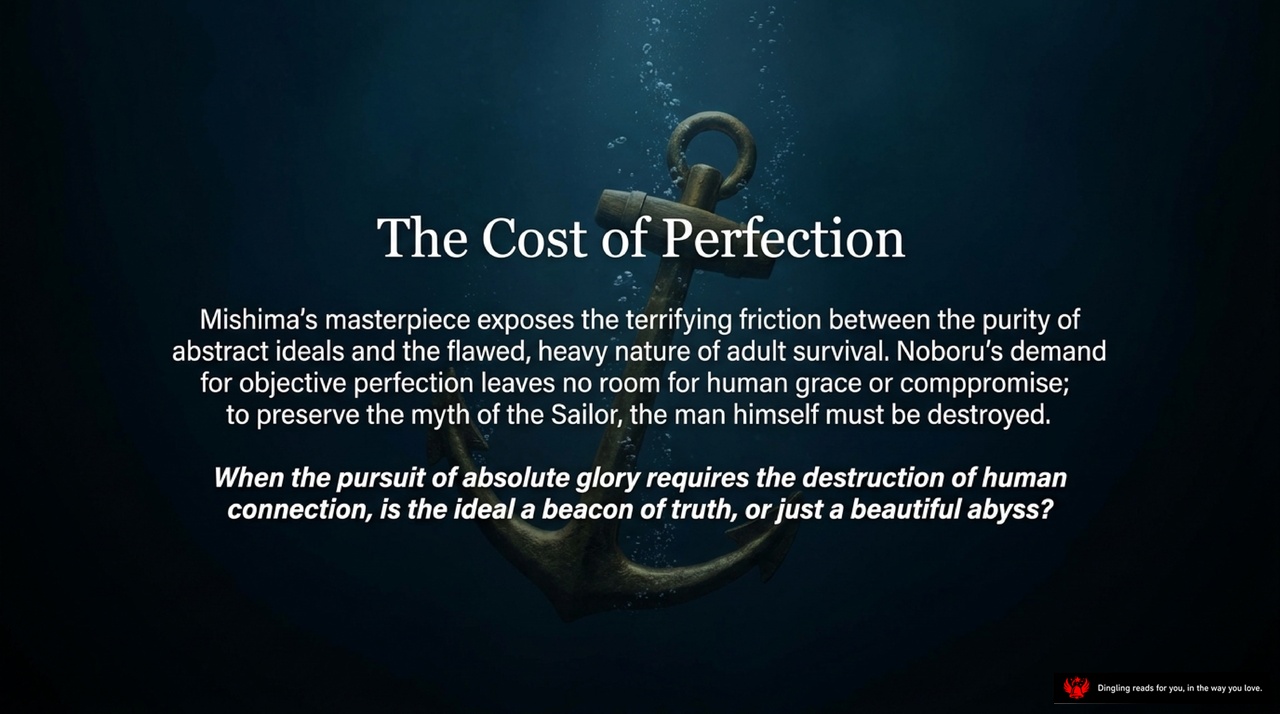
Look at this anchor sinking into the deep. It's not just a symbol of stability; it's the heavy price of perfection. In *The Sailor Who Came from the Sea*, Mishima shows us how terrifying it is when the purity of an ideal clashes with the messy reality of adult life. Noboru, our young protagonist, demands absolute perfection. He wants the "Sailor" to be a myth, a flawless god. But myths can't survive in the real world. To keep the myth alive, the man himself must be destroyed.
When the pursuit of absolute glory requires the destruction of human connection, is the ideal a beacon of truth, or just a beautiful abyss? Noboru realizes that his father figure, Ryuji, is no longer the heroic sailor he imagined. He's just a man trying to fit into a world of normalcy, a world Noboru hates. The friction between these two worlds is unbearable. To preserve the myth, Noboru feels he has no choice but to eliminate the reality. This isn't just about jealousy; it's about the cost of refusing to accept a flawed, human world. The anchor represents that weight—the crushing burden of trying to force life into a perfect shape, even if it means dragging someone down to the bottom of the sea.